Mere Humanities

Categories, while necessary, can be troubling things.  One place to see this clearly is in academia, which is itself a category.  In the long history of deciding what counts as a legitimate job (you can make a living now being a YouTuber!) somewhere in the Middle Ages, based on the idea of the monastery, the university arose.  This required some justification—people are to be paid for researching topics and teaching others to do the same?  Not quite back-breaking labor, but it can lead to lumbago nevertheless.  Topics had to be worthy to permit this excused absence.  Law and theology were the earliest majors available.  Hobbes’ two swords.  Church and state.  This makes sense since monasteries were all about obeying rules and obeying God.  Theology was the queen of the sciences.

Perhaps unbelievable in today’s world, it was thought that other topics than theology—called humanities so as to distinguish them from divine discussions—should be added to the curriculum.  These were topics that the educated were expected to have mastered, and they included things like history and, yes, mathematics.  In the early days the building blocks of science (such as math) were considered humanities.  Theology wasn’t.  The Reformation complicated things because now there were lots of theologies.  And this thing called the Enlightenment was suggesting that they were all just a bit naive.  Still, universities grew up around theological training grounds, including places like Harvard, Princeton, and Yale.  Slowly, however, theology began losing relevance and became more and more a humanities subject.  Call it a strange form of incarnation.

By the time I became aware of theological study, it was firmly, and deeply a humanities subject.  Often called “religious studies,” other academics often considered it a throw-away major, but if you dug deep enough you found yourself learning dead languages that even a scientist couldn’t comprehend.  When I began attending a Christian liberal arts college, it was clear the engineers and others of what would come to be called STEM topics were given preferences.  Science, Technology, Engineering, and yes, Math.  Some of the subjects that had started out as mere humanities, now received the praise (and cash) while theology—religious studies—had become a purely dispensable humanities topic.  These days humanities majors are dropping like theologians, and going to university means preparing for either business or science-based careers.  Subjects in which you make more mere money.  And one of the founding subjects of this entire enterprise will earn you a starting salary position at Walmart.  And that’s a category worth avoiding at any cost.

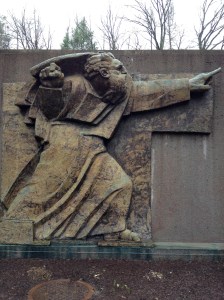
Photo credit: Ben Schumin, Wikimedia Commons


Thunder Towers

It sounded like brontide.  The Martin Tower, the tallest in the Lehigh Valley and once corporate center for Bethlehem Steel came down yesterday morning.  Completed only in 1972, the following decade saw the collapse of the steel industry, and the building has sat vacant a dozen years.  Now it’s gone.  The reasons the building could no longer stand are many and I won’t try to explain them as if I understood.  The fall of the tower, however, put me in mind of human folly and the belief that corporate profits will only ever grow.  Capitalism is built on a set of myths that the wealthy truly believe—I suspect many others do too, otherwise the system couldn’t possibly last.  Adam Smith may have been right academically, but in reality humans are greedy, venal, and shortsighted.   At least those who “rise to the top” are.

We didn’t move to the Valley for the steel.  Having settled in New Jersey just about when the Martin Tower was abandoned, like many other displaced academics I was looking for a job.  There were cities in the Midwest—we weren’t far from Milwaukee or Madison—but there was no work.  If you’re “overeducated” your best bet is to settle near a huge metropolitan area, as closely as you can afford to.  Then hang out your shingle.  Capitalism, however, has made New Jersey affordable only for the excessively wealthy.  Besides, I was born within the imaginary lines that we call the Commonwealth of Pennsylvania.  In fact, when I got my license transferred last year the computer asked me if I still lived in Venango County, where I was born.

I didn’t see the tower come down.  It’s not visible from my house, but it was always right there when I drove to Lowes to pick up some necessary hardware to survive in this area.  (Weed-whacker and lawnmower—reel variety.)  My mythology of towers always takes me back to Babel.  In the biblical worldview towers were a sign of arrogance.  God seemed to think they were trying to invade divine turf, and so he made it so we could no longer understand one another.  There hasn’t been a moment’s peace since.  We build towers tall to show what we can do.  We don’t really need an angry deity to come down and confuse our language any more.  We’ve got capitalists and their excess money to lead the way.  The sound of thunder roared and I divined just where such leadership will guide us.


Revisiting Mesopotamia

As a refresher on my own ancient history, I picked up Tammi J. Schneider’s An Introduction to Ancient Mesopotamian Religion.  This was one of those books that spawned several internal conversations simultaneously as I realized just how much modern lenses color our perceptions of past societies.  Before commenting on that, however, a few necessary points must be made.  Our knowledge of Mesopotamia is in its infancy.  There are only a handful of universities around the world that have the resources to prepare young Assyriologists adequately.  Once prepared, those young folk will be introduced to the job market of those with far lesser education because there are practically no jobs in the field.  Seems a poor way to treat the civilization that invented wheels, arches, and beer.  Or so I’ve read.  In any case, many tablets in ancient languages have never been translated because there simply aren’t enough people to do it.  Any conclusions, therefore, must remain tentative.

Ancient religion in western Asia was extremely political.  From our perspective, this seems odd—although it’s happening again in real time.  Ancient societies relied on the cooperation of religious and political leaders and each institution helped the other.  They didn’t have the added complication of monotheism to deal with.  In trying to keep all the gods happy, they simply reasoned that if things fell apart, another god had grown to a superior position.  Certainly they believed the gods were there—we do too.  We call them cash, the stock exchange, and commodities, but we still worship and adore.  And they keep the government going.  (I kind of liked it better when they were old-fashioned gods; at least they had sympathy for the human condition.)

After getting to know the gods, Mesopotamians recognized that humans were to do the work for them.  Gods, after all, owned the land and priests and kings were powerful individuals.  You didn’t want to cross them.  Rituals were developed to ensure the smooth continuation of seasons and agriculture.  As Schneider points out, we don’t have enough information to understand all of this.  Our information comes from across millennia and from locations sometimes hundreds of miles apart.  If this is a puzzle well over half the pieces are missing.  We glimpse people like us, trying to survive.  Gods are unpredictable, but you can try to read a liver or two to find out what’s on their minds.  And some of the kings thought they were gods.  The more things change, the more, it seems, they stay the same.


Drowning in Words

One of the features of this blog, which as inclined more lately toward books of all sorts rather than simply religion, is that I only write one post per book read.  There’s no law that says this should (or must) be the case, but I’ve held myself to that standard for about a decade now, and if I have trouble recalling a book this blog is generally a kickstarter for my memory before hauling myself off to the attic to find the physical copy—long live print!—to do a bit more detailed work.  This method sometimes leads to crises of my own making.  Long books take some time to get through.  And despite the action-packed picture you get of my life from this web log, many long weeks are spent doing work and I can’t really share the details here.  And so it goes.

Like many people I read multiple books at a time.  Although I have a kind of general plan, the actual books being read at any one time often depend on my ability to lay my hands on a copy.  And since I’m in the final stages of Nightmares with the Bible, I tend to prioritize books I really should read in whole for that tome.  I also read (and write) fiction.  Normally I reserve my fiction for bedtime reading; it’s more pleasant to prepare for sleep with an engaging story that I know isn’t factual enough to haunt me.  Sometimes the fiction is a long book too.  Two lengthy books going simultaneously feels like trying to pass a truck going uphill.  Or swimming underwater.  The insistence of the necessity of taking a breath (writing a blog post on a book) strains against me as I look up and see the surface still some distance away.  Drowning in words, however, isn’t that bad.

As I confessed to a friend the other day, I am a graphomaniac.  I write incessantly.  To do that it helps to read incessantly.  At any one time I’ve got several books going, and I’ll let you know when I reach the end of any of them.  This is, I suppose, the bookish life.  Ironically I read more now than when I was a professor.  Those days were filled with lesson prep, teaching, and reading student papers.  Grading tests.  Fulfilling administrative duties.  On the days when I feel like lamenting my lack of time (and those are most days) I need to remind myself that a great deal more of my effort is now spent with books than it used to be.  You’ll have to trust me on that since I don’t always get to write about reading until the long books are done.  And that’s okay by me.


Price of Learning

Holy Horror, as some are painfully aware, is priced at $45.  Even those of us in publishing have lessons we must learn, and one of them is that writing a trade book involves more than just a “friendly narrator” style and non-technical language.  It also involves a subject the public finds engaging (or at least what a literary agent thinks the public will find engaging).  Holy Horror throws two apparently disparate topics together: horror films and the Bible.  The fans of each don’t hang out in the same bars—the fans of the latter, in some circles, don’t go anywhere near bars!  My thinking was that this juxtaposition was odd enough to qualify as trade, but I also knew that you have to work your way up to that kind of readership.  That’s why I’m on Goodreads, Twitter, and Facebook (followers and friends welcome!).  It’s not like I’ve got tons of spare time, but platforms must be built.

Book publishers face a dilemma: they have to sell books, but as I’ve noted before, they must do so profitably.  There are people like yours truly who’ll occasionally pay essentially a dollar a page (or at least a two-page spread) for a book that’s essential to their work.  As the capitalists grin, it’s “what the market will bear.”  I never thought of myself as a market.  To me, knowledge is priceless.  The effort that it takes to write a book is truly unimaginable to those who haven’t done it.  Obstacles exist almost from the inception.  Getting the resources you need, unless your employment comes with a free library pass, involves sacrifice.  I still look at other books I must read priced at about $45 and groan—how can I justify the expense?  It’s a strange club to which to belong.

My mother asked about Weathering the Psalms: “Is it the kind of book you get money for?”  In theory, yes.  I’ve yet to see any kind of profit from it since the tax forms you need to file for royalties cost more than the actual checks contain.  At least it’s not vanity publishing.  And you truly learn what it means to rob Peter to pay Paul.  It has nothing to do with gentiles.  Publishing is the price you pay for following your curiosity.  My books are very different from each other, a fact that comes with an invisible price tag that has little to do with money exchanging hands.  Well, maybe it does.  And maybe it does have something to do with gentiles.  Or maybe it’s an appeal to a higher power.  In a capitalist nation we all know what that is; herein lies holy horror.


The Heart of Publishing

My heart goes out to academic authors.  It really does.  They labor over a book important to their field and see it come out costing near triple digits and wonder why it’s not in the local bookstore.  There is, however, a very wide gap between academic and trade publishing.  It is bridged here and there by authors who value readers over reputation, but unless you deliberately try to learn how all of this works, it is bewildering.  Academics, you see, are area specialists by and large.  You don’t write a dissertation on the Bible, for example, but on a specific part of the Bible (New Testament or Hebrew Bible).  And within that section your specialization is not a single book, but often a small part of a book, or a theme.  I’ve seen dissertations written on a single Hebrew word.  Specialization.

With all of this tight focus, it’s easy to forget what browsing in a bookstore’s like.  Even with some of the incredible brick and mortar stores in Edinburgh, technical books had to be ordered—this was before Amazon.  When you check the books of colleagues out of libraries it doesn’t always occur that you do this because libraries are the only places that buy such books.  And with the explosion of doctoral degrees in shrinking areas of studies (there are no jobs here, folks!) the number of published dissertations has skyrocketed.  Even advanced scholars forget the average reading public would find their work impenetrable.  It’s not going to be in the local bookstore, and it costs so much because it sells so few copies.  I do feel for academic authors.

In addition to all the area specialization, it would make sense to research the academic publishing industry.  Yes, it is an industry—it has to try to turn a profit when sales are minimal.  And with so many books being published, libraries can’t keep up.  The end result is high prices.  I’m as guilty as the next academic at wishing economics would just go away and leave me alone.  I want to believe in the pursuit of knowledge for knowledge’s sake.   That’s not the way the world works, however.  At least not the publishing world in a capitalistic context.  The internet itself has become competition.  Much of the information’s out there for free.  So your academic book, when it comes out, will be priced out of your comfort range (been there, done that).  It’s not that your publisher doesn’t believe in you, but that they have to try to turn a profit.  All it takes to understand why is a bit of research.

Not that kind of book.


Digging Bad?

Academics, as a rule, focus on books by other academics.  Theirs is a specialized vocabulary with specific goals (tenure, then an Ivy League position).  It’s easy to see, sometimes, why they distrust books by those of us outside the academy.  We aren’t as constrained, and can say some speculative stuff.  I just finished Evil Archaeology: Demons, Possessions, and Sinister Relics, by Heather Lynn.  Now, most academics I know won’t take seriously a book where the author is cited by “Ph.D.” on the cover.  That’s a sure sign of trying to impress a lay readership.  This book is clearly heartfelt, and personal, but it does raise a host of questions regarding sources and details. I found myself wondering where the author found out so much about Pazuzu when I, who hold a doctorate in ancient West Asian studies, had such trouble locating sources.  Then I checked the bibliography.

Even academics have been known to cut a corner or two, now and then.  For my last book I didn’t have access to a university library so I had to make do with what I could get my hands on.  (JSTOR is not cheap for individuals, in case you’re wondering.  If you teach and you get free access from your library, you don’t know how lucky you are!)  So it is with my present research.  I muddle along, often buying used copies of the books I need, sometimes from eBay.  Researchers can be driven that way.  Lynn’s book covers a lot of territory, and not all of it seems related to demons.  Little of it covers archaeology in any detail.  But then, it’s not intended for academic readers.  I learned a thing or two.  I also distrust a thing or two she claim (having once been in the academy), but there’s no doubt she’s trying to do a service in this book.

Demons cut a wide swath.  Lynn discusses bits and pieces from here and there, and at times her treatment is rather a gallimaufry of anecdotes.  There are interviews, personal experiences, and urban legends.  It does seem hard to believe that scientists worldwide are studying demons in order to explain illnesses, though.  For me, finding a new book on demons just when I was finishing my draft on the same topic, it was imperative to read what she had to say.  It’s clear she’s seen some of the same movies I have.  I like to think that, as an inbetweener I can still read academese as well as regular writing.  You always find interesting things there in the middle.


Bradbury’s Dream

There’s a Ray Bradbury story—I can’t recall the title, but with the Internet that’s just a lame excuse—where explorers on Venus are being driven insane by the constant tapping of rain on their helmets.  They try to concentrate on discovery, but the distraction becomes too much for them.  Living in Pennsylvania has been a bit like that.  I grew up in the state and I knew it rained a lot.  Here in the eastern end we’ve hardly since the sun since March.  And when you’ve got a leak in your roof that only compounds the problem.  If I were weathering the Psalms, mine would be a lament, I’m afraid.  You see, the ground’s squishy around here.  Mud all over the place.  Rivers have been running so high that they’re thinking about changing their courses.  And still it rains.

There’s a lesson to be taken away from all this.  The fact that we use water for our own ends sometimes masks the fact that it’s extremely powerful.  Not tame.  The persistence of water to reach the lowest point contributes to erosion of mountains and valleys.  Its ease of transport which defines fluidity means that slowly, over time, all obstacles can be erased.  It’s a lesson in which we could stand to be schooled from time to time.  Rain is an artist, even if it’s making its way through the poorly done roofing job previous occupants put into place.  Would we want to live in a world without valleys and pleasant streams?  And even raging rivers?

There’s no denying that some of us are impacted by too much cloudiness.  When denied the sun it becomes easy to understand why so many ancient people worshipped it.  Around here the temperatures have plummeted with this current nor-easter and the heat kicked back on.  Still, it’s good to be reminded that mother nature’s in control.  Our high officials have decided global warming’s just alright with them, and we’re warned that things will grow much more erratic than this.  As I hear the rain tapping on my roof all day long, for days at a time, I think of Bradbury’s Venus.  Okay, so the story’s appropriately called “The Long Rain” (I looked it up).  Meanwhile tectonic forces beneath our feet are creating new mountains to add to the scene.  Nature is indeed an artist, whether or not our species is here to appreciate it.  If it is, it might help to bring an umbrella this time around.


Linking In

Like many in the internet age, I have most of my “connections” online.  It’s somewhat of a rarity to be invited, for example, to connect on LinkedIn by someone I actually know.  I remember the early dissemination of information from that network—it was strictly for people you really did know in real life, because they could help or hurt your career.  I took that seriously for a year or two, but it became clear that this was another Facebook with a more professional cast.  I’ve been told of authors who try to build their online platform by adding thousands of connections on LinkedIn.  The website, however, is not intended as an advertising venue.  It has, however, become one.

I’m not denigrating LinkedIn.  I’ve found two jobs through it and I’ve had recruiters reach out to me because they found my profile there.  For a religionist that can be quite flattering.  Academia and society tend to tell you that such a skillset is okay but basically useless.  Having others who know the wide diversity of human employment these days can be a sign of hope.  Nevertheless, advertising has crept into LinkedIn.  I’m not talking about the frequent invitations to go professional on the site, which will only cost a small fee that will suddenly show up on your credit card bill when you least expect it and thought you were in the clear.  No, I’m talking about connections contacting you to do gratis work for them.  Advertising their book, or their services.  Letting others know, they ask, that they can provide this or that service.  (Just to be clear, I’m not referring to people who contact me personally because we have an actual connection!)

For those of us working stiffs not in a position to hire anyone—professionally or personally—this is another symbol of how any form of communication becomes commodified.  Fully over half of my email is soliciting money in one form or another.  Hearing from an actual person with an actual message for me is so rare that I’m stunned to find one in my inbox.  Capitalism just doesn’t know when to let go.  And it doesn’t have a good read on what little I actually do buy.  Underwear (and just using that word will color the tailored ads I receive for weeks) vendors seem to think I’m concerned about the fashion of garments others don’t see.  The books Amazon suggests, based on a solid track record, are generally far off from my interests.  What hope do those who don’t know me have of selling me their wares through LinkedIn?  The dream of connection without cash changing hands nevertheless remains alive.

Old school connectivity


Mother of Stone

One thing we all have in common is mothers.  Whether it’s the mysteries of biology or something more spiritual than that, the connection lasts forever.  The thought occurred to me yesterday as we visited Columcille, one of those places that reflects a vision for a piece of land that transforms the ordinary into sacred.  Columcille Megalith Park is inspired by the standing stones of Celtic lands.  Open to the public for a suggested donation, the park consists of a stone circle and several menhirs (megaliths) arranged along paths through the woods.  Recognized by the Nature Conservancy as a sacred space and outdoor sanctuary, it draws thousands of visitors of all faiths with both recreational and religious rationales.  Throughout the park we found evidence of spiritual interaction with nature left on or near the stones.  But what has this to do with mothers?

One of the areas in the park is the Sacred Women’s Site.  As we lingered there yesterday, I reflected on the sacred nature of all women, and mothers.  That’s not to suggest that motherhood is for all women, but rather that our society has been slow to catch up with the idea that women show us the way.  Men have “had charge” for millennia now and look at where we are; cooperative ventures and peacekeeping efforts crumble as world leaders encourage the resurgence of exceptionalism.  We’d rather have an inveterate liar lead the nation than a politically able woman.  Britain wants to pick up its marbles and let the European Union disintegrate.  We seem to have forgotten that just a century ago a world war ended.  We need sacred spaces like Columcille.  We need to remember the sacred women.

One takeaway from our brief visit was that although there was also a grove for sacred men, that of the women was more peaceful.  The idea of standing stones making a site sacred goes back at least to the Bible.  Stone circles are found from ancient Israel to the far-flung Orkney Islands of Scotland.  Standing among them, whether modern like Columcille or ancient like the Ring of Brodgar, or yes, the more famous Stonehenge, there is a sense of sacred purpose.  Miles from Stonehenge stands Avebury, a town built around another stone circle.  There the megaliths were divided between female and male stones, with both required to make the ring complete.  Such places require a tremendous amount of work.  When they’re constructed, however, they give us places to think of mothers and the mystery of life.


A Nightmare or Two

Some books are complex enough to require a slow reading.  Alan E. Bernstein’s The Formation of Hell: Death and Retribution in the Ancient and Early Christian Worlds is such a book.  For those of us raised in a faith primarily geared toward avoiding Hell, the concept becomes a lifelong nightmare.  It doesn’t help that, depending on your clergy you’re taught different, sure-fire ways of achieving that avoidance.  Often it hinges on “believing” the “right” thing.  Fundamentalists tend not to call it “doctrine” since that sounds rather Catholic, but the idea’s the same; it’s a tenet of faith.  As Bernstein shows, however, Hell is an idea that developed over a very long time with several different views of what happens after death.  There’s no single, linear progression, but rather a conglomeration of ideas from a variety of sources.

No single volume can cover all the background to Hell.  Bernstein focuses on Egypt for the early material, as well as Babylonia.  These early civilizations demonstrate that people have always wondered what comes next, and what happens to those who oppress others—the bullies of this life who don’t deserve the same eternal rest as the rest.  Usually some form of punishment awaits, but not always.  In the Hebrew Bible one of the great issues was the fact that everyone goes to Sheol, good and bad alike.  As in classical Greece and Rome (on which Bernstein spends a great number of pages) the concept of the netherworld is gloomy, but not torture.  Except in exceptional cases, of course.  The Greeks had Tartarus as a place for those who dissed the divine.

Even early Christianity didn’t have a uniform view of it.  The New Testament is decidedly divided on the topic.  Revelation seems to be the last word, but it’s not.  Later thinkers such as Origen and Augustine (who came to different conclusions) weighed in.  Catholic Christianity lavished great love on the latter and Augustinian views became disproportionately influential.  Reading his lack of compassion can cause nightmares, although he justifies it theologically.  The one thing I missed in Bernstein’s lengthy treatment was the Zoroastrians.  This religion of ancient Persia introduced a distinct dualism into the biblical world; it perhaps represents the first relatively developed concepts of Hell and Heaven.  Zoroastrianism suffers from lack of documentation, however, and it is difficult to parse it as meticulously as Bernstein does the other cultures covered.  This book requires much pondering as it’s read, and if you were raised believing this kind of thing it’s sure to bring back a nightmare or two.


Dandy Lions

O great—just what I need right now.  I knew lawn care would soon become a necessary avocation after buying a house, but this I did not expect.  Over the weekend I found myself pulling up dandelions that were growing out of cracks in the front steps.  Since we compost, I laid them out on a slab, figuring when they dried out I could make them into more soil.  (From which more dandelions will grow, I know, but still it just feels right.)  I came back a day later to find that the dandelions had returned to the vertical position.  Zombie dandelions!  They apparently couldn’t stay dead.  Now, I’ve been writing about demons for the past several months and I’d forgotten about zombies.  Well, I did post about resurrection on Easter, but my short-lived digression left me unprepared for this.

Really, the persistence of life is a sign of hope.  Perhaps dead zones, such as morality in Washington DC, will someday come back to life.  There’s hope for a tree, Job tells us, even if cut down.  These dandelions were a message for me.  Don’t give up.  Prior to religion being hijacked by theology it was a system intended to make life better for people.  Human beings were more important than heretical thoughts.  You help those who need it, regardless of what they believe.  Or don’t believe.  That was the point behind resurrection, I suspect—we can rise above all this dirt in which we find ourselves.  There’s a nobility to it.  Then again, fear trumps hope just about every time.  The dandelions are rising and we have no hope of outnumbering them.  

The ancients feared the dead coming back.  It’s a primal phobia.  All those things we buried with tears we hoped would stay the way we left them.  Life, as Malcolm says, will find a way.  Politicians, it seems, will find a way around it.  Call it executive privilege or whatever you will, the end result is the same.  The yellow-headed fuzzies will threaten you even when uprooted and left to dry in the sun.  Now, our lawn isn’t pretty.  Grasses of different varieties contend with weeds I’ve never seen before for scarce resources.  I’ve never minded dandelions.  They don’t ask much, only they now seem to be demanding the right to come back from the compost.  And if we let that happen, all hope is lost.


On Publishing

I fear I may be transitioning.  I may actually be becoming someone who knows something about publishing.  Reading about the merger between Cengage and McGraw Hill actually seemed interesting.  What’s happening to me?  Actually, the largest impact has been the realization that scholars need to become more aware of the world around them.  As a doctoral student I was taught to find an unexplored subject and write obscurely on it.  Then, when it’s time to publish, to say to the editor that general readers will understand and find it compelling.  It took some time, however, even though I frequented Waterstones and Blackwells, to realize that the books they housed were not the kinds of books I’d been taught to write.  Back in America, where the brands were Borders and Barnes and Nobel, the same thing applied.  People want books they can understand.

Two articles that caught my attention recently addressed the plight of the academic monograph.  One was “Worried About the Future of the Monograph? So Are Publishers” from the Chronicle of Higher Education.  The other was “Making Monographs Open” from Inside Higher Ed.  Both share some common themes: scholars write books so obscure that even academic libraries won’t buy them and since it’s “publish or perish” it becomes the publisher’s problem.  Listen, I understand that mentality.  Isolated in the woods of Wisconsin with the wind howling through the trees, writing about weather in the Psalms seemed perfectly natural.  Forgetting that the average reader doesn’t know Hebrew, I assumed everyone would find my disquisition irresistible.  Even back in the early 2000s publishers disagreed.  Life is so interesting!  There are so many minutiae to explore!  If you haven’t had the pleasure of following in the tracks of a thought that won’t let you go, you’ve never been really seduced.  But then, somebody’s got to pay for all this.

Scholars are reluctant to acknowledge that publishing is a business.  Indeed, higher education is now a business as well.  Everything’s a business.  To stay solvent publishers have to sell enough books to cover the cost of making them.  As these articles point out, that cost isn’t negligible.  The scholar who explores the publishing industry (as rare as that may be) will discover plenty of resources to help rethink academic writing.  Even without reading the industry rags, just paying attention when you’re in your neighborhood bookstore can be an eye-opening experience.  I was looking for a book (hardly even academic) last time I was in Ithaca, New York.  If any town is likely to have such books on the shelf, it’s Ithaca.  I had to ask and leave empty-handed.  There are lots of books out there, colleagues!  And if you want to get yours published, it pays to do a little research.  Your time will not be wasted.  And I fear I’m becoming someone who knows a little about such things.


Relatively Unknown

The Edinburgh Festival draws people from around the world to experience culture and fun in one of Europe’s most beautiful cities.  The festival also attracts the fringe—artists not associated directly with the festival, but who get included in what used to be a huge, thick catalogue that would keep us busy for hours, considering what a student and spouse could afford, and what you could not afford to miss.  One year a group called Outback was performing at an area church.  It featured Graham Wiggins on the didgeridoo—an Oceanic aboriginal instrument that is essentially a tree branch hollowed out by termites.  It’s so long ago now that I can’t recall if I knew ahead of time, but the leader of the group, the didgeridooist, was Graham Wiggins.  While not exactly a rare surname, Wiggins isn’t common either and when I saw him a strong family resemblance was immediately obvious.  So much so that after the concert we went to meet him only to find out his Wiggins side was from Oxfordshire.  Mine was from South Carolina.

Graham Wiggins, who was a month younger than me, was known as “Dr. Didg” because he held a D.Phil. in solid-state physics from Oxford University.  While an American, he had decided to stay in the UK to make a living from his music.  Some months later, on a Christmas break, we saw him busking in Bath on a chilly night.  We bought the band’s second CD from him that evening.  When my wife put on our Baka disc the other day, I grew curious whatever became of him.  I was surprised and saddened to learn that Graham Wiggins had died three years ago.  I knew we shared a surname and a family resemblance, as well as UK doctorates, but I learned he went to the British Isles from Boston University, which is where I had studied before attending Edinburgh.  He left the year I arrived.

Websites are reluctant to say of what Wiggins died.  I learned of this just days after finding out that a high school classmate had passed away, so mortality has been on my mind.  Wiggins, unlike this Wiggins, was a talented musician with a brilliant mind.  We saw him interviewed on television about the physics of didgeridoo playing.  I never did find out if we were distantly related.  The US Wiggins clan from South Carolina doesn’t have strong genealogical interests, although we know they started out in North Carolina many years ago.  It stands to reason they had come from England at some point, since it’s an English surname.  I only met Graham of the clan twice, but now I can’t get the fading didgeridoo sounds from my mind.


Writing Life

Writers are a conservative lot, in many respects.  Consider the epigraph.  I’ve written about this before—in modern-day publishing epigraphs require permission to reuse and serve little purpose beyond two negotiable factors: to prove the writer is well-read, and that someone else just summed up your chapter in a single sentence.  Most modern books have stopped using epigraphs, but scholars read old books produced before aggressive copyright laws.  There is a trick you can use, however, that brings an epigraph into the realm of the fair use doctrine.  It involves moving it into the body of your chapter.  Make it a quote.  Comment upon it.  For all their research skills, many academics do not take advantage of easily found advice on academic publishing.  Just ask an editor.

We all, I’m sure, have tunnel-vision.  Life is so incredibly busy and demanding that choices have to be made.  For most academics publishing is part of the rubric for tenure.  Perishing is the only other option.  Been there.  Done that.  Those of us who make a more modest living on the other side of the book sometimes write for different reasons.  We may need to supplement our income (as if academic publishing really ever helps with that!), and thus we must pay attention to the finer details of the business.  Write what people want to read.  Think like a reader.  And, yes, get rid of the epigraphs.  We know you’re smart; you’ve written a book.  Another reason for writing beyond the tenure-dome is the compulsion.  The need to do it.

While the struggling artist is a tired trope, it’s also true.  Many of the writers most admired today had lifetimes of struggle and obstacles which often stopped them too soon in life’s tracks.  I often think of the Brontë sisters.  In a family apparently cursed with premature death, living in a time when women writers were rare, three sisters set themselves the task of becoming novelists.  Not one of them lived to forty.  Anne, who wrote The Tenant of Wildfell Hall, made it to twenty-nine.  Emily, author of Wuthering Heights, died at thirty.  Charlotte, who gave the world Jane Eyre, survived to thirty-nine.  They defined, in many ways, the English novel.  And while they lived to see some measure of success in their brief lives, they wrote against the obstacles of life and the specter of early death.  Writing is a passion.  A craft.  And even academic authors provide a favor to the world if they do it well.

Brontë sisters by brother Branwell