World Environment Day

Do you like where you’re living?  Planet earth, I mean.  Today is World Environment Day.  It’s not enough of a holiday to score time off of work, but it is well worth observing nevertheless.  More than that, it’s vital.  Other holidays tend to be the decaying remains of religiously appointed observances or sops thrown to the Cerberus of patriotism, but World Environment Day impacts every one of us, all of the time.  Whether sleeping, waking, working, or playing, it’s in the context of the one planet we have.  Even those in space have to check in here to survive.  We might try to make World Environment Day an international holiday, but I’m sure we could never all agree to it.  Business would collapse if everyone took the same day off, all at the same time.  Instead we’re left to dream.

I recently watched The Lego Movie.  Although released in 2014 it perfectly anticipated 45 with “President Business.”  Overlooking for a moment that Legos represent big business, the film underscored the problem: the only thing hard enough to cut a diamond is another diamond.  And the only way to fight business is with business.  Perhaps there aren’t enough people to envision what life could be like without the constant stress of having to make more money.  It’s a sickness, really.  But it’s a pathology we worship.  There are some abysses, it seems, into which nobody dares peer.  Who doesn’t want to be in charge?  And those in charge care nothing for Mother Earth.

We have spent the past two-plus years watching helplessly as the Republican Party has done its level best to lay waste the planet.  Rolling back and abolishing environmental initiatives deemed detrimental to “business,” these are folks who need to feel what it’s like to lose a job or two and have to reinvent themselves.  Not that long ago, most of the humans on this planet lived on farms or supported those who did.  Daily in touch with the planet in a literal way that those who mow with industrial, sit-down lawn helicopters can never be—how can you be in touch when your feet never even meet the ground?—they knew that paying attention to the planet is crucial.  But that’ll have to wait.  It’s a work day, after all.  And a Wednesday, no less.  In the middle of the week-long worship at the altar of Mammon.  Still, I urge you to take a moment or two today to consider how to save the only planet we’ve got.  It’s worth celebrating.


Leggo My Lego

Given my proclivity to seek the profound in what is often considered the banal, I have been mulling over The Lego Movie.  Before you cast the first brick, yes, I know this movie is five years old and I know that it has sophisticated intertextuality with other movies and sly humor.  I use banal in the sense that Legos are, quite literally, plastic and they don’t work well in conveying the human form.  Our overactive psyches help here, and we give the characters their necessary humanity, but this is a movie for kids, even with its Trump-like President Business forecast some two years before the last election.  With all of that being said, and the word “forecast” already being used, my “Bible radar” zeroed in on the prophet in the movie, Vitruvius.

Vitruvius is based on a combination of Tiresias, the blind prophet, and any number of biblical characters who forecast the future.  Dressed like Moses, but named after a Roman author and architect, Vitruvius utters the prophecy at the beginning of the film and returns as a character that combines Obi-Wan Kenobi and the prophet Samuel.  (I said there was sophisticated intertextuality.)  Whether any of this is intentional is difficult to say—well the Obi-Wan part is pretty obvious—but it plays into the common view of prophets.  One of the points I make in Holy Horror (which deals with a different genre of movie) is that people understand biblical ideas through the lens of pop culture.  Prophets, through that lens, tell the future.  In the Bible itself they don’t do that very much, but since the New Testament reads itself into the Hebrew Bible (more intertextuality) the idea became pretty fixed that prophets told the future all day long.

Ironically, Vitruvius—a name that sounds like “virtue”—was famous for describing perfect proportions.  Indeed, Leonardo da Vinci’s “Vitruvian Man” sketch is based on this idea.  As ideas go, this is a false one against which many of us struggle our entire lives.  There is no perfect, Platonic human body.  Yes, certain people are attractive, but genetics and circumstances make us who we are.  And some of us grew up without Legos, but despite that deficiency we came to know the product.  The Lego characters aren’t in any sense of Vitruvian proportions.  Witty and intertextual, they’re made of plastic and they encourage us to buy for our children.  And one wonders whether Vitruvius is a prophet or a hidden symbol of that word’s homonym.  Let the building begin.


Epistemic Epistemology

I’ve been thinking about thinking, if you’ll pardon my meta.  More to the point, I’ve been thinking about what happens to thinking when it becomes writing.  Thoughts may or may not be safe if they’re left in your head, but once they’re on paper other people start to get concerned.  A diary, of which the weblog is a public variety, is often private.  You may write to remember.  You may write to stab at mortality.  You may do it just for fun.  No matter why you do it, if enough people read it, your writing will be misunderstood.  Ironically, even in a nation with freedom of speech, and the press, the writing rights of individuals aren’t guaranteed.  Take this blog, for example.  Over the decade I’ve kept it, a few jobs—two actual and one potential—have instructed me in what I could or could not write.  Like Niagara Falls, you’re getting only a portion of what flows in my river of thoughts.

Thoughts can change the world.  Considering the news lately that might not be such a bad thing.  In any case, the vast majority of writing remains private.  Even with Amazon and others making self-publishing simple, it’s not easy to get ideas out there.  Getting the attention of a major publisher has odds that are vanishingly small.  And the internet’s a big place, getting bigger by the day.  In cyberspace nobody can hear you scream, I guess.  Even on a smaller scale, my own computer complains that I write too much.  “Not enough space for updates,” it says in its dialogue box dialect, “too many documents.”  Never mind that I purchased it for writing, and a bit of surfing.  It wants more of the latter.  Other’s words, in other words, commodified.

My writing life began young, but not as young as that of many fictional writers like Jo March or Francie Nolan.  Our apartments and eventually small house had no space for one of the kids to hole up and write.  When I did start, in my early teens, I breached the dam without anticipating the results.  I’d been reading a lot, and writing seemed the right way to join the conversation.  I started composing novels before high school, but my first published book (and for many years my only one) was my dissertation.  I always believed that writing could be done on the side for any job, but that’s not the case.  Well, it is if you keep it in your diary, I suppose.  If you open the tap, however, you’d better make sure you have a mighty big glass in hand.


Refuge in Diversity

The Easton Saturday morning farmer’s market is a happening place.  Daring to spend a non-raining Saturday away from mowing, my wife and I decided to check it out.  If you’re not familiar with Easton, Pennsylvania, it has more than the Crayola factory that smells like childhood itself.  The downtown is marked by a traffic circle with an island in the middle large enough to fit, well, a thriving farmer’s market.  As usual, large gatherings attract those selling spiritual rather than material goods.  A very well dressed gentleman handed me a flier and when I got home I had to look up Refuge Church of Christ to find out what it it’s all about.  A New York City-based denomination of predominantly African-American membership, the church has over 500,000 members.  That I hadn’t heard of it before is no surprise.  There are well over 40,000 denominations of Christianity alone and it’s difficult to keep track of them all.

There comes a time in the life of anyone who takes religion seriously enough to study it professionally when s/he’s inclined to ask which is the original.  Think about it: you’re bartering with your eternal soul on the barrelhead here and don’t want to make the wrong choice.  When someone invites me to convert (I don’t know the secret handshake to show I’m already a member) I’m curious about them.  The unfortunate thing about all of this is that each tradition believes it has the truth and most, if not all, others have got it wrong.  Few are the faiths that declare, “Believe whatever, just believe.”

I once tried to make a denominational genealogy chart.  Part of the problem is that tracing things back to Catholicism isn’t quite right.  The Roman Catholic Church as it exists today is quite different than anything Paul, or Peter, or James would’ve recognized.  To say nothing of Jesus.  And that’s inevitable.  Religions don’t stay the same.  They evolve as soon as they pass from person to person.  Those who belong to denominations often do not know what the official teachings of the body are, and getting back to the original they’d find that their denomination started out believing things quite different than its own current theology.  If you’ve got only one soul with which to make that eternal decision and literally thousands of choices, well, let’s just say that you don’t want to think about it too much.  Besides, we’re here for fresh fruits and vegetables.  And it’s a rare gift of a Saturday without rain, no matter who’s responsible.


Q

If you haven’t spent much of your precious time attending to theories of how the gospels were written, you might not be familiar with the dilemma I’m about to describe.  A brief primer: Matthew, Mark, Luke, and John were not eyewitnesses of the events described in their gospels.  In fact, each of these books is anonymous—the titles were only added on later.  Despite their New Testament order, Mark was written first and Matthew and Luke borrowed from it rather extensively.  Mark is the shortest gospel and Matthew and Luke also share material that’s not in Mark.  Since John was written much later (and doesn’t have these common stories), scholars proposed many years ago that Matthew and Luke used a source—in German Quelle—that no longer exists.  This is called “the two-source hypothesis.”  As scholars are inordinately fond of abbreviations, Quelle is known as simply Q.  Other than in explanations like this you’ll never see it referred to by its full name.

So here’s the dilemma: many websites don’t allow for a single-letter search.  If you’re wanting to learn about Q, and you know no scholar worth their s (by which I mean salt, of course) who will spell it out, how do you search for it?  The same might be said for J, E, D, and P, who, along with R, put together the Pentateuch, but at least there you can search for phrases involving more than one letter.  You see, scholars existed before the internet and its search parameters.  Books and articles used to be written on paper, and the former had indexes, so looking up your sources—single letter or not—was fairly easily.  With electronic searching, it has become more difficult.  That’s not to say that single-letter searches can’t be coded—they can—but apart from biblical scholars and their alphabet soup of sources, apparently most people don’t want single-letter options.

This is the trouble with specializing in ancient things.  The internet was originally designed for academic and military purposes—serious stuff.  But then, like everything else in the world it became commodified.  Like a once pristine countryside it has billboards plastered everywhere after one’s Gelt.  (Scholars also like to throw in random foreign words to show how smart they are.)  And when it comes to searches, why enable atomistic, single-letter searching when it won’t end up in the sale of something?  In any case, my search did not end successfully.  I eventually gave up.  And in the light of the ever-shining internet, I’ve opted for the one-source hypothesis.

It must be in here somewhere…


Evil Origins

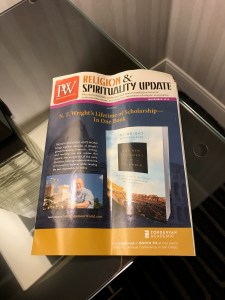
I remember well the eerie, uncanny feeling I had as a child reading Genesis 6.1-4.  This wasn’t a story we heard in Sunday School, and it wasn’t in any children’s Bible or Arch Books.  It was mysterious and strange, and not understanding what sex was made it even weirder.  The sons of God, or perhaps angels, came down from Heaven to mate with human women.  Although not stated directly, their offspring seem to have been giants.  Abruptly the story ends.  Archie T. Wright was clearly fascinated by this story as well.  His book, The Origin of Evil Spirits: The Reception of Genesis 6:1-4 in Early Jewish Literature, isn’t so much about demons as it is about the influence of this very brief, extremely odd story.

As a young person I knew about the book 1 Enoch.  Living in a rural town with no bookstore and no library (there was one in the town three miles away, but I didn’t drive and out-of-towners had to pay for a card), I had no way to read it.  Wright writes quite a bit about it here.  (In case you’re wondering, yes, in subsequent years I did read it.)  His history of transmission is a little suspect, but he explores the impact of these four brief verses on what can perhaps best be described as a diegesis.  This universe includes Watchers (the first part of 1 Enoch is called The Book of the Watchers), archangels, angels, evil spirits, giants, and demons.  Later Judaism moved away from this world, while early Christianity grew fascinated with it.  The mythology that emerged from it is sprawling and quite bizarre.  All encapsulated in a few verses before the flood.

Wright’s book is academic; it’s a revised dissertation.  Still, it’s a source more credible than a lot of what you find on the internet.  This particular biblical episode is an example of what happens when you don’t explain enough.  Granted, the writer likely had no idea that this brief account—shorter than a blog post—would eventually make it into a book that some people would consider from the anthropomorphic mouth of God himself, but because of this brevity questions, like angels, hung in the air.  As Wright shows, these verses were incorporated into ways of explaining the existence of evil in the world.  It was known by many names, and even took on personification in the form of Satan and his ilk.  This is a world of the unexpected, and it readily took me back to a childhood of wonder concerning the inexplicable passages in the Good Book.


Not from Nazareth

The world just doesn’t feel safe any more.  I’d better give a little context as to why.  You see, I just learned that what I thought was the work of carpenter ants is actually that of carpenter bees.  I never knew such things existed!  This still might not give you the thrills you were hoping for, so here goes a true story: when I was maybe six or seven my mother took my older and younger brother and me to a place in the woods where we could run around and holler and not bother anybody.  We had our dog there too, as well as our grandmother.  After a while my brothers started a game—throwing a stick to see who could get to it first, me or our dog.  I was running along, stepped on a stump, closely followed by the dog, when a swarm of angry yellowjackets flew out.  I was wearing shorts at the time and received multiple stings on my bare legs.  We didn’t think our dog would survive; he was completely covered.  So I have a thing about bees.

My phobia isn’t as bad as it used to be.  I’ve been stung many times since, and it always feels like an insult as well as a bad memory.  (I still don’t wear shorts, except on very rare occasions, when the bee quotient is zero.)  Believing in turning the other cheek, I’ve even captured and released bees from the house rather than killing them.  Still, to this day, when I get a haircut if the woman pulls out a set of clippers you have to pry my fingers from the naugahyde when she’s done.  Anything that sounds like buzzing near my ears sends me into spasms of terror.  Please pardon the graphic fear.  It’s heartfelt.

I used to have nightmares about killer bees.  I still worry about them a lot, and wonder that if, instead of a wall, we might put up a massive, small-weave net this side of Texas.  I don’t know how high they fly, but we should try to do something, don’t you agree?  Now I’ve learned that bees can eat you out of house and home, literally.  The carpenter bee, to the untrained eye, looks like a bumblebee.  They’re big, heavy-bodied insects that can crawl through three-eighth-inch holes, perfectly round the insect guy tells me.  They’ll eat and mate, and release their larva, ready to grow stingers, into the world of my back porch.  They appear to enjoy the global warming, judging by their numbers.  Maybe it’s a good thing we settled not far from Nazareth because a friendly carpenter might soon come in handy.


Trees and Cities

Some years ago I decided I’d read A Tree Grows in Brooklyn.  I had no idea what it was about, but I’d heard cultural references to it over the years.  So I decided to read it.  Then I saw how thick it was.  I confess I shouldn’t do this, but when I sign up for reading challenges, I want to make sure I can finish them.  Books tipping the scales at over 400 pages make me nervous.  Although I work with books, I’m a slow reader, and I panicked when I saw the size of Betty Smith’s ouvre.  All of which is to say that I’ve finally done it.  I’m glad I did, although, as someone who grew up in quite humble circumstances, with an alcoholic father, some of the story hit pretty close to home.

What really stood out, however, was how women and girls were treated in the early part of the last century.  They couldn’t vote.  Full-time work was often difficult for them to find, and when they did it didn’t pay well.  Francie Nolan, however, overcomes this because she’s smart, driven, and literate.  Her reading ultimately rescues her family after her father dies prematurely.  I’m certain there are other messages in this novel.  Other lessons to be learned.  Reading is nevertheless a great takeaway from any book.  As a symbol of its time, Francie learns to read from the Bible and Shakespeare.  These days that combination can get you into trouble.

Perhaps the most disturbing part of the book, for someone who writes instinctively, is that Francie gives up her writing in a deal with God.  When her mother goes into labor and Francie fears she’ll die, she makes a bargain that, strangely, she doesn’t seem to regret too much at the end of the story.  Some of us find writing as natural as breathing or eating.  I can forget to do both when I’m thoroughly into the zone.  I can’t image having that taken from me.  Smith notes that as she reflects on her unholy deal with the Holy One, that she now better understands God.  Indeed, in a kind of Kierkegaardian moment about halfway through she declares she no longer believes in God at all.  Her teacher doesn’t understand her writing.  Ah, but that’s a familiar dilemma to those of us who dare to attempt this craft.  For its size, the book was a fairly smooth read.  It took several weeks, but I learned about myself as a writer, and that makes it worth it.


Idol Thoughts

The Enlightenment led, in some respects, to a condescending view of the past.  Historians know, for example, that the basics of science and engineering predate the Middle Ages.  Just consider the pyramids.  The people of antiquity were anything but naive.  We tend to think in Whiggish ways, despite our awareness of past achievement.  Perhaps it’s because we misunderstand past religious thought.  After all, the Enlightenment is generally understood as freeing the human race from “superstition” and leading to empiricism.  Empirical thinking had been there all along, of course, only it hadn’t been the sole way of making sense of the world.  Consider, for example, the “idol.”  In the biblical world food was left for statues of the gods, but it seems to me that people were smart enough to figure out that images didn’t actually eat it.

Elaborate rituals, of course, attended the making of gods.  These symbolic actions were said to make this object more than just a piece of wood, stone, or metal.  Assuming it required food, however, strains credulity.  The symbolic nature of the offering, however, was accepted.  The same is likely true of the offering of food to the deceased.  Even in ancient Israel the time-honored practice of leaving sustenance for the dead was carried out.  Was this symbolic rather than naive?  I tend to think so.  Reason told the ancients that the dead ceased to move, and therefore to eat and drink.  It was nevertheless a sign of respect to leave food, which, in a world of frequent malnutrition, could have been put to better use.  It was a symbolic sacrifice.

Surely they didn’t understand the fine interactions of nature that require microscopes and telescopes to see, but their knowledge relied on the divine world to address what remained mysterious.  We still, for example, have difficulty predicting weather.  We understand that the atmosphere is subject to fluid dynamics and countless minuscule factors that contribute to it.  We’re also aware that global warming is a reality.  Like the ancients we can choose to ignore, or pretend that the obvious doesn’t exist.  Like them, we do so for a reason.  Our political leaders are unwilling to stand in the way of the wealthy.  Reelection and all its perquisites—including personal enrichment—are simply too enticing.  Empirical evidence is worth ignoring for such emoluments.  When we feel tempted to assert our superiority over those of past ages, we might pause to consider that we still offer food to idols.  And get just as much in return.


Fear of Religions

There’s a narrative of fear in Christianity that seems to have been absent at the beginning.  This is evident when driving the highways of America where you’ll see billboards (which are meant for selling things) advertising the truth of a kind of biblical Fundamentalism.  On my recent trip across Pennsylvania this fear stood out in some rather obvious ways.  And it doesn’t reflect the Christianity reflected in the Good Book.  Stop and think about it: although the persecution of early believers was probably never as widespread as the usual narrative says it was, the writings we have describe facing persecution with joy.  Believing that they would be delivered, the oppressed welcomed the opportunity to prove their faith.  The Chick tracts I read as a child, however, focused intently on how scary the future persecution would be.  Fear, not joy, was the motivation for belief.

As we stopped in a turnpike rest area, we noticed a kiosk of Christian books amid snacks both salty and sweet.  The only other reading material available had to do with tourist attractions and finding directions.  It was, upon retrospect, odd.  Pondering this I recalled the narrative I heard repeatedly in my youth—a time was coming when it would be illegal to be Christian.  There would be persecution and the only proper response was a faith borne of fear.  This was not a religion of love thy neighbor.  No, this was a religion of armed survival based not on turning the other cheek, but on asserting itself with a show of firepower.  This kind of weaponized evangelicalism has taken over the narrative of Christianity.  Paul of Tarsus, knowing he would likely be executed, wrote of his joy from prison.  In the land of plenty we tremble.

The more cynical side of my experience suggests that politicians—who have learned that fear gets them elected—found in this form of Christianity a convenient set of sheep without a shepherd.  There’s fear in these billboards.  Fear that another religion may take over.  Or that secularism may make cherished beliefs illegal.  This isn’t cause for celebration, as the sermon on the mount proclaims it should be, but rather a call to arms.  In this country we have more than enough.  Among those left out, however, this fear grows just as rapidly as among those who fear they may lose the abundance they have.  They try to convert the weary traveler whose eye is drawn to the billboard.  And even those who stop for a drink of cold water which, the Bible suggests, should be freely given.


Night of the Living

The New Yorker view of the world, so the joke goes, sees the five boroughs in great details, then a very thin New Jersey across the Hudson with a vague California somewhere out west.  Having worked in New York City for nearly a decade now, I know that such a view is exaggerated, but has a small glimmer of the truth.  We can only pay attention to so much and things are constantly coming at you in Gotham.  I sometimes forget, now that I’m in Pennsylvania again, just how diverse my home state is.  I’m not from old Pennsylvania stock—neither of my parents were born here and neither of my mother’s parents were born in the same state she was.  Still, when you’re born in a place it’s natural to feel that’s where you belong.  You inherit the outlook.  I inherited Pennsylvania.

Pennsylvania is a bit unusual in being a commonwealth divided in two by a mountain range.  Laid out with an horizontal orientation, it’s about 280 miles across, and once you’re over the Appalachians, you’re into a different subculture.  On our way into Pittsburgh, signs for Evans City reminded me that among its many contributions to American culture, the Steel City also gave us zombies.  Now from a history of religions point of view, zombies came from Caribbean religions that fused indigenous African beliefs with Catholicism.  A religion that arose among people commodified as slaves.  A zombie was a body with no will.  It took George Romero, living in Pittsburgh, to give us the movie zombie with The Night of the Living Dead.  Pittsburgh, among some, is glad to claim the title of zombie capital of the world.  Its zombie walk is a thing of legend.

Ironically, the western end of the state, beyond the mountains, tends to be more conservative than the side closer to the seaboard.  (Pennsylvania is the only of the original thirteen colonies not to have direct Atlantic Ocean water frontage.)  Yet it has adopted the most egalitarian of monsters—the living dead.  Romero tapped into the universal fear of unsettled death to make what were later to appear as “zombies” the unnamed monsters of his most famous film.  Everyone has to die, and no matter our religious outlook (or lack thereof) the question of what comes after is asked on both sides of the Appalachians.  And even by those across the Hudson in New York City.  There may be even something between the two.


Iron Ages

I find myself in Pittsburgh again.  We set out from the former steel city of Bethlehem and ended up in the former steel city on the other side of the state.  I’m not here for the metal, of course, but to visit family.  Making our way over the great eroded spine of the ancient Appalachians, I was thinking of how cities often take on the identity of their industries.  Pittsburgh and Bethlehem vied with each other for their facility with unyielding iron—one of the technologies so important to human history that we still use the Iron Age as a marker of advancing technology.  Pittsburgh’s now a tech city, much reduced in size from its heyday when only fifteen cities in the country were larger.  Bethlehem, it seems, is still trying to figure out exactly what it wants to be.

Back in college, I used to work in a church in the south hills.  I haven’t been to Windover Hills United Methodist Church since those days.  I was weighing my future then, deciding to attend Boston University School of Theology—the seminary the pastor had attended—and exposing myself to liberal thinking rather than more of the conservative milquetoast that was mistaken for milk and honey at Grove City College.  The memories that attended the drive were powerful and poignant.  I only lived in Pittsburgh two summers—the second working as a bagger at a grocery store (I should’ve known then where a college degree in religious studies might lead, even if summa cum laude).  As iron sharpens iron, so the Good Book says.

Recently I tried to recall all the addresses at which I’ve lived.  This seems particularly important because many of the buildings no longer stand and I greatly fear being erased.  Those of us who write often do.  I can recall the cities and even a few of the streets.  Numbers often escape me, for they seem to be mere place holders.  My days in Pittsburgh were decades ago, when life was really only just beginning.  Now I drive these hills with memories my only maps, wondering if I can find the place I’m seeking.  This place is part of me, even as Bethlehem is now becoming such a piece.  Cities change depending on the laws of supply and demand that can, as we know, even break iron.  And those of us who live in such places know that any industry is subject to memory, whether of God or of steel.


Cool Cash

The seller’s market is the place to be in a capitalist society.  Last year, when we were looking for a house, it was a seller’s market.  Our realtor said he’d never seen inventory so low and staying so low.  We found a domicile we liked, but it was older and had obviously (only after moving in) been neglected.  The previous owners, it was clear, had simply let things go (and they were younger than us, and had no excuse).  When we asked for a new roof they had flat-out refused.  With no other options (our lease was about to expire) we agreed to take it on anyway.  We’ve been having the roof done in installments—and if you’ve been getting the record levels of rain that Pennsylvania has, you know our decision was, in a literal way, short-sighted.  Ah, capitalism!

So, just after I noticed the piles of sawdust that the web tells me are carpenter ants, the refrigerator died.  Of course.  I tried to keep cool.  We don’t have what the overlords call “liquidity.”  Our cashflow is dammed at the source, as it were.  A new major appliance was not a welcome addition to the fixer-ups that appear nearly every day.  The first warning was that my soy milk was room temperature when it splashed on the cereal yesterday.  All of this made me reflect on how much we rely on our appliances, our modern conveniences.  When talking to my mother later in the day, I realized that as recently as her generation not everyone had a refrigerator.  You could live without one.  You could also live without a dishwasher, believe it or not!  

The whole episode of packing the food in ice sent me on a Calvino-esque reverie of what we keep in the refrigerator.  There are foods that must be kept cool or they’ll spoil, foods that are better if they’re kept cool but can be left at room temperature, foods that you prefer to drink cold but can be kept anywhere, and items which are technically not food.  Considering the state of our kitchen, there are also foods that you keep on top of the refrigerator because no amount of cupboard space is ever enough.  As the carpenter ants make their free lunch of our porch, we have to throw away food for which we paid because an appliance has come to the end of its life cycle.  And since it’s a holiday weekend we’ll pay for a more expensive replacement unit because it’s on a holiday sale.  For unlike my soy ice cream, I lack liquidity.


Rock Solid

Old interests don’t die so much as they become sublimated.  As a child I picked up a cheap “gem display” in a small cardboard box at a yard sale, probably for a quarter.  A couple of the samples were missing, and those that remained were tiny, but I was fascinated that rocks came in such varieties, especially since the ones I tended to find on my own were all shades of gray.  Science education wasn’t especially great in my small town, and besides, I had a massive interest in not going to Hell, so religious study took precedence over my predilections toward scientific studies.  Still, as a child and later, I read a lot about science and I never doubted that it could teach us about the natural world.  Years later I rediscovered my love of rocks.  I joined the Wisconsin Geological Society.  I bought a rock hammer.  I began hounding.

One of the first truisms you learn about life is that movers don’t like heavy things.  Seems that if you are in the business of helping people move (for money, no less), you might be stoic about such matters.  But I have yet to move and not have the guys complain about all those boxes of books.  Well, the rock collection is even heavier.  I discreetly marked the boxes “heavy collection,” hoping nobody’d say “What you got in here, rocks?”  Because, well, yes.  I like rocks.  While in Wisconsin the collection grew—we lived in a house at Nashotah, and we had space.  I had a rock tumbler going in the basement.  We attended rock and gem shows.  Then we moved three times in three years.  I became embarrassed of my petrine peccadillo.

On my way out the door yesterday, I spied a fossil I’d picked up in Ithaca.  Immediately my old inclination to rocks returned.  I don’t know why I bought so many books on geology and seriously considered changing professions after my academic position fell apart.  Perhaps in a life so unstable rocks seemed solid, reliable.  Or maybe it was nostalgia for my young days when a cheap white box of neatly labeled specimens provided hours of transfixed wonder.  I still pick up interesting rocks, and even go to places where collecting is permitted.  This whole world under our feet is full of surprises and an interesting stone can send me into a reverie that is, if I’m honest, as spiritual as it is scientific.  


Wag the Book

I was pulling together a bibliography, you know, like one does, when I realized just how outdated the usual formats are.  Particularly the trinity invoked at the end of Chicago/Turabian—city: publisher, date.  Now, to their credit a number of more recent formats have dispensed with the “city” part.  Most presses have multiple offices and even those of us in the biz can’t always tell which one produced the book, which was, in all probability, printed elsewhere anyway.  Why list the city?  In this internet age, no physical copy of the book may have even been in the office.  The real problem, however, is the date.  Scholars want to know when something was published.  Publishers want to prolong the copyright (seventy years after an author’s death apparently isn’t long enough).  They can do this by using the next year as the copyright, as long as a book’s published in the latter half of the year.

Maybe you’ve had this happen too.  You put a book in your bibliography which, at the time, has a date a year later than it is in real-time.  You’re writing the future, apparently.  Or maybe publishers are just optimistic.  The fact is it’s a fiction.  Citations were invented so that you could find where an idea originated.  Dates can be important for a book that’s gone into multiple editions and you want to be sure to look in the correct one.  I had any illusions about permanency shattered when I realized that publishers routinely fix errors in books with no indication that they’ve done so.  It used to be that, if you knew how to read the printer’s key on the copyright page you could even figure out which printing of a book you held.  All of this fun disappears when we go electronic.

This sense of temporariness is problematic.  People ask me “Why don’t you get a Kindle?”  Books are an investment.  Consider iTunes.  How many times have you had to “rebuy” a song because you changed devices?  Or has your battery died right in the middle of something?  Have you tried to sell an MP3 you no longer listen to in a yard sale?  Books are physical objects—more than the words they contain.  They may be dated before they’re published, but they do have staying power.  Besides, citing an electronic source, what with broken links and all, is a tenuous business.  Those who write books want some indication that what they labor over for so long has a real presence in the world.  Even if you can’t say, precisely, when or where it was published.