You Call That Working?

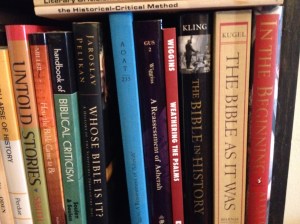
A recent post of mine on the United Methodist Church got a lot of response (for me, anyway) on other social media.  As I pondered this—I’ve written about the topic many times before—it occurred to me that most people probably have no idea what biblical scholars do all day.  (That is, besides write books that only other biblical scholars read, and teach their classes, or, very occasionally, edit books.)  Biblical studies is arguably one of the oldest academic pursuits in the world and what it boils down to in a word is “contexts.”  We try to understand the multiple contexts of the biblical texts.  Think about this a second: when you pick up a book, newspaper, magazine, or their electronic equivalents, what is the first, if often unconscious, thought you have?  Isn’t it something like “what kind of book, newspaper, etc., is this?”  Is it fiction or non?  Is it reputable or not?  Who wrote it and when?  These are all contexts.

The Bible was written about two millennia ago.  Very little of that original context still remains.  In fact, none of the original manuscripts even still exist.  It was a book written in Hebrew, Aramaic, and Greek.  The vast majority of people in the western world do not read these languages, and so the Bible comes to us in mediated form—translation.  Translation, as any writer knows, is a form of interpretation.  It is not, and can never be, the original.  To figure out what the Bible “means” it has to be interpreted—even just reading it is a form of interpretation.  Biblical scholars want to be able to interpret it in informed ways.  We learn about its various contexts and use them to help us understand.

What did people think like thousands of years ago?  Can you even remember what it was like to look up a distant location without the internet?  Writing letters or dialing a rotary phone to get information on it?  Going to triple A to get maps?  And all of that was only two decades ago.  Life in biblical times was very different than life today.  The people then didn’t understand science the way that we do.  The writers of the Good Book didn’t have any idea that what they were scribbling would one day be considered holy scripture.  They had completely different contexts.  Whether the contexts are historical, literary, or social scientific (we still haven’t figured out an elegant way of saying the latter) biblical scholars use a variety of methods to get to those contexts.  We can’t go in with the answers already in our heads—if we did we’d only find what we were looking for.  At the end we have an answer, not “the” answer.  And so biblical studies continues.


Devil or Con?

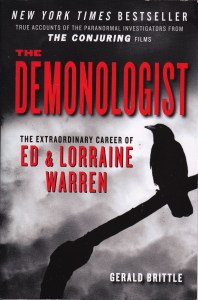
You can’t believe everything you read.  That’s one of the first tenets of critical thinking.  This whole process is about how to get to the truth, and in a materialistic world that truth can’t involve anything supernatural.  These were my thoughts upon finishing Gerald Brittle’s The Devil in Connecticut.  Controversy accompanied Ed and Lorraine Warren’s investigations and some of the people involved in these cases have later claimed the extraordinary events didn’t happen.  Others claim that the Warrens offered them to make lots of money by selling their stories.  The effect of reading a book like this is a blend of skepticism and wonder.  Among their fans the Warrens are held in the highest regard.  Anyone who begins to look into their work critically ends up frustrated.

So when I put this potboiler down—it is a compelling read—I went to the internet to find out more.  Then I realized what I was doing.  Using the internet?  To find the truth?  It’s a vast storehouse of opinion, to be sure, but what with fake news and alternative facts who knows what to believe anymore?  I found websites debunking the whole case as a hoax.  Others, naturally, claim the events really happened.  Both kinds of web pages have the backing of someone in the family involved.  It’s a pattern that follows the Warrens’ work.  In one of the many books I’ve read about them they claim to have ten books.  If my math is right this was number ten.  Even that remains open to doubt.

The word “hoax” seems a bit overblown.  Dysfunctional, maybe, but hoax?  Reading Brittle’s account it’s clear there were some issues in this family.  Having grown up in a working class setting, I’m aware such scenarios are extremely common.  Accusations were made that this was an attempt to spin gold from straw.  The nearly constant stress of blue collar families makes that seem less far-fetched than a stereotypical devil showing up in a modern house because a satanic rock band placed a curse on the family.  Lawsuits—the most avaricious of means for determining facts—apparently prevented a movie deal and have even made this book a collector’s item.  Somebody, it seems, is making money off the story.  As after reading the other nine books, the truly curious are left wondering.  My skepticism kicked in early on, but then again, I’ve always liked a good story. 


Common Tyrants

“Common tyrants, and public oppressors, are not intitled to obedience from their subjects.”  The words aren’t mine, nor are they from this century.  That, however, makes them no less true.  Jonathan Mayhew was an eighteenth-century clergyman arguing that Bible’s admonition to obey government officials did not apply to those who abused power.  In reading these words I felt a sense of loss in a very basic way.  No, I’m not a fan of turning back the clock—it can’t really be done anyway—but when the word of a single book was not disputed those tempted to follow tyrants could be made to justify it with a Good Book that could also be used to refute it.  We no longer have a common frame of reference, but tyrants still exist.

Shouting matches have been substituted for discussions because those who support tyrants can’t see how they are also being oppressed.  It’s one of the ironies of history.  This internet age has only found a way of magnifying people’s differences on the political scale, even as it has brought us to the common marketplace of culture.  Who doesn’t use Amazon?  Tyranny, by definition, is the arbitrary use of power.  One might think of, oh, declaring a national emergency when none exists just to get what one wants.  One might think of surrounding oneself with criminals against the nation just to get what one wants.  One might think of business practices meant to ruin others just to get what one wants.  There seems to be a common theme here and it’s one on which the Bible has a great deal to say.  The only Scripture that gets quoted is that which supports tyranny, eh, Mayhew?

When the debate was about the Good Book we were largely all on the same page.  Not all colonials wanted to break with King George III.  Some profited from the connection.  Others thought Holy Writ prevented revolutions rather than inspiring them.  Tyrants have always been with us.  You’d think that with all the media we have these days that we’d be able to spot one fairly easily.  The camera, however, has a way of giving the lie to the Good Book.  Anyone can say they read it.  Or claim they obey it.  Its own test seems to be “by their fruits you will know them.”  The words aren’t mine.  They’re from a distant century past.  But it seems the fruit is dying on the tree, even as spring begins.


Quoth Hardy

There are days when the quote from an author is the best thing to happen to me.  You probably know those kinds of days—days when there’s nothing really to stay up for so you go to bed early.  Lengthy days when your Muse wins easily any game of hide-and-seek.  You see, I save most of my fiction reading for bedtime.  If I turn in soon enough I can read quite a bit before falling asleep.  Not to sell you a false bill of goods, but that’s not the source of the quote.  It actually came to me from an unrelated email about the Bible.  The quote, while lengthy, comes from Thomas Hardy:

By the will of God some men are born poetical. Of these some make themselves practical poets, other are made poets by lapse of time who were hardly recognized as such. Particularly has this been the case with the translators of the Bible. They translated into the language of their age; then the years began to corrupt that language as spoken, and to add grey lichen to the translation; until the moderns who use the corrupted tongue marvel at the poetry of the old words. When new they were not more than half so poetical. So that Coverdale, Tyndale, and the rest of them are as ghosts what they never were in the flesh.

This comes from a letter to Professor D. A. Robertson of the University of Chicago, dated to February 1918.  Hardy was a known critic of religion, but like most writers of his day he knew the Bible.  Now, I’d never generally put myself on the same page with Hardy, but something similar to this thought had occurred to me long before I saw this quote.  We treasure ancient writing simply because it has survived.  This should be a sobering thought to any of us who try to forge our thoughts into words.  We have no way of knowing if, at the time, an author was considered great.  Merely the passage of time can make writing unfashionable in its age appear brilliant.  Like rocks tumbling over each other at the base of a cataract, they find polish over time.

My particular context for receiving this emailed quote was the King James Version of the Bible.  Often considered sacred in that translation, it was not uniformly well received when first published.  There had been English Bibles before, and since the Good Book is the foundation of western literature, a new translation commanded attention.  It had its critics, but over the centuries the translation itself became holy, whether it deserved it or not.  Similarly, Martin Luther’s translation of the Bible helped to codify the German language.  We shouldn’t be too quick to dismiss Scripture, not for its theology, but for its immense influence on western thought.  As Hardy noted, it may be the passage of time that makes writing great.  Even so we might be wise to pay attention.


Not Your Parents’ Bible

As someone always interested in origins, I reflect on how I’ve ended up the way I have.  I mean, who plans to end up a Bibles editor?  In the grand scheme of a universe with a sense of humor, it’s an odd job.  I grew up reading the Bible, but lots of people do.  Most of them end up with ordinary people jobs.  Obviously, working on a doctorate in the field is admittedly strange, but then, my interests have always been to get to the truth.  The other day I spotted a book on my shelf—the book that arguably started it all.  The Lost Books of the Bible and The Forgotten Books of Eden.  These days I would recognize this for what it is, a cheap reprint of a book published quite some time ago (1926 and 1927).  No “value added content.”  Just a reprint.  But why did this book have such influence?

It was the first time I’d realized—and growing up in poverty with parents lacking college educations you have to teach yourself a lot—that there were other books about as old as the Bible.  The idea fascinated me.  Somehow my fundamentalist upbringing had convinced me the Bible was the first book ever written—after all, its author was God and how much more primordial can you get?  Now this particular book (Lost Books of the Bible etc.) contains some apocryphal Gospels.  Not having a strong grasp on the concept of canon, I wondered why these books had been excluded, or, to use the title conceit, “lost” and “forgotten.”  In college I would learn about the canonical process.  I’d hear more about it in seminary.  There I would learn that even older sources existed.  In the pre-internet days, in a rural town without so much as a public library, how would you find out about such things?

Helmer Ringgren’s Israelite Religion captured my imagination in seminary.  Even there, however, nobody on the faculty seemed to know much about what had come before the Bible.  Harrell Beck told us of ancient Egypt in our classes, but clearly there were further depths to plumb.  I learned about James Pritchard’s Ancient Near Eastern Texts, which I bought at the Harvard Divinity School bookstore.  Other texts went back beyond Holy Writ.  Just how far would have to wait until the University of Edinburgh.  I sometimes wonder if I might’ve taken a different turn here or there had anyone been able to answer my young, unformulated questions about the origins of the Bible and other ancient books.  Now we just have to ask the internet.


A Saint Lent

Photo credit: Andreas F. Borchert, Wikicommons

Lent, among the denominations that observe it, is intended as a time of intense reflection.  Beginning on Ash Wednesday the fact of one’s own mortality becomes a foremost consideration as the faithful are reminded that they will die.  It has always struck me as paradoxical that St. Patrick’s Day always falls in Lent.  Those who abide by the liturgical calendar readily acknowledge that Lent is a punctuated season; saints’ days and feasts can still occur, temporarily disrupting the heavy contemplation.  While at Nashotah House we never celebrated St. Patrick beyond a brief mention during a collect of the seventeenth.  His day, rich in Celtic mythology, it seems, was inappropriate to the mandated gloom so highly valued by the soul-sick.  Having some Irish ancestry, I always felt a little slighted by this aloofness regarding a saint most people can actually name.

College campuses, I later learned, tend to schedule their spring breaks to include Saint Patty’s Day because of the damage drunken students may exact.  The stereotypical besotted Irish have become an excuse for excess during Lent, although, I suspect the forty days have little to do with it.  A saint becomes a justification for sin, it seems.  And Lent continues the morning after.  There’ll always be Lent.  The tray holding the ashes of last year’s palm branches is never empty.  Two once religious observations clash in mid-March of each year.  During a brief spell the historically oppressed Irish are celebrities for a day.  Such are the vicissitudes of liturgical calendar clearing.

Today many people celebrate a saint they wouldn’t otherwise recognize.  One that mythically drove the snakes from the Emerald Isle, and who perhaps hid a pot of gold at the end of the rainbow.  A holy man who has made it possible for anyone to be Irish for a day.  Leprechauns and clovers are in fashion as the ironic luck of the Irish closes down major thoroughfares for parades in the midst of ashes and dust.  Outside there may be snow or budding trees.  Perhaps both at once.  There’s a richness to these conflicting symbols that belies the commemoration of a missionary with alcohol.  The day is part of the complex of equinox holidays, whether intentional or not.  The green man of yore begins to awaken as light starts to outstrip darkness for half a year.  We’ve had enough of dusk.  Anticipate the light.  The rules state that Lent will still be here tomorrow.  But the light is beginning to grow. 


Culpability Defined

What seems to be lacking in the United States government is any realization that actions have consequences.  While in Christchurch, New Zealand at least 49 people have been murdered only for being Muslim, Trump feels that tweeting “heartfelt” condolences somehow exculpates him from fostering an atmosphere of hatred.  Indeed, the main shooter in that travesty cited Trump as an inspiration.  The sickening lack of awareness that deeds have consequences has once again led to a body count.  Meanwhile in these states the Republican Party refuses to condemn the daily and consistent message of racism coming from an edifice that is more and more appropriately called the “White House.”  Do you have to pull the trigger to be guilty?  History will decide.  

Politics has always been a crooked game, but until 2016 most elected to the highest office—God help us, even George W. Bush—realized that the office had responsibility associated with it.  It wasn’t a place you could play loose and easy and tweet from the hip and think it was your right as “just another citizen.”  Muslims have been part of American culture from very nearly the beginning of this experiment in colonialism.  Freedom of religion was one of the pillars of democracy that Trump has been chopping down like a cherry tree while tweeting “No I didn’t.”  The GOP applauds.  Here’s how to instill one religion as the norm, not considering the consequences.  Massacres in the name of Christ don’t make you Christian.  Not cutting history class should be a requirement to run for elected office.  Or at least taking basic civics.  Instead we have a government that refuses to recognize that it can inspire murderers around the globe and then offer heartfelt condolences with no apologies.

Where is the condemnation of racism?  Where is the line between black and white?  Where is the sense of any culpability for creating and sustaining the warm, moist environment where the bacteria of hatred thrives?  When you awake to the news that yet another white supremacist has taken inspiration from an angry white man who has nothing to be angry about and has consecrated murder as patriotism how can you look the world in the eye?  Hiding behind a tweet does not bring back the dead.  How do we get the message through?  Millions of us have repeatedly marched in protest.  We flipped one house of congress and we daily sign petitions until our fingers bleed but no response comes from those who won by a mere technicality.  If there are indeed ghosts in this world there will be mass immigration and it shall be richly deserved.


The Rules of Waiting

Tom Petty must’ve been a commuter.  On a winter’s morning after switching to Daylight Saving Time, waiting is the indeed the hardest part.  For a bus, that is.  In the dark.  The saving grace is that humans are rule-makers.  Before I even began commuting into New York I’d been instructed in the etiquette.  Those who get there first leave some kind of avatar—a briefcase, an umbrella, a lunch box—in their place in line and then sit in their cars.  Being the paranoid sort, and also thinking myself tough, I’ve always just stood at my place as the chill wind finds its way down my collar and then buffets me almost off of my feet.  With the time-change, however, I decided to do like the commuters do.  I walked out to the line of objects to find one widely separated from the others.  Being a law-abider, I put my lunch down after the errant water bottle.

“Hey,” a stranger called me on my way back to my car.  “Somebody just left that water bottle—you should move your bag up next to the backpack.”  Thanking him, I did so.  Not only was this person I didn’t know watching me in the dark, but he was also keeping the rules.  Indeed, when the bus crested the hill and commuters lined up next to their possessions, the water bottle remained unclaimed.  It was still there fourteen hours later when I got off the returning bus.  Now, I’m not a big fan of anarchy, but this incident demonstrates just how inclined we are toward civil behavior.  There’s no bus stop police force to ensure nobody jumps line.  Even at the Port Authority waiting in the queue at the end of the day the rules are mostly self-governing.  Those who don’t obey are scolded by their peers and generally comply.

There’s a natural sort of ethic among those who catch the bus before 5 a.m.  We’ve all been awake earlier than nature would seem to dictate.  We’re in a dark, isolated location outside town.  We look out for one another, realizing that any one of us might easily lose our place in line should the rules break down.  I was struck by the kindness of this caliginous stranger.  Or perhaps it was just his love of order.  Had my representation been out of place, other commuters might’ve grown confused.  The system might’ve broken down.  The last thing anyone wants is chaos before cock-crow.  I decided to interpret it as kindness, however, as I made my way back to my car to put on Tom Petty to face the hardest part.


If It Itches

The problem, or rather a problem, of growing up Fundamentalist is taking things literally.  I suppose we’re all born naive realists, learning only later that things aren’t what they seem.  One of the dynamics of finding something new to say about demons involves an unconventional method of research.  Richard Beck’s Reviving Old Scratch: Demons and the Devil for Doubters and the Disenchanted is a case in point.  Being part of a series called “Theology for the People,” this book is not an exploration of literal demons or the Devil.  Well, it kinda is and kinda isn’t.  It is an engaging and often insightful treatment of the question of evil and what to do about it.  Evil is a question, but most of us, at least pre-Trump, could recognize it when we saw it.

Beck is a professor of psychology.  This meant that at several points I found myself pausing to consider some of the points he was making.  Some parts didn’t work for me—welcome to the world of reading—but others were eye-opening.  One thing that all books about the Devil seem to have in common is the observation that evil is clearly present in our world.  Governments, and Beck uses Rome as an example, easily become oppressive and harmful to the weak and powerless.  As a volunteer in a prison ministry, Beck knows whereof he speaks.  When governments are run by the unstable (think of the one with a toothbrush mustache or any other who declare themselves geniuses) oppression follows.  Evil not only bobs in the wake of oppression, it is oppression.  Beck has a Christian anchoring—call it theology—behind this, but it clearly works even without that.

Getting over my literalism, I know that academic books about demons or the Devil come with more serious titles and more hefty price-tags.  The value of a book, however, has to do with more than the cash you shell out for it.  Beck does a service by offering a theology that isn’t too theological.  I’ve known many candidates for the ministry who lost their compassion by getting tangled in the weeds of theology.  Even to the point of making sarcastic remarks to someone who wanted to help them when they fell on the ice.  I know myself, and I have to learn to trust those who practice theology in ways that I do not.  This may not be conventional research, but it is important reading.  Old Scratch, after all, is not just in the details.


Checkmate

March has been designated as Women’s History Month.  Since history has been written, well, historically by males, women have frequently been excluded.  History as a serious attempt to describe “what actually happened” is a fairly recent phenomenon.  Yes, men (mostly) have been writing their views of what events meant from the days of the Bible and the Classics on.  A few females had made their way into the narratives, but reading history often makes it seem like males were the only people of consequence.  I was thinking about this the other day after I read a reference to the Red Queen in Lewis Carroll.  Chess, I realized, is a game with a message.  Now I don’t often have time for games, but this felt important.

I’m not a good chess player, but I know that if you lose your queen you’ve got to be far better than I am at it to win the game.  In fact, the queen is the most powerful piece on the board.  Now if you plan to come back with something like “using the bishop, knight, and rook you can surpass the power of the queen” it suggests two things.  One, you’re better than me at chess, and two, you’re missing the point.  The queen can move in both perpendicular and diagonal lines.  She can land on either color.  The range of her motion is limited only by the size of the board.  The bishop is limited to one color square only and the rook takes two moves to equal the queen’s diagonal skills.  

Think about the king—he moves one space at a time, and mostly only to avoid capture.  The queen is out there defending the realm.  Even as a kid learning to play chess, it was obvious that the queen did far more than a bishop limited to his ecclesiastical domain, or the rook with his brute force.  The knight makes a move the queen cannot, but his range in limited.  If a player retained only a queen the opponent’s king could still be captured, in my mind.  Chess should be a queen’s game.  

History is a way of looking at things.  Although it involves facts—and this is where the government narrative goes off the rails; the denial of facts is an autocrat’s game—it’s not the same as facts.  History is an interpretation of facts.  The fact is that male history of the world just could not have been possible without women.  It’s time not just to acknowledge it, but to celebrate it.


Learn and Let Learn

My wife often works weekends.  Generally this involves trips to New Jersey, and since my unconventional schedule means we see each other awake only a brief time during the week, I often tag along.  The colder months of the year, and general economic caution, mean things to be done around the house can wait.  Most of the locations where she works have nearby bookstores, but even a guy with proclivities like mine finds it hard to spend more three or four hours in one place, even in such a welcome environment.  It finally occurred to me that one need not be a resident to find shelter, and free wifi, in the public library.  I’ll pack my laptop, and if it’s going to be a full day, a sack lunch, and head to the library for a change of scenery.  It has led to a kind of renaissance for my spirits.

Public libraries generally do not house the books I read.  The source of my jouissance has rather been discovering how well used the libraries are.  In both affluent and more modest neighborhoods, people willingly spend part of their Saturdays in buildings dedicated to learning.  Not all are there for the books, but they seem comfortable surrounded by them.  We gather in a temple to the human mind.  And everyone’s generally quiet.  Mentors coach young people who want to learn.  Some even dress well, as if the library might be a place to be seen.  In a nation where education is under attack, I always leave refreshed without spending a penny.

Such opportunities are a rarity.  Before the library opens, if we happen to be at her venue early, I may need to find a Starbucks.  They more or less assume you’ll consume to utilize their free wifi, but beyond that a day at the library comes without cost and considerable gain.  A variety of ethnicities are always present, and nobody’s right to be here is questioned.  It’s a microcosm of what we could be as a nation, had we the will, the desire to learn and let learn.  People generally have a difficult time with silence—just ask any introvert.  I suspect this is one reason not everyone shares my enthusiasm for a cloistered experience of a Saturday.  Libraries are where we’re forced to be relatively quiet to respect the needs of those actually there to read.  Hoi polloi prefer to be loud, as any bar on a weekend afternoon will reveal.  But the libraries remain, and even in their own way, are buzzing hives of the life of the mind.


Mostly Clear

“Chiasm” is a literary technique based on the name of the Greek letter chi, shaped like a latinate X.  The idea is fairly simple and generally resembles a sideways V more often than an actual X.  It goes like this: a poem, or story, begin at a large, or wide premise, narrows down in steps to a center, and then, by corresponding steps, again out toward a larger, or wider resolution.  Another way to think of it is a set of Matryoshka dolls; first you take them apart, and then you put them back together.  David Mitchell’s Cloud Atlas is a chiastic story.  Starting on a cross-ocean voyage at an indeterminate time in the recent past centuries, it moves on to a Briton on the continent in about the turn of the last century, then a mid-twentieth-century American investigative journalist, a late twentieth-century or present-day rogue publisher in Britain, a clone in future Korea, and finally, to a planet of the apes-like Hawaii of the distant future.  Not really finally, though, since after the center of the X, it moves back outward through the nesting stories to bring us back to the beginning.

I’m not going to attempt to retell the story here, so don’t worry—it doesn’t get any more complicated.  There are, however, a couple of remarkable things about the tale.  In the brutish, nasty, post-collapse future that marks the center of the narrative, religion is central.  Some of the Hawaiians have come to believe the protagonist of the nesting story, the clone mentioned above, was a god.  To find her story, however, you’ll need to read the book.  Suffice it to say, that origin myth is part of the overall complex structure.  The second of the remarkable features, and one that makes this book very salient, is that in all the ages the issue of accepting those who are different is central.

In the outside framing story, the initial and terminal points of the chi, one of the characters is a missionary.  He’s trying to “improve” he life of Polynesians by making them into slaves, whereby they benefit from the largess of Christianity.  Quite a bit of the narrative draws its energy from the eventually faltering sense of superiority of the AngloSaxon “race.”  In that sense it’s definitely a parable for our time.  A story that deserves to be read.  Defying easy genre identification, Cloud Atlas is a thought-provoking novel that doesn’t fear religion and its larger implications.  A couple of the nesting stories have exquisite twist endings worthy of the Twilight Zone.  This book will make some demands on your time, but its message makes it a sound investment in a world rapidly heading toward a future that reveals just how troubled our species is.


Time Saving

As we suffer through another pointless Daylight Saving Time, I’m thinking of rituals that have lost their meaning.  Life is full of them.  We do things because we’ve always done them this way and even when they become harmful because of the way lifestyles change (auto accidents, for example, increase after shorting people of an hour’s sleep) we can’t seem to let go.  DST alone should’ve been enough to convince those who claimed religion would simply go away when science kicked in that they are wrong.  This is one reason that I’ve always found the origins of ideas fascinating.  Why did people believe this?  Why did they do this?  What started this whole process?  (Just to be clear, I’m not asking this about DST; I’ve written about that before.)

We can’t know the ultimate origins of religion.  I’ve suggested in the past that what we would term religious behavior has clear origins in the behavior of animals.  A somewhat fully developed consciousness provides incentive to rationalize such behavior.  The earliest organized religion of which we know involved state functionaries (priests) supporting, probably for sincerely believed reasons, the “secular” government.  Kings and priests needed each other and people quickly conformed.  Even when those on the inside came to realize that they were merely pretending, they kept on doing so.  It was too late (or if DST, too early) to change anything, so the mascarade continued.  Tracing the history of religious ideas reveals perhaps more than we want to know.  And human beings are natural actors.

Once, while in a restaurant, I sat near the kitchen.  The smiling servers, as they neared that portal lost their smiles and harried looks came to their faces as they told frantic cooks what the couple at table eight wanted.  Yet they continued to pretend they were happy when at table-side.  Or think of work with its “public facing” information that is inevitably different from what is known by those on the inside of the company.  Actors.  We’re all actors.  Perhaps it’s the price to pay for living in a civilization.  If we stopped to think about why we’re doing something as inane as pretending five o’clock is now six o’clock, or even that all people are the same and should be at work between nine and five, society could not stand the scrutiny.  Anarchy would erupt in the streets.  We should be thankful that people don’t think about these things too deeply.  Or, then again, maybe I didn’t get enough sleep last night.


Long Journey

Although it may be only a venial sin, overwriting is nevertheless an offense.  As a professor I read many papers from students who had great difficulty clarifying what they were thinking only to disguise it with too many words.  I have finally finished Andrea Perron’s House of Darkness, House of Light.  Because academics too often dismiss personal testimony, I feel compelled to consider it.  Now over 1,300 pages later, I have discharged my duty.  Ed and Lorraine Warren, despite being famous, are difficult to assess in book form.  Yes, they (ghost-)wrote ten books, but they never had permission to include the Perron story that stands behind The Conjuring.  The eldest daughter took on the task herself and even seems to be aware of (in the acknowledgements) a dubious talent for overwriting.  What the Warrens saw as demons, she sees as ghosts.  Who has the right to decide?

I wish the author well in her writing career—those of us who write tend to be natural boosters of others—but it would’ve been nice to have had a more condensed version focusing on the events in the Harrisville house.  One interesting thing caught my attention here: according to Perron the Warrens called by phone after the Perrons moved from the offending house and tried to talk Carolyn, the mother, into a book deal.  Offering a healthy income from the proposition, they gave a hint of what other writers have claimed—they had the business angle firmly in mind.  I’ve read enough from people who actually knew the Warrens to believe they sincerely believed they were helping people.  They also had to make a living, and ghost stories tend to sell well.  Some use that as evidence that they were only trying to make money.  I’d remove the only, without dismissing the financial incentive.

It’s nearly impossible to read a very long book and feel that you haven’t come to know the author.  Also, it’s difficult to dismiss material written, even if overwritten, so sincerely.  We live in a world that we don’t understand nearly as well as we think we do.  Call it old school on my part, but I believe in extending the benefit of the doubt to eyewitnesses, particularly when there are several of them and they have a decade to observe closely what many others never get a chance to see.  This set of three books is a window into a realm over which the drapes are usually drawn.  For those willing to do some hard mining, there’s something of value here.


The Price Is Wrong

The costs for academic books can seem criminal.  Don’t get me wrong; I work in academic publishing and I know the reasons—or at least the reasons publishers seem to believe—for such pricing.  Still, when I see a book that my little public library will never be able to convince its network that it should be able to borrow, I look at the prices and blanche.  At least the pallor looks good with my skin type, or so at least I’m led to believe.  Why are books so very expensive when so few of them retain any resale value?  Publishing—the information business—is unlike any other.  In fact, it could be argued that the printing press was the earliest internet.  Ideas could be spread more quickly, among those who were able to read, than they could have previously.

These days books are the handmaidens to the internet.  The problem, of course, is that the web contains ideas that haven’t been vetted.  Publishers offer that service, but you have to pay for it.  Books don’t sell like they used to—physical books, I mean.  Inflation, however, ensures that the cost of paying employees is constantly going up.  This is the hidden factor of “overhead”—the cost of doing business.  You need to sell a lot of books to pay a staff.  Not only that, but unlike most “commodities”—I shuddered as I typed that word—books can be returned to a publisher if they don’t sell.  It’s like an entire business model run on consignment.  And the honest truth is—academic authors may want to cover their eyes for this part—very few books sell more that a couple hundred copies.  That means that the per unit cost has to go up.  Next thing you know you’re selling a kidney to continue your research.

I keep a running list of books I’d like.  Some are for research and some are for other pleasures.  The list grows quite lengthy when more and more interesting books get published.  I look at academic books and I wonder if maybe there’s another way.  If they were priced down in the range of mere mortals, would they sell enough copies to meet their costs?  I’m well aware that Holy Horror is priced at $45.  Believe it or not, that’s on the lower end of academic extortion pricing.  Many books on my “must read” list cost three times as much.  Are we paying the price for keeping knowledge solvent?  Or is all of this just criminal?