Beating around the Bush

You know things are bad when another president who couldn’t win the popular vote criticizes you. Don’t get me wrong—criticism is good. In my academic existence (on life-support for over a decade now) I’ve received plenty. The point is you can’t improve if you’re not willing to take a few blows. Defensive academics don’t survive long. The problem seems to be, if I may speculate from my knowledge of biblical studies, the word “criticism.” Growing up, one of the last things I wanted to have was criticism. Already overly self-conscious of my sins, criticism only felt like making an already bad situation even worse. Then I was introduced to biblical criticism.

Biblical criticism sounds like the worst kind, but in reality it’s absolutely necessary. The idea is to study the Good Book rationally. I knew, and still know, many people who believe biblical criticism to be evil. If you trust any history—either secular or divine doesn’t matter—you quickly learn that nothing is simply one-sided. The Bible itself offers examples of this: did God or the Devil tempt David to take a census? Just how many angels were in that tomb on Easter morning and who arrived there first? Only one answer can be right. Criticism is, typical of academics too long out of the sun, a poor word choice. Nobody’s picking on the Bible. All the biblical critic is trying to do is to find out what it really says by asking questions of the text.

IMG_1163

That’s the heart of the matter. Autocrats don’t like questions. The assumption that the inherent authority of a position should be unquestioned undermines any attempt at democracy. As I was often told in church—Christianity isn’t a democracy. Our political system, we’re told, is. That why checks and balances were built into it. Either extreme and the applecart is upset. No matter what believers believe the same applies to biblical studies. Some rampant Harvard toadyism remains, but for the most part we recognize that a scholar with—shall we call them “critical skills”? may emerge from even a school shorn of ivy. We understand that’s how learning works. No one’s above criticism. Only those with something to hide can’t take their lumps like the populace that allow them to claim the name populist. Nobody likes it, but we all have to take criticism from time to time. Even the Good Book.


The Cargo of Cults

Among religious studies scholars “cult,” in the popular sense, is a swear word. Professionals in the field don’t use it because it implies that a belief system—usually modern—is somehow less important than an established religious tradition. Instead, we’ve been taught to call these “New Religious Movements,” or NRM for short. Looking around it seems that political correctness is now gone and open advocacy of white power is the new norm. After all, the minority of the American electorate voted for it so we can change the rules on that basis. Even before the election, however, Rebecca Nelson wrote an important article on GQ about the cult of Trump. As a person, what’s there not to dislike? A long history of shady business deals, lawsuits, and sexual harassment (we just couldn’t get beyond Bill Clinton and Monica Lewinsky just a couple of decades ago, but all that’s water over the dam) such a man couldn’t have been elected even in the W era. Well, cult thinking explains that.

Nelson cites the work of Rick Alan Ross, an expert (back from in the days when we still had those) on cults. The rise of Trump followed exactly the pattern of how cults work. A single man (nobody voted for Pence) who is able to fix this great broken machine called America. He can do it by referring to a black box that nobody may open to examine, but yes, believe me, the solution’s in there. Stir the muck and tell people things are awful when life expectancy is better than it’s ever been, everybody has health care, and the economy’s finally starting to stabilize, and you’ve got yourself a cult leader. As Nelson insinuates, the Kool-Aid is in the future.

We learned a sum of zero from Jim Jones, David Koresh, and Marshall Applewhite. We wrote them off as weirdos getting off on a power trip. Swept away by the mere fact of being followed. Mentally unstable with delusions of grandeur. Narcissistic to a fault. Wait, what? We ignored them so well that we’ve elected a candidate who took not just a page from their playbook, but an entire chapter. Back in the days of political correctness, when there was still such a thing as experts, I sensed that things were pretty good. As horror movies should’ve taught me, too good. Caligula insisted that his statue be set up in the Jerusalem temple next to where Yahweh resided. The temple may be gone, but the desire to be worshiped will always be with us.

Wait, that's not the Washington Monument is it?

Wait, that’s not the Washington Monument is it?


World Stories

worldofstoriesAlthough I’ve not formally studied it, Buddhism has long been part of my thought process. Like Thomas Merton—and this may be the only point of comparison between us—I find little difference between the contemplative worlds of Buddhism and Christianity. Mindfulness knows no denominations. I suspect David R. Loy’s book The World Is Made of Stories would cause anxiety for some. Those not comfortable, for example, with paradox. Or those who believe that only the literal is meaningful. Separated by the vast land mass of Asia, eastern and western ways of thinking about the world—telling their stories about the world—diverged widely in antiquity. There was a kind of “rediscovery” of south and east Asian thought in the late nineteenth century western hemisphere. Since then occasional famous explorers such as the Beatles, or professional practitioners such as the Dalai Lama, have brought Buddhism’s ideas to the mainstream, but because they coexist well with Christianity there has been no cultural reason to displace them.

I found Loy’s world compelling. All is narrative. That’s the way human brains work. If you’re reading this right now, you’re following my narrative. If you’re not really paying attention, another narrative has gripped you. Science is a narrative just as religion is. It is the way we think. The internal monologue. Consciousness itself. Stories. People will follow a story quite naturally, which is one of the reasons it’s such a shame so few people read for pleasure. We can watch our stories (what is a sporting event but a narrative playing out before a fan’s eyes?) and many people do. The written story often, however, takes us deeper.

Contemplation is an endangered species. Although I found the enforced quiet days at Nashotah House (such as Ash Wednesday) to be an onerous rule, I would arrive home with little to say in any case. The world of busyness that we’ve made our business can choke the meditative spirit. Although some workplaces offer yoga sessions (themselves based on Hindu spirituality) they hardly encourage meditating at your desk. It seems the natural enemy of productivity when, in reality, it increases it immensely. Who doesn’t work better after a vacation? The business world often presents the religious life as one of indulgent non-productivity. I remember being made to feel stupid asking for one Good Friday off while working my first full time job in retail. When cash transactions grew to be too much I’d find a church on my lunch hour and just sit. Now I only find time to read Buddhist books on the bus on the way to work. Look deep enough and there’s a story in that.


Admission Price

bibleandcinemaThe drama of acquiring Adele Reinhartz’s Bible and Cinema: An Introduction almost overshadows the joy of reading it at last. Back in my teaching days I realized that in very long class sessions (some went for four hours at Rutgers) students needed a break from me almost as much as I needed a break from myself. So I showed short clips of movies that had the Bible in them. The problem was, there was no easy way to find such movies. I’d seen many myself, but academics hadn’t written much on the subject and even a web search, in those days, wasn’t much help. Reinhartz is one of those scholars who understands we can learn about the Bible from movies, and her book would’ve been welcome in those days of fumbling my way through a darkened room, as it were.

Bible and Cinema is a Routledge book. In fact, it was underway during my brief tenure at the press. I very much wanted to read it but for questions best left to the empty ether, my welcome at Routledge wasn’t prolonged. The book came out before I left, yet I didn’t have a chance to get my hands on a copy. Being Routledge priced, I couldn’t afford it with my own funds. The book stayed with me, though, and last year I found a used copy, in passable shape, offered on Amazon for the price of a regular book (currently about $16). I immediately ordered it and anxiously awaited it. December came and went. The book didn’t arrive. Amazon informed me that it hadn’t been shipped and they would cancel the order unless they heard from the seller. In the new year, that’s what happened.

Once I’ve made to order a book, I have a hard time stopping. I had to cough out a bit more since reasonably priced used copies still couldn’t be found now that the one had gone AWOL. I’d been bitten, though. The new seller also delayed. The Trump administration began. I received a familiar message from Amazon. I wrote to the seller in anxious tones—if only I’d comped myself a copy before exiting Routledge! At last, late, and a bit beat up for the price, it arrived. It was worth the wait. This is a fine exploration of how the Bible has been made into movies and how movies have incorporated the Bible. Reading it was like watching movies on the bus. And for that, it’s hard to overestimate the price.


Doing the Math

Erich Fromm once defined evil as “attraction to what is dead, decaying, lifeless, and purely mechanical.” Certainly Fromm doesn’t hold the cachet he once did, but this way of thinking about evil has stuck with me. It’s not so much the dead, decaying, or lifeless part—that’s part of nature—but the purely mechanical. I don’t disparage the many machines we have that make life easier, and modern life possible—can you imagine your job without computers? The problem in my mind, as Fromm defines it, lies in the word “purely.” Purely mechanical. By the numbers. You see, we often forget that being human, and thought itself, isn’t about pure logic. Our brains evolved to be half emotive and have rational. Our feelings can be smart. When we reduce all of life to numbers, according to Fromm’s definition, we’ve entered the realm of evil.

Some, in the past as well as present, have posited numbers as the only real truth. No matter where you are in the universe 2 + 2 = 4. It’s about the only certainty we have. I think what Fromm was concerned about was not this kind of certainty, but rather that which sees only numbers as being important. Think of the multibillionaire who’s lost sight of the human misery he (and it’s generally a he) has caused to become so wealthy. It’s not something towards which an enlightened individual would aspire. Purely mechanical it is, by definition, evil. We’ve all known people like that—those who just can’t get beyond the numbers whether they be the bottom line or the instructions for the doomsday device. The human element is missing. Are we truly beyond good and evil?

Does it add up?  Photo credit: Cpl. Jovane Holland, Wikimedia Commons

Does it add up? Photo credit: Cpl. Jovane Holland, Wikimedia Commons

Governments, once upon a time, were put in place in democracies to protect the interests of the people. When people are mere marks—numbers at an inauguration or cheated at the polls—we’ve entered the realm of purely mechanical. Of course, intellectuals are out of favor now. Why be troubled with the news when you can make up your own? 2 + 2 need not equal 4 if you say it loud enough. Behind stage, however, you’ll make sure your accountants know the score. Those who wish to start a New World Order must insist that the classics are outdated. While we’re counting out the days in our prison cell it might be a good opportunity to read. I plan to have Erich Fromm on my list. I’m only human after all.


Signs and Portents

Horror movies are, of course, more than escapism. Although it’s taken many years academics are starting to pay some attention to them. Because of a conversation with a colleague this past week I felt compelled to watch The Omen again. The current political situation merits such viewing, in any case. Interestingly, the first time I saw The Omen—which was during a spate of unemployment—it didn’t scare me much. Like most classic horror, the scenes that had everybody talking in the mid-‘70s had been described so often that they failed to shock. All that was left was a dispensationalist tale of the end of the world—non-biblical, and the fright only came from belief. This time, however, I could see it as nothing but a film about a political takeover.

Omen_ver4

With the open admission on the part of Steve Bannon that his administration—let’s not kid ourselves here—intends to dismantle the government we’ve had in this country since around 1776, we can see that this election was only an excuse. Knowing that this dark side of human nature (some call it the Devil) won’t be given a chance again—they didn’t win the popular vote this time around and unless they silence the media they won’t win the next one—Bannon’s crew, like Damien, has to deconstruct quickly. The Republican establishment, unless it opens its eyes soon, will find itself locked outside as well. Ironically, it’s the public that can see this, not the elites. It’s as if George III were back from the grave. Power, as The Omen intimates, is incredibly seductive. The GOP, wrongly supposing it will share it, goes along with nominations that have now been openly declared agents of destruction. Where is Revelation when you need it?

The Omen is all about Satan getting a back-door entry to the White House. The politicians are all easily duped. Evangelical Christians have been brainwashed into thinking that only by voting Republican can they prevent abortion and gay marriage—two decidedly non-biblical issues. You see, the Devil works that way. Scripture says he can disguise himself as an angel of light. People who don’t educate themselves are very easily fooled. We’ve followed the script rather precisely. Satan’s greatest tool, it’s said, is that people don’t believe in him. So after you finish reading 1984—which we all should—watch The Omen. Ponder what inviting evil to take over the one remaining superpower might really mean.


Seeing Thinks

Look, up in the sky! It’s a bird! It’s a dude! What what is it? It’s actually a cloud. I enjoy the entries on Mysterious Universe, but sometimes a cigar is just a cigar. It seems like decades since I laid down on the ground and looked at the clouds, seeking shapes. The sky is nature’s cerulean canvas and although they’re just water vapor, clouds take on endlessly fascinating shapes. Since religion has historically been projected onto the sky, many people take signs in the sky as somehow divine. The photo on Mysterious Universe is of a cloud that some thought was Jesus and others thought was Mary. Herein lies the rub of pareidolia. You see what you want to see.

There is, in traditional Christian thought, a world of difference between Jesus and Mary. You really don’t want to mix the two up. I mean one is divine and the other is only venerated. Don’t want to cross that line into worship because idolatry leads to all kinds of trouble. So who’s in the sky? Someone that we should perhaps think sacred: water. In a world quickly running out of fresh water (of course since now, officially, there is no global warming we’ll have to find another way of explaining our disappearing ice caps) we should all perhaps worship our clouds. The harbingers of fresh water. It won’t last forever.

I, for one, complain when it rains too much. I suppose that’s because I’ve lived most of my life in the rainy climates of the eastern United States and Scotland. Days can pass without a glimmer of sunshine. I get depressed and truculent. Yet the freshwater falls. Water tables are replenished. In much of the world—indeed, in much of the United States—it is not so. Water shortages are bad and are growing worse. We use far too much and when the ice caps are gone, the largest reserves of freshwater on the planet will be empty. Then again, capitalists have never been too keen on saving up for the future. Most of us alive today, at least in the rainy climes, will have our lifetime supply. The future, however, looks pretty hot and thirsty. So who is it in the sky? Could be either gender—wearing robes makes it hard to tell at this level of detail—but whoever it is, let’s hope they’ve brought plenty of friends with them.

Look like anybody you know?

Look like anybody you know?


The New Neighbors

Apartment dwellers often ponder new neighbors. If anything gives the lie to being in control of your own destiny, renting your domicile does. Still using the old, aristocratic terms landlord or landlady, we know that we are under someone else’s authority. “As long as you’re under my roof,” my bully of a step-father liked to huff, “you’ll obey my rules.” When you rent, you can’t choose your neighbors. Those who own the property have final say. If they play the stereo too loud (“game” is probably the modern equivalent, but I was born before Pong even came alone) and won’t listen to your plea for a more monastic setting, you throw yourself on the mercy of your lord or lady. We got new neighbors this week. Not just us, but the whole galaxy. Seven new earth-like planets—surely ruled by Trump-like dictators—have been discovered. Let’s hope they’re early to bed, early to rise types.

During the Bush administration I often fantasized about the aliens landing on the White House lawn. I thought, with a president so obviously lacking intelligence, what would our new neighbors think of us? Would they complain to the landlord? You’d think that after that long trip across cold, vast interstellar space they’d maybe have the right to expect to find the brightest and the best in charge, right? Mission accomplished. The sign says so right there. Or to put it in a modern key, “Earth first, Earth first.” If they’ve got their intergalactic television on, I hope it’s switched to a different channel.

15207890820_d855b341e3_z

Contact, the novel by Carl Sagan, suggested the first contact from the aliens would be of Adolf Hitler. Among the first poisoned radiation this planet flung off into space was the fascist propaganda of 1930s Germany. Earthlings, not yet tempered by the Trump brand, were shocked. Surely this is a sign of hostility! Unless, of course, you control both the legislative and executive branches. Then you can just decide not to show up at the town hall and tell everyone you’ve got more important things to do. So, what will our new neighbors think? Do they just want the bodies of their compatriots from Roswell back, or is it a more serious discussion to be held behind closed doors? After all, African slaves were merely chattels in a negotiation between a more powerful culture and unhuman indigenous dullards with nothing better to do. On the spaceship back to their extraterrestrial slave mines, I do hope they have the common decency to keep the music down to a reasonable level.


Dreaming Reality

The problem with monsters is that they’re not easily reduced to a lowest common denominator. This becomes clear in an article about the under explored (from a western perspective) monsters of Australia. Christine Judith Nicholls, in “‘Dreamings’ and place – Aboriginal monsters and their meanings” (sent by a friend), describes many of the scary creatures of the outback. The article title references Dreamtime, a kind of aboriginal journey that ties into indigenous Australian religion. The division between imagination and reality isn’t as wide as we’re sometimes taught. (More on this is a moment.) Nicholls’ article demonstrates that many of these monsters impress on children the dangers of wandering away from parents. Indeed, that is clearly part of the socializing function of monsters. The question, however, is whether that’s all there is to monsters or not. (Nicholls doesn’t use reductionistic language—she does note this is a psychological explanation.)

In an unrelated article in The Guardian, by Richard Lea—“Fictional characters make ‘experiential crossings’ into real life, study finds”—researchers suggest that fictional characters seem to appear in “real life” from time to time. All those who read fiction know this phenomenon to a degree. Just because someone is completely made up doesn’t mean that s/he doesn’t exist. Since our minds are the ultimate arbiters of reality, fictional characters and monsters may indeed be “real.” This isn’t to suggest that physical, flesh-and-blood imaginary beasts lurk in the dark, but it isn’t to suggest that they don’t either. Reality is something we haven’t quite figured out yet. The more we think about it, the more it appears that both hemispheres of our brains contribute to it.

monster

When the morning newspaper raises alarm after alarm about the frightening tactics of the Trump administration the temptation is to give up to despair. That’s not necessary, actually. Reality requires our consent. Imagination can be a powerful antidote to the poison spewed by politicians. What fictional character—or monster—might step into a situation such as this to make it right? If the power of millions of smart minds were concentrated on such a being, would it not become real? Friends have suggested over the past four months that the arts—creativity—are going to be especially important in the coming years. If we are to survive evil we’ll have to use our imaginations. That’s something that the aboriginal peoples can teach us, if only we’re willing to believe.


Devil of a Time

thedevilOne might be excused for thinking so much about the Devil these days. Displays of lies and evil intentions are on pretty obvious display at the highest levels. Indeed, the current political situation has me reassessing my skepticism about the Antichrist. One of the truly well thought out books on the subject is Jeffrey Burton Russell’s classic, The Devil: Perceptions of Evil from Antiquity to Primitive Christianity. The first in a series of books Russell wrote on the topic, The Devil opens with evil. Noting that the Devil defies easy definition, Russell begins rather disturbingly with literary descriptions of acts that can only be described as evil. This allows him to point out that real life events often surpass those that authors can get us to read, intimating that something is seriously wrong with the world.

Having noted that, the emergence of the Devil is not an easy one to trace. Evil has been recognized in many cultures and it has been explained in many ways. Some have personified it, but even that took a long and circuitous route to the dark lord we know today. Bits of Greek philosophy and Zoroastrian cosmology combine with an emerging monotheism among the Israelites and their kin until eventually we have an embodiment of evil appearing. Even so, the Bible has no clear image of who “the Devil” is. This took further developments beyond the New Testament and the image that eventually won out, so to speak, borrowed heavily from classical mythology. Eventually Old Scratch emerges in a recognizable form.

Belief in the Devil still runs high in American culture. I suspect it will run even more so in months to come. At the end of Russell’s well researched study, the Devil comes down to the blatant disregard for the suffering of others. One might think of the mocking of the disabled or the favoring of the wealthy over the poor. Evil may be known by many names but it is easily recognized by those not caught up in its worship. This became clear in the biblical quotations sprinkled throughout the book. “Woe unto them that call evil good, and good evil,” for example. Or “when an ungodly man curses Satan, he curses his own soul.” Mirrors may serve multiple purposes. The vain look into them and see only beauty. Those who believe in the Devil can’t help but know who it is that stares back.


Bigger Bibles

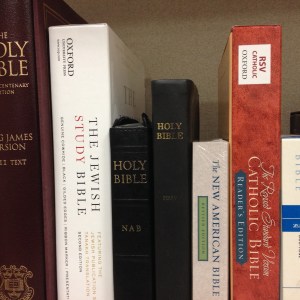
The Book of Jubilees. 1 Enoch. It’s been years since I’ve read these “apocryphal” books. I’m thinking about them today because of the concept of canon. If you’re like me—and I sincerely hope you’re not—you never heard the word “canon” until you reached college. If I’m honest with myself I’ll admit that I thought the professor was saying “cannon.” A single-n canon is a “rule,” or in this case a collection of texts. There were lots of texts in antiquity. Not many people could read, but that didn’t mean that those who could stopped writing (those who have ears to hear, pay heed). The image of the Bible with which I was raised—and mine said “Holy Bible” right on the front, so I knew it had to be right—was a collection of 66 books; 39 in the Old Testament and 27 in the New. Before I reached college I heard that Catholics had some extra books in their Bible. (Surely they must be about image worship and praying to Mary!) Then I discovered “the Apocrypha.”

The number of apocryphal books is not fixed. When I became an Episcopalian I learned to call them Deutero-canonical books instead of Apocrypha. I still couldn’t figure out the number because two of them (Daniel and Esther) are already in Protestant Bibles, but are expanded somewhat in Catholic Bibles. Do they count or not? Then there were others like Judith, Tobit, and 1 and 2 Maccabees. Interesting books, but it was hard to see what they added to the already pretty long Scripture I grew up with. I became accustomed to considering these “extra” books part of the canon. The Bible was bigger than I thought. Then I heard someone say that Jubilees was in the Ethiopic Orthodox canon. Indeed, eastern Orthodox Church canons differ from Roman Catholic Bibles. The Ethiopic Church (called Tewahedo by the locals) has millions of members. It is an ancient faith. It has a really, really big canon. You can’t learn much about it, however, at least not easily.

Because it is almost completely confined to Ethiopia, not much western scholarly attention has been lavished on Tewahedo. Sure, you can pay university press prices for a monograph or two to find technical reports, but few have bothered to ponder what all this means for the Bible. That’s why I’m thinking about Jubilees and 1 Enoch. These books are part of a Christian Bible but not the Christian Bible. There are many sacred texts in the world. Those of Hinduism and Buddhism put our somewhat tiny Judeo-Christian Bible in a different light as a small contender in a huge arena. There are scriptures from all over the world. And the response in our “globalized” university system is to cut religion departments. There’s still a lot to learn. I taught Bible classes for nearly twenty years and fell behind a bit in the larger world. It’s been far too long since I’ve read Jubilees and 1 Enoch.

img_1354


Lunar New Years

Celebrating the New Year in the middle of winter is a strange idea, at first glance. As I have discussed before, January 1 is “Circumcision-style New Year,” based on the projected date of Jesus’ circumcision after the church had settled on December 25 as his birthday. In actuality, a winter New Year date is due to its proximity to the winter solstice, and the other popular contenders for the honor of the head of the year, historically, have been the spring and autumnal equinoxes. The matter gets more complicated when a culture has a lunar calendar since the sun and moon don’t see eye-to-eye when it comes to their timing. That accounts, obviously, for a shortened February, but also for why a full moon doesn’t occur on the same day of each month. Now, I know little of Chinese culture, but I do know that Chinese New Year fell on January 28 this year, initiating the year of the rooster. Considering what had happened only eight days prior, this feels incredibly apt to me.

800px-hahn_im_huhnerhof_flamisch_17jh

Cultural diversity is a wonderful thing, and this nation is rich in it. You can, to pick a trite example, sample cuisines from around the world in a moderately sized town. Here in New Jersey getting onto a public transit bus will almost guarantee that you’ll hear at least one non-English conversation going on. Nevertheless I do have to confess that I don’t know what the year of the rooster represents in a Chinese context. As concepts cross borders they take on new associations and those who assign those new associations don’t represent those from the original land. So let it be here. Not knowing what the rooster symbolizes in China, I turn to its American expression—the cock. This is its year. The newspaper headlines read like a fortune cookie, in this distorted view of things.

To shift this metaphor to yet another cultural context—originally Jewish, but now appropriated by Christians around the world—think of Passover. For Jesus a night of betrayal. Peter, arguably Jesus’ best friend, denied three times in one night that he even knew his BFF. Cursing and swearing, according to the Gospels, he said, “I don’t know that man.” The cock crowed. It was around the spring equinox. A new year had begun. Within 24 hours, according to the story, Jesus was dead. We have much to learn from other cultures. The concepts change, however, when they’re stopped at the border.


Ash Monday

I was traveling abroad with a friend. We’d just arrived back in the United States and were making our way through customs. Since he was from another country we were separated. The border agent told me I couldn’t come back into the country unless I demonstrated that I was a racist. Only racists were permitted. He began to pressure me, even offering to help. Should I comply? I awoke in a panic. As someone who suffered frequent childhood nightmares, this was something new. In the past it was merely a monster chasing me, or my alcoholic father. Now I’m having nightmares about the government of my own country. And here it is, Presidents’ Day. Like U2’s early “New Year’s Day” or Bruce Springsteen’s “Independence Day,” there’s a decidedly poignant tone to this holiday. Looking towards DC I see nothing to celebrate. I see a government putting the mock in democracy.

This Presidents’ Day, I have a modest suggestion. It could fix democracy. When an election (I’m thinking Brexit as well as 11/9) squeaks out a victory because people don’t vote or don’t understand the issues, a true democracy would then hold a follow-up, “what I really want” vote. If we insist on keeping such arcane tools as the Electoral College in place, this is the only way for democracy to actually work. It wouldn’t be necessary in the case of a candidate winning both the electoral and popular vote. When that happens it’s pretty clear someone won. When the two are divided, however, that’s also a clear signal. Only unthinking automatons would declare that a landslide defeat is actually a win, based purely on political casuistry. Is there an ethicist in the house?

dscn6820

This Presidents’ Day feels more like Ash Wednesday to me. Ash Wednesday is for public mourning. It is a realization and confession that we have sinned. We wear ashes to make it conspicuous. This year no ashes are required. Perhaps we should wear black bands on our arms. I would, only arm bands seem to have a way of becoming bright red and appropriating ancient religious symbols. We have sinned, and we have sinned boldly. The miasma of Foggy Bottom is as clear a condemnation as is devoutly to be wished. When I start waking up in a panic, in a body-sock of sweat, my childhood monsters have become real. It’s Presidents’ Day 2017.


Alma Mater Matter

I was a teen-age religion major. Okay, that’s a bit dramatic, but I did start college at 19 and, being a first generation matriculant, had no idea about majors. No idea about colleges either. The school you choose stays with you for your life—especially if you decide to go into academia. A couple of recent events brought this home to me again. Grove City College is stridently conservative. Since I was raised Republican, it felt like a good fit at the time. It was cheap and close to home, and since my parental contribution was a total sum of zero, both of these factors counted heavily. Overlooked by many a hiring committee, it was also academically rigorous at the time. For better or worse, it’s now on my permanent record. Enough ancient history.

Recently a colleague asked me about an author, noting his undergraduate degree was from a school not unlike Grove City. I saw myself from the outside (yet again). Conservatism can be a lifestyle choice. My fellow religion-major grovers mostly went on to Gordon-Conwell Theological Seminary or other bastions of further conservative thought. Their minds were already made up. In their early twenties, no less. I headed to Boston University, at the time the most liberal of the United Methodist seminaries, by reputation. But still my record says “Grove City.” My academic writings should leave no doubt as to my scholarly outlook (most of these papers are available on Academia.edu), but there is always a shadow of suspicion over a former grover. You can’t change your alma mater, no matter what the next decision you make says about you.

Then I came across a recent writing sample from one of my Grove City professors who’s still on the faculty. This piece showed that as this faculty member was in the early eighties, so he is still today. Biblical literalism all the way down. With over three-and-a-half decades to read, that’s incredible to me. I guess I just don’t share the kind of arrogance that declares you got it right the first time and that everything you read confirms a literal Adam and Eve. And a snake and a tree. What am I to think when I see a conservative undergraduate school on someone’s academic record? I would hope that I would know to look at the next step to see what that reveals. I am a grover, but a bad grover, I guess. You have to know how to read a permanent record.

Photo credit: The enlightenment at English Wikipedia

Photo credit: The enlightenment at English Wikipedia


Ode to Zibaldone

Scribbling. All it takes is a margin of an agenda paper or the back of an envelope. I don’t remember when I started doing it—I’ve been writing my own blend of fiction, facts, and philosophy since I was in elementary school—but I would find a relatively clean piece of paper, fold it up, and put it in my pocket. I’ve carried a pen around with me for decades. Why? You never know when an idea might strike. There’s nothing like the discovery of a new idea. Lifelong learning is like that. So it was when I was reading Lemony Snicket’s Series of Unfortunate Events to my daughter that I learned about commonplace books. A commonplace book is a notebook where you jot all kinds of things down and you know where they are, unlike that piece of paper in my pocket that long ago started to rip apart at the folds, the ink becoming illegible as the paper grew softer and more pliable. A commonplace book seemed like a great idea.

This all came back to me when a friend send me a story on zibaldones. I’d never read the word before. A zibaldone, according to the story by Cara Giaimo on Atlas Obscura, is an Italian commonplace book. They used to be part of every thinking person’s accoutrements. A blank book where you could write down anything of importance. Giaimo suggests that the internet has taken the place of the zibaldone—blogs, Facebook, Twitter, Pinterest—we’re spoiled for choice where to put our thoughts. I still carry a commonplace book, however. Too many, in fact. Next to my writing chair rests a stack of notebooks. There’s one for each non-fiction book I’ve written, whether published or not. There are several filled with fiction. Some with poetry. My most recent zibaldones are Moleskines, which I purchased—as many as I could afford—when Borders sadly went out of business. Ideas. They just keep coming.

Some of my notebooks.

Some of my notebooks.

Perhaps the greatest benefit of the zibaldone is that, if one survives, an historian gets a glimpse at what someone who was not famous saw. Observations about the world scribbled down. The most proficient of scribblers organized their commonplace books in advance. As for me, I still scribble things on scraps of paper. I carry a notebook and pen at all times, but sometimes an idea is so slippery I don’t have time to pull a formal zibaldone from my pocket. I tape scrapes of paper into my notebooks. Right next to new words I’ve learned. Somewhere among today’s scribbles you’ll find the word zibaldone along with the hope that some day some of this might be significant.