Day Labor

It’s difficult to believe in Labor Day. Don’t get me wrong—I’m glad for the day off. It’s just that I don’t think people really believe in the idea any more. It’s hard to take professed goodwill for workers seriously in a plutocracy. Especially when money’s a fiction. When pay was in coin, although abstracted, you were literally handed something of value for your work. Now technicalities and loopholes and utter abstractions make some—including would be and actual politicians—wealthy. These are all tricks on paper, affirmed by accountants, and we watch like the audience of a magic show as the improbable is made out to be actual fact. And these who hold this imaginary wealth control the lion’s share of the waking hours of the rest of us. We’re given Labor Day off with a pat on the head and we’re told to go enjoy ourselves before summer is up and we really have to get back down to work.

DSCN5084

Many of us—I know because I can see the cars—use the holiday to travel. It’s not really so much a day of rest as it is a day of trying to get back home so we can be to work bright and early tomorrow. Since it’s the last break before Thanksgiving you’d better enjoy it. If there were really money in that pay envelope—not even real envelopes are used any more—it might be easier to buy the illusion. Like Amazon I take a small cut of the transactions between employer and debts I owe just to live near where I work, which isn’t really so near but as close as I can afford. At least today I can not go into the office. I can spend the day getting home instead.

I often wonder why we’ve let ourselves be fooled by a system that will only ever allow the very few to truly find financial independence. Like lemmings we run right after them, thinking that just beyond that cliff true prosperity lies. A chicken in every pot. A car in every garage. Right now all those cars are actually out on the road—I can see them—and they’re not really paid for because they cost too much to buy outright. Most of us need them to get us to and from work. Or to and from vacation. Summer’s winding down. Hurricanes are already spinning away in the Atlantic. I’ve grateful for the day off. I really am. I only wish I could believe that it meant something deeper about human nature.


Becoming the Past

Back home for a flying visit over the final dregs of the summer, I find myself in a hotel in my hometown. It’s an odd place to be. As I’ve often remarked to those who know me, I remember living in three houses in this area and all three have been torn down. Looking over the vacant lot where my elementary school once stood, I have a feeling of being erased. Just up the hill from my hotel is a blank space, like when a molar has been removed, where my junior high school once stood. Even the seedy shops I remember from childhood are gone, an entire block of buildings torn down. Wal-Mart opened up just a couple miles away outside of town, and all small businesses got down on their knees and prayed before dying. Being from somewhere is more than just a matter of going away. It’s also coming back.

IMG_2930

Standing outside in the misty morning sipping my coffee, I watch the river flow. There’s a fog rising over the Allegheny this morning and it makes this place look mysteriously beautiful. I think back to New Jersey, where I was at this time the day before, and how I can’t step outside without seeing other people. I go jogging at 4:30 in the morning sometimes. I’m never alone. On this balcony over the river I see no one. That person down by the river is really just a statue. Maybe I am too. What is left of a person when their hometown disappears? My fascination with ghost towns is catching up with me. Once someone said they thought I disliked small towns from the way I talked. Quite the opposite, the statue whispers. Quite the opposite.

If it weren’t for the people I know, would I ever come back here, I wonder. The warm coffee through the styrofoam cup reminds me of Judas. Even he knew how to kiss. This town, shrinking with age, gave me life. When I stamp the streets of Manhattan on my way to work, I know I’m a different man than I was back in this town. I would’ve found it difficult not to want to help anyone in need, back then. This homeless guy’s been sleeping in the same spot all week while millionaire wannabes look the other way. There’s a mist on the water this morning. The Allegheny flows on to the Ohio, and the Ohio on to the Mississippi. Down into the gulf that’s part of the ocean than encompasses us all.


Zoo or Farm?

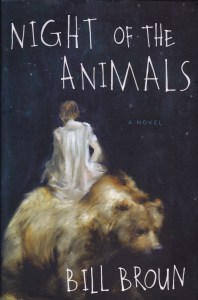
It comes as no surprise, I hope, that I read lots of fiction. While not every book I read makes it onto this blog, a good many of them do, along with some I haven’t read yet. Bill Broun’s Night of the Animals is one of the latter. A suspicion is itching way down deep telling me that I’ll probably end up a fan. Part of my suspicion comes from having read a story on NPR about the book. First of all: dystopia. Need I say more? I admire those who try to paint a future with a lighter palette, but I’ve been observing the way those in power behave and it kind of makes me think optimism about improvement is just a tad naive. People are too easily lulled into apathy by things like sports and the internet. The Romans used bread and circuses. Meanwhile those in power help themselves to a bit more until you can’t even get on an airplane without a total stranger seeing you sans briefs. If I can’t be trusted by those I elect, what cause do I have for hope? But enough about me. The book’s the thing.

DSCN1969

Night of the Animals, according to the NPR piece, is kind of a reverse ark. The animals in the London Zoo are understood by a man and they ask him to release them. I don’t know what happens, but I sure hope to find out. When interviewers ask Broun what it was like to spend fourteen years working on a novel, he responded in a way that, I suspect, many writers would understand. He said that it was a spiritual journey. Writing this book was his search for God. Many of us must nod our heads to that.

Concentration is becoming a dying art. I’ve written a number of books in my life—by far the greatest number remain unpublished—and I know there’s nothing like the intense concentration you experience when lost in such a world. Yes, it is spiritual. It is also a cry to be heard. As George Orwell well knew, we are the animals hoping to be heard. Zoos represent entrapment. Broun states that he wanted to explore how people are trapped in his novel. Looking at a system that rewards greed and keeps workers in unfulfilling jobs just so they can keep the system going while their CEOs buy another hotel chain or sports team and decide to run for office, I begin to hear the oinks, whinnies, and neighs all around me. And I haven’t even read the book yet.


Mysterium Tremendum

HistoryHorrorFor those of us accustomed to ancient things, horror movies are remarkably new. That doesn’t mean, however, that they are scarce or even easy to understand. While it is beginning to erode, the academic derision of popular culture has long avoided the decidedly low brow genre of horror. It doesn’t know what it’s been missing. Wheeler Winston Dixon’s A History of Horror is an insightful attempt to make some order out of a century of monsters and mayhem. Beginning at the stage when “horror film” was still just a demonic gleam in some vampire’s eye, Dixon points out that from the very earliest experiments with movies “horror” was a popular trope. It seems only natural that the idea of a full-length scary movie would be the expected development. What happened in Universal Studios in the 1930s is that business began making money out of monsters. Where there’s money, there be monsters.

Dixon takes us through the early days into the tired era in the 1950s when life was, apparently just so darned good that people weren’t really thinking about monsters. (Dixon’s analysis is a bit more sophisticated than that.) Horror films matured in the 1960’s and spun out of control in the ‘80s. His book continues up to the first decade of our current century. There’s obviously a lot that can be said about this, but what caught my attention, naturally, was how quickly religion entered the discussion. Those of us who approach horror with an open mind know that religion is its next-door neighbor. Indeed, one of the nihilistic aspects of the proliferation of horror movies since the 1980’s has been the lessening of this getting to know the neighbors. Horror, as Dixon notes, seems to have devolved to brutality and cruelty with no real message.

I’ve never been a fan of gore. I’ve watched my share of slashers, I suppose, but they’re not my favorites. Horror can—in the best of its offerings—be very profound. Indeed, it can even inspire thoughts not so terribly far from those generally classed as religious. For what is worship if not carefully managed horror? The concept of the holy as mysterium tremendum underscores this dynamic. Part of this connection is the appeal to emotion. Horror movies make you feel something, and that is a large part of their appeal. They can be more, however. A smart horror movie will feed your brain rather than just having zombies eat it. Academics, eventually, will catch up with it. Dixon starts to show the way.


Finite Gods

Just how many gods are there, anyway? Well, that’s not really a fair question. For one thing, do I mean “real gods” or gods that people believe in? Do I mean “believe in” or made up? Do I mean “made up” or intentionally fabricated? And the nesting questions could go on and on. Over the years in my professional capacity as an erstwhile teacher, I accumulated books listing the deities of various cultures with brief descriptions. I once even argued that using “god/goddess of” (the divine-genitival construct) as a phrase distorted ancient concepts of divinity. The fact is people have believed in many gods in many different ways. As modern scholars of religion we’ve only begun to reach the heavens (or underworld, or anywhere in between, for deities may be found anywhere). This issue comes to mind because a friend recently shared a story from IFL Science about a new Etruscan goddess. The piece by Ben Taub mentions a stone recovered from Poggio Colla, a site in Italy, written in Etruscan. The stone seems to mention a new “fertility cult” goddess. And once again religion and science have met, but not quite kissed each other.

Photo credit: Jastrow (2006), Wikimedia Commons

Photo credit: Jastrow (2006), Wikimedia Commons

Let’s begin with the Etruscans. Before the Romans, Etruscans lived in Italy, giving Tuscany its name. We know very little about them, as their language (Etruscan) is rarely found and imperfectly understood. Some of the classical gods may go back to Etruscan originals, and the Etruscans seem to have known of at least some of the cultures of the ancient Near East, or ancient West Asia. We have no idea how many deities the Etruscans recognized. Polytheism, for all its heathenish exuberance, never had a problem with adding more gods. Interestingly, the “new” goddess mentioned here, Uni, is someone I used to talk about in my Rutgers classes on ancient Near Eastern religion some five-plus years ago. Pardon my crowing—I seldom get to suggest I was ahead of my time.

What really interests me here is that websites that advocate science still take an interest in religion. Although belief is relegated to inferior minds (generally) science does admit, from time to time, that it’s interesting. The study of religion, in at least some schools, is a scientific enterprise. No, we don’t put gods under microscopes (telescopes might be more useful) but we use the same techniques as empirical studies of nature use in order to try to draw some conclusions about religion. Despite the fact that the vast majority of humans on the planet are believers, higher education has consistently under-funded or disbanded departments who apply rational thought to religion. We suppose that someone else can pick it up and study it, coming to useful conclusions without putting in all the homework. Don’t mind me, though. I’m just basking in the light of having known about Uni years before she was discovered.


Twitter Me This

Techoncrat I’m not. At least I understand that to be authentic in this world you need to be on social media. I have a Twitter account. Have had for years. I don’t follow it religiously, but then, I don’t treat any social media like holy writ. The other day I noticed a disturbing trend. Donald Trump’s tweets end up on my bird feed. No, I didn’t accidentally follow him—I have a natural aversion to fascists with delusions of divinity—but nevertheless his mug shows up so frequently that I tend not to follow the bird maybe as much as maybe I should. I wonder how someone thinks s/he has the right to buy part of my consciousness.

Tweet or honk?

Tweet or honk?

The world-wide web is without laws, like the subconscious mind. Thoughts from around the world—at least the affluent part of it—milling, swirling about in an electronic soup thickened by irony. It’s addictive. The opiate of the masses. Perhaps it is a religion after all. Tweets are micro prayers. Blogs are sermons. Facebook is coffee hour. All these connected minds have created a consciousness of their own. Like Victor Frankenstein, we too know what it feels like to be God. It’s not a particularly joyous place to be. Does God, I wonder, lack the control that we experience on the Internet?

I like Twitter. It doesn’t demand much. The only problem is that to stay on top of things you have to have it going all the time. I turn it off and when I come back on I’ve missed hundreds of tweets. And then there’s Donald Trump again. I can come up with my own nightmares, thank you. I don’t need Twitter to suggest any.

Perhaps this is the apotheosis of capitalism. The ability to buy anything, including space on somebody else’s bird feed. Buy the most powerful office in the country, if not the world. Buy hatred and distribute it freely. One thing you can’t buy is intelligence. At least, up until now, some universities still understand that. It has taken me years to gather Twitter followers, like Mrs. Partridge the family band-mates fall behind in a neat, technicolor line. I have no money. I have very little influence. I’m really not a very good capitalist at all. I give away for free what universities charge for. Just like in the classroom, few pay attention. What do I expect? Who really listens to sermons anyway?


Evolving in Place

ImprobablePrimateEnvy is not a word I would use to describe how I feel about those trying to piece together the earliest stages of humanity. Evolution, naturally, is a given. Once beyond that, however, the landscape gets dicey. Clive Finlayson is an author I don’t envy. I just finished his The Improbable Primate: How Water Shaped Human Evolution, and it felt like he had to put this immense puzzle together while missing about nine-tenths of the pieces. Early human fossils are rare and it doesn’t take much to throw a laboriously constructed scenario into yesterday’s mistaken hypothesis bin. The central premise of the book, as stated already in the subtitle—human evolution followed water—seems about as firm as any idea. We need water daily and our bodies evolved to help find it efficiently. It’s a fascinating story. Along the way I learned that much of what I’d previously learned about ancient human development was probably wrong. I’m only a casual evolutionist.

Finlayson suggests—and not all biologists would agree with him—that all humans living on earth at any one time (with one possible exception) were of the same species. That is to say, the model I grew up with of separate species (Neanderthal and Cro-Magnon were the usual suspects) duking it out over scarce resources doesn’t match growing evidence very well. We Homo sapiens seem to share some Neanderthal DNA and that paints a somewhat more romantic encounter between the species than the violent one I learned. The same goes for other human ancestors, according to this little book. Our first instinct may not be to kill the stranger. We may have lived apart for a few thousand years, but when populations come back together they “share genes,” if you get my drift. This still happens, of course. The difference is today we’ve become politicized and entitled. We don’t want people not from around here to share our stuff.

Part of that is natural, I suppose. Finlayson points out that the feeling of belonging in natal territory is something we share with other primates. We feel that we belong where we’re born. That seems to me a difficult thing to quantify, but I feel it nevertheless every time I venture back to my hometown. It just feels right. Not that we can’t adjust to elsewhere, but our nature rewards us, in some measure, when we come home. This is a wide-ranging study for such a small book. I don’t envy all the meticulous jigsaw staring without a box-top that students of human origins must do, but the results are still quite interesting. Even if the picture, when enough pieces are finally found, ends up being something different than we thought it was.


The Neighborhood

583px-Ptolemaicsystem-small

Let me send out a warm welcome to the neighborhood, I think. Not that I officially represent Earth—or anything for that matter. I’m just friendly, I guess. Now that astronomers have strong evidence that the nearest star to our own, Proxima Centauri, likely has a planet, it’s not premature to head over with a casserole. It’s not every day that a new solar system is discovered. We don’t know for sure that the planet’s there, but chances are pretty good. In reading about this discovery I learned that the orthodoxy has changed since I took astronomy in college. It seems now standard wisdom teaches that most stars likely have a least one planet. I can’t even count the stars—I usually start to trail off after I get to about ten—so I can’t imagine the number of potential planets out there. And where there are planets, there are gods.

Let me rephrase that. If there are billions and billions of planets it is very likely that there’s life out there. I know I’m racing ahead of the evidence here, but let me have my fun. If there’s life, there’s a chance, a glimmer of a chance at least, that given enough life we’ll find consciousness. I’ve always thought it was a touch arrogant on our part to assume we were the only ones out here. Perhaps it’s because the stakes are so, ahem, astronomically high we seem to be afraid to admit the possibility. We don’t really want to be alone in this cold, vast, universe after dark. Enter the gods. Conscious beings—even arrogant ones—have no trouble supposing that there is an even greater presence out there. I suspect this isn’t an earth-bound bias. I should hope that conscious life looks toward the stars with wonder, and even after they discover that there’s no lid on their planet they might still ponder what else might be out there.

Let’s suppose there are other creatures out there with other gods. When the meeting takes place we’ll need to have that discussion. You know the one I mean. We’ll need to ask whose deity is really real. Is it yours or is it ours? Hopefully we’ll enter into this with an open mind. I suspect it will depend on who’s in the White House, and all the other big houses, at the time. There are certainly those who claim their own almighty brooks no rivals. If it turns out that we can’t agree, I hope it doesn’t come to blows. There will always be other planets to explore, and maybe even new orthodoxies to accept. It’s an infinite universe, after all.


Imagining Monsters

WideSargassoSeaAll fiction writing, it is often said, is borrowing. I’m not exactly sure that’s literally true, but the basic idea is that writers often trade with one another. They also borrow against their own experience and observations that others have made. When a character, or set of characters, an author develops become(s) wildly popular, fan fiction can result. There are websites dedicated to “fan fic” where characters from one writer are personalized in another writer’s imagination. Another form of borrowing is the parody. Pride, Prejudice, and Zombies takes Jane Austen far beyond her original scenario while using her novel as the basis of something somewhat new. These borrowings, as the saying suggests, have been around for a long time. I recently read Jean Rhys’ Wide Sargasso Sea. The novel from the 1960s is a “prequel” of sorts to Charlotte Brontë’s Jane Eyre. Although spoiler alerts for literature nearly a couple centuries old might seem like overkill, I’ll give one here anyway. You’ve been warned.

Jane Eyre includes quite a lot of gothic mystery. Thornfield has a mad woman, Bertha, the first wife of Mr. Rochester, living in the attic. Bertha is from the Caribbean, and Rhys, although Welsh, was born in Dominica. Taking an interest in the point of view of the neglected, insane Bertha, she decided to tell her story in Wide Sargasso Sea. I won’t sum up the plot here since you may decide to read it. The reason I brought the whole subject up in the first place is the glimpses given of the religions of the Caribbean. Clearly this was not Rhys’ main objective. The Creole of the various races from the slave trade and colonialism, however, did produce fascinating religious amalgams. The zombie, a figure that plays a small part in the imaginative aspects of the novel, is only the most familiar of the creatures.

The soucriant, or soucouyant, is a blood-sucker. A figure that combines elements of witches and vampires, the soucriant takes the form of an old woman by day and a blood-sucker by night. (Before you get the wrong idea, there are no zombie or soucriant characters in Wide Sargasso Sea—they are merely mentioned briefly in conversation.) This concept, while derived independently, relates to the succubus but also to the more modern chupacabra. These are all creatures that suck the vital essence from another, be the victim human or animal. The ubiquity of the idea is striking. In the context of the novel, however, such creatures merely haunt fevered imaginations. Our minds, however, are what make monsters real. Although Rhys declines to diagnose “Bertha” completely, it is clear that human mistreatment of one another creates, in its own ways, monsters. That’s an idea, I suspect, that I’ve borrowed.


Eye of Survivor

I don’t watch television. This isn’t any kind of moral stance. It’s financial. We can’t afford any “triple play” plans for the little free time we have for television. My wife and I both work long hours. We like to read, so we don’t have time for the tube. We buy the shows we want (it’s more honest than advertisements) and movies are a one-off thing. I sometimes lose track of culture, though. Maybe I’m two-faced. I grew up watching television. Then I grew up. But I still occasionally read about television. When we stay with relatives or in a hotel sometimes we imbibe. What I’ve noticed the past few times we’ve been away from home is reality television. Programs with more and more bizarre “real” situations fascinate those who don’t get out much on their own. One of the venerable ancestors of the genre is “Survivor.” I’ve never seen it but even I know what getting “voted off the island” means.

A recent piece in the New Jersey Star-Ledger celebrates a local young man on the show, now in its thirty-third season. This youth, who fancies himself, well, a survivor, notes that his role models are Jesus Christ and Ronald Reagan. I shudder for the future of our species. This young man says he likes to “screw with people’s heads and lie every chance I get.” Is that Reagan or Jesus? Or is it all just a game? The piece by Amy Kuperinksy goes on to quote the boy as saying his tactic for survival is to manipulate people, getting one over on others. But then he’ll use Christianity to build bonds. Machiavelli might have been a better choice of role model here, but then, who has time to read when “Survivor” is on TV?

Photo credit: Smithsonian Institution

Photo credit: Smithsonian Institution

This isn’t going to devolve into an old person’s jeremiad about the younger generation. Nor is it a castigation of television. (As Homer Simpsons reminds us, many of us were raised by television.) Rather, this is a question posed to our future selves. Perhaps we simply can’t see far enough ahead to get an idea of the consequences of our actions, but my question is what values do we wish to see in our society? Rugged individualism may have worked in the early days, but it led to genocide. Have we gotten over all that? Have we come to the point where we make stars out of those who don’t even pretend to be someone else any more? Maybe I’ve got that wrong—lying and manipulation may well be acting after all. Reagan was among that pantheon. I’m just not sure where Jesus Christ enters the picture.


Take Your Time

PleasuresOfReadingReading is fundamental. Those of us who grew up hearing that slogan have never forgotten it. The part that I wish had stuck better is just a touch shorter: reading is fun. Or it can be. Should be. Alan Jacobs’ little book The Pleasures of Reading in an Age of Distraction is like an extended essay on the subject. As a professor of literature, Jacobs has considerable experience encouraging people to read, and in his book he makes a case for reading what you want to read (reading on a Whim, he calls it). Wisely he recognizes that many would-be readers are discouraged by being instructed to read that which they don’t find appealing. I learned quite a lot from the suggestions contained herein, and I’ve been reading so long that I thought I knew pretty much what I needed to know about it. Perhaps the most fundamental issue (apart from reading itself) is that many of us expect to be told what to read. We second-guess our own judgment, feeling we need an expert to tell us how to do it. Like singing in public, it’s intimidating to come across someone better read than oneself. Jacobs advocates reading what gives you pleasure and not worrying about what others think.

Recognizing that readers are spoiled for choice, Jacobs addresses, among other topics, rereading. And taking notes. And reading slowly. I recall speed-reading courses advertised, ironically, on television. At college you could take courses in improving your quota of pages turned. There is a specific kind of reading, as Jacobs notes—reading for information—where this may be helpful. This is different than reading for pleasure, or even reading for understanding. In the case of the Bible (Jacobs taught at Wheaton before moving on to Baylor) many people, he suggests, read for information rather than for understanding. When reading for pleasure taking your time is a virtue. Getting to know a book requires rereading. We need to make time for what is important.

Jacobs makes the point that readers are a minority sect. There have always been fewer of us than there have been of those who don’t read. We are, in his words, a tribe. We can generally spot one another. Those of us who can’t walk past a bookstore will recognize ourselves in the pages of this meditation. Those who spend long hours with books become like them, in some respects. Familiar, layered, and requiring more and more attention. Like the reading that it advocates, this book itself is a delight to read. There is so much in this brief volume that it’s difficult to summarize in the short-form writing that I use on this blog. I found myself wishing for an index so that I might find my favorite passages again. Then I realized that perhaps this absence was intentional. Maybe I’ll have to reread it, taking notes as I go. What a wonderful thought.


Not Quite Dead

Duria_Antiquior

Extinction is a cause of fear. Having evolved a certain level of self-aware consciousness, we fear becoming the next tyrannosaurus-rex or spinosaurus, or whatever the next top predator turns out to have been. We’re here to stay. So we like to think. Data have been known to interfere with comfort zones, however. Take religion, for example. America has always been a religiously diverse “country,” but many people suppose it has a Christian beginning. Moreover, the historically uninformed suppose that generic Christianity to have been Protestantism (which is not really a single religion) and white (which isn’t really a race). Now, it seems, that white Protestantism is slowly going extinct. An article in the Washington Post by John Sides contains an interview with Robert P. Jones of the Public Religion Research Institute. Jones has written a book about the end of this particular hegemony.

Demographics tell the story. The powerful cultural force of the mainstream Protestant churches hasn’t disappeared, and really isn’t likely to become extinct. It has, however, diminished. As soon as we began to embrace technology this was a more or less inevitable trajectory for the human race. We made oceans smaller and came to see that we’d evolved different religions in different regions. And that Christianity wasn’t quite unique as we’d thought. “Orthodoxy” was actually a form of prejudice for a past that may never have been. We saw the writing on the wall and went on scribbling. Making claims the data don’t support.

One of the drivers—and this is a complex phenomenon—behind this shift has been the ossified positions of religions in the light of increased understanding. For example, most people see no problem with homosexuality. They believe shooting someone because of their race is wrong. Women, they radically suggest, should have the same rights as men. The hold-out positions on these issues have historically been religiously based. Just listen to the rhetoric of televangelists and see if it has changed. Meanwhile, the world moves on. Many religions are holding still. Or racing to see if their diminishing number of feet might make the world spin backwards after all.

Religion is a human invention. Many protect themselves by claiming direct revelation by a God who used to live in a glass ceiling above our heads. Trips to the moon, probes to Mars, and out of our solar system have proven that view false. If the view of something as basic as the universe was wrong, what else might’ve been a mistake? Jones’ new book will no doubt cause some panic. Extinction, at least not imminently, doesn’t seem to be in the cards. Protestantism seems to have reached a stasis. Religion still has an important function in society. When it takes the lead on issues of equality, we may begin to see a miracle.


Of the Night

August isn’t too early to start thinking about vampires. The nights are already noticeably longer than they were in June and some leaves are just beginning to change on the trees. I’m thinking of vampires because one of my readers sent me a link to some investigative reporting about the “Highgate Vampire.” I’ve posted about this before, but the brief story, if you don’t have time to browse through my “monster” category, is that beginning in the 1970s a group of people came to believe a vampire haunted London’s Highgate Cemetery. This led to the publication of written accounts of the hunt for the undead. On a trip to London in 2012 I visited the Highgate Cemetery as my host for the trip lived quite close by. Apart from being the resting place of many famous people, the cemetery is moody and Gothic and it’s easy to see how, in days when it was neglected, it could’ve spawned such tales. Thing is, we know vampires don’t exist. So we’re told.

IMG_0061

Back to the story. My reader pointed me to the website Vamped, and now I’m afraid my limited time has just grown more limited. More specifically, there is a story by Erin Chapman entitled “5 Reasons Why a Wampyr Didn’t Walk in Highgate Cemetery.” The article investigates claims made in Sean Manchester’s book on the subject (reviewed elsewhere on this blog), demonstrating that his locations, photographs, and narrative don’t add up. The piece on Vamped shows a meticulous level of detail, comparing notes and photos in a way some of us simply don’t have time to do. Now I’ll sleep more securely on my next visit to London. I hope. The conclusions are disputed.

At this point some may be asking why an educated, rational adult is even addressing such questions. Why worry about something that isn’t even real? This brings to mind the realm of religion. Archetypes, whether they have an objective existence or not, are part of our consciousness. Supernatural beings of many varieties inhabit our heads, no matter how much garlic or holy water we happen to have lying around. Ignoring them can lead to problems. Do I think there is/was a vampire in Highgate Cemetery? I don’t think so. Do some other people sincerely believe it? I have to think yes. No matter which religion people follow, there will be entities that other people don’t believe. That doesn’t mean that they should be ignored. The Highgate Vampire isn’t real for most people, but it is for others. And just in case, I’ll keep a bit of garlic around as the nights begin to grow longer.


Foiled Again

Few things travel as well as curses. Or so it seems in a news report from Serbia. Archaeologists in Kostolac, according to The Guardian, have excavated skeletons nearly two millennia old. That’s not news, since people have been dying as long as there have been people. What makes the find extraordinary are the gold and silver metal foils that have been found at the gravesite. Inscribed in Aramaic with Greek letters, these tiny missives were rolled and placed in lead tubes to be buried with the dead. Although translations of the inscriptions aren’t given, the fact that they contain the names of demons would suggest these might be curses against anyone seeking to disturb the tombs. Such devices go all the way back to the Pharaohs, and perhaps earlier. Nobody likes to have their sleep disturbed.

Serbia, for those unfamiliar with geography, isn’t exactly next door to ancient Aram. The burials and inscriptions seem to fall into the Roman Period, however, a time of cultural diversity. When cultures come into contact—in the case of Rome and prior empires, through conquest—new ideas spread rapidly. And sometimes old ideas. The Romans, in general, didn’t like competing religions. Then again, their idea of religion was somewhat different than ours. Ancient belief systems were more or less run by the state. They served to support political ends—at least they were upfront about it. Your offerings and prayers were to be given in support of the king, or emperor, and beyond that nobody really cared. Unless, of course, you were making curses.

Curses, it was believed, really worked. Even today in cultures where belief in curses persists people tend to be physically susceptible to them. We don’t want others to wish us ill. Perhaps that’s the most surprising thing about politics today. Our society has taken a decided turn towards the more secular. Candidates for political office, even if they personally believe nothing, can still cast curses on those who are different. They can claim support of their “faith” to do so as well. Words, in ancient times, were performative. They meant something. Curses were taken seriously because if someone were serious enough to say it, they probably meant it. They could be written down and preserved beyond death. Today, however, words are a cheap commodity. You can use them to attain your personal ends and discard them once they’ve outlasted their usefulness. Perhaps we do have something to learn from the past after all.

Copper scroll from Qumran, replica. Not a curse, just an illustration.

Copper scroll from Qumran, replica. Not a curse, just an illustration.


Personal Heroes

I’m not inclined toward hero worship. Sometimes I think it must be a personality flaw on my part. The cult of celebrity is so pervasive that I feel desperately behind the times when I read what web-savvy authors write. Or maybe the truth is that my heroes live closer to home. Or lived. I grew up in a small town as the child of a working-class couple, both of whose sets of parents were not educated beyond high school. We were simple folk. We didn’t have much money and we didn’t have elaborate demands. My mother put up with an alcoholic and then absentee father, raising three children largely on her own for the better part of a decade. (She eventually remarried and the three became four, but I want to focus on the early part of the story today.) She had a rough life. Her hero, not surprising for an only girl with four brothers, was her father. Her admiration for him, whether genetic or via learning, passed on to me. I can’t claim to remember him since my grandfather died just before I turned two and just before he turned 75. As I grew up, however, he became my hero.

HomerSitterley

Today would have been his birthday, and I’m thinking about Homer Sitterley, my hero. He grew up on a farm in upstate New York and tried to better his circumstances. He taught in a one-room schoolhouse, which you could do in those days without a college degree. He also met my grandmother in that schoolhouse, which you could also do in those days. He had to change careers and became a civil engineer—still with no degree. He started and supported a family of five and moved around the country trying to keep his spouse happy. Back in the 1920s and ‘30s they moved from Virginia to Montana and back to the east, eventually settling in New Jersey, where my mother was born. They finally moved to Pennsylvania where my three brothers and I were born. He died there in August of 1964.

Homer Sitterley may have never worn a cape like one of his silly grandsons did in college. He didn’t have any super powers beyond the strong will to survive in a hostile and thankless world. He never grew rich despite hard work and few outside his family knew his name. He is a hero nevertheless. His kids were upstanding people: religious, polite, and kind. Their children—my many cousins—are good people. In a world where superheroes are shown increasingly as flawed, the real heroes are simply human. And my personal hero, although he never knew he was—and is—was a man who cared for his family to the very end. He was only human. And all the more heroic for being so.