Story of God

Synchronicities come at kinds of synchronaddresses. After I had written a recent post on human sacrifice, I watched the first episode of Morgan Freeman’s The Story of God. My wife actually figured out how to get it without the miracle of the triple play, and we watched the initial installment on death. I’ve stated repeatedly on this blog, as I used to in my lectures, that death is a universal concern of religion. I wasn’t really expecting to learn anything new from the show, but it is a good idea to keep up with what hoi polloi are being told about the field in which I’m supposed to be a specialist. In any case, The Story of God is very much like Through the Wormhole, only from the other side. Science and religion. Religion and science. Like chocolate and peanut butter, two great tastes that taste great together. Really, I mean that.

So after telling us that the Egyptians may have invented the afterlife (although it’s clear they didn’t), the show takes us through other religious expressions: Christian, Hindu, Aztec. The Aztec segment brought up human sacrifice again, in its particularly grisly expression, as a means of thinking about what happens after death. In the light of the article I’d read (see last Sunday’s post) I couldn’t help but think how this was an ideal form of social control. There’s no doubt who’s in power when you’re looking up at your still beating heart, strangely cooled. As I’m pondering that heart, I’m thinking it wasn’t the Egyptians who first had this idea at all.

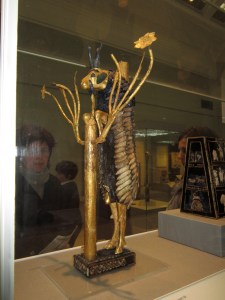
DSCN6127

Neanderthals, it appears, may have buried their dead. Even if they didn’t other ancient, pre-historic people did. And with grave-goods which, if you think about it, are rather superfluous without any afterlife in which to use them. It stands to reason, even before reason, that as soon as people began to recognize death, they had to be wondering what happened next. It is a bit simplistic to suggest that religion began because of the fear of death. It is also equally simplistic to suggest that death had nothing to do with the beginnings of what we call religion. People have died as long as there have been people. And survivors have carried on after the passing of others. Maybe we are all grown up now, but it seems that we aren’t fully human unless we give some sort of thought to what comes next. Even if the answer is “nothing,” it’s some kind of religious statement, whether intentional or not.


God’s Rain

Photo credit: Micahmedia, Wikimedia Commons

Photo credit: Micahmedia, Wikimedia Commons

Music has been in the news this week with the death of the artist formerly and forever known as Prince. Also, in a lesser covered story, Bono’s friendship with Bible translator Eugene Peterson. This post will focus on the former former artist. I’ll have to circle back later to pick up Bono and Peterson. I have to admit that I haven’t listened to Prince much lately. I saw “Purple Rain” when it came out, and some of his songs have resonated with me throughout the years. What makes him such an intriguing figure is his view of sexuality. My source here is the Washington Post, specifically, an article by Michelle Boorstein stating that Prince was, beneath the sexy exterior, a conservative Christian. Specifically a Jehovah’s Witness. He would not be alone in this role since Alice Cooper is famously also a conservative Christian. Life upon the stage is that of the actor. With Prince, as Boorstein points out, the question goes deeper: he wrote about religion, but he also wrote about sex.

Those of us who indulge in creative writing know that poetry is perhaps the only place where dishonesty is impossible. Song lyrics are true. Prince often cites Christian tropes (see Boorstein’s article for samples), but his material is deeply sexual as well. This leads to the suggestion that he saw sex as a means of worshipping God. Once again, Prince doesn’t find himself alone in this place. Scholars brave enough to examine both religion and sexuality often find a connection there, and not just a tangential one. Both are about communing with something greater than the individual. Thinking back to my first viewing of “Purple Rain” I can say it wasn’t the religion part that stood out to me.

Histories of Rock-n-Roll are rife with stories of performers’ untamed sexuality, so that’s hardly news. What really strikes me is that with recent deaths—David Bowie, and now Prince—the media seems intensely interested in their views of religion. We don’t often look to artists for advice on how to live our lives, but as the polar opposites of scientists and rationalists, they are in touch with and willing to share their feelings. And we the people want to know what they thought of God. Often because it is so surprising. It’s easier to put someone in a box. Religion, however, is way more complex than most non-specialists think. It has room for creativity, for sexuality, and for exploring the meaning of life. I many not listen to Prince much, and when I do it’s not for religious advice. I am, however, inclined now to think in new ways about colorful rain.


Mother Earth

Son, behold thy mother.

Behold thy mother.

As a planet-locked earthling, I’m thinking about Earth today. Such a quotidian planet. While I’ve been to others in my mind, this is the only one on which I’ve ever been or am likely to be. And yet there are no laws protecting it from my own species. Corporations are treated as individuals, legally. Only they’re much, much bigger and have lots more money. They can drill and dig and spew and slew all they wish. I can mutter a feeble, “Hey!” but they legally have to pay no attention. It’s like that guy with a loud device on a quiet bus. Or someone smoking too close to the door. They invade the little space you occupy and there’s nothing you can do about it. We look to our politicians to learn how to be better bullies. Our corporations look past us to the bottom line. When the planet dies, that will indeed be the bottom line.

We tend to make fun of those who believe there’s other life out there. Whether sci-fi nerds or gullible believers in conspiracy theories, we tell them all intelligent life is located right here. In your bank account. Your net worth. The contribution you make to the GNP. It all comes down to numbers. As if there weren’t something magical about walking in the woods. As if all of this is just dress rehearsal for the play of getting rich. The beasts we had to fear used to lurk in the jungle. Now they brazenly drive through our cities in expensive cars with tinted windows. They build towers to defy the spacemen to come down. “Don’t worry,” they seem to say, “our money is great enough that we can come to you.” And yet, we are still left with only one planet. And it seems to be getting quite stuffy down here.

I worry about our throwaway culture, because there’s nowhere else to go. You can’t prevent me from fracking the very ground beneath your feet. Or like Martin Luther, prevent me from flying over your head. You don’t like my loud music? You don’t like my noxious fumes? I can blow my vape into the shared, public airspace if I want. Ownership is a funny concept. Our species has been on this planet for a geologic sneeze and yet we plant our flags and bray our allegiances. It takes treaties and accords for us to act like civilized people. We won’t call it “global warming” because that offends those big people called corporations. If it feels a little warm in here to you, turn on the air conditioner. If we use up this planet, we can always buy another one.


Meaningful Fear

BeVeryAfraidReading about the things that wrong, like terrorist attacks, may not be the best way to occupy your time on a bus heading to New York City. Robert Wuthnow’s Be Very Afraid is appropriately titled, in any case. I had been warned. Discussing sociological reactions to nuclear war, terrorism, pandemics, and global warming, Wuthnow suggests, sensibly, that action is the best response. He also points out that, statistically, people tend not to panic. What I’d like to focus on is his repeated assertion that humans need to find meaning. Disasters only bring this into clearer view.

We live in an age when religion and philosophy have been relegated to the children’s table of academic pursuits. They are, however, the traditional intellectual ways of finding meaning . Economists may be paid much more, and scientists receive more respect, but when the bombs fall or avian flu really strikes, even they sometimes turn to their beleaguered colleagues for answers. Money is notoriously poverty-ridden when it comes to purchasing meaning. Reductionistic materialism may allow a final shrug as the curtain falls, but plenty of scientists hope for a little something more. Not everyone, of course, finds meaning in religion or deep reflection, but we are all human and we want to know what it’s all about. We need to have somewhere to look.

Even as a child I was preoccupied with meaning. I wanted to be the usual things when I grew up—scientist, firefighter, G.I. Joe—but when it came time to make actual choices I moved in the direction of careers that would allow me to find meaning. I swiftly learned they didn’t pay well. Money is not meaning, however. I was teaching in a seminary when 9/11—a major topic of Wuthnow’s study—occurred. I saw people desperately seeking meaning, but not knowing where to look. This was just my fear, growing up; what does it profit someone to gain the whole world if s/he is groping about in the dark for meaning? We’ve created a world where even greater causes of fear are likely to arise. In our emergency kits, it seems, we should leave a little room for meaning.


Prayer before Meals

It was in Wisconsin. Oshkosh. I was teaching for a year in a replacement position, and my roster of classes at the university covered several aspects of religious studies. During the course of prepping a course, I first saw it. The Flying Spaghetti Monster. It was only a virtual Flying Spaghetti Monster sighting, but since Creationism was much in the news in those days, I boiled with curiosity. By now it would probably be a strain to explain the whole thing, since everyone knows about his noodly appendages and predilection for pirates. The short story is that the Flying Spaghetti Monster was an invented deity to demonstrate the ridiculousness of trying to get Creationism taught as science in public schools. For those who believed in other gods, such as the FSM, there should be equal time in the classroom, the argument went. Since that time Pastafarianism has taken on the semblance of a real religion with “believers” earning the right to have driver’s license photos taken with colanders on their heads, and even a book of scriptures being written.

An Associated Press story from Sunday’s paper tells of the world’s first known Pastafarian wedding. Bylined Akaroa, New Zealand, the blurb indicates that the Oceanic nation down under has decided that Pastafarians can officiate at weddings, and a couple was married with al dente accoutrements. The Church of the Flying Spaghetti Monster, it seems, is going the way of the somewhat more serious Jediism and Avatar religions in that people are deliberately electing fiction as their faith. Interestingly, this may not be a new phenomenon. We are told, for example, that Zarathustra deliberately outlined a new religion—one that may end up having had the greatest impact on humanity of all time, if roots are considered. In those days the strict division between fiction and fact may not have been a mental filter yet discovered. The “it really happened” test of religious veracity was still some distance in the future. Metaphor meant something then.

IMG_2753

The internet, it seems likely, has facilitated and accelerated the appearance of new religions. As with most things, the real issue comes down to money and power; if a government recognizes a New Religious Movement as legitimate, it may be granted tax exempt status. And how can it be proven that someone really does or does not believe what s/he says s/he does? If you’ve got a box of Barilla on your pantry shelf, who’s to say? It’s a short distance from that colander in the cupboard to the top of one’s head. And who doesn’t like pirates? And who’s to say that under that rotelle moon in a stelline-studded sky someone hasn’t indeed kissed their hand and swore the ultimate starchy allegiance? Keep watching the skies!


Biblical Stories

The Bible had quite a week last week. It went from being vetoed as the “state book” of Tennessee to making it onto the list of the ten most challenged and banned books of the year for the first time. Did you ever get that feeling that you should’ve thought a bit more closely about career options? I mean, the Bible’s not half bad. Yes, it has some naughty bits, a few instances of cursing, and adult situations. There are homicides, suicides, and genocides. It endorses slavery and advocates religious intolerance. It’s not all bad news, however.

IMG_2634

We find it easy to make summary judgments based on our own tendency to elevate human products to divine status. That which is most holy, after all, becomes the most profane when it’s defiled. The Bible itself can be like any other book. Printed on paper, bound between two covers, it contains ideas that must be interpreted. There’s no such thing as “just reading.” Even that road sign that says “slow children” is open to hermeneutics. What is objectionable is the use to which the Bible is put. And that use is objectionable due to the claims made about it. Saying that God rolled up his immaterial sleeve and took a transcendent pen into his incorporeal hand and began to scrawl is a bit naive. We know that people wrote the Bible—and much of it is sublime—and other people compiled it into a book that eventually acquired sacred status. It wasn’t born holy, it had to grow into it.

Once the Bible became objectified it turned into what people eventually use all objects for: a weapon. We can take sticks and stones and break your bones (no, that’s not in the Bible), and we can take paper and ink and hang you as a witch. Or pillory you as a liberal. Or say that it forbids the love you feel in your God-given heart. Something strange has happened here. The Bible’s not a bad book. It’s a bit on the long and repetitious side, but it has many, many memorable sayings and noble sentiments. Entire civilizations have been based on it. Or readings of it. They’ll ask you to put your hand on it and swear in court, and then they’ll ban it so your kids can’t read it. It’s been a tough week for the Good Book. Somehow, however, I don’t think we’ve heard the last of it because people love a conflicted story.


Gods and Giants

Day of the GiantsComing back to a book you first read as a tween, in the days before tweens even existed, can be a revelation. Lester del Rey’s Day of the Giants introduced me to Norse mythology as a kid, and, along with Thor comic books, was my Nordic Bible. The last time I read it was probably in the Ford administration. As part of a reading challenge I’m undertaking this year, I had to select a book I’d read before and, amazingly enough, I still had my copy. Reading the book as an adult, however, proved a very different experience from reading it as a child. For one thing, I noticed quite a bit more of the implicit theology of the story. Del Rey was no theologian, of course. This little book, however, makes a statement that is difficult to miss regarding the gods: they are victims of tradition.

It is probably not worth worrying about spoilers over half a century after a book was published, but I’ll try to be sensitive nevertheless. Leif Svensen, our protagonist, finds himself in Asgard on the eve of Ragnarok. All the familiar Norse gods are there: Thor, Loki, Odin, and kith and kin. As they prepare for the battle with the frost giants, who, in the mythology win the contest, the deities are decidedly subdued. They believe their fate is sealed by a prophecy of defeat. Leif, being a true American, gives them a rousing speech about overcoming the old ways. Gods, by nature, are conservative. They don’t have to bow to tradition—they are gods, after all. The deities are not swayed by the logic of a mere mortal, even after his apotheosis. Fate, it seems, trumps even gods.

I’m pretty sure that Lester del Rey wasn’t attempting to make any profound theological observation here. One can be an accidental theologian. Ideas of gods and what they must do can be a detriment to their own future. Even with the evidence of the failure of their own prophecy, the gods can see no way forward other than that they’ve recognized as fate. They are, without saying too much, out-maneuvered by human resourcefulness. A man tames his god, and it can become a man’s best friend. I wasn’t expecting such theological insight from a sci-fi book from my youth. Then again, you never know what may happen when you come back to a book after leaving it on the shelf for four decades.


Le sacrifice humain

The thought of lying tied to an altar while you know someone is about to murder you is a terrifying one. For several reasons. Clearly, you don’t want to die. A more potent fear, however, may be that a darkly savage deity lies behind the dead. An angry, demanding god who desires nothing less than your annihilation. A story in the Washington Post by Sarah Kaplan suggests new findings by anthropologists now suggest a much more frightening rationale behind the world-wide phenomenon of human sacrifice. Kaplan reports that the article in Nature suggests human sacrifice was a means of social stratification. Maintaining control. Surely it must be obvious that those sacrificed are never the powerful and elite, unless, in a reversal of power structures, they suddenly find themselves on the wrong side of the might that makes right. Think of England’s King Charles I, for example. The societies scrutinized in this study, however, are less “civilized” and human sacrifice is a means to remind people who’s in charge.

404px-Ofiara_Abrahama1

What I find interesting about this is how easily the discussion slips into religion being part of the mix. Those of us who’ve spent our professional youths earning advanced degrees in the field have long realized that there is a political element to religion. Temples, yes, were built to the glory of their gods. They were also built to help finance the monarchies in power. Even the temple in Jerusalem was only erected after the monarchy was finally entrenched. Priests supported kings and kings supported priests. They were the elites of society. As Nathan so aptly pointed out, you don’t sacrifice your own lamb when you’re rich. You take someone else’s. Thus it has always been with the exercise of power.

The Nature study examines stratified and egalitarian societies. Human sacrifice is most pronounced in the most stratified. Those where—let’s not be too blunt here—the top one percent want to demonstrate their obvious control over the rest, human sacrifice is most common. Is it really religious? I think the answer is obvious. The gods people worship are those that are most like themselves. The difference is largely one of power. Might, despite all protestations to the contrary, does make right. Or at least right-wing. Human sacrifice still occurs. If the new study is right (and who can argue with science?) there is only one way to avoid being at the wrong end of the sacrificial knife. Or stone. Or torch. And it is to sacrifice the potential to become rich in order to ensure true equality.


What Vampires Abhor

IMG_2731

It began as an innocent trip to the grocery store. I was in the produce section seeking the various vegetarian foodstuffs I need to make it through the week when I came across a monster. Well, more precisely, the mention of a monster. Brad’s Crunchy Kale. Vampire Killer variety. Now, I’m not the world’s expert on vampires; I’m a dilettante at best. Still, I’ve never heard of kale as a vampire bane. (The store didn’t have wolfbane on offer, that I could see.) But this advertising ploy made me wonder about the use of vampires, and other monsters, as means of selling food. The Count Chocula family of breakfast cereals is perhaps the most famous example. Kids love their monsters. Especially with milk. Perhaps Brad is trying to get kids hooked on kale? Start them early on the right path and they’ll not soon depart from it.

Walking through the aisles I didn’t see much else that related to monsters. More the daily bread than the undead. After all, this was just post-Easter and people won’t be thinking about ghosts and ghouls until the other equinox rolls around. The brighter half of the year is a time for sunnier prospects. Monsters go into hibernation. Long, light-filled days are ahead. Why are we putting Vampire Killer on the shelves now? I looked at the ingredients. Garlic didn’t seem to feature prominently among them. I had to admit to confusion. And a desire for garlic bread.

Food, so scarce in many parts of the world, is something we need to decorate to get the attention of the modern consumer. Who’d buy a bunch of generic green, leafy stuff that requires some preparation—you at least have to wash it. And even then it might not protect you from vampires. Try a little packaging. All you have to do is open and eat. Rather like a vampire, actually.

We used to shop in one of those stores where they eschew fancy packaging and you pay for grains and dry goods by the wholesome, unwrapped pound. There seemed to be little ambiguity about what you were getting then. But we wish to be entertained by our food. This could be part of Buffy’s buffet, could it not? I find myself having to hold up a crucifix to stop from dropping it into the cart. There are vampires out there, I’m just sure of it.


Long Distance Commute

AwkwardSilencesWhat should my next book be? This is the perpetual question of the long-distance commuter for whom electronic devices are mere distractions. If that commuter is socially awkward and believes that only books truly understand them, that is. I’m as eclectic a reader as I am a voracious one. Each book suggests, in some measure, the next one. I always have to keep an eye ahead. Then I read (present tense) a book without peer. I feel lost because what will replace that experience I’ve had for the past few days of looking up and finding myself at my destination? Of actually looking forward to getting on the bus so I can read? I’ve been doing this commute for over 400 books now, and I’m at a loss for what to read next. I blame it on Amazon.

In the publishing world we use Amazon to purchase competitor’s books. Then Jeff Bezos decides to buy the Washington Post, you know, the way people do. Since my email address is on their list I get sent a daily invitation to read the most read stories on said Post. I read a story by Alexandra Petri and I was hooked. Where could I get more? A Field Guide to Awkward Silences is the rare kind of book that makes you laugh out loud on the bus, which, at six in the morning, generates its own kind of awkward silence.  Petri makes you feel like it was actually okay to be that dorky kid who read all the time.  Like there’s a world out there that responds to your longings, somehow.  A world of possibilities.

Now here I am about to climb on the bus without Petri. I’m like a kid staring disconsolately at an empty candy wrapper. “That was so good!” you think. “I wish there was more.” Petri writes as if she’s achieved Bob Dylan’s blessing and has stayed forever young. The time of life when the future seems so full of possibilities. Hers is writing that reminds you of a time when you didn’t spend hours a day nursing hemorrhoids, sitting on a hard bus seat. That reminds you it was possible, unlike your own experience of it, to be cool as an Episcopalian in Wisconsin. That reminds you of the time when you had A Field Guide to Awkward Silences to look forward to reading. No, this book didn’t make that choice of next book any easier at all.


States Slights

States, at least the united kind, can have personalities. Some of us move after the diminishing herd of jobs and so end up in places we hadn’t really planned to live. In each state where I’ve made by domicile (six, as of the present), I’ve met people born and bred, down home and with no intention of ever leaving their native land. To such people, I imagine, state symbols may be important. I always felt unjustly proud of Pennsylvania’s Keystone status. I was born there, but neither of my parents and none of my grandparents were. I don’t live there any more myself. I was pleased and just a little surprised to learn that New Jersey has a state dinosaur (the hadrosaurus), discovered right here in the Garden State. This past week, according to an NPR story my wife sent me, Tennessee is trying to garner its own state dinosaur, in the form of the Bible as the State Book. I think it would be a great idea for each state to have an official book, but I would think that it might be a book written by someone from that state.

IMG_1363

Senator Steve Southerland, according to the story, put forward the legislation due to the Bible’s importance in the Volunteer State. The problem is, of course, the Bible is a religious book and that by choosing a religious book you’re getting dangerously close to choosing a state religion. “There used to be a wall here,” you can almost hear the constitutionally minded saying. The Bible is important. Whether we want to acknowledge it or not, no well-informed individual can deny that the United States has had a long and complicated love affair with the Good Book. As I try to show in many of my posts, the Bible still permeates our society in unexpected ways. Nobody’s trying to erase that history, but really, which state is going to select the Rigveda for its own book? Or the Qur’an? The Analects?

States are justly proud of their contributions to the whole. We have state flowers, mammals, trees, and birds. Tennessee’s is the Mockingbird. We have state slogans and mottos. But can any single state claim the Bible more than any other? I have to be just a little suspicious about claims that there’s no religious jingoism at play in suggesting it should be any state’s book. Yes, many Bibles are printed in Tennessee. Many writers have called the state home as well. Wouldn’t the more distinctive contribution come from a book that Tennessee actually had a hand in producing? Bibles, like it or not, can be claimed by all. I can see a tug-o-war coming with Texas, should this state symbol be canonized.


Rainbow Nation

By now I suppose it’s old news that North Carolina has joined the wall of ignominy as the latest state to try to discriminate against gays. It seems our aging leadership just doesn’t get it that a large majority of people in the younger generation just don’t have a problem with accepting homosexuals for who they are. Laws are generally still made by old white men, though. One might be tempted to say “good ole boys.” They may make the claim that this is political, but as one astute editorial in the New Jersey Star-Ledger pointed out, this is about religion. The editorial, which ran on Saturday, notes that studies have shown that when people learn a law sequestered under “religious freedom” is actually discriminatory, the law loses support. The government by the people thing seems to be working backwards. What will it take for elected officials to realize that we are a rainbow nation? And rainbows, according to the Bible, are good.

MyFavoriteNoah

I’m always amazed at these attempts to turn the clock back. It is the season of “spring forward” is it not? Religions that have a problem with homosexuality also have an unscientific understanding of human sexuality as well. Not one person in the Bible had a clear idea of how conception worked. If they didn’t understand the facts of life, how can we expect to learn the life of facts from them? What amazes me most is that such views don’t take the whole picture into account. Intersex individuals—of whom there are many—demonstrate that easy definitions of gender are sure to be wrong. Even tying the concept of gender to sex seems to be misguided. And yet we pass laws the favor a first-century understanding of what it means to be human.

In the end what will change the minds of the corporations will not be their heads or their hearts. The decision will be made by their backsides where their wallets will be growing a bit lighter as corporations decide to take their facilities elsewhere. It’s a sad commentary on our society when justice isn’t enough to strike down a prejudicial law. It takes money to do that. It is a strange world indeed where it take lucre to lead to light.


Taking God to Bed

SavingSexThere are varieties of evangelical experience. It is so convenient to put people into neatly labeled boxes that we tend to forget religious experience can be very different, even to conservatives. This point is made very clearly in Amy DeRogatis’ Saving Sex: Sexuality and Salvation in American Evangelicalism. The title of the book requires some further disclosure. DeRogatis is offering an academic study of evangelical sex manuals and teachings about sexuality. If you’re anything like me, the very concept sounds strange. I grew up in an evangelical household and we would’ve been scandalized to learn that such things as godly sex manuals existed. In fact they did, but we didn’t know about them. Although evangelicals share a common idea that there are appropriate and inappropriate varieties of sexual experience, they disagree, according to the evidence, over what some of those boundaries are.

DeRogatis’ book offers some fascinating insights even within this circumscribed field of study. For example, some writers of such manuals give rather permissive instructions as to what might happen in a heterosexual, Christian boudoir, while others keep to the basics. Some suggest that the very practice of sexuality opens its participants to demonic infestation, so much so that they consider STD to be Sexually Transmitted Demons. This is an intriguing and frightening world to enter. Many of the writers of such books suggest that women should indeed be under the authority of their husbands in all things. No room for Lilith there! Others, however, are surprisingly broad minded. More so than some Episcopalians I’ve known.

This brings me, as a former evangelical, to my concern about academic studies of such groups. It seems to me that to truly understand what are undoubtedly irrational beliefs, you must have had the experience of truly believing. If I might be excused of the pun, are you experienced? As much as we wish it were, evangelicalism isn’t a neat packet of propositions that people simply accept. It is a complex, emotional, and, in its own universe, logical response to the belief that the Bible is the owners manual. Sola scriptura gone wild. How individuals deal with this impossible truth is widely divergent. We’re taught not to discuss sex in polite company, but we just can’t help ourselves. For some that’s good news indeed. For others it is the very definition of wickedness. As Saving Sex shows, there is more than one position to be taken.


Resurrecting Color

ColorOfDistanceIf you’re one of those people who’s attached to books, you know the frustration of someone who borrows a book and never gives it back. Many years ago I stopped lending out books for that very reason. I do, however, sometimes give them away. A friend recently reciprocated the gift of a book, giving me Amy Thomson’s novel, The Color of Distance. It is a profound story involving, as is common on this blog, themes of resurrection and transformation. A science fiction tale, it is set on another planet where something has gone wrong with an Earth survey team. The humans are dying on this alien world when one of them, Juna, is transformed by the alien into something like one of them. She comes back to life transformed. It wasn’t until I finished the book that I read the cover blurb that reads “Reborn in her savior’s image, trapped in her savior’s world.” Not a bad summary, capturing as it does the deep religious elements in the story.

The religious aspect, however, comes through most clearly in the environmental elements of the novel. Humans, somewhat optimistically, had set in place protocols not to interfere with alien life. So much we know from Star Trek’s prime directive. What makes this so interesting in the case of The Color of Distance is that Thomson knows that any contact is contamination. Two worlds cannot meet. They must collide. There is a gentleness, however, in her narrative. Juna, marooned (long before The Martian) on a foreign planet, has to learn to see things through alien eyes. And every little thing that humans have done has left a footprint on the planet. Protecting our own planet is a profoundly religious undertaking.

It is clear that Thomson has influenced later writers and stories. Not only does The Martian pick up on the stranded aspect, but Avatar clearly presents a world similar in many respects to the planet of the Tendu. The Color of Distance is a book not easily forgotten. The world into which the reader is drawn is indeed one of transformation and resurrection. I suppose spoilers aren’t an issue with a book two decades old, but I will satisfy myself merely with noting that another resurrection takes place as the story winds to its close. Deeply hopeful, and almost prophetic, this novel should be more widely read, for the sake of the world on which it arose.


Psychics Anonymous

New York is a city that is fascinated with itself. To me it’s kind of like rooting for a professional sports team. The members of the team come from all over the place. As Jerry Seinfeld once said, “You’re rooting for the jerseys,” or something to that effect. So it was that I found a piece in News Watch so interesting. “New York City: Psychic Capital of the World?” the headline ran. New York has to be first in this too? I’ve noticed on my daily walks through Midtown Manhattan that many psychics hang out the shingle proffering their wares. In my half decade of commuting into the city, I’ve only ever seen one person take up such an offer by pushing through the door. Nevertheless, I have been impressed by the sheer number of psychics that advertise in New York.

IMG_1178

I’m not one to rule out psi without giving it a fair hearing. Much knowledge is lost, I fear, by the ridicule factor. How many times have you thought about someone for the first time in years and then they called you? We all experience significant coincidences from time to time. Princeton and Duke Universities even set up, once upon a time, laboratories to test such things. What really interests me here, though, is that those who advertise are doing it as a business venture. Something of value changes hands for a chance at some insider knowledge. For legal purposes the psychics have to declare their wares for entertainment only—they go where no empirical evidence dares follow. Lawyers live for such ambiguity. Even so, some of the most influential people in the world of politics have relied on psychics. Some police departments do as well, very quietly.

News Watch says that psychic consultation is the closest some New Yorkers get to spiritual. If so, I’m glad they exist in such profusion. Our world has many shortages: fresh water, adequate food, and, for the tastes of some, fossil fuels. Perhaps the most dangerous shortage of all is the recognition that we are spiritual beings. Call it emotion, call it irrationality, call it feeling—our non-physical selves are what we care most deeply about. When we greet someone after an illness or surgery, we don’t ask “How do you think,” but rather “How do you feel?” We can give it many names, but the existence of our psyches is what keeps us sane and healthy. New York City is just like anywhere else, in that regard. It is a very human city.