Missing Apocalypses

Sharknados aside, we seem to be in a lull of apocalypses at the moment. In the run-up to the change of the millennium and 2012, we perhaps had our fill of dire predictions of the end of all things. Funny how the fears seem to run so high when the Grand Old Party is telling us what to believe. When we settle down and try to wrestle with real-world issues with real-world ideals, the need for watching it all burn seems to settle down in the back seat and let the adults drive for a while.

IMG_1309

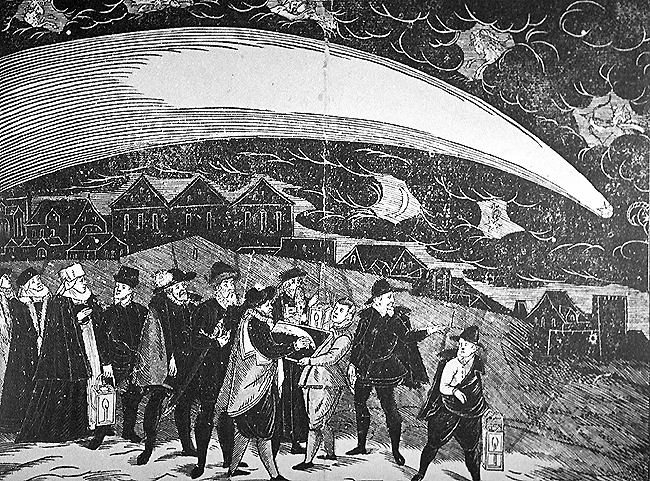
I recently came across The End Times Bible (now out of print). Published in 1999, this Bible had a not-so-subtle message that the end of all things was nigh. As it had been before, and, knowing human nature, will be many more times again. I imagine myself, in a Left Behind fantasy, watching a neophyte trying to make it in the post-apocalyptic world with a Bible. References to the end times are rare in Holy Writ, and dreadfully obscure. Reading Tim LaHaye or Hal Lindsey you might think the Bible has step-by-step directions for negotiating the wrath that is to come. As if the Bible were a recipe book and you wanted chocolate-chip cookies. Ironically the world is full—over-full in point of fact—of people with advanced degrees in Bible who’ve spent years and years of their lives learning to uncover the minutest hints that the Bible gives. Most of these folks are unemployed and wouldn’t mind sharing a bit of that simplistic apocalyptic pie baked up by the premillennialists. And yet, the world goes on.

Even as I was researching The End Times Bible, however, I began seeing references to the next apocalypse. Some are hopefully suggesting 2019, since, apparently, God likes round numbers. The reprieve we’ve been feeling, I have no doubts, is only temporary. In the course of human events we will have alarmists elected to high offices and once again panic will begin to build. The Maya let us down, and Howard Camping up and died. No worries—there are other arcane civilizations and the world knows no shortage of prophets in button-down shirts. Still, I’ve kind of enjoyed this little vacation without having to hush the irrational fears that God’s non-biological clock is inexorably ticking.

The biblical world is a simple one, in its own way. Created in six days just a few thousand years ago, it topples off its pillars and ends in a fiery demise in some millennial scenario, if only it can keep its own story straight. And like any good story, children will come back to it time and again.


Programming God

Robots have been part of my world far longer than I ever recognized. Still, growing up in a small town in the 1960s, their impact was fairly minimal—they may have had a part in the manufacture of the car we drove, and perhaps helped prepare some of the products we bought—but those robots were far away. Far more present were those on television who, for the most part, were funny and helpful. This month’s Wired magazine runs a story entitled “Trusting Our Robots,” by Emily Anthes. The point of her short article is that people feel more comfortable with robots that are programmed to appear uncertain. We don’t trust robots to drive our cars, as she points out, but we give them more, old-fashioned primate sympathy when we make them look like they’re having a hard time. Just a couple weeks back Time magazine had a blurb on how we’re now at the point of programming drones to kill without human input. Add a dose of uncertainty and we get a glimpse of what it must be like to be gods.

Underneath our exteriors, we all know that robots do what they are programmed to do. In many respects—physically, especially—they are superior to us. Nevertheless, human knowledge is not perfect. We, too, are prone to uncertainty. Our robots aren’t better than we are, only more efficient. Doubt is a human quality. Perhaps our most endearing. As Ms. Anthes notes, “even when confronted with evidence of our own inferiority, we resist a robot’s help.” We have evolved over millions of years to interact with other creatures. Those non-biological entities we’ve created and endowed with artificial intelligence (sound familiar?) somehow can’t equal the right we’ve earned from struggling against, and along with, nature for these many eons. Would God really trust us with the keys to the universe?

An early plan for a robot.

An early plan for a robot.

Robots, we are told, are our inevitable future. Some visionaries look forward to uploading human consciousness (even though we have no idea what it is) into a machine and, with replaceable parts, living forever. Before the dead and resurrected Jesus, according to the gospel of John, stood Thomas—the man some traditions said was Jesus’ very twin—and yet he doubted. As much as we claim otherwise, we adore Thomas for it. Evolving even in a world full of religion—itself a product of our evolution—we are so unsure. Our robots, however, programmed by us, have no doubts. Even when they act confused, it’s only because we tell them too. Our minds, as Wired tells us, resist letting robots drive the car for us. We let them pull the trigger, however, and pray our programmers got it right.


St. Ghost

HauntedSouthernTierSince they combine two of my soft spots—local history and ghost stories—books telling the tales of home-town specters are compelling in a homespun way. On a visit to Binghamton, New York, I picked up Haunted Southern Tier by Elizabeth Tucker at the local bookstore (I have a hard time passing up an independent bookstore anywhere). Those of us at least a little familiar with upstate New York know that the southern tier is not strictly defined, but it is a recognizable section of the Empire State that runs just north of the Keystone. I was drawn to the book by Elizabeth Tucker’s name; she is the author of Haunted Halls, a book I reviewed earlier on this blog, about college campus ghosts. These local travel guides tend to focus on the weird and whimsical, and aren’t meant to be taken too seriously. Nevertheless, the connection between ghosts and religion is tangible in just about any part of the world, no matter what one believes.

This fun read brings a number of explicit religious points to the surface. One involves the strange phenomenon of haunted churches. Given that many varieties of Christianity offer Heaven as a reward immediately following death, having a ghost hanging around a church seems strangely disingenuous. Perhaps that’s why few churches admit to such things. Another interesting tie-in to religion comes in Tucker’s section on roadside ghosts. Stories of spectral hitchhikers are quite ancient, but I had never considered them biblical. Tucker mentions one such instance in the Book of Acts, and upon reflection I realized that she may be onto something. The account of Philip converting the Ethiopian eunuch is one of the odder tales of the early Christian movement. Philip explains Isaiah’s prophecies to the chariot-riding dignitary who gives him a lift, and baptizes the visiting Ethiopian before mysteriously disappearing. Could this be the prototype for the vanishing hitchhiker folklore theme?

Perhaps the most serious of the religious connections in the book, however, has to do with St. Bonaventure University. For those familiar with Thomas Merton’s life story, St. Bonaventure will not be unexpected. Merton taught at the school as he was struggling with his identity that led him to become one of the most renowned Trappist monks in the world—one who spoke approvingly of Buddhism, to boot. Merton is not said to haunt the university, but his presence there at one time has endowed this Catholic school with a sense of spiritual gravitas. The ghosts come from elsewhere.

Books on ghosts are a guilty pleasure with a serious undertone. End of life issues, once we move beyond the medical, are the unquestioned provenance of religion. Whether or not there are any ghosts out there, religion will claim the final word on afterlife. And only those who experience it will ever really know.


Real Reading Rainbow

Libraries rule. According to recent studies libraries rate higher than religious institutions, according to public surveys, in their usefulness to society. From the lost library of Alexandria of yore to the local Carnegie, libraries have been the repositories of information almost from the beginning of civilization itself. Last week the American Library Association, according to an article forwarded to me by my wife, and the Banned Books Week planning committee, announced a theme for this year’s recognition of the books various groups (many of them religious) tell us we shouldn’t read. Banned Book Week, of course, falls in September. It might seem strange that planning has to go into this, but the banning of books has never ceased and the list grows year by year. I recently mentioned John Green, one of the authors who frequently appears on banned lists for children. In an age when encouragement to read should be running high, we hide behind platitudes to keep our eyes toward a predetermined prize. Among the reasons frequently given for banning a book: its religious outlook. I.e., the “wrong” one.

IMG_0324

I often wonder why we think sheltering children who are old enough to read from the collective knowledge of the human race does them any favors. Our culture so successfully removes us from nature that we don’t experience the “facts of life” that our ancestors no doubt noticed early and often. Violence, sex, drugs, and death, however, haven’t become any less common. They are only hidden until their knowledge hits with often catastrophic force, leading to neuroses about how unsafe our world really is. A function of story, if neurologists are to be believed, is to help us navigate the many trials we’ll encounter by seeing how others have done it before. I don’t doubt that there is age-appropriate material for children, but they understand a lot more than adults like to think they do. In my teaching days I was always amazed at how much undergraduates knew that I was only beginning to discover as a professor. Books seem a good way to introduce knowledge appropriately.

The internet, of course, gives access to unvetted knowledge to anyone with access to a computer or phone. Published books, it used to be, had the added value of passing through editorial hands on their way to public presentation. A funny thing happened on the way to the library. We’ve democratized the writing of books through self-publishing, but we’ve not yet ceased to ban them. Perhaps the real way to protect our children is to listen to them. We seem to think telling is better than hearing, although the flow of knowledge can go both ways. Instead of banning books for our young we might all benefit from opening of our own minds.


Clockwork Universe

longitudeIn a clockwork universe, time is an essential interpretive factor. Those of us constantly crushed for time hardly realize just how recent of an invention it is. Time has, of course, been around forever. Human interaction with it, in the daily sense of what defines work and what defines leisure, dates only to modernity. Train schedules, in the Victorian Era, led to the need for standardized time across large land masses such as North America. Prior to that, with an uncanny precision to those of us who infrequently take the time even to look at the sky, clocks across the nation were set at noon by observing the sun at its zenith. Even though the concept of longitude existed, its measurement at sea was maddeningly difficult. The Phoenicians, the ancient mariners who circumnavigated Africa, did so by staying in sight of land as much as possible. The open ocean gives few clues as to those imaginary lines we assign to keep our location certain.

Dava Sobel’s Longitude: The True Story of a Lone Genius Who Solved the Greatest Scientific Problem of His Time, is, despite the lengthy title, a brief book laying out the story of John Harrison. Harrison, a clock-maker whose precision clocks made the calculation of longitude a much more precise science, was in a race for a royal grant to reward the discoverer of a method for giving precision to ships at sea. Harrison represented those who believed accurate clocks could solve the problem, while others argued that mapping the heavens would give sailors the best chance. Often we forget that loss of life greater than that on the Titanic could occur when ships ran aground, due to lack of knowledge concerning their longitude. Navigating the seas before GPS and before accurate watches, was often a matter of informed guessing with very high stakes. Harrison never did get to claim fully what he’d earned and we’ve all but forgotten how difficult finding the correct time was when our computers remind us, to the second, of precisely when we are.

Prior to science, the keeping of time was a religious function. Sacred calendars marked holidays—often with the ulterior motive of keeping farmers on track for when planting time for various crops, and their harvests, should commence. Telling the change of seasons by when to add or discard a layer of clothing seems eminently practical, but it doesn’t help an agricultural society to plan ahead adequately. The gods would give the time, and all they would require was a cut of the profits. It was, all things considered, a reasonable trade-off. And now holidays have mostly slipped their religious moorings to become times when we simply don’t have to go to work. Speaking of which—look at the time…


Jonahado

SharknadoSome movies are so bad that they become classics. Some are just plain bad. The jury in my head is still out on Sharknado. The story, obviously tongue-in-cheek, is so far-fetched as to be pretentious, and anyone who knows something about either sharks or tornadoes, or both, will likely find credibility waning from the first scene. For those sensible among my readers, who’ve not seen the movie, the title gives it all away. A global-warming-induced hurricane hurries toward Santa Monica with its forever young sun-worshippers. The hurricane floods the California coast, bringing sharks to the city streets. As our protagonists drive around somewhat pointlessly, the sharks attack their car, eventually eating everyone who’s not family. At one point the family tries to buy rations at a liquor store, only to have the news announce that this is the apocalypse. The store owner scowls that it’s the government, not God, that’s bringing this upon them. Then the waterspouts appear, morphing into tornadoes carrying sharks, still hungrily chomping at everything as they fly through the air.

Ironically a biblical theme comes about with the swallowing of Nova. As she falls from a helicopter (don’t ask), a great white shark snaps her up in mid-air, and since she’s about the only character you can care about, the movie seems to have reached its nadir. As the tornadoes dissipate and the sharks coming raining down, the eponymously named Fin is swallowed whole by a huge great white, while still holding his chainsaw. We already know that this latter-day Jonah will make his way back out, and we are supposed to be surprised that this is the very same shark that holds the reborn Nova, who admits her real name is Jenny Lynn. Like Neo in The Matrix, she is the convert to a new faith, this time in the family of Fin, whose only fault, it seems, is that he cares too much for others.

While a made-for-television B movie (although C or D might be more appropriate), Sharknado demonstrates the popular conception of the apocalypse. Not that it will involve flying sharks and destructive wind-storms, but that the end of the world is somehow inevitable. We have convinced ourselves that its a matter of when, not if, the world will meet its demise. Global warming, clearly our fault, is blamed by the movie (as is the government), but the story is that the flimsy culture we’ve constructed is subject to utter ruin by a hurricane and maritime predators. Or I could be reading far too much into this. Religious tropes may be picked and chosen at will. And when things really go wrong, like accidentally switching on Sharknado, we have a ready arsenal of religious ideas at hand to blame. And the apocalypse may be the least of our worries.


The Fault in Whose Stars?

The_Fault_in_Our_StarsTheodicy. I’m no theologian, but the problem of suffering erects a wall ever higher between wanting to believe and actual experience. Many great thinkers have laid down their faith because of this insuperable hurdle. The movie version of John Green’s The Fault in Our Stars opened last night, but I didn’t see it. It was difficult enough to make it through the book. I have to admit feeling a bit wimpy about finding a young adult novel emotionally challenging, but it just is. As I mentioned a few days ago, Veronica Roth’s Divergent trilogy has been topping charts lately, but so has John Green’s novel of childhood cancer. Theodicy is deeply inscribed in this sad tale of loss and love. From a purely biological perspective, the death of the young is explicable, but that seems to be the easy way out.

I’ve been toying with The Fault in Our Stars since January. Picking it up long enough to read a few pages, then growing frightened and putting it aside for a few weeks. The story begins in “the literal heart of Jesus” in a church for a cancer support group where Hazel meets Gus, and, as young people do, falls in love. Green is clear on one point from the beginning: no novel where the protagonists are victims of cancer can ever have a happy ending. We just have to watch and wait for the inevitable. The children return time and again to the “literal heart of Jesus” but no healing comes. They face loss and every page you turn brings more imponderable questions. Yes, this is fiction, but we live in a world where childhood cancer exists. And childhood starvation. And childhood victims of abuse and violence. And still we try to find a way to fit it into a broken-down theology and wonder why we don’t smile more often.

I don’t shy away from provocative fiction. I read scary stories with all sorts of monsters. Finding ourselves, however, in a world where neither rationalism nor theology really makes all the sense they should, sometimes the scariest stories are the truest to life. John Green’s fiction, it comes as no surprise, is frequently banned. Reading it as an adult one finds parts predictable and parts handled too gently, but with enough realism thrown in to want to see it through to the end. Banning books, however, is merely an attempt to shield children from that which they need to see. We do no favors, hiding the truth from those best equipped by nature to accept it. The real question is whether theodicy itself can survive. Perhaps, like the characters in the novel, it will come to its own quiet termination with no real answers to offer.


Map and Territory

MapsHeavenMapsHellAt first glance the Puritan divines of early New England should seem to be as far from horror films, on the cultural divide, as phenomena can be. After all, academics long ago declared “genre fiction,” and particularly Gothic and horror fiction, to be lowbrow at best, and generally of no cultural worth. The amazing success of scary movies only underscores this point. Edward J. Ingebretsen (S.J.), however, begs to differ. His wonderfully insightful book, Maps of Heaven, Maps of Hell: Religious Terror as Memory from the Puritans to Stephen King, is a surprising study of how religion and terror share much that is essentially human. On this blog I have, from time to time, claimed that religion and horror are close cousins. In fact, they may be siblings. Since studies of Cotton Mather and Jonathan Edwards are often produced by Reformed, or at least Protestant, theologians, it may be that a Catholic thinker will catch aspects often overlooked. The Puritans, with their Calvinistic underpinning, had a worldview that holds much in common with standard horror fare. Ingebretsen suggests that to map Heaven, you must also map Hell.

The map conceit works well as the reader navigates through unconventional ways of thinking. The fears of the Puritans included the fear of God, and those who read or watch horror have noticed that nothing scares like the divine. It may not be on the surface, however. Even those not accustomed to deep digging can, upon a few moments’ reflection, see that the Gothic writers of the American canon have drawn repeated from this well. Many literary experts (well, some) celebrate H. P. Lovecraft’s atheistic rationalism, but enjoy his tales of the old gods nevertheless. His modern heir, Stephen King, is quite open about the potential fear of religion. He even blurbed the back cover of the book.

As society grows continually more secular, the religious impulse will not disappear. Sublimation, the process of changing states, may hide what is happening from the casual eye. A close look shows, however, that the same fears Mather and Edwards unleashed on witch-addled, spider-fearing New Englanders, have come back to us in pulp and celluloid. Religion has its earliest roots in a kind of holy fear, it seems. The innovative human mind, however, with its drive to rationalize, devised mythologies that make fears seem plausible. Those mythologies are relatively easy to believe. Everybody likes a good story. Stories, with all their twists and turns, can leave you lost in the woods. It’s good to have a map. I would suggest Maps of Heaven, Maps of Hell. You may still be scared, but you may feel more sophisticated for it.


Uisge Beatha

Water is essential for life. Life as we know it, in any case. It is no surprise, then, that many religions incorporate water into their rituals. Last week I posted about the biblical stories of Jonah and Noah, both of which involve acts that were later interpreted by Christians as baptism. Muslims use ritual ablutions as part of their worship tradition. Water is life, after all.

IMG_1392

While wandering the halls at work, I notice the various artwork on the walls. One large, framed image has frequently caught my attention: several men are shown carrying a statue of Genesha, the Hindu elephant-headed god, through the water. Coming at this from a Christian background, I wondered what was going on since it looks like baptism. Hinduism, I know, is not a unified religion, but rather a conglomeration of many folk traditions from ancient India—one of the two seats of ancient religiosity. The stories of ancient India are colorful and diverse, and a bit of research suggests that this particular photo is likely the festival Ganesha Chaturthi, commemorating the story of how Ganesha came to have an elephant’s head. Crafted from inert matter by his mother Parvati, Ganesha was posted to watch the door while his mother bathed. Parvati’s consort Shiva returned and not knowing who the boy was, the lad’s refusal to allow anyone to enter led to a war. Eventually the Ganesha was beheaded and to appease his consort, Shiva supplied him with the head of a dead elephant and the boy resurrected. The immersion of Ganesha statues, or Visarjan, takes place as part of the Ganesha Chaturthi, during August or September.

I admit I’m not an expert on Hinduism, so some of the details may be a little off here. What strikes me, however, is the similarity between this story and that of Jesus. Like Ganesha, Jesus was associated with a modest mother, slain, and resurrected. He, too, is associated with ritual baptism. Growing up, we were taught of the many unique aspects of Christianity. We had, we were led to believe, the only resurrecting deity in the world. Our God alone could bring back from the dead, and the way in was through immersion in water. While learning about Ugaritic religion I read of Baal’s death and resurrection. Although stories of baptism haven’t survived, he also battled the sea and came out victorious. Some ideas, it seems, are particularly fit for religious reflection. The details may be unique, but the archetypes are very similar. Religions may be many things, but in the end, unique is a word that must be applied with the greatest of care. In the meanwhile, the next time I read of walking on the water, I will recall that even Asherah was know as “she who treads upon the sea.”


Inerrant, Indeed

The other day at work, I discovered a huge Bible. This one was truly massive, in three volumes, almost too heavy to lift. As I pulled down the last fascicle, which weighed more than a newborn, I noticed the sticker on the cover. “Author’s proof.” This gave me pause. Does God read his own material or does he hire out freelancers? Printed Bibles have a long and venerable history of typographical errors, especially in the early days. Speaking in the name of the Almighty does have its risks. After all, little is more persuasive in America than the words, “it’s in the Bible.” I remember kids saying that to me in high school, where I had the reputation of being a walking concordance. More often than not, I had to correct them, since, in fact, the Bible mentions nothing about Popes or guns.

IMG_1389

Prior to the electronics revolution, printing a Bible was a complex process. Typesetting, or compositing, was not an undertaking for the foolhardy. Type has to be set, cast, and molded in order for offset printers to roll. And although page proofs aren’t set in stone, metal isn’t a forgiving medium to manipulate. And let’s face it—the Bible has a lot of words. Some of them very dry. The King James Version has over 780,000 words. Those with any experience in publishing know that’s one big book. Bible proofreaders command a hefty fee. I would be afraid to correct the word of the Lord myself. Reading through holy writ, word-by-word, takes a bit of time. The mind wanders to monks in their scriptoria.

Nevertheless, printer’s errors abound. Growing up as an evangelical, lighthearted entertainment was to be had as we read about the “Breeches Bible,” the Geneva Bible that had Adam and Eve fabricating britches for themselves from fig leaves. Coverdale’s Bible was known as the “Bug Bible” for its translation of Psalm 91.5, “Thou shall not nede to be afrayed for eny bugges by night.” Various versions of the King James have typos including Judas telling the disciples to watch in Gethsemane while he goes yonder to pray, and the somewhat self-serving “Printer’s Bible” that renders Psalm 119.161, “Printers have persecuted me without a cause” (which may be true, but the Hebrew would seem to indicate “princes” instead). The most notorious was the “Wicked Bible” wherein the seventh commandment in Exodus reads, “Thou shalt commit adultery.” All but eleven copies were destroyed and one of the remaining sold in recent years for $89,000. A Bible printed during the First World War, had “Thou shalt kill” as a commandment, Freud be praised. I slip the author’s proof back onto the shelf. I’ll let this be somebody else’s problem.


Vive la compagnie

I’m cleaning out the closet at work. I doubt that either J. C. L. Gibson or Nicolas Wyatt envisioned my future thus. Edinburgh University was exotic and optimistic, designed to make my curriculum vitae stand out. More like standing out in the rain. “We have to ask what’s best for the company,” I’m told. I’m not a proud person, but earning a Ph.D. to take out the trash seems like a strange allocation of resources to me. “Take one for the team,” we’re told, since we’re part of a company and when the company prospers, we prosper. On a pro-rated scale, of course. It’s not that taking out the trash is beneath me. I willingly do it at home; my first career aspiration was to be a janitor. Only now I’m dressed in work clothes for the City. And I spent nine years in higher education to get here.

Lately I’ve been pondering how this “for the company” trope is a one-way street. Knowing in advance that Nashotah House could be a Hindenburg career for a liberal, I gave it the old college try. Writing about 90 pages of class notes a week for my first year of teaching, attending mandatory chapel twice a day, I tried not to step on any toes. Even though the theology over which I was forced to chew smelled a bit like this garbage I am now carrying, I made no fuss. Don’t rock the boat, especially if it’s a garbage scow. Take one for the team. After fourteen years of not making a fuss, I was summarily dismissed. I found out, literally, how hard it is to get a job as a garbage man.

Portrait of a livelihood about to end.

Portrait of a livelihood about to end.

Eventually I landed a job at Gorgias Press. Neither prestigious nor lucrative, it was a job and I had already proven I could take one for the team. Positions evaporate around here like dribbles from a spilled cup of coffee. So I found myself at Routledge, jetting around the country, spending long hours on the bus, being told to think what was best for the company. Only don’t expect the company to do the same for you. Stoking egos, I tried to get people with qualifications I could match to write a book for me. At Nashotah House I played on the football team (don’t laugh, it’s true). We had only one game a year, against our rival—the now defunct Seabury-Western in Chicago. During practice one day, one of my students blocked me with a forearm to the chin that left me on my back, seeing stars. I can take one for the team. But sometimes the company needs someone to take out the garbage. Ask the guy with a doctorate in rubbish removal. He always thinks about the company.


Two Roads Divergent

DivergentOne of the most hopeful signs for culture is the quality of young adult fiction on the market. Since I’m now in the book industry, Publisher’s Weekly is required reading. I always take a look over the fiction lists as well as the non, and over the past several months a couple of “teen fiction” books have been near the top for regular bestseller lists as well as for demographic-specific ones. (That is, adults seem to be reading them too.) One of those books is Divergent by Veronica Roth. While movie tie-ins certainly don’t hurt, as many of us opine, it is difficult to do justice to a complex story on screen. Divergent is one of those books that stays with you after you’ve closed the cover, and that suggests to me that something deeply meaningful is going on. What about dystopias is so compelling?

I’m not indulging in any spoilers to say that Divergent is a dystopia. Set at an indeterminate time in the future, civilization still exists—at least in Chicago—as society has fallen into five factions: Dauntless, Erudite, Candor, Amity, and Abnegation. Each group has its own beliefs as to why civilization collapsed, based on philosophical dispositions. Abnegation, the self-deniers, are the leaders of government. And clearly, the idea of Abnegation is a form of quasi-monastic Christianity. In fact, among the factions, Abnegation is the only one that seems to mention God. The other groups, stressing bravery, intellect, honesty, and peacefulness, don’t really have much need for the divine. To deny oneself, however, requires a powerful motivation. Even the protagonist’s name, Beatrice, is taken from its favored status among early Christians. I know little of Veronica Roth, but I have to wonder whether Dante is in the background here.

In the acknowledgements to the novel, Roth first gives thanks to God. As a high school convert to Bible-based Christianity, I suppose that’s only natural for a writer who is, at the moment, only twenty-five. Writers for young adults often have their religion close to the skin. Stephanie Meyer’s Mormonism translates into moral vampires. Orson Scott Card provides Ender Wiggin with values from the same faith tradition. People are, despite the logical implications, inherently religious. That doesn’t prevent Divergent from being a page-turner. Full of action and personal development, the first book of Roth’s trilogy bristles with self-sacrifice and belief in something better to come. Even if it’s a world we have to make ourselves. And like most human enterprises, it comes out as a well-meaning dystopia that underscores the value of reading for us all.


Singing the Truth

Attending a local high school choral concert recently, I arrived late. That’s fairly common since the bus from New York is often quite tardy—arriving forty minutes after the scheduled time is pretty standard. In any case, I joined the concert already in progress. One of the first pieces I heard was “Operator,” a number based on an old Manhattan Transfer song. Since my wife grew up liking the group, I recognized the song and yet it felt strange to have Jesus mentioned repeatedly in a public school setting. Music, by its very nature, however, often contains religious sentiments. The Doobie Brothers had, in the early 1970s—the height of a hedonistic age—done very well with a cover of “Jesus is Just Alright.” Jesus, after all, had been declared a superstar a couple of years before. I used to tell my students that the musical impulse is linked with the appearance of religion in very early human culture. Still, disestablishment reigns.

I know that a large Jewish population makes up a significant demographic at the school, and I often think about how the cultural supersessionism of Christianity must feel. Much of what became Christianity has deep roots in Judaism, and even Jesus was Jewish. Can a song be just a song? After a while Randall Thompson’s “The Last Words of David” was performed. No offense there, since the Hebrew Bible is recognized by both Jews and Christians. But what of those of other faiths? Don’t get me wrong—our high school has an excellent music program. I was just wondering how the music might be perceived in a multicultural world. We have Muslim and Hindu students, as well as secular. Is this just counted as mythology to them? The selection of music teachers would be far more restricted if all music associated with religious words or themes were jettisoned.

Affaire_de_Bizoton_1864

These were the kinds of thoughts milling about my head when the last song from a religious tradition came up: “Wangol.” This is a Vodou song. I was pleased and amazed that the “last word” went to an underrepresented religious group. True enough, Vodou grew out of Christianity’s interaction with traditional African religions, but it demonstrates just how eclectic both American religious culture and high school music concerts can be. Choosing the music for a secular choral concert in a multicultural setting must be a trying experience every single time. When we lived in Wisconsin, most concerts were unabashedly Christian in orientation. This is hardly surprising, I suppose, since choral music itself is often composed to express religious sentiments. New Jersey is a different world. I left the auditorium musing that Vodou is just alright with me, and just as plausible as calling Jesus on the telephone.


Transparent

With its endless versatility, gold is many things to many people. Already at the dawn of civilization, both in the old world and the new, it was a valued commodity. It is one of the few things that conquistadors didn’t have to impose on their victims; love of gold was already there. One of the qualities of gold that makes it such a remarkable metal is that a little bit can go a long way. Gold plating, for example, can be accomplished with very thin sheets of gold. This made it ideal for decorating statues of gods in antiquity, or at least the heads of the statues, as reflected in Daniel’s dream of Nebuchadrezzar’s statue. “Thou art this head of gold,” even Daniel obsequiously crows. Today, of course, gold represents commerce and it often sits, unused, in great storehouses heavily guarded, so as to prove a nation’s worth.

Gold still has industrial uses in the book business, particularly with Bibles. A classic Bible with calfskin leather, gold letters stamped on the cover, and gilt-edged pages, can be a luxury item. The gold on the edge of Bible pages is only 1/300,000th of an inch thick, or thin, meaning that a Troy ounce goes a long, long way. Only books with an idolatrous value get this kind of treatment. And they still sell. Somehow an ebook just doesn’t compare. The irony here is that the contents of the Bible suggest that gold is of lesser value than the spiritual truths contained within. Still, we can’t help but smooth the outside with burnished gold. Show and tell it on the mountain.

DSCN4534

Although the populace demanding evangelical standards such as the Scofield Bible are going ever more and more towards the large-print editions, the leather-and-gold crowd is still alive and has the cash to prove it. The same content is available online with just a few keystrokes, but there is no gold coating here. All that glitters is not gold, goes the old saying. As we turn our gaze ever heavenward, the glass visors of space helmets are also covered with a thin layer of gold, as if the deity we might glimpse is best viewed through gilded glasses. From the moon—humanity’s farthest step—back to the early statues of gods whose names have been forgotten, even though it may be the thinnest veneer possible, we look at the world through gold.


The One That Got Away

While looking for reviewers for a book proposal on Jonah, I had a strange realization. Few mainstream biblical scholars are interested in the book. Or at least in publishing on it. The same goes for the Bible’s other great watery adventure, Noah’s story. Ironically, these are the stories we, as children, are weaned on. Kids love animals, right? And both Noah’s ark and Jonah’s great fish mastication involve animals, as well as lots of water. Both stories have more than a whiff of the fantastic about them—the kind of thing children can relate to. And yet, biblical scholars, collectively, wonder why few people are interested in their work as they take on the more heady work of unraveling Isaiah or Romans.

Sistine_jonah

Jonah used to be a test case for the Fundamentalist crowd. You were a “Bible believer” if you could, with steely gaze, claim that Jonah was swallowed by a fish—the Bible doesn’t say “whale”—and survived three days only to be vomited up on the Levantine shore to make his soggy way back to Assyria. Three days swimming in the gastric juices of just about any animal doesn’t do a great deal for a prophet’s credibility. Or physique. And since the story is fantastic, and populist, scholars avoid it like a giant fish. Meanwhile, John and Susie Q. Public want to know about this story—what does it mean? Did it really happen? Why is it in the Bible at all?

My generalization above is somewhat faulty. (What generalization isn’t?) Evangelical scholars still take an active interest in Jonah. Jonah is the stomach-acid test of faith. Since I never really outgrew my love of monster movies and outlandish plot lines (my brothers recently convinced me that I should see Sharknado) I’m fascinated by the tale of Jonah. It is one of the most carefully constructed stories in the Bible, and it clearly has a very counterintuitive message about who is acceptable in God’s eyes—here’s a hint: they live in Nineveh and even dress their animals in sackcloth when they realize they’ve been naughty. The book of Jonah, however, has been condemned for being a puerile tale of a guy who can hold his breath three days, amid chemicals that can dissolve most organic substances, and utter Psalm-like prayers all the while. Fish stories, after all, are something that many folks intuitively know how to interpret.