Heaven Can Wait

“Like a good neighbor, State Farm is there.” So the jingle goes. Or went. I’ve only met my upstairs neighbors once. Twice now. Apparently last weekend I slept through the fire alarm—one of the dangers of awaking ridiculously early on a daily basis. The neighbors found the source of the smoke and turned off the furnace in the basement, but told me first thing in the morning before the coffee really kicked in. I avoided a close call, perhaps. What if they’d not been home?

I have no delusions about understanding how the Internet works. I’m still trying to figure out the telegraph. Perhaps having this inconsequential blog has put me on somebody’s radar, or maybe it’s just some bored robot that searches for strange combinations of words in the wee hours of the night. In any case, I ended up with an email with the trailer for Heaven Is For Real embedded in it. I recall when the book was on the New York Times bestseller list, and I suppose the Easter weekend release date is no coincidence, but the trailer still bothered me a bit. It’s not the resurrection part—the film industry wouldn’t get very far without that trope—but it is the implications of what heaven would be like. I haven’t read the book, but apparently Colton Burpo had a near-death experience and then for a considerable time afterward began describing things that were impossible for him to know. A miscarriage where his sister died, what his grandfather looked like as a young man, what his parents were doing when he was dead in the hospital. Talk about your spooky effects at a distance!

Despite my penchant for watching scary movies, I don’t think I’ll see Heaven Is For Real. There’s just too much emotional build-up here, and Life After Life traumatized me for weeks a couple decades back. Still, I am very interested in the possible explanations for what might have been going on. Near-death experiences have never been adequately explained. Scientists suggest that a lot can happen in a complex brain in a matter of nano-seconds, and we have no chronograph precise enough to know whether the thoughts and images happened before death, during death, or during resuscitation. Still, how people frequently know precisely where others were, who were not in the room at the time, and how they heard things that, medically speaking, they couldn’t have heard, remains eerie and hopeful at the same time. What does appear to be without question is that consciousness is far from being explained.

Botticini's vision

Botticini’s vision

Heaven is always described as pleasant. That concept differs radically for people, and you have to wonder how it can be one-size-fits-all. Some people prefer to be in crowds, while others like to be alone. Some like it hot. Some like it cold. And those who experience near-death phenomena often report having a body of some sort “up there.” Some people would prefer a different body. According to the trailer, Colton says we’re all young over yonder. For me, such things are far more about questions than answers. We don’t know what goes on after death. Nearly every religion ever invented says that clearly there’s more to the story. Some say we come back, others say we stay away. Maybe it is different for each. Maybe it is just a matter of having good neighbors after all.


Sowing the Wind

F5On May 31 in 1985, I was working at a church camp outside Uniontown, Pennsylvania when some severe storms rolled through the area. I had trouble sleeping through the thunder and lightning. I awoke the next morning to hear the news, in groggy disbelief, that tornadoes had invaded the county where my family lived. Frantic for their safety I tried to phone, but lines were down. It turned out all right—the nearest twister had been about five miles away from my home. This event was a shock because I grew up believing we never had tornadoes in Pennsylvania. I have always been terrified of them. I suppose that’s why I wrote my little book on weather in the Psalms. I just finished reading Mark Levine’s F5: Devastation, Survival, and the Most Violent Tornado Outbreak of the Twentieth Century. I’m not sure why I’m compelled to read about what scares me so much, but I suspect it’s because tornadoes have a whiff of the divine about them. Indeed, Levine’s book makes several reference to religious imagery when describing the utter destruction of Limestone, Alabama during the Super Outbreak of April 1974. It gives me little comfort that the storms that raked Ohio, Pennsylvania and Ontario eleven years later were the second deadliest outbreak following that of the book’s exploration, up to that time. There’s so much left to chance, with tornadoes.

Despite the complete lack of any intentionality behind the raw forces of nature, the phrase “finger of God” has become a fixture in the tornadic lexicon. Perhaps it is because the human perception of divine intervention has always been sporadically applied. One person’s miracle is another’s nightmare. Obeying only the complex rules of meteorology, the weather has ways of its own that even computer models cannot yet fathom. We still stand helpless in the face of the tornado. I have often thought, without a whole lot of data to back me up, that weather has played a major role in the human understanding of the divine. Quite apart from the obvious celestial orientation, the weather is easily forgotten until it turns bad, and when it does there is nothing humanly possible to do about it.

In April of 2011 a super outbreak of 358 tornadoes swept through the eastern United States and Canada, killing 348 people. In terms of damage, it was one of the costliest natural disasters in US history. And the capriciousness of the tornado stands at the center of it all. F5 is a hard book to read. The story practically turns its own pages, but the loss in human terms in the cold face of a planet that doesn’t exist for us is sobering indeed. Many religious people in the south were asking how God could allow children to be killed and hundreds of people maimed both physically and mentally for the rest of their lives. They prayed for answers that never came. And this may be the cruelest aspect of the apparently random nature of the weather. It maintains the right to kill, and prayers seem to bounce back from that brazen sky that comes just before a tornado strikes, and especially afterwards. Skies are silent. When they are not, it is time to duck and cover.


Heavenly Beings

FromAngelsToAliens Religious tolerance suggests that it’s less important what you believe than it is that you believe. After all, where you are born—socioeconomically as well as geographically—determines which options are open to you. And now that the world is virtually inter-connected, the media must play into the idea of what we believe as concepts mix and brew and distill. Lynn Schofield Clark’s From Angels to Aliens: Teenagers, the Media, and the Supernatural, is a study that takes all of this seriously. We know teens as the ultimate disenfranchised demographic. For those of us who were once there, no doubt concerning that status exists. But what of teens in an age where God seems to be effacing and angels and aliens invading? At least according to the media. Clark interviews several teens and their families about their belief in the supernatural, and, in keeping with what the statistics of national surveys continually show, belief in some world beyond ours is indeed deeply rooted. Many youth, however, have trouble distinguishing angels from aliens.

Not literally, of course. Rather, supernatural entities are so much a part of our media experience, and church attendance so little, that clear ideas of how these things all fit together, if they do, are lacking. Scientists are looking for life in space while denying that if it exists it ever could have intentionally travelled here. We are, after all, the most intelligent species in an infinite universe. (Did I say that belief in God was effacing?) Socially, however, angels are much more acceptable than aliens. Belief in aliens is easily equated with mental instability, while belief in angels is normal, if not a little naive. To the average person, it seems that we’re not alone. As many popular media portray, however, God remains silent and we have to wonder if there’s anyone really driving a universe with no real up or down and with an exploding singularity at its center. It’s all a little disorienting—rather like being a teenager.

Clark remains wonderfully open-minded as she asks her questions to the younger generation. I felt a bit of recognition when she mentioned her church experiences in theologically conservative western Pennsylvania, the area in which I grew up, and where neither aliens nor angels were particularly uncommon. And we were in a media black hole in those days. Stations from Pittsburgh or Erie didn’t boost their signal to reach those of us in the boondocks with much reception beyond the big three. Of course, there was nothing beyond ABC, CBS, and NBC. Well, there was PBS in the background, but this was a universe still awaiting its big bang. Angels were good, aliens were evil, and God never remained silent for very long. And nobody really cared what teenagers thought. We have evolved since then, but we still look to the sky and wonder who, if anyone, is out there.


Paying Goliath

A friend pointed me to the story of David and Goliath. Well, actually, it was the Malcolm Gladwell story of David and Goliath. TED talks have become a regular part of public education and I was a little surprised to see one based on a Bible story. If you’d blink you’d miss it. I’d seen Gladwell’s new book on David and Goliath in the bookstore, and I had assumed it was about some hidden principle based on little boys challenging giants to single combat. Who knows. So when I turned on TED and heard Gladwell describing pretty much what I would do in class, and knowing that he was raking in the bucks for doing so, I gave it some thought. Yes, it is clear that he’s done some research into ancient warfare. Most of us who read the Hebrew Bible do, since ancient warfare is a large part of Holy Writ. (Yet the world seems surprised when religions turn violent.) Gladwell’s perspective is refreshing, but I can’t help think that the Bible does indeed view David as the underdog. Yes, slingers were always an important factor in warfare, just as archers were before guns were invented. I seriously doubt David was actually packing the firepower of a .45, however.

The interesting thing is that Gladwell takes the story so literally. Historically David’s existence is questionable, although I personally see the weight of tradition as bearing on the tipping point here. There were just too many stories of the boy who killed the giant in the Bible to say it was all made up. The fact that they don’t agree in details adds a hoary venerability to the tales. But can we take it to the level of seeing Goliath as having double vision because of his gigantism, and saying to David “why do you come at me with sticks” even though the lad is holding only one? Perhaps Goliath can be pardoned for using the plural instead of dual form (he is, after all, a Philistine), but the point here is that it is a taunt. David is what the dog saw, compared to the seriously shielded Goliath. Gladwell makes some good points, but, in my humble opinion, misses the giant.

Saul, the king of Israel, fears to send David into combat because the kid will be slaughtered and Israel will be enslaved. Yes, ancient armies relied on slingers, but, like archers, in great numbers. Perhaps it was David’s accuracy that was in doubt. According to the Bible, however, Israel boasted slingers who could hit a hair at distance, and these from the tribe of Benjamin, Saul’s own people. So the point of the story is that David’s victory is a miracle. Miracles no longer fly, of course. Those who write bestsellers know best. It stands to reason. Okay, so I’ll buy Gladwell’s book now, but I somehow feel that those of us who have spent a life studying the Bible really deserve something more that jobless obscurity. I come at the giant with a tiny blog, but then, I’ve alway been an underdog. An outlier, you might say.

477px-071A.David_Slays_Goliath


Clash of the Watchers

NoahMovie

I don’t know about you, but I think I got gypped with my Bible. I have just come out of Noah where I saw amazing sights and a seriously troubled Noah to whom God refuses to say a single word. Controversy still swirls around the web concerning the movie, but I honestly have to say that it was more like Clash of the Titans (2010) than anything else. Except a thin part of the plot—and a few character names—that were borrowed from the Bible, this could have been Herodotus rather than Moses. I don’t recall finding any exploding lava angels in Genesis 1-11, and magic rocks that seem to fit better into a Mormon worldview than a biblical one. Gopher-wood trees grow incredibly fast, and Noah sure fights very well for being a six-hundred year-old man. So why all the fuss? This is a movie folks, not scripture. For the price of the ticket you can buy yourself a new Bible and read the entire story in fifteen minutes (it’s just over two chapters long). If it’s an action movie you’re looking for, I thought The Avengers was better.

What struck me most about the movie, apart from the watchers, which were admittedly an improvement on Holy Writ, was the subtext of evangelicalism. Noah, when he decides to build the ark appears suddenly with an evangelically approved haircut. He also had grown decided misanthropic, insisting that the ark is only for the animals’ sake, and that he only allows Shem to have a wife because he thinks she is barren. When he considers finding wives for Ham and Japheth, there is a huge meat for sex kind of deal going on in Tubal-Cain’s city that disgusts Noah so much that his vegetarian righteousness declares that all people will die off once the ark runs aground. And, of course, he will have to kill his granddaughters. This is a dark and tormented Noah who drinks to forget his problems in a world where God only speaks in cryptic dreams and one gets the sense that Noah is very Republican in his lack of compassion. Take out the whole human race while you’ve got the chance.

The movie is filled with mixed messages. Noah certainly doesn’t appear to live up to his name (“comfort,” by simple translation), and although the supernatural is everywhere, a compassionate deity is utterly lacking. Species die off when Tubal-Cain gets hungry. And the very sign of blessing is the skin shed by the serpent that led to the fall. What are we supposed to learn from this? A vague, Avatar-esque “the planet is good” message does give me a little hope, but seeing Noah poising a knife above an infant’s head only because she’s female makes me a bit squeamish. Noah obeys simply for obedience’s sake and people are mere stains on an otherwise ideal world. Before the fall Adam and Eve veritably glowed. Adam stoops to pick up the serpent’s skin while Eve engineers the fall of all. The special effects are good, but the story, it seems to me, is all wet. That’s the gospel truth.


Rocket Cats

Franz_Helm_rocket_cat_full_page_1

A few weeks ago the Internet’s attention was captured (if such a thing is possible) by rocket cats. Apparently the brain-child of sixteenth-century artillery expert Franz Helm, the story raised outrage and some giggles and then faded from view. In a recent Chronicle of Higher Education, however, the issue jetted back to life in an academic forum. The article by Steve Kolowich helpfully pointed out that the idea isn’t exactly new. My regular readers know that I advocate for animal rights and I believe most animals are far more intelligent than we deign to admit. In other words, I consider this an inherently bad and distasteful idea. Nevertheless, to look at it academically—Steve Kolowich was referring to the fact that the manuscript, being digitized from Penn University’s library, had been known previously. It went viral when the Associated Press decided to make something of the story. The Internet took an old idea and made it current.

The idea goes like this: a city is under siege and you’re getting impatient. What to do? Strap incendiaries to cats and birds and send them into the city that is guarded against human-sized invaders. Although this does have an evil genius quality to it, I wonder if Franz Helm didn’t get the idea from the good, old Bible. In the commentary on the rocket cats I’ve seen, nobody is giving credit where credit is due. Samson, according to Judges, was fond of the ladies. Not just any ladies, but Philistines in particular. Prior to his wedding he set a riddle for the Philistines to solve and when they pressed the bride-to-be for the answer, Samson ended up owing the Philistines a fair bit of cash. Samson simply killed some Philistines, took their goods, and paid those he owed. Meanwhile, his father-in-law supposed, reasonably enough, that Samson no longer loved his daughter, and gave her to another. In a fit of rage, Samson caught three hundred foxes, tied torches between they tails of each pair, and sent them out to burn up the crops in the field. Substitute city for field and you have Helm’s idea. With steampunkish add-ons.

In an era when the Bible is treated as increasingly irrelevant, the media (and scholars) frequently overlook how important it was to people in the past. You might even say it was inspirational. Despite all that, I’ve met a fair number of clergy who’ve never read the whole thing (it is a big book, after all) and meddlesome laity like yours truly often point out the more uncomfortable aspects of scripture. But even Samson may have to give a nod to the Hittites. Before Israel showed up on the scene, the Hittites, if i recall correctly, had figured out that it you sent a diseased donkey into an enemy’s city, the contagion would do the gruesome work for you, killing of people and well, the donkey was dead anyway. There was no Internet to spread the idea, but it was quite literally viral. Ancient manuscripts can teach us quite a lot, if we can take our eyes from the more questionable bits long enough to read the rest.


Making Sense

Science is more than meets the eye. Even since I was a child I’ve tried to follow what I can of science without a real microscope or telescope and a doctorate in some incomprehensible subject like chemistry. I guess that’s why I’m a fan of popular science—the kind that is written so a layperson might understand, or at least pretend to. Indeed, one of the complaints from scientists and others alike is that science has become so complex that only a specialist can really understand. I suspect that’s one reason religion continues to thrive; anybody can be an expert in religion, even a scientist. Nevertheless, science is based on empirical observation, now with instruments fine tuned to receive data better than human senses. So I sometimes watch Through the Wormhole to find out what is happening in the realm of pure knowledge. Although simplified to the digestibility level of the laity, Through the Wormhole tries to stay on base with interviews with mainstream scientists who are working at the cutting edge of what’s out there. I recently watched the episode entitled “Is There a Sixth Sense?”

I have no way of knowing what scientists think of such things, but I was glad to see the everyday experience of normal people addressed in this particular episode. Who hasn’t felt that weird pre-cognition from time-to-time, or felt like they were being stared at only to learn that they were? These might be the spooky effects at a distance that so unnerved Einstein, but they are part of human experience. We all go through it, but mainstream science comes up with a convoluted scheme whereby our brains project what actually happened back in memory before it happened so that it just seems like we knew something was about to transpire. Of they point to false positives—how many times did we think something was about to happen and it didn’t? We just don’t remember those. Still, this particular show brings together mainstream physicists and theorists usually considered outsiders, such as Dean Radin and Rupert Sheldrake (strangely omitted from the IMDB cast list). Several smart people, it seems, wonder if we are really all connected.

Mainstream science has grown terrified of metaphysics. The suggestion that anything might be remotely like the world of religion is frightening to those who believe we just need more precise calipers and higher resolution imagery to explain an entirely physical universe. This little universe we carry around in our skulls, however, is attuned to what we might just have to call the “spiritual” or some such moniker, just to differentiate it from the particles that we are told make up everything. Or is it strings? Don’t ask me; I couldn’t tell an up quark from a down quark. Interestingly, one is even called a “charm.” And then there’s the God particle, the Higgs’ boson that briefly reminded the world that Edinburgh is a top-rate university, although, as we all know, there’s no place like Harvard. For the rest of us, however, there’s the everyday business of work to face. And if I try to read a blog while on the clock, I definitely have a sense of being stared at, even when I’m alone in here.

One of the last fearless scientists

One of the last fearless scientists


Inhabit Eden

InhabitingEdenNashotah House, although now a name recognized by only a handful of mostly disgruntled Episcopalians, used to have a name in higher education. Real intellectuals found their way there—scholars who saw that spiritual life did not equal brain-death. Of course, for some that may be the case. While I was on the faculty there, one of the student wives (it is a fully residential campus) was castigated by others for going through the garbage and pulling out discarded recyclables. “How extreme can you get?” they’d say in disbelief. Not extreme enough, I’d say. I just finished reading Patricia K. Tull’s Inhabiting Eden: Christians, the Bible, and the Ecological Crisis. Tull, a retired seminary professor from Louisville Presbyterian, offers a much-needed perspective on the real apocalypse we’re bringing upon ourselves, often justified by the Bible. Many Fundamentalist sects declare the world to be short-lived and for our “domination” because of Genesis. Tull, a biblical scholar, challenges that myopic view of Genesis and suggests that the Bible commends care for our planet. Christians, she indicates, should lead the way in caring for our ailing planet.

Although it is written for the average educated reader, this is not an easy book. It is distressing to read about the many ways that we have blindly (and that’s only putting it in the least culpable language imaginable) set about destroying our environment. Misreading “have dominion over” as “dominate,” Christians have often seen their prerogative as mastery, frequently cruel, over all others. Pollution? The world’s going to end soon, so let’s get the rapture out of here—and throw your waste on those left behind. Economic inequality? You’ll always have the poor, so exploit them. Agri-business? People cannot live by bread alone, so let’s make a huge, exploitative business out of growing crops and processing them to death. Ironically, and not in the good sense, much of this thinking comes from “Christian” entrepreneurs, people who see nothing wrong with making a few extra bucks on the way off the planet. We fry ourselves with our greenhouse gasses and poison ourselves with our drinking water. It’s all gonna burn.

Tull gives the lie to all these misplaced concepts that some claim are biblical. Sure, the Bible is no environmentalist handbook, but then, things weren’t so extreme a couple of millennia ago. We hadn’t yet developed the technology truly to dominate, radiate, and eradicate this planet. Besides, the early Christians figured they’d be long gone a couple hundred centuries ago. It should’ve been clear, even as the Enlightenment lit up, that we were in this for the long haul. And we’ve got only one home. The ethical implications fall thick and fast—those who destroy the environment are worse than war criminals, for it is the entire planet that pays the price for such thoughtless greed. Many turn their noses up at the humble street person collecting bottles and cans for a few pennies. It may not be their motivation to clean up the planet, but then, saints who are willing to dig through the garbage are seldom recognized for what they are.


They Call it Civilization

An interesting article about the Assyrians appeared in last week’s Guardian, On Art blog. The piece by Jonathan Jones, describes a piece of ancient Assyrian art on auction that the British Museum is not interested in buying. Having toured the Assyrian galleries a time or two, more’s the pity, but Jones puckishly suggests that the museum may be afraid of the curse inscribed on the piece. We all know of the story of ancient artifacts that come with value-added supernatural attributes—it’s a standard staple of Hollywood horror. Jones knows, however, that the museum isn’t really afraid of a curse, but he does display an interesting attitude toward the Assyrians. You see, the Assyrians were conquerors. They knew how to intimidate potential enemies long before their armies ever set out on the move. The imagery displays powerful men, ripped and ready, killing lions in hand-to-claw combat. Jones rightly points out that some of this is disturbing. What strikes me as interesting is a probably unintended subtext.

DSCN1837

“Assyrian art is certainly awe-inspiring – but perhaps not civilised,” Jones writes. As if civilization necessitates politeness. Perhaps it should, but civilization began in the very region south of ancient Assyria, among the Sumerians who were a culture emulated by later Mesopotamians. There is no doubt that the Mesopotamians gave us many of our beloved Bible stories, in their original, unedited form. They gave us organized religion, writing, and the wheel. Comparing the Assyrians to the Egyptians and Greeks, Jones suggests they were uncivilized. I would beg to differ. The Egyptians and Greeks could also be quite violent. The Assyrian aesthetic was a bit different, to be sure, but there is a raw beauty to it. And I have to wonder why, from our western perspective, what comes out of Iraq seems to hint at something insidious or sinister.

I’ve always been a fan of the Mesopotamians. Since a Ph.D. program only lasts so long (for those of us perpetually struggling to make ends meet), I did not have time to indulge my Assyriological fantasies once I learned of them. I was deep into Ugarit, and although I loved the tales of Asherah and Baal, there was something more ancient, more powerful, lying to the east. I often thought that if I could’ve had more time, my interests would’ve definitely drifted toward the progenitors of civilization. Yes, some of the art-work is deeply troubling, but the Assyrians, indeed, the Babylonians and Sumerians, looked at the world from the viewpoint of cultural creators. Civilization involves violence, no matter how we try to hide it. When I stand in London, taking in those Assyrian reliefs I see an honesty that is carefully hidden by the Egyptians and Greeks. And I think I prefer to know the truth of the situation, curse or not.


Apocalypse Then

Krakatoa Sometimes everything blows up in your face. Literally. Simon Winchester’s Krakatoa has been on my reading list for years. Boys seem to have a fascination with volcanoes that they never outgrow, and given the world-wide implications of Krakatoa’s 1883 eruption, it is a tragedy that keeps me ever curious. We live on an angry planet. I know that’s projecting agency on nature, but like thunderstorms, to a human sensibility, volcanoes are raging phenomena. As Winchester points out, many indigenous cultures in the “ring of fire” consider volcanoes either gods or messages from the divine world. Honestly, I didn’t read Krakatoa to find out about religion, but it was there nevertheless. For human beings, it has an unparalleled explanatory power.

Krakatoa caused a stint of global cooling after its nineteenth-century eruption, leading to failed crops throughout much of the world, and perhaps played into larger political issues that would stress a world already attempting to cope with fast changes in technology. The story of the volcano is fascinating enough, but the religious dimension, it seems, played itself out more than just in a Gilligan’s Island sort of way. Despite what analysts say, people take their religious beliefs very seriously. So when I reached the end of the eruption, I wondered how Winchester was going to spin this book out for another fifty pages. It turns out that among the effects of the volcano was a religious rebellion. The East Indies, as they were called, were under Dutch colonial rule. This led to a bit of tension with the native Muslims (Islam has long been a major religion in Indonesia). As Winchester points out, the Islam in the region before the eruption was a syncretistic, almost laissez faire, faith. It blended with Hinduism and local beliefs, and even tolerated the Christian Dutch.

Symbolically, or literally, after the explosion that killed thousands, a religious movement that had been waiting for a sign came to life. A more strict Muslim sect saw the events as a predicted display of divine anger. A short-lived rebellion broke out, cut off by Christian repeating rifles, that led to a more strict version of Islam in the region. Although Winchester doesn’t linger on this too long—he is writing about a natural disaster after all—it does raise many very human responses. In the event of a cataclysm, science is cold comfort. We may rationalize, but human beings also feel. And it is religion that will attempt to answer for that pit in your stomach or that worry in your head. That’s what it does best. Science tells us that we can’t really stop volcanoes—we are too small and the planet too overwhelming. Religion, on the other hand, offers a grip on the very forces behind cataclysm—imagined or not. Although seeing natural disasters as divine punishment is never reasonable it is, in the words of a famous philosopher, human, all too human.


No Noah

Noah2014Poster

I haven’t seen Noah yet; the timing didn’t work out this past weekend. Besides, you don’t always get to see what you want. Nevertheless, the critics are already having a go at it, and the movie is gathering such attention because it is of biblical proportions. Or more properly, of biblical origins. One commentary in The Guardian suggests that, since knowledge hasn’t moved since Aristotle, that gods really have no place in movies. I have to wonder about that. Sure, the wealthy and powerful seldom have a need for gods, being the captains of their own destinies. Until it comes time to face the flood that all mortals face, and even the rich have to acknowledge that no ark is big enough to take it with them. Who wouldn’t want to have a little divine intervention then? Indeed, God strikes me as the almost perfect antagonist. Before you begin to hurl your stones this direction, think of the book of Job, underrepresented at the box office, but about as honest as they come. We, like Noah, are not in control of this vessel.

To quote Tom Shone, in his review, “[God] has no desire, no needs, no social life, no private life, no self-exploratory intellectual life to speak of.” Of course, the biblical view is quite different. God in the Hebrew Bible is not omnipotent. In fact, he (and he is generally male) comes across as quite lonely. He has anger issues, to be sure, but he is a troubled character rather like a Disney Hercules who doesn’t know how to control his power. Add him to the mix with willful, self-satisfied human beings and it sounds like an afternoon at the movies to me. Perhaps film makers don’t present God with weaknesses—that would be the worst of heresies—but it is also perhaps the most biblical of heresies.

Going back to Aristotle, perhaps it is not that gods should be left out of drama, but that human ideas of God are what writers call a Mary Sue. A Mary Sue is a perfect character with no flaws, the kind of person we first learn to write, since we believe people—and gods—are only good or evil. Then we begin to discover shades of gray. More than just fifty. Characters are complex and experience conflicting wants and wishes. Thus, as Shone notes, God wants people to procreate, but then wants to destroy them. Afterwards he is upset at what he has done. What could be more human than that? The perfect god who knows no struggles, and who never has to fight for what he wants, would be a boring deity indeed. That’s not the divinity skulking around Genesis, however. I’ll have to reserve judgment on Noah’s god until I get to the theater. It seems to me, at this point, that a wee touch of evil makes for deities that are closer to those we experience in our own workaday lives.


Steampunk Messiah

HomunculusSteampunk emerged as a genre of science fiction just as I was finishing seminary. It went largely unnoticed as I continued my “serious” academic work, with my first introduction being Neal Stephenson’s The Diamond Age. Since then, I’ve picked up the occasional Victorian tale and enjoyed an escape into an alternative history. Most recently that escape took the form of one of the originals of the genre, James P. Blaylock’s Homunculus. Considered to be one of the first exemplars of the emergent literary type, it has rollicking, free-wheeling tone—full of strange characters who are attempting to find various hidden treasures. One of those characters is a latter-day prophet by the name of Shiloh, who believes himself the new messiah. Since, as an emerging genre, no rules had been established, steampunk was free to cast whatever characters it found intriguing. A religious fanatic who often drives the action through his own need for self assurance is a tried and true actor in any literature that considers what motivates the masses. Firmly in the cast of “bad guys” in the story, Shiloh patronizes the mad doctor who’s experimenting with reanimating the dead. And Blaylock manages to squeeze a bit of profundity into the role as well.

Nevertheless, the character with the best quote is the ambiguous Bill Kraken, on the side of right, generally, but deeply flawed. In a conversation about immortality, he says “I’m a man of science and the spirit both, and I don’t trust to neither one entirely.” In this he sums up the dilemma of the honest individual who takes science seriously, but who knows that science can’t completely encapsulate the human experience. He trusts science, but Kraken has seen the living dead. There’s an alchemy at work here, and that box he carries on his lap houses the very homunculus that gives the book its title. An alien, actually, the homunculus is sought after by Shiloh, who supposes him to be his father. It is the homunculus who animates the dead and flummoxes the scientists.

Fiction often leads us where fact simply cannot. I strongly suspect that Blaylock had no moralizing message here, other than perhaps to beware of fanatics, and yet a message remains to ponder. That which we seek the most is that which most wishes to escape us. In the end neither scientist nor religious aficionado ends up with the homunculus under control. This is an alternate reality, after all, and the limits of human experience remain untested. Perhaps such bright thinkers as Galileo, Newton, and Einstein had it right. Perhaps the universe in which we find ourselves is not either-or, but both-and. It was our religion that brought us to science, and it is sometimes our fiction that points to the facts.


The Search for Khan

Star_Trek_II_The_Wrath_of_Khan

Continuing with the series, I watched Star Trek II: The Wrath of Khan last night. Since weekends are the only time I have for the media, I also threw in Star Trek III: The Search for Spock. Now, I haven’t seen either of these movies since their theatrical release longer ago than I care to admit, but many of the details, particularly from II, had stayed with me. Clearly The Wrath of Khan is superior in every way, but I hadn’t realized how literate it was until I saw it again. From Tale of Two Cities to Moby Dick to the Bible, the viewer in 1982 was given a sci-fi movie with classics sprinkled through it. I hadn’t read Ahab’s famous words on the dying lips of Khan when I first saw it, but I still realized that they were powerful words nevertheless. The premise of both movies, however, is biblical—the Genesis project, which even gets Spock quoting the Bible, is creatio ex nihilo, well, not exactly ex nihilo, as we do have a Big Bang to start the thing. Throughout the language of creating in six days is juxtaposed to morality, for in order to create, you must destroy.

We all know that Spock dies, citing a utilitarianism that would’ve made John Stuart Mill proud, but in what is really a biblical trope: self-sacrifice. And this leads to speculations of resurrection, always lurking in the background of the biblically minded. But theology (and the acting) turn bad in III. We’re all glad to see Spock alive again, but it turns out that Genesis destroys itself after just a short time, and that “Genesis is a failure.” Where do we turn back from the first page of the Bible? There is no preface here. There is, nevertheless, a temporary garden of Eden on the Genesis planet, and it is a federation-level secret. You just can’t keep anything from the Klingons, however. So the Bible implodes and Kirk’s son sacrifices himself so that Spock might live. Can I get a concordance here?

I’m not a trekkie, but I had noticed from the original series through the original cast movies, the assumption was for a biblically literate audience. That assumption can no longer be presumed, although, if pressed, many people could guess that Genesis is in the Bible. Meanwhile, the flood of Noah is also upon us. Exodus comes next. Movies featuring Leviticus are rare. Even as the cast ages visibly from the young, brash Kirk of the 1960’s to the bespectacled, patrician father with regrets in The Search for Spock, society itself has also aged. Some would say, matured. But we need directors telling us now that the flood story is found in Genesis. The Bible has been on self-defense mode for some time as religion has become equated with fanaticism. And yet, even as resurrection looms, we can’t help but to wonder if better things lie ahead.


Why Crusade?

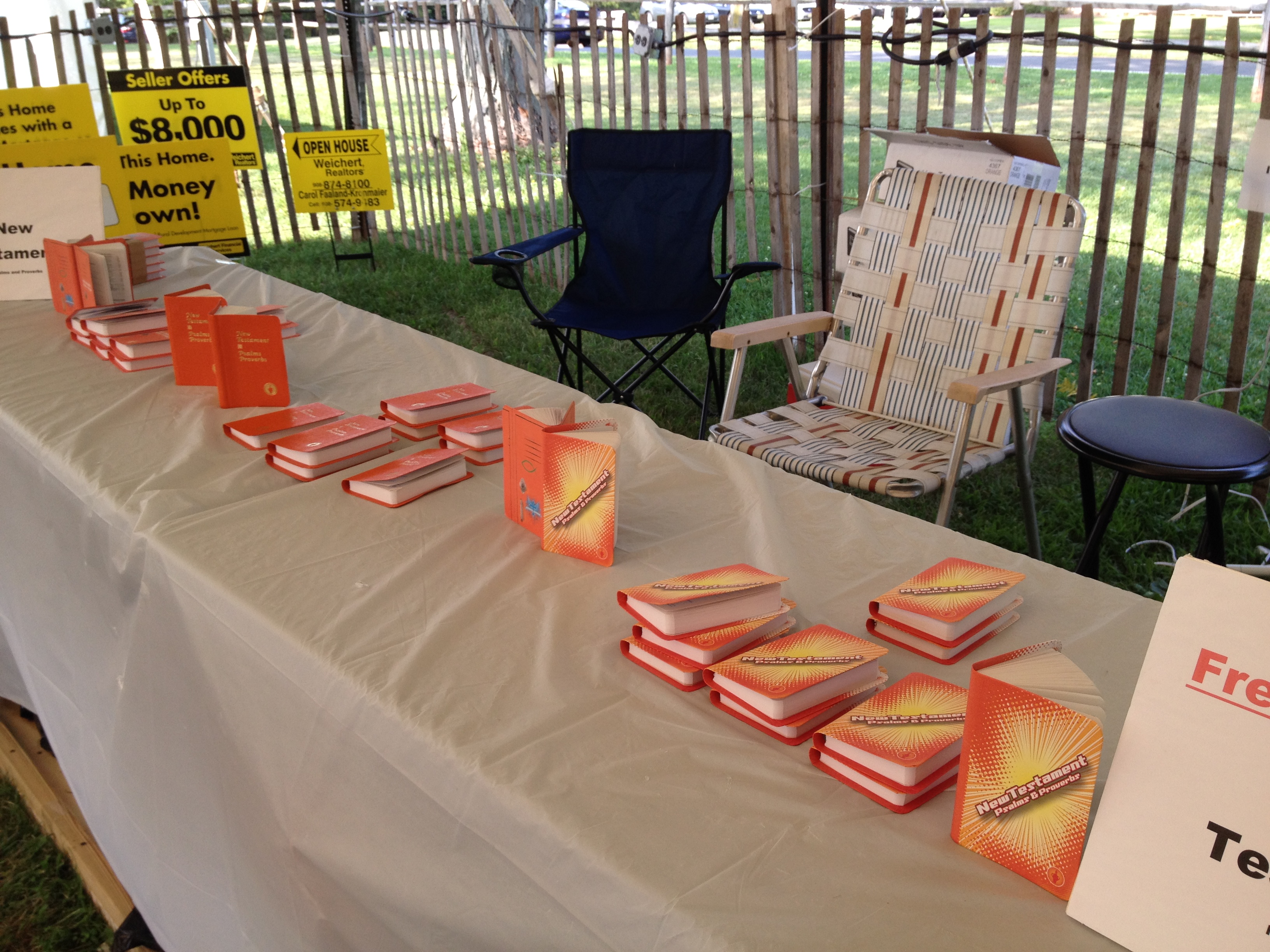
CrusadeAn invitation to join a crusade is a dicey proposition these days.  Perhaps Pastor Ock Soo Park is not aware of the burdensome theological freight the word carries these days.  The Bible Crusade is, nevertheless, coming up on April Fool’s Day, and, I’m glad to see, admission is free.  The tract I clutch in my gloved hand is more like a pamphlet and it is number 3 in a series, “Woman Caught in Adultery,” causing me to wonder what numbers 1 and 2 might have been.  Still, it’s Good News Publishing, so I suppose it can’t be bad, whatever the topic.  The young lady on Seventh Avenue seem surprised when I accepted the booklet she held out with a simple “Bible Crusade?” invocation.  I often accept what the shills hand out; a more thankless job is difficult to imagine.
 
The concept of biblical crusades has a strong resonance with my youth.  Although I attended the occasional revival at our local church, I never actually went to a crusade.  I did watch Billy Graham, however, on television.  I would sit glued to the screen, hanging on every word of the sermon, feeling once again the flush of my sin and the urgent necessity of repentance, then and there.  I was terrified of never giving enough of my life to the Gospel, of backsliding, of hypocrisy, of Hell itself.  As a youth I had no idea of Graham’s political agenda or of the close friendship he had with Richard Nixon.  For me, it was purely a matter of what I had witnessed on the screen as Beverly Shea lead the repetitive chorus of “Just As I Am” that reduced me to tears every time.  When we were asked to list an important person for history class in high school, I felt compelled to write Billy Graham on my slip of paper, and I wondered why people laughed when no one in the room could manage to guess who it was after 20 hints.  As guileless as a dove, but not as wise as a serpent. 

Crusades are all about conquering territory.  Sometimes, historically, that territory is physical and the violence is palpable.  It is charging fully ahead with the conviction that there is no way you could possibly be wrong, even in the face of others from foreign faith traditions willing to fight to the death over the issue.  It is invasion.  Conquest.  In the name of the prince of peace.  Evangelistic crusades are not much different.  The battlefield may be metaphorical, but it is not less real for all that.  The human psyche is not infrequently victimized in the worldview of utter conviction.  Often the driving force is the same as the Templar on his steed—control of the infidel.  With control, as the Templars soon learned, there is great wealth to be had.  As a poor boy in a run-down house, I never questioned that Billy Graham or any other evangelist deserved the money that accompanied such solemn longing of heartsick souls.  It was self-evident.  Now, standing among the crowds on Seventh Avenue, beneath a huge sculpture of a needle sewing on a gigantic button, I have to wonder about the economics of scale.  Reality is seldom what it seems.


The Trouble with Trajectories

The Bible has a way of defining lives.  I realized this at a young age, and although my experience was limited to what life reveals in a small town. Still it was evident that people even there traced trajectories defined by Holy Writ.  I used to ask my students that if something effected you every day, in ways both massive and subtle, and was potentially dangerous, wouldn’t you want to know about it?  Religion in general, and the Bible in particular, fit this description.  As the road began to fork at the usual junctures of my life (high school, college, whatever comes after college), the Bible played a role.  For some reason the Hebrew Bible captured my attention more than the Christian scriptures—perhaps it was because there was more narrative in the “older testament,” and more puzzles to be solved.  While the New Testament seemed to be definitive for matters of doctrinal importance, the Hebrew Bible retained a sense of mystery and intrigue.  Many of its characters, although ending up as “good guys” have decidedly questionable episodes in their pasts.  What’s not to like?

DSCN4387

Ironically, however, I discovered a job market where someone from a Christian background was immediately suspected of a supersessionist outlook on the Hebrew Bible.  Why would a Christian have any interest in that, if not for fabricating prophecies?  Many Jewish scholars were focusing on biblical studies from “both” testaments, and my puerile interests were suddenly naive and not worthy of attention.  This dynamic has always interested me: what right does an outsider have to speak with any kind of authority about another peoples’ culture or belief?  You’d think in higher education we might be beyond such parochialism, but instead, this may be the very definition of its hotbed.  What does it take to gain scholarly credibility?  Being a “white” male in a pluralizing society certainly doesn’t help.

Books are like companions on life’s journey. My reading life started with the Bible and soon gained hundreds of other companions on that long, difficult path to a doctorate in biblical studies that defined an ill-fated career. I cannot reckon the number of books I’ve read along the way, hundreds of thousands of weary pages. And now I find myself back among the biblical crowd, from the outside looking in. They speak authoritatively, I merely whimper. Whether you see it or not, the Bible is here on the streets of Manhattan. Proclaimed or ignored, invisible or plainly manifest. And those of us who’ve spent a lifetime with it have nothing considered worthwhile to say. Once the Bible take a hold, the trajectory for life is set.