Monsters are Due on Main Street

MedievalMonstrosityNow that the slow descent into darkness has begun, my mind naturally turns to monsters. In the early days of this blog I felt as though I had to justify writing about monsters when I was limiting myself (mostly) to religion, but it is now clear that many scholars have recognized the connection. Monsters cross over boundaries, and, given religions’ focus on proper borders, declaring monstrosity is often a sacred task. That comes through clearly in Sarah Alison Miller’s Medieval Monstrosity and the Female Body. Utilizing mainly three medieval texts, Miller draws out how they present various aspects of the female body as monstrous. Predictably, the source of their conviction is frequently the viewpoint of the church, the dominant institution of the Middle Ages. Biology was a touch more advanced than it had been in the biblical period, but despite the figures, many writers assumed the male to be the default model of humanity and the female somewhat suspect. Given the multiple pluralities of the natural world around them, this idea is passing strange.

This book is not for the squeamish. Miller plumbs the depths of bodily fluids and the beliefs surrounding them in a pre-scientific era. Male writers wondering at the changes the female body undergoes, however, may have been a necessary stage in the growth of knowledge. It is easy for us today to suppose that equality should have been always on their minds, but Scripture, a large source of authority for medieval mentality, had cast the sexes into an uneasy opposition. The only figure in the Bible who seems sensitive to the unfairness of it all is Jesus. And even his viewpoint couldn’t change the conservative conviction that somehow God was truly the über-male and that all the females of nature were somehow subordinate. Dare we say it? Monstrous.

Miller closes her brief consideration by delving into the writings of Julian of Norwich. Julian was a most remarkable mystic who wrote of God in strikingly feminine terms. Turning those boundary-violating bodies into the sacred, here was one medieval writer who saw the female as normative, salvific, even. Julian never commanded the kind of authority that a male cleric could, but as Miller shows, even men in this period were considering the feminine aspects of a wounded deity. Reformation, however, snapped a masculine, Protestant lid on any such speculation. Today, ironically, many Protestant traditions have, at first reluctantly, admitted female clergy. The religious body of the Middle Ages, the Roman Catholic church, still keeps women in a separate, somehow subordinate role. Monsters come in many forms and they break down boundaries. Some borders, however, may be meant to be breached.


Darwinian Dawkins

Richard Dawkins seems like he’s probably a nice guy in person. You can tell quite a bit about somebody from their writing, and even when Dawkins is being abrasive in script, you can almost see a gleam in his eye. When I read The God Delusion, for example, I found myself nodding in agreement quite a bit. Not that I agree with everything he wrote; as an academic I can’t, in principle, agree with everything anyone writes. Nevertheless, Dawkins expresses himself with passion and clarity, if with a bit over overstatement. I was interested to read the interview with him in the 10 Questions section of this week’s Time magazine. When one is building a case, it is easy to pile on rhetoric, and pretty soon the force of an argument takes on its own life and sometimes a few casualties are left bleeding in the wake. Still, it is a good exercise to sharpen the mind.

Wikipedia Commons, photo credit: Mike Cornwell

Wikipedia Commons, photo credit: Mike Cornwell

The last of Time’s 10 questions deals with how Dawkins can be certain there is no God. Dawkins, in a conciliatory move, declares that there is much of which we can never be certain. Noting that future science will discover realities that we simply don’t foresee, he suggests, “it’s extremely unlikely that it would happen to home in on an idea from a Bronze Age tribe in the desert.” I found this final sentiment a touch off-kilter. We have plenty of scientific developments that have come out of the “Bronze Age tribes,” but God is not one of them. “Desert tribes” gave us metal smelting, bovine and caprid domestication, and, perhaps most importantly of all, writing. God, however, comes from a much earlier evolutionary strata. In fact, by the time that the Sumerians appeared, multiple gods were already in their train.

In fact, evolutionary scientists seem to indicate that our brains have contrived some need for God/gods. That God isn’t a semitic desert mirage, however, is attested by people all over the world developing the idea independently. Not only did the Israelites and their forebears have deities, so did the Vedic cultures that we now call Hinduism. So did the Native Americans, indigenous African religions, and those who developed in isolation on Australia. Gods evolved everywhere. It doesn’t take a scientist to figure out that this means that we have some need of them. I like what Richard Dawkins writes. I enjoy his candor and passion. We do, however, have to credit the desert tribes with much of the thinking that leads to science, but the gods, they are far more ancient than that.


What’s a Sukkot?

It’s not every day you see a lulav and etrog, even in Manhattan. You can tell life’s too busy when you miss that it’s sukkot. Not that I’m Jewish, but I have been invited to sukkot a time or two by a friend, and it was always a fun, relaxed occasion. A festive little booth in the back yard, sweet wine and cookies. Running the rat race in New York City it is sometimes easy to forget. On my hurried footrace to some place or another, I noticed a group of Orthodox Jews standing along East 42nd Street with lulav and etrogs in hand. So distracted was I that I only vaguely wondered, “why are they holding those at this time of year?” Several blocks later, entering the Port Authority Bus Terminal I saw a man just standing as the crowds parted around him like the Red Sea. In his hands lulav and etrog. Finally it dawned on me: sukkot. It is fall, the time of year when I used to be able to enjoy the bounty of nature and the good-natured holidays. A time before when.

800px-EtrogC

The Hebrew Bible prescribes a set of three pilgrimage holidays: sukkot, shavuot (pentecost to the Greek, or Christian), and passover. Of the three, all associated with the exodus from Egypt in some traditional way, sukkot is the most lighthearted. The command to live in booths is said to be a reminder of the dwelling in tents during the wilderness wandering. Anthropologically speaking, it probably goes back to an ancient tradition of living in huts during the harvest when you don’t always have time to go home and tuck yourself comfortably in every night. Combines hadn’t been invented, and harvesters had to work long hours to ensure that the crop was gathered in. Eventually it became a celebratory occasion. Nice of Moses to allow a bit of festivity here.

Back while at a certain seminary in Wisconsin, a local Jewish friend used to invite my Hebrew Bible class to sukkot. Numbers were small, and invariably wary—were they going to be proselytized by the other? No, but they were invited to shake the lulav and etrog, sip a little wine, and chat about Leonard Cohen. A bit of a cultural exchange in the midst of prolonged indoctrination. I often wonder if my friend continued the tradition after I was asked to leave. The Christian school never made any reciprocal invitations, of course. Ecumenism is often a one-way street. So I stopped a moment at smiled at the stranger in the bus station, solemnly holding lulav and etrog aloft. Life is a bit too busy when we can’t even take a moment to consider all the things we take for granted every day.


Civil Lies a Ton

Often I began my classes by asking a basic question: if something pervasive, invisible, and very powerful were affecting you daily, in all aspects of your life, would you want to know about it? I don’t recall too many sleepy shoulders shrugging. We want to know what it is that is impacting us on a daily basis. Of course, I meant religion. Our secular society has a peek-a-boo affinity with religion; if we close our collective eyes, it will go away. Time and history have long put the lie to this idea—religion is a deep and pervasive force in society, and it is not about to go away. In our one-size-fits-all culture, however, we like to think that the bottom-line of greed and personal promotion will satisfy everyone. Statistics, however, seem to indicate otherwise. Not just America, but the world is a pretty religious place. I have always wondered at the strange elitism that considers itself above the influence of hoi polloi (in the literal sense). “If I’m not religious,” so the reasoning goes, “then no sensible person can be.” And we ignore religions until they explode and then go on ignoring them some more.

Although my career hasn’t turned out the way I’d hoped—I am an academic through and through—I still believe in the conviction that got me started down this rough and tangled trail. Religion is important. It is important to understand because it is very much a part of what it means to be human. Even those who are not religious have had to switch off an instinct that every child feels during a thunderstorm, and every adult feels at a time of deep, existential crisis. We may not believe, and yet we believe we believe. Religion is part of us. If we ignore it, we become strangers to ourselves.

I often look at our insipid culture. Sure, the internet provides hours of entertainment, and even some bits and pieces of knowledge. We have, however, consistently devalued those things that make us civilized. Art, music, literature, and yes, religion, all played a part in the very founding of what we consider civilized existence. Prior to that we were hunter-gatherers, roaming after the necessities of daily life. While our institutions of learning struggle to make entrepreneurs believe they still have value, we train our children to hunt and gather. It may not be food, but it is something not so different from food. Only money truly satisfies. If there were another way of being in the world, it might imply—why, it might imply that there is something more to be gained from life. And since that idea is a religious one, it is safest to ignore it and pray it will go away.

IMG_0558


No Singing Matter

Canticle for LeibowitzA Canticle for Leibowitz, by Walter M. Miller, Jr., is one of those books that I read years ago, and when I picked it up again found that I remembered very little of it. I suppose this is one of the hazards of extensive reading—some important things get lost in the noise. I recall having read A Canticle for Leibowitz when I was a grad student at Boston University, and I remembered the detail of a grocery list being taken for holy writ in a post-apocalyptic world where, in a strange reincarnation, monks have once again become the guardians of knowledge. Little else remained. Perhaps part of the reason is that the book requires more experience with the church than I had in those days. One might suppose a seminarian would have about as much ecclesiastical experience as one might need. Not so. It did teach me, however, to read provocative books.

Like most dystopias, there is a deep bleakness to A Canticle for Leibowitz. In the light of recent developments in the papacy, the book is remarkably prescient. In the final pages of the final section, a radiation-sick woman and her young child, in constant pain, seek the government sponsored euthanasia camp. Abbot Zerchi, however, condemns this as a sin against God. Doctrine takes the place of compassion, and only moments later the final atomic strikes wipe the abbot and his monks off the earth forever. Yet there are monks on a spaceship, ensuring that any future planets will have the same uncompromising doctrine planted there as well. For a book published in 1959, it sounded incredibly contemporary. Miller’s anger still echoes throughout. The church builds societies that destroy themselves. A cycle of futility.

I wonder what the result would be if more people read such stories. It is, of course, easy enough to shut out any implications we don’t like and claim it is all a silly piece of fiction. The problem is that Miller is not too far off base. Our civilization does own much to its religious institutions. Those institutions sometimes have considerable trouble relinquishing control when society finds its grounding in science and technology. It is difficult to believe divine proclamations from above in the age of the space telescope. Yet, even so, we still elect to power politicians who look back millennia for the instructions on how to treat those of other genders or races. To do so, as Miller recognized, is to begin building bombs all over again. And even old Ecclesiastes declared that there is, in a Leibowitzian twist, nothing new under the sun.


Com-Passion

I suppose it is always premature to hope that ancient institutions are likely to improve. Like many other followers of developments in religion, I was pleasantly amazed to read reports of Pope Francis declaring that, in my vernacular, that the church should not be so stuck in the rut of doctrinal abstemiousness that it forget mercy and charity. How sad to see that hours later he was forced, Galileo-like, to recant somewhat. The forces at work are far more powerful than the vicar of Christ. In some minds religion is doctrine. I know whereof I speak. For several years of my professional life I worked for a doctrinaire institution where any hint of mercy was considered a kind of Protestant mewling before a God who would’ve made even Jonathan Edwards tremble. Although officially released “without cause,” I can’t help but think that my own pastoral sensitivities were at fault. I don’t believe that religions thriving on condemnation deserve the title.

Ironically, I was at Notre Dame University when headlines about the Pope’s declaration that the church should not obsess about homosexuality and abortion appeared in the papers. It was with a kind of wonder that I heard an academic say, “the Pope is sounding more Lutheran all the time.” I’m not naive enough to suppose that the pontiff is suggesting a change in doctrine—there are rocks so heavy that the Almighty himself can’t lift them—but that the leader of the world’s largest church was suggesting mercy and compassion outweigh legality felt as if Amos or Micah had just walked into the Vatican. The next day the Pope had to come out and strongly condemn abortion. Politics, it seems, will always trump human understanding.

IMG_0996

We live in an era of iron-willed religions. The human element often vanishes beneath a frowning providence that wishes for clocks to be turned back decades, if not centuries. These religions have no place for improving the human lot in this sinful world—it is much easier to condemn than to contemplate compassion. Religion is hard, for people find forgiveness a difficult doctrine to accept. Jonathan Edwards dangled his spider over the eternal fires of hell, but ecclesiastics today suggest that swift shears taken to that silken web would solve all the problems. Time for change? Not in this century. Religions, too, evolve. But evolution doesn’t equal improvement. Many an agnostic has become so because of the reality of “nature red in tooth and claw.”


From Darkness

All things being equal, most religions side with light. Let there be light. Enlightenment. Dewali, the festival of lights. The light of heaven is as much the appeal just as the darkness of hell is its antipode. Today, as the autumnal equinox turns us toward the darker half of the year, many religions mark the occasion with some kind of notice of the fading of the light. In the Celtic calendar, so indicative of the old religions of Europe, the recognition of the triumph of the dark comes at Samhain, or Halloween. It is the realization that darkness always follows light, and even the relative carelessness of summer has its limits. We are, half the year, no matter our location on the globe, in darkness.

Despite the habits of some college-age folk, people are not, by nature, nocturnal. Biology has evolved our sense of daylight, color-rich sight as a main means of our survival. Our religions have taken our fear of the dark and valorized our experience of light. Even as the winter solstice rolls around, festivals of many religions add more and more lights to ward off the encroaching night. The equinox is a moment of stability. It is a tenuous moment, occurring only twice a year, when darkness and light hold an uneasy truce. We are poised to move into shorter days, cooler weather, and the apparent loss of life. There is a melancholy to it, beautiful and compelling, if somewhat sad.

As I reflect on the fading of the light, I realize that the southern hemisphere, whence light seems to be rising, is facing the vernal equinox. Their summer is about to begin. Days will lengthen and light will be abundant. Our religious calendars tend to be keyed to the experience of those in the northern hemisphere. Those in the south, following the dictates of Rome, celebrate Christmas in summer and Easter in the fall. After my rainy visit to Indiana, where, on a rainy Thursday evening I saw a rainbow in the east, I awoke to a rainy Friday and saw a rainbow to the west. Fractured light. The light of a fading day broken into its myriad shades and hues. Light is that way. It is always daylight somewhere in the world, but religions focus on the light where we find ourselves at the moment.

IMG_0744


A Certain Man Went Down

Among the progeny claimed by Wabash College is Dan Simmons. I’ve read a couple of Simmons’ ghost novels, although in reverse order. I read A Winter Haunting, which I quite liked, and followed it up with Summer of Night. Having lived in the Midwest many years, it was easy to visualize the scenes. Then came the time for my trip to Crawfordsville, Indiana. I started the day in South Bend, finishing up my meetings at Notre Dame. I’d noted on the map that, as is often the case, the places I need to get to just aren’t connected by anything resembling a direct route. Although the forecast said “30 percent chance of rain,” I’d awoken at 4 a.m. to a thunderstorm and it had been pouring all morning long. I could swear they were making plans to convert the great Notre Dame stadium into an ark. Perhaps I’d forgotten just how persistent Midwestern storms can be. Soaked, I crawled into my rental car to tool down to Crawfordsville. At least the rain had finally stopped.

On one of those highways in the middle of corn fields as far as the driver’s eye dares look, the low tire pressure light came on. I dutifully pulled over and called Hertz. The suggestion was to find a gas station and put some air in the offending tire. Someone could be there in three hours. Looking about me at the amber waves, I thought of the spirits of Dan Simmons’ stories. A car breaking down in the heartland. No one around to offer assistance. The illusion allusion was shattered when a stranger pulled over and asked me if I needed help. I recall a priest friend once tearfully confessing to me that he had, on a rainy night, refused to stop to help someone with a flat because of fear for his safety. I understood completely—it can be a scary world out there. “And likewise a Levite, when he was at the place, came and looked on him, and passed by on the other side.”

With multiple stops to put air into my slowly leaking tire, I limped my way from town to town, reaching my destination after dark. Along the way a fierce rainbow appeared to the east as the sun began to set. Once you’ve abandoned the interstate in Indiana, there’s no going back. I began to notice just how many churches dotted each little village through which I drove. Samaritans, I thought. As I write this in Crawfordsville, I think of the corn, sorghum, and soybean fields that inspired Dan Simmon’s ghosts. I think of a stranger, a woman of minority demographics, stopping to see if I needed help along a lonely highway. She was among those our society would deem vulnerable, and yet she was the only one who stopped. And I think of parables. “But he, willing to justify himself, said unto Jesus, And who is my neighbour?”

IMG_0988


Our Lady of Culture

So I’m in the land where sport and religion become one.  Notre Dame is an intimidating university for a small Protestant like myself.  Like on a first date, I’m never sure what to do with my hands.  Standing below the famous “touchdown Jesus,” more properly, the “Word of Life,” I feel small indeed.  For a long while in US history, Catholicism was treated like some kind of cult.  Those of us reared Protestant were taught to fear “them” and their ritualistic ways.  I’m more afraid that someone might ask me about football stats.  Sports is a religion I’ve never studied.

IMG_0997

Culture is like a colossal Cuisinart.  Lots of stuff goes in, all of it more or less equal, and the blades begin to whirl.  Sports, religion, fast food, alcohol, a dash of education, and we’ve got an American classic.  The only time that sports come to my mind is when they start to take on the flavor of religion.  The level of the devotion of fans is the envy of many a church.  In fact, the word “fan” was borrowed from the lexicon of religious behaviors.  It is not difficult to sense the pride in football here, but then, sports are often a civilized way to assert one’s self-worth in a culture where self-worth feels under threat.  It is hard to recall a time when the Fighting Irish were not mainstream.

“High culture” has put itself on the endangered species list by becoming inaccessible in a culture that doesn’t value education (not to reflect on the academics I’ve seen at Notre Dame, which are pretty impressive).  I cringe, however, when I see polished politicians basking in their lack of introspection on issues that impact the entire human race.  They seem proud to declare themselves untainted by education.  They will support sports, however, and particularly football where violence is padded, but still encouraged.  It is culture for those who enjoy the lowest common denominator.  In the airport I noticed another “touchdown” character who, in some quarters in more recognized than the deity soaring over Notre Dame’s venerable stadium.  I was in the true presence of culture even before I boarded the plane.

IMG_0977


High Tide

While the devastating rains in Colorado this month are a very serious concern, over the past several days I heard and read the adjective “biblical” associated with them several times. Even the National Weather Service made reference to “biblical rainfall amounts.” It’s true that the Bible does contain the most famous, if not exactly original, flood story in the modern world. The tale of Noah easily goes back to the Sumerians, and there are deluge stories from around the world that rival it in most details. Even in this secular age, though, we all still know that floods are the province of providence. It is of interest, however, how the word “biblical” has taken on a distinctly negative connotation. The most noteworthy of biblical materials are high literature of optimism and potential for good—and sweet heaven when we die. And yet, floods, droughts, plagues of insects, these are the “biblical” events in our lives.

Floods can indeed be devastating. They demonstrate the illusion of solidity under which we try to assure ourselves that the high ground is the safest place to be when the globe warms up, or God grows somewhat impatient with human antics. Biology has implanted deeply in our psyches the desire for a safe haven, a place where we can store our stuff securely. In fact, the “net worth” of an individual—so noteworthy when we die—is measured in terms of the material goods which we control, or “own.” The quality of a person’s inner life is not something of their “net worth” to society; it can’t be divvied up by lawyers and investors, and, in terms of legality, is unimportant. We are valued for our things.

That’s why floods are so pernicious. I don’t devalue the lives that have been lost, but the headlines declare the dollar amounts more loudly. Here is where the obvious clash between the days of Noah and our own come into play. The only goods the delugonaut took aboard the ark consisted of food and life itself (although the Sun Pictures version shows his family with anachronistic metal knives and even some furniture). When the whole world is flooded, the only property valued at all is that on the deck next to you. Our society values people by what they acquire rather than by who they are. Floods wipe out the former, leaving the latter harried but hopefully intact. If we were to build arks today, no doubt as the clear-cutting of rain forests with the subsequent extinction of countless species shows, we would use the choicest wood and would cram every last square inch with our stuff, while people and other animals outside beg for entrance onto the boats that we “earn.”

448px-Noah_mosaic


Grace, Virtually

Although Yom Kippur is now over, I have a confession to make. My wife just showed me eScapegoat, the website where you can confess your sins over the virtual priest laying electronic hands on a disturbingly cute animated goat. Even before I owned a computer (or one owned me), and even before I knew of the internet, I used to joke with friends what the technological revolution would mean for religions. Would we eventually go to an ATM for virtual communion? Would the screen glow with the words of the eucharistic liturgy, Rite 1, or would it be more contemporary (Jesus raised the glass and said, “This blood’s for you!”)? Would a physical wafer come through the slot? If so, would it have to have been pre-consecrated? So our bemused musings ran. But our idle thoughts held a touch of prophetic insight, it seems. Can the force of religion come through the keys upon which your fingers rest? The monitor that glows like heaven itself? Whence electronic salvation?

There can be no doubt that religion is a huge topic on the internet. I generally don’t go looking for it, because it will come to me. Religions, by their very nature, spread. They are aggressive memes, wanting desperately to replicate themselves. Our frail human minds want so much to believe that we have found the truth, and once we have, we want to share it with others. Bibles were among the first books off the first printing press. Television soon evolved televangelists. The internet became the home of virtual religion. For some it is reality, nothing virtual about it. Concepts such as grace, however, defy any kind of clear exposé, there’s always shadows in this room. Can it make its way, preveniently, through the wires and waves of the internet?

eScapegoat is lighthearted, but I can’t help but wonder if there isn’t a more serious side to it. Confession on the internet can be cheap. Anonymity (excepting, of course, the NSA) is easily maintained. Your confession, visible to the faith community, is really between you and the Almighty, right? The book of James tells us confession is good for the soul, or something similar. We all know that admitting a mistake has its own cathartic release, but I found confession, in my Anglo-Catholic days, terribly invasive. Surely I knew that I’d made errors, and I knew that I felt badly about them. Did I really have to tell someone else so that I would feel bad about them all over again, reopening wounds that had already begun to heal? Isn’t this the beauty of eScapegoat? You can make a serious confession that others will see anonymously as a joke. Our poor, blinking goat will pay the ultimate price.

800px-William_Holman_Hunt_-_The_Scapegoat


Where No One has Gone Before

766px-VoyagerI already miss Voyager. Not that I ever met her, but I followed her progress from her youngest days and to when she was a curious youngster flirting with Jupiter and Saturn, to her more circumspect considerations of the outer gas giants. An extension of human curiosity itself, Voyager 1, like the Energizer Bunny, just kept going and going and going, revealing a solar system more beautiful and complex than we earth-bound denizens knew. And she didn’t see God. Ancient people had always supposed, given the human disposition to climbing, that God was somewhere above us. Even the discovery that we live on a globe didn’t really change that—we are still down here, so God must still be up there. Voyager 1 has traveled 11 billion miles with nary a glance at the divine, and she is now the first human-made object, besides perhaps God, to exit the solar system.

Space has always been a personal fascination. I took astronomy both in a Cold War era high school that actually had a working planetarium (in a very moderate-income town, even!), and in college (where there was no planetarium). In unguarded moments I even considered astronomy as a career. I don’t have the “right stuff” to be an astronaut, but I can stare at the sky for hours and wonder. Voyager was out there doing things I’d never do, seeing what I could never see, experiencing the deathly frigidity of cold, cold space. And now she’s leaving home. No one is certain how long she’ll keep serving humanity with new images and information. It will take her a long, long time to reach anywhere else, unless she’s abducted by aliens. In the meantime, all of us down here will age and die, as will the next few generations. Voyager will simply keep going.

Space is beautiful in its solitude. The objects that we’ve glimpsed out there have been full of wonder and mystery. Still, we are told, it is mostly empty space. Or dark matter. Perhaps because of the active volcanos on our own planet we were once told that Hell lay under our feet. There is a fiery world below, to be sure, as science has demonstrated. We call it the mantel rather than Hell, and visits to it are decidedly short-lived rather than eternal, but ancient religious thinkers got the temperature about right. If the analogy holds, Voyager 1 may yet meet some kind of deity out there. She, after all, has escaped the solar system and has slipped into Heaven. In order to explore eternity, we need to boldly let her go where no device has gone before. Although I never really knew her, I already miss Voyager 1 badly.


Just Binghamton

I seem to find myself in Binghamton again. The town, while clearly economically depressed, still retains a bit of its 19th-Century charm with some beautifully restored downtown buildings and a sense of history. While too many store-fronts are still vacant and too little money exists to improve the area sufficiently, I happened upon a warm and cheerful independent bookstore—River Read—and that always gives me hope in such circumstances. Bookstores such as this are like seeing the first crocuses after a long, harsh winter. There is some life in this seemingly dead planet yet. Outside the bookstore stands a statue of Martin Luther King, Jr., backed by a sluggish river and yet more vacant windows. I think of justice and all that it means.

IMG_0969

My own hometown (not Binghamton) is virtually a ghost town. It is a feeling difficult to describe, visiting a place that served as your first secure setting in the world only to find it crumbling under an economy with so much wealth with so little reach. Where is the justice in that? Binghamton, near the founding location of IBM, ironically began suffering at the decline of the Cold War. Manufacturing has gone for pastures of a different kind of green, leaving a sometimes sad and forlorn city in its wake. Binghamton sheltered a young Rod Serling, a man who would give the world the Twilight Zone and its endless spinoffs. It is home to a first-rate university. And a wonderful bookstore.

While in River Read we heard some locals talking, in almost Springsteenian fashion, of local civic traditions that had disappeared. Times have changed. Cities like Binghamton don’t draw in the curious or those with liberal purse-strings. Endicott Johnson, the shoe manufacturer, developed a strong sense of welfare capitalism in the city last century—capitalism with a heart seems to have gone extinct these days. The idea that those with the means to create jobs and livelihoods should care for their employees would seem to be a matter of common sense. Instead, common cents have come to rule. Binghamton University is investing in the town, and a sense of cautious optimism dares to suggest itself. Justice is a matter of distribution rather than entitlement. And that’s why I’m standing out here under gray September skies, staring at the statue of Martin Luther King, Jr.


Dystopian Dreams

Hunger_gamesOne of the most terrible stories in the Bible is the slaying of the firstborn of Egypt. Of course, depending on your point of view, this was either a necessary evil or an act of wanton cruelty by a deity with anger issues. Still, it ends with a bunch of dead children. Then, as if that weren’t enough, a horrible reprisal comes at the birth of the child of the main character, with Herod slaughtering the innocents in Israel. And let’s not forget the very source of Kierkegaardian angst, the knife poised above a bound Isaac by his completely believing father. More recent, less literary examples could add poignancy and reduce the distance: Columbine, Newtown, Virginia Tech—the murder of children is beyond the farthest reaches of perversion into a realm that no longer classifies as human. I think the Bible might agree with me there. So it was with some trepidation that I read Suzanne Collins’ The Hunger Games, at the urging of my daughter.

Although written for a young adult readership, The Hunger Games is a classic dystopia with a dark future and repressive government mandating the killing of twenty-three children every year, just to make a point. Deftly combining teenage angst with the bleakness that just about any future-based novel seems to hold, Collins spins a sad but engrossing tail. Dystopias have grown in popularity since some of the earlier, Cold War exemplars such as 1984 and Fahrenheit 451. The number of dystopian novels grows every year. I suppose if I were an elected official I might cast a worried eye towards the increasing number of exposés of a society where consumers read so many books of the future gone awry. I know many intelligent, sober people who seriously wonder if we’ve already shifted onto that track. Tomorrow is only an extension of today.

Dystopias are among the most biblical of literary genres. The Bible itself is a bit of a dystopia. Consider the framing of a perfect world ending up with the original apocalyptic tale, the Apocalypse, or Revelation. It only ends well for 144,000. In-between there are pages and pages, chapters and chapters of oppression, violence, and suffering. Paradise gone bad. That’s the essence of the dystopia. Although Collins doesn’t make any overt biblical or religious references in The Hunger Games, the very genre she chose can’t escape the biblical bounds laid out for it. And besides, long before the year both Collins and I were born, the Bible had already set its vision for our society. And that vision, to our everlasting trembling, includes the massacre of innocents.


True Possession

Jheronimus_Bosch_050_detail_01

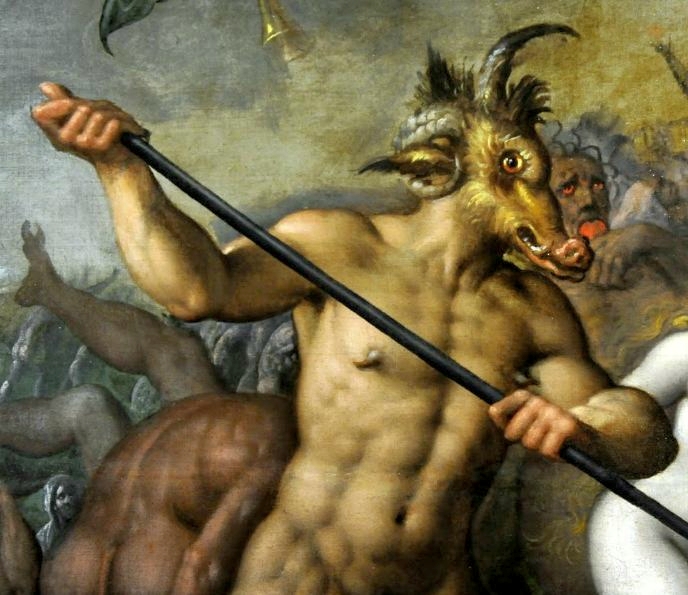
Demons are among the earliest of supernatural creatures. Although sources can be spotty, they appear in the first advanced civilization known, that of the Sumerians. Even with their technology and scientific sense, early people still knew that demons had great explanatory value. Why did things sometimes utterly fall part? Why did some people act so weird? Why did the good will of the gods not always shine through? Demons, while not exactly tricksters, are the demoted gods who cause problems. They also harbor possibilities too, if an article sent by a helpful relative is anything to go by. According to the BBC, a trio of styled and battle-trained young exorcists are about to take to the airwaves to ply their trade in a show called Teen Exorcists. Savannah and Tess Scherkenback join preacher’s daughter Brynne Larson as a trio of demon-dropping debutants ready to take on the powers of Hell. All three, according to the article, are home-schooled.

I’m not quite sure what to make of demons. Aware of more rational explanations of human psychoses and inevitable misfortune, there doesn’t seem to be much room for second-rate deities in the world any more. Still, writers like Matt Baglio and Malachi Martin narrate enough strangeness to make you wonder if we might’ve been a little too hasty in dismissing the supernatural. Especially after staying up late to watch The Exorcist. And it’s not just that it’s three young girls casting demons into the pit—according to Acts Philip’s daughters were prophets and Mark says people who didn’t even know Jesus were pretty handy with the rite. It’s the whole issue of demons. According to the BBC, the girls believe England is especially afflicted because of the Harry Potter novels. (The spells, they say, are real.)

The team of three and Rev. Larson do, unlike Ghost Hunters, charge for their services. And even a duck hunter on television can strike it rich. Simon, later known as Simon Magus, offered the apostles money to gain the power of the Holy Spirit, according to Acts 8. Rebuffed, Simon turned against the fledgling Christians. If there were reality shows back then, I suspect he’d have had one. The three girls are black belts in karate, adding to the television appeal, but demons, we’re told, are incorporeal. That’s right—they have to be fought without physical violence. Armed with Bibles and crosses (no crucifixes, since this is a Protestant exorcise) three young girls take on the dark side of the spiritual world. The chief of the demons, however, is named Mammon. Against that one there seems to be no defense.