Call for Papers

The following is a call for papers from my colleague Dr. Joseph Laycock. Anyone interested and qualified, please contact him directly:

Dear Colleagues

I have recently been given the privilege of guest editing a special
issue of Nova Religio on the paranormal. In the last few years,
several good books have appeared that consider so-called “paranormal”
beliefs, discourses, and experiences as an object of inquiry for
religion scholars. Like the category “religion,” the category
“paranormal” is poorly circumscribed and may potentially include a
wide milieu of supernatural and pseudo-scientific beliefs and ideas.
We seek papers that address the place of paranormal discourses within
the larger context of religious and cultural studies. We also invite
papers on religious aspects of specific paranormal discourses such as
UFOs, psychics, hauntings, etc.

Submission Guidelines
Potential authors should first review Nova Religio’s website to get a
sense of the aim and scope of the journal. Authors should follow the
guidelines for authors on the website for the format of the paper and
its citations.

Submission queries, including abstracts, should be sent to Joseph
Laycock: jlay@bu.edu. Completed articles are due August 1, 2012, and
should be approximately 8,000-10,000 words including all documentation
and critical apparatus. As the guest editor, I will make the initial
determination about which papers are suitable for publication, and
work with authors to improve their draft papers before forwarding them
to Nova Religio’s co-general editors. The co-general editors, Eugene
Gallagher, Joel Tishken, and Catherine Wessinger, will make the final
decision about whether or not a paper can be accepted for publication
in Nova Religio.


The Price of Religion

Gender is a religious construct as much as a biological one. The study of religion has brought me face-to-face with the reality that religion appeals to many women and to those who would manipulate them. Lately I’ve taken to reading the memoirs of women who’ve discovered the abuse their faith has doled out to them and who’ve taken moves to reclaim their lives. This past week I read Deborah Feldman’s Unorthodox: The Scandalous Rejection of My Hasidic Roots. As someone who has spent much of his life reading and re-reading the Hebrew Bible that gave fuel to the Mishnah that gave fuel to the Talmud that gave fuel to the Hasidic movement, I found Feldman’s narrative gripping. Some branches of Judaism, like some branches of Christianity, try hard to separate themselves from society. Their cloistered lives become secretive, and often by the standards of secular culture, incomprehensible. While reading this wrenching account of sexual domination, I kept wondering why Feldman didn’t try to escape. At the same time I already knew the answer.

I was raised by a religious mother who found her faith both a source of rules and a source of comfort. Unaware that religion can be a trap, women are frequently its victims. In a society that still refuses to give females equal opportunity for earning a living, is it any wonder that religions offer alternative routes that equally entrap? How do you appeal to a higher power when that higher power is, by biblical definition, male? Who will help you out when the largest religious structures in the world are male constructs? Yes, lately some religions have opened themselves to female leadership, but almost always at the cost of splitting off of factions that claim seniority and sanction from the beginning, when, they claim, only men ran this show. Deborah Feldman was trapped in a religion where her life, down to her hair and clothes and reading, was programmed by male expectations. In this continuum between religions we find the same progression in a series of degrees where men make the rules.

Many who read Unorthodox, I suspect, will see it as a condemnation of Hasidic Judaism. It is not. As Feldman makes clear, she has retained her Jewish identity, but she has let it evolve into a place where she is finally free to express herself. Gazing over the religious landscape, I see this as a place that many women find themselves. The very religions that had formerly held them down, however, continue to be male preserves. Even if women may join the club of bishops, clergy, or rabbinate, they do so with the constant reminder that they are only invited guests in what was once a masculine world. The world of men never voluntarily relinquishes its grip. As long as people are considered in the image of God they will always be by default male and female only as an afterthought. To conceive it any other way would be very unorthodox indeed.


Honor Thy Mother

Earth Day should be an international holiday. Perhaps the most disturbing attribute of some varieties of Evangelicalism is their tendency to read the “Be fruitful, and multiply, and replenish the earth, and subdue it” of Genesis 1 to be a mandate not tempered by a literal reading of Genesis 4. As I noticed when tweeting the text yesterday, Genesis 4.11 has God say to Cain, literally, “And now art thou cursed from the earth, which hath opened her mouth to receive thy brother’s blood from thy hand.” Her mouth? What is this if not a biblical affirmation of Gaia? The earth, according to Genesis 2, is literally the mother of Adam. Yahweh is the male element, the fingers molding the dirt (those who have ears, let them hear), while the womb of this bizarre conception is the earth itself. She has a mouth to receive the blood of Abel. The planet beneath our feet, according to the Bible, has not only a mouth, but also hands (Psalm 89, for those who doubt). It is our duty to grasp these hands and save our mother from ourselves.

In the spirit of the day, I decided to fix that pesky leak in the bathroom sink yesterday. We rent, of course, and our landlord—the nicest I’ve ever known—can be a bit slow when it comes to non-emergencies. I fixed the kitchen sink a year or two back, so I stuck my head under the cast-iron monster, baptized by the drips that continued to appear above my head from pipes far older than Methuselah, to see what I could do. After trips to every hardware store in the area, watching bemused DIY experts scratch their heads at photos on my phone of the Byzantine arrangement under my sink, I finally had to admit defeat and reassemble the old faucets again. The drips that fall are Gaia’s tears.

When I was in college I learned of Pascal’s wager. A philosopher who liked to hedge his bets, Pascal deduced that if God exists then our eternal fate relies on our obeying him (always him). If God does not exist, we have lost nothing by behaving ourselves, Pascal concluded. While many Evangelicals find that reasoning attractive, they do not apply it to their mother planet. If God is not coming back any day now, we’d better take care of the planet that sustains us. If God does show up, against all odds, what have we lost? Watching the plants burst back into life after a gray and dank winter, who can help but wonder at it all? Literal or not, the earth is so maternal that we should all pay her the reverence she is owed. Even if it means being a literalist for a day.

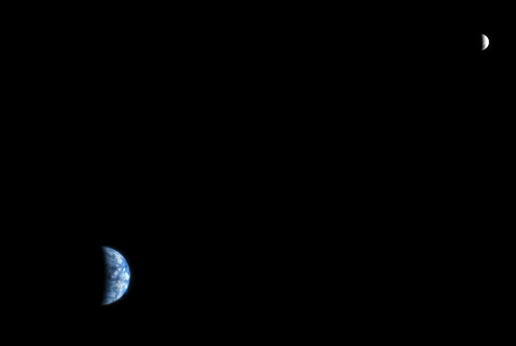
NASA's picture of our mother.


Nun Such Luck

It hardly seems to be news anymore when the headlines read “Vatican orders crackdown on US nun association.” Religions are largely characterized as men telling women (and milquetoast men) what to do. Perhaps because of our evolutionary, simian respect for the alpha male, most followers will resist pointing out inequities in the system just to have a smoother ride. The all-male Vatican is reportedly worried about how nuns of the Leadership Conference of Women Religious might be distorting the masculine teachings of holy mother church. No matter how much science the Vatican supports, it just can’t get over the idea that when God is found out there he will have not only a human face, but a human penis as well. The Associated Press article states that the Congregation for the Doctrine of the Faith—that is the organization of the Inquisition, my dear readers—found grave errors of doctrine among the ladies. Sounds like time for an auto-da-fé, n’est-ce pas?

Somewhere on its long and weary trek, the control of fellow humans for the sake of God has slipped into the rut of control of fellow humans for the rush of power. The Catholic bishops are worried about abortion (and other healthcare options for women). The Bible says nothing about abortion, considering life to coincide with the first breath. The chosen people did not have a conception of how conception worked (you can’t see the sperm or ova without a microscope, no matter how divine they may be) and so life began and ended with breath. The only reason to push the origin of life to conception is so that men may control women’s sex lives. These decisions are made by sexless men who wear dresses behind inscrutable walls of power. When nuns start seeking fair treatment for women it quickly becomes heresy.

I don’t mean to single out the Roman Catholic Church here, since many religions proclaim male superiority—loudly or softly. Back in ancient times when goddess worship was taken as seriously as the cult of male gods, a few religions did exist that gave women a position equal to, or sometimes even above, men. The priests of Cybele, for instance, had to undergo ritual emasculation. Strangely, religions with celibate priesthoods today leave their men intact, perhaps as a loophole for sin. I wonder how much more women-friendly official theologies would be if only eunuchs were allowed to serve as pastors. It is, as Genesis famously states, sin that “is crouching at the door,” and therefore it is better to remain gendered and pray not to be led into temptation. Perhaps we have something to learn from history yet.


Dark Shadows Indeed

Part of my childhood died today. Like millions of others, I have been eagerly anticipating Tim Burton’s new Dark Shadows movie to wash the treacle of Twilight from the vampire’s mouth. Barnabas Collins was the epitome of the conflicted gentleman vampire, fully aware of and repulsed by his curse. After school I would religiously sit in front of the black-and-white television and watch the waves crashing into the cliffs of Maine as the moody story began to unfold in daily episodes. So when I read this morning that Jonathan Frid had died, I knew the vampire had found peace at last. And I was sad.

Although I’ve read scholarly analyses of monster fascination, nothing sets me back to childhood so directly as my beloved monsters. I don’t know why I feel a thrill in my chest and my pulse quickens when monsters appear before me. Perhaps it is a child’s way of coming to grips with a world beyond his or her control, or perhaps it was my way of dealing with a broken family. Lacking a father figure in life, I was fascinated by the gentle care and predatory nature of Barnabas Collins. He really did care, but he still had to bite you in the neck to survive. To my pre-adolescent mind, Jonathan Frid was Barnabas Collins. When I grew old enough for gothic novellettes, I consumed the serialized Dark Shadows books by Marilyn Ross, no matter how predictable or trite. I was reading about my heritage.

I have no doubts that Johnny Depp will portray a believable Barnabas Collins next month. Jonathan Frid, it is said, was consulted and was often present on the set of the new movie as it was being filmed. His turn to portray the tortured ancestor of the Collins family had lapsed, but he was the original. What is the draw of the vampire if not life after death? And although Jonathan Frid is gone, next month I will stand in line to see the resurrection of the vampire on the large screen.


Final Flight

Back in the day before CD players, let alone MP3 files, my mom had a squat, boxy rectangle of a cassette-tape player. (Remember, I am a student of ancient history.) The cassettes we had were home recorded, scratching and hissing like a disgruntled cat, but they were the latest in technology. And, of course, they were religious in nature. One particular tape I still remember with terror. Narrated by a optimistically doleful bass male voice, it recorded the events surrounding those climbing aboard a plane bound for heaven, along with authentic jet noises. It was, of course, a thinly disguised metaphor for death, something I realized even as a child. As the passengers climbed aboard, anticipating that meeting with Jesus, I trembled in fear. They were all about to die.

I have never been particularly afraid of death. Not that I’m in a hurry to go there, but I have always sensed it as inevitable and therefore not worth worrying over excessively. I was one of those who grew up thinking quite a lot about it, viewing it from different angles, trying to make sense of it. I still do. While I was in England, Time magazine ran a cover story on Heaven. Now that my feet are back on the ground, I have been reading the story with interest since I’ve just been spending several hours on a jet in the sky. One of the most surprising elements in the story is the fact that some evangelical preachers are beginning to inform their flocks that heaven is what we make it here on earth.

This may not sound shocking to you, but having grown up evangelical I knew that the only reason we behaved so well all the time was so that we could get into Heaven when we died. This was the economic basis of salvation—you paid for Heaven in good deeds and correct belief. Not that you exactly earned it, but you did invest in it. This was the defining characteristic of Christianity. The suffering that is so obvious in the world (I saw three homeless men curled up together inside the Port Authority Bus Terminal just this morning) can harsh anyone’s paradise. The traditional “Christian” response has been to look past that to a shimmering, if imaginary, kingdom in the clouds. I am very surprised that some evangelical pastors are willing to risk their entire campaigning platform in order to help those in need. It’s getting so that it is hard to tell which way is up any more. Maybe that’s what happens when you spend too long on a plane bound for a mythical destination.


Fighting Jesus

Jesus Wars, by Philip Jenkins, accomplished something no other book has ever done for me—it actually made the doctrinal debates of Late Antiquity interesting. An historian of religion with wide interests, Jenkins produces fascinating books on what might appear to be esoteric aspects of religious life. I remember yawning through theology classes where we learned of crusty, if utterly convicted, monks and bishops arguing over single prepositions in their efforts to define exactly who Jesus might have been. When Jenkins turns his attention to this dusty, unwashed phase of Christianity’s gamy early years, new avenues on regulated belief structures open the way to understanding just how little most believers know of their own traditions. On its way to feel-good evangelicalism, Christianity frequently paused along the way to brutally murder some of its own for disagreeing about whether Jesus shared the same essence as his dad.

Today many Christians are taught by their clergy that their faith differs little from that of the earliest Christians. All who are taught this should be compelled to read Jesus Wars in order to get a grip on what really happened. From the very beginning Christianity was deeply divided about who was truly a follower of Christ and who was not. Even within a generation of the death of Jesus his various groups of followers could find little that they all agreed upon. As Jenkins demonstrates, over the next few centuries that sad history was worked out with extreme cruelty and cudgels and swords. The side with strongest force of arms got to decide on doctrine. Nor did matters improve with the Protestant Reformation. Many Reformers lapsed into what would have found them tied to a stake for heresy, had they been fortunate enough to have been born in the early centuries of “the Christian Era.”

The one figure that seems to have been lost during the Jesus Wars was Jesus of Nazareth. Instead, human constructions of who Jesus might have been became the source of great suffering. Bishops beating bishops to death, saints having women murdered, monks forming an unwashed militia—it’s all here along with the debate over how many angels might dance on the head of a pin. Jenkins does an excellent job of demonstrating that what is now known as “orthodox” Christianity was often a matter of political accident. In the case of Theodosius II, the future of Christianity literally rode on the horse that stumbled, tossing the emperor to his death. No doubt, there will be those of one or another brand of Christianity who will see the divine will behind the ultimate outcome. That outcome, however, will always insist that all others are wrong. For those seeking a bit of balance, Jenkins will make enlightening reading. For others it may give the lie to doctrines made what they are by mere mortals. In any case, the words attributed to Jesus about loving your neighbors and enemies will nowhere be found amid the debates of who he might have really been.


Darwin’s Descendents

The plague that goes by the name of Creationism has been attempting to spread its reach to the shores of Britain. Proponents of a biblical literalism, whether overt or covert, have championed the idea that the world is terribly young—a mere cosmic toddler, in fact—compared to the vast geological ages of actual fact. When I unfolded my first ten-pound note and found Charles Darwin on the back, I smiled. England may claim a lion’s share of the heritage of one of the great unifying theories of science. In my brief jaunts between bouts of work I came across the tombstone of Herbert Spencer, the man who coined the phrase “survival of the fittest.” On a visit to Kew Gardens I strolled through the Evolution House. When I paid for my lunch, Darwin passed hands as the common currency of the realm.

Ten pound note

A school of thinking exists among many religious believers that insists that if science makes its claims justly then God cannot condemn them. Evolution runs as close to fact as does atomic theory. Those who doubt the latter should visit Hiroshima. Or Three Mile Island. Our literalist companions certainly don’t doubt nukes, but then, the Bible is mum on the subject of what things are really made of. Well, almost. According to Genesis 1, everything is made of chaos and divine words. The Bible doesn’t describe the origin of chaos—it is the natural state of things. God’s word, when it generates uranium, can be very deadly indeed.

Evolution House

Creationists selectively choose which science to believe and which to reject. Fundamentalism can trace its origins to Britain, but the culture rather quickly outgrew these childish fantasies. In America literalism sank deep roots, roots deep enough to withstand the hurricanes of reason that would otherwise clear the air. Can an American imagine Darwin sharing the money which reads “in God we trust”? And yet, Darwin lies scarcely two meters from Isaac Newton in England’s holiest shrine of Westminster Abbey. Science and religion have here embraced one another. Perhaps when we put all the monkey business aside, we will come to realize that we may still have a thing or two to learn from the nation of our founders. Literally.

Darwin at rest


Cain’s Dilemma

As I tweet the Bible into cyberspace, Cain strikes me as a most misunderstood character. Mercilessly portrayed as an ungrateful boor, the first vegetable farmer in folklore is demonized as the father of all sinners. Genesis, however, is impossibly vague on Cain’s crime. A close reading of Genesis 4 indicates that Cain was the first human being to offer a sacrifice to a higher power. Being a tiller of the soil, that sacrifice was of the fibrous kind, bereft of any fat or blood. The divine nose (metaphorically) is turned up at this attempt at pacification. In steps Abel with his bloody slaughter of animals and God is well pleased. Traditionally, Christian readers have attributed Cain’s evil intent toward Abel as jealousy. Genesis doesn’t seem to bear this out. “But unto Cain and to his offering he [the Lord] had not respect.” Cain was not jealous, but “wroth.”

Much later in time Paul of Tarsus will tell fledgling Christians that God is “no respecter of persons.” Still, in that first moment of divine favoritism, prior to any explicit instruction being given, we catch a glimpse of the future of this nascent religious movement. Even today, the literalists tell us, God expects something from us. What, exactly, differs from interpreter to interpreter. Cain’s crime was simply being human. Even more poignant in this case is the fact that the divine allowance for consuming meat has not yet been made. Abel raises animals for God’s appetite while Cain raises vegetables for human consumption. No sentient being is harmed in Cain’s offering. Abel, one might say, is the first killer in human history.

We all know the story. Cain will rise up against his brother and slay him. He will then receive a prototype of the mark of the beast and scamper off to rustle up a wife somehow. All this before the third natural born human being, Seth, is even conceived. Beowulf will reflect Cain’s dilemma centuries later, as Grendel is the spawn of the first murderer. The descendents of Cain are routinely demonized while the children of Seth repeat the cycle of divine favoritism over again. Here is Cain’s problem: God will like whom God will like. The rest cannot earn divine favor. The bloody consequences of this reading of history continue to play themselves out even today. Those who need divine approbation will go to any lengths to feel special, while all of us, the true heirs of Cain, have to work it out as best we can under silent skies.


Bookends

There is something extremely satisfying about bookends. Bookends are those events that bracket moments of our lives and give them a frame, a perspective they would otherwise lack. If my readers will indulge my recollections of my trip to Britain for a day or so longer, some of this may become apparent in esoteric ways. Our kind hosts in London live in Highgate. Our first bleary-eyed morning in the city we wandered to Highgate Cemetery. This burial ground is divided by Swain’s Lane and that makes it frightfully convenient to charge separate admission fees for the two halves. Both, however, are worth the pounds dropped to gain entrance. Our first visit was via tour group on the western half of the grounds. The ornate—indeed grand—architecture of this necropolis bespoke the mysterious connection between the living and the dead. Tycoons are buried there, as is the non-conformist Michael Faraday, a name that lingers on from my childhood physics classes.

Highgate Cemetery West

Just before leaving to board our flight back to the States, we completed the bookend by visiting the eastern half of the cemetery. Here the most famous residents seek eternal rest. The most famous of the dead on this side is Karl Marx. Visitors speaking Cyrillic or Sinitic languages milled about, but even an American idealist might find some grounds for admiring a man who felt deeply about the plight of the workers in society. Just across the lane lies Herbert Spencer, one of the founders of sociology. Less than two minutes will take you to the grave of Mary Anne Evans, known to the literary world as George Eliot. She is not far from Douglas Adams, inventor of the Hitchhiker’s Guide to the Galaxy. Across the path from Adams rests Anthony Shaffer, writer of both Sleuth and of the screenplay of The Wicker Man.

Highgate Cemetery East

Perhaps it seems macabre to travel such a distance only to bookend a visit with treks to Highgate Cemetery. Death, however, is the ultimate bookend to life, with each generation shoring up those that come after through its unique perspective on what has brought us here. Not even a visit to Westminster Abbey is complete without paying respects to the most noteworthy of the Brits found both within and without its walls. This trip to England will remain in my memory as the pilgrimage bookended by the solemn parentheses of death. With such august company, however, one might have less to fear from that final veil that all must face.


Abbey Rood

On the long flight home from London, experiences during my brief free time play back in my head in a continuous loop. One monument to civilization I wanted my daughter to experience was Westminster Abbey. I would liked to have taken her to St. Paul’s as well, but churches are just too expensive to visit. I’ve written before about our drive to visit places of significance, the urge toward pilgrimage that is as old as humanity itself. (Perhaps even earlier.) Because of the reach of the British Empire, events that have taken place in Westminster have affected people all over the world. The cream of the British crop is buried there. To see them, however, you need to pay an unhealthy sum of money. “Money changers in the temple,” as my wife aptly observed. And once inside photography is prohibited. How easy simply to become a slab of marble hazily remembered in the mind of an overstimulated tourist. There is no way to absorb it all.

The church has fallen on hard times in much of Europe. Speaking to several Brits the real interest seems to be in Islam, a religion clearly on the rise in the United Kingdom. During a brief respite from work, during which I ducked into the British Museum, the queues were out the door for an exhibit on the hajj. Tickets for the exhibit were sold out. Meanwhile, across town, the Church of England charges a visitor 16 pounds even to enter the great minster with roots in the eleventh century. Christianity and capitalism have become inextricably intertwined. A building as massive as Westminster, let alone St. Paul’s, must be costly indeed to maintain. These have become, however, icons to culture rather than religion. Their value in that regard cannot be questioned.

Standing beside Isaac Newton, Charles Darwin, Charles Dickens, and T. S. Eliot, it is noteworthy how few clerics buried in the Abbey maintain such a draw. Kings, queens, knaves and aces of many suits may abound, but apart from the eponymous Archbishop of Canterbury, few men and women of the cloth stand to gain our attention. The nave soars high overhead and the crowds of sightseers jostle one another to get a view of the sarcophagus that now houses the dusty bones of those whose names endlessly referenced from our childhoods vie for admiration. The sign says “no photography,” and the docents throughout the building cast a suspicious eye on anyone holding a camera. How jealous Christendom has become in a land of secular advance. I stand next to Sir Isaac Newton and contemplate how the seeds of destruction are often planted within the very soil that surrounds the foundations of mighty edifices of yore.


Sutton Courtenay

Sutton Courtenay lies sleepily outside the bustling business complex known as Milton Park. Over my work time at Routledge in the United Kingdom, I have been immersed in the frenetic world of academic publishing. Putting a book together and selling it may seem a simple prospect, but in reality it involves many people at multiple stages who specialize in everything from writing content to ensuring that the four-color print of the cover looks just right. Sometimes working in publishing one can get so close to the trees that the forest really does become invisible. So it was that a friend of mine took me to Sutton Courtenay over lunch one day. The hamlet was very quiet. Next to the clattering pub—the only real sign of life here in midday—stood the gateway to an abbey long decayed to dust. Iconic thatched roofs and brilliant grassy greens make this place seem very far indeed from the negotiations and dealing that take place just down the road in Milton Park.

In a silent cemetery dotted with yew trees just behind the twelfth-century Norman All Saints’ church, rest a couple of very influential people. Lord Asquith, sometime Prime Minister, holds the most prominent place. A few paces away in an unassuming grave are the remains of Eric Arthur Blair. Unless you knew his penname, you wouldn’t be aware that you were in the presence of George Orwell. Orwell never lived in Sutton Courtenay. When he died in 1950, requesting to be buried nearest where he died, there was no room in the interment grounds. Millions of people live in London and millions have died there. The image conjured in the mind is distinctly Orwellian. Sonia Brownell, his widow, with the help of David Astor, found a resting place in Sutton Courtenay.

Today one would be hard-pressed to find a school child in Britain or the United States who has not been assigned to read one or both of Orwell’s prescient novels. Orwell’s anti-fascist views were often eerily prophetic. In 1949 1984 seemed a long way off. As the latter year came and went, some heaved a sigh of relief that Big Brother never arrived. Those who labor away in busy office parks, those who attempt to board a commercial airliner, those who live in cardboard boxes on busy city streets, and those who pay taxes so that the wealthy won’t have to, however, know that Big Brother is indeed alive. He has grown crafty with age and is well adapted to camouflage. He is known by many names: Free Market, Laissea Faire, Unrestrained Capitalism. One place he is not to be found is in a quiet churchyard in Sutton Courtenay contemplating a simple stone to a man named Eric Arthur Blair.


Latin Goddesses

Armed with her shield and trident, as if blending those ancient rivals Athena and Poseidon, Britannia sits proudly atop buildings and plinths of the United Kingdom. She is an hypostasis of the island itself, and as Britain catapulted toward empire status, the goddess was adopted as her protector. She even appears on the coin of the realm. Literally. Across the Atlantic Ocean, those coming into New York City via boat (and occasionally jet) see the familiar green lady standing in the harbor. Generally called the Statue of Liberty, the woman is actually Libertas, another Latin goddess, the personification of freedom. She too has appeared on the coinage of her adoptive nation, although she has been replaced mostly by the more human heads of state and symbols of civil religion. In Great Britain, Charles Darwin appears on the reverse of the ten-pound note.

I’m sure that Britain and the United States are not the only nations to honor goddesses in their national mythology. Whenever nations want to display what is truly noble and to symbolize their highest aspirations, they choose goddesses. Ironically, some of the nations to do so hold a stringently Christian view of themselves, as if Yahweh were battling it out with an old, divorced spouse. Civil religion, however, should not be confused with doctrinal belief systems and dogma. These insidious agitators have forged the weapons with which religions daily clash. Masculine religions brook no rivals.

As Britannia sits in my pocket, and Libertas reigns in my head, I think of the nations run with male agendas and their goddess consorts. The temples to Britannia and Libertas are in the Square Mile and on Wall Street, for lucre always assumes the superior position in any relationship. I fondly recall the days when goddesses had actual power. Of course, the skies have always been empty, with the exception of our imaginations, but once the belief that protective goddesses were there gave humans cause for hope. Maybe they grew a little ambitious now and then, but the Latin goddesses always had the best interest of their patrons in mind. Have we outlived our need for goddesses? That will only happen when mothers and nature’s best protectors are no longer necessary. The Latin goddesses will long outlive our civilization.


The PhD Supply and Demand Crisis

As a special treat, I am presenting a guest blog post by Sofia Rasmussen. This is an issue very relevant to readers of this blog. Enjoy!

The PhD Supply and Demand Crisis
By Sofia Rasmussen

It is traditionally believed that getting a higher education is the key to gaining successful employment. So it is not surprising that the number of students earning a doctorate degree, either through a traditional or online PhD program, is at an all-time high. However, with the economy struggling and job growth crawling, many job seekers with PhDs are having difficulty finding full time employment. The overabundance of doctorate holders has created a supply and demand crisis in the academic job market leaving highly trained PhD graduates looking for employment in other fields and often accepting lower wages. This crisis is effecting the university education system, PhDs and the economy as a whole as the nation’s brightest are unable to reach their fullest potential.

With the economic crash of 2008, the United States government was forced to make severe budget cuts to the university and education system. As a result, universities are unable to offer the same tenure track positions that were previously available to PhD holders. And although many doctorate students are being recruited for their research abilities, those abilities do not translate into full time positions once they earn their degree. Instead, tenure positions are being replaced by underpaid adjunct positions and recent PhD graduates are left struggling to find employment in the academic sector.

The supply and demand crisis for academic positions has had a profound effect on recent PhD graduates entering into the job market – there is a huge deficit in available jobs for PhDs. From 2008-2009, 100,000 new doctorate degrees were awarded while only 16,000 new professorships became available.

PhD graduates are left looking for employment in non-academic sectors. This is creating additional employment challenges for recent doctoral graduates since many non-academic positions do not require a PhD and many hiring managers are reluctant to hire overqualified candidates who would require higher salaries. This leaves many new PhD graduates in jobs unrelated to their academic expertise and making significantly less money than they would in an academic position. So what is being done to combat this employment tragedy?

Sadly, not enough is being done on the part of the American government and universities to quell the PhD job crisis. Free research in the form of graduate students motivates many universities to admit an increasing number of doctorate students every year. However, in response to the growing budget cuts to the university systems, many universities are cutting academic positions, leaving nowhere for PhD graduates to go for relevant employment. Between 2008 and 2011 there were 35% fewer assistant professorships offered in Sociology and 39% fewer assistant professorships offered in Political Science. In addition, for the 2011 fiscal year, funds for higher education where cut by $1.2 billion; and cuts are expected to reach $5 billion this year. With more budget cuts to universities and fewer endowments for students, the government is making little effort to expand academic positions and create more jobs for PhDs.

The PhD supply and demand crisis not only effects those who have earned a PhD, but it effects the university system and economy as a whole. As tenure track positions are being replaced by adjunct assignments, PhD graduates are forced to look elsewhere for employment. This drives the most talented PhDs away from the university system and leaves university instruction lacking.

This is a disservice to college students who are not getting the best education and entering in to the job market without having received the best training in their field. The economy is further affected as highly qualified people are unable to be adequately compensated for the skills, more graduates are unable to pay back student loans and less students are motivated to pursue a graduate education.

As the gap between the number of PhD holders and academic positions for PhD holders widens, more and more talented researches and scientists will continue to leave the academic sector in search of more lucrative careers. This leaves universities in need of talented professors and doctorates in need of relevant work. As the economy slowly recovers, more academic positions will become available but the mass discrepancy between academic positions and qualified candidates will only decrease significantly by increasing university funding and academic endowments for students.


Rule Britannia

Being back in Britain serves as a constant reminder of how conspicuous consumption has come to be a hallmark of American culture. When my wife and I moved to Britain back in the 1980s we soon became acclimated to the shift in scales to a size that seemed much more within our grasp. Yes, civilized people could live without undue excess and still be quite happy. Living in the States swiftly eroded the confidence that less is enough. Those who do not climb die. Back in Britain, there is evidence that the unabashed capitalism is spreading like a poison through this nation as well. Too readily the draw of gain and personal comfort outstrip our concern for other people. On a whole, however, the ideals of a society where all have health care and the elderly are not simply forgotten still remains intact.

Perhaps it is the benefit of having once been an empire that spanned the globe, or perhaps it is a hangover from having borne the burden of monarchy and a stratified society where noblesse oblige ensures that those below are not left behind. Not that such a system is without its faults. A century ago Titanic was setting forth from these ports and sank with the humble classes going first. Such tragedies show that even where noble ideas hold sway, the inexorable draw of evolutionary development will favor those who assert themselves. The monkey on top when the ship sinks gets to draw the last breath.

Back in my Nashotah House days I used to have recurring nightmares of sinking ships. In our attempts to extend mastery over the largest environment on our planet, the one in which we cannot survive, we face an uncomfortable reality. Even if those whose names still register a nod of recognition are those who had amassed the most wealth, they are equally as deceased when the hull strikes the Atlantic floor. Is it such a difficult matter to make sure that everyone has enough before allowing those enamored of wealth to accumulate superfluous amounts of it? When the ship sinks, those with the wealth to buy themselves extra minutes may have time to think. And if those thoughts are honest, they will realize that the cost has been too great all long.