Latest Temptation

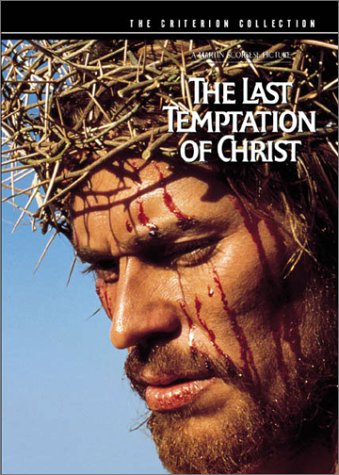
It would be a rare day indeed when I claimed to be the first to see, read, or watch something. Caught up between constant obligations (part-time jobs can be more demanding than their full-time facsimiles) I often find my mind awhirl for a semester at a time, only to discover that inter-term courses start just two or three days after the current term ends. If there’s a great movie out there that everyone’s commenting on, I am lucky to catch it before it leaves the theater. Sometimes I even miss the DVD version. So it was that yesterday I finally got around to watching The Last Temptation of Christ, the 1988 Martin Scorsese movie. This film came out right after I finished seminary, while I shared an apartment with a seminary friend who was an irrepressible movie buff. Together we missed it and, despite teaching in a seminary for a decade and a half, I still missed this one by twenty years and a few. At last I can feel caught up with the late eighties.

I’m not a big fan of Jesus movies. Movie makers shooting such films portray an eminently likeable guy getting beat up and tortured to death with such contempt that it is wrenching to watch. Yes, I know that’s how the story goes, but must we be brought into the Schadenfreude? As a life-long religionist raised in the Christian tradition, however, I feel a professional obligation to see popular portrayals of the foundation stories. The first one I recall viewing was Franco Zeffirelli’s 1977 Jesus of Nazareth, a movie so reverently rendered that it is frequently cited as the best ever. The eponymous Jesus by Peter Sykes and John Krisch came out in 1979 and claims to be the most watched movie of the genre. I saw Jesus Christ Superstar in college, but even Andrew Lloyd Webber’s music couldn’t remove the depressing aspect. Then, of course, Mel Gibson’s The Passion of the Christ in 2004. All of them have left me depressed. Perhaps that is their intended purpose.

The Last Temptation was laden with controversy in its day. I was anxious to see why (okay, so not terribly anxious, but I was curious). So yesterday I got to satisfy an ancient itch. Despite the caveat at the opening of the film, many critics jumped on the portrayal of an indecisive Jesus who has a rather chaste love scene with Mary Magdalene in a “last temptation” vision while on the cross as irreverent. Perhaps two decades and countless movies later this criticism has been calmed, but I found Last Temptation to be a typical Nikos Kazantzakis introspective, full of self-doubt and deluded penance. Kazantzakis’ work is a man’s struggle against his personal demons. Do dream sequences count as theological fodder? The movie suffers from pacing issues and at times contrived dialogue. The best scene is where Jesus meets and dresses down Paul only to have Paul declare himself the true bearer of the message. Even that is in the dream at the end.

In 2004 a Fundamentalist atmosphere pervaded Nashotah House. Newly appointed “theologians” on the faculty easily bought into Mel Gibson’s theatrically distorted view of their faith. By the end of that academic year it was clear that the evangelical leadership had decided on a new victim for the sake of facile Christianity, but that is a story that can wait another couple of decades before being told.



The Good (Face)Book

One of the funnier books I’ve enjoyed has been Sarah Schmelling’s Ophelia Joined the Group Maidens Who Don’t Float: Classic Lit Signs on to Facebook. Its unwieldy title as well as the temporary nature of the subject ensure that this book isn’t destined to be a literary classic, but it is a nuanced and subtle treatment of the Facebook phenomenon. (My daughter found it on the bargain table at Borders, and it cost us less than two dollars.) Schmelling presents the Facebook pages of famous, departed authors, often with hilarious results. For some time I regarded YouTube, Twitter, and Facebook as passing fads, but now I’m beginning to wonder if we’ve become so connected that shutting down the networks would be tantamount to pulling the plug on the respirator. We live to be connected. Humans are social animals, and yet many of us find ourselves isolated and alienated, living apart from family and those who were significant to us in times past. It’s the Internet to the rescue.

My wife pointed out an article on CNN entitled “The theology of Facebook, an online ‘altar’” by Omar L. Gallaga. Gallaga explores the concept that Facebook is now being taken as a spiritual venue by many. Quotes from the Bible or self-righteous, self-congratulatory religious sentiments are very commonly posted. So much so, Gallaga suggests, that some clergy worry about their jobs. Facebook has developed its own “spirituality” quite apart from anything its creator may have imagined. Facebook is evolving. I joined Facebook last year, but I limit my involvement to mostly watching others. Rather like I did as a kid on the school playground.

Is there balm in Gilead? In rereading Brave New World I am reminded of the insidious nature of soma, the feel-good drug. I’ve been to churches like that. Like Bernard Marx I left feeling empty. In Facebook-world it feels the same to me. We are communal creatures by evolution, but we want to talk about our troubles more than we want to listen. We are seeking that mythical, homeopathic cure to the ills our society creates: lack of prosperity (except for the Prosperity Gospel crowd, of course), joblessness, despair. Misery loves company and Facebook loves company. It is like the confessional without the absolution. Gallaga may be right; maybe Facebook has become a religious institution for some. If Facebook had come along a little earlier there would be no lost years of Jesus for us to ponder. We would know through his posts and tweets, exactly what it was like to be the son of God.


Tax Dollar Peep Shows

Yesterday’s New Jersey Star-Ledger ran a column by Paul Mulshine entitled “It may be 2010, but it sure feels like 1984.” The topic, of course, is the increasingly invasive procedures that TSA officers have been granted. For a guy who “held it in” every day for the six years of middle and high school because of bashful bladder syndrome, the airport has begun to feel like the shower room after gym class. Having been raised with the idea that certain body parts were to be viewed by God alone (and the occasional physician), being undressed in front of others was a nightmare scenario. I still avoid public restrooms when at all feasible. Now TSA officials have tickets to a free “scope and grope” fest whenever you want to fly. I say the terrorists have already won.

Perhaps by coincidence, in trying to keep up with my daughter’s reading assignments, I have started to reread Aldous Huxley’s Brave New World. The grandson of Thomas Huxley, Darwin’s bulldog, Aldous had written a foreword in 1946 that was affixed to the front of my college edition of his novel. In it he states his bleak vision of a future where governments have all become totalitarian and control vast numbers of slaves made willing by apathy (read “world-wide web” or “Internet”). Showing your private parts to a total stranger who then gets to grope you later? This is freedom? Abandon hope all ye who enter here.

Have these TSA officials been trained, seriously trained, to deal with the fact that they see what many people would pay good money to glimpse? (Well, not in my case, but you get the picture.) Where are their credentials? No, wait, don’t show me that! If I decide to display myself in public, I could easily be arrested for indecent exposure, but if a pervert wants a free look, all s/he has to do is apply to TSA. What will it take for Americans to shake off their electronically induced haze and say “No more!”? Perhaps I am alone in feeling vulnerable naked before strangers. Perhaps others enjoy giving it all away. Is it not better to survive that flight so that another stranger gets a gander at the jewels when you fly back home? You can kiss my arse goodbye and call it government work. 1984? Brave New World? I think Silence of the Lambs might be a better paradigm.


The Violence of the Lambs

Religious holidays are curious affairs. In many Christian contexts “the holidays” are often poignant scenes of tension and angst. Granted, much of this is generated by human family dynamics, but then, what of religion is not? An unfortunate shooting episode erupted yesterday in Baluchistan, Pakistan during the Muslim festival of Eid al-Adha. According to Star-Ledger wire services, the followers of two rival religious leaders pulled out guns in the mosque and began firing. The festival of Eid is the commemoration of Abraham’s near-sacrifice of his son. Islamic sources suggest the intended victim was Ishmael while the Bible claims it was Isaac. Whoever came under the knife, however, the implicit human sacrifice is disturbing.

Human sacrifice has been a part of human culture for a very long time. Never a common practice, it was generally reserved for times of severe crisis, when you really, really needed the gods to pay attention. The story of the Akedah, or “binding,” of Isaac demonstrates the reluctance in Judaism to speak of Abraham as an actual murderer of a child. After all, this was only a test. Many biblical scholars see this story as an etiology, a story of origins. The binding of Isaac explains why human sacrifice is not permitted in the religion of Abraham. When it does occur, for example in 2 Kings 3.27, it is effective. Nothing like a good, old-fashioned human blood-letting to satisfy the gods.

Soren Kierkegaard found the story of the sacrifice of Isaac so disturbing he wrote an entire book to deal with it. Even if we, the readers of Genesis, are given the advance knowledge that this is only a test, the image of a religiously devoted old man with the knife hovering over his bound son is the very definition of horror. And that frozen moment comes to life and acts itself out time and time again in acts of religious violence. One of the most recent was in Baluchistan, but as sure as the knife rises above the sacrifice, there have been other incidents of religious violence since that awful moment. Human sacrifice may be at the heart of religion after all.

Precious moments akedah, shamelessly borrowed from James McGrath's blog


Hallowed Be Thy Game

I don’t follow sports. At all. This may seem an unmanly confession, but I think of it as more a silent protest against a society that pays excessive bonuses to people who play for a living. It’s not that I have anything against physical fitness – I still jog regularly and have been known to rattle the free-weights around a time or two – it’s simply the recognition that the more difficult achievements, intellectual achievements, are undervalued. Not that I make any claims of being an intellectual – I have no time for those who tout Ph.D.s like intellectual currency – but I see things from a different angle. Usually when I reach the sports section, I simply flip over the whole wad of pages to get onto what’s next. Today, however, a front-page sporty headline caught my attention, “‘God Can Turn Mistakes Into Miracles’ is the message Michael Vick sent out…” I confess, I don’t know who Michael Vick is. But he knows what God can do in some sports venue.

I grew up with God. The information I was given was that those who devote the majority of their time and attention to God will receive their reward. Not always in money, despite what the Prosperity Gospelers bray, but at least in kind. Being the kind of person who likes to follow things through to their logical conclusions, I ended up with an appropriately named “terminal degree” in religious studies. The prosperity came in the satisfaction that I could teach others for a reasonable, if low-end, salary and continue my goal of deeper understanding. Then Prosperity Gospelers took over the seminary and those of us without material cache were kindly kicked out. I was jogging between seven and nine miles a day, looking for answers.

The headlines this year have included tragic college sports-related injuries, one of the more dramatic from my own part-time home of Rutgers. Immediately medics rush to the field and prompt, professional medical care is given. I am covered by no medical plan. Many athletes take my classes, and they can count on the good graces of God and university officials to take care of them. In my opinion they are just as capable of learning as any other students, but the incentives just aren’t there. Why earn a degree in a field that will plant you on your backside all day for minimum returns when you can perform miracles in the athletic world for more money than the average citizen can even imagine? If God can turn mistakes into miracles, perhaps this misspent life of religious studies can turn into a lucrative position after all.

Miracle or mistake?


Round Tables and Belligerent Gods

One of those bits of mail in my part-time lecturer mailbox at Rutgers informs me that the Oxford Round Table is hosting a discussion entitled “Civilization at Risk: Nationalism, Religion and Nuclear Weapons.” Given that the cost for attending is about what I make for teaching one of my adjunct classes, and the fact that they spelled “civilisation” the American way, my guess is that the target audience resides on this side of the Atlantic. Still, the topic is indeed vital. Nationalism is a relatively new plague to arise in the human menome. Cultural differences matter little in the face of nationalism; the real issue in this ideology is dominance. Nuclear weapons add a unique poignancy to the issue, but the heart of the matter is clearly behind door number two: religion.

Religion usually makes the list of the hallmarks of early civilization. Along with complex governance and the arts, it is considered one of the aspects that marked the break from merely subsistence living. Religion, however, in its monotheistic form has more divisive power than nearly any other aspect of civilization. Polytheistic religions hardly worried if people worshipped the “wrong god.” Monotheism bears a larger burden, and that burden is not dissimilar from that of nationalism: dominance. Let’s face it – what kind of respect can you expect for a god who can’t throw the brimstone behind all those threats? And if your god doesn’t readily ante up (no visible actions, depending on who you read, since the first or the seventh centuries) then the devout must take up the spear, cudgel, or atomic weapon to prove the honor of their all-powerful god.

Uranium in the hands of an angry God

Is there a solution to the “Middle East” crisis? I’m no politician, but I would make the following humble observations. The crisis as it exists today is as much about nationalism as it is about religion. Religion serves as a convenient excuse when one’s way of life feels threatened. (Push any Neo-Con into a corner and when all the cards are on the table it will amount to precisely this.) We all want things our way. If we can’t get it, we can take it by dropping the G-bomb. It may be apt that the region of the world that instituted civilization is destined to destroy it. A cosmic symmetry pervades the idea. It might be a lot less messy if we’d all admit what the arguing is really all about.


New York Sinning

Men’s Health, a magazine I’ve never read, is making a foray into spirituality. Or at least religiosity. According to an article in the Friday New Jersey Star-Ledger, the magazine noted for its washboard abs and iron biceps is poised to claim New York City among the least devout cities in the country. Even lower on the scale are New Jersey’s own Newark and Jersey City. Quite apart from wondering what a magazine whose cover frequently involves suggestions on how to improve your sex life has to do with religious devotion, the criteria for this assessment also give pause. According to the article, a city’s saintliness is measured by the per capita number of worship venues, the diversity of religious groups in the city, and the amount collected in donations. Interesting criteria.

I’ve spent enough time in New York to know it is hardly Heaven – still it is one of my favorite venues – but that it is hardly Gomorrah’s brute step-brother either. Per capita places of worship as a measure of spirituality overlooks size of venue and number of services. A Midwestern town with a dozen churches, each with a dozen members and with one service a week scores ahead on such a scale against a city with more than 2000 churches, 1000 synagogues and 100 mosques, many with multiple congregations. Diversity of religious groups? Surely New York and New Jersey must come out in front on that! I’ve been to Europe, and even Israel, and there are days when I’d swear New Jersey has a higher percentage of ethnic groups than any similar-sized region I’ve experienced.

My main concern, however, is with the amount of donations criteria. “Where your treasure is, there your heart will be also,” a famous guy once said. Was the treasure monetary? Precisely the opposite seems to have been the point. True, money today is often a measure of value, but it is not the only such measure. In fact, the same guy who made that statement once said a poor woman’s two cents were worth more than the lucrative eternal investment of the wealthy. I don’t doubt that New York, Newark, and Jersey City have their share of innovative sins. Their citizens, however, are just about as religious as people are anywhere. In my opinion the trouble is not in the souls of the masses, but in the design of the assessment. But with pecs like that, what does it really matter?

A God's eye view of Sin City


Physics of Religion

As an observer on life’s sidelines, I rarely participate in the action. The subject matter is more important than the critic, so I tend to respond in this blog rather than create. Once in a great while, however, someone I know shows up in the media. A number of years back Neal Stephenson introduced me to George Dyson. I instantly felt an affinity for him, and found his book Darwin Among the Machines a great triumph of intelligible science writing. It was no great surprise, then, when George was mentioned in an article in December’s Atlantic magazine, comparing his outlook to that of his father, physicist Freeman Dyson. I was intrigued by physics in high school, but my overwhelming supposition that religion explained life overruled this predilection and so I’ve ended up an unemployed religion professor than a scientist. In the article, however, author Kenneth Brower brings these things together.

Brower asks a pointed question: how can a physicist as brilliant as Freeman Dyson hold factually inaccurate and apparently misguided ideas about global warming? The story contrasts Freeman with his son George as exemplars of two different religions. George represents the environmentalist religion while Freeman represents the belief in humanity’s ability to solve any problem. The use of religion as a means of distinguishing these views again raises a question of definition. I don’t dispute the use of the word – it is entirely apt in this context – but the functional definition here is that religion equates to something deeply believed. I am a little troubled by this. Not because no gods or deities or supernatural forces enter into it, but because for years many evangelicals have boldly declared that science itself is a religion. That idea has been used as leverage to get Creationist ideas equal time with those of science because it comes down to purely a matter of one religion against another.

Belief is a phenomenon that is not well understood. Most people have no difficulty accepting the truthfulness of factual data. Seldom do even religious zealots doubt two plus two equals four. At a more theoretical level, however, facts become formulas incomprehensible to most of us and critics are quick to call this “religion.” Faith in human ability to solve the riddles of the universe. Where is the line with religion crossed? In the year 2000 Freeman Dyson received the Templeton Prize, an honor reserved for those who make significant contribution to the spiritual dimension of life, often with a scientific component. It is the dream of every religionist to be considered for this great honor. Once again, however, the further out we peer into our universe, the more the lines become blurred. That does not worry me. What concerns me is how such ambiguity will no doubt be used by Creationists and their Neo-Con supporters who are only too glad to have a scientist of Freeman Dyson on their side. When religion trumps science not even 2 + 2 = 4 is secure.

Hubble's ultra deep field has yet to detect any deities


Plumbing the Depths of the Universe

Lasting summer I helped a friend unclog his sewer line (the mark of a true friend). That episode readily released me from a lifelong fear of plumbing, and when our kitchen sink leak got to me shortly after, I took courage and fixed it. Now, a year later, it looks like a seal has gone bad. With stagnant water dripping on my face, cantilevered under a pot-bellied sink, I discovered that plumbers have their little trade secrets. Trying to loosen in intake line nut with a standard vice-grip set of pliers, removing skin from my knuckles while at an unbecoming angle for a man my age, I felt like Bill Bixby turning into the incredible Hulk. I knew I had to make the long drive to New Brunswick to get my Rutgers campus mail after this, and I was getting nowhere with the nut. Traffic in New Jersey is relentless, and it looked like my entire day was shot when I noted there was a Scarlet Knight football game today, and I have to drive right by the stadium where the millionaire football coach prevents guys like me from being hired. So there, head under the sink, fuming with rage, I had an epiphany.

Reality, as we are taught in our rational educational systems, can be explained by reason. Certainly the fact that I’m typing this post on a highly sophisticated computer to upload to a god-like Internet, demonstrates that reason works. Bit by bit, piece by piece, scientists figure out how our world works. And yet, many scientists also ascribe to religious beliefs. Explaining religion will need to await another post, but it is fair to state that religion is generally something that effects the emotions. We tend to accept religion with our feelings rather than trying to wrench it in with reason. With my face dripping with runoff, I wondered, what if there are two separate realities?

Ockham’s razor may apply here, but I don’t shave. What if reality consists of a non-rational, emotional universe as well as a simultaneous, empirically explainable one? What if we are leading dual lives straddling two different forms of reality? That doesn’t make any one religion true, but it might explain why we haven’t been able to explain emotion. Psychologists like to trace it back to “fight or flight” functions from our reptilian brains, but the emotion we experience often seems more intense than that. Emotion may drive a highly rational human being to completely nonsensical behavior. Perhaps we are participating in a universe that requires a two-pronged approach. Perhaps rationality is only half the picture. As I prepare to stick my head back under the sink again, I realize what plumbers must have long known – some things, such as under-sink arrangements, simply can’t be explained by reason alone.


What Would Noah Do?

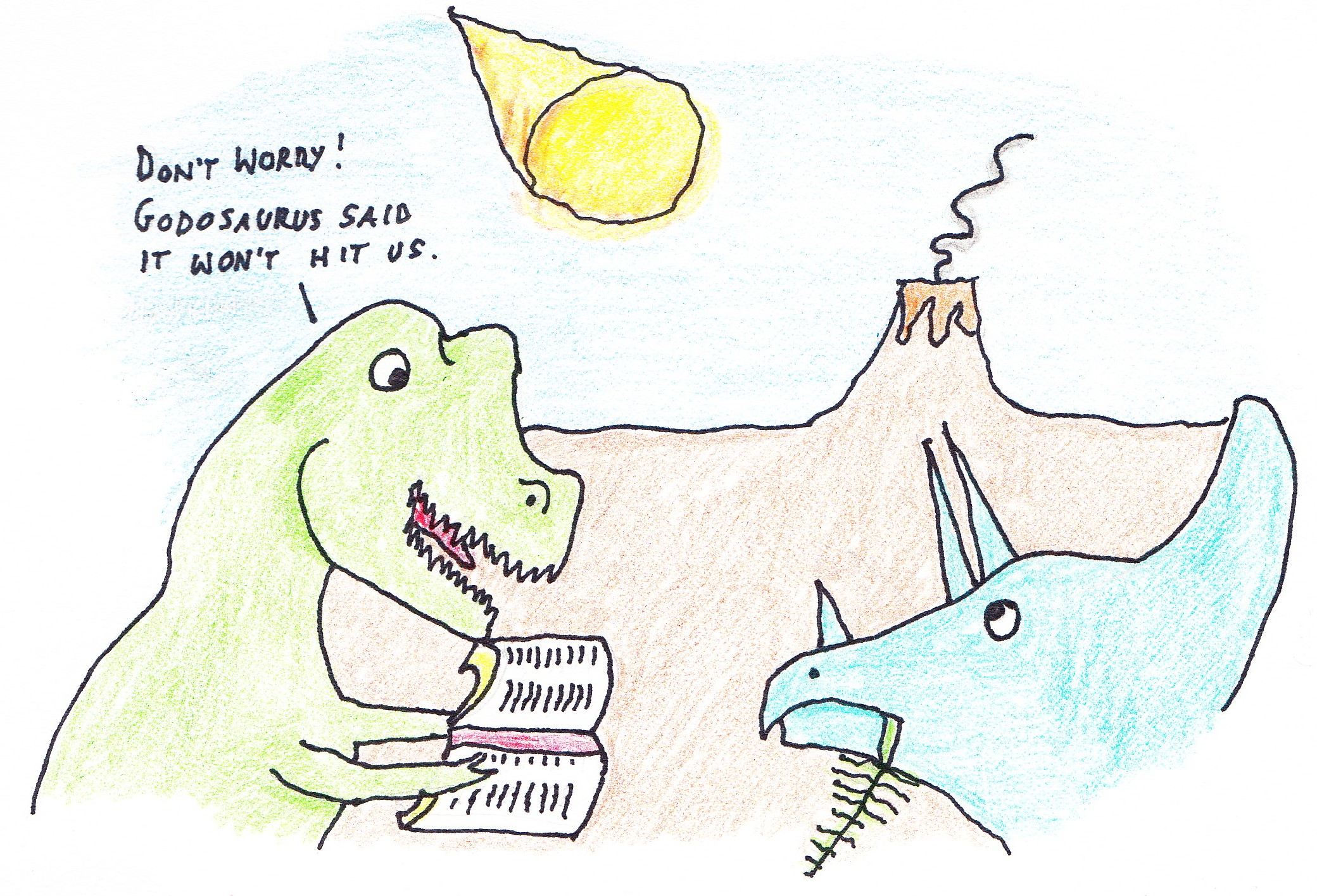
Unfortunately, religion and politics do mix. A story on POLITICO.com announced on Wednesday that the House Energy and Commerce Committee chair hopeful, Rep. John Shimkus has declared Genesis on the side of conservatives. Stating that the Noah myth (not his exact words) promises God won’t flood the earth again, Shimkus claims we have nothing to fear from global warming. In a twist that makes some of his fellow conservatives squirm, Shimkus admits global warming is a reality but suggests that we really don’t need to worry about it because “the Bible tells me so.” Time for Shimkus to go back to Sunday School.

Part of the problem lies in the concept of Bible itself. The Hebrew Bible isn’t too much of a self-referential work, claiming to be pure words of divine gold. Paul, on the other hand, found the Hebrew Bible useful to cite against enemies, and his admirer who wrote letters to Timothy in his name took the idea even further. For all that, the Bible wasn’t finally settled on for a couple more centuries. Once the concept took hold, however, the world could never be the same. A book written by humans had become direct revelation from the word of God himself. The Bible makes few such lofty boasts about itself, but its less conscientious followers are not nearly so shy. As I demonstrate repeatedly in my classes, the Bible has become a magic book.

Politicians now feel comfortable claiming God as their ally because “he said so.” Without having ever critically engaged Scripture, or even having read it in its original languages, those in positions of public trust know enough to flaunt it. And it always scores points with Americans. Liberals fear the ramifications of using the Bible while Neo-Cons charge bravely ahead to places Noah himself would fear to go. Maybe it’s time to put the Bible back in the schools. Only this time it should be taught by people who realize that the Enlightenment has taken place and that we can’t rely on magic to save us from dangerous situations we ourselves have created.

The lesson from the Cretaceous Period


Foxhole Atheists

It’s Veterans Day and prayer makes the headlines. The old adage about no atheists in foxholes comes to mind as those who fought for the values we hold reminisce about the not-so-happy days before the 1950s when the last semblance of normalcy in American life apparently died. The New Jersey Star-Ledger quotes a World War II veteran who participated at the Battle of Normandy saying “I might have prayed more than I ever prayed before.” No atheists in foxholes. As a lifelong pacifist, I have always believed that war is a terrible waste. 3.5 billion years of evolution and the best we can come up with is to hurl supersonic lead slugs at each other over who gets what and who deserves more than who else. I don’t deny that veterans should be honored – my father was a veteran – but war should not.

A sad truth is that many wars, probably in the history of the modern world, most wars, have been fought for religious reasons. The idea that God demands certain things ultimately leads to fighting over what it is God wants. Both sides often claiming the silent deity is on their side. Millions of mere mortals have had to pay the price. Hey, can’t we just talk about this?

War may very well have evolutionary roots. Studies of chimpanzees suggest that homo sapiens are not the only overly aggressive primates. If we deny our cousins religion, however, only homo sapiens fight for mythological causes. One of the great ironies of life is that the most advanced technology trickles down to civilian life from military applications. If something is new, it must have a tactical use against the enemy. Once the enemy is subdued, we can share the wealth. I grew up hearing about “godless Communists.” I watched in dismay as Bush declared a new crusade. I shudder when I read that Iran is developing long-range missile facilities. God is the midst of all this. Veterans protected us from the human-level wars of a bygone era. In our own homemade Armageddon, however, our own technology will doubtless become the weapons in the hands of an angry God.

If God be for us...


Faith of a Lusty Monk

Wisconsin is so much more than its iconic cheese. I was reminded of this fact when my wife sent me an advertisement from the latest edition of the National Mustard Museum catalogue. I have to confess that while living in Wisconsin we became fans of the earlier incarnation of the institution when it was a roadside attraction called the Mount Horeb Mustard Museum. In addition to the perk of the biblical namesake of the town, the museum itself was the kind of place you instantly fall in love with. Quirky, pungent, and informative. The museum was nevertheless dominated by the shop that spoke for most of the actual floor-space. You could sample most mustards either by pretzel or by little sample spoons – no double-dipping please! There were only a few hard-core patrons there at our first visit, but as we continued to stop in over the years, the clientele seemed to be growing.

The ad my wife brought to my attention is for “Lusty Monk Altar Boy Honey Mustard.” The title begs for exegesis: Lusty Monk is the brand. The concept on many of the mustards we saw at the museum was to emphasize humor and shock value. Apparently the venial sin of enjoying mustard is enhanced with a decorous dollop of naughtiness. I suspect many people buy the products for the cleverness of the labels alone. Altar Boy is the title of the specific mustard blend. One must be careful to separate the word “Honey” from “Altar Boy,” otherwise an inappropriate picture might emerge. Of course, no one need admit they were thinking that anyway. “Honey Mustard” is familiar to condiment connoisseurs as a slightly sweet version of the dressing made with a generous infusion of industrious bees’ work (and there are many honey bees in Wisconsin as well). Thus read, there is nothing suggestive of mendicant malfeasance in this mustard.

On Wisconsin!

An entire blog could be devoted (and there may be one for all I know) to the slightly unsavory names of various mustards. A good place to do research would be at Wisconsin’s own National Mustard Museum. We still receive their catalogues, but since moving to New Jersey easy access to one of our favorite free museums has sadly become an empty jar of dreams and memories. We still proudly display a Poupon U. banner in refrigerator-magnet format to remind us of the tasty hours we spent sampling the very plant whose seed Jesus compared to faith itself. And the many off-color titles temper this faith with fun.


Hallelujah of a Long Night

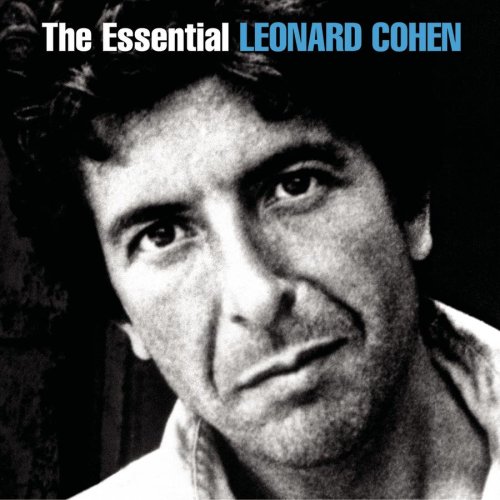
I discovered Leonard Cohen is an unusual way. Having grown up with very limited funds for purchasing music, most of what I listened to growing up was what I heard on the radio out of a small-town station or what I heard emanating from my older brother’s room. My musical tastes, however, always included a “religious” element, whether that be a blatant religious message or provocative lyrics combined with compelling tunes. It was only when I first watched Shrek that I learned about Leonard Cohen. The moving scene where Shrek and Donkey have gone their own ways, both disappointed in love, is framed by John Cale’s rendition of Cohen’s “Hallelujah.” It is particularly poignant even in an animated movie, and I wanted to learn more about the haunted composer. The official movie soundtrack included the song covered by a different artist, but I found Cohen’s name listed as the writer. That’s when I began to explore.

I can’t pretend to be a groupie of any performer, but I find much of Cohen’s music to be moving and provocative. His lyrics, self-effacing and tentatively assertive, seem to capture the ideals of many religions. Reach out but don’t touch. Seek your own fulfillment, but put others first. I was reminded of this the other day while listening to some of his songs. A commentator once described Cohen as an artist with a Psalter in one hand and a picture of a naked woman in the other. An artist who struggles to overcome his humanity, yet who thoroughly enjoys it. “Hallelujah,” Cohen once explained in an interview, began as a religious song and ended up an erotic one.

As the nights grow longer and the days grow colder, my thoughts return more often to his provocative lyrics. After viewing Shrek I began to purchase Cohen CDs (this was back in the day when I was fully employed). I was amazed at what I’d been missing. There is an honesty about Cohen’s work from which many who overtly claim religion could learn. Cohen is the sinner who does not pretend to be a saint. His work openly expresses the struggle. If those who want others to join their religion could learn this simple trick of being honest, they might be surprised by the results. Self-assured bravado cannot convince as readily as the confessions of a lost but sincere seeker.


Jesus Gets a Head

Sunday newspapers often contain stories calculated to appeal to the purveyor of the unusual in addition to the usual current events. When my wife pointed out an article in yesterday’s paper about the new (unverified) tallest statue of Jesus in the world, I was instantly intrigued. A Polish priest by the name of Sylwester Zawadzki created the statue which tips the yardstick at somewhere between 108 and 167 feet (a little triangulation might be helpful here). Noting that Rio de Janeiro’s Jesus is 125 feet tall, some are claiming this as the largest Jesus in the world. According to the article, some Poles feel the statue is tacky and in bad taste. Others rejoice that a very large likeness of what Jesus may have looked like now overlooks Swiebodzin.

Religions frequently display their colors. Knocking down crosses for crescent moons or stars of David for crosses is a religious activity as old as monotheism itself. Zawadzki claims that he was called by Jesus to do this task. According to the Gospels, Jesus seemed to focus more on his message than on himself, but the two have become so intricately knotted that the Jesus icon has come to stand for everything from preserving fetuses to longhair free-lovefests. What Jesus is depends on the eye of the beholder. As the gold-crowned head was lifted by crane onto the awaiting shoulders, a cross was lifted from the shoulders of Zawadzki who expressed thanks at having been able to fulfill God’s will.

Construction workers gathered at the base of the statue for photos, wearing safety helmets. Working on Jesus, like any construction zone, can be hazardous. If it is the will of Jesus to have enormous statues erected in this faithless world, are safety helmets really necessary? It is all a matter of perspective. Many people in the world are in need. Many do not have the resources they need to survive. Where is the triumph here? I understand the artistic urge, I sympathize with the need to stand out. But is the will of Jesus to be represented in larger and larger formats, or is it to help those who feel physical need day by day?


10 Questions

This week’s Time magazine’s 10 Questions feature is directed to Stephen Hawking. Predictably, the first one concerns God. “If God doesn’t exist, why did the concept of his existence become almost universal?” a reader asks. I was less concerned with the answer than with the implications of the question itself. The very question represents a paradigm shift. Time was, such questions were directed to local clergy. The minister had the answers. To be sure, many millions, if not billions, of people regularly rely on their clergy for divine guidance. I used to teach clergy, so I am wary. Today, however, we need to know if all the answers fit. To find out if God exists, ask a scientist.

Theologians have earned their reputation as inscrutable doyens of the unspeakable. I have been involved in higher education in the field of religion for nearly twenty years and when I read theologians I am left scratching my head and asking “what?” Erudite to the point of being obtuse, the issues and methods of theologians address the unknowable. Much of it is idle speculation. The specialists, however, must earn their keep. Deans are impressed by what they can’t understand. God himself, I’m sure, wonders what some of it means. Is it any wonder that the average citizen would rather ask Dr. Hawking than ask some obscure theologian?

Religion and science are bound to bump at the borders like the parallel universes of string theory. Both are concerned with explaining things. Science has a proven track record of presenting verifiable results while theology has produced a poke full of intangibles. I am the first to admit to being a working-class Joe who has no special knowledge. What I’ve learned has come from the many classes I’ve endured and the books I’ve read. As far as I can tell, none of it comes directly from God. In my mind’s eye I reverse the situation. I see a popular theologian, take your pick (I have trouble conjuring the moniker of a household-name theologian), being featured in 10 Questions and the first query being, “What is M-Theory?” I can imagine the convoluted answer.