Cuckoo’s Roost

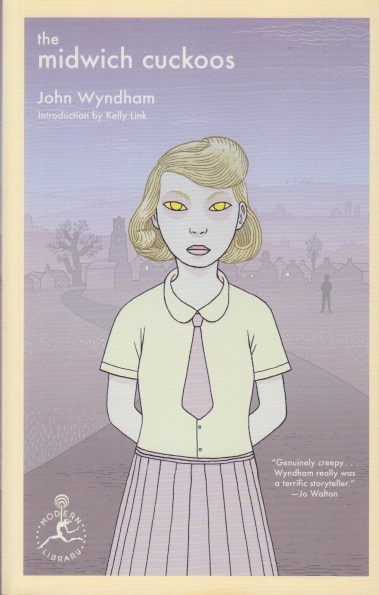
John Wyndham is someone I discovered through movies.  Often considered a science-fiction writer, his works cross over into horror, particularly on the silver screen.  Many years ago I read Day of the Triffids and, having seen Village of the Damned, wanted to read The Midwich Cuckoos.  It was a pretty long wait.  I kept thinking I might find a copy in a used bookstore, but it never happened.  When I saw a reprint edition I ordered it with some Christmas money.  There are some horror and sci-fi elements to the story, but there’s also a bit of thriller, as it’s called now, thrown in.  The book is quite philosophical because of the character Gordon Zellaby, a Midwich resident who keeps thinking about what is happening in terms that don’t match the expectations of other, more prosaic thinkers.  In case you’re not familiar:

Midwich becomes unapproachable for a period because an alien ship (the sci-fi part) has covered it.  Everyone in the village is asleep for a couple of days.  When they awake, generally no worse for wear, they soon discover that all the women of childbearing years are pregnant.  They all give birth about the same time to children that look eerily alike and have bright golden eyes.  The officials know this has happened but adopt a wait-and-see attitude.  Meanwhile, the locals get on with things but they discover these new children develop about twice as quickly as humans do and they can control people with their minds.  They also have collective minds so that their brainpower is quite above that of Homo sapiens.  Zellaby makes the connection with cuckoos—birds that lay their eggs in the nests of other birds and after they hatch shove the other chicks out of the nest.  Indeed, this is a story about what if cuckoos were humanoid aliens who tried the same thing with people.  Told with a British stiff upper lip.

The story slowly unfolds and gets scary as it grows.  I saw the movie quite a few years ago and the details were lost on me, so I was learning as I read.  I suspect that it differs from the book quite a bit.  Perhaps it’s the Britishisms that make this story less of a horror tale.  There’s a kind of jocularity to the style, at least for a good bit of it.  The serious issues of how governments and individuals interact is raised and discussed to a fair extent.  Even though the book is fairly short, there’s a lot going on here.  But now I need to watch the movie again.


Alien Invaders

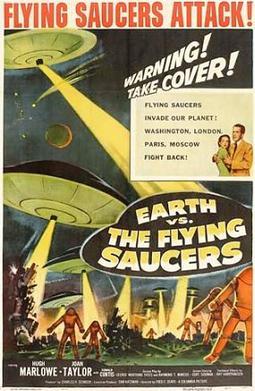
I’ve been pondering genre for some time now.  And since Stephen King assures me (not personally) that Earth Vs. the Flying Saucers is horror, I figured I’d give it a try.  In fact, given the various themes of the movie, I’m surprised I hadn’t seen it before.  The title pretty much gives it away—aliens try to take over Earth with a swarm of flying saucers.  Two scientists figure out how to make their saucers stall, and even though the aliens have a disintegration ray that pretty much destroys anything, the earthlings prevail.  Having summarized it all in less than a hundred words, is there really anything worth comment here?  I think so.

Like many older movies this one makes use of stock footage to fill in action sequences and to keep the budget reasonable.  So there are big guns going off and rockets being launched.  (This was a pre-Sputnik movie and it depicts America having eleven satellites in orbit.)  But the additional footage that stayed with me was a scene of two planes colliding and crashing.  It was clear these weren’t models and the footage was authentic, apart from the flying saucer shooting the planes.  It turns out that this scene was indeed real, and that the pilots of both planes died in the crash.  During an air show outside Spokane, Washington in July 1944 this collision was caught on film by a Paramount news crew and it was reused in this film.  This got me to thinking about war footage—something that really only became possible in the Second World War.  And what we now see today in real time on the internet because the world is wired.

It’s as if those who wage war are fine with it as long as people with a conscience don’t know what happens.  There’s even a phrase used to excuse unspeakable barbarism during combat: the haze of war.  This we know about our species—there’s a tipping point beyond which rationality shuts off and we’re no longer responsible for our behavior.  We also know that war puts people in that zone.  It was fine as long as only surviving warriors were left to tell the stories of their bravery.  Photographing, particularly in motion pictures, combat revealed a much darker truth.  Well, at least in Earth Vs. the Flying Saucers the enemies under attack were fictional.  Except.  Except, some of the casualties were real people whose final moments were caught on camera.  Be sure to get out and vote today, if you’re in the United States.  There’s a party even less understanding than aliens out there, desiring to take over.


Revisiting Witch Mountain

Suspension of disbelief is essential for many movies.  When a friend pointed out that Disney had rebooted Witch Mountain, of course I suspended.  Recast as a new millennium-style action sci-fi movie, it really didn’t rock the critics, but there’s a lot going on in it.  Shall we start at the beginning?  The opening credits sympathetically establish the reality of UFOs as alien visitors to Earth.  In other words, we know from the beginning that the kids are aliens, not witches.  And the chasing begins immediately and doesn’t let up.  Not only is the government after the kids, so is a “bounty-hunter”/“terminator” from their home planet.  A body-building cab driver and an ostracized academic (with you there!) work to get the kids back to their ship, which is being held by said government in Witch Mountain.

In a nod to the original an RV is thrown in, and the setting at a Los Vegas UFO convention ads a kind of surreal twist. That’s what was kind of disturbing, in my experience—the blending of “nut job” UFO enthusiasts and the reality aspect prompted by the prologue.  UFOs, like most things in American culture, have become extremely divisive.  With nods to everything from The X-Files to Close Encounters, and many enthusiastic high-fives to Star Wars, there are mixed messages and there’s too much going on.  It’s difficult to process.  The cameo by Whitley Strieber was a nice touch.  Long gone are the locals with shotguns trying to find witches.  Witch Mountain itself is a government facility more secure than Area 51.

The reimagining of the story is signaled by the change of title to Race to Witch Mountain.  So the story seems to have gone off the rails at some points.  I always find movies where people faced with the obvious “supernatural” simply refuse to believe, fascinating.  It is, after all, about belief.  The plot, with its “our planet is dying—yours is too” message, is a bit tricky to decipher.  There are those convinced that we need to abandon Earth to other worlds where we can continue our acquisitiveness unhampered, and those who believe we should repair the damage here.  As I say, everything is divisive.  Overall, the movie seems to say that the system kinda works, so let’s keep with it.  And wreck lots of stuff along the way.  I couldn’t help but notice the borrowed trope from Pirates of the Caribbean, “You’re a good man, Jack.”  It seems Jack is a favored protagonist name.  And strange things like that happen on planet Earth, at least seen through the Disney lens.


Which Mountain?

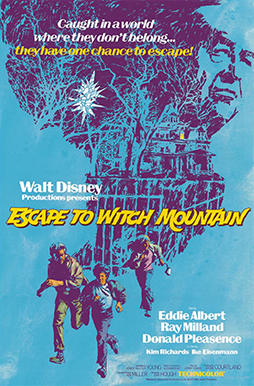
Disney movies—and I still think of Disney primarily as a movie studio—were part of my childhood.  A small part, but there nevertheless.  We didn’t go to theaters often but we caught some movies on television (do you remember eagerly reading TV Guide to find out what was going to be on that week?).  We did watch The Wonderful World of Disney and some of their series—I recall the one ones on Daniel Boone and Davy Crocket.  Still, I missed a lot.  I didn’t see Mary Poppins, for example, until I was in college.  So the other day I got curious about Escape to Witch Mountain.  I’d not seen it as a child and never saw any reason to watch it as an adult.  I’ve been taking a break from bad movies, and, as it turns out, Disney.  So there may be spoilers below, in case you’re waiting to see it.

I didn’t know the backstory or the plot, so seeing this the first time I wasn’t sure what to expect.  The movie shows its age (I was a mere lad of twelve when it was released), but the story is interesting.  Tony and Tia are adopted but have to be sent to an orphanage.  We quickly learn that they have “powers,” and that adults like to exploit such things.  A wealthy villain has his fixer pose as their long lost uncle to get them to his house, under his control.  The children realize that they must escape to, well, Witch Mountain.  Actually, that takes some time and a sympathetic adult who can drive.  In the end it turns out that they’re aliens, not witches.

Not cheery like many Disney films, Escape to Witch Mountain, although you know it will end well, has a fair bit of tension.  Especially scary is the mob mentality that takes over the locals when they start their literal witch hunt.  Armed and dangerous, those who want to preserve the uniformity of small-town mentality are serious about their convictions.  As usual, they focus on the enemy without getting to know who, or what, they really are.  Obviously, there are larger issues to consider, as there are when anyone has an advantage.  But the kids, aliens, are sweet and mean nobody any harm.  All they want is to get back to their people.  Can humans, however, ever be satisfied knowing that there are others out there more advanced than we are?  Perhaps there’s a reason for cover-ups, after all.  Disney often says more than it’s given credit for saying.  Even if I missed it until now.


Brain Exercise

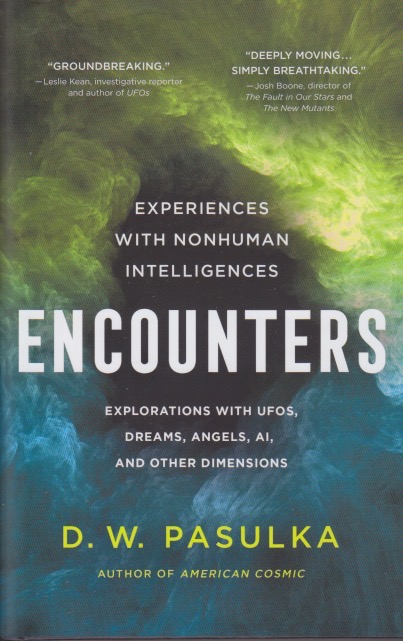
Why do we read, if not to expand our minds?  I’ve read all of Diana Walsh Pasulka’s previous books but Encounters is mind-blowing.  I feel particularly honored that a scholar of religion has been able to put together so many pieces of a very strange puzzle.  Pasulka’s first book was about Purgatory.  Having grown up Catholic that seems a natural enough choice.  Her second book, American Cosmic, focused on a topic that academics were just starting to address at the time—UFOs.  That book justly earned her acclaim.  Encounters takes a few steps further into the mysteries of being human.  Those who experience UFOs have much in common with people who have other extraordinary encounters.  The profiles in this book will give you pause time and again.

Many of us have felt that the unfortunately successful government strategy of ridicule toward experiencers has been a blanket covering up the truth for too long.  I was interested in UFOs as a child and was unmercifully teased for it.  One of the reasons I was interested was that I learned, when I was about eleven, that my grandfather had been interested as well.  I was only two when he died, so there was no way to learn this personally.  It came through discovering a couple of his books that my mother had kept.  Since she was one of five siblings, it’s difficult to say if he’d had any other books on the subject, but being a reasonable kid, I wondered why this was a forbidden topic.  You could talk about ghosts (at least a little bit) and be considered “normal.”  Mention UFO’s and you’re insane.

When the Navy’s video recordings of UFOs—renamed UAPs—were released in 2019, there was silence in the room for about half an hour.  Serious people began to realize there might be something to this.  Of course, those who’d internalized the ridicule response continued to fall back on it, perhaps as a defense mechanism.  That revelation has allowed, however, serious consideration of what is a very weird phenomenon.  I’ve deliberately avoided saying too much about what Pasulka covers in her book.  As I generally intend when I do this, what I’m hinting is that you should read this book.  You should do so with an open mind.  If you do, you might find yourself thinking in some new ways.  Of course, some will ridicule.  Others, however, may walk away with an expanded perception of reality.


Yep, Nope

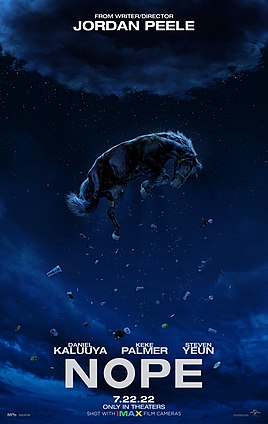
I can honestly say that I’ve never seen a movie that starts with a quote from Nahum.  I also honestly admit that Nope left me scratching my head, but very glad to have seen it.  I trust Jordan Peele implicitly as both a screenwriter and a director, and I know I need to see Nope again to make it all fit (if that’s possible).  His movies are the most Twilight Zoneish things out there, and despite Peele’s reported reason for naming the film Nope, I’m going to keep watching the skies.  It’s clear he had done his ufological homework.  Even the idea that—SPOILER ALERT—have you seen it yet?  Are you going to?  You might want to finish this later, if you haven’t—they are biological entities has been widely discussed.  

Although classified as horror, Nope has mercifully few jump startles.  In fact I noticed (there were maybe only 10 of us in the theater) that one couple had brought their kids.  I can imagine they had some interesting discussions on the car ride home.  For me, driving home alone, I felt like I’d watched Close Encounters, Twister, Signs, and Arrival simultaneously.  Peele set out to film a spectacle and he did indeed.  Horror has become more intelligent of late, and there’s so much going on here that I’ll need some time to sort it out.  The online nattering suggests the Nahum quote (“I will cast abominable filth upon you, make you vile and make you a spectacle”) reflects Peele’s thoughts on the Bible.  A more literal take might see the evacuation of waste creating a spectacle, which it does.  How to explain the angel form of the creature?

Alien horror works.  Alien sees them deep in apace, but many films, such as Fourth Kind, see them closer to home. Fourth Kind, also by an Africa American director (Olatunde Osunsanmi) never received critical acclaim, but I thought the first half was impossibly scary.  It’s natural enough to fear those we don’t understand.  Perhaps that’s one reason we tend to deny their existence.  If we deal with them in fiction we can call it horror and go home happy.  Nope asks us to consider whether our differences matter so much in the face of a non-discriminate predator that eats any human that enters its territory.  Even if they were there first.  I still have a lot of questions about the movie.  Some of them will likely never be answered.  One that will is “Do you plan on seeing it again?”  The answer is yep.


Body Doubles

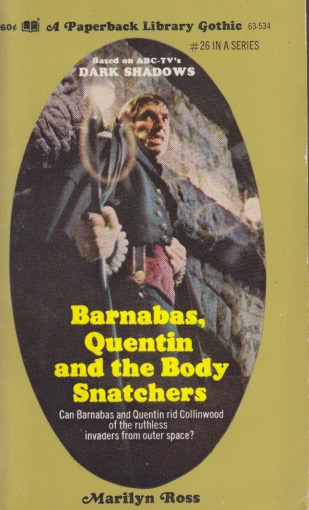
Learning about how Dark Shadows developed has freed me a bit, I think.  The stories between the original program, the novels, and the movies were never consistent.  I’d made that most fundamental of Fundamentalist errors—I’d assumed there was only one story and it went in only one way.  This helps explain, but not excuse, the Burton-Depp version of the story.  In any case, now I can read the novels with minimal baggage.  Understanding childhood is important if we survive long enough for it to haunt us.  Barnabas, Quentin and the Body Snatchers is a departure, even for Marilyn Ross.  Something critics sometimes overlook is just how literate the original, and subsequent, program was.  Ross occasionally attempts to cash in on that without feeling tied to the story line.

This plot relies on the 1956 movie, Invasion of the Body Snatchers.  Indeed, as a daily show Dark Shadows couldn’t really utilize a “monster of the week” format effectively (although it seems to have given the idea to those who later did).  The novels, however, could draw on such cultural tropes.  Both major releases of Body Snatchers (there was a remake after Dark Shadows ceased, in 1978) were considered terrifying by implication: how could you tell if someone took over the body of someone you know?  Who could you even trust, if such a phenomenon were possible?  Since such things aren’t common down here, it’s easier to suggest they come from outer space.  So it is that this installment has the weird juxtaposition of a vampire and werewolf having to outsmart aliens who take over human bodies. Kind of an early monsters vs. aliens scenario.

Again, not to seek too much depth where it doesn’t naturally exist, this scenario raises interesting questions.  How would terrestrial and extraterrestrial supernaturals interact?  I’m not sure W. E. D. Ross was up to this kind of gothic-sci-fi mash-up.  He was, after all, primarily a romance writer.  (Although, a recent trip to a library book sale and used bookstore in the same day led to the realization that paranormal romance is a burgeoning field.)  I recently read an article disputing the “willing suspension of belief” that is said to accompany such ventures.  As an adult I know that these novels are what must be considered cheesy, quick, and formulaic ephemera.  Still, I couldn’t help being pleased to see Barnabas and Quentin cooperating here.  If aliens ever do decide to invade, we’ll need all the help we can get.


Remarkably Green

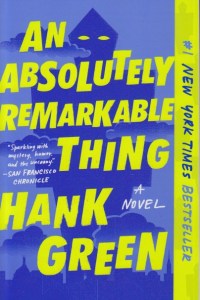
Fame is something most of us never experience.  In a world of billions we imagine what it would be like to have others pay attention to us.  Care what we think.  Admire us.  I can’t help but suppose that a large part of our political crisis is based on this concept.  It’s one of the reasons Hank Green’s An Absolutely Remarkable Thing is such a timely novel.  I’ve read a couple of Hank’s brother John’s novels, mostly in the Young Adult category, and I’ve been curious about this one for some time.  April May, the protagonist, isn’t seeking fame.  In an almost parable-like way it happens to her and she becomes addicted to it.  Safety and human relationships fall aside as she follows what seems to be the next logical step in order to secure more fans, more followers.  (There may be some spoilers below.)

There’s more than that, however, going on in the story.  Tales of “first contact” with alien intelligence often pose the question of humanity’s readiness for such an encounter.  The Defenders, a group that looks an awful lot like the right wing, are afraid.  They’re afraid of what humans might face once a superior power arrives.  Their response is to attack April, who, for some reason has been chosen as the first contactee.  Her fame isn’t accidental.  I’ve watched enough of Hank Green’s excellent YouTube videos to suspect he’s not exactly looking for a Christian parallel here, but April is a kind of messiah.  The book, in many ways, could be read as a recasting of Christianity’s foundation myth.  This isn’t a book with which most Sunday School teachers would be happy—there are adult situations and adult language.  They don’t cancel out the message of the book, however; I’ve known evangelists to use these techniques as well.  They help capture attention.

With all the books I read I have to admit that many are forgettable.  I sometimes read an old post on this blog, or a review on Goodreads, and find myself having forgotten a novel completely.  Something Hank shares with his novelist brother is the ability to make an impression.  It’s too soon to tell for sure right now, but this has all the marks of a story that’s going to be my mental companion from now on.  There’s wisdom and humor in it.  There’s a touch of Qohelet as well.  Whether intentional or not, An Absolutely Remarkable Thing follows the line of a classical story arc.  And the reason that stories have become classics is that they make us think.  I’ll be thinking about this for quite some time.  Fortunately, I don’t have to deal with fame—that would only be a distraction.


Alien Ideas

One of the iconic moments in all of cinema, known well beyond the confines of sci-fi and horror fans, is the alien bursting out of Executive Officer Kane’s chest.  The movie, of course, is Alien.  The screenwriter, Dan O’Bannon, was also known for contributing to Star Wars, Total Recall, and Return of the Living Dead.  Alien is one of those horror films I was too afraid to watch when it came out in 1979.  I was sixteen at the time, and had been primed by commercials that still haunt me.  I would eventually, in seminary, see Aliens and prompted by curiosity, eventually went back to watch the original.  It has since become one of my favorites, and analysts of genre fiction and religion quite often point to the iconic role of Ridley as worthy of theological mention.  Her self-sacrifice in the third installment has been heralded as one of the many cinematic messianic moments.

Science fiction and horror are closely related genres.  They can be teased apart in Alien only with extreme finesse.  Consider the most famous scene again.  Kane, while on the derelict alien vessel on LV-426, has the unfortunate experience of an alien larva sealing itself to his face.  The crew of the Nostromo can’t get the creature off—whenever they provoke it, it wraps its tail more tightly around Kane’s throat or leaks acid.  Then it falls off and dies.  Everyone, not least Kane, is relieved.  He joins the rest of the crew for a meal, but then shows signs of distress.  Something is eating him from inside.  The alien rips out and the line from sci-fi to horror is irrevocably crossed.  That unforgettable scene immediately became a classic of the genre.

Dan O’Bannon, the screenwriter, suffered from Crohn’s Disease.  He attributed the alien-bursting scene to his own experience with the condition, which eventually took his life.  Someone in my family was recently diagnosed with Ulcerative Colitis, a disease similar to Crohn’s.  In response I did something I’d never done before; I started a fundraiser on Facebook.  The Crohn’s and Colitis Foundation is a non-profit organization funding research into these debilitating illnesses.  It offers support to those who suffer with the diseases, the incidence of which is on the rise.  I once told my family member about O’Bannon’s use of his own suffering as the inspiration for that cinematic moment.  It brought a rare smile in the midst of a flare, a smile with a little too much understanding for a young person.  If only Ripley were here to take control of a menace far too human.


Museum Monsters

Timing has never been my strong suit.  As soon as I stopped my daily commute to New York City, the Morgan Library and Museum opened a display titled “Medieval Monsters: Terrors, Aliens, Wonders.”  To appreciate the irony of this fully, you need to realize my office was just across the street from the Morgan Library, and the daily visits would’ve provided a good opportunity for a lunch-time break with my beloved monsters.  Instead I was spending the time moving further west and unpacking.  Still, displays like this are a tacit form of validation.  Those of us who admit, as adults, that we like monsters huddle under a cloud of suspicion.  Monsters are a matter for kids—like dinosaurs and fairies—not something on which an upwardly mobile adult spends his time.  We’ll take whatever validation we can get.

Perhaps we’ve been too hasty to dismiss our monsters.  Even the Bible, after all, has them.  They help us cope in a chaotic and uncertain world.  A world of hurricanes and Trump.  A world lacking compassion and sense.  Monsters have always been symbols of the borderlands.  Creatures that cross boundaries and that shouldn’t exist but somehow do nevertheless.  Science has helped us understand our world, but in our desire to grow up enough to use Occam’s razor, we find that it shaves a little too close.  Besides, what can be more unnatural than shaving?  When we lose our ability to believe in monsters, we lose a piece of our ability to cope with an unpredictable world.  Monsters have their practical uses indeed.

If the world were more predictable, I would still be teaching instead of editing.  Or I’d still be living in an apartment rather than a house.  Moving is chaos embodied.  Like monsters, it’s best left to the young.  It’s just like this world for a monster display to open just across the street right when you’ve moved out of town.  I should expect no less in a cosmos marked by uncertainty.  Medieval Monsters isn’t the only museum display of the weird and wonderful.  Monsters have a way of showing up again once you think they’re safely gone.  Family and friends share with me their visits to other monster exhibits at other museums.  They may wonder at my fascination with them—an adult with a sober doctorate in the field of history of religions, biblical studies, ancient Near Eastern religions, whatever.  It’s kind of a monster in its own right, on display here daily.  If you happen to miss it, don’t worry.  It’ll remain lurking in its own corner of the internet.


On Time

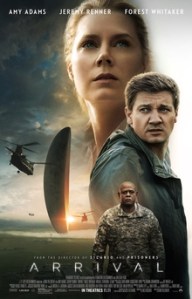
Getting to the movie theater is not only costly, but increasingly difficult to schedule. This can be problematic for someone who likes to write about movies, but the realities of the commuting life aren’t very malleable. So it was that I finally had a chance to watch Arrival, on the small screen. It had been recommended, of course, and although it’s not horror it has aliens and a linguist as the hero—my kind of flick. Once it began, I wondered if religion would play any role in the story. Alien contact would certainly rate as one of the more formative religious events of all time. The only reference that was obvious, however, was the suicide cult shown on a news story in the background, immolating themselves as the aliens became known.

Louise Banks, a linguist who has security clearance, has a sad story. Spoiler alert here! If you’re even more tardy than me you might want to fire up Amazon Prime and read on afterward! The movie opens with her watching her daughter grow up, only to watch her succumb to a rare disease as a young woman. Then the aliens arrive and she’s whisked off to Montana to try to communicate with them. It’s only after repeated encounters, learning the written language of another race, that she asks who this little girl she keeps dreaming about is. The child is in her future. The aliens see time as cyclical, not linear, and by learning their language she begins to think like them—knowing the future holds a tragedy for her. The intensity of the experience makes her fall in love with Ian Donnelly, another academic, who will become the father of her child but who will leave when she reveals the future to him.

Just as the aliens prepare to leave, not religion but philosophy takes over. A question posed by none other than Nietzsche goes: if you could live your life over exactly the same as you lived it this time, would you? Nietzsche’s point was that those who say “no” deny life while those who answer in the affirmative, well, affirm it. Ian says what he would change. Louise, however, embraces life with the tragedy she knows will inevitably come. While religion is off in a corner doing something that shows just how nonsensical belief can be, philosophy stands tall and faces the difficult question head-on. Although the movie follows some expected conventions—aliens bring peace but militaries want war—it rests on a profound question to which, I’ll admit, I haven’t got an answer.


The New Neighbors

Apartment dwellers often ponder new neighbors. If anything gives the lie to being in control of your own destiny, renting your domicile does. Still using the old, aristocratic terms landlord or landlady, we know that we are under someone else’s authority. “As long as you’re under my roof,” my bully of a step-father liked to huff, “you’ll obey my rules.” When you rent, you can’t choose your neighbors. Those who own the property have final say. If they play the stereo too loud (“game” is probably the modern equivalent, but I was born before Pong even came alone) and won’t listen to your plea for a more monastic setting, you throw yourself on the mercy of your lord or lady. We got new neighbors this week. Not just us, but the whole galaxy. Seven new earth-like planets—surely ruled by Trump-like dictators—have been discovered. Let’s hope they’re early to bed, early to rise types.

During the Bush administration I often fantasized about the aliens landing on the White House lawn. I thought, with a president so obviously lacking intelligence, what would our new neighbors think of us? Would they complain to the landlord? You’d think that after that long trip across cold, vast interstellar space they’d maybe have the right to expect to find the brightest and the best in charge, right? Mission accomplished. The sign says so right there. Or to put it in a modern key, “Earth first, Earth first.” If they’ve got their intergalactic television on, I hope it’s switched to a different channel.

15207890820_d855b341e3_z

Contact, the novel by Carl Sagan, suggested the first contact from the aliens would be of Adolf Hitler. Among the first poisoned radiation this planet flung off into space was the fascist propaganda of 1930s Germany. Earthlings, not yet tempered by the Trump brand, were shocked. Surely this is a sign of hostility! Unless, of course, you control both the legislative and executive branches. Then you can just decide not to show up at the town hall and tell everyone you’ve got more important things to do. So, what will our new neighbors think? Do they just want the bodies of their compatriots from Roswell back, or is it a more serious discussion to be held behind closed doors? After all, African slaves were merely chattels in a negotiation between a more powerful culture and unhuman indigenous dullards with nothing better to do. On the spaceship back to their extraterrestrial slave mines, I do hope they have the common decency to keep the music down to a reasonable level.


True Natives

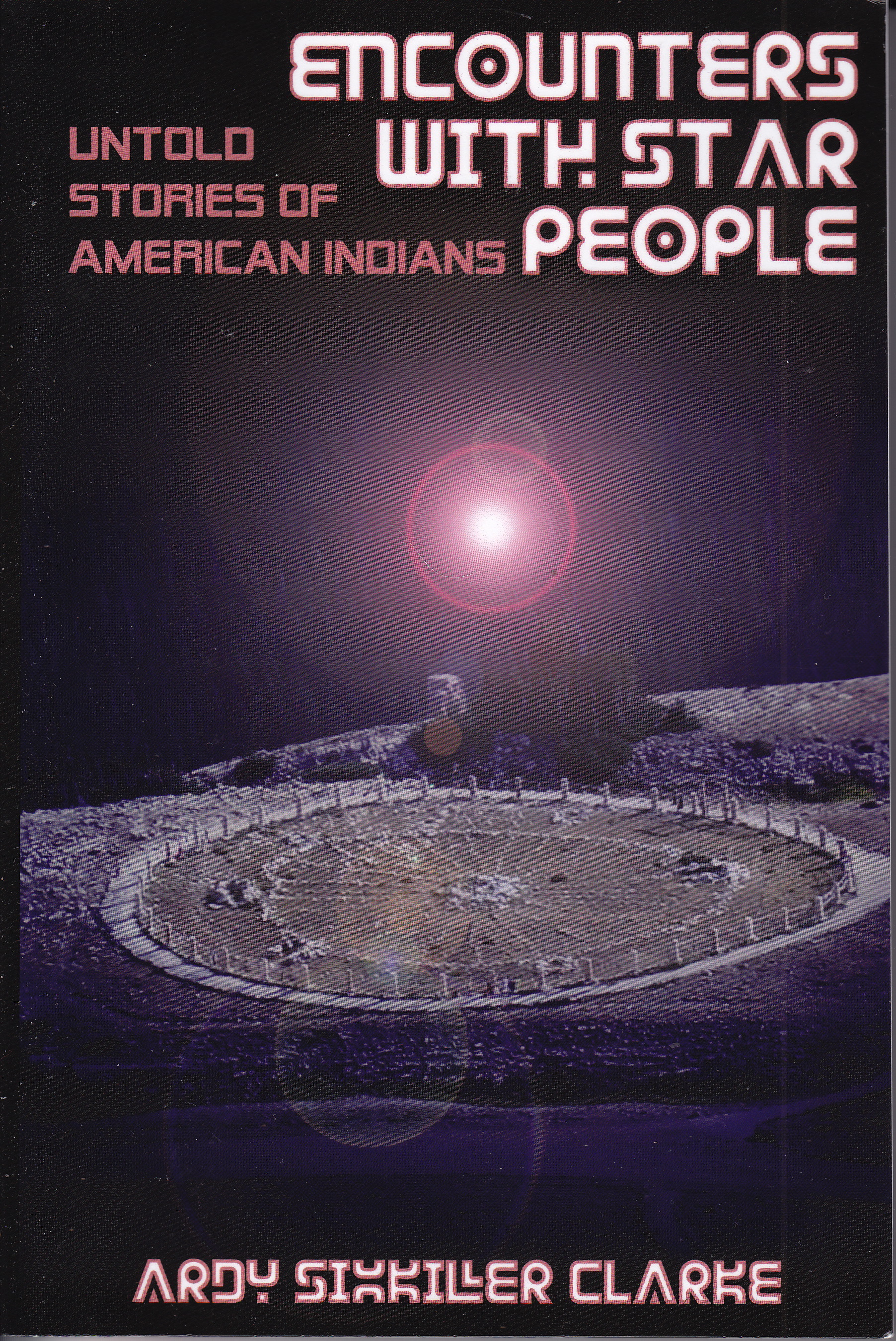
StarPeopleI have long been fascinated by American Indian folklore. In fact, the first book I read this year was a set of Indian tales. Just this week I finished a most unusual book by Ardy Sixkiller Clarke entitled Encounters with Star People: Untold Stories of American Indians. Clarke, who is herself Indian, taught at Montana State University and collected stories from various tribes concerning Star People. Mainstream western science has already made up its mind that Homo sapiens are the most advanced species ever to grace this universe, and so any discussion of visiting non-terrestrials is off the table. What Clarke shows us, however, is that just because there’s no such thing doesn’t mean that all worldviews agree on that point. In many interviews with indigenous peoples of the Americas, belief in Star People emerges as perfectly normal. As does not talking about it because white people will ridicule and belittle anything that doesn’t fit into their limited cosmos of technology and money.

Reading these stories felt like absorbing wisdom from those who observe nature more carefully than those of us of European stock are inclined to do. With eyes pressed to microscopes and telescopes, it is sometimes possible to miss the big picture. We crowd into cities and have no idea how to live under the stars. We can’t even see the stars most of the time. Have we lost our ability to wonder?

Purely from an academic point of view, I wonder why aliens can’t be taken seriously. I try to think of other topics that are simply laughed out of discussion before examining the evidence. To me it seems that human pride is at stake in this case. We are a very proud species, enamored of our own accomplishments. If we can’t reach the stars, nobody else can. This to me is troubling. Aliens, after all, don’t fall into the category of “supernatural” unless we mythologize them into yesteryear’s angels. If they are real, they are as natural as we are. They would have a technology that we haven’t replicated yet, and anyone who doubts interstellar flight should consider the impossibility of carrying a computer around in your pocket or on your wrist only thirty years ago. No, if there are Star People, they are natural. Whether or not they might exist is simply a matter of belief.


Soaring Prophets

EzekielSpaceshipOkay, so I pulled the book off the shelf, and I feel now like I need to read it. Call it an occupational hazard. Josef F. Blumrich’s The Spaceships of Ezekiel, despite its von Däniken-like sales, has never been taken seriously by biblical scholars. Blumrich, no doubt a brilliant engineer, simply had no street cred among biblicists. His handling of biblical passages is awkward and he leaves out anything that really can’t be explained by his theories. Not exactly professional exegesis. He suggests, of course, that the “chariot” vision of Ezekiel was, in fact, a spaceship. The figure Ezekiel assumes is God is actually a commander of the ship and the message (which accounts for the vast majority of the book) really doesn’t matter in this context. In my earlier post, having not read the book then, I made the error of supposing that the helicopters were impractical in space. Reading it, I instantly saw my error. This was engineered as a landing craft from the mothership circling the earth above our heads. Boy, do I feel stupid now.

The overall mistake Blumrich makes is the “unforgivable sin” of eisegesis. Suspecting that he has a well-engineered spacecraft on his hands, he draws out the implications—such as the propellers—which would not be necessary, but must be there because of a “literal” interpretation of Ezekiel. Once the eisegesis is done, it can be used to explain further episodes throughout the prophetic book. The message of Jerusalem’s destruction and the hopeful prospect of a return from exile get lost in the space dust raised by these propellers. Blumrich was quite right, however, that technical people and humanities people need to be willing to learn from one another. Ezekiel may have seen something unexplained, but his function was that of a prophet, and prophets say the strangest things.

Even more odd, from my unprofessional reading, was the sense that Blumrich saw capitalism as the default economic system of the galaxy. Time and again he mentions how expensive such interplanetary travel must have been. How do we know, I wonder, that aliens like to exploit each other as capitalists do? If they are a more advanced species, surely they must have an imagination that reaches beyond one percent controlling 99 percent of the wealth to aggrandize themselves. I can imagine a society without money. A society with fair trade where everyone is cared for by medical individuals who don’t charge an arm and a leg to treat an arm and a leg. A world where doctors don’t worry about being sued by lawyers. A world where dreamers are free to dream and society values it. Ah, I’d better be careful since, it seems, I may be beginning to sound like a prophet.


Somewhere, Out There

With Pope Francis’s impending visit, the New York-Philadelphia corridor is abuzz with discussions of traffic and commuting disruptions. From a little further away, Irish Central is reporting that the Vatican chief astronomer has gone onto record stating that he believes in extraterrestrial life. (Despite the headline, the article doesn’t say anything about UFOs, and the astronomer, Fr. Funes, is noted as saying that he doesn’t believe extraterrestrials are flying here.) The real issue, however, is metaphysical, rather than physical. How would life elsewhere impact theology? Long ago the Vatican expressed some comfort with the idea of evolution. As early as Augustine of Hippo, thinkers have noted that reason cannot contradict truth and still be convincing. The evidence for evolution, overwhelming as it is, falls under that rubric. Life in space, at least according to orthodox science, is more a matter of mathematical certainty rather than experiential. And like any scientific idea, not all scientists agree with the astronomical odds in favor of life in space.

Funes, according to the article by Frances Mulraney, believes that aliens are not fallen races in need of salvation. The grand master plan laid out in the Bible was unique to this world only. Human beings sinned, we required divine intervention, and, as you’d expect from a Christian source, the incarnation, death, and resurrection of God’s only son. It does raise interesting questions about what the aliens might think of a chosen race. How could you not think yourself superior if you had no need of God’s special attention? One can only hope that ET isn’t the jealous sort.

Photo credit: John Fowler, Wikimedia Commons

Photo credit: John Fowler, Wikimedia Commons

For years those who speculate about non-earth-based life have argued over how religions would handle the news that humanity isn’t alone. Would religious observance increase or decrease? It might depend on what our fellow universalists have to tell us. This, in a nutshell, is the dilemma of ancient religions. Founded when worldviews were pre-scientific, back when the earth was the center of everything, they didn’t add an infinite universe into the equation. And infinity always complicates things. Fr. Funes says the Bible isn’t a science book, and indeed, biblical scholars have long known that to be the case. It’s the contingencies outside the ordinary of two millennia ago that are most worrying to literalists. Even with all we have learned of science, we have a great deal yet to comprehend. Religion is a uniquely human response to an uncertain universe. And since ours is apparently infinite and expanding, religion may very well be something we’ll need to take with us to the stars.