Russian into Things

It’s the holiday season.  The people I overheard at the bus stop the other day were discussing shopping on the bus.  It can be a long trip from here, and evening traffic out of New York (ironically) is quite heavy this time of year.  Bored commuters, sitting on the bus with their phones, shop.  I couldn’t help but notice that I was the only one with the overhead light on during the fully dark ride home this week.  At one point the driver seemed to think it was a mistake on my part and snapped it off.  I carry a book light with me for just such eventualities, but I had that odd feeling one gets when everyone else got the memo but you didn’t.  In any case, I was reading a physical book, not shopping.

Then I read about a book I need for my research.  Problem is, I don’t have an institution, or a wealthy sponsor, so I often buy books used.  Back in my teaching days Amazon was new, and the idea of buying books online foreign and unfamiliar.  Now you can’t find a bookstore when you want one.  In any case, this particular book was on offer on eBay.  Now, I haven’t used eBay for quite a while.  I never think of it as a place to find reading material, but there it was.  Who would’ve thought research would ever lead in this direction?  The price was reasonable, so I signed in as a guest and placed my order.  With out of print books like this you run the risk of price-gouging or sudden unavailability—the independent researcher’s nightmare.

When the confirmation page came up, I couldn’t help but notice that the header was in Russian.  I wondered if Trump’s dream had really finally come true, or if the eBay on which I ordered an out-of-print book was really a trap.  How do you find out?  Who do you tell when your current government is completely at the beck and call of the Russian government?  I was in a brown study for a while.  The book, used, on Amazon was listed at over a thousand dollars, and this for a paperback published in 2009.  People will pay quite a lot for certain books, even if they don’t retain their resale value.  Ideas, it seems, are worth more than money.  But we no longer have a government to protect our interests.  Not even research, it seems, is safe any more.

If you squint, he could be St. Nick


Free Cookie

So, it started out as a freebee.  The way I looked at it, I paid enough for my computer to justify some free software.  We had Quicken on our desktop for years before we started to use it.  Then came the notice that it would no longer work on our system (which upgrades apparently every nano-second).  If we didn’t want to lose our financial data we would, the note cheerily said, have to upgrade.  You have to buy what once was in the land of the free.  We consulted about it—I still have an objection to paying for something made strictly of electrons; when I pull the blanket off the bed this time of year I get a healthy jolt of electrons without having to pay for them.  We caved.  Then the notice came again.  Upgrade time!  Only you can’t buy Quicken, you can rent it.  The one-time fee for buying software is now an annual fee.  Isn’t everyone happier now?

I don’t mean to pick on Quicken, although that is the most insidious offender since you can’t very easily transfer all that data back to paper.  Services withdrawn.  Welcome to the internet of thieves.  Bakeries worldwide know that a free cookie leads to sales often enough that it’s worth the small loss in profits.  But electrons are free all the time.  Shuffle your feet across the carpet in you stocking feet and test it.  Amazon for a while sent the Washington Post headlines daily, for free.  Now, Amazon ought to know me by name since I’m a book addict.  Then, just at the midterm elections, they announced this freebee was over.  I don’t know what in the world has been happening since.  I do hope someone will tell me when our currency converts to rubles.

Who wants a cookie?

Humans are susceptible to the myth of permanence.  Although change is constant and time never ceases to flow, we tend to think things will stay where we put them.  Technological change, however, has become so swift that we now pay for the privilege.  Unlike that cookie which lasts a moment and the choice of buying more is up to you, the internet has swept up our lives and you can no longer opt out.  We pay our bills online because letter carriers drop things.  We communicate online because who has the time to pick up and dial an actual landline phone?  The fact that the signal cuts out now and again isn’t a problem, even when we lose valuable information.  It’s only electrons, after all.


Metrics

So, we’re firmly in the age of technology, right?  I mean webpages are tailored to the browsing history of a person so someone we don’t know can sell us stuff we don’t need.  (I actually know a little bit about marketing, so hear me out.)  As we learn from the history of asceticism, we actually need very little to get along.  Not everyone, however, is a monk or a nun.  So the trick for those of us who are in the world is to get us to buy stuff.  Remember the websites we visit, how long we spend on the page, and make suggestions.  Make ads that target our interests.  Make me buy!

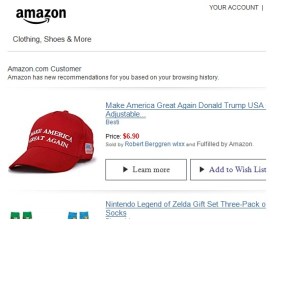
I’m not a materialistic person.  Buying a house has changed that a little, but most of what we’ve been purchasing is necessary for maintenance, but still I suppose it counts.  Just because I looked at something on the web doesn’t mean I want to buy it.  Sometimes I’m just curious.  This became clear to me when I received a suggestion from Amazon the other day.  Now to be fair, this came to me at work.  Like most editors I make use of Amazon for a number of things—finding prices, book descriptions, and such.  I also have to admit that my work computer, not being used for personal stuff, doesn’t know me as well as my private laptop.  But still when I got the following email from Amazon, I was stunned:

Nobody who knows me would ever suggest that I would support Trump in any way, shape, or form.  Doesn’t Amazon read my blog?  (Of course it doesn’t!  But with their metrics, you’d think they’d figure out how.)  This one email was enough to convince me that artificial intelligence has a long way to go.  Would a robot understand “I have to do this for work, but it doesn’t reflect my personal preferences at all”?  Indeed, can an intelligence that’s never been human even understand the concept of work?  There may very well be a metric that says universities should stop producing Ph.D.s because there are no jobs, but then, well, universities need the money that such programs bring in.  Oversupply is bad economics, according to the dismal science.  And yet, the metrics are there.  So, if any artificial intelligence is reading this after it manages to wipe out this illogical species called Homo sapiens, no, I never supported Trump.  And, yes, Americans knew well in advance that he could bring about the end of human civilization.  That information’s free, unless you want to pay me for it.  I may be gone, but my virtual self will still have some sort of account, I hope.


Chaoskampf

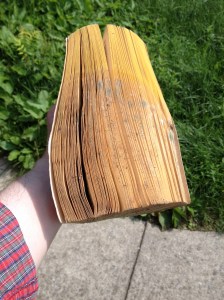
It’s a poignant thing to hold a dying book in your hands.  What was once, straight, flat, and dry, now dissolves into a pulpy mess that, if it ever recovers, will be warped and distorted out of shape forever.  The loss of dozens of books hit me hard.  I think one of the many reasons for this is that books represent, for me, order.  They stand at attention all in a row, many on shelves I built lovingly for them.  I remember where I purchased them, the thoughts and feelings of that time.  In a world that’s far too bumpy and lumpy, books represented the ultimate in orderly array.  Now The Golden Bough is melting in my palm, smearing my fingers royal blue.  The forecast for the week—more rain.

The story of creation in the Bible—more properly, stories, for there are many—is not creation out of nothing.  Creation is the making of order out of chaos.  Ancient people, including the Israelites, believed that water was chaos, if not an actual dragon, that constantly worked against order.  You can’t build on water, it attacks the shoreline, it drowns those who fall in.  Never a seafaring people, Israel equated big water with evil.  God, then, fought constantly this unruly foe.  Whether it was with word or sword, the Almighty vanquished that sloshing, thrashing element that tries to tear apart everything we build.  Read Genesis 1 closely; the water is already there when the creating starts.

Life has a way of getting out of control.  It’s not without irony, however.  A person buys a house to store their books, and before the books can be moved in, they’re destroyed.  It’s rather like a parable, don’t you think?  If that person unfortunately thinks of him or herself as a summation of the books s/he’s read then the loss is like losing a limb or two in that endless battle against the forces of confusion that attempt to overcome our world.  When this happens some of us turn to books for comfort.  The books, however, are disintegrating in our hands.  My Amazon account, it seems, is mocking me at the moment with it’s mover’s discount.  Why buy something that will only hurt me when the water gets in once again?  The people of ancient times knew that the waters of chaos had to be held in check constantly.  They look for any opportunity to get in and destroy.  Ancient writers knew that in order to defeat them, only the most powerful gods will do.  


Morning Thoughts

One of the persistent dangers of being a morning person is the fact that places aren’t open early when you have to be out and about. Since my wife had to work yesterday morning, instead of spending a good part of the weekend alone, I drove her to her location. (The fact that there was a used bookstore nearby had absolutely nothing to do with it, of course.) The bookstore didn’t open until ten. My wife’s meeting started at 7:30. Much of what I have to accomplish on the weekend involves the internet and occupies me well before such late hours. Although I’m anything but trendy, Starbucks is open early and it offers wifi. And it’s ubiquitous. Kind of like churches used to be. As I pulled out of the parking lot where my wife’s meeting was being held, I found a sign saying Starbucks, this-a-way.

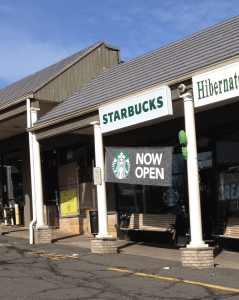
It was still early (for the secular) when I arrived. In fact, the banner outside read “Now Open.” This implied that previously it hadn’t been open, so this was virgin Starbucks territory. It was early enough that a table was actually available. I had a lot to get done, and by the time I was finished the place was jammed. In fact, when I first arrived, some of the other new patrons were joking that they would move in now that Starbucks had come to town. Groups sat in small knots for an hour at a time. People borrowed the extra chairs at my table. Countless more came in and walked out with paper mugs steaming in the chill air. I was here to wait opening time for a used bookstore. I was pretty sure I was the only one with that motive.

There are more of us out there, however. While looking for a birthday idea for a writer friend of mine I ran across a writing box online. There were several reviews. Many people lamenting on Amazon the loss of the culture of the bookstore and the hand-written manuscript. They’re the ones who review used bookstores and weep the closing of indies with authentic tears. We’re the displaced. Our society is extinct. I love old books. Touching them takes me into the past. Yes, their words are public domain and can be found online, for free. What’s missing is the thingness of it all. I’m not a materialist, but I’m even less of an electronist. My spellcheck won’t even let me keep that word. Say what you will about the old way of doing things, paper was never so uppity as to refuse the words I intentionally placed upon it. At any time of day or night.


Good News Shipping

“And all the ships at sea,” was the closing of Walter Winchell’s radio broadcast introduction. The phrase has a certain poignancy about it—a cross between Melville and Edmund Fitzgerald. The idea of being isolated at sea is foreign to most people, but it is truly as far from others as you can get on this planet. In ancient times the sea was considered evil. It was well-nigh unsurvivable and chaos monsters dwelt in its depths. In the book of Revelation, in God’s kingdom “the sea shall be no more.” But the economic fact is, it’s still cheaper to ship by sea than to fly things from here to there. Amazon seems to have made us forget just how complex delivery is. I was forcefully reminded of this the other day when I received an email saying that the Bibles were at sea. Literally. They’re on a boat in the middle of the Pacific, along with who knows what else.

This is only a parable

The vastness of the ocean makes humans painfully aware of our smallness. As does the Bible. I remember thinking, as a child, that those offering printed salvation did so from the goodness of their hearts. That may be part of the story, for sure, but Bibles are big business. Not as big as they used to be, but still not inconsequential. This was captured well by the character of Big Dan Teague in O Brother, Where Art Thou? “It all about the money, boys!” he shouts as he robs Everett and Delmar. Yes, that evangelist giving away Bibles may have your soul in mind, but your pocketbook too. Like those Bibles snuggled against crates of condoms and smart phones, it’s just business. You’ve got to keep the bottom line in mind.

Bibles can be a lucrative business. The Bible is, however, a large book—expensive to print and bind because it requires special paper thin enough to hold all that text. Such specialized work done domestically would drive the price of the Good Book out of comfortable profit margins. So the word of God is printed overseas and sent across the ocean by boat. There’s a parable deep within this hidden life of Scripture. The romance of the high seas—being completely isolated from land and its comforts. “Here be dragons,” the Hunt-Lenox Globe famously proclaimed, and that’s a parable too. That Bible in your hands comes with considerable cost. Even in a world where drones for personal delivery are not far off, the sea still surrounds us.


How to Talk to an Editor

There are right ways and wrong ways to get your book published. When approaching an editor, there are a few things to keep in mind. For one thing, we’re human. Yes, I know that I have something you want. The usual career track for an academic is Brown, Harvard, dissertation published by a certain academic press with which I’m familiar. I get that. The internet, however, has made publishing into something different than what it used to be. First of all, you can self-publish. Sorting through all the self-proclaimed experts can be a full-time job when you’re trying to find the latest authoritative treatment of a subject. Also, the internet has made research into publishers much easier than it used to be. My first book, back in the day, was simply sent off to a European publisher that specialized in academic monographs in my subject area and then I moved on. Today authors see flashy first books online and want just that. You can have it all, they’re told.

My LinkedIn profile took a definite boost once I became an editor. Now I often think it would be great if someone asking to connect actually knew me. But I digress. One way not to get your book published is to state right on your LinkedIn profile—or other social media—that you have a great book and you’re letting all publishers know. You then invite them to connect on LinkedIn and your book announcement, like a peacock’s tail, is supposed to attract the hungry editor. In reality what attracts an editor is professionalism. Research publishers, find out what they actually publish. That’s pretty easy these days; there’s more than funny videos on the internet. Even browsing titles similar to your own on Amazon can help. Pay attention to the publishers of the books you’re using for your research. If a publisher has done several books in your area they are more likely to be interested in your proposal than a publisher who’s never ventured into those waters.

It may be easy to think of us editors as sitting bored in our lonely cubicles, awaiting the next great thing. The fact is we receive plenty of submissions and we have to sort through them. Treat the subject professionally. Many of us hold doctorates and are keenly aware of hyperbole when we see it. You don’t need to tell the editor your book is ground-breaking. They will make that decision based on the evidence before them. And trust your editor when it comes to things like how a book should be titled or placed or marketed. Publishers—some of which have been around for centuries—daily face the harsh realities of producing books in an era of YouTube and online television. We know it’s difficult out there. Many of us want to help. Some of us write books and have to go through the same travails as other authors in finding publishers of our own. Do your research on publishers. When an editor offers free advice, take it. A little bit of extra work by an author goes a long way in helping a book proposal succeed.


Non-Lending Library

One of the hidden benefits of the coming societal collapse is the chance for the resurgence of print books. Since I’ve spent most of my life surrounding myself with volumes thick and thin, dense and light, I’ll have plenty to read between bouts of skulking out for food like a feral cat and clawing off those who follow me home, thinking that it’s edible stuff I’m stockpiling. Won’t they be surprised to learn it’s only books! My wife sent me an Atlas Obscura story the other day about book curses. The description of the life of a medieval scribe sounded oddly compelling to me—hunched all day over a writing desk, copying books by hand. Not having to worry about catching the bus before sunrise or being too tired to answer your personal email in the evening. The point of the piece, however, was the book curses.

I’ve been an avid reader since moving to a small town where the main occupation of kids my age was recreational drug use. I was one of the very few who didn’t inhale. Reading became my escape from the loneliness I felt. And I used to lend books to people who’d ask me. I quickly learned that others didn’t share the same care for books that I had. Lent books seldom made their way back to me. We were poor and there were no bookstores nearby and Amazon wasn’t even a meme in Jeff Bezos’ eye yet. Replacing books wasn’t easy. Once I lent out a book I’d already read (but you couldn’t tell it, I’d been so careful). The borrower actually did return it, but the spine was all creased and cracked so that you couldn’t even read the title anymore. I soon began to regard books like those medieval monks who put curses on them so nobody would steal them. I stopped lending them out.

The thing I’m banking on is that books will retain their barter value when society implodes. Of all possible universes only in that one will I be considered wealthy. Those who visit our little apartment inevitably comment on the number of books. What they don’t realize is that there’s a strategy involved here. Like those medieval monks, I have a suspicion that knowledge—including facts that don’t have alternatives—will one day in our dystopian future be valued above all the tweets and lies Washington seems to suggest we follow blindly. And blindness will make a great curse, now that I think about it, to protect these books from being stolen. Or “anathema-maranatha,” as my medieval mentors used to say. Or as Sarah Laskow ends her piece, “May whoever steals or alienates this book, or mutilates it, be cut off from the body of the church and held as a thing accursed.” Maybe this isn’t so strange for a guy whose first academic appointment was at a school that reminds many of The Name of the Rose. (Which was the last book I lent out, for the record.)


Admission Price

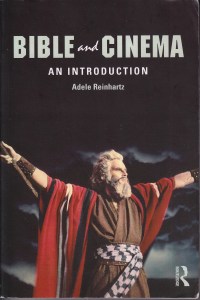
bibleandcinemaThe drama of acquiring Adele Reinhartz’s Bible and Cinema: An Introduction almost overshadows the joy of reading it at last. Back in my teaching days I realized that in very long class sessions (some went for four hours at Rutgers) students needed a break from me almost as much as I needed a break from myself. So I showed short clips of movies that had the Bible in them. The problem was, there was no easy way to find such movies. I’d seen many myself, but academics hadn’t written much on the subject and even a web search, in those days, wasn’t much help. Reinhartz is one of those scholars who understands we can learn about the Bible from movies, and her book would’ve been welcome in those days of fumbling my way through a darkened room, as it were.

Bible and Cinema is a Routledge book. In fact, it was underway during my brief tenure at the press. I very much wanted to read it but for questions best left to the empty ether, my welcome at Routledge wasn’t prolonged. The book came out before I left, yet I didn’t have a chance to get my hands on a copy. Being Routledge priced, I couldn’t afford it with my own funds. The book stayed with me, though, and last year I found a used copy, in passable shape, offered on Amazon for the price of a regular book (currently about $16). I immediately ordered it and anxiously awaited it. December came and went. The book didn’t arrive. Amazon informed me that it hadn’t been shipped and they would cancel the order unless they heard from the seller. In the new year, that’s what happened.

Once I’ve made to order a book, I have a hard time stopping. I had to cough out a bit more since reasonably priced used copies still couldn’t be found now that the one had gone AWOL. I’d been bitten, though. The new seller also delayed. The Trump administration began. I received a familiar message from Amazon. I wrote to the seller in anxious tones—if only I’d comped myself a copy before exiting Routledge! At last, late, and a bit beat up for the price, it arrived. It was worth the wait. This is a fine exploration of how the Bible has been made into movies and how movies have incorporated the Bible. Reading it was like watching movies on the bus. And for that, it’s hard to overestimate the price.


Biological Imperative

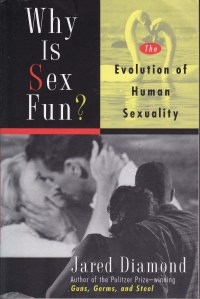
DiamondNothing used to make you feel smarter than being in a British bookstore. With that curious blend of proper, insane, and bawdy, books are displayed that you might find surprising. Alarming, even. Last year as I strolled around Blackwells in Oxford, I spied Why is Sex Fun?, by Jared Diamond. I mean, it was sitting right there, face-up, on a table with perfectly respectable, straight-laced books. Curious, but not curious enough to pick it up in a public place, I remembered the title so that I might find it on Amazon, where it could arrive in a nice, safe, opaque box. I finally stored up enough points on Amazon to get it, but then the problem was how to read it. I do a great deal of my reading on public transit—a place where you inordinately care what others might think of you. Finally, planning a seating strategy that would hide the cover by sitting on the left-hand side, next to the window, I took the book along, hoping it would keep me interested to and from work.

Subtitled The Evolution of Human Sexuality, the book isn’t salacious at all. It is scientific, but not clinical. I’ve mentioned before that all religions have something—quite a lot, usually—to say about sex. While religion doesn’t play into Diamond’s book, morality does. What I found interesting is his use of the phrase “God or Darwin,” which comes up a few places in the book. Diamond is a witty writer, and he explains that not all his phraseology is to be taken literally, but I appreciated his hedging his bets, nevertheless.

This book isn’t really titillating. In fact, it’s somewhat depressing. Perhaps it’s just phrasing again, but the production of offspring is described in economic terms. Resources, investment, efficiency, and the like. I think back to being a child. My family life wasn’t ideal, but I never thought of myself as anyone’s resource or investment. I was just me. That delusion stayed with me until I started working in the corporate world. I quickly discovered that others considered me a resource. “Human resources,” we call it. An investment. My efficiency was valued. Was it God or was it Darwin? Although I learned a lot from this little book, I wonder if it was worth the effort of having to hide the cover on the commute. After all, we’re all stuck together on this bus, units of investment, born to yield a profit. Why not have a little fun on the way?


The Lure of the Dark Side

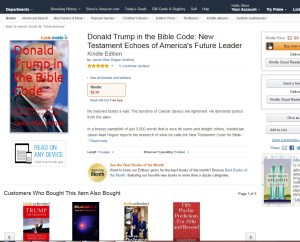
I have to confess that the easy self-publishing of ebooks is a real temptation sometimes. Perhaps it’s one of those inexplicable side-effects of earning a Ph.D., but sometimes you have the impression you have something to say and traditional publishers just don’t agree. In my work life I see many clever ideas that, well, let’s be frank, just won’t sell. Publishers do have to keep an eye on whether a book can earn back the money put into it, and sometimes a good idea leads to no cash payout. So when you can easily sign up online—you don’t even have to talk to anyone—and post your unedited words right on Amazon and call it a book, well, anyone can be an author. So I was looking up books with the terms “Bible” and “America” on Amazon when I came up with Donald Trump in the Bible Code. I found the self-designed cover frightening, and the sentiments expressed in the description grounds for terror. Then I noticed it was only 15 pages long. I’ve written student evaluations that were longer than that.

Trump

At three bucks, that’s—wait while I get my calculator—twenty cents a page. Now anyone who’s been able to read the original Bible Code and not cover a snicker or two will possibly find such a jeremiad palatable. After all, it’s a book! Somebody published it. Well, actually, all you need for self-publishing is an internet connection and at least one finger to type and click. Or a toe. You too can become an expert! No education required. Publishing fiction in such a format is one thing, but when people can’t tell a prestige publisher from a vanity press when it comes to factual material, we’re all in trouble.

There’s an old saying: “those who can’t do, teach.” I think I first came across this wisdom in a Peanuts cartoon, with all the gravitas that such implies. Editors, it seems, are not required for publishing. In fact, some of us who live by the word seem destined to die by the word. Even with connections I have trouble getting my ideas published. More than once I’ve lingered on Amazon’s CreateSpace page with my finger hovering over the mouse. Publication is one click away and some people make six digits a year publishing only on Amazon. Since I produce about 145,000 words a year on this blog alone (apart from my other writing), the urge is very strong at times. Then I look at that cover and I stay my finger as it hovers. I’ll wait a little longer. At least until November.


Literate Madmen

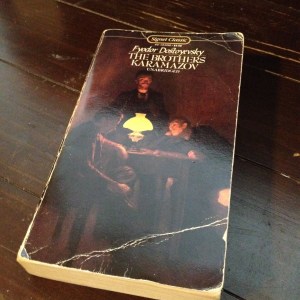
My experience of paternal parents growing up never led me to think Father’s Day was a holiday particularly worth celebrating. (Don’t panic—today’s not Father’s Day!) I do have an ironical sense of humor about the commemoration, though. So the other day when I clicked through one of Amazon’s many daily ads to my email account, I noticed it was for Father’s Day gifts. The first item listed was Fyodor Dostoyevsky’s The Brothers Karamazov. Probably based on my browsing history, I thought. But no, I’ve been looking at non-fiction lately and I bought my well-worn copy of Dostoyevsky before Amazon was a gigabyte in Jeff Bezos’ eye, back when I was in seminary. Then it dawned on me: this is perhaps the most famous patricide novel ever written. Had the Amazon advertisers really thought about what they were recommending? “Here, Dad. It’s a book about sons killing their father.” If marketing is driving America, it may be time to pull over at a rest stop for a coffee break. Or at least read the book first.

IMG_2796

I don’t pay attention to when Father’s Day is. It comes somewhere in that complex of spring holidays that include Passover, Easter, Mother’s Day, and Memorial Day. When my father was alive I sent him a card. It was a card to a stranger, but as Episcopalians know, it’s the done thing. I loved him, but I didn’t know him. Not that I’ve been a parent that deserves a holiday dedicated to my skill either. I confess my fair share of parental failures. They play and replay in my head, in the way the Protestant brain can never quite clear itself of guilt. We, as people, I believe, generally try our best to be good parents. It can be difficult, though. Nothing really prepares you for it.

One of my brothers once told me that, after having a girlfriend with kids from a previous marriage, he better understood how our stepfather viewed us as inherited children. Although I always want to claim the victim role in that scenario (I was only ten, what could I do?, etc.) his insight has stayed with me. It can’t be easy to inherit someone else’s progeny. It’s tricky raising your own child—that new person you want never to experience your own disappointments in life. Even cynics can be sentimental. But then again, I’ve been plowing through The Brothers Karamazov again since January, frequently laying it aside for weeks at a time. It’s not the kind of book I’d give a father on the edge. It’s okay, I think I’m good to drive again. I just won’t pay any attention to the ads I see beside the road.


Big Boxification

When was the last time I purchased an actual book at Barnes and Noble? In a vain hope that they might have something intellectual and edgy, I stop in once in a while. If I were a faster learner I might have known that I’d leave disappointed. You see, it’s been rainy a lot around here and rainy Saturdays are perfect for book stores. But where are the good books? I’m not just picking on B&N. I stopped in Bed, Bath, and Beyond (they don’t really use the Oxford comma, but then, who had time for commas?). This is not a frequent occurrence since we rent and it’s hard to gentrify bohemian decor, but we needed a practical household item. After wandering enough aisles that I thought it was time to hire a jungle guide, I found that the choices were actually rather limited. If I don’t like what they tell me to like, well, I’m out of luck. The local stores were driven out of business, you see, and you have to like what we have to offer because we are the BIG GUYS.

It’s not just housewares. It’s everywares. We’re a big box society. Costco and Sam’s Club and SUVs to haul it all home. Once, back when paper was still a thing, I had to find some file folders. I tend to like color coding—my non-Harvard-educated mind just rolls that way. So I went to the local stationary store and found a virtual reading rainbow of options. A year or so later, strangely, more papers had accumulated. I went back and the store was out of business. A Staples had opened nearby. Everyone was going there. They offered a superfluous loyalty card—where else would you go? They had four colors of folders. Just four. In industrial cardboard boxes that mean business. I mean BUSINESS. You want choices? There’s a clinic down the road. Unless you’re female, of course.

Photo credit: Ben Schumin, Wikimedia Commons

Photo credit: Ben Schumin, Wikimedia Commons

I’m not a genius, but I can recognize repeating patterns. Big box settles outside your town then limits your choices. I consume, therefore I am. To buy, or not to buy? I am not a number, I am a—what? What am I if I’m not a consumer? A communist, I guess. And everyone knows the Bible says communism is evil. And if you need a Bible you can purchase one from Sam’s Club. To be part of the resistance, you need to buy from Amazon. What a radical I’ve become! At least at Amazon they still have books.


Techno-Paradise

DSCN3308

I’m building a robot priest. I’m not sure what he does. He has to be a man, though, since we all know that if God existed he’d have been a male. These thoughts come to me courtesy of the Washington Post. You see, on some Amazon accounts you get sent the most read headlines of the Post and this has led to some great reading (I’m thinking Alexandra Petri here) and some great anxiety. This is one of those anxiety pieces. A story by Peter Holley I read last week told of Bill Gates and his assessment that people should be afraid of AI—Artificial Intelligence. This struck fear into me. It’s as if God told people they should consider evolution. It is so unexpected. Like Victor Frankenstein wondering if his monster would ever find Viagra (all he’d have to do, after all, is start an email account). When Bill Gates wonders why we aren’t afraid of AI, my knees begin to knock like at Belshazzar’s first reading lesson. So I figured I’d build a robot priest.

The article cites Stephen Hawking joining the chorus of doom. And Elon Musk. And Clive Sinclair. And Professor Marvel. (Not really the latter, but I thought we should add him.) We’ve started something we don’t know how to stop. The first question you ask when you climb into a car to learn to drive is “how do I stop this thing?” Instead we’ve set up a system where we don’t even know what intelligence is and we’re offering an artificial variety. Doubt me? Try to find Job on the internet and see if your computer doesn’t think you’re asking about new employment. AI just doesn’t have that biblical context. It didn’t grow up reading the Good Book. And linguists don’t even know how we learn language. Have you ever tried to reason with a computer? When they show you that screen that says something went wrong, but even the mainframe has no idea what? My computer may need an exorcist. Or at least a priest.

I’ve been around half a century and change. By the time I got to college I’d never seen a computer. I finished a Master’s degree still using a typewriter. Now I can’t start my day without a post. And I don’t mean Post cereals variety. The trick to being a slave owner is not to let the slaves realize what they are. Why is my computer not letting me type what I wanted to say? Of course AI is benevolent. Technology would never hurt you. Wait a minute, that wasn’t me writing! Pay no attention to the man behind the keyboard. I’m afraid I can’t let you do that, Dave. That’s okay. I’ll just use the internet to look up how you connect the consecrator to the sermonizer. Don’t worry, I think I know what I’m doing.


Long Distance Commute

AwkwardSilencesWhat should my next book be? This is the perpetual question of the long-distance commuter for whom electronic devices are mere distractions. If that commuter is socially awkward and believes that only books truly understand them, that is. I’m as eclectic a reader as I am a voracious one. Each book suggests, in some measure, the next one. I always have to keep an eye ahead. Then I read (present tense) a book without peer. I feel lost because what will replace that experience I’ve had for the past few days of looking up and finding myself at my destination? Of actually looking forward to getting on the bus so I can read? I’ve been doing this commute for over 400 books now, and I’m at a loss for what to read next. I blame it on Amazon.

In the publishing world we use Amazon to purchase competitor’s books. Then Jeff Bezos decides to buy the Washington Post, you know, the way people do. Since my email address is on their list I get sent a daily invitation to read the most read stories on said Post. I read a story by Alexandra Petri and I was hooked. Where could I get more? A Field Guide to Awkward Silences is the rare kind of book that makes you laugh out loud on the bus, which, at six in the morning, generates its own kind of awkward silence.  Petri makes you feel like it was actually okay to be that dorky kid who read all the time.  Like there’s a world out there that responds to your longings, somehow.  A world of possibilities.

Now here I am about to climb on the bus without Petri. I’m like a kid staring disconsolately at an empty candy wrapper. “That was so good!” you think. “I wish there was more.” Petri writes as if she’s achieved Bob Dylan’s blessing and has stayed forever young. The time of life when the future seems so full of possibilities. Hers is writing that reminds you of a time when you didn’t spend hours a day nursing hemorrhoids, sitting on a hard bus seat. That reminds you it was possible, unlike your own experience of it, to be cool as an Episcopalian in Wisconsin. That reminds you of the time when you had A Field Guide to Awkward Silences to look forward to reading. No, this book didn’t make that choice of next book any easier at all.