Bible Use

In the current presidential race, it seems, the Bible hasn’t been as large an issue as it has been in the past. Bluff, bravado, and bullying seem more the order of the day. Goliath rather than David. This makes me think of the varied uses that the Bible has had in American life. It has been used as a spiritual guide, a textbook, a set of moral principals, a grimoire, and a science primer, as well as a political playbook. It is versatile, the Good Book. It has been prominent in American society from the very beginning, but clearly its prominence is starting to fade. Not likely to disappear any time soon, the interesting question is how people use the Bible, often without reading it. This is what scholars call the “iconic book” aspect of the Bible. It is performative—it acts in a way that has an outcome, no matter what the intent of the user. As I’ve argued in academic venues, it has become a magical book.
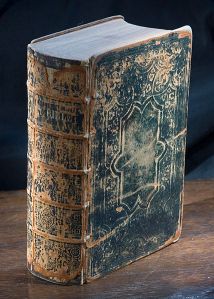
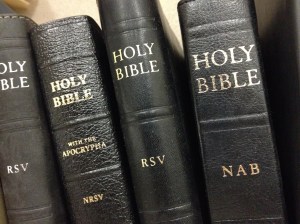
An iconic book (photo by David Ball)

An iconic book (photo by David Ball)

Wondering whether this is a new situation or not (I deeply suspect it’s not) I’ve been reading about the Bible in early America. Almost all the reference material points to the “official” uses of the Bible—that by statesmen and clergymen (both classes of “men” in the early days) with almost nothing of how it was used in private. This question involves some exercise of the imagination since there are few data. Would not a family, struggling to survive, see in the Bible a powerful book? And would not a powerful book be capable of subverting the laws of nature? Reading about the witch trials in Salem, we see that thunderstorms and other “prodigies” were considered magical. Surely one could use the Bible for unorthodox purposes? There’s little to be said in the absence of evidence. The use of magic in the colonial period, apart from the trails of witches, was not unusual.

How do we measure the ways the Bible was used when nobody beyond interested parties, such as clergy, wrote about it? Mr. Trump even tries to quote it from time to time, but since his citation that sounds like a joke opener, “Two Corinthians [go into a bar],” he seems to have let that hot potatoe drop. The Bible, seldom read, remains a powerful book. The source of its power, I suspect, is in its use by the common people. Many people are familiar with it, and believe in it. Some have even read it. It remains, however, one of the great mysteries among the early European settlers. We know they had their Bibles with them. How exactly they read them, when not under the eye of the preacher, we apparently have no way of knowing.
Bible Search

The Bible is, in many ways, not suited to internet study.  Let me explain: this artificial world of the internet is based on searchability.  To search for something, you need to have a distinctive word, a keyword, or catchphrase.  As perhaps the most successful book of all time, the Bible has undermined its own uniqueness.  How many books are titled The Gun Bible or the Dog Bible or substitute your favorite noun Bible?  Web searches for “the Bible” bring up a large number of relevant hits, but then quickly devolve into other Bibles.  Too many Bibles. Not only has the noun “Bible” been appropriated, so have many aspects of its story.  Particularly the Good Book’s penchant for using short, common words for titles of individual books.

Search for Mark, or John, for example.  Don’t bother adding the word “Gospel” since it too has become widely utilized to give any popular subject an air of authenticity.  Not only did the four evangelists write such books—the Gospel according to Biff, Trump, the Simpsons, or Bruce Springsteen will likely pop up ahead of the original fab four.  Or consider the books whose names became common nouns: genesis, exodus, numbers, judges, kings.  Then there are the ambiguous titles: Job, Proverbs, Song of Songs, Acts.  Sure, you can lengthen them out a bit: Acts of the Apostles, Song of Solomon, the Proverbs of Solomon, but the results you get tend to skew evangelical that way.  Job is just a non-starter. Do you mean employment or enlightenment? Do I need to get a job or to get Job? At least it’s not a popular name for kids.

The other area where the Bible’s success works against it in the computer age is its success at giving names to people.  In a culture so biblically based, the Bible has been treated as a name-list for newborns for centuries.  Even though the Anabaptist penchant for using prophetic names has faded from popular culture, there are plenty of Isaiahs, Jeremiahs, and  Ezekiels out there.  Even some minor prophets, too.  Amos, Micah, Zechariah.  (Habakkuk, Zephaniah, and Haggai haven’t particularly caught on.)  Daniel, David, Joseph, Abraham, Isaac, Jacob.  We live in a world of biblical nomenclature.  There’s even more than one Jesus running around.  (Jesus, is, of course, Greek for Joshua, so there may be even more than one might suspect.)  I spend a good bit of the day searching various biblical material online.  I wonder if anyone ever imagined, over two millennia ago, that a three-letter name was bound to cause problems in a world of billions? Were it submitted for publication today, the editor would’ve sent the Bible back to the author for a rewrite, along with a list of suitable keywords.

IMG_1364


Grim Where?

An inordinate amount of my childhood time was spent on television. While the device of the day had been around for a decade already, I was among those who grew up learning that watching was easier than reading. Like most children, I took the path of least resistance. I watched. As a teen, however, I rediscovered reading and from that time television began to take a back seat to books. When the great switch-over to digital occurred we didn’t get a conversion box, and we could never really afford cable for as little TV as we watch. When a program gets commended, or if nostalgia takes too great a toll, we can always purchase programs—the price of watching television without the commercials. So it was that I began watching Sleepy Hollow. Very quickly in the first season the monster of the week trope was established as the plot grew more and more tangled. The Bible was so prominent in that season that I wrote an academic paper on it.

Sleepy_Hollow_-_Title_Card

Over the past few months my wife and I have been working through season two. The DVD version was delayed and we only watch on weekends. Recently we finished the eighteen episodes of the second installment. Clearly the budget had improved over the first season, but the Bible, it was also clear, had diminished. Throughout the first season the driving motif of the story was that biblical “prophecy” (from the book of Revelation) was unfolding in Sleepy Hollow. This is what one scholar has termed a “local apocalypse.” Throughout season two, however, the end of days is shut down. Molech, its architect, is killed. The headless horseman is less Death than a jilted lover. The second horseman, War, loses his armor and dies.

Magic, however, along with special effects, take on an increased roles. Instead of turning to the Bible to solve problems, the most helpful book to have on hand is a grimoire. Sleepy Hollow, which is anything but what its name suggests, is full of monsters. Powerful magic is required to contain them, and, it seems, the Bible is no longer needed as a tool to take down evil. Perhaps there is a parable at work here. I was drawn into the series by its biblical literacy, as well as its literacy in general. More action has been introduced, and fewer books. It’s a pattern I’ve seen before. I suspect I’ll watch season three presently. When I do I’ll be casting a wistful eye on the stack of books I have yet to read, and I’ll be wondering if reading may not have become easier than watching.


Creating English

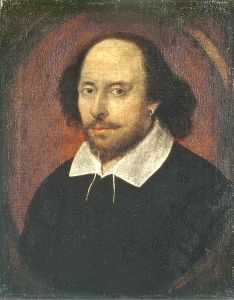
From Wikimedia Commons

From Wikimedia Commons

The seventeenth century was a portentous time for the English language. Well, I suppose every day is portentous in some way, but in the year 1611 the King James translation of the Bible was published, and it still has considerable staying power in the English-speaking world. Quotes from it show up regularly among the modern media with many readers (and likely a few writers) having no idea of the origins of the phrases they use. Just five years after the King James Version made its debut, William Shakespeare died. Many languages can point to formative individuals or literatures that codified their forms of expression. In English the honor is shared by the forty-seven translators of the KJV and William Shakespeare. This four-hundredth anniversary of Shakespeare’s death is set to be a year of celebration among Anglophiles worldwide. We will gladly acknowledge that the words we write and speak owe much to the Bard and his lasting influence that still has high school students griping all the way through English class their senior year. I have read a Shakespeare play or two that I was never assigned in school, as many come to do. This year, among my reading goals, is at least one more of the works I’ve never read.

As with the text of the Bible, there is doubt about some of Shakespeare’s plays. Scholars scrutinize. (That’s what we’re supposed to do.) And scrutiny raises doubts. The seventeenth century was a time of generally acknowledged authorship. Some great English epics, such as Beowulf, have no author we can cite by name. Over time, however, quality came to be associated with the person who produced the literature. Even today a name often sells a book far more readily than the contents do. Some of Shakespeare’s plays may not go back to William himself, but the English language wouldn’t be the same without them, in any case. We are heirs to this legacy. Spelling began to be standardized. Grammatical expressions were codified. Classic stories predating Shakespeare became endlessly replicated and copied by those who know there’s no replacing an original.

A story on NPR notes that the First Folio—the first bound copy of all of Shakespeare’s plays—is being sent around the country this year by the Folger Shakespeare Library. Each state will host the first edition during the course of the year. The article by Susan Stamberg notes that this folio is the literary equivalent of the Holy Grail. Shakespeare is nearly as canonical as the biblical canon itself. Even if the Bard’s authorship is in doubt, it is still holy writ. Those of us who’ve spent considerable time with religious texts recognize the hagiography readily. No, these aren’t signed editions. Some of the work may have been done by someone else. Nevertheless, four centuries ago, through a combination of Bible and what we would today call “fiction,” the English language as we know it, was itself becoming canonical.


Imagine the World

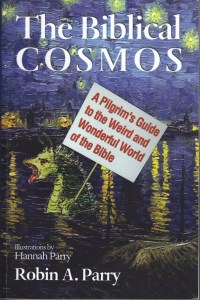
Biblical CosmosRobin A. Parry’s, The Biblical Cosmos: A Pilgrim’s Guide to the Weird and Wonderful World of the Bible is a fun trip through territory already familiar. Familiar, that is, to anyone who has studied the biblical world on its own terms. Fundamentalists, I think, would benefit from taking this guided tour seriously. The fact is, most people have no real sense of how mythology might inform a scientifically inclined world. Not that Parry will convince everyone, but the dangers of literalism are best disarmed by a believer. This little book endeavors to demonstrate just how odd a world produced the Bible we still use today.

Although the point of the book may not be what I took away from it, I would suggest that the most important aspect is that times change.  A biblical worldview, unless one is mentally able to hold two realities simultaneously in mind, is simply not possible today.  I told generations of students that the world described by the Bible does not exist.  It is a flat world, held up by pillars and with a solid bowl inverted over it for a sky.  At the same time, those who lived in the biblical world were not simpletons.  The basics of science were well understood and their engineering capacity easily bypassed that of the current writer.  It was a world based on different assumptions than ours.  The problem occurs when people who know better (i.e., anyone born since about the time of Copernicus) try to pretend that the Bible can be taken literally.  It is disingenuous to say so.  The Bible, regardless of divine status, is a document of its time.  No dinosaurs had been discovered.  The processes of geology were understood only in the most rudimentary of ways.  Stars were not millions of light years away.
 
So what are we supposed to do with this information?  Parry concludes his book by describing ways in which the biblical view of the cosmos might fit, conceptually, into a modern theology.  For many of those starting out in the academic study of the Bible such a demonstration can be quite valuable.  Those who’ve been at it a while will surely have come up with their own systems.  When books become sacred, in the minds of the believing community, the “truth” attributed to the book is the truth of that era.  As any scientist or historian will attest, truth is contingent.  We haven’t learned everything yet.  Given the limitations of the human mind, we likely never will.  We should accept our universe with a little mystery.  Humility can be a good thing, and it is more effective not having to make excuses for what will surely become outdated information sooner than we think.


Factor Fiction

An article on CBS that my wife sent me tells how Costco mistakenly labelled a shipment of Bibles as fiction, setting off a tweet-storm. Some offended, some applauding, a 140-character barrage ensued as Costco apologized. What was the fuss about? As a person who has experience with both fact and fiction, it has become clear to me over the years that these categories are not nearly as sharply defined as they might appear. We make labels to help us categorize a confusing reality. Our brains, nevertheless, easily accept fiction as fact, at least for purposes of getting along in the world. The earth is spinning, right now, at over 1,000 miles per hour. We don’t perceive it, and in fact, it took not a few deaths and apologetic clerics before it was admitted that evidence we don’t feel proved the case. Each day we choose to believe the fiction that we are holding still and the sun goes overhead. Is anybody tweeting about that?

One of the angry bird calls pointed out that Costco (which apparently now has an imprimatur) doesn’t label their Qurans as fiction. How many Christians have read the Rig Veda and not wondered whether its proper label fell on that side of the pricing gun? The matter of fact or fiction is one of opinion. Even those books bearing the label of non-fiction are interpretations of evidence. When it comes down to ultimate truth, where it lies is always a matter of faith. Who buys a Bible at Costco anyway?

IMG_2634

When I was a child and Amazon did not exist, buying a Bible was itself a kind of sacred act. You wouldn’t think of going to Wal-Mart to do such a thing. You went to the Christian bookstore (or, I suppose, if you grew up in a city, a secular bookstore might do). You talked to clerks who knew the differences between versions. The place smelled of leather and velvet. It was a place dedicated to the truth. Costco is a big box store. Buying in bulk implies something. Ironically, those who angrily tweet about the Bible’s label don’t seem to realize that Bible selling is big business. You won’t find much in the way of small publishers’ literature in such a store. Next to your giant cartons of cereal and immense packages of diapers, why not tuck in a Bible as well? When you get home you can tweet about how much money you saved buying eternal salvation in bulk.


Reptile Fantasy

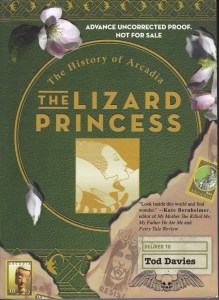
LizardPrincessThe generous folks at Exterminating Angel Press graciously sent me a copy of Tod Davies’ The Lizard Princess to review. A fantasy novel that includes a conflict between a world that admits of the supernatural and skeptics who deny anything beyond the material, it is a tale for our time. Indeed, the antagonism is real enough. We live in a world where fantasy can bring in untold wealth while we are taught that not an atom of it is true. Clearly material explanations fit the physical world we inhabit. It’s the world inside our heads that often rejects such materialism being taken to its “logical” conclusion. Davies clearly feels the angst of this discord. The Lizard Princess is a fantasy in the face of harsh reality. And we still need fantasy—perhaps we need it more than ever.

Throughout The Lizard Princess, whether intentional or not, biblical imagery pervades. The Bible offers classical stories that, no matter how we might receive them, continue to influence our ideas and ideals. Here, in a world created especially for the reader, the battle between good and evil is an everyday reality. The turns taken along this path are unconventional, and at times even uncomfortable. The awareness that there is a larger story in the background, however, offers some consolation. Angels, the Devil, and even a subtly veiled God are all players in this fantasy world of Arcadia. Mythical creatures abound, and transformations lead to new perspectives along the way.

In my conversations with other scholars I’m reminded that academics don’t often turn to novels for escape. Some do, of course, but the academy recommends a steady diet of technical non-fiction for those who wish to make an impact upon the world of knowledge. I have always been grateful for literature, however. During my years in graduate school and early in my teaching career I neglected the kinds of books that were my constant companions growing up. In a rural setting far removed from any institutions of higher learning, novels were often the only reading readily available. I never considered the time between their covers wasted. I found in The Lizard Princess a vivid world strangely like our own, but different enough to be more a parable than a simple piece of fiction.


I Am Legacy

The word “legacy,” I fear, is losing its meaning. Well, words really don’t having “meanings” as much as they have “usages,” but still you get my point. When I was young (before the Internet had been invented) a legacy was a time-honored contribution. Something that had, perhaps, been a family heirloom or a significant school of thought. Legacy today simply means something outdated. It’s a polite word for “old.” I’m reminded of this constantly in our computer age. I’ve never been a fan of lingo. In fact, I seldom use slang. (I think it was being raised with Holy Writ that said, “Let your yea be yea and your nay be nay.”) It’s not that I don’t hear slang frequently. I can even replicate it when necessary. It’s just my legacy.

The other day I attended a meeting about fonts. I never stop to think much about fonts. I’ve designed a few (on paper only, that most archaic of ancient mediums) and I enjoy the wonder of knowing that no matter how embellished or plain, an A is still an A, just as surely as a yea is a yea. When discussing fonts, however, “legacy fonts” kept coming up. Perhaps alone in the room I could recall the days before computers. The days when a font was a set of clearly defined green dots that you could trace with your eye as they appeared on the cathode-ray tube. The legacy fonts under discussion were much more recent than that. It was simply a way of saying fonts we no longer use. Old fonts. Outdated fonts.

Unicode, to be sure, is a thing of wonder. As a scholar who struggled to get Hebrew vowel points to line up correctly on the pages of his dissertation, I knew well the benefits of having a system to organize any sign we use in writing. Even as recently as my last book, published last year, I was still struggling to find transliteration symbols for some words in Ugaritic. I’m sure they must exist in Unicode, although I don’t know if Unicode Ugaritic is yet a reality. It’s barely a reality in biblical studies any more. So maybe I’m just feeling like the memory of ancient things has been devalued. We go after the new, the fresh, the simply coded. Meanwhile, I still prefer to write with pen on paper. I’m old-fashioned in that way. Those who are too kindly disposed might even say, although I would blush at the compliment, that I’m a legacy.

A legacy font? Photo credit: Bilsenbatten, Wikimedia Commons

A legacy font?
Photo credit: Bilsenbatten, Wikimedia Commons


Fundamental Fear

Something truly scary landed on my desk. Working for an organization that has many different departments, there’s no way to know everyone. So when something bible-ish arrives in the mail, it gets directed to me. Now, I don’t follow the afterlife of creepy religious people through prison, so it took a few minutes to remember who Warren Jeffs is. I knew I’d read about him but I couldn’t remember where. Then I remembered the Fundamentalist Church of Jesus Christ of Latter-Day Saints. Jeffs was once the head of this church before being put into prison for child sexual assault crimes. So why had he sent a copy of Jesus Christ Message to All Nations to my publishing house? It is already published, and it is rather modeled on the Bible, at least at a surface level. No letter, no instructions. Just a book that I felt I needed to wash my hands after touching.

IMG_2571

I’d not heard of this book before. The author is boldly listed as Jesus Christ. “President Warren S. Jeffs, Mouthpiece of God” it says, given credit for, I suppose, putting pen to paper. What’s to prevent me, I wondered, from claiming God wrote what I framed into words? It is far too easy a claim to make and the credulous follow where the bold lead. That’s the way human authority, unfortunately, often works. Someone with a surfeit of testosterone declares that he speaks with absolute authority—I think of angry atheists as well as televangelists here. Such sense of irrational conviction must feel god-like. I can only guess from the sidelines. And I wonder about those who wrote what are recognized as scriptures in other religions.

Did those who wrote the books of the Bible, for instance, ever feel that they were writing unquestioned truth? Might they not have been a bit more circumspect? Maybe they were writing in the heat of inspiration, but not with the confidence of claiming divinity. Somehow I doubt even that. Writing is a human activity. The creator of an entire universe shouldn’t need to use it. Still, religions are often built around written texts. Parts of the New Testament claim to come from Jesus of Nazareth, although he’s not the actual writer. I guess he must have been working on later works of which I’ve never heard. And I do wonder how the doctrine of the faulty vessel applies in cases like this. I know better than to ask a Fundamentalist of any stripe, because I already know the answer they would give.


What’s a Bible?

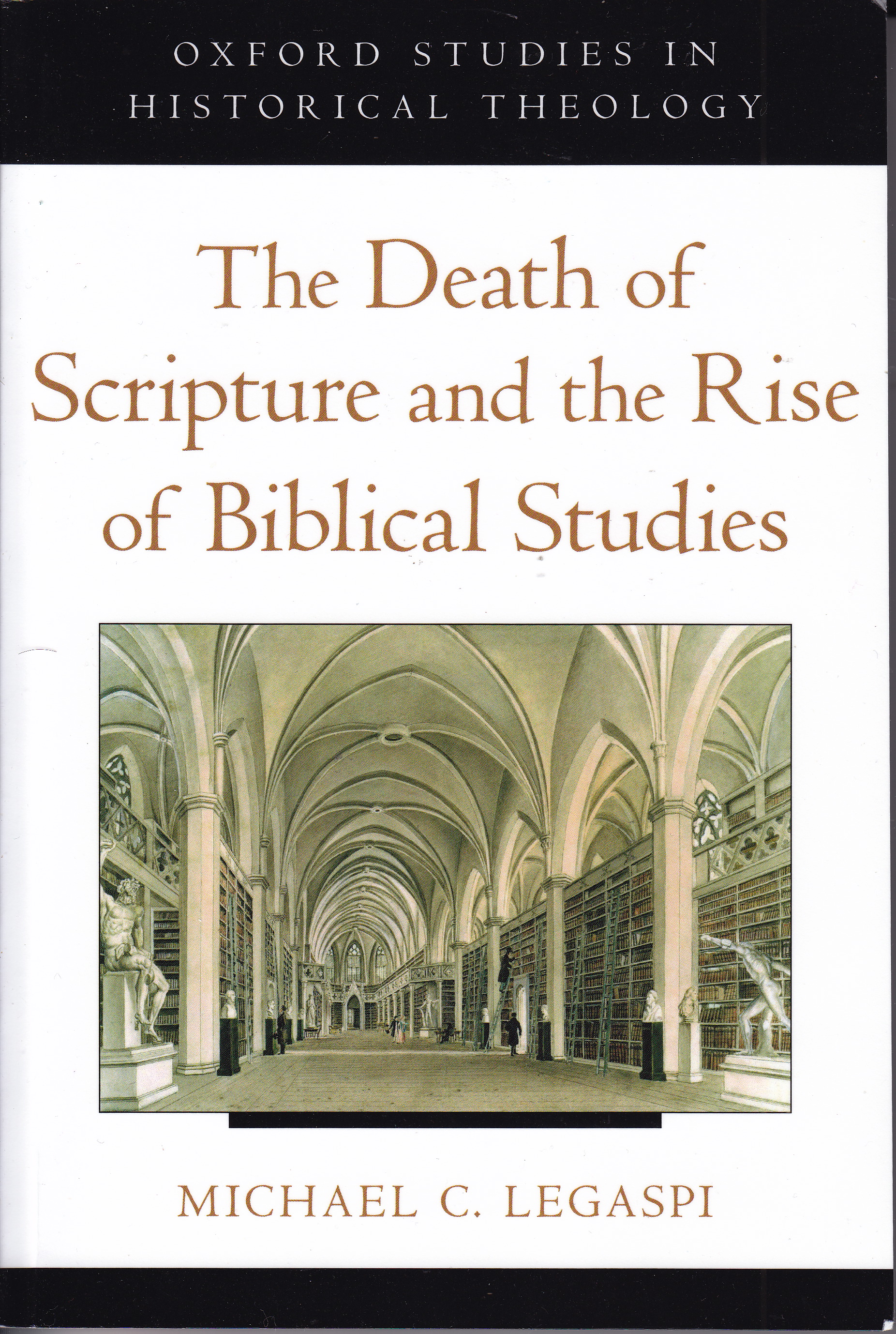
LegaspiWhat is the Bible? This might seem a strange question coming from someone who holds a doctorate in what has sometimes been characterized as biblical studies. Still, it is a valid question. The fact is, very different things are referenced by the word “Bible.” This is made abundantly clear in Michael C. Legaspi’s The Death of Scripture and the Rise of Biblical Studies. Legaspi points out that the Bible hasn’t always been the central force of Christian identification that it seems to have become. Martin Luther was largely (but not solely) responsible for the view that the Bible alone is sufficient for eternal well-being. Historically it had been much more complicated than that. The church had traditions and sacraments, Judaism had Talmud and rabbinic interpretation. The idea that the Bible alone was necessary was more radical than it might seem in today’s secular world. The problem was, the Bible isn’t an easy book to understand.

It has long been recognized that the Enlightenment and the Reformation went more or less together. The mysticism and mystery of “superstition” were bound to fade in the brilliance of pure reason. The Bible, however, still held a revered place, and it had to be studied. The sea change of the scriptural Bible to the academic Bible took place largely in Germany. No surprises there. What Legaspi demonstrates is that this study was closely bound with the university as an organ of the state. Germany didn’t boast the oldest universities in the eighteenth century, but it could claim the most intellectually rigorous. Among its biblical scholars, indeed, perhaps the one who led to the creation of the academic Bible, was Johann David Michaelis. The book is mostly about Michaelis and his influence and background in biblical studies. Clearly, applying university treatment to an ancient text was not going to be Sunday School.

By the time people like me began advanced study of the Bible, the “academic Bible” was about all there was. Many of us with serious training in the field watch in wonder as some (many) theologians take the Bible literally. They use ideas and concepts that biblical scholars have long recognized as artifacts of antique understanding. The problem is once you’ve gone down this path, there’s no going back. You can’t unlearn the academic Bible. So, what is the Bible? Obviously, it’s going to depend on who you ask, but it is clear that no one answer will satisfy all takers, even if they all claim to share a single faith. And should you venture to those hallowed halls of higher education, you’ll find the Bible is studied here, as are dinosaurs and an earth that is a few billion years old.


School Bible

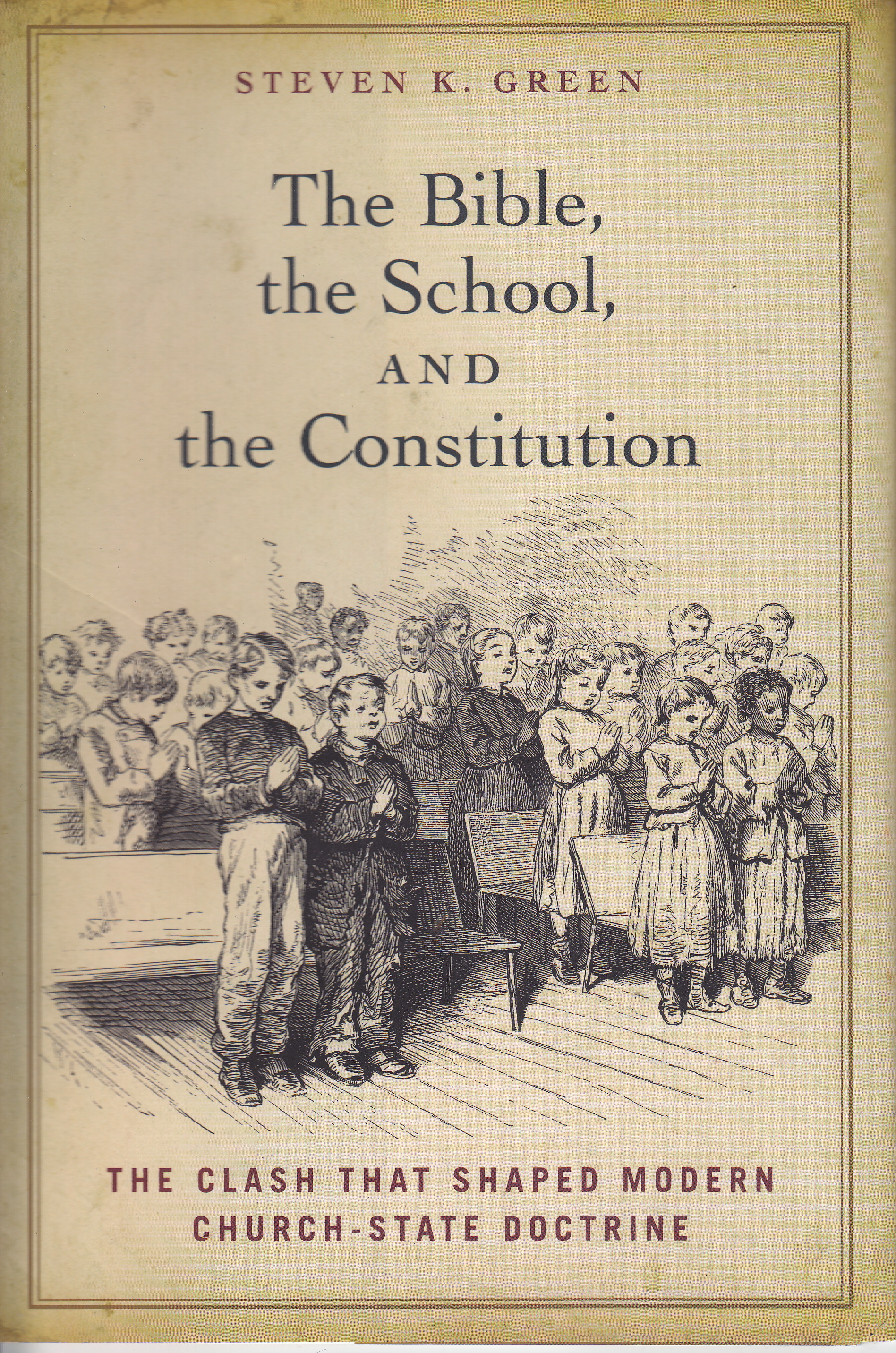
BibleSchoolConstittnAs a very young scholarlet, I recall the horror expressed when some form of prayer was expelled from public schools. It had to have been in the late ’60’s. Maybe early ’70’s. The nation, it seemed, was headed for Hades in a hurry. Little did I know that this was part of a long, drawn-out—tired, even—battle. Steven K. Green’s The Bible, the School, and the Constitution: The Clash that Shaped Modern Church-State Doctrine gives pretty close to the full story. Bible reading in public schools was foundational, in the beginning. In the early days of public education, the Bible was ubiquitous. It was considered non-sectarian since practically everyone was a Protestant. When the religious mix of the country began to diversify in the mid-1800’s, a new dynamic emerged. People got upset. There were riots. People were killed. Legislation was proposed that would explicitly add God—Jesus even—to the Constitution. Who knew?

Green’s study takes a close look at the various cases that arose around the time of the Civil War regarding the Bible in school. Protestants, it seems, didn’t appreciate that Bible reading, in the King James Version, without comment, violated Roman Catholic policy. The first to challenge Bible reading in public schools were Christians. Secularists only joined the fray later. I’m oversimplifying, of course. Some Catholics wanted equal time, the reading of the Douay Bible instead of King James. Others wanted Catholic schools to receive state funding. Nobody was really aware of other religions such as Hinduism or Buddhism. It was a country of limited religious imagination. Various groups tried in various ways to get God—their God only—into schools as the default deity. And so the fun continued.

For me, it was eye-opening to realize that all of this isn’t new. The legislation, since long before my grandparents were born, has been heading in the direction that led to the aggrieved tears in my youth. Green points out, however, that the conflict has never been completely resolved. School vouchers and a long spate of evangelical presidents have had their impact on our children. The Hades that we feared has only come with the weaponizing of our culture, largely by those who want Bible reading back in the schools. The thing we fear finds us through the thing we love. Ironically the issue never seems to be education. God or guns—it’s the power that we want. The early debates revolved around morality. How could kids be moral without Bible reading? How the definition of morality has changed. We, as a nation, still can’t figure out religious freedom or how to let kids be kids.


Go Down, Moses

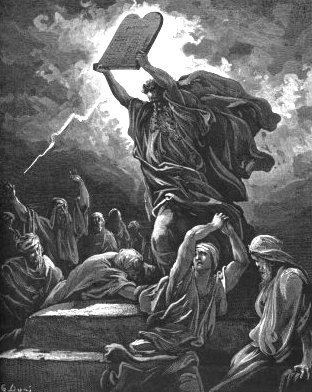
For a time, I tried to write down family tradition. My family was somewhat unusual in that regard. Family saying came generally from my maternal grandparents—my father wasn’t around for my childhood years—and since my grandparents died when I was relatively young, I didn’t hear much of their wisdom firsthand. Still, my mother told me various things her parents used to say and I tried to keep a record. Kind of like I wanted to be an anthropologist for raw folk sayings among the, non-elites. One thing my grandmother used to say, so I was told, was “Where was Moses when the lights went out?” I was always intrigued by this since I supposed it had something to do with Moses the miracle-worker. I guess I imagined Moses waving his rod and the lights coming back on. That single question is all I ever heard of this particular family treasure. I forgot about it until recently, though the miracle of the world-wide web, I learned that the query comes from a song.

Moses gets down

Moses gets down

The song, it turns out, exists in multiple versions. The Library of Congress has a recording dating to 1901 available on the web. According to this version, written by Harry von Tilzer, Moses was not “the” Moses, but a preacher condemning gambling. Also, “lights” is rendered in the singular. So much for the canonicity of family tradition. Duke University library has an undated, but clearly old, version of another song by the same title. This one does reference the biblical Moses, also the name of the song’s narrator. A child afraid in bed at night falls in love with and marries his nurse girl who used to ask him the question “Where was Moses when the light went out?” as he was falling asleep.

Yet another version, dating from 1965, has the question “Where was Moses when the lights (plural) went out?” followed by the answer, “He’s in the dark.” With all of this instant information from the internet, I’m still not certain what was being conveyed by my grandmother with this cryptic question. My mother said she used to say it when someone walked into the room too late to help with something, a kind of sarcastic “Where were you when I needed you?” What is clear is that the song was about as old as my grandmother and she found it somehow appropriate in an unconventional situation. I have to wonder how much of sacred tradition, including the Bible, might have come from misunderstood original instruction. We will, of course, never know. I don’t know what the original lyrics were, but I have learned that even family wisdom has a backstory, like any Scripture, for those who look hard enough.


Biblically Business

Bibles are business. I recently read that the first book of which Oxford University Press sold a million copies was the Scofield Bible. The Scofield is incredibly resilient to the advancement of scientific thought, and, although large print editions seem to be gaining, it is nevertheless an icon. Conservative Bibles still make good business sense. Still, the Bible originated in a rather more Catholic context. As Christianity was being born, and growing up, there were many sources of information on what it mean to be a member. Initially, being Jewish was a prerequisite. When that was dropped, you would have needed to be able to find an enclave. This wasn’t always the easiest thing to do since Roman emperors sometimes made a quasi-Olympic sport out of killing Christians. Once a church was found and joined, you just participated in the fellowship and listened to the leader. Reading from “Scripture” was likely part of worship services, but the Bible we recognize didn’t exist.

Well, parts of it did. Torah and Prophets were around. The Writings were written. Paul’s letters—several of which are still missing—were still circulating. The Gospels and Revelation would come somewhat later. About the fourth century there was general agreement about which books we meant when the word “Bible” was used. There was some fuzziness around the edges, though. Books like Tobit and Maccabees were accepted by the church, but had never been part of the Jewish canon. Judaism never officially closed its canon, so putting a limit around what would become the “Old Testament” was not as easy as saying it was just the “Jewish Bible.” No books have been added, of course, but nobody bothered to set the list in stone. Now Catholic Bibles, largely because of the counter-Reformation, included the Deutero-Canonical, or Apocryphal books. Protestants soundly rejected them. And Protestants were the champions of personal Bible reading.

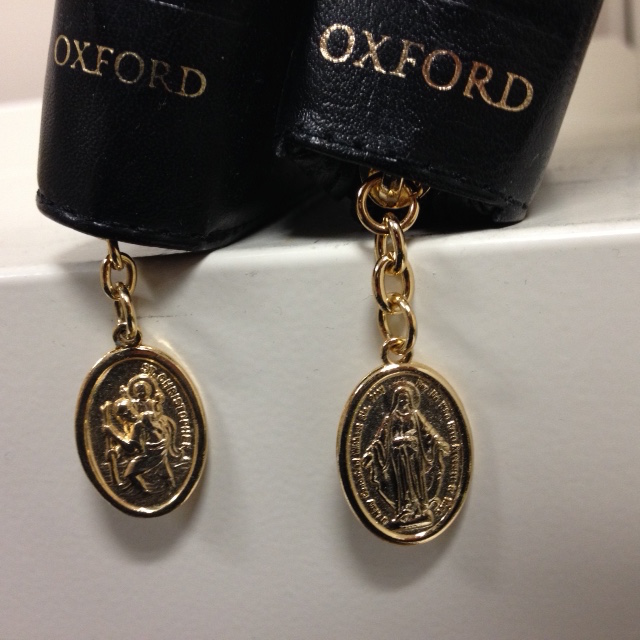
About the midpoint of last century, both Roman Catholicism and Judaism began to show a renewed interest in what had largely been a Protestant (and somewhat Teutonic) endeavor: critical study of the Bible. Bibles specifically directed toward these new readerships began to be produced. With metaphorical bells and whistles. The zipper Bible has always intrigued me. I never owned a zipper Bible. Once I had a zipper case, but never a zipper Bible. What was the message here: the word of the Almighty had to be protected? The other day I came across two zipper Bibles with saints’ medals as fobs. One was St. Christopher (who protects travelers) the other was for St. Mary (generally overall saint). These symbols of tradition interact with the more textual tradition that has come to be known as Bible. Religion is seldom monolithic, and even saints can watch over what is hidden by a zipper and regarded as the ultimate truth among those for whom Bibles are business.

IMG_2404


Ancient Tech

I feel like scraping Roman numerals on the wall of my cave with a sharp rock. One for each day I have to spend without my laptop. I’ve been working on this blog, born in this very cabin in which I sit, for six years now. With some exceptions, I’ve posted something new (and, I hope, thoughtful) every day. Even holidays and weekends. Most of those posts have been written on the deceased laptop that’s sitting in my carryon, electronic carrion. This has caused me to stop and consider that the most lasting words—the ones we all quote or at least recognize—tend to come from a far older form of communication technology: the pen and paper. Of course, there are older technologies yet. The Sumerians figured out that clay of the right consistency keeps marks made by a pointed reed pressed into it while it was still damp. Cuneiform writing lasted for millennia as the most advanced technology humanity had devised. The results, however, were bulky, heavy, and fragile. Few could learn the technique. It was an elite skill.

Nobody quotes the Sumerians anymore. Well, maybe the occasional quip from Gilgamesh will work its way to memory, but not much else readily does. The Bible, perhaps the most quoted book of all time, at least in western culture, wasn’t written on clay. By the time the earliest books of the Bible came along, scrolls had been developed. Probably suggesting itself from the way that papyrus naturally rolled up, this early form of paper—indeed, the word “papyrus” gives us our word “paper”—could be marked up with styluses or brushes and ink. Prepared animal skills, or parchment, sometimes called vellum, could also be used, but they were expensive. Pens at this period were sharpened objects dipped into ink, but the most famous words, well, penned by humankind were passed down in that medium. Copied, recopied, memorized. Electricity hadn’t even been discovered yet.


Printing presses and their children—typewriters and the consequent qwerty—have led the way since they were invented. Until, however, the 1980s at least, professors would accept only the old fashioned manuscript for papers. Indeed, the medium had given its name to the end result. We still write academic papers, although they are more often published and read electronically. So here I find myself in a cabin on a beautiful lake, surrounded by nature, worried about a communication device that can speak with the stars. There may not be workable clay here—the soil is far too sandy and I don’t have the patience to look up how to make clay on my phone—but there is paper. Pens are scattered everywhere. I am at home in the matrix that has given us the great ideas of humankind.


Preacher’s Best Friend

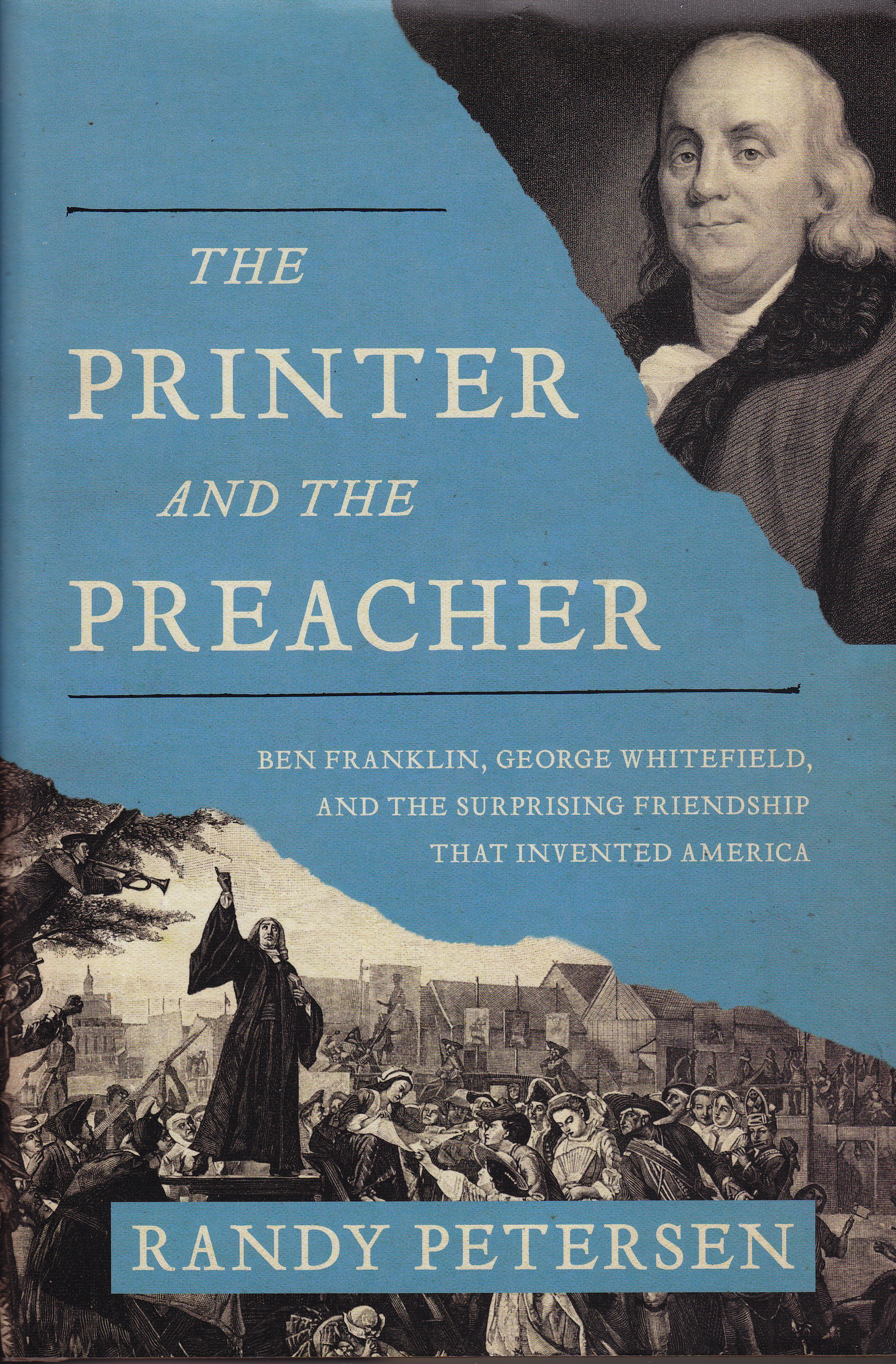
PreacherPrinterPerhaps it’s because I was born in Franklin, Pennsylvania, or perhaps it’s because everything I’ve ever read about him suggests he was delightfully unorthodox, but whatever the reason, Benjamin Franklin has always held my admiration.  Probably we all like to hear echoes of ourselves in the great.  It is difficult to believe that during his early rise to fame, Franklin was eclipsed by an unlikely superstar who was, of all things, an evangelist.  George Whitefield, an early English Methodist, wowed the colonies with his born again message, perhaps being responsible for its appeal even today.  Randy Petersen’s The Printer and the Preacher explores the unlikely friendship that sprang up between Franklin and the younger Whitefield.  While cataloguing early founders’ religious lives is always problematic, Franklin was a self-described Deist, and certainly not an Evangelical.  Whitefield was very into the personal relationship with Jesus idea that Franklin found, at best, simplistic.

Petersen’s book is a kind of wishful history.  He wants to see Franklin and Whitefield together, often suggesting that they might have met here or there, or that they might have discussed this or that.  The fact is, we have little to go on beyond the reality that the two knew and respected one another.  Whitefield stayed in Franklin’s house in Philadelphia.  Franklin printed and sold Whitefield’s best-seller sermons.  Certainly there was a good business opportunity here.  Even today the evangelical Bible market is a strong one.  Savvy businessmen and women know that a good living may be had from the Good Book.  You can’t read a book like The Printer and the Preacher without thinking that Whitefield and Franklin were a kind of odd couple.  Franklin is remembered as a man of wit and science.  Whitefield is barely remembered at all.  One of the first preachers to hire a publicity manager, Whitefield was the Joel Osteen of his day, raking in the accolades for being emotional in front of salt-of-the-earth colonials.  His oratory skills were legendary.  Even though he is honored as one of the founders of the University of Pennsylvania, he was no scholar and has largely been relegated to an historical footnote.

Petersen’s book is a quick read.  His writing is winsome in an evangelical way.  He assumes the truth, or so it appears, of the evangelical position.  Nevertheless, there is material to stop and ponder here.  Many of the questions can never be answered: why, particularly, did Franklin and Whitefield hit it off, for example.  On a more approachable level is the why of Whitefield’s faded flower verses Franklin’s perennial bloom.  The message of Whitefield simply doesn’t stand up to the experience of history.  Human beings—many of them born again—experience constant turmoil in their lives.  Franklin, on the other hand, was the consumate pragmatist.  His aphorisms are regularly mistaken for verses of the Bible.  Although others would have gotten there, we largely have him to thank for our harnessing of electricity, and even the birth of a new nation.  Whitefield’s spiritual descendants now rally to prevent stem cell research and the teaching of evolution.  Franklin’s children, illegitimate or not, reap the benefits of the lightning rod.