Groan

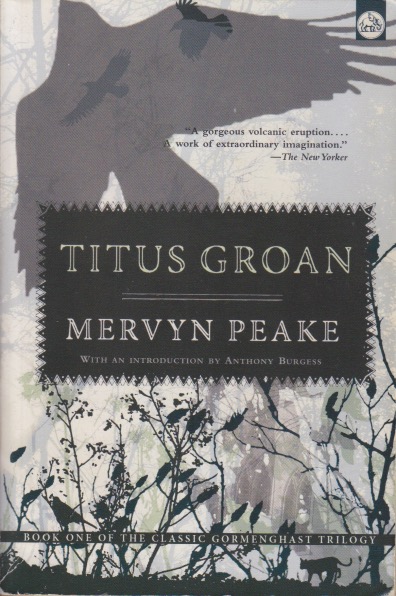
Authors are a peculiar but definite taste.  Some noteworthy voices have vociferated regarding the wonders of Mervyn Peake.  Mine has not been among them, but then, I’m not noteworthy.  Having read somewhere that the famous Gormenghast universe was one of the most gothic in mid-twentieth century literature, I read Titus Groan many years ago.  I understand the linkage between grotesques and the gothic, but this simply didn’t appeal to me.  I never felt interested in moving on to the second book of the trilogy.  At the same time, I held onto it.  Just in case.  Recently, I thought my younger self might’ve been prematurely harsh on the book and so I gave it a second try.  This time through, I appreciated some of Peake’s famous wordplay, but the novel, to me, dragged. The victim, perhaps, of the foreshortening of time, I just couldn’t get into it.

J. R. R. Tolkien once explained that he wrote The Lord of the Rings cycle to see if a really long story could be made interesting.  He succeeded.  I read the trilogy, after The Hobbit, when I was in college.  I really enjoyed it.  Titus Groan isn’t cut from the same fabric.  Peake’s thick description is sometimes a thing of wonder.  It is also very ponderous, to the point of being tedious at times.  The action is interesting enough, what there is of it.  The characters are well drawn, even if overdrawn.  And it’s clear by the end of Titus Groan that to make any sense of any of this you will need to commit yourself to two-plus volumes more.   Peake died before he could finish the fourth volume.  The first three are now solidly referred to as a trilogy, but I fear that if I were to force my way through the other two I’d still be left hanging.  I really do appreciate resolution.

It’s a personal failure, in my opinion.  I mean, Peake was obviously a talented writer.  The question is whether you can stretch a story out for too long.  Part of me wants to know the resolution, but not enough of me to get me through at least two more books like this.  I’m not sure that I’d declare this terribly gothic.  I can see why some would: castle, skulduggery, and one very well drawn villain.  Again, some of the characters are too comical to be effective gothic.  To me it felt like a mismatch between style and vehicle.  I realize that should any of his fans perchance read this, I’ll be declared a Peake imbecile.  I’ll admit that the fault is mine.  It’s a matter of taste.


Hallowed Halls

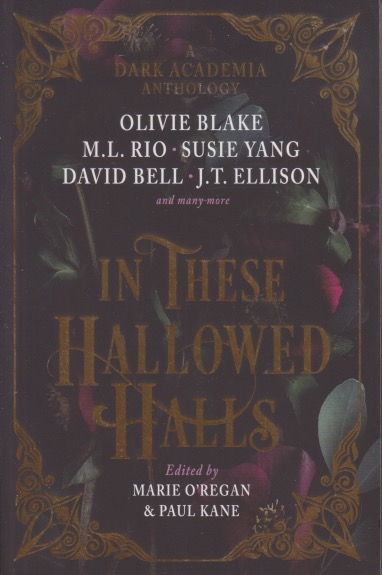
Every time I read a short story collection I tell myself I should do so more often.  Knowing that you’re only committing yourself for maybe thirty or forty minutes at a time is one way to incorporate more reading into a life that’s incredibly busy.  I read In These Hallowed Halls, edited by Marie O’Regan and Paul Kane, because, as its subtitle declares, it’s A Dark Academia Anthology.  As with nonfiction anthologies, it is a mixed bag.  The stories are all well written and all were enjoyable to read.  They also display some of the breadth of dark academia.  Most of the stories are literary (as a genre), others dip into science fiction and horror.  Dark academia doesn’t specify whether a book (or story) will be speculative or not.  As someone who writes short fiction, it seems that some of my tales might wag that way.

In any case, discussing a collection is tricky because there is such variety.  Some of the stories stayed with me beyond reading the next, which could be quite different.  Others I have to go back to remind myself what happened.  These days it can take several weeks to finish a book and a lot can happen in real life in that time span.  The stories that stay with me the most have obsessive narrators, or characters who are obsessed.  This kind of story, I know from experience, is difficult to get published.  Many of us who write, I suspect, do get obsessed.  An idea latches on and won’t let go.  Of course, most of us also have jobs that force the jaws open and drop us down in the world of the ordinary again.

Another thread that runs through many of these stories is how students struggle for money.  That’s true to life.  Thinking back to both college and seminary, there were times in both settings that I was working two part-time jobs as well as being a full-time student.  And living like, well, a student.  That experience, except for the truly privileged, is fairly common and our writers here recognize, and perhaps remember, that.  The other unavoidable theme when writing about young people in college is, shall we say, hooking up.  For many of us, college is that period in life when, thinking of our futures, and following our hormones, we start looking for love.  (I know, high schoolers do that too, but college has a way of focusing your energies.)  All of that swirling around the darkness that sometimes falls over our tender years makes this dark academia collection worth reading cover to cover.


Unwritten

It has been clear to me for some time now that I won’t live long enough to finish all the books I’m writing in my head.  A good number of them have a head start on my hard disc, but as Morpheus says, “Time is always against us.”  The largest culprit in the 9-2-5 job.  Eight hours is a huge amount of time to devote each day, no matter how you slice it.  Since eight hours are required for sleep, or trying to sleep, that means work is half of each day’s waking hours.  The other half includes things like making meals, washing clothes, family time, paying bills, running the vacuum, exercising because you sit in front of a screen all day, and, of course, yard work.  Plants don’t have the same constraints that humans do and can get to the business of growing larger 24/7, as long as the weather cooperates.

Some days I grow reflective about this.  My daughter often asks why I don’t draw or paint more.  I love doing both.  The answer is time.  Even weekends are eaten up with shopping for the food you need to get through the week, and yes, the yard was bigger than I realized, and the house needed more repair work than anticipated.  You see, writing well requires a lot of practice.  And even more reading.  Any successful writer (which I am not yet) will tell you that reading is essential.  I do read a lot.  A friend recently sent me an article about a writer whose heirs calculated he’d read at least 4,000 books.  I know that I’ve read about 1,200 since 2013.  I also know that I can’t count them all before that time.  I went through our living room shelves and counted 500 I’d read there, and that’s only one room.  

Ironically, as a professor reading time is limited.  Unless you have a research only post.  I read a lot as a kid and a ton as a student.  When I started teaching I had less time, except on semester breaks and I tried to read as many books as possible during those interludes.  Then the 9-2-5 began.  My current pace of reading began when trying to live as an adjunct between Rutgers and Montclair State.  Montclair was a 70-mile drive, so between classes I started reading voraciously.  Ironically, the commute to my 9-2-5 spurred me to start writing books again.  By then I was practically fifty.  Since my nonfiction books take about five years to write, well, the math’s not in my favor.  Time to stop my musing, because the 9-2-5 begins shortly.


The Season

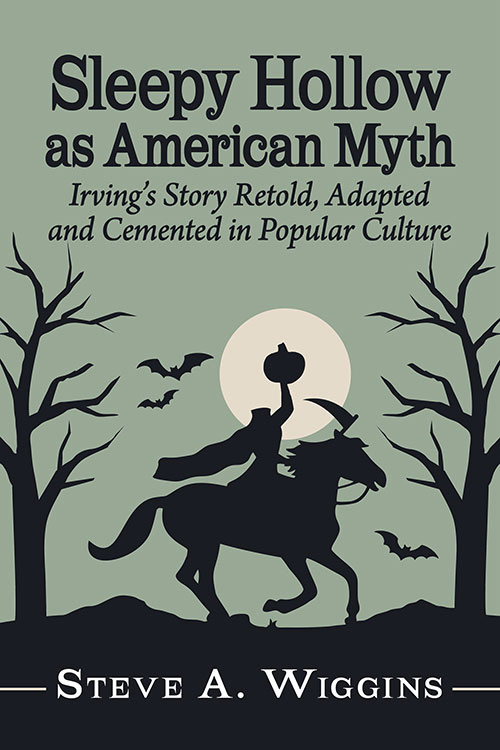
I learned about the Horror Writers Association years ago, shortly after I started publishing horror stories in 2009.  I couldn’t join because you had to have earned at least $30 from a publication.  I took this to mean a fictional one and I never made it beyond that benchmark until this year.  (It’s possible I misunderstood and could’ve joined for Holy Horror and beyond.  I think the point is they want to know you’re serious.)  In any case, these folks may be my tribe.  During the month of October the website has a set of free blog posts available to the public.  Mine—located here—dropped yesterday.  It deals with nonfiction, of course, since I’m still not finding much traction in getting novels published.  One of the weird things about book publishing is that you don’t know, unless you’re already successful, how well your sales are going until after about six months or so.  Sleepy Hollow as American Myth may be flopping for all I know. 

I’ve tried to promote this one as much as I can.  I contacted bookstores and libraries in Sleepy Hollow itself.  I had bookmarks printed and put them in local libraries and bookstores.  I arranged a discussion at the upcoming Easton Book Festival.  I told my local writers’ group about it.  Posted on a Halloween Facebook group.  All of this is tricky rather than treaty when a book is priced near $40.  That’s quite a trick, I know.  As Halloween approaches I keep seeing memes and posts about the Headless Horseman.  But I’m not sure if anyone’s finding my book or not.  It’s an anxious period when you write.

Working in publishing for nearly two decades now, I’m starting to realize that there are two ways to relevancy.  One is to be hired by an institution with name recognition—that automatically makes you an expert and everyone want to know what you think.  They’ll even pay you for it.  The second way is to write a book that sells well.  That one’s a bit of a catch-22, however.  To get published these days you need to already have a following.  I suppose that’s what the internet is for.  The best forums at the moment seem to be YouTube and TikTok, but there’s more much traffic there than on a Los Angeles freeway during rush hour.  I’m not sure if many people read the Horror Writers Association Halloween Haunts blog posts.  These folks, however, seem to look at this from a similar perspective.  Maybe a few of them will buy Sleepy Hollow as American Myth.  ’Tis the season.


Famous Cemeteries

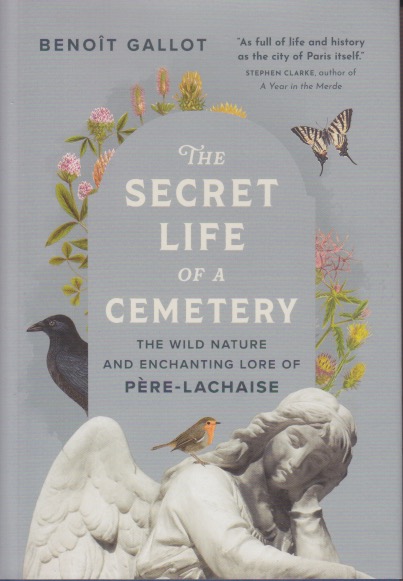
I have to confess that I really didn’t know about Père-Lachaise Cemetery before this book.  I knew that Jim Morrison was buried in Paris, but I’d never really paid attention to where.  My wife picked up Benoît Gallot’s The Secret Life of a Cemetery: The Wild Nature and Enchanting Lore of Père-Lachaise and we decided to read it together.  It seems likely that Père-Lachaise is the world’s most famous cemetery.  This little memoir by the current curator of the cemetery is a delightful read.  It is reflective and sensitive (and spawned by the attention the author’s social media was getting, so hey, help me recruit some fans!).  Gallot began posting pictures of wild animals that he snapped in the course of his work and Parisians, and others, were fascinated to learn about wild animals at home in the capital of France.  This book reflects on the animals, plants, and people of the graveyard.

I enjoyed this book, but one aspect gave me pause.  Gallot notes that the cemetery doesn’t permit jogging.  Perhaps this is a cultural thing, but cemeteries have been some of my favorite jogging spots.  I mean no disrespect by it.  Cemeteries are peaceful and have very little traffic (one of a jogger’s concerns).  I’ve never found people walking their dogs (another jogger issue) in cemeteries.  I can see how mourners might not want to see someone taking their exercise near the grave of a departed family member, but a jog is simply a fast walk.  And we are, as a species, part of nature.

Many famous people are buried in Père-Lachaise.  I visit cemeteries to find famous people’s burial places.  Indeed, that’s what I tended to post on my Instagram site, but I found no followers.  We had visited Highgate Cemetery in London—another famous burial ground—and discovered many familiar names there.  Perhaps to Anglophones, Highgate is more famous than Père-Lachaise.  But even Highgate would’ve been off my radar had it not been for the Highgate Vampire incident that I’ve written about before.  Gallot, who lives in the cemetery, is skeptical of ghosts in Père-Lachaise, although he’s well aware that the stories are told.  This brief book is contemplative autumnal reading.  There are several black-and-white photos of animals among the graves.  They are the living among the dead, and an appropriate symbol that life goes on.  If you’re looking for a place to reflect on mortality and you want to learn about cemetery life, this may be the book for you.


Ancient Asherah

It seems like ancient history.  Actually, it is ancient history.  Ancient history with a new angle.  A Reassessment of Asherah is finally available in paperback.  Although my research has moved in a different direction, an author cares for all of their books and Asherah is my firstborn.  My doctoral dissertation originally, what separates it from many proposals I now see as an editor, is that it has a broad topic and some native sense of writing.  I have always eschewed technical jargon.  Academese obfuscates.  And is boring to read.  In any case, being young and naive, at the instruction of one of my doctoral supervisors, I sent it to the distinguished series AOAT (Alter Orient und Altes Testament), published in Germany.  It came out as an expensive hardcover and sold through its only print run.

Years later, evicted from academia, I found a foothold in publishing at Gorgias Press.  The owner of the press did something that even Eisenbrauns couldn’t, he talked what was then Ugarit Verlag into granting Gorgias the rights to republish my out-of-print book.  But he decided to do it in hardcover, so it was still too expensive for most potential readers.  Also, to make this a proper second edition, I added all of the articles I’d written about Asherah as well as the original text of the AOAT version.  If I recall correctly, it sold pretty well for Gorgias.  I moved on to other things.  Weathering the Psalms had been written before my career malfunction, but publishing that made me realize I could still write expensive books with low sales.

Four books further along, all on aspects of horror, a friend did the impossible.  He talked Gorgias Press into publishing a paperback of A Reassessment of Asherah, without my prompting.  For the first time in the thirty-plus years that the book has been available, it is now “individually priced.”  Please keep in mind, though, before emptying out your bank account, that “individually priced” here is still in the academic realm.  It seems the minimum price for books in this category is around $40, which is a bit steep for most of us.  But still, it is a new thing in the academic world.  I do hope that someone more persuasive than me might talk to Bloomsbury about a paperback of Nightmares with the Bible.  That has been, as far as I can tell, the poorest performing of all my expensive books.  It’s also the one that, I suspect, would have some individual readers.


Brutal Boys

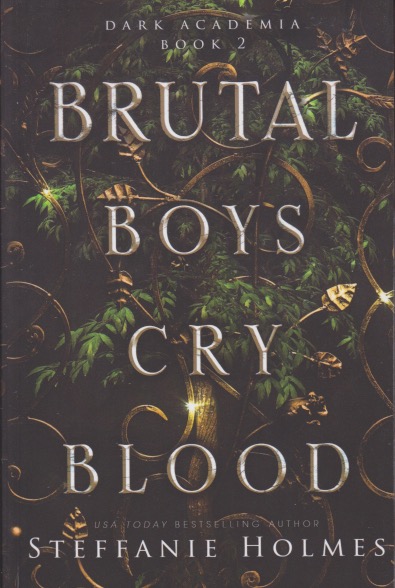
Some time back I posted about Steffanie Holmes’ Pretty Girls Make Graves.  It was a first book in a duology and since I’d been trying to keep up with dark academia, it was a recommended exemplar.  As I mentioned in that post, the book ends with a cliffhanger, so I got to Brutal Boys Cry Blood as quickly as I could.  Holmes is a prolific self-publishing author and I found Pretty Girls much better written than the majority of self-published material I’ve read.  Brutal Boys picks up right where the previous novel left off, freeing George Fisher from her predicament and moving her into new ones.  At Blackfriars University, George is investigating the death of her former roommate.  The Orpheus Society, consisting of old money blue bloods, seems to be involved in more than wanton destruction of property and orgies.

Much of the first half of Brutal Boys sets the scene for a relatively happy period in George’s life.  She establishes a polyamorous relationship with the uberwealthy student William Windsor-Forsyth and Father Sebastian Pearce, a teacher and college chaplain.  The three of them are mutually in love, but even as George is admitted the Orpheus Society, a deeper part of the sect emerges.  This group is even more insidious and has designs on human sacrifice.  But I’ve already said too much.

Reading is, of course, a subjective exercise.  My personal experience of this duology is that the first book is better than the second.  It’s not that I feel Brutal Boys is a bad story—it keeps your interest pretty much the whole way through—it just seems to be far more improbable than the first novel.  It is fiction, of course, and there is nothing speculative here.  There are no ghosts or monsters or divine intervention.  Speaking strictly for me, it might’ve helped with believability if there were a little of this.  I was not one of those swept away by Donna Tartt’s inaugural dark academia novel The Secret History, but she did include just a little of a speculative element that allows for a reader to perhaps convince him or herself that this might just possibly happen.  Some writers and readers prefer not to use that escape hatch.  I’ve read good dark academia both with and without speculative aspects to the story, but to me, such mystery adds a little depth to what might be happening.  And I admire self-publishing authors who write well enough to draw you into a second book, which can be a rare thing.


Discovering Witches

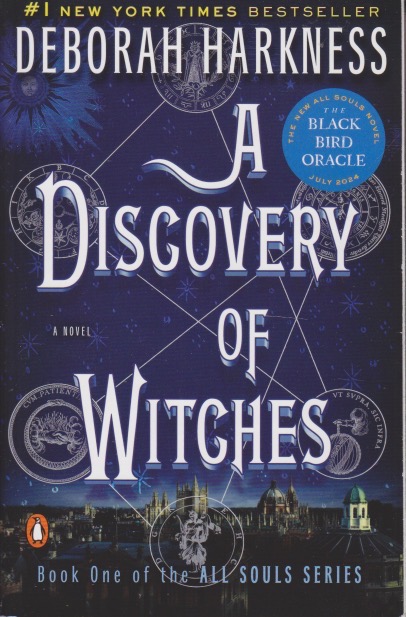
On a number of best of dark academia novel lists, A Discovery of Witches was a book I knew I had to read.  Frightened by the size of the tome, I put it off.  Although it says it on the cover (by which I don’t buy a book) that it’s part of a trilogy, I was hoping it’d be self-contained.  Of course, it ends without resolving what happens to the main characters, more or less coercing the reader into the remaining two volumes.  Now, this is not unique.  Many authors do it.  Publishers especially like books with series potential—assured sales.  My eight novels (none published) are stand-alone.  One is over 200,000 words, but the rest are reasonably svelte.  Big books take a large commitment of time and, well, at my age you have to make some choices.  This one took me nearly a solid month of daily reading, sometimes multiple hours at a stretch, to finish.  I have some decisions to make.

Set initially in Oxford, this world created by Deborah Harkness contains three kinds of humanoid creatures besides humans: witches, vampires, and daemons.  The daemons aren’t really defined, but they don’t seem to be the kind that possess girls like Regan McNeil.  The witches seem pretty traditional and the protagonist/narrator is one.  The vampires are quite different than the Hollywood version, as well as the traditional sort.  Vampires can be out in the sunlight, they aren’t affected by crucifixes, and, indeed, can be quite religious and Christian.  They can eat things other than than blood.  The protagonist, Diana Bishop, is a witch who doesn’t use her powers.  A professor, she’s doing research at Oxford where she meets, and eventually falls in love with Matthew Clairmont, a vampire.  An ancient pact between witches, vampires, and daemons forbids them from consorting closely, and herein lies the tale.

The dark academia aspect comes in a couple of guises.  One is that much of the first part of the novel takes place at Oxford University, and even in the Bodleian Library.  Also, vampires seem to be quite compatible with dark academia as a whole.  The dark aspect comes not only from the creatures, but their situation.  There is ancient animosity and tension that results in murders.  The novel ends with a war starting and Diana and Matthew taking a risky journey.  I may be content to let this state of affairs stand.  From the look of things, the sequel is also a long book and I am content to let my imagination fill in the blanks.  I’m glad to have read it, but I’m going to look for a novel with a little less time-commitment next.


Covid Books

There’s a fairly new phenomenon called “Covid books.”  No, I don’t mean books about Covid-19, but books affected by the virus.  (Not infected.)  Let me explain.  Many publishers, unaware of the menace, continued scheduling books through what became the pandemic.  You see, books take a long time to put together, and, interestingly, much of the work can be done remotely.  That meant that even as we locked down, books still published.  But in 2020, few people were interested in books on other subjects.  Children’s books and others intended for young readers did really well.  Online ordering made this possible.  Fiction for adults didn’t fare too badly.  What suffered was nonfiction on topics unrelated to the pandemic.  This is so much so that publishers designate as “covid books” those that underperformed and appeared in the early twenty-twenties.

To put a more personal spin on it, I published a covid book.  Nightmares with the Bible came out late in 2020.  Granted, the topic didn’t appeal to everyone, and the price was about $100 when people were wondering if their jobs would be there after this was all over.  (Is it over yet?  I still wear a mask in crowded places.)  The reason that I consider it a covid book is that although it has received more reviews than any of my other books, it has sold the worst of them all.  Less than its dollar amount.  The publisher, which was bought by another publisher, has no inclination to do it in paperback, so it will remain an obscure curiosity.  Interestingly, I found a Pinterest page that was a listing of unusual book titles and mine was there.  But it was a Covid book.

In the wider world, even in 2025 publishers discuss Covid books.  A promising author whose book appeared in the height of the pandemic may have sold down at my levels.  What with the gutting of government programs and agencies since January, it’s difficult to tell if we’ll ever get a pronouncement that the pandemic has ended.  Where two or three are gathered, I’ll be wearing a mask.  And I’ll likely be thinking of books of that lost generation.  Information that will never be processed.  Book publishing survived, despite being a nonessential business.  People still buy and read books.  Some day some bibliophile might write a book for other readers about the year that robbed us of interesting but ultimately irrelevant books.  There’ll be too many to list, of course.  But we have been given a lesson.  Let’s hope we continue to do our homework.


King and the Rest

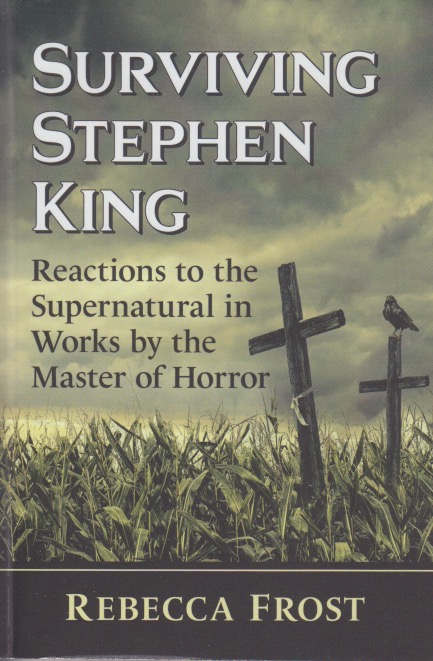
Stephen King is an author I admire, although I haven’t read all of his books.  Not even close.  Still, his cultural cachet is high, as it has been pretty much since the seventies when horror literature was first being recognized.  I’ve been fascinated by his outlook on religion, or, in broader terms, the supernatural.  Rebecca Frost approaches things from a different angle, but her Surviving Stephen King: Reactions to the Supernatural in the Works by the Master of Horror is a volume worth pondering.  Quite often, as was the case with Douglas Cowan’s America’s Dark Theologian, I haven’t read all of the books and short stories the author discusses.  Frost gives good summaries, however, which help frame the discussion.  One of the reasons I enjoy King is that he allows the supernatural in, but something I hadn’t really realized until reading this book was that the supernatural is generally a threat.

Now, knowing King as a horror writer, it’s obvious that there has to be a threat, but in what Frost explores, standard Christianity doesn’t always work well against the supernatural.  One of the points I made in my expensively-priced Nightmares with the Bible is that physically fighting a demon crosses ontological lines if demons are spiritual beings.  Frost discusses how quite often “success” in a King story involves destroying the physical aspect of the supernatural threat.  It doesn’t always work permanently, but for the protagonists, at the time, it tends to be sufficient for them to get on with their lives, sans supernatural.  Having studied religion through three degrees, this made me stop and think.  The impetus to start on that career track was the idea that the supernatural tends to be good.  Enter King.

I only started reading King after my doctorate, and I haven’t read as much as true fans, I suppose.  Still, I tend to try to analyze what I read—thus the many posts about books on this blog—and it helps to have the guidance of someone more familiar with his oeuvre than myself.  Reading books like Surviving Stephen King also gives me an idea of which of his books I should pick up, and also which I might safely avoid.  Frost is an able guide, considering the various appropriations, or Christian solutions to the supernatural, in King’s imagination, and whether they work or not.  The ideal reader for Frost has probably read King a bit more widely than me, but I still found this study enlightening.  And it added some novels to my to read list.


Then Again…

C. S. Lewis wrote somewhere (I can’t recall, but it was probably in Surprised by Joy) that when reading autobiographies, he found the youngest years the most informative.  I found that true for So, Anyway… , John Cleese’s memoir of his life up until the founding of Monty Python.  My wife and I read this book together—I tend not to gravitate towards autobiographies of living persons unless it’s someone I’m utterly fascinated by, but since we both enjoy Monty Python, why not?  It gave me quite a bit to think about.  Some parts are very funny, others more mundane, but mainly it was the path to a writer’s life that interested me.  I typecast Cleese in my mind as an actor, specifically a comedic one.  Of course, comics often write their own material.  Or at least some of it.  What became clear is that Cleese thinks of himself primarily as a writer.  That helps me understand.

It struck me that becoming a writer might’ve been easier had I started trying to get published when I was younger.  Of course, I didn’t have the advantage of attending Cambridge, or any other university where connections might’ve paid off.  Or having my writing encouraged after high school.  Already by college I’d been writing both fiction and non for many years.  In any case, Cleese found a teaching job because he’d attended the school himself, and then studied for a career in law.  Performing, however, and the attendant writing, soon came to be his self-identified career.  Anyone interested in Monty Python would find this an interesting account.  It only goes up to that point in the author’s life, which was, of course, only until he was still a fairly young man.  These days it’s difficult to be taken seriously as a writer without a degree in English or journalism.  The rest of us founder.

Monty Python was a group effort.  My wife and I read Eric Idle’s memoirs a couple years back (for some reason I didn’t post about it).  So, Anyway… was, however, a find at a used book sale, and we’re not actively looking for Michael Palin, Terry Jones, or Terry Gilliam’s reflections.  (Graham Chapman died young, of course.)  Mental typecasting is probably a crime against a fellow creative but the space someone moves into in our consciousness tends to be the same room they will always rent there.  It’s difficult to make a living as a writer and many who declare that as their identity work other jobs to make it possible.  Sometimes, such as the case of the famous, that other job may be the one where all the recognition lies.  Such is the creative life.


Talking Sleepy Hollow

After writing a book comes talking about it.  I very aware that this blog has quite a limited reach, which is why I’m very grateful for friends who are willing to chat about my books.  John Morehead’s TheoFantastique is a blog I’ve known about, and appreciated, since I began this blog sixteen years ago.  John has always been very gracious and generous with his time and has interviewed me about each book since Holy Horror on.  Yesterday we had a chance to talk about Sleepy Hollow as American Myth.  The blog post with the recording is located here.  Please give it a watch if you have any interest.  To those of us not inclined to inflate opinions of ourselves, doing self-promotion feels awkward, and so it’s always good to have a friend willing to help us over the hurdle.  John has written and edited many books himself, and we’ve both published with McFarland. You might enjoy some time on his blog.

Writing a book on a subject may not automatically make you and expert, but it does give you a voice in the conversation.  Talking about a book helps you to think of aspects you might’ve missed or things that you really need other eyes to see.  Those fortunate enough to have academic posts sometimes have colleagues willing to read their nascent books and discuss them.  I never had colleagues who wanted to read what I was working on, but then, I was never really in a position where people paid much attention.  As a result, I work on my books alone.  This one had a peer reviewer when an agent took a temporary interest in it, and I received some feedback then, but otherwise it was me wondering what others might think of it once it was available.  The strange thing is, after writing a book you often feel like you could write another on the same subject, looking at different angles.

Since I’m trying to break into that rare sphere of getting a supplemental income from my books (free advice: academic writing really isn’t the way to do this), getting even a little buzz is immensely helpful.  I have contacted bookstore owners and museum shop holders in the Hudson Valley to tell them about my book.  I’m trying to arrange for a local book festival slot to talk about it.  But, of course, I have a 9-2-5 that doesn’t really make an allowance for time off to support your sideline job.  So I’m very grateful for John Morehead’s willingness to talk about my work.  If you’ve got some time, and interest, you can hear a bit more here.


Dark Romance

My study of genre leads me to believe that there really may be no such thing.  Or at least many aspects of genre are open to question.  In the case of Steffanie Holmes’ Pretty Girls Make Graves, there’s no doubt that one genre is dark academia.  Indeed, this is book one of a duology titled “Dark Academia.”  Although self-published it is quite well done.  There’s a lot of backstory, and George (Georgina) Fisher, the protagonist and narrator, is a character from a previous series by Holmes.  Another genre that fits here is romance, although this novel is more than that.  Maybe a bit of the story will help.  George is a new student at Blackfriars University in England.  From California, she has trouble fitting in among the blue bloods that are the usual make-up of the student body.  She soon learns about the Orpheus Society, the secretive organization that pulls the strings on campus.  Then her roommate, the girlfriend of a prominent Orpheus Society member, goes missing.  George decides to investigate. 

Consciously aware of dark academia, Holmes aims directly at the heart of it and offers a compelling story that keeps readers interested from cover to cover.  I was never quite sure what was going to happen, and I do have to add a warning—this first book does end on a cliffhanger, so be ready to commit yourself to book two.  George is so well drawn that it’s not hard to care for her and start rooting for her against the secret society types who can buy themselves out of anything, including murder.  (I have to say, that part is a little too close to reality in the current US of A, so it may be a trigger for some.)

My regular readers (if any) know that I’m on a dark academia kick at the moment.  There’s so much to like in the genre.  Holmes makes clear the close ties between dark academia and horror; they share a common ancestor in the form of gothic literature.  The sheer variety in the novels classified this way means that not all of the books will contain every element associated with the genre, but Pretty Girls Make Graves comes close.  Holmes also effectively writes the ostracism of the outsider into the tale.  Anyone who’s had trouble fitting in (or may still have trouble fitting in) will recognize the scenario and its fallout.  Let’s hope, though, that they don’t end up like George at the end of volume one, even when they enjoy reading the book.


Dark Introduction

Since I’ve discovered that I live in dark academia, I’ve grown curious.  Kara Muller has put together The Little Book of Dark Academia as a kind of first step in the discussion.  I have learned that some academic articles on dark academia are starting to appear, but this is pitched more toward those who maybe need some tips on how to get started.  By the way, this is a full-color, heavily illustrated book.  In practical terms, that means it doesn’t take too long to read it.  It’s also self-published, so less expensive than many books, but without editorial shaping.  It begins with history and definitions.  The term came into use in 2015 but the concept had been around much longer than that.  Sometimes a label is necessary to bring together thought on something that’s been floating around for a while.  As Muller points out, it tends to revolve around books.

My imagination isn’t so constrained as to believe that ebooks have no place in dark academia; they have their own special kind of darkness.  Still, the setting for these stories often takes place in real life, in studies and libraries full of books.  This is not a Star Wars paperless universe.  Muller gives a list of acclaimed dark academia titles with a brief paragraph or two about them.  In other words, a reading list.  And also a movie viewing list.  She also includes some television series that fit the aesthetic.  If you’re in the mood for dark academia, you’ll find plenty of places to indulge your hunger here.  The lists aren’t comprehensive, of course.  A bit of searching online indicates that many such lists exist, not all of them in full agreement.

Muller then presents a section on style and design.  Dark academia is, in many ways, like cosplay.  There’s a look and feel to it that can be emulated.  And I can’t help but say it’s backward looking.  A longing for classical education, the way that it used to be.  To me, this seems to be behind much of the current fascination with it.  This lifestyle is rapidly disappearing.  Even professors are now using AI instead of getting their hands dirty in the library.  And publishing online rather than in print form.  Showing up to class in tee-shirts and jeans.  Some of us, and I count myself in their midst, miss the feel of armloads of books and professors that wore tweed and could read arcane languages.  And nobody was trying to cut their funds because, well, the world was smarter then.  And everyone knew education was important.


Dark Poetry

Playful.  Serious. Weird.  Very intelligent.  These are the words that come to mind.  Adrienne Raphel’s Our Dark Academia is a poetry book unlike any other I’ve read.  The poems take many forms from impressionistic reflections on life to a crossword puzzle.  From cutout paper-doll clothes to a faux Wikipedia article on dark academia.  It’s quite difficult to summarize since it’s more of an experience than anything else.  It’s the kind of book that makes you want to get to know the author.  Economy of language and an ability to manipulate words are required for poetry, and although I still dabble in it now and again, my tortured mind finds long-form prose a bit easier to produce.  I do try to keep these blog posts short, but I write a lot of other stuff as well.  In any case, Raphel’s keen intellect is obvious throughout this collection.  And she holds a doctorate from Harvard.

I’ve been exploring what is now being called dark academia pretty much my entire life.  And it has an articulate spokesperson here.  The academic life, although I love it, isn’t always the cushy existence it’s thought to be.  It requires a lot of work and long hours.  Those jealous of the lifestyle probably know it by fantasy.  It has taken a hard turn towards the political since about the seventies, something I didn’t know as I enrolled in a doctoral program in the next decade.  You learn by experience, and it’s clear Raphel has that.  The life of the adjunct instructor, which I tried to live for two years, demonstrates the inhumane things educated people can do to one another.  Of course it’s because of money.  In a late capitalist society, what else really matters?

One thing I know about myself is that I tend to take on the characteristics of authors I read, while I’m reading them, if they have distinctive voices.  Thought processes carry on in the mind even after a book is put down.  I find reading endlessly fascinating and wish I could share this enthusiasm with everyone.  I have to stop and remind myself, however, that our society only works with those who are doers as well as thinkers.  It works best, it seems to me, when those who are thinkers are in charge.  But not all thinkers are good.  My solution, at the moment, would be to have them read Our Dark Academia.