A Few Days

My fellow blogger over at Verbomania (worth following!) posted a piece on the word Romjul.  In case you haven’t read the post, Romjul is the Norwegian word for the period between Christmas and New Year’s Day.  It’s kind of a liminal period.  Not really holiday and not really not holiday, in northern climes it’s often cold and dark and you don’t feel like getting out to do much.  In many reasonable parts of the world it’s a given that this should be time off from work.  With all the preparation that goes into Christmas and the standard convention of starting the New Year with a freebie, and the fact that the days of the week for the holidays are movable, it just makes sense.  In these developed States, holidays are left to employers.  Mine granted two days off: Christmas Day and New Year’s Day.  What are your choices when they fall on Wednesday?

Romjul gave me a good feeling.  I cashed in a vacation day or two to take some time off.  The years when I’ve worked between the holidays I’ve found nobody in their offices or answering email, and that led to long hours of waiting for the work day to end so that I could actually do something productive.  In America we love our work.  At least employers love our work.  I talked to a young man who had to cut his holiday short to be into work on Monday, December 29.  He’d just returned from an international trip, but his employer insisted he be there.  There was no work he could do because his colleague whose input he needed had taken that day off.  Work is like that.

I recalled a snow day when I had to commute daily to New York City.  New Jersey Transit got me as far as Newark but the trains were shut down from there.  I had to take a PATH train that took me close to my Midtown location.  It was running late.  A woman was panicking about not being on time.  A wise, older gentleman said, “Employers just want you to show up.  They’re not looking for a full, productive day of work.  They just want you to come in.”  I believe he was right.  Employers like to make their puppets jump, no matter if there’s anybody there to watch the show.  In a civilized world, as in much of Europe, we would celebrate Romjul.  If not for religious reasons, then for simple humanitarian ones.  In late December we can all use a week off.

Conversations

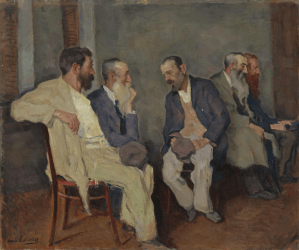
Arnold Lakhovsky, The Conversation, via Wikimedia Commons

While I tend not to discuss books on this blog until I’ve finished them, I realize this practice comes with a price tag.  Reading is a conversation.  Your mind interacts and engages with that of another person (or persons, for books aren’t usually individual efforts).  I find myself as I’m going along asking questions of the author—whether living or dead doesn’t matter—and finding answers.  Materialists would claim said answers are only electro-chemical illusions spawned by this mass of gray cells in my skull, only this and nothing more.  The realia of lived experience, however, tells us something quite different.  These interior conversations are shaping the way I think.  There’s a reason all those teachers in grade school encouraged us to read.  Reading leads to an equation the sum of which is greater than the total of the addends.

I’ve been reading through Walter Wink’s oeuvre.  Specifically his trilogy on the powers.  Although this was written going on four decades ago, I’m struck by how pertinent and necessary it is for today.  As he posited in his first volume, the embrace of materialism has blinded us to spiritual realities.  Wink was bright enough to know that biblical texts were products of their times and that simple acceptance of these texts as “facts” distorts what they really are.  He also convinces the reader that institutions have “powers.”  Call them what you will, they do exist.  Throughout much of western history the “power” cast off by the church has been somewhat positive.  Christianities has established institutions to care for the poor and for victims of abuse and natural disaster.  Orphans and widows, yes, but also those beaten down by capitalism.  They have established institutions of higher education to improve our minds.  Until, that is, we start objecting that our improved outlook demonstrates that the biblical base isn’t literal history.

Churches then often fight against those educated within its own institutions.  Ossified in ancient outlooks that value form over essence, many churches take rearguard actions that we would call “evil” if they were undertaken by a political leader such as Stalin or Hitler.  Those evil actions are justified by claiming they are ordained by an amorphous “Scripture” that doesn’t really support those behaviors at all.  I’ve been pondering this quite a lot lately.  Although I taught Bible for many years my training has been primarily as an historian of religions.  I specialized in the ancient world of the northern levant, for that culture provided the background of what would eventually become the Bible.  Reading Wink, I think I begin to see how some of this fits together.  I won’t have the answer—we many never attain it—but I will know that along the way I’ve been engaged in fruitful conversation.


Job’s Jobs

Many years ago, after Nashotah House decided it no longer required my unique outlook, I bought a book.  (That’s my default reaction.)  This book was on how to write killer cover letters.  I don’t remember the title or the author, but I followed the advice, well, religiously.  It got me nowhere.  Business tricks, at least historically, don’t work in academia.  Sitting at home, pondering my sins, I flipped to the chapter on advice to take if none of the rest of this was working for you.  Here’s where the human side began to show through.  Have you been eating onions or garlic before your interviews? it asked.   Do you need to lose weight?  Try dressing nicer.  It occurred to me that the business world lacks the imagination required for denying jobs.  And besides, who was getting any interviews before which I shouldn’t eat garlic?

Business advice is, in a word, shallow.  It assumes that if you’ve got the goods there’s no reason you won’t get hired.  Reality is a bit more complex than that.  I often ponder how people simply go for what they want.  They reach for the biggest piece without pondering the repercussions of their actions.  I see it in my small world of publishing all the time.  Those who are “hungry” (read “greedy”) succeed.  Those who wait behind to help others simply can’t compete.  So the cover letter book did get that part right.  Is it possible, however, to devise a society where everyone fits?  Not all are created equal, perhaps, but do we have to reward those who seem to care only for themselves?  Let them eat garlic.

The cover letter book, in the end, never really did me any good.  I found my way into publishing by being willing to aim low.  I’ve written many cover letters since leaving Nashotah House, and only two ever led to a job.  Those who work in business, what with their concerns about readers’ aromas and weights, seem never to have considered the intricacies of the intellectual job market.  What strikes me as particularly odd is that there are plenty of smart people out there, and yet they haven’t organized to offer alternatives to the greed-based structure on which our work lives are based.  They can’t, it seems, gaze beyond capitalism as a mechanism for helping individuals lead productive lives.  Business operates on the principle of replaceable parts, many of which happen to be human.  And even those who know how to write can’t hope to compete against those who prefer cogs that know to avoid onions.


Pay Per View

One of the things editors can teach academics is that the latter should pay more attention.  Especially to the world of publishing.  An erstwhile academic, I learned to go about research and publication in the traditional way: come up with an idea that nobody else has noticed or thought of, and write about it.  It is “publishing for the sake of knowledge.”  (Yes, that is Gorgias Press’s slogan, and yes, it is one of my hooks—marketing, anyone?)  The idea behind this is that knowledge is worth knowing for its own sake.  Researchers of all kinds notice details of immense variety and there’s always room for more books.  Or at least there used to be.  The world of publishing on which academics rely, however, is rapidly transforming.  Money changes everything.

The world has too many problems (many of them generated by our own species) to pay too much attention to academics.  Universities, now following “business models” crank out more doctorates than there are jobs for employing said wannabe profs, and those who get jobs pay scant attention to knock-on changes in the publishing world.  Just the other day I was reading about “pay per use” schemes for academic writing that, unsurprisingly, came up with the fact that most academic books and articles lose money.  If someone has to pay to read your research, will they do it?  Especially if that research is on a topic that has no obvious connection with the mess we’re busy making of this world?  Probably not.  Publishing for the sake of knowledge is fast becoming a dusty artifact in the museum of quaint ideas.

For those still in the academic sector that means that research projects now have to be selected with an economic element in mind.  “Would anyone pay for this?” has to be one of the questions asked early on.  The question has to be answered honestly, which requires getting out from beyond the blinders of being part of the privileged class of those who are paid to think original thoughts.  Academia has followed the money.  A capitalistic system makes this inevitable.  How can you do business with an institution that doesn’t play by your accounting rules?  And academic publishers, which have difficulty turning a profit due to low sales volume, are bound to play along.  This situation will change how we seek knowledge.  More’s the pity since some of the things most interesting about the world are those that nobody would think to pay to view.


Private Matters

Mercenaries have long been part of human culture.  With some exceptions, people really don’t like to fight to the death meaning that wars have often relied on those willing to fight for pay.  As society buys more and more into capitalism—and capitalism always means you want what someone else has—we’ve had to pay armies to become a massive part of our national existence.  In the United States the military budget is the most massive drain on taxpayers’ dollars, dwarfing all other areas of government spending.  Even Dwight Eisenhower, himself a military man, warned the country of the military-industrial complex.  It was becoming too powerful, he believed.  Knowing better, we continue to spend to curb our fears—generally unfounded.

The other day I was reading about the private military industry.  I didn’t even know there was such a thing.  Yes, I’ve known of mercenaries since I was a kid, but I think was got to me was the word “industry.”  This has apparently now become a legitimate line of work, I suspect with tax breaks and other kickbacks.  What’s more, it’s recognized by governments as a legitimate business.   Perhaps I spend too much time in my own headspace—I am a Bibles editor after all—but I felt like I’d just crawled out from my scriptural rock.  There’s an entire industry where your job is to be a fighting force for hire?  Victory to the highest bidder?  The ultimate, weaponized free agents?  How does that feel?  Mercenaries have often suffered in reputation.  Now we recognize them as just another job.  I guess that’s one way to handle unemployment.

While the Good Book is considered outmoded by many, I do think it has many things right.  One of its most compelling messages is that we should be peacemakers.  We should love one another, seek to help, not to harm.  Nobody’s going to pay a lot for that, however.  War is more profitable.  Meanwhile the education industry—even it can be capitalized—suffers.  We don’t want to pay for cooperative ventures where the entire human race, and other species, might benefit.  That we deem too expensive.  After all, there’s only so much money to go around for bombs and missiles and whatnot.  How are we supposed to protect that which we’ve extorted from others if we don’t have a massive military?  I suppose we could hire freelancers, but then, that costs money.


Evolving Tales

There’s nothing like a six-and-a-half hour flight to get some reading done.  I’d made good progress on Kurt Vonnegut’s Galápagos before leaving for England, but the plane ride gave me time to finish it.  While nobody, I think, can really claim to understand Vonnegut, there are clearly some trends in this novel that demonstrate his struggle with religion.  There may be some spoilers here, so if you’ve been saving this book for later you might want to wait before reading the rest of this.

As the title suggests, it’s a story about evolution.  Charles Darwin had his first divine epiphanies about evolution while visiting the Galapagos during his voyage on the Beagle.  Land creatures isolated from others of their species adapted to the environment in which they found themselves, and over eons passed on useful traits to their progeny.  If humans only had as much foresight!

With his trademark cast of quirky characters about to set out on a cruise from Equador to the Galapagos, Vonnegut has war break out.  Riots and pillaging take place.  Vonnegut takes broad aims at capitalism and business-oriented thinking, and how these represent the devolution of our species.  Of course, being Vonnegut, he does it with wit and verve.  Vonnegut was a writer not afraid to use the Bible in many ways, including what experts would call misuse.  As the surviving passengers make their way onto the stripped, but functional ship, he notes that they are like a new Noah’s ark.  They end up populating Galapagos with humans that evolve a million years into the future.

A thought that caught me along the way was a line where he wrote that in the long history of David and Goliath conflicts, Goliaths never win.  This kind of sentiment could do the world some real good right now.  In fact, although the book was written decades ago, one of the characters, Andrew MacIntosh, reads very much like a foreshadowing of 2016, down to the descriptions of how he regularly mistreats others.  In Galápagos MacIntosh gets killed during a rebellion, showing that grime doesn’t pay.  The cruise goes on without him.  Galápagos is a book that points out the evils that our system encourages, or even necessitates.  There can be another way.  The survivors land on the barren islands and set about adapting because they have no other choice.  A more egalitarian scenario evolves largely because females are in mostly charge.  While not intended as an actual solution to social ills, Galápagos is nevertheless not a bad guide, especially when shipwreck seems inevitable.


Leggo My Lego

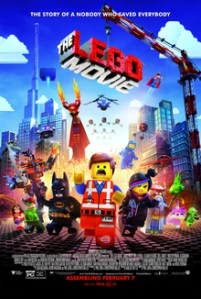
Given my proclivity to seek the profound in what is often considered the banal, I have been mulling over The Lego Movie.  Before you cast the first brick, yes, I know this movie is five years old and I know that it has sophisticated intertextuality with other movies and sly humor.  I use banal in the sense that Legos are, quite literally, plastic and they don’t work well in conveying the human form.  Our overactive psyches help here, and we give the characters their necessary humanity, but this is a movie for kids, even with its Trump-like President Business forecast some two years before the last election.  With all of that being said, and the word “forecast” already being used, my “Bible radar” zeroed in on the prophet in the movie, Vitruvius.

Vitruvius is based on a combination of Tiresias, the blind prophet, and any number of biblical characters who forecast the future.  Dressed like Moses, but named after a Roman author and architect, Vitruvius utters the prophecy at the beginning of the film and returns as a character that combines Obi-Wan Kenobi and the prophet Samuel.  (I said there was sophisticated intertextuality.)  Whether any of this is intentional is difficult to say—well the Obi-Wan part is pretty obvious—but it plays into the common view of prophets.  One of the points I make in Holy Horror (which deals with a different genre of movie) is that people understand biblical ideas through the lens of pop culture.  Prophets, through that lens, tell the future.  In the Bible itself they don’t do that very much, but since the New Testament reads itself into the Hebrew Bible (more intertextuality) the idea became pretty fixed that prophets told the future all day long.

Ironically, Vitruvius—a name that sounds like “virtue”—was famous for describing perfect proportions.  Indeed, Leonardo da Vinci’s “Vitruvian Man” sketch is based on this idea.  As ideas go, this is a false one against which many of us struggle our entire lives.  There is no perfect, Platonic human body.  Yes, certain people are attractive, but genetics and circumstances make us who we are.  And some of us grew up without Legos, but despite that deficiency we came to know the product.  The Lego characters aren’t in any sense of Vitruvian proportions.  Witty and intertextual, they’re made of plastic and they encourage us to buy for our children.  And one wonders whether Vitruvius is a prophet or a hidden symbol of that word’s homonym.  Let the building begin.


Cool Cash

The seller’s market is the place to be in a capitalist society.  Last year, when we were looking for a house, it was a seller’s market.  Our realtor said he’d never seen inventory so low and staying so low.  We found a domicile we liked, but it was older and had obviously (only after moving in) been neglected.  The previous owners, it was clear, had simply let things go (and they were younger than us, and had no excuse).  When we asked for a new roof they had flat-out refused.  With no other options (our lease was about to expire) we agreed to take it on anyway.  We’ve been having the roof done in installments—and if you’ve been getting the record levels of rain that Pennsylvania has, you know our decision was, in a literal way, short-sighted.  Ah, capitalism!

So, just after I noticed the piles of sawdust that the web tells me are carpenter ants, the refrigerator died.  Of course.  I tried to keep cool.  We don’t have what the overlords call “liquidity.”  Our cashflow is dammed at the source, as it were.  A new major appliance was not a welcome addition to the fixer-ups that appear nearly every day.  The first warning was that my soy milk was room temperature when it splashed on the cereal yesterday.  All of this made me reflect on how much we rely on our appliances, our modern conveniences.  When talking to my mother later in the day, I realized that as recently as her generation not everyone had a refrigerator.  You could live without one.  You could also live without a dishwasher, believe it or not!  

The whole episode of packing the food in ice sent me on a Calvino-esque reverie of what we keep in the refrigerator.  There are foods that must be kept cool or they’ll spoil, foods that are better if they’re kept cool but can be left at room temperature, foods that you prefer to drink cold but can be kept anywhere, and items which are technically not food.  Considering the state of our kitchen, there are also foods that you keep on top of the refrigerator because no amount of cupboard space is ever enough.  As the carpenter ants make their free lunch of our porch, we have to throw away food for which we paid because an appliance has come to the end of its life cycle.  And since it’s a holiday weekend we’ll pay for a more expensive replacement unit because it’s on a holiday sale.  For unlike my soy ice cream, I lack liquidity.


Thunder Towers

It sounded like brontide.  The Martin Tower, the tallest in the Lehigh Valley and once corporate center for Bethlehem Steel came down yesterday morning.  Completed only in 1972, the following decade saw the collapse of the steel industry, and the building has sat vacant a dozen years.  Now it’s gone.  The reasons the building could no longer stand are many and I won’t try to explain them as if I understood.  The fall of the tower, however, put me in mind of human folly and the belief that corporate profits will only ever grow.  Capitalism is built on a set of myths that the wealthy truly believe—I suspect many others do too, otherwise the system couldn’t possibly last.  Adam Smith may have been right academically, but in reality humans are greedy, venal, and shortsighted.   At least those who “rise to the top” are.

We didn’t move to the Valley for the steel.  Having settled in New Jersey just about when the Martin Tower was abandoned, like many other displaced academics I was looking for a job.  There were cities in the Midwest—we weren’t far from Milwaukee or Madison—but there was no work.  If you’re “overeducated” your best bet is to settle near a huge metropolitan area, as closely as you can afford to.  Then hang out your shingle.  Capitalism, however, has made New Jersey affordable only for the excessively wealthy.  Besides, I was born within the imaginary lines that we call the Commonwealth of Pennsylvania.  In fact, when I got my license transferred last year the computer asked me if I still lived in Venango County, where I was born.

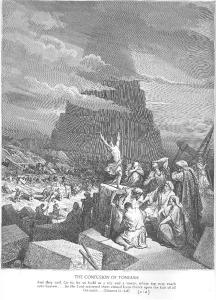
I didn’t see the tower come down.  It’s not visible from my house, but it was always right there when I drove to Lowes to pick up some necessary hardware to survive in this area.  (Weed-whacker and lawnmower—reel variety.)  My mythology of towers always takes me back to Babel.  In the biblical worldview towers were a sign of arrogance.  God seemed to think they were trying to invade divine turf, and so he made it so we could no longer understand one another.  There hasn’t been a moment’s peace since.  We build towers tall to show what we can do.  We don’t really need an angry deity to come down and confuse our language any more.  We’ve got capitalists and their excess money to lead the way.  The sound of thunder roared and I divined just where such leadership will guide us.


Price of Learning

Holy Horror, as some are painfully aware, is priced at $45.  Even those of us in publishing have lessons we must learn, and one of them is that writing a trade book involves more than just a “friendly narrator” style and non-technical language.  It also involves a subject the public finds engaging (or at least what a literary agent thinks the public will find engaging).  Holy Horror throws two apparently disparate topics together: horror films and the Bible.  The fans of each don’t hang out in the same bars—the fans of the latter, in some circles, don’t go anywhere near bars!  My thinking was that this juxtaposition was odd enough to qualify as trade, but I also knew that you have to work your way up to that kind of readership.  That’s why I’m on Goodreads, Twitter, and Facebook (followers and friends welcome!).  It’s not like I’ve got tons of spare time, but platforms must be built.

Book publishers face a dilemma: they have to sell books, but as I’ve noted before, they must do so profitably.  There are people like yours truly who’ll occasionally pay essentially a dollar a page (or at least a two-page spread) for a book that’s essential to their work.  As the capitalists grin, it’s “what the market will bear.”  I never thought of myself as a market.  To me, knowledge is priceless.  The effort that it takes to write a book is truly unimaginable to those who haven’t done it.  Obstacles exist almost from the inception.  Getting the resources you need, unless your employment comes with a free library pass, involves sacrifice.  I still look at other books I must read priced at about $45 and groan—how can I justify the expense?  It’s a strange club to which to belong.

My mother asked about Weathering the Psalms: “Is it the kind of book you get money for?”  In theory, yes.  I’ve yet to see any kind of profit from it since the tax forms you need to file for royalties cost more than the actual checks contain.  At least it’s not vanity publishing.  And you truly learn what it means to rob Peter to pay Paul.  It has nothing to do with gentiles.  Publishing is the price you pay for following your curiosity.  My books are very different from each other, a fact that comes with an invisible price tag that has little to do with money exchanging hands.  Well, maybe it does.  And maybe it does have something to do with gentiles.  Or maybe it’s an appeal to a higher power.  In a capitalist nation we all know what that is; herein lies holy horror.


Linking In

Like many in the internet age, I have most of my “connections” online.  It’s somewhat of a rarity to be invited, for example, to connect on LinkedIn by someone I actually know.  I remember the early dissemination of information from that network—it was strictly for people you really did know in real life, because they could help or hurt your career.  I took that seriously for a year or two, but it became clear that this was another Facebook with a more professional cast.  I’ve been told of authors who try to build their online platform by adding thousands of connections on LinkedIn.  The website, however, is not intended as an advertising venue.  It has, however, become one.

I’m not denigrating LinkedIn.  I’ve found two jobs through it and I’ve had recruiters reach out to me because they found my profile there.  For a religionist that can be quite flattering.  Academia and society tend to tell you that such a skillset is okay but basically useless.  Having others who know the wide diversity of human employment these days can be a sign of hope.  Nevertheless, advertising has crept into LinkedIn.  I’m not talking about the frequent invitations to go professional on the site, which will only cost a small fee that will suddenly show up on your credit card bill when you least expect it and thought you were in the clear.  No, I’m talking about connections contacting you to do gratis work for them.  Advertising their book, or their services.  Letting others know, they ask, that they can provide this or that service.  (Just to be clear, I’m not referring to people who contact me personally because we have an actual connection!)

For those of us working stiffs not in a position to hire anyone—professionally or personally—this is another symbol of how any form of communication becomes commodified.  Fully over half of my email is soliciting money in one form or another.  Hearing from an actual person with an actual message for me is so rare that I’m stunned to find one in my inbox.  Capitalism just doesn’t know when to let go.  And it doesn’t have a good read on what little I actually do buy.  Underwear (and just using that word will color the tailored ads I receive for weeks) vendors seem to think I’m concerned about the fashion of garments others don’t see.  The books Amazon suggests, based on a solid track record, are generally far off from my interests.  What hope do those who don’t know me have of selling me their wares through LinkedIn?  The dream of connection without cash changing hands nevertheless remains alive.

Old school connectivity


Patchwork

I don’t wear clothing with advertisements.  Perhaps it’s my Quaker-like sensibilities, or maybe it’s just that I hate being a shill.  What has any corporation done for me that I should give it free advertising?  Actually, not free—advertising that I have to pay to give?  I do have a few college sweatshirts, though.  Always a booster for education, I don’t mind wearing that brand.  Otherwise, I sit back and marvel how marketers get people to think it’s cool to strut their (the marketers’) stuff.  Brand names declare one’s tribe, one’s level of affluence.  I used to rip any exterior labels off my clothes but it became clear it was a losing battle, especially when brands are incorporated (note the word) into the very design.  And we play along.

I shouldn’t be too harsh.  After all, corporations are people too.  At least in the cataract-infested eyes of the law.  They have rights just like, or even more than, individuals do.  We live this fiction and watch the wealthy grow loftier, and we wear their brands so that others will sense where we belong.  Long ago I began to object to this.  Maybe it was because I grew up poor and wearing cheap knock-offs of brand names was embarrassing.  The cut of your trousers said something about what your folks could afford.  I actually began buying all my own clothes at the age of fourteen and, consequently, habitually wear things until not even Goodwill will consider them appropriate for resale.  And I still tend to buy generic.  Thoreau, in a patched quote from Walden and Civil Disobedience can be made to say it well:

As for clothing, […] perhaps we are led oftener by the love of novelty, and a regard for the opinions of men, in procuring it, than by a true utility. […] No man ever stood the lower in my estimation for having a patch in his clothes; yet I am sure that there is greater anxiety, commonly, to have fashionable, or at least clean and unpatched clothes, than to have a sound conscience.

The fact is we despise the patch-wearer for not playing the capitalist game.  You’ve got to pay good money for jeans with tears already in them and the world of the facile has no room for posers who actually wear through the knees.  If we ever meet you’ll know me by the frayed edges of my sleeves and cuffs.  I’ll likely be the guy sitting on a bench without a Starbucks cup in my hand, cradling Henry David and nodding vigorously.


Edifices

In a process that’s been going on for decades, church buildings have been sold and repurposed.  Part of the reason is the fact that spirituality has come to resemble a free market and there’s increasing competition from the Nones.  Thinking back over a lifetime of attending various services, many of which seemed to do nothing more than demand I pull out my wallet, I can understand this lack of public engagement with established religions.  At the same time the rather shallow, but emotionally based evangelical tradition continues to grow, largely based on the emotional payoff it gives.  Ironically, it makes the claim that it’s the doctrine responsible for this appeal, but it seems more likely that it’s the way the doctrine allows you to feel about yourself that’s the key.  And still the wallet comes out as the mega-churches grow.

There’s a profound beauty in dereliction.  Some of the more solidly built structures—for even the way a church was constructed was a theological statement—have lent themselves to creative reuses.  I’ve visited churches converted to used bookstores, and this seems fitting.  The trade-off of doctrine for knowledge is appropriate.  In Pittsburgh, years ago, I was intrigued by the Church Brew Works.  Occupying a closed Roman Catholic Church, the brew pub is a trendy gathering place and the titillation of drinking in a once hallowed location is part of the draw.  People find such irony irresistible, it seems.  Better than letting an abandoned building simply fall to ruin.  When it first opened some were scandalized—a lingering belief in sacred places may account for this.  People were married here.  Baptized.  Funerals were held.

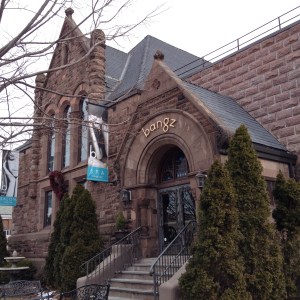
While walking through an unfamiliar neighborhood recently I found a church building that has been converted to a spa.  The idea struck me as so counterintuitive that I had to think through the implications.  Churches, for all their faults, are places advocating spiritual growth.  Whether or not it takes place is quite a different question, of course, but this is all about interior life.  Spas are about the surface, physical beautification.  Indeed, often personal pampering.  This is building space come half circle.   An edifice built of heavy stone, implying the gravity of the business inside might have eternal consequences is now a place to beautify the body.  Perhaps the building itself has gone through a similar process.  What used to advertise to the world that depth could be found  here has now become merely an exterior.  Market forces dictate what it will become on the inside.


For the Love of Dog

All I have to do is say “Old Yellar,” and everyone will know the feeling.  Everyone of a certain age, I should add, who’s owned a canine.  The love of dog.  From where I pass my days I can see out the window into the neighbors’ back yards for four houses over.  They all have dogs.  Big dogs, mostly.  They also have fenced in backyards.  One of the things I haven’t seen too much in our neighborhood is dog walking.  People let their dogs out to frolic, and do their, ahem, other outdoor activities in the yard.  Once a day some member of the family, either with the basic plastic bag or with the specialized, long-handled brush and scooper, slowly surveys the yard to remove any offensive matter so the space may be used for human activities.  It’s a level of care that most would shudder to provide for their own species.

Wolves were the earliest domesticated animals.  In those hunter-gatherer days either they or humans—the jury’s out on which—realized the advantages of working together.  Kind of like we were fated to be partners.  Besides, unless the dog turns on us, there’s no question of who’s the master here, and everyone likes to be the boss.  When I catch a glimpse of one of the neighborhood pets being scolded, or praised, it’s clear they share emotions with us.  The bond is deep.  I often wonder about this—they recognize the tone of voice, something that takes humans a while to learn.  I grew up with dogs and I found out that even if you insult them in a friendly, encouraging tone of voice they’ll love you for it.  Dogs are just that way.

Our first real dog—the one that ended up staying with us his whole life, was a beagle pup we got at a farm.  Dogs like to be with others.  Unlike humans, they don’t have to pretend.  (Although they can do that too, as when they growl at you during a game of tug-o-war.)  Then we leave home and go to our places of business, where capitalism reigns.  We treat other humans coldly, clinically.  “It’s only business,” we’ll parrot, especially if we feel bad about doing what the boss tells us.  That’s the way we treat our own species when money’s involved.  And we’ll sit at our desks, daydreaming of our dog at home that will be so glad to see us when we walk through that door.  And we’ll gladly clean up after our pets what we find obscene even to write in human language.  It kind of makes me wonder when I glance out the window while at work.


Christmas Lights

How many people read a blog on a major holiday?  The process of writing takes no vacations, however, and I often think of holidays as a time to write.  It doesn’t really matter if anyone reads it; writing is our witness to the cosmos that “Kilroy was here.”  Even if most of us have no idea who Kilroy was.  So I find myself awake earlier than most children on Christmas morning.  My long habit of rising early to catch the bus hasn’t been easy to break.   I creep down the stairs and water the tree before turning on its colorful lights.  I make a cup of coffee and wash the dishes left in the sink after a festive Christmas Eve.  And I think.  There’s always the thinking.

The meaning of Christmas, as the holiday classic tells us, eludes Charlie Brown.  Linus van Pelt gives one rendition—that of the Gospel of Luke—as the canonical meaning, but in my experience it shifts during a lifetime.  Christmas, after all, is one of a host of solstice celebrations.  My thinking these days is that it’s all about light.  Shimmering angels, glowing stars, light coming into the darkness.  These ideas seem to have, for the most part, Zoroastrian origins, but they’ve been thoroughly appropriated and, in true American style, commercialized.  The news headlines read how disappointed retailers always are.  The take could’ve been bigger.  Capitalism relies on Christmas to make the third quarter.  Light in the darkness, in its own distorted way.

As I sit for these quiet moments in the glow of only a tree, I think of those for whom the holiday has become a kind of disappointment.  Not a cheery Christmas thought, I know, but an honest one.  As families grow and diversify the childhood Christmas of excited children scrambling under the tree to excavate the next gift for me starts to fade.  Our economic system separates, and the dearth of days off around the holidays makes travel back to childhood homes difficult.  We do the best we can, but the fact is the sixties (speaking for me) are over.  Our reality is colder and darker than it used to be.  I part the curtains and look for any sign of dawn.  It will be a few hours yet before the sun brightens this winter sky, but then, that’s what the holiday has come to mean for me.  At least this year, it is the hope of light returning.  And that, alone, makes it a holiday.