Horror Time

In case anyone’s wondering (ha!), I haven’t lost interest in horror.  I’ve been discussing quite a few dark academia movies lately since that’s where I seem to be, but what’s really lost is time.  I’m no great consumer of social media.  I spend literally five minutes on Facebook daily.  Less than that on Bluesky and Twitter.  I don’t have time.  I love watching movies, but they take time.  I often discuss this with family—I’m not sure where the time goes.  In my case it’s not social media.  Much of it—the lion’s share—is work.  When a three-day weekend starts to feel like just enough time to get everything done before starting it all over again, I think there’s an elephant in the room.  If I can just squeeze past your trunk (pardon me) I would note that I spend as much time as I can writing and reading, but even that drains too quickly.

I read a lot.  And I read about writing.  Those who do it best have time to put into their craft.  If they’re working long hours, have a family, and weeds that love all the rain we get around here, they’re better than I am.  Home ownership (if you can’t afford to hire groundskeepers) is itself a full-time occupation.  As is writing.  And, of course, work.  What’s been suffering lately has been my time for watching horror.  Part of that’s money too.  I’m not sure if anybody else has noticed, but prices haven’t exactly gone down since January, and movies aren’t always free.  I have a long list of horror films I want to see (quite a long list), but tide, time, and money wait for no-one.  I even had a four-day weekend not long ago during which I had no time to watch horror.  Horrific, isn’t it?

I’m at a stage of life where the shortness of it all stares me in the face.  I was a late bloomer and my career never really took off.  It ended up taking time and not rewarding that time at the usual exchange rate.  I’m watching friends and family retire and some finding too much time on their hands.  Hey, brother, can you spare an hour?  I think of my farming ancestors where every minute was filled trying to stay alive in a world where leisure time really is a luxury.  I have no right to complain, but I do wonder where the time goes.  I suppose if I didn’t blog I’d have a little more time for horror, but I just can’t face giving up all this fame.


Recession Value

While reading about recessions (am I getting old, or what?), I suddenly got the creepy feeling that our entire lives are unduly influenced by those who think they know what they’re doing.  Financially, that is.  The Great Depression and the Great Recession were both times of economic hardship because the rules capitalism put in place defined us as being in an era of lowered GDP, or gross domestic product.  Why?  Because there were no jobs.  Why?  Those who hold the purse strings (capitalists) had pulled them shut with all their might.  Then, like magic, depression and recession end and everyone tries to get back to business as normal.  To me this seems utterly ridiculous.  They call economics the dismal science for a reason, after all.  The fact is the rules are made by us.

Society is very complex.  This is one reason that people should really think hard about who they’ll vote for.  Leaders who think it’s all simple inevitably lead to disaster.  If I could, I would switch the world economy away from capitalism.  If I were president and were to try this, it would be a very, very slow process.  It would take generations.  Why?  Because this is a complex system.  Sudden changes don’t last.  Of course, to people who believe the universe took only six earth days to create and that a big flood wiped out all the dinosaurs (or maybe some were on the ark), complexity is anathema.  Of the devil.  Well, as they say, the devil’s in the details.

Image credit: I forgot where I found this; if anyone recognizes it please let me know!

And so we suffer through depressions and recessions.  To those of us with feet on planet earth, it doesn’t feel like much has changed.  We still need to sleep and eat and all that, but some “experts” are telling us why we have to pay more at the grocery store or at the fuel pump, and why those at the top of the pyramid seem to be all right, no matter what happens to the rest of us.  And we let it carry on.  Economic systems are simply a reflection of what people value.  The things we value most cost the most (it’s called supply and demand, AKA capitalism).  The most expensive material thing I own is my house, and truth be told, it’s mostly owned by the bank.  But the most valuable actual thing I own is my mind.  It can’t be bought.  And one thing it keeps on telling me is that all of this business about recessions and whatnot is rather silly.


Remembering Holidays

Memorial Day is an important stepping stone to get through the capitalistic year.  Not only does it mark the unofficial beginning of summer, it’s also the first holiday after the long, long drought of March, April, and nearly the whole month of May.  That’s a long stretch of unbroken work.  My ideal holiday may be one where I could hole up in my study with books and endless time to write, but that kind of situation isn’t really realistic.  There’s a lot to do.  Around these parts, however, getting outdoors to take care of those weeds has proven difficult.  Every day since last Tuesday (nearly a full week, as of today) it has rained at least a little.  Sometimes a lot.  And the temperatures dropped on Wednesday, back to early April levels, as if May were vying for the title of the cruelest month this year.

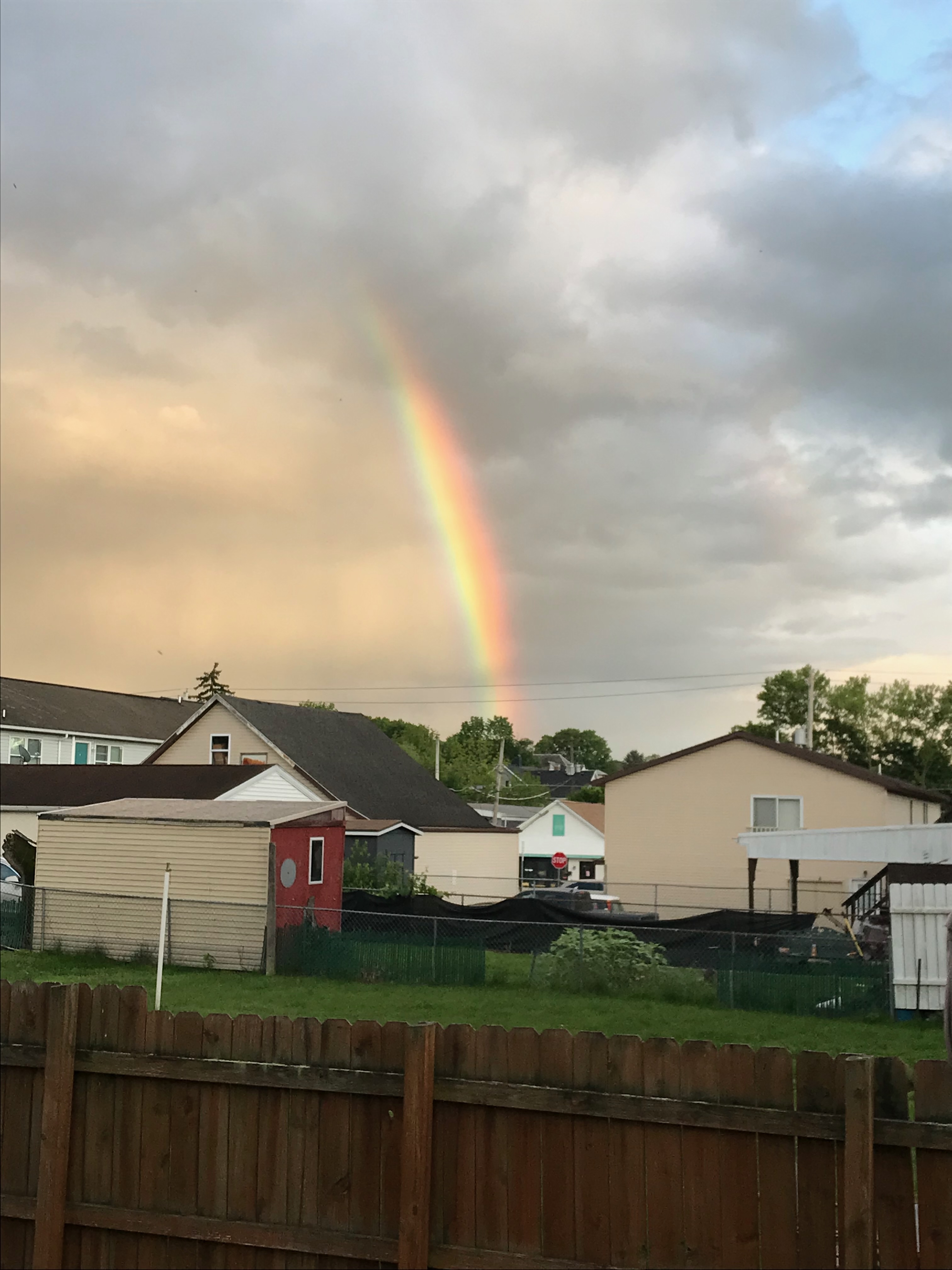
We’ve been making the best of it, getting out to see local attractions while dodging raindrops.  The weeds, I’ve noticed, love this kind of weather.  And I have a visceral reaction to putting on a heavy jacket to go out pulling weeds while watching each passing cloud for a potential downpour.  On the plus side, we have rainbows.  In fact, two nights in a row, about the exact same time, near sunset, we had a rainbow in the exact same spot in the sky.  That’s a sign of hope.  And indeed, the summer takes on a more relaxed atmosphere at work and a few holidays start creeping back in.  Until the stretch of September-October, the second annual drought.  But by then, however, off in the distance I can see the holiday season that starts in November and I know I can make it through to December.

It’s an odd way to live, isn’t it?  Experts talk about how work will be different in the future, but I have a mortgage due in the present, so I step from holiday to holiday, grateful for the time to recover.  With a government trying its best to eliminate benefits to seniors I may have chosen a bad time to reach my sixties.  At least I’m young enough to still pull weeds and push a mower.  (Once the grass dries, that is.)  The main point is not to waste this rare gift of a holiday.  There’s no rain in today’s forecast (but there is for Wednesday, every day through next weekend).  Seeing the sun buoys me up.  And if I can’t have that I can always hope that at least I can have rainbows.


University Death

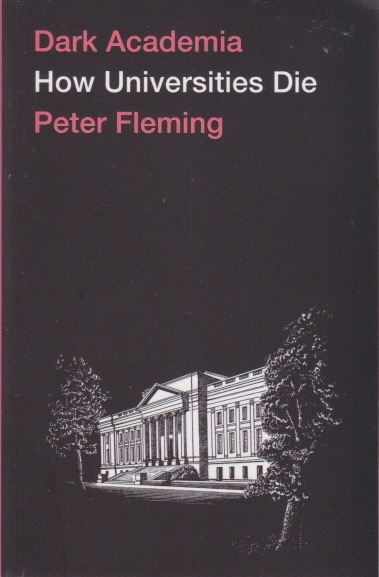
This is an important and thoroughly depressing book.  Despite globalization, I fear that a book from down under might fail to be readily found in the United States, where it’s also needed.  Peter Fleming’s thesis is spelled out in the subtitle.  Dark Academia: How Universities Die.  I’ve read a few other books like this, but I was attracted by the title of this one.  Fleming points out much of what I already knew, but with the stats to back it up, as well as compelling personal stories.  Few people worry about professors.  We’re conditioned to think their lives are easy and carefree.  I doubt they ever were, but since the eighties, when universities started to act like business ventures, the cracks showed in the foundations and their lives grew harder.  Capitalism ruins everything.  Fleming discusses the political maneuvering in the UK and Australia, as well as in the US.  We’re all facing the same nemesis.  Greed.

Politicians began attacking universities likely because they realized that educated individuals can see through the shenanigans that people like Trump, and Reagan and Bush before him, pulled.  They didn’t want alternative voices.  Debate is anathema.  The easiest solution was to make education a business because businesses always want more money.  Now, I’m shooting from the hip here, but Fleming pulls such things together with evidence.  I have witnessed firsthand some of what he describes—living as an adjunct instructor, barely making enough to cover the bills.  At the same time learning the university I was working for had been hiring “managers” (hundreds of deans, associate deans, etc.) but couldn’t afford to hire faculty.  That sports (something Fleming doesn’t address) were allocated far more money than teaching.  Yes, things were bad.

Fleming points, rightly, in my opinion, to neoliberalism as the culprit.  That’s the form of liberalism that’s wedded to free market capitalism while spouting the causes that traditional liberals support—care and concern for all people.  The older I get the more I see that neoliberalism is what the Republican Party used to be.  They’ve veered hard right and since, in America, liberals have never really had a chance to hold power since Roosevelt, they’ve become neoliberals.  Thus began the transformation of higher education before I ever started my doctorate, but I didn’t know it.  I’m no political scientist.  I’m a teacher interested in the past.  And religion.  Having grown up poor, I invested all my scant resources into getting qualified to teach, only to discover that the ivory tower was being sold to the highest bidder.  Dark academia indeed.


O Levels

Out jogging last week, I was thinking about a harsh interview I once had.  It was in Manhattan.  The woman interviewing me made no attempt to hide her disdain.  I’m not sure if it was for me personally or what I represent.  She did not smile at all, not even for the usual niceties.  She asked me whether I was better at speaking or writing.  I said they were about equal.  “No,” she briskly corrected.  “Which is it, one or the other?”  This came to me while jogging because I was reflecting that public speaking and writing are really the only two things I’m any good at, and I have worked on both for my entire life.  These years later I still can’t say which is stronger.  That was appreciated by my students and fellow scholars in my teaching career, if reviews are anything to go by.  I like to communicate.  (My wife might say too much so.)

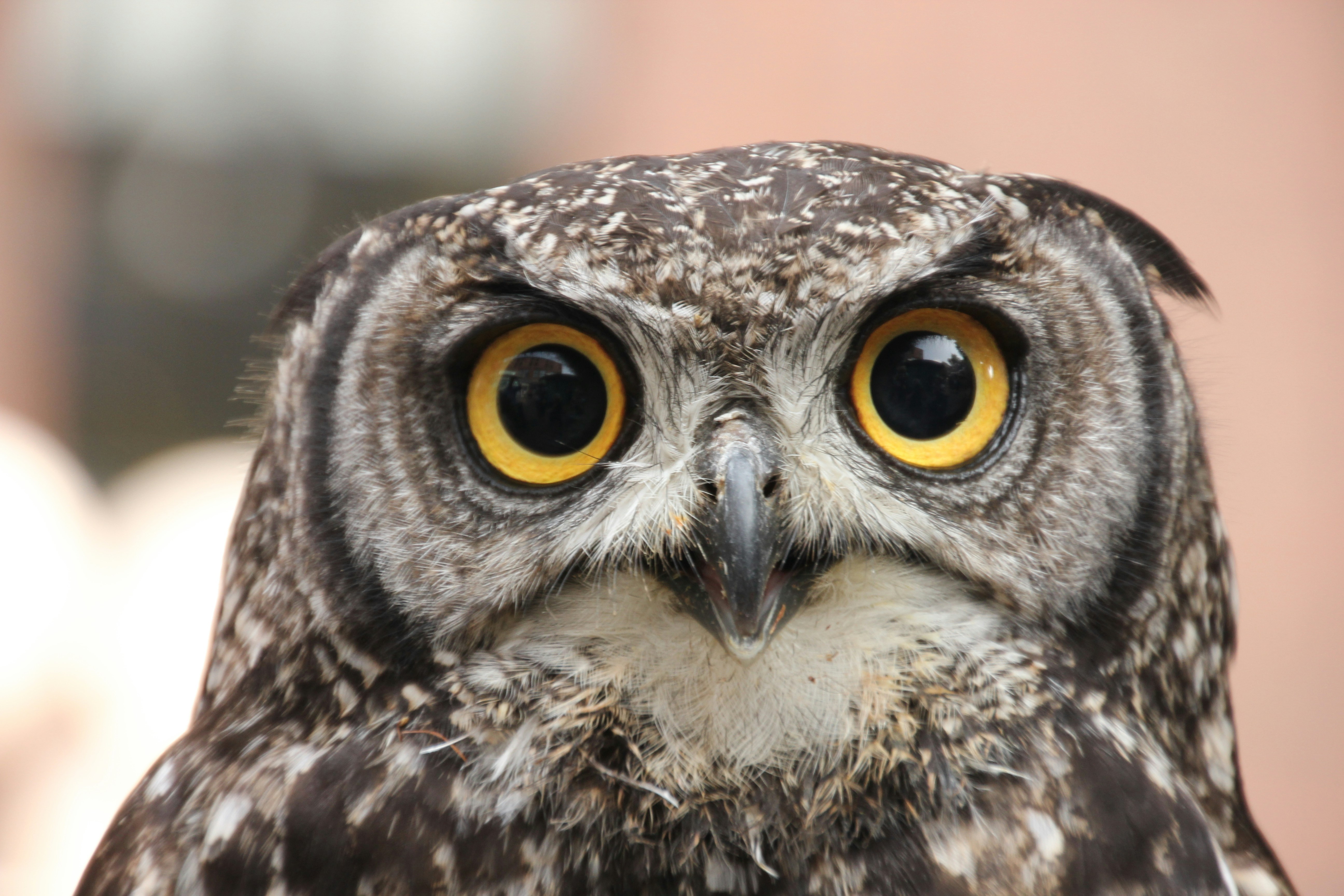
Owls are difficult to spot in the wild.  Just last week I’d seen only my second in some sixty years.  This was a screech owl.  It’s not unusual to hear them when jogging at dawn.  This time my right ear picked up on it more than my left as I jogged past a grove of trees.  I looked but saw nothing.  The trees were budding and some had small leaves already.  I reckon I’ve seen my fair share of bald eagles.  They’re large and they’re pretty obvious when they’re in the area.  Owls are more secretive.  Good at hiding.  I reached the end of the path and turned around.  As I reached the stand of trees, now on my left, it screeched again and I saw a blurred flapping of wings as it disappeared in flight.  I couldn’t identify this owl in a line-up, but then again, that’s not something I’m good at. The voice is distinctive, however.

The person hiring is a bald eagle.  Bold, aggressive, and sometimes literally bald.  I’m more like that screech owl.  Their public speaking is distinct and isn’t really a screech at all.  I can’t speak for their writing ability.  Life is our chance to come to know ourselves.  We may think we have it figured out in our twenties, but each score of years makes you question past assumptions.  Two things I always thought would be part of my career—public speaking and compelling writing—have both fallen by the wayside.  At least professionally.  What we say to others has an impact.  Especially if we’re eagles.  All things considered, however, I would rather be an owl.

Photo by James Toose on Unsplash

Going Viral

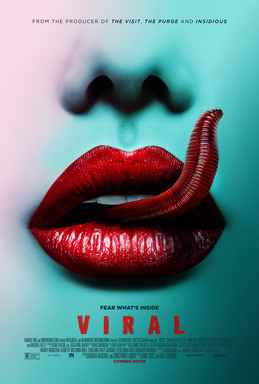
Okay, so there are some pretty big plot holes, but Viral is nevertheless an effective horror film.  The “virus” is actually a parasite spread by blood, which carriers cough in your face, if they don’t kill you first in a fit of parasite-induced rage.  The really scary thing is that this movie was produced before Covid-19 and the government response, as presented in the movie, is somewhat believable.  Nevertheless, it retains its ability to be a story about family and loyalty.  There are some missed opportunities in that regard, but overall it’s fairly well done.  It certainly keeps the tension going and I feel some spoilers coming on so I’ll warn you here.  A Blumhouse production, it seems to have had a reasonable budget.  And there’s a solid attempt to have a storyline with characters you care about.

Sisters Stacy and Emma are trying to adjust to a new school system as news reports increasingly focus on a new, and lethal, virus.  Their California community is the site of the first U.S. outbreak and the initial panic isn’t unlike what happened in 2019.  I’m a little surprised that, given that development, the movie didn’t gain more residual watching.  In any case, a quarantine and curfew are set up, but the teens of the housing development decide to have a party.  Kids will be kids, after all.  Of course, an infected guy is there and Stacy, the older sister, gets infected.  Their parents were caught outside the quarantine zone, so they have to try to survive on their own.  Emma has a new boyfriend—the guy next door—and he urges Emma to leave her sister, but she won’t.  Martial law is declared and “nests” of the infected are being bombed by the government.  Emma and boyfriend manage to survive, but the rest of the town’s a wasteland.

As I say, the implications are the really scary part.  Governments have the mandate to protect the greatest number of people—isn’t that utilitarianism, by default?—and decide to cut their losses and destroy infected communities because there’s no stopping the disease.  Even as the gaps in the story kept coming up, I was asking myself would our government do such a thing.  I could find nothing to dissuade me that it would.  Self-preservation is human nature.  As is might makes right.  Our government, for my entire life, has consisted of the wealthy and one thing we know about those with money is that they’ll do whatever they can to protect their interests.  Oh, and there are a number of effective jump startles as well. But they’re not as scary as the government.


Craving Enchantment

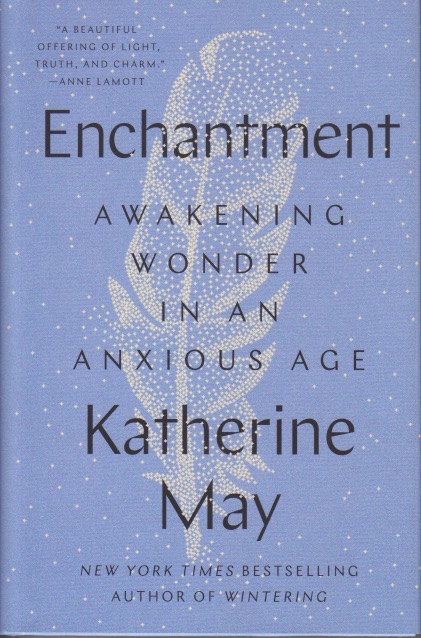
I really want to know, but just can’t figure out, how to write like Katherine May.  My wife and I read her book Wintering and now have added Enchantment.  In many ways I seem to be like May; we may be different shades of neurodivergent, but I understand what she says.  Indeed, at one point in Enchantment she talked me down from a writer’s dilemma that had me worked up for days.  But I can’t write like her.  I have times when my rhetoric for a blog post or two might come close, but I have tried to sustain it for an entire book, so far without success.  My background was perhaps too sullied by academic writing, although May is also an academic, so I may simply be making excuses for lack of talent.

That’s too bad because Enchantment is meant to improve your outlook.  Subtitled Awaking Wonder in an Anxious Age, it consists of life lessons the author learned during the pandemic.  I often, if I allow myself in this constant struggle for my time, experience the sense of wonder May describes.  I enjoy walking in the woods, watching heavenly bodies, staring into a river or pond, and trying to draw lessons from such things.  Lately, however, I find myself rushing through them because I have something else I have to do.  Daily, it’s the 9-2-5, of course.  That schedule overloads my weekends with things that have to be done even if I want to spend time appreciating the enchantment I can find, if I have the time.  Sorry, I’m letting the anxious part take center stage.

This is a wonderful book.  I admire the way that May is able to face down her own struggles with grace and remain open to possibilities.  I found such things much more readily when I was at Nashotah House.  There were moments between classes and there were semester breaks.  We lived in the woods.  By a lake.  There was wonder there, for the taking.  Having a young child to introduce to the wonders of nature definitely helped as well.  Children force you to see through new eyes (it’s not a surprise that May has a young son when writing).  Too quickly we grow up and let capitalism tell us what to do.  It takes so much from us and gives so little.  I’m looking out my window at nature, as I write this.  I know it has enchantment to offer.  I also know that work begins in fifteen minutes.


Fabric of Time

I’m not a sewer.  I mean, a person who sews.  I know people who are, though, who are quite distressed that JoAnn Fabrics is going out of business.  In an effort to console such folk, I indulged in an online search for fabric shops that led to a couple of conclusions.  One is that the internet is lousy at clean-up, and the second is that big box stores have ruined the ability to find things, funneling all purchasing to Amazon.  Let’s take these one at a time. 

If you’ve ever searched for a physical store (fabric or otherwise) online, you know that sites like Yelp are full of artifacts.  Stores that closed a long time ago and have never been removed.  In fact, when I commuted to New York City I sometimes walked several blocks on my lunchtime, looking for a store only to learn that it had closed five or ten years ago.  It still beamed happily on the web, though.  I have driven to bookstores that no longer exist, based on their location being proclaimed loudly online.  Regarding fabric, I located directories for Enright’s Fabric Warehouse, in nearby Bethlehem.  Nothing online indicated that they were long out of business.  I street-leveled the address on Google Maps and found a building I’d driven past many times; I’d actually driven by it the day before.  It obviously was a large factory-like building, but it hadn’t been a fabric store in the seven years I’ve lived in the Lehigh Valley.  This isn’t the only time I’ve searched specifically for a company/store with the query word “bankrupt” or “out of business” to find Hal-9000 saying, “I can’t let you do that, Steve.”

The second point.  Big box stories come to town, drive smaller stores out of business, then fold themselves, leaving us all poorer for it.  As big boxes go, I liked JoAnn’s.  Probably because they were failing, they had lots of things besides fabrics that I could look at on family outings.  But the fact is smaller fabric stores (which still appear online as existing) went out of business when JoAnn came to town.  There were two JoAnn stores in the Lehigh Valley.  Smaller places closed, and now we’ll be running around naked before we can find a fabric store willing to sell.  I’ve seen this happen with other industries as well.  There was a fine office supply store in Oconomowoc, Wisconsin when I was at Nashotah House.  Staples came to town and closed them down.  If you’ve been in a Staples lately, you know the writing’s on the wall.  I know we’re stuck with big boxes.  More often we turn to Amazon where a few keystrokes will get you what you need.  Check and mate.


Hoping for 2025

Those who predict, as pollsters repeatedly remind us, can’t really prognosticate.  In ancient times some prophets were thought to be given (usually conditional) views of the future directly from God, but even these weren’t fail-proof.  Nobody knows what 2025 holds for us.  I love holidays, but New Year’s Day is one of the more chancy ones.  I don’t stay up until midnight because if I do I don’t sleep that night (I tend to awake just a couple hours after midnight most days), and I don’t make resolutions since I try to correct errors in my life as soon as I find them.  Maybe New Year’s could stand a makeover.  Something beyond staying up late and drinking.  In my experience, the next year comes anyway.  And it should be an opportunity for hope.

Interestingly, although attempts have been made to Christianize the day, it tends to remain secular.  The current date was established in the west because of the rebranding of solstice celebrations to the birth of Jesus, but the religious elements never really stuck to New Year’s Day.  It marks a clean slate for taxes and other financial resets.  Importantly, it’s a day off work.  Maybe we should rebrand it.  Honestly, I don’t have any suggestions myself—this sounds like a job for a committee.  Who wouldn’t want to be on a holiday committee?  And holidays do evolve over time.  When it was Columbus Day many employers didn’t make it a paid holiday.  Rebranded as Indigenous Peoples Day, some progressive companies did.  See what I mean?  Holidays are what we make them.

The more I think about this, the more I wonder if we shouldn’t reinstate the twelve days of Christmas.  Epiphany (aka Insurrection Day) comes on January 6, and, pre-Adam Smith the twelve days lasted until then.  New Year’s could be one among siblings.  I’m sure that if we tried hard enough we could come up with some branding for each day.  The Brits already have Boxing Day on the 26th.  The Scots make the 31st Hogmanay.  Our task, should we choose to accept it, would be to fill in the 27th through the 30th and January second through the fifth.  If we divide that up and send it to committee I’m sure we could come up with something.  It seems we already have the ten lords a-leaping lined up.  Said lords prefer having two more work days this week, I know.  Perhaps New Year’s, or even the Christmas season, could stand a bit of workshopping so we can really catch up with our sleep.  Here’s hoping, for 2025.

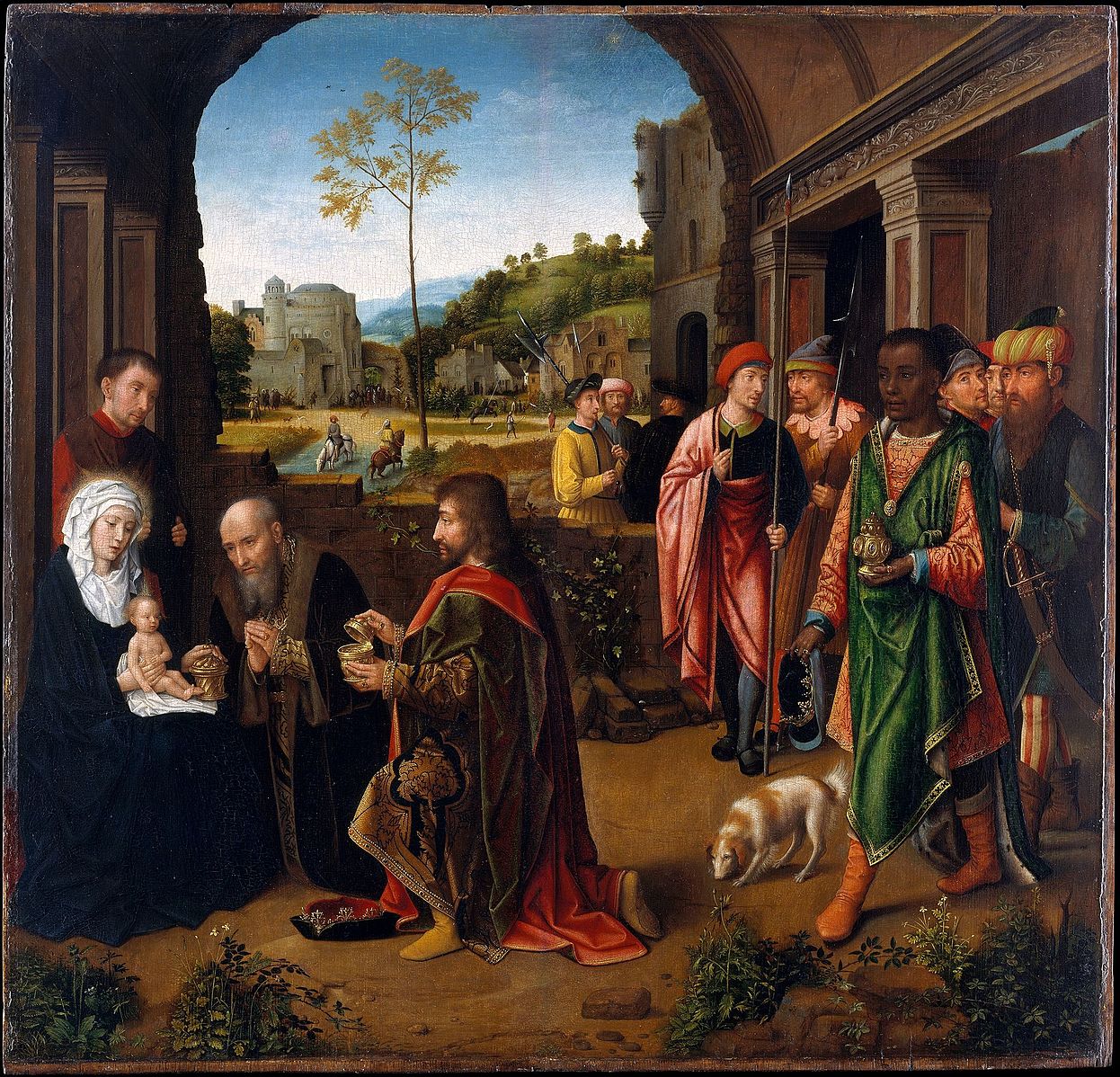
Let’s give them time to arrive! Image credit: The Adoration of the Magi – painting by Gerard David, Creative Commons CC0 1.0 Universal Public Domain Dedication by the Metropolitan Museum of Art

Eves and Holidays

If you stop in to this blog for reading about horror movies, don’t worry, there’ll be plenty of that to come.  One thing everyone who knows me knows is that I believe in holidays.  Capitalism has been killing us for centuries, but since I began having to do a 9-2-5 job, I feel the grim reaper’s approach more steadily.  Day after day after day being eaten up by work and leaving so little time to be who I really am.  I invest a lot in holidays because they break, if only temporarily, capitalism’s death-grip around our throats.  And today is Christmas Eve.  Not technically a holiday, I’ve worked for employers who, Scrooge-like, don’t consider this a paid day off.  You want to mentally prepare for Christmas (the only paid holiday in the season), you cash in a vacation day.

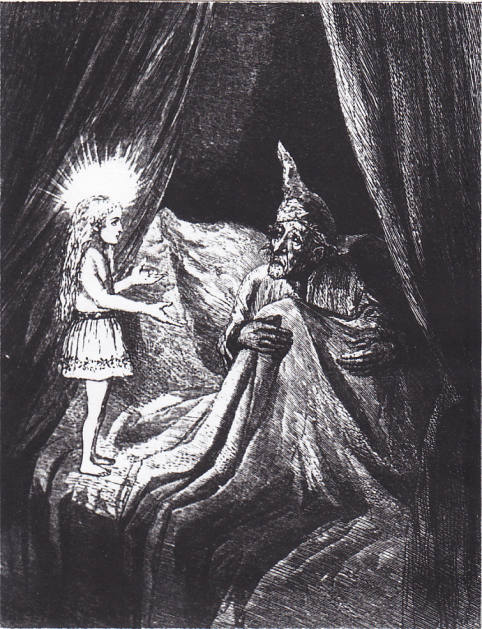
Image credit: Sol Eytinge, Jr., The Ghost of Christmas Past. Public domain via Wikimedia Commons

As influential as Charles Dickens’ A Christmas Carol is, late capitalism simply doesn’t get  the message.  Studies show, consistently, that work in this era is more efficient when workers have more time off.  Now, I’m not so naive as to realize that some professions require work on holidays.  After all, I trained for ministry for many years, and Christmas is always a work day in that profession (even if nobody comes to church).  Emergency workers of all sorts have to be at least on call for holidays.  Police can’t assume citizens will behave just because it’s a holiday.  But such professions, I profoundly hope, have other payoffs.  I entered a profession (professoring) partially because of the division of time.  (And it is one of the few things I’m very good at.)  People should have fallow periods.  Why is Christmas Eve still a work day?

Scrooge is clearly still in charge.  I, for one, will not shed a tear when capitalism dies.  I’ll predecease it, I’m pretty sure, but even so, I welcome a world where people’s needs come before the plutocrats’ profits.  A friend of mine always insists on saying that we don’t live in a democracy but a plutocracy.  Seeing the election results last month only confirms that he’s right.  As I recently wrote here on this blog, the howling is most fierce before the new dawn.  And lasting change must take place slowly.  Sudden shifts only lead to more sudden shifts.  Stable growth is slow.  I’m sure influential people don’t read this blog, the humble musings of an unfluencer, but if they do, there’s a simple plea here.  Consider the holidays.  Read Dickens, and have the courage of your convictions afterwards.  And yes, a blog post (unpaid) will appear on Christmas.


Thankful Time

Thanksgiving’s late this year, for which I’m thankful.  I must be nearing retirement age because I really could use a little more time off.  Of course, I’m a big fan of holidays and I wish our late capitalistic system might throw a few more bones to the dogs.  Autumn is always my favorite season.  In September I feel the migratory urge of the classroom, but that’s an unrealized desire now, so I set my eyes on Labor Day and Indigenous Peoples’ Day.  Some of the more progressive employers give the latter off.  From there I can see Halloween, although it’s often a working day.  Still, it’s Halloween.  It’s yet a long stretch from there to Thanksgiving, but if I’m careful with my vacation days I can take a few long weekends as stepping stones to this four-day weekend.

I’m not being sarcastic or facetious at all.  I don’t believe I could survive the calendar year without the holidays and I am deeply, deeply grateful for them.  Capitalism seems to have a death grip on the idea of people as “assets”—a brand of thinking that should be buried with a stake through its heart.  People are people and we work for a living.  We don’t sell our souls for health care and a roof over our heads.  The internet has increased productivity immensely, but most companies are reluctant to consider the costs of overwork.  When you can check your work email from 6 a.m. to 9 p.m., for those of you who can stay up late, don’t you think that a few more holidays might prevent burnout?  Do assets burn out?  Engine parts have to be replaced when they wear out.  Why are we so slow to learn the lesson?

Today we reflect on the things for which we are thankful.  Even in difficult times there are many.  I’m thankful to live in a world with books in it, for one.  On those rare days off I read, trying to catch up with an ever-growing stack of intellectual stimulation.  And I try my best to contribute to literary life, although my books appeal to few.  I’m thankful for hope.  Without it this last year would’ve been impossible.  And I’m thankful for family and friends, whether actual or virtual.  This is an interesting world that I’ve come to inhabit.  The more I learn the more there’s left still to learn.  And with Thanksgiving so late this year, Christmas is less than a month away.  I look ahead and I’m thankful.


Hungry Eyes

They’re watching.  All the time.  I may be a quasi-paranoid neo-Luddite, but I have proof!  Who’s the “they”?  Technology nameless here forevermore.  So my wife and I attend Tibetan singing bowls once a month when we can.  It’s the night I get to stay up late even though it’s a “school night” and get bathed in sound.  Our facilitator is a kundalini yoga instructor.  To those of you with experience, you know what that means.  At the end of each session we sing the “Longtime Sun” song.  Each and every month the next morning I groggily look it up.  I know it’s a recent song (hey, I’m in my sixties) but I can never remember by whom.  So for the record it was written by Mike Heron of the Incredible String Band and it’s part of a piece called “A Very Cellular Song” on the 1968 album The Hangman’s Beautiful Daughter.  (Now I remember!)  Okay, so I’ve got that out of my system. (I must add that this is disputed, with some claiming it’s an old Irish blessing. But note, AI only complicates the issue because it doesn’t do actual research.)

Incredible String Band: Image credit—Bert Verhoeff / Anefo, under the Creative Commons CC0 1.0 Universal Public Domain Dedication, via Wikimedia Commons

So how’s that proof?  Well, there’s an unconventional website I check daily.  Are you surprised?  Really?  To get headlines I have to reload it daily and the ads sometimes refresh.  I checked this site a mere five minutes after searching “Longtime Sun” for maybe the fifth time and the ads in the refreshed page were for singing bowls.  Just five minutes earlier I’d been searching a hippie tune and already they were preparing ads for me.  You see, “Longtime Sun” is a standard of many (I gather from the interwebs) kundalini yoga classes.  So much so that it’s commonly said that this is a traditional Tibetan song.  Well, I suppose to call it “Very Cellular,” or even “Hangman’s Daughter,” might harsh the experience a bit.

Kundalini yoga is very esoteric stuff if you read a little more deeply.  For me such reading is an occupational hazard, so I’ve read enough to know that many respectable people might be a bit shy upon hearing the details.  That’s not to say that it’s ineffectual on the level of singing bowls.  I have great respect for esotericism, although Hinduism isn’t in my background.  But if “they” know what kundalini teaches, what kinds of ads might begin to show up on the websites I visit?  What’s truly amazing is that a web search for a specific song brought up an ad for something that would be puzzling, were a reader innocently wanting to find out about “A Very Cellular Song.”  For academic purposes, for instance.  Of course, they know, you can merch anything.  You can trust the internet only so far. And they are watching.


Mere Eagles

One of our summertime jaunts was to the small town of Eagles Mere in the Endless Mountains region, north of the Poconos.  Growing up in western Pennsylvania, I often heard of the mysterious Poconos out east, and now that we live just south of them in the Lehigh Valley, they are weekend-getawayable.  As are points north.  Eagles Mere was an early resort town built on the second highest natural lake (“mere”) in Pennsylvania.  In the early days it was accessible mainly by a slow moving train that took visitors up the mountain.  Today, of course, everyone drives.  It’s a town of about 150 people but the population increases to 3,000 in the summer.  It’s also known for its winter sporting opportunities.  It’s fully dependent on tourism.  I got the sense from walking around that it’s the kind of place you need to stay in to appreciate fully.  Once there were four major historic hotels, all of them gone now, so visitors stay in more modest accommodations, or like us, far enough away to be affordable.

I often wonder what it must be like to live full-time in such a place.  I mean, the rest of us slog away at daily jobs until we can get away for a few days, perhaps to Eagles Mere.  I can’t imagine having to draw in your entire income during a summer with lesser business in the winter, and a smattering of visitors in the fall.  What must life be like in the off-season?  Is it better than the 9-2-5 sitting in front of a computer screen?  At least they have a beautiful, clear lake.  And peace and quiet.  One of the things that struck me—we were there on a drizzly, somewhat chilly August day—is just how silent things can be when we get away from the sounds of civilization.  Perhaps this is the pay-off to not getting year-long pay.

Such places exist because the rest of us need to escape what is it we normally do.  Work, at times, seems mainly to be dealing with other people’s frustrations.  These build up over time until we need to forget about it for a while.  In other words, getaways are interludes of fantasy.  Imagining how it must be to live with so much money that you could afford not to work, but just to paddle out on the lake, watching for eagles, and listening to silence.  Every time I visit a resort town I wonder what it must be like to live in one.  The docent at the museum said many of the 150 are descendants of those who ran the grand hotels.  Even in, perhaps especially in, the off-season this is home to dreamers.


The Unpersistence of Memory

Perhaps this happens to you.  It’s a creepy feeling, regardless.  You’ve heard a lot about a movie and you decide to see it.  Since you’re not rich you decide to wait until it comes to a streaming service to which you already subscribe.  So far I’m sure you’re with me.  One evening, when the timing seems right, you sit down to see it.  You don’t know how it will end, but some scenes look familiar to you.  You nevertheless enjoy it—the jokes are fresh to you and you laugh.  You figure that you must’ve seen the familiar parts in the trailer.  You think the movie is quite good, and your spouse agrees.  Haunted by that uncanny feeling that parts were memories instead of just a trailer, you do some investigating only to learn that you did indeed see it before.  And it was only five years ago.

My memory is still reasonably good, I think.  I can recollect various movies from different ages of my life—including five years ago—but others failed to stick.  I hate to admit it, but this has happened to me more than once.  I’ve watched a movie, written a blog post on it, posted it, only to discover that I’d seen the film before and had even written about it.  Perhaps there’s too much stimulus entering this limited brain I have.  I can’t help but think it has to do with my work schedule; I started having such things happen when I was chained into a 9-2-5 day.  Before that, life seemed much more easily handleable.  As proof I would put forward the fact that my memory for movies, books, etc., before being dismissed from my calling is much better than it is for the years since.  Career malfunctions can have lasting effects.  A therapist once told me I was suffering PTSD.

Of course, I might just be getting older.  Still, it seems that memory works better in some circumstances than in others.  Movies have been an important part of my life, especially since being forced out of academia.  It’s troubling to find myself forgetting them.  As much as I enjoy cinema, I have limited time for watching films, and if one I rewatch wasn’t very good the first time, I’ve just used up a valuable Sunday afternoon when I could be researching my next book.  That’s the human dilemma, I suppose.  I Just can’t get over the idea that it has to do with work.  If it weren’t for that, the next book would be done already.  I’m sure this happens to everyone.  At least those with 9-2-5 jobs, if I remember correctly.

Photo by Denise Jans on Unsplash


Science of Convenience

One thing I’ve noticed about employers is that they’re all for science, except when science contradicts capitalism.  Then they become all mystical.  I had a situation illustrate this particularly well with one of my many employers.  Touting everything to be “evidence based,” they liked to refer to the science behind their reasoning.  Then a study came out demonstrating, scientifically, that more breaks actually increase efficiency in learning and working.  Suddenly silence from management. Crickets chirped.  This observation was just as “evidence based” as daily operations, but it was ignored because, well, it would be giving too much to employees.  You see, science that benefits the upper levels of management is one thing, but by the time it trickles down, well, you know.

American culture is based on the premise that you need to drive people to work as hard as possible.  Perhaps anecdotally, the Covid-19 pandemic showed that workers at home were just as, if not more, productive than they were after enduring an often horrendous commute to get to the office.  Once pandemic strictures began to lift, however, it was all “we want you back in the office.”  Bosses like to look out over seas of employees in their cubicles and feel the surge of the galley master with his whip.  You need to keep workers in line, you understand.  That’s the way capitalism works.

I often wonder where the world would be if superpowers didn’t have cultures based on greed.  One of the seven deadly sins, or capital (!) vices, the worship of personal gain stands behind capitalism as we know it.  And we’ve seen the results.  A shrinking middle class as those with all the wealth make plutocracy out of what was intended to be a democracy.  (Of course, the wealthy founders of the country probably didn’t have a real grasp of what life was like for the poor, even at the start of things.)  Capitalism is good at using aspects of all human endeavors in order to increase its reach.  Science is one such tool.  Religion is another.  Science says more time off is good, and can increase productivity in our current world.  Religion says greed is evil.  These are the parts we’d like to ignore.  Even the Harvard Business Review suggests a four-day work week is beneficial.  Business leaders are skeptical, of course.  Skepticism is one of the elements of science.  And science can be very profitable, if it favors those who hold the reins of power.

Photo by Alex Kondratiev on Unsplash