Work Weekend

It’s a Saturday and my wife’s at work. She’s worked five days already and will still be at work tomorrow. I’m lazing in bed until 5 a.m. when I hear the neighbor’s alarm clock from upstairs. An hour later I see him headed to his car, dressed for work. I think about the concept of weekend and how it apparently means nothing any more. Well, I’m not at work, so it must mean something, but it’s not what it used to be. Don’t get me wrong—when I was a professor I gladly worked through weekends. Indeed, I was working pretty much all the time. I was paid to be a thinker, and I can’t shut this thing in my head off. My current job, however, is a 9-to-5 with expectations of more, but not entailing any extra compensation. Overtime? You lucky one, you’re “exempt!” And don’t forget to take your laptop home, in case something comes up in the middle of the night. (I do read the timestamps on my emails.)

The weekend is a religious idea. Ideal, even. We have the biblical concept of the Sabbath to thank for our free Saturdays, when they come. Christian beliefs about resurrection to account for Sundays. Days originally set aside for worship. Time off work is worship now. When else will we get the laundry done? Groceries bought? Floors swept? I leave before six each day and arrive home near seven at night. To keep up my Manhattan lifestyle I have to awake before four and head to bed at eight. If I had an extra minute to access my memories I might think this a little odd. I used to have time to write books. Where did that go? Vacation time? You have to be at the airport two hours early so you can be frisked for a plane that’s inevitably late. You get five days off, and two will be spent traveling. Work waits for no one.

1912_Lawrence_Textile_Strike_1

I guess it’s no surprise that those who argue that we should abolish religion have jobs that either they love or that don’t require weekend hours. They have time to examine this gift horse minutely in the mouth. You know, we don’t have to have days off. In olden times, or even today on farms, the concept of a weekend is only academic. Those whose jobs are just work to keep an imprisoned soul in its weary body are, after all, expendable. Perhaps I’m just too weak. The occasional three-day weekend rejuvenates me to a degree that’s almost frightening. I wonder why we can’t add holy Fridays to our list of days to worship. There is a price to be paid for neglecting time to reflect. I can’t imagine Pharaohs and kings wanting to grant any more time off, however. We all know who we’re really working for, and it’s not the one who gave us our weekends in the first place.


Ice Church

Eternity is a concept closely associated with religious thought. It bears a freight that phrases such as “steady-state universe” and “Big Bang” lack. Indeed, the foundations of Christianity and Islam involve the belief that eternal life can be had for those who play by the rules. Great cathedrals and mosques were erected to last forever, or at least until the end of the physical world. Perhaps that is the reason I find the idea of a church constructed out of ice so engaging. Annually for the past several years, a church has been built of ice in the Romanian Alps. Accessible only by cable car, the church is a temporary structure in a land where varieties of Christianity (let alone other faiths) are openly hostile to one another. As the globe slowly wobbles back to a northern inclination, the church will melt and disappear. Still, in its brief time in the world, baptisms and marriages will be performed there. Eternal vows in a temporary structure.

A theological message is inherent in such an institution. We are trained from our earliest days to be consumers. We are to acquire goods and desire more. Were we ever to be satisfied, capitalism would crash to the ground like an ice church left out in the heat. The secular world in unrelenting in its message that we are born to eat, buy, and use. The more expensive, the better. And the more quickly obsolete, the more profitable it will be. The towers of our cities are constructed of concrete and steel, and yet, I have watched new buildings grow and supplant those that have seemingly stood forever but which, in reality, have existed for less than a century. Indeed, all of our towers ought to be made of ice.

IMG_1252

Ice is cold and hard, but it is still water. An article in The Guardian notes that some pastors see this as a kind of baptism frozen in time. Shape given to that which follows the contours of its container. The water, however, will ultimately follow its natural order and rejoin the oceans of the world. While humans are naturally disposed to collect, to save up against lean times, we have to be taught to be consumers. Some of us are content with relatively little, knowing that elsewhere our fellow human beings have nothing at all. Their churches are made of ice, and our corporations are eager to reach even them, to teach them to covet what the more “affluent” have. And the world slowly warms, turning all into liquidity.


Middle Eastern Idol

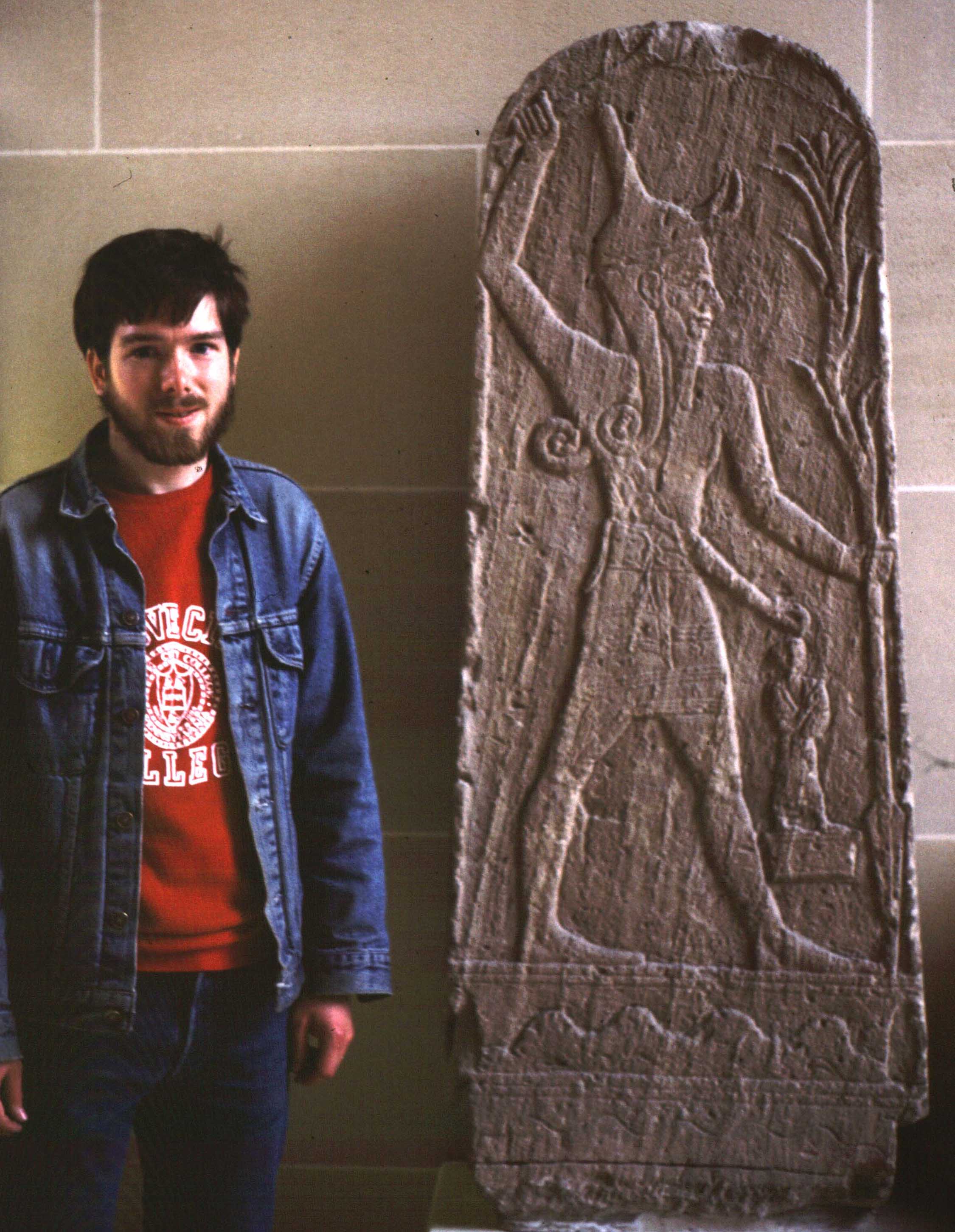
As the Passover-Easter complex of holidays approaches, our stern, scientific face turns toward the more human sensibilities of religion and its impact on our lives. PBS recently aired the Nova special The Bible’s Buried Secrets (originally aired in 2008) and when a colleague began asking me about it I figured I’d better watch it. As an erstwhile biblical scholar there wasn’t much here that was new to me, but one aspect of the program bothered me. Well, to be honest several things bothered me, but I’ll focus on one. When referring to the gods of the Canaanites, among whom the program readily admitted the Israelites should be counted, they were invariably referred to as “idols.” The problem with this terminology goes back to an issue I frequently addressed with my students—the term “idol” is a way of demeaning the gods of a different religion. Implicit in the word is the assumption of the monotheistic worldview and its attendant problems.

The Bible’s Buried Secrets seemed to adopt an overly optimistic view of the monotheistic religions sharing the same god while everyone else worshipped idols. The view is as fraught as it is simplistic. Historically Judaism, Christianity, and Islam are certainly connected. Each recognizes in the others a glimmer of its own theology and outlook, but the concept of deity has shifted somewhat at each development. Judaism and Islam are rather aniconic, especially compared to many varieties of Christianity where images are allowed, or even encouraged. It is difficult to grab the attention of the magazine-reading public with an image of invisibility on the cover. It should come as no surprise that some Jews and Muslims believe Christian images to be, well, idols.

An idol moment?

An idol moment?

The word “idol” is by nature pejorative. Ancient people were sophisticated polytheists. That statue that represented a deity was not thought to be that deity in any absolute sense. Rituals assured the ancients that they were instilling some aspect of divinity into the statues they used, making them sacred in the same way a Christian consecrates a church building. What’s more, it is natural for people to seek a visual focus for its devotion. It is difficult to conceptualize the Almighty as a person without giving it (often him) a body. Islam, especially, has been adamant that this can’t be done, and looking back at Christian practice it is sure to see idols abounding. As the holy days begin for our vernal celebrations, we should perhaps use the opportunity to rethink such religious vocabulary since every orthodoxy is someone else’s paganism.


No Beef

IMG_1932

Burger franchises aren’t always the best option for vegetarians. When you’re traveling, however, choices can be slim. My wife and I recently pulled into a Burger King. They do have a veggie burger, although it is clear that those who prepare them seldom eat them. They must be frozen because they inevitably have that tough edge that comes from microwaving them just a little too long. Anyway, we were sitting down to have a bite, or chew, when a group of three gentlemen in the corner booth caught our attention. They were arguing, in a friendly way, over Christianity. Among the topics of conversation was the age of the earth. (Ten thousand years, at the outside.) Overhearing the conversation, I started to get nervous. I noticed the guy at the table next to them glancing curiously their way.

I glanced around. Other people having conversations about mundane things. Perhaps this is what we’re taught to do. Speak of things that have little depth. We are in a public place. We don’t discuss religion or politics here. But then I reconsidered the situation. If I were to join their discussion I’m sure we would have found little in the way of common ground, but I realized that conversations around religion do have depth. These guys, despite the media’s incessant message that religion is for non-intellectuals, were thinking deeply about topics of ultimate concern. When’s the last time I talked with a colleague about what really matters over lunch?

A blurb in a recent Christian Century mentioned Bob Dylan. It suggested that in a recent interview that he’d intimated that if he hadn’t gone into music, he would likely have studied theology. Likewise, I recalled an interview many years ago with Bruce Springsteen that suggested he might have made a good priest. Listening to the lyrics of many of the songs of these two icons will reveal that depth and public religious discourse many not be so rare as this incident in Burger King seemed to suggest. Maybe the words aren’t always direct. Maybe we speak in metaphors and with guarded asides. Maybe we speak with our actions instead of our words. Many of the most profound conversations we have, when viewed in that light, are like those of three men in a Burger King.


Pauline Resurrection

271px-Bartolomeo_Montagna_-_Saint_Paul_-_Google_Art_ProjectPaul is dead. Has been since the first century. In biblical studies, however, he is undergoing a kind of resurrection. Studies of Paul are coming thick and fast, with many claiming, with some justification, that Christianity was his invention. Biblical scholars have long realized, however, that many New Testament letters do not come from Paul. Some never made that claim (Hebrews), while others seemed to have played on the popularity of the epistle genre and added Paul’s name to gain authority. Or maybe they were written by somebody else called Paul. Far more intriguing to me is the fact that in the authentic Pauline letters, the apostle from Tarsus mentions other letters he wrote that were not preserved. This should strike no one as unusual; would Luke’s grocery list have been preserved as scripture if it had been found? Probably not. Still, these missing letters do raise an issue that might crinkle brows with thought. What have we been missing?

Paul, like other scripture writers, had no idea he was writing “the Bible.” In fact, the Bible is one of the most obviously cobbled together holy books in world history. It is inspiration by committee. We have known for many many decades that there were other Gospels, for example. Some scholars treat the Gospel of Thomas as canonical, while others have reconstructed Q down to chapter and verse. The Hebrew Bible cites some of its sources that have gone missing. Some of the existent biblical books in their current state are obviously somewhat garbled. An imperfect scripture. And I’m wondering what Paul might have written in those missing letters.

The process of constructing a Bible has been examined time and again by scholars. Mostly they accept the material we have to work out some scheme of how Christianity decided “thus far and no further” and these books only will be Bible. Isn’t there, however, a problem when we know that other bits of parchment were floating around out there with the apostolic stamp of approval? What if Paul changed his mind over time? His current letters, the ones that survive, aren’t always consistent. It’s the job of exegetes to try to tell us what Paul really meant, but the fact is we know that this founder of Christianity sent more advice to more people and nobody bothered to keep a copy. Those bits that were preserved are not systematic or comprehensive, making me wonder just how solid a foundation a theology built on such small bits might have. Nobody, it seems, wrote a life of Jesus in real time. It took a couple decades at least before people started to sketch out his life’s story and teachings. By then Paul had already been killed. His letters, slowly gathered over time, formed a nucleus of a faith that grew to be the world’s largest. And, despite all that, we don’t know what he fully said. And we never will.


Geneva Conventions

As an alumnus of Grove City College, I generally don’t have the chance to consider other colleges as unreasonably conservative. College taught me, after all, that education involves thinking things through, and that, of all things, doctrine is one of the many human constructs that wilts under close examination. Both religious and political doctrine fall under this rubric. So when an article in the Chronicle of Higher Education fingered Grove City’s near neighbor, Geneva College, I was both relieved and not really surprised. Grove City was strict, but Geneva, located down the road in Beaver Falls, was even more Reformed. Tales at the Grove said that even off-campus dancing was an infringement of the student code there, and that even a legal sip of beer with dinner, off campus, could get you expelled. You know how students talk. In any case, both cut from Presbyterian fabric, Grove City and Geneva Colleges hold out against the world and its multiple evils. So why did humble Geneva merit notice in the exalted Chronicle?

Geneva College recently sued for exemption of the contraception-coverage mandate of the Affordable Care Act. You see, in many conservative religious traditions pre-marital sex is not only from the Devil, it practically never happens among true Christians. If it doesn’t happen, why should you be forced to pay for its treatment? Denial runs profoundly through these conservative colleges. While at Grove City, in a first-floor dorm room, my roomie and I were awakened one night by a group of pretty obviously drunken frat boys from the third floor. Cursing loudly, one of them rammed his fist through our window, showering the floor with glass before stomping loudly up the stairs. When I went to the housing office the next morning, they wondered about my story. Students at Grove City, drunk? It simply did not happen. In all likelihood, I’d broken the window and made up the story so I wouldn’t have to pay. I pointed out that campus security had noted the glass was inside the room and my roommate and I were both there at the time. Reluctantly, while still withholding judgment about the drunken part, I was believed.

Conservative Christian colleges often face the specter of reality. College kids were killed driving drunk. Girls, gasp!, did get pregnant and did not always decide to keep the baby. Real world issues declared anathema by a magisterium with its hands firmly over its eyes. No matter one’s view of morality, singling women out for punishment of sexual sins is just plain unfair. The issue here is health care, not the consequences of a decision made in the heat of passion. How often the anonymous male gets to scamper off, his health fully covered. The co-ed, however, is treated like Eve holding a newly bitten apple. Students attend Christian colleges for a wide variety of reasons, and the education, apart from the theology, can actually be excellent. It is the ethical obligation of the schools to cover all the human needs of emerging adults, not just those based on a morality still mired in the Middle Ages.

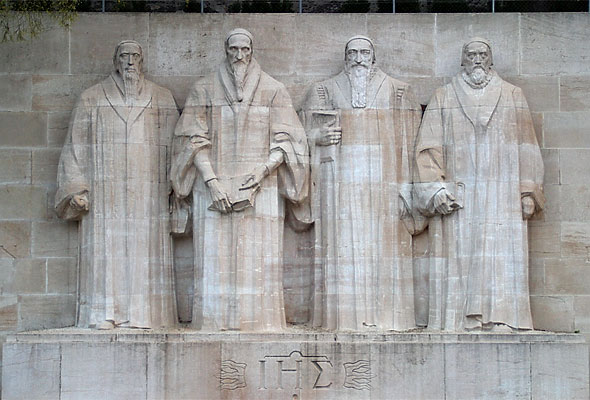
Time for a Reformation?  Photo credit: Roland Zumbühl, Wikimedia Commons

Time for a Reformation? Photo credit: Roland Zumbühl, Wikimedia Commons


Star Struck

One of the coveted symbols of approval in my childhood was the star at the top of a paper. I watched in amazement (perhaps because they were so rare) when a teacher would inscribe a star without lifting her pencil from the paper. I thought I had never seen anything so perfectly formed. Of course, in my teenage years under the influence of Jack T. Chick and his ilk, I learned that the five-pointed star, especially in a circle, and more especially upside-down in a circle, was a satanic symbol. My childhood achievements had been, apparently, a demonic blunder. This fear of geometry still persists in America, as a story of a woman in Tennessee fighting to have “pentagrams” removed from school buses shows. The woman, who has received death threats and therefor remains anonymous, took a picture of the offending LEDs and has asked, out of religious fairness, to have the satanic symbols removed from the bus. The news reports are almost as tragi-comic as the complaint.

600px-Hugieia-pentagram

The pentagram, or pentacle, has a long history, some suggest going back to the Mesopotamians. (Uh-oh! We know how they loved their magic!) In fact, the symbol was benign in religious terms until it was adopted by Christians as symbolic of the “five wounds” (zounds!) of Christ. The symbol could also be used for virtue or other wholesome meanings. The development of Wicca began in earnest only last century, although it has earlier roots. Some late Medieval occultists saw the star as a magic symbol, and the inverted pentagram was first called a symbol of “evil” in the late 1800s. As a newish religion seeking symbols to represent its virtues, Wicca adopted the pentagram and some conservative Christian groups began to argue it was satanic, representing a goat head. (The capital A represents an ox head, so there may be something to this goat. I’m not sure why goats are evil, however.) Wicca, however, is not Satanism, and is certainly not wicked.

Symbols, it is sometimes difficult to remember, have no inherent meaning. Crosses may be seen in some telephone poles and in any architectural feature that requires right angles. The swastika was a sacred symbol among various Indian religions, long before being usurped by the Nazis. And the pentagram was claimed by various religions, including Christianity, long before it was declared dangerous by some Christian groups. There may be a coven in Tennessee seeking to covert children by designing and installing taillights of school buses, but I rather doubt it. School children feel about their buses as I feel about mine on a long commute to work each day. A kind of necessary evil. The truly satanic part, I suspect just about every day, is the commute itself. There must be easier ways to win converts.


Divergency

DivergentSelf-denial, no matter what its motivation, is a religious ideal. In its more extreme forms it becomes martyrdom, but most religions agree on the value of taking less for yourself so that others might have more. This has been running through my head since seeing the movie Divergent. I read and posted on the book some time ago, but having recently seen the movie—a fairly faithful adaptation to the novel—I was forcefully reminded that this is a dystopian parable. In the future, society is divided into different factions, based on a person’s predisposition. This is done to keep the peace, and the factions seem to get along until suspicion grows about the group called Abnegation. The Abnegation faction is moved by pity and compassion for others. They are the consummate self-deniers, not thinking of themselves to the point of limiting time they can spend looking in a mirror. Others are the focus. Naturally, those who see the utter selflessness of others wonder what they’re really up to. Suspicion grows that this group is after wealth, in the form of food, secretly stockpiling it for themselves. Nobody would give up for themselves so that others can have more.

As I watched the movie I thought about religious groups that preach self-denial. Granted, I’m only one person, but growing up that was the message I continually heard loud and clear in the teachings of Jesus, according to the Gospels. Deny yourself so that others might have more. The deeper I became involved with the church, however, the rarer I found such behavior. By the time I reached college, I still hadn’t figured out that religion had become an industry, like any other. A service industry, to be sure, but it still had CEOs and treasurers and, increasingly, political power. The political seduction of religion already had a history by the time I became aware of it, but I still believed that self-denial was at the core of true religion. Perhaps the factions I heard whispering around me were right. Perhaps there was something more driving all this.

In Divergent, the belief in selflessness leads to self-sacrifice. In many feel-good movies, this leads to an expected resurrection. Here the future is bleak, and the dead remain dead. There is a kind of resurrection as the Dauntless faction comes out of its stupor, but the movie leaves the viewer wondering if there is a future after all. Is there a place in the world for those who legitimately want everyone to share? I think that every time I find myself driving. Behind the wheel, selfish maneuvers that lead to little, if any, ultimate gain seem to be deeply embedded in those who want to get there first. Abnegation, it seems, is a danger on the road. Driving, it seems to me, is a real test of someone’s religious convictions. Perhaps it is that one has to realize that the vehicle in front of you contains another human soul. Or perhaps it is that the fragmentation of society has already gone too far and those who don’t take for themselves are not emulated, but consumed.


The Past of Education

Meanwhile on earth, I have been checking up on my colleagues at General Seminary. While I’m limited in what I’m allowed to say, an article last week on Inside Higher Ed indicated that a provisional readmission of seven of eight of General’s faculty is now in place. There will be mediation. People are especially good at recognizing patterns. Some years ago, a naive and overly trusting individual, I also participated in mediation. The faculty at a certain seminary had been turned over to Conflict Management Incorporated to learn that you need to make the pie larger before slicing it up. Everyone can get enough to be satisfied. Of course, that doesn’t mean you’ll still have a job after the dessert course. Power structures being what they are, no one willingly lets go. And we’ll do just about anything to get the media off our backs.

Seminaries are probably more important to higher education than anyone would like to admit or acknowledge. The impetus to gather and educate individuals began as a religious enterprise. The earliest universities were often founded for that very purpose, and even the great intellectual powerhouses of Harvard, Yale, and Princeton were originally established to train clergy. Religion and education have been inextricably tied together since the Middle Ages and even before. Ironically, these days clergy are often cast as backward and superstitious. When’s the last time a seminary faculty landed a robot on a comet? If you ever venture to a church door, however, often the denizen of the pulpit is seminary bred. And there is power here. The collective collections can support such splendor as the Vatican. The faithful, we know, are willing to give. With a little pressure.

The Protestant traditions, despite their power structures, never officially developed a doctrine of ex cathedra truth. It is actually a difficult concept to pull off when there are over 40,000 different denominations of Christianity, and many other religions besides. But we can insist that our clergy attend special schooling. We can pay close attention to those we hire to teach them. Not everyone can read a dead language. Anyone, however, can quote scripture (or at least look it up on the internet). Seminary professors must have advanced degrees and faithful hearts. A combination that may be rarer than a comet. And we will put those individuals into a power structure that dates from the Middle Ages and wonder why it no longer works. Somewhere out past Jupiter a human device sits on a comet. Meanwhile in New York City we’re just not sure we can trust these people with our future priests. People are, however, especially good at recognizing patterns.

IMG_1275


Huge or Not?

The word “refugee,” I recently learned, was originally coined to refer to the Huguenots. As the Reformation began to take hold in Europe, although mostly associated with Germany and Switzerland, many French believers left Catholicism and became known as Huguenots. Early modernity was a time when religious persecution was rather openly practiced (as it still is in parts of the world) and many Huguenots were forced out of their homeland where Catholicism was the state religion. The word used to describe these unfortunates was “refugee.” For whatever reason, the plight of the Huguenots has never really captured the public imagination the way that many groups of displaced individuals has. We seldom hear of Huguenots any more, but generic refugees are daily in our news.

800px-Print_entitled_Horribles_cruautes_des_Huguenot_en_France_16th_century

While it is hardly a mark of pride or accomplishment to have Christians persecuting Christians as the origin of the term “refugee,” the fact that refugees are becoming more common rather than less so should be worrying. Borders, all of which are artificial, no matter how high we build our walls, lead to closed opportunities. Every once in a while, I ponder the phenomenon that none of us has any control over where we’re born. We might be fortunate enough to find ourselves in an affluent democracy (so I’m told) or equally beyond our control in a repressive totalitarian military state. The ability to see things from another’s point of view is essential to the concept of the refugee. Can we imagine what it is like to be persecuted for religious belief? For being born female in a chauvinistic society? For being poor when money seems to be everywhere for those who know how to extort it? Have we no sympathy for those who find themselves conceived under trying circumstances? If it were me, I’m sure I would think differently about it.

Historically, and by the numbers, the Catholic Church has been by far the most successful form of Christianity that the world has known. Claims to the title of “Christianity” are hotly contested, but the continuity, in some form or other, has hung together for a couple of millennia. In times past, those who differed, such as the Puritans in England and Huguenots in France, were encouraged to leave. The world was plenty big enough. Were the borders of today erected in early modernity, the plight of the Huguenots, like that of many untolerated religious groups, might have been far more dramatic. Largely assimilated today, the Huguenots are not much on most people’s minds and yet refugees still regularly approach the borders beyond which a more humane life awaits. Religious persecution gave the world the word; could its opposite provide the solution?


Washed Out or Burnt Over?

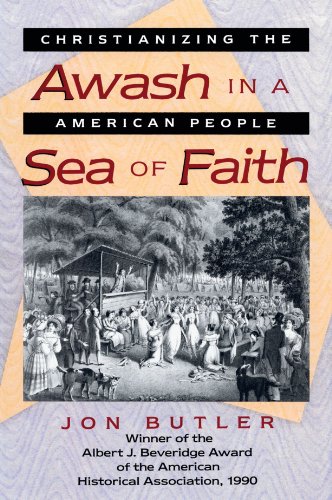
AwashInASeaOfFaithIs America a Christian nation? The answer to that question will no doubt raise ire in some part of the room. People, speaking mostly without data, will assert yes or no, generally based on opinion and sensibility. It is refreshing, then, to read what an historian uncovers by asking the right questions. Jon Butler’s Awash in a Sea of Faith: Christianizing the American People is a book that asks the right questions. On the surface, yes, colonial America was settled by disgruntled Christians from various religious conflicts in Europe. Actions, however, are notoriously louder than words. Butler examines church attendance patterns and affiliations among these early (and later) settlers and finds that they weren’t nearly so Christian as one might think, listening to the rhetoric. Indeed, for people struggling to survive in a new land, religion might well have been the last thing on their minds most of the time. Throughout the book surprising changes of perspective appear. When clear thinking is railroaded by political agendas the issues often become clouded.

A good example of this is Butler’s exploration of the survival of magic and occult traditions. It is not unusual to hear, anecdotally, that the Enlightenment did away with superstitious thinking. In fact, the data point elsewhere. Not only did Americans bring magic and occult practices with them from overseas, they actually continued to develop them in the New World. At times these beliefs substituted for congregational religion. At others, they subsisted alongside it. There was a “sea of faith” here, but it wasn’t always very orthodox. It wasn’t until fairly late in the history of the country that church attendance could be considered the norm. At the same time, many read back into history that “we’ve always been like this.” Not so.

The “myth of the American Christian past” was born out of wishful, and one suspects, political thinking. The country’s founding by Deists led to a fear of Deism—a fairly new phenomenon that descended from that self-same Enlightenment. Still, America could give birth to Spiritualism and a host of new religions. Perhaps it would be more accurate to think of the United States as fertile soil for religions rather than a Christian country. Certainly, by the numbers, Christians have been in the majority since statistics were kept, but, if the anachronism may be pardoned, the “nones” are not a new phenomenon. They were previously just those to be converted. Through much of history, we’ve been a people who didn’t think too much or too deeply about religion. Only when the issue really became politicized did the past become distorted. We have Dr. Butler to thank for providing a clear view into what history actually reveals.


Viking Trail

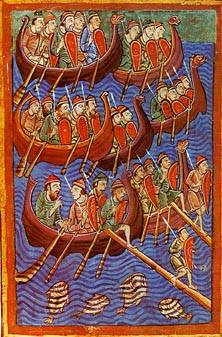
History is a powerful elixir, capable of transforming sinners to saints with the mere passage of time. Well, calling Vikings saints may be a bit of a stretch, but still, they have become some of the sexy bad boys of the Middle Ages, and with the finding of a Viking horde in Scotland last month, they are in the news once again. Vikings and monks were kind of like medieval dogs and cats. Monasteries, located in lonely regions, often amassed wealth and Vikings, looking for loot and less scrupulous about bloodshed, were eager to take it. The give and take (literally) of this violent lifestyle involving seafaring, battles, and churches, makes for good ancient drama and much of it took place along the coasts of Scotland. Our Scandinavian scourge, however, didn’t stop there. It is well established that the Vikings made it to North America well before Columbus. Those who don’t dismiss the Kensington Rune Stone also claim that the Vikings reached Minnesota long before football ever did. Whatever the reason, we are fascinated with Vikings.

Wikinger

Perhaps they are the ultimate autonomous self-promoters. We all would secretly, at least, enjoy being able to set our own standards so that they favored us and our loved ones. The Vikings represent the flaunting of the rule of law, traveling far to take what they want by force. And, perchance, leaving a bit of treasure behind as well. The Vikings became Christianized and the slave trade (long before the New World caught hold of the idea) was effaced to the point of becoming uneconomical to them. Nobody is certain why, but the Vikings, probably for a variety of causes, ceased to be the terror of the seas. Now the Scandinavians are considered among some of the most literate peoples of the world.

Along with the decline of the Vikings, however, also came the fading of the monastic cultural hegemony. To be sure, there are monks and nuns still today, but the force with which they gripped the medieval imagination began to decline with the Protestant Reformation and the recognition that vast wealth, even if cloaked in poverty, is still vast wealth. Now the finds from both monasteries and Viking sites constitute historical treasure. Information about a world long gone. The underlying idea, however, is never very far from the surface. We may lay claim to post-colonialism, but powerful economies have a way of getting what they want in the way of trade treaties and tariffs in any case. When a Scot finds a Viking these days, it is a cause for celebration as we let bygones be bygones and cut the humanities curricula nevertheless. The Vikings never really disappeared.


Centuries and Millennia

This past week I had a look at Christian Century. It has been about a century since I’ve read it, so I noticed quite a few changes in that time. Magazines in general, I’ve noticed, have been on a weight-reduction program. They are thinner and more direct than they used to be. Also, the last time I looked at Christian Century, perhaps in my college days, it was still assumed that Christianity was the dominant paradigm for American society. Church attendance wasn’t stellar, but it seemed pretty solid. In my town, in any case, pretty much everything was closed on Sundays. There was a sense of status quo ante, perhaps it was just that social changes of the sixties and seventies were taking a while to settle into the cracks. My college town was pretty far from the forefront of theological, or even social developments, and enough other places must have still been as well. There was no denying that you had great odds of finding Christians, self-professing, in places outside the halls of government.

Christian_Century_Dec_2010

It was almost sad that Christian Century felt so diminished. Inside I was surprised to see so many ads and reviews concerning themselves with secularism and/or atheism. Attempts to understand, or convert, were the foci of seminars and books. Get things back to the way they used to be. A century ago. One gets the sense that subscriptions might have slipped a bit. The consensus is breaking up. Too much information—too many choices. People aren’t sure what they will choose after all. The Christian Century seems to have been the nineteenth or twentieth. We are sadder but wiser.

It could be that I’m misreading this whole thing. After all, a couple of the articles were written by big name scholars teaching at big name institutions. One of them, however, is admittedly not a Christian. Those who are are, it seems, trying to learn about this sea change that happened around them while they perhaps supposed everything was progressing as normal. Growing up where I did, I know that I was unaware that people could not, in great masses, not go to church. That other religions were not but minor blips in an otherwise uniformly Christian country. Considering the posturing of many televangelists, I’m not the only one who thought so. It may be that another Christian century is to come. Or even a millennium. Until that happens, however, the institutions that look backward instead of toward a future approaching very fast will feel, I suspect, that a century quickly slipped by and left them wondering in its wake.


Water Flowing Underground

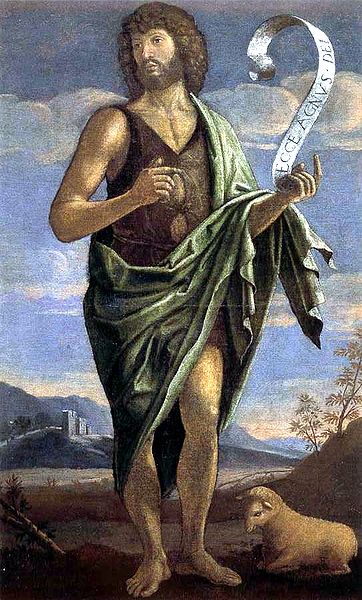
One of the most compelling characters of the Bible is John the Baptist. Unconventional and non-conformist, he speaks with unquestioned authority based on pure conviction. Baptism comes in many forms. When we moved our daughter into her dorm room, we found water from the HVAC vent dripping on her bed. I’ve been similarly baptized on NJ Transit buses in the summer when the condensation gathers just above my head. (Of course, being on the bus, I’m always hoping that it’s only water.) Considering how well HVAC contractors seem to be paid, it is always a wonder to me that little things like leaks can’t be sought and settled. Water always seeks the lowest point. In baptism a person is plunged even lower, beneath the water. It’s kind of like drowning.

John the Baptist with the number of the HVAC guy

John the Baptist with the number of the HVAC guy

I was baptized in a river (or a creek that passed for a river in my part of Pennsylvania). Our church didn’t believe in infant baptism, so I was old enough to know that I was to be held under the surface for a second or two—a frightening prospect for a non-swimmer like me. It turned out alright, as these things generally do, and my ten-year-old sins were washed away to be somebody else’s problem further down stream.

The origins of baptism are somewhat of a mystery. Many religions include purification rituals, including Judaism. Judaism, however, never seems to have taken ritual washing to the level demanded of John the Baptist. Even he had a rather tepid view compared to that of later Christians who made salvation without it impossible. It is perhaps the implicit admission of shame, or possibly the public spectacle of it all that makes it such a rite. Being rained on in the presence of a priest doesn’t count. Nor does, in some traditions, a mere trickle on the head. The victim must be cut off from the air above. Religion does insist on a fair bit of threat for believers as well as non. And so the water drips. Of course it’s a holiday weekend so they can’t get the maintenance guy to fix it until at least Tuesday. As we wait we know that the water will always continue to seek the lowest point.


Men Without Hats

Do you want to start an argument? Mention hijab in a Christian environment. Some tempers will likely flair. The idea that a patriarchal religion would tell women to cover themselves suggests something sinister, doesn’t it? The other day I came across headcoveringmovement.com. There are, as I have come to know, many Christian groups that consider Paul’s directive for women’s headwear as, well, gospel. Commentators still spar about why Paul insisted that women cover their heads in worship. Adding “for the sake of angels” only evokes more convoluted imaginations. As any stroll through Manhattan will reveal, many Jewish men also observe head covering. What is it with bare heads, gods, and angels?

No doubt, in cultures where men are expected to restrain themselves less than women, hair can sometimes be seen as sexually provocative. (I’m not excusing, just observing.) Most men will eventually experience nature’s tonsure in some form or another, and perhaps this knowledge makes feminine hair more alluring. None of this, however, answers the question. What is so hubristic about uncovered heads? I’m not authorized to speak about fashion, but I feel confident in asserting that in many periods of human history, hats were the norm. Look at old portraits. What did Martin Luther or John Calvin look like without their ubiquitous hats? Did they serve to cover bad theological hair days? Or was it just the climate? Distinctive hats have been used to identify social classes and professions. We still use the expression “putting on my [chose a noun] hat.” So what’s all this with head covering for women?

“The wearing of fabric head coverings in worship was universally the practice of Christian women until the twentieth century. What happened? Did we suddenly find some biblical truth to which the saints for thousands of years were blind? Or were our biblical views of women gradually eroded by the modern feminist movement that has infiltrated the Church…? – R.C. Sproul.” So states Headcovering Movement’s homepage at the date of this writing. There can be little doubt about what’s behind this scheme. I recall a phase when my mother wore headscarves to church. Many years later, even in high church Episcopalian settings I’ve seen women walk in with what looked like lace doilies on their heads. Is there an agenda here? I can’t speak for Muslims, but it seems that Sproul believes the rightful place for a woman is beneath a man. Theology in the service of chauvinism. Just try to read 1 Corinthians 11 and come out without a headache. The saint’s logic here is so confused that I want to pull my hat over my eyes. Or I would, if I wore a hat.

Photo credit: Themightyquill, Wikimedia Commons

Photo credit: Themightyquill, Wikimedia Commons