To the Swift

Despite its generally secular reputation, one of the great charms of New England is its churches. I was forcefully reminded of this during my recent trip to Boston. Each city along the way boasts impressive churches that might be glimpsed even from the highway, and although there are now many taller buildings it is possible to imagine the days when the steeples stood over all. Boston’s historic churches remain stunning symbols of the power Christianity once held in this city. We first climbed off the T at Arlington in the shadow of the great stone Arlington Church. On the Esplanade the looming steeple of the Church of the Advent violently reminded me of the deep mysticism that drew me to the Episcopal Church even while I was a Methodist seminary student. Park Street Church, King’s Chapel, The Old North Church, the Old South Church, and finally Trinity Church in Copley Square invited us to gander and ponder. Almost like fossils, these churches remind us of the history of what made the city, or the nation, what it is.

Trinity Church lies nestled at the base of the John Hancock Tower, Boston’s tallest building. A blue glass Brobdingnagian, this prophet of capitalism represents the highest possible aspirations of our race, so we are led to believe. The material triumph over the spiritual. And yet the tourists stop to photograph the stunning church. It is on the street level, down here among us mere mortals. Upon closer examination, I noticed the statue of the tortoise and the hare in the plaza of Copley Square, the holy terrapin racing toward the sanctuary, it appears from my angle. It seems that I have unexpectedly received a kind of epiphany.

Look closely.

Look closely.

I first came to Boston many years ago as a spiritual seeker. In the intervening years during which I was attempting to find out what that might mean in a life that was intellectually honest, many bronze sculptures appeared in this city. The one commemorating Robert McCloskey’s Make Way for Ducklings, installed after I completed my studies at Boston University, would not have caught my pre-parental attention, as I had never read the book. Now you have to stand in line even to snap a picture. The work of local artist Nancy Schön, both “Make Way for Duckings” and “The Tortoise and the Hare” are part of Boston’s continual evolution of character. Officially, we are told, the turtle and rabbit are representative of the Boston marathoners who trudge the final feet past this church toward the finish line. To me, this sculpture suggests something more as the hare dawdles and the tortoise breaks toward the church. It may be a marathon, indeed, but the race, I remind myself, is not always about being swift.

Elmer Gantry

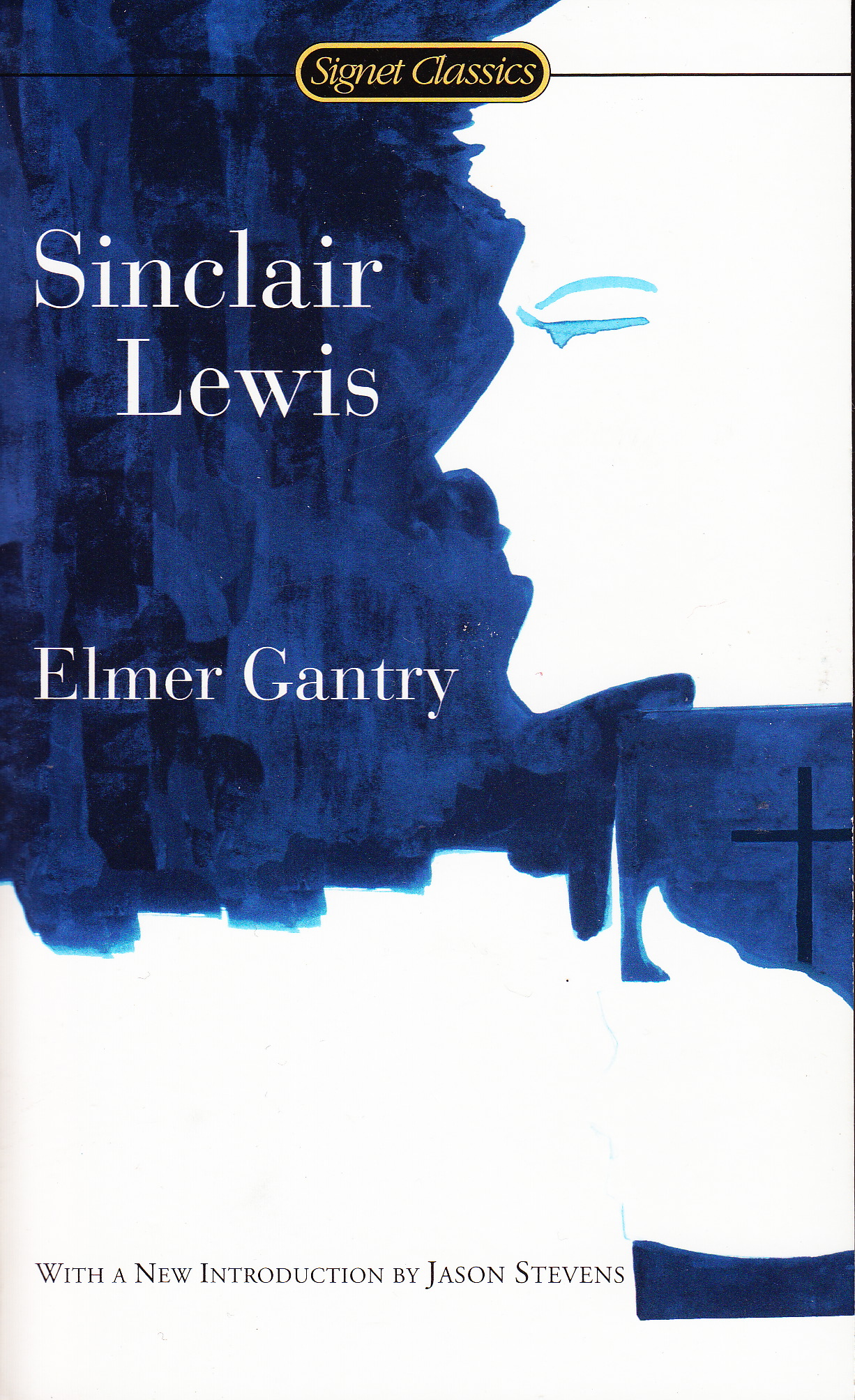
ElmerGantryIn recent years a renewed interest has arisen concerning how powerful entities are perceived by others. Academics are asking how the United States is seen by other nations. Corporations are trying to improve their public images because, well, let’s face it, it effects the bottom line. The same thing applies, but with a difficult kind of finessing, to churches. Part of the difficulty is that churches declare that they have the truth. Backing down from this in the face of public opinion more or less scuttles any claims being made. Thus I’d been curious about Elmer Gantry for some time. Sinclair Lewis’s novel of the self-absorbed, arrogant clergyman who believes in no god other than his own desires, is considered a modern classic. Written during the height of the follies of the Scopes Monkey Trial and Prohibition, as the Fundamentalist movement was just getting started, Lewis used dark satire to try to put the self-righteous in their place. I’d known the name Elmer Gantry from many other media references, so I figured it was time to see who he was.

Going into the novel I had few preconceived notions. Gantry, I knew, would be a hypocrite from the start, but beyond that, cultural references don’t give many hints. Although Lewis’s well-known wit shines through from time to time, on a whole the novel is a distressing read. I suppose it’s the mark of a great writer that you can despise a character so, but really, Elmer is led on his path, indeed, encouraged, by those who know him and whose only zeal is conversion for conversion’s sake. A womanizing, athletic, hard-drinking student, Gantry is where many young men want to be. The campus ministries, however, keep after him until he realizes what all clergy know at some level—there is power in being able to manipulate people by religion. As portrayed by Lewis, Gantry does try, once or twice, really to believe. His cynical and selfish nature, however, are too difficult for him to overcome and he therefore employs them in all his relationships as he climbs the corporate, ecclesiastical ladder.

There is really no triumphalism here, with the society discovering and ousting the charlatan. Indeed, as the book ends, the Reverend Doctor Elmer Gantry dodges a serious threat to his career only to be appointed to one of the most influential churches in New York, poised to go on to even greater things. Trying to find the blame in the novel, however, is not a simple task. Gantry is all too easily led. He follows his base desires deftly and confidently. He knows a mark when he sees one. Throughout his ministerial life, however, he is encouraged and prodded onward to success. Most ministers, in my experience, are burdened with conscience. I’m sure a few slip through with their own agendas, but the working clergy are nothing like the protagonist to this tale. Lewis focuses on the worst offenders. Those who are in it for the power, should they read Elmer Gantry, would find a model who is, like many in the era of early psychology and sociology, too easily excused because of circumstance. More than that, however, they might learn how they look to a larger society for which the church has become a mere historical curiosity. Elmer Gantry is by no means the worst type of figure we can imagine in a secular society.


St. Ghost

HauntedSouthernTierSince they combine two of my soft spots—local history and ghost stories—books telling the tales of home-town specters are compelling in a homespun way. On a visit to Binghamton, New York, I picked up Haunted Southern Tier by Elizabeth Tucker at the local bookstore (I have a hard time passing up an independent bookstore anywhere). Those of us at least a little familiar with upstate New York know that the southern tier is not strictly defined, but it is a recognizable section of the Empire State that runs just north of the Keystone. I was drawn to the book by Elizabeth Tucker’s name; she is the author of Haunted Halls, a book I reviewed earlier on this blog, about college campus ghosts. These local travel guides tend to focus on the weird and whimsical, and aren’t meant to be taken too seriously. Nevertheless, the connection between ghosts and religion is tangible in just about any part of the world, no matter what one believes.

This fun read brings a number of explicit religious points to the surface. One involves the strange phenomenon of haunted churches. Given that many varieties of Christianity offer Heaven as a reward immediately following death, having a ghost hanging around a church seems strangely disingenuous. Perhaps that’s why few churches admit to such things. Another interesting tie-in to religion comes in Tucker’s section on roadside ghosts. Stories of spectral hitchhikers are quite ancient, but I had never considered them biblical. Tucker mentions one such instance in the Book of Acts, and upon reflection I realized that she may be onto something. The account of Philip converting the Ethiopian eunuch is one of the odder tales of the early Christian movement. Philip explains Isaiah’s prophecies to the chariot-riding dignitary who gives him a lift, and baptizes the visiting Ethiopian before mysteriously disappearing. Could this be the prototype for the vanishing hitchhiker folklore theme?

Perhaps the most serious of the religious connections in the book, however, has to do with St. Bonaventure University. For those familiar with Thomas Merton’s life story, St. Bonaventure will not be unexpected. Merton taught at the school as he was struggling with his identity that led him to become one of the most renowned Trappist monks in the world—one who spoke approvingly of Buddhism, to boot. Merton is not said to haunt the university, but his presence there at one time has endowed this Catholic school with a sense of spiritual gravitas. The ghosts come from elsewhere.

Books on ghosts are a guilty pleasure with a serious undertone. End of life issues, once we move beyond the medical, are the unquestioned provenance of religion. Whether or not there are any ghosts out there, religion will claim the final word on afterlife. And only those who experience it will ever really know.


Two Roads Divergent

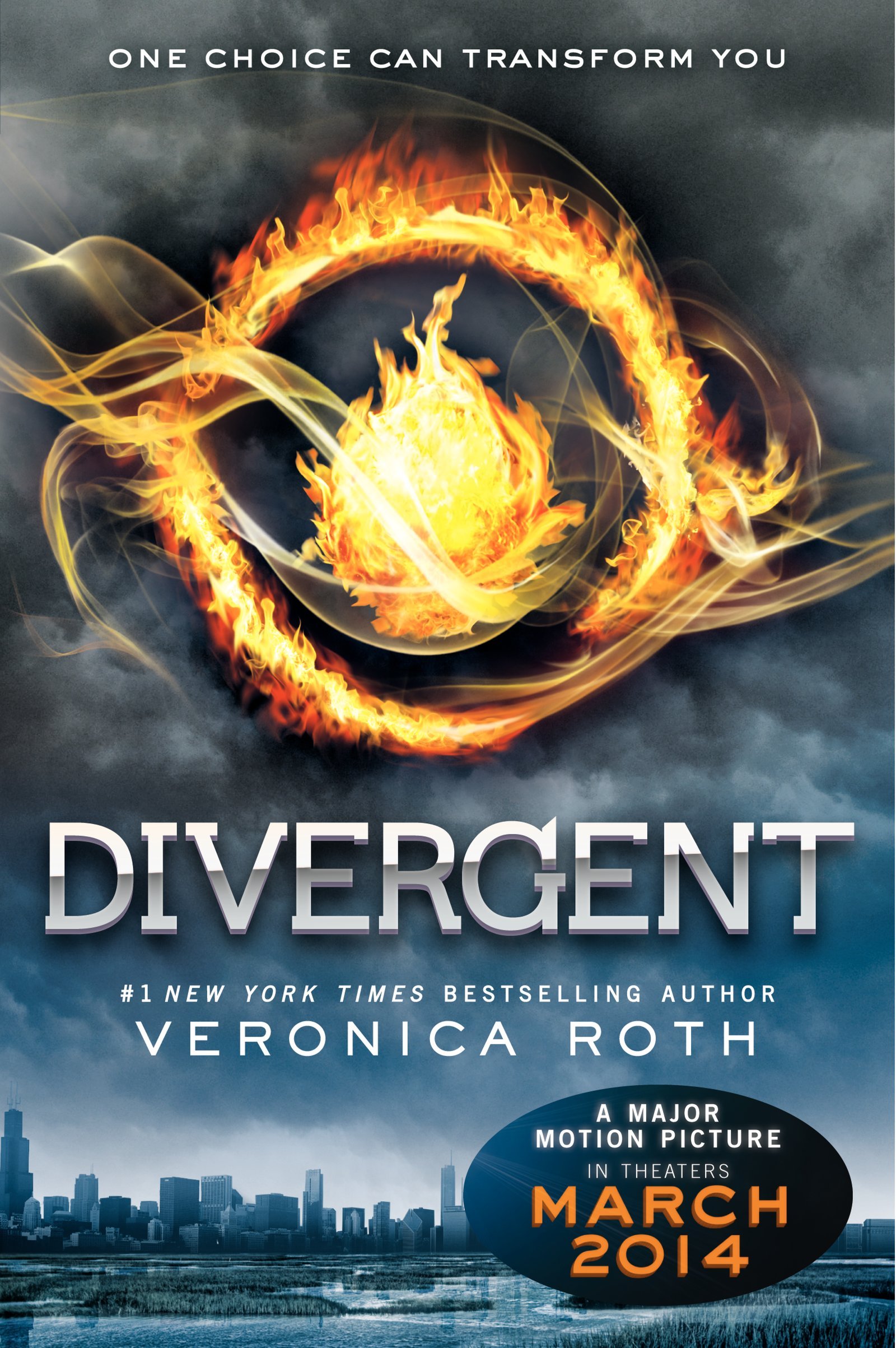
DivergentOne of the most hopeful signs for culture is the quality of young adult fiction on the market. Since I’m now in the book industry, Publisher’s Weekly is required reading. I always take a look over the fiction lists as well as the non, and over the past several months a couple of “teen fiction” books have been near the top for regular bestseller lists as well as for demographic-specific ones. (That is, adults seem to be reading them too.) One of those books is Divergent by Veronica Roth. While movie tie-ins certainly don’t hurt, as many of us opine, it is difficult to do justice to a complex story on screen. Divergent is one of those books that stays with you after you’ve closed the cover, and that suggests to me that something deeply meaningful is going on. What about dystopias is so compelling?

I’m not indulging in any spoilers to say that Divergent is a dystopia. Set at an indeterminate time in the future, civilization still exists—at least in Chicago—as society has fallen into five factions: Dauntless, Erudite, Candor, Amity, and Abnegation. Each group has its own beliefs as to why civilization collapsed, based on philosophical dispositions. Abnegation, the self-deniers, are the leaders of government. And clearly, the idea of Abnegation is a form of quasi-monastic Christianity. In fact, among the factions, Abnegation is the only one that seems to mention God. The other groups, stressing bravery, intellect, honesty, and peacefulness, don’t really have much need for the divine. To deny oneself, however, requires a powerful motivation. Even the protagonist’s name, Beatrice, is taken from its favored status among early Christians. I know little of Veronica Roth, but I have to wonder whether Dante is in the background here.

In the acknowledgements to the novel, Roth first gives thanks to God. As a high school convert to Bible-based Christianity, I suppose that’s only natural for a writer who is, at the moment, only twenty-five. Writers for young adults often have their religion close to the skin. Stephanie Meyer’s Mormonism translates into moral vampires. Orson Scott Card provides Ender Wiggin with values from the same faith tradition. People are, despite the logical implications, inherently religious. That doesn’t prevent Divergent from being a page-turner. Full of action and personal development, the first book of Roth’s trilogy bristles with self-sacrifice and belief in something better to come. Even if it’s a world we have to make ourselves. And like most human enterprises, it comes out as a well-meaning dystopia that underscores the value of reading for us all.


Singing the Truth

Attending a local high school choral concert recently, I arrived late. That’s fairly common since the bus from New York is often quite tardy—arriving forty minutes after the scheduled time is pretty standard. In any case, I joined the concert already in progress. One of the first pieces I heard was “Operator,” a number based on an old Manhattan Transfer song. Since my wife grew up liking the group, I recognized the song and yet it felt strange to have Jesus mentioned repeatedly in a public school setting. Music, by its very nature, however, often contains religious sentiments. The Doobie Brothers had, in the early 1970s—the height of a hedonistic age—done very well with a cover of “Jesus is Just Alright.” Jesus, after all, had been declared a superstar a couple of years before. I used to tell my students that the musical impulse is linked with the appearance of religion in very early human culture. Still, disestablishment reigns.

I know that a large Jewish population makes up a significant demographic at the school, and I often think about how the cultural supersessionism of Christianity must feel. Much of what became Christianity has deep roots in Judaism, and even Jesus was Jewish. Can a song be just a song? After a while Randall Thompson’s “The Last Words of David” was performed. No offense there, since the Hebrew Bible is recognized by both Jews and Christians. But what of those of other faiths? Don’t get me wrong—our high school has an excellent music program. I was just wondering how the music might be perceived in a multicultural world. We have Muslim and Hindu students, as well as secular. Is this just counted as mythology to them? The selection of music teachers would be far more restricted if all music associated with religious words or themes were jettisoned.

Affaire_de_Bizoton_1864

These were the kinds of thoughts milling about my head when the last song from a religious tradition came up: “Wangol.” This is a Vodou song. I was pleased and amazed that the “last word” went to an underrepresented religious group. True enough, Vodou grew out of Christianity’s interaction with traditional African religions, but it demonstrates just how eclectic both American religious culture and high school music concerts can be. Choosing the music for a secular choral concert in a multicultural setting must be a trying experience every single time. When we lived in Wisconsin, most concerts were unabashedly Christian in orientation. This is hardly surprising, I suppose, since choral music itself is often composed to express religious sentiments. New Jersey is a different world. I left the auditorium musing that Vodou is just alright with me, and just as plausible as calling Jesus on the telephone.


The Price of Flags

As a child, Memorial Day signaled the start of summer. Most of the time it announced that the obligations of school were nearly over and that was sufficient cause to celebrate. It was not until well into adulthood that I realized the holiday commemorated those who’d died in the armed services. I’d noticed the flags in cemeteries, of course, and we often visited the graves of civilian ancestors buried close enough to reach. The message did not penetrate my head, however, that all of those little flags should be telling me something. I grew up not knowing my father, but I did know he was a veteran. When all his children gathered for a (mostly) impromptu picnic yesterday, for the first time in well over thirty years, I realized how much of a mystery he was to me. At his funeral the flag on his coffin was presented to my older brother as part of military tradition, although he had died in peacetime, and pretty much isolated from all his progeny. It is a somber thought even now, although it was eleven years ago.

I have been a pacifist since my youngest days. Sure, I played with toy guns and G. I. Joe, but that was the culture of kids growing up during the Vietnam War. Only vaguely did we realize the actual horrors that were happening daily thousands of miles away. In my mind there was no reason to go to war. In Sunday School we were taught to settle our differences nicely, even if it meant that you had to be cheated or take less for yourself. This always seemed the central tenet of Christianity to me, and I wondered why the most conservative of Christian presidents seemed the most hawkish, the most ready to sacrifice the fathers, sons, brothers, and now mothers, sisters, and daughters of others for so little. The number of flags even in that little country graveyard where my grandparents were buried haunt me.

We still have members of the armed forces over seas. The military budget of one of the most prosperous nations on the planet is astronomical. We can now kill with drones so that we don’t even have to see the carnage we create. When did the lives of young adults become small change? I know it’s idealistic of me, and probably terribly naive, but I still can’t make sense of our cultural perception of how cheap human life can be. Maybe I’m just a little overly sentimental about a father I never really knew. But looking over my siblings, I see that he produced some nice, generous, and peace-loving children over half a century ago. And while we have our picnics and enjoy a rare day off of work or school, thousands of silent flags will be flapping in cemeteries all across this country reminding us that better ways exist to resolve our differences. If only we could take a holiday from war and violence we might see fewer flags and even more holidays.

Photo credit: Remember.

Photo credit: Remember.


Nothing to Do with Pigs

Pseudepigrapha is not a word that flows mellifluously off the tongue, and the first time reader stops to give pause over its awkward beginning and several syllables. It comes from a couple of words meaning “false” and “letters” and it designates a book, usually ancient, falsely attributed to somebody important. Since most people in our post-modern world don’t even read the regular Bible (many Fundamentalists among them), throwing a false gospel out there and telling everyone what it says is a fairly safe bet for getting some attention. A friend sent me a link to a web story about the “Gospel of Barnabas” based on an allegedly clandestine Turkish manuscript, that has been circulating for a few years now. Let’s face it: how is a non-specialist supposed to find a copy of the Gospel of Barnabas, and how is the public going to know how to weigh one ancient document against another? After all, we as a society have determined that biblical scholars are more than useless, and they should be employed doing odd jobs just above minimum wage, the unbelievers!

Dante making Scripture

Dante making Scripture

The story on the promisingly named Liberaland website makes a Bill Maher of mistakes regarding the ancient document, however. Citing only vague “religious experts and specialists located in Tehram,” (after all, we all know that there are no religious specialists in North America or Europe) the article claims with an unattributed quote, that this 23-million-dollar gospel has been squirreled away for safe keeping because of its scandalous claims about early Christianity. Any biblical scholar knows, however, that truly original scandalous claims are difficult to come by. The Gospel of Barnabas has been known since the seventeenth century and it is likely a document with Muslim sympathies. It doesn’t help that actual ancient documents are sometimes held in secret (I know of one being kept in a Turkish monastery that is being held, literally, for ransom to help finance the place), and the general public is ill-equipped to know who’s telling tales outside of school.

There’s no point in denying that religions have made a plethora of mistakes and missteps over the centuries. New religions are emerging all the time and new mistakes and missteps will be made. Given that people are, according to the best evidence, programmed to believe, it would seem to this insignificant former scholar that keeping a few religion specialists on the payroll might not be such a bad idea. Of course, I am an interested party, and that makes me suspect from the beginning. I spent my early adulthood years learning to read a dozen dead languages and that has landed me in an obscure job that barely covers the rent. One thing it did prevent, however, is being taken in by claims of mysterious gospels that seem to surface several times a year. There will be those who dispute what I write, but then any document these days is liable to be called pseudepigrapha.


Not Child’s Play

Games reveal quite a bit about a culture. That’s a little takeaway from my undergraduate anthropology class. Different societies favor different types of games: chance, strategy, zero-sum, role-playing, the list could go on and on. Indeed, games have surpassed movies as the big money makers of the tech entertainment industry. We love to play.

Religions sometimes try to capitalize on popular culture. The difference is that religions are taken with a lethal seriousness that most games leave behind. Sure, you may end up shooting a few hundred people, but when you walk away from the flat screen you probably know that the game is over. Religions, of course, realize that they aren’t fun. Despite the constant criticism that religions get for being simplistic and superstitious, anyone who has tried to be a serious adherent knows that it isn’t as easy as it looks. Being religious is very hard work. So, why not turn to games to convey hard truths? The other day I found an old, still-in-the-box, shrink-wrapped game called Divinity. It is designed to teach the catechism of the Catholic Church. A Monopoly-like track edges a stained-glass center board, and, I suspect, you get considerably more than $200 for passing Go.

IMG_1307

Using games to sugar-coat bad tasting doctrine is nothing new. One might argue that the Sunday School tradition long ago capitalized on the idea of making avoiding perdition fun. In some cases it does seem to have worked; some kids grow up terrified and spend their lives trying hard to win the game. In fact, it can set some lives on a trajectory far too high to achieve, but far too important not to try. We can’t all be priests, after all. Should we all be clergy, then many interested parties would be out of a job.

IMG_1308

Once upon a time, the state religion could demand a sizable chunk of municipal funding. Taxes went to support the expensive luxury of clergy dedicated to pleasing the gods, Then the rules changed. With religious freedom there comes a great outpouring of creativity to ensure that the coffers never run dry. Christian comic books, Christian rock, Christian movies, Christian board games. We have come to an age of faith branding. It’s no surprise, really, for it is, according to the rules, a zero-sum game.


The Plague

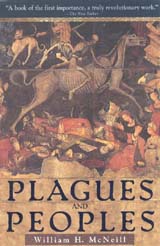
Plagues&Peoples Sitting on the bus next to some guy with a consumptive cough may not be the best place to read Plagues and Peoples. But William H. McNeill’s book is considered a kind of modern classic, and since the Middle Ages have been on my mind, I persisted anyway. I did wrap my scarf around my face, though. Plagues and Peoples isn’t just the story of the Black Death, however. It is a sweeping account of pandemic and endemic outbreaks and how they form recognizable patterns with human populations. Perhaps the most striking aspect of McNeill’s study is how determinative plagues have been for many decisive aspects of human history, including religious ones. Indeed, religion keeps cropping up in the book. One reason is because of the roles religions play in human suffering—to be more precise, I should say in trying to alleviate human suffering. (Yes, some religions definitely cause it as well, but that’s a story for another time.) McNeill even suggests that fear of disease might have led to the parting of the ways between Swiss and German Reformers, playing a role in the divergence of what would become the Presbyterian and Lutheran flavors of Protestantism. The spread of some religions was facilitated by the ravages of disease.

During the period of the spread of the Plague, however, McNeill notes that those cultures attended by Christian and Buddhist institutions managed to fare better than irreligious, or, perhaps more accurately, folk-religion ones. Once people figured out Plague was contagious, they sensibly kept away from the sick, but the moral teachings of Christianity and Buddhism compelled the religious to tend to the ill, with the result that more people in those religious traditions survived. That’s not a universal declaration on McNeill’s part, but it is a fact worth bearing in mind. The risk to self paid off when more individuals cared for each other rather than just heading for the hills when the Black Death came along. On the other hand, religions frequently insist on behavior that spreads disease as well. The great pilgrimages to Mecca or the Ganges often brought great crowds together where disease could quickly spread. The passing of the peace in some churches is more like the passing of the plague.

In ancient, pagan times, disease had its own deities. In ancient Ugarit, Resheph, the archer, was also the god of pestilence. Pestilence frequently accompanied the horrors of warfare, and even Apollo opens the Trojan War by firing his arrows at the Greek troops. Gods are the source of disease. One of the ancient truisms, which may not be taken as true today, is that the force that wounds is also the force that heals. Instead of ignoring Resheph, you pray to him, make offerings to him. He can slay, but he can also heal. In the monotheistic and even non-theistic traditions McNeill mentions, the focus shifted to the care of those suffering rather than the offering of sacrifice to unhearing gods. Even the Romans were impressed by Christian care for one another. Of course, that was well before Obamacare offered the hope of medical treatment for those cut off from lucrative employment. The Christian response now, it seems, is to complain about others taking advantage of my surplus cash made over to a program to prevent illness in one’s fellow citizens. Take the bus to work, you’ll see what I mean.


Apocalypse Then

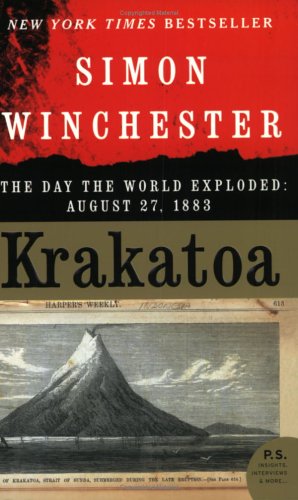
Krakatoa Sometimes everything blows up in your face. Literally. Simon Winchester’s Krakatoa has been on my reading list for years. Boys seem to have a fascination with volcanoes that they never outgrow, and given the world-wide implications of Krakatoa’s 1883 eruption, it is a tragedy that keeps me ever curious. We live on an angry planet. I know that’s projecting agency on nature, but like thunderstorms, to a human sensibility, volcanoes are raging phenomena. As Winchester points out, many indigenous cultures in the “ring of fire” consider volcanoes either gods or messages from the divine world. Honestly, I didn’t read Krakatoa to find out about religion, but it was there nevertheless. For human beings, it has an unparalleled explanatory power.

Krakatoa caused a stint of global cooling after its nineteenth-century eruption, leading to failed crops throughout much of the world, and perhaps played into larger political issues that would stress a world already attempting to cope with fast changes in technology. The story of the volcano is fascinating enough, but the religious dimension, it seems, played itself out more than just in a Gilligan’s Island sort of way. Despite what analysts say, people take their religious beliefs very seriously. So when I reached the end of the eruption, I wondered how Winchester was going to spin this book out for another fifty pages. It turns out that among the effects of the volcano was a religious rebellion. The East Indies, as they were called, were under Dutch colonial rule. This led to a bit of tension with the native Muslims (Islam has long been a major religion in Indonesia). As Winchester points out, the Islam in the region before the eruption was a syncretistic, almost laissez faire, faith. It blended with Hinduism and local beliefs, and even tolerated the Christian Dutch.

Symbolically, or literally, after the explosion that killed thousands, a religious movement that had been waiting for a sign came to life. A more strict Muslim sect saw the events as a predicted display of divine anger. A short-lived rebellion broke out, cut off by Christian repeating rifles, that led to a more strict version of Islam in the region. Although Winchester doesn’t linger on this too long—he is writing about a natural disaster after all—it does raise many very human responses. In the event of a cataclysm, science is cold comfort. We may rationalize, but human beings also feel. And it is religion that will attempt to answer for that pit in your stomach or that worry in your head. That’s what it does best. Science tells us that we can’t really stop volcanoes—we are too small and the planet too overwhelming. Religion, on the other hand, offers a grip on the very forces behind cataclysm—imagined or not. Although seeing natural disasters as divine punishment is never reasonable it is, in the words of a famous philosopher, human, all too human.


The Trouble with Trajectories

The Bible has a way of defining lives.  I realized this at a young age, and although my experience was limited to what life reveals in a small town. Still it was evident that people even there traced trajectories defined by Holy Writ.  I used to ask my students that if something effected you every day, in ways both massive and subtle, and was potentially dangerous, wouldn’t you want to know about it?  Religion in general, and the Bible in particular, fit this description.  As the road began to fork at the usual junctures of my life (high school, college, whatever comes after college), the Bible played a role.  For some reason the Hebrew Bible captured my attention more than the Christian scriptures—perhaps it was because there was more narrative in the “older testament,” and more puzzles to be solved.  While the New Testament seemed to be definitive for matters of doctrinal importance, the Hebrew Bible retained a sense of mystery and intrigue.  Many of its characters, although ending up as “good guys” have decidedly questionable episodes in their pasts.  What’s not to like?

DSCN4387

Ironically, however, I discovered a job market where someone from a Christian background was immediately suspected of a supersessionist outlook on the Hebrew Bible.  Why would a Christian have any interest in that, if not for fabricating prophecies?  Many Jewish scholars were focusing on biblical studies from “both” testaments, and my puerile interests were suddenly naive and not worthy of attention.  This dynamic has always interested me: what right does an outsider have to speak with any kind of authority about another peoples’ culture or belief?  You’d think in higher education we might be beyond such parochialism, but instead, this may be the very definition of its hotbed.  What does it take to gain scholarly credibility?  Being a “white” male in a pluralizing society certainly doesn’t help.

Books are like companions on life’s journey. My reading life started with the Bible and soon gained hundreds of other companions on that long, difficult path to a doctorate in biblical studies that defined an ill-fated career. I cannot reckon the number of books I’ve read along the way, hundreds of thousands of weary pages. And now I find myself back among the biblical crowd, from the outside looking in. They speak authoritatively, I merely whimper. Whether you see it or not, the Bible is here on the streets of Manhattan. Proclaimed or ignored, invisible or plainly manifest. And those of us who’ve spent a lifetime with it have nothing considered worthwhile to say. Once the Bible take a hold, the trajectory for life is set.


Witch Way

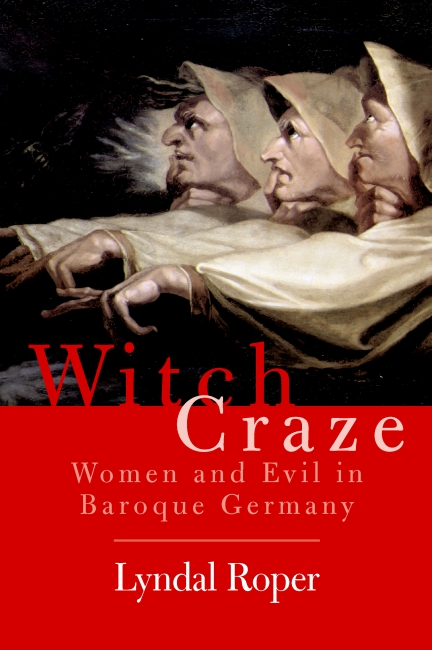
WitchCraze2Women generally bear the brunt of religious intolerance. This is an evil that has proven tenacious and insidious, and which has played out in history far too many times. Lyndal Roper’s Witch Craze: Terror and Fantasy in Baroque Germany brought this home to me once again. Books on witch hunts are deeply disturbing, but we need to engage with the brutality of the past if we want to prevent its reappearance. Roper points out that although many nations persecuted “witches” in the Middle Ages, even into the early modern period, Germany by far had the highest numbers. There were probably many reasons—no simplistic answer meets all the clues. One is clearly related to politics. Germany lacked the central cohesion of other European nations in this period. Feuding princedoms from a fragmented Holy Roman Empire had no strong central authority. When it is everyone for themselves, scapegoats are never far off. Roper doesn’t leave it at that. She points out that the central characteristic of the witch is the intent to harm Christians. Indeed, the witch is a monster born of religion, and which murdered thousands of women in the name of Christianity.

Compounding this unrealistic fear that Christians have always seem to have had, was the emerging Reformation. Distrust erupted in Germany. Was one’s neighbor a Lutheran or a Catholic? In either case, the other was heretical, from someone’s point of view. Distrust ran at premium prices. And women picked up the bill. Yes, there were male witches, most of them associated with women who’d been accused, as Roper points out. Even as the Enlightenment was burgeoning, renewed hunts for witches broke out, leaving innocent women dead in a land that valued fertility perhaps above all else. Women’s bodies, as Roper notes, were to focus of suspicion and fear on the part of a male power structure that dealt with its phobias by the use of violence. Even the Enlightenment couldn’t wipe this slate clean.

Today in the western world, secular thought has replaced superstition for many people. Women are not longer accused of witchcraft. Besides, witchcraft is a chic new religion in many places. But the longed-for equality is still not here. In many parts of the world religious violence is still directed at females by male power structures that should’ve died out with the fading of medieval Teutonic anxieties. Those who perpetrate such violence hide behind scriptures—even the Hebrew Bible acknowledges the reality of witches. Religion creates its own cadre of monsters, and those with stout conviction look for women to blame. The flames of the pyres did not lead to a universal enlightenment and the Tea Party tells us Christianity is still endangered in a world where it may spread largely unhindered. One truth, however, remains. The truly endangered are women, and men who don’t fight against the real monsters do not deserve to be called defenders of the faith.


Pope of Deliverance

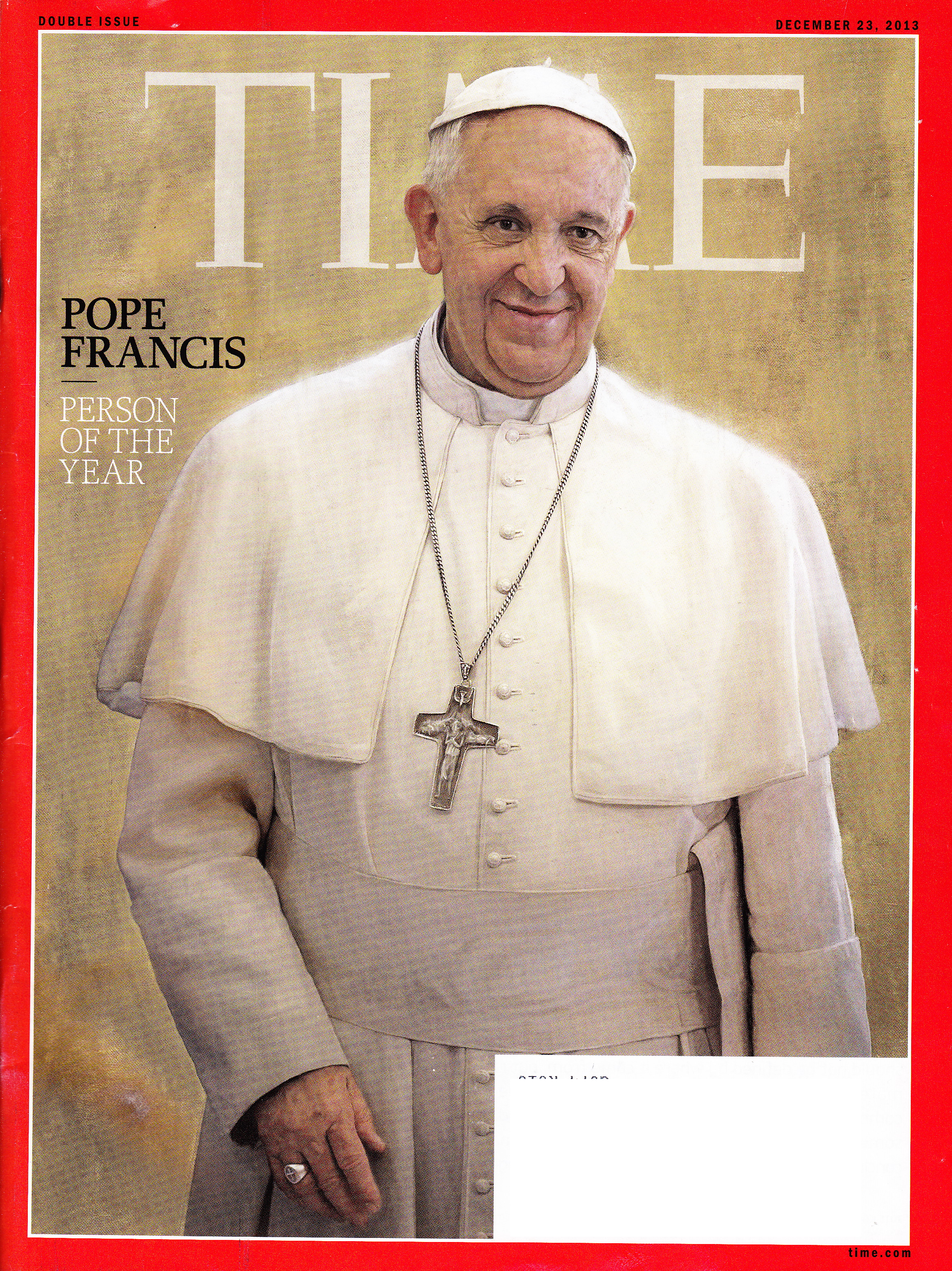
TimePopeIt’s the Time of year. The time of year Time chooses a person of the year. Not for the first time in recent memory, a religious figure has been chosen. Granted, Time declares the person of the year is the most newsworthy, not necessarily the best to emulate morally. Notorious scoundrels have made their way onto one of the nation’s top news magazine’s covers, while many more worthy will never be selected because they just don’t garner the notice. Despite this, Pope Francis is certainly the most deserving pontiff in living memory. Over this year he has demonstrated that the Catholic Church does have some historical memory of its original call and mission to the Christian faith.

Ossification is a natural tendency with institutions. We tend to think the earliest universities are still the best (in some cases that may be true), while in fact better educations are often found elsewhere. We want to believe that as it was in the beginning, is now, and do I really have to finish it? Times change, institutions evolve. Within half a millennium the Christian movement went from a bunch of persecuted, fearful peasants hiding in corners to the power brokers of a powerful empire. Problem is, once you’ve tasted empire, there’s no going back. Until now. How odd it is to see a person who could live a life of opulent self-service giving it up to be kind to his fellow humans. It is almost as if the Vicar of Christ has somehow become incarnate. A pope who is one of us. And the world stares in wonder.

I don’t mean to pick on the Catholics here. We see it in many religions. Someone humble and spiritual joins a religious movement for obvious reasons. They then grow through the ranks, acquiring a craving for power. What a temptation it must be to stand before an audience of thousands, knowing that by television hundreds of thousands more are watching you—hanging on your every word. Our underlings tell us we are great and it isn’t so hard to believe them. The man who steps down from his kingly throne to mingle with the laity, who doesn’t ride bulletproof cars to represent a man who willingly, so the story goes, gave himself up to die. What saddens me is that this is newsworthy. Not to detract from the spirit Francis has injected into a stony Vatican, but that we find it incredible is a comment on what has come to pass for religion in this time. Thanks, Time, for holding up this important mirror to our society.


Human Resources

I’m thinking about how we blithely accept cruelty and christen it “just business.” It’s legal, and even encouraged. Was a time when you wouldn’t dare trade with a stranger because he might cheat you. To make a deal implied a relationship. To get away with something unseemly you had to be able to look someone in the eye and take advantage of her or him anyway. Oh, we’ve sanitized it alright. Most workers never meet the CEO. His hand doesn’t even deign to sign the paycheck. The workers are forced to trust nevertheless. Don’t worry, it’s just business. Or is it?

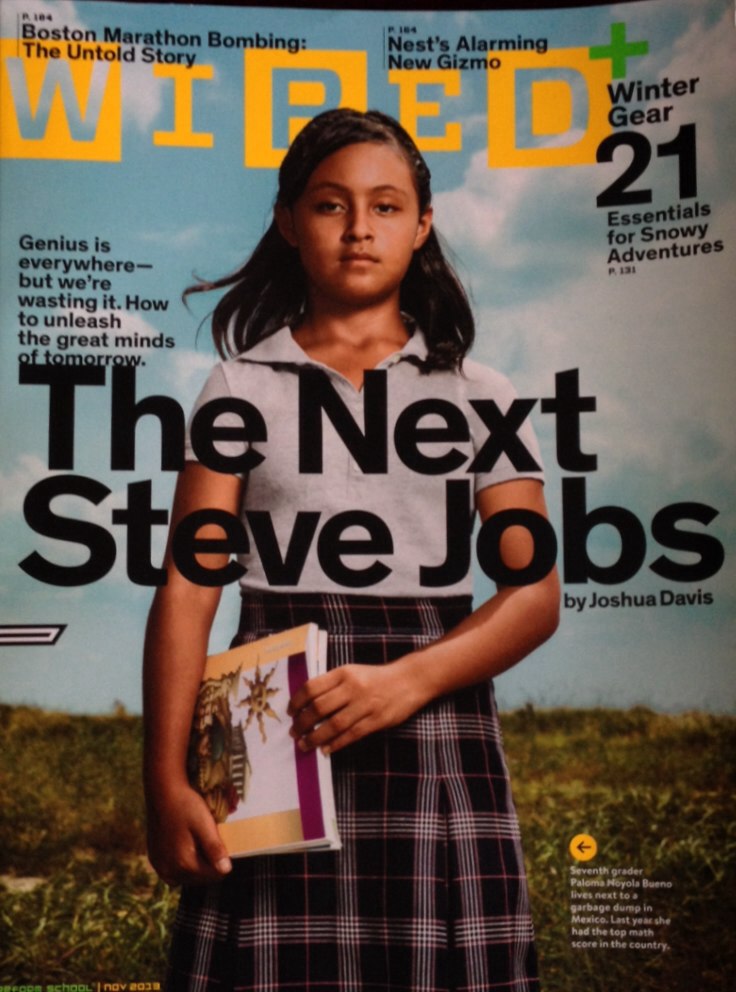
Wired GeniusThe system, of course, favors those with the loudest voices, and those voices speak the language of Mammon. We don’t dare upset the order, believing we will get ours some day. Delusion is so sweet. On the cover of Wired magazine is a little girl. The caption reads, “Genius is everywhere—but we’re wasting it… Seventh grader Paloma Noyola Bueno lives next to a garbage dump in Mexico. Last year she had the top math score in the country.” Careful, Wired, you’re beginning to sound socialist. Bueno was on the cover of a major magazine because she was discovered. Those who remain hidden far outnumber those who claim far more than their share of capital. You don’t make it to the top unless you crawl over the other caterpillars. When you reach the top, as Trina Paulus sagely warned, you find there’s nothing there. Just human detritus beneath your feet.

Business has come to mean “cold and impersonal.” Keep the human element out of it. In fact, the term “just business” is a very effective shield against all kinds of unethical behavior. And it is the model on which we shape our society. Is it any wonder that the economy takes such precipitous tumbles? Funnily enough, those who support “business ethics” such as these most vehemently also claim the title “conservative Christian.” Unless Christianity has thrown its moral compass into the sea, there’s no legitimate way to claim the latter half of that moniker. We praise and wonder at our Einsteins. How many of them died in the gas chambers and ovens of the Nazi regime? How many of them have starved in Africa? How many never rose above the crippling poverty of Mexico? Perhaps it is time we as a society demanded a stop to the wastage. “Waste not, want not,” should be our mantra. And if those at the top can’t show what they’ve done to help their fellow human resources, perhaps they should live next to the garbage dump. Don’t take it personally, one percenters, it’s just good business.


Carrie the Cross

Carrie1976With all the buzz about the new Carrie movie just released, I decided to go back and watch the Brian De Palma version again. I’ve written here before about the religious symbolism of the movie, but I have to confess to never having read the novel. This time a particular symbol stood out, and I’m not sure whether it derives from De Palma or King. Crosses abound in the 1976 Carrie. This is a bit odd because of the indeterminate religion of Carrie’s mother. Clearly she has a belief in Jesus, but an odd Jesus it is. In Carrie’s prayer closet the statue—presumably of Jesus, since it is never clearly identified otherwise—is of a man whose abdomen in pierced with arrows. Those familiar with saints immediately recognize Saint Sebastian, but the arms are outstretched, as if this poor victim were both crucified and superfluously shot with arrows. The traditional cross, however, seems to be missing in that dark room. It reappears on prom night.

While Carrie is getting ready for the prom, her crazed mother peers out the window at passing cars, telling Carrie that Tommy isn’t coming. In one shot, as two cars pass in the street, there appears an inverted white cross on the road. I supposed at first that this was a painted parking space marker, but then, this is a residential street, and no such markers appear in other shots. Carrie’s mother had accused her of being a witch, and the upside-down cross is an oft-claimed symbol of Satanism (not the same, however, as Wicca). At the prom, Tommy insists that Carrie vote for them as the prom queen and king. When Carrie makes her x, the camera angle rotates slightly to reveal the sign as a Latin, as opposed to Saint Andrew’s cross. After Carrie kills everyone and goes home, her mother stabs her and, chasing her through the kitchen, makes the sign of the cross with her knife. Finally, Sue—in a dream?—wanders to Carrie’s burnt down house to lay flowers at the foot of a “for sale” sign that is a white cross, with the clashing words “Carrie White Burns in Hell” scrawled on it.

I may have missed more since the use of the symbol only dawned when the passing cars pointed me toward it. There is a strange kind of misuse of the cross here—not visible on the Sebastian-Jesus, and ultimately also Carrie’s mother figures, but inverted on the street, a sign of pride at the voting, made with a knife by the mother, and scrawled with an arrow pointing to Hell in the final scene. Carrie’s fiery end appears to confirm her mother’s interpretation of telekinesis as witchcraft. There is no forgiveness in this film. Well, I suppose I’ll have to go see the remake now. And maybe even read the book. I need to know if I’m just seeing things or if I’m still sleep-deprived from worrying about jobs and a surfeit of imagination as October’s chill settles in.