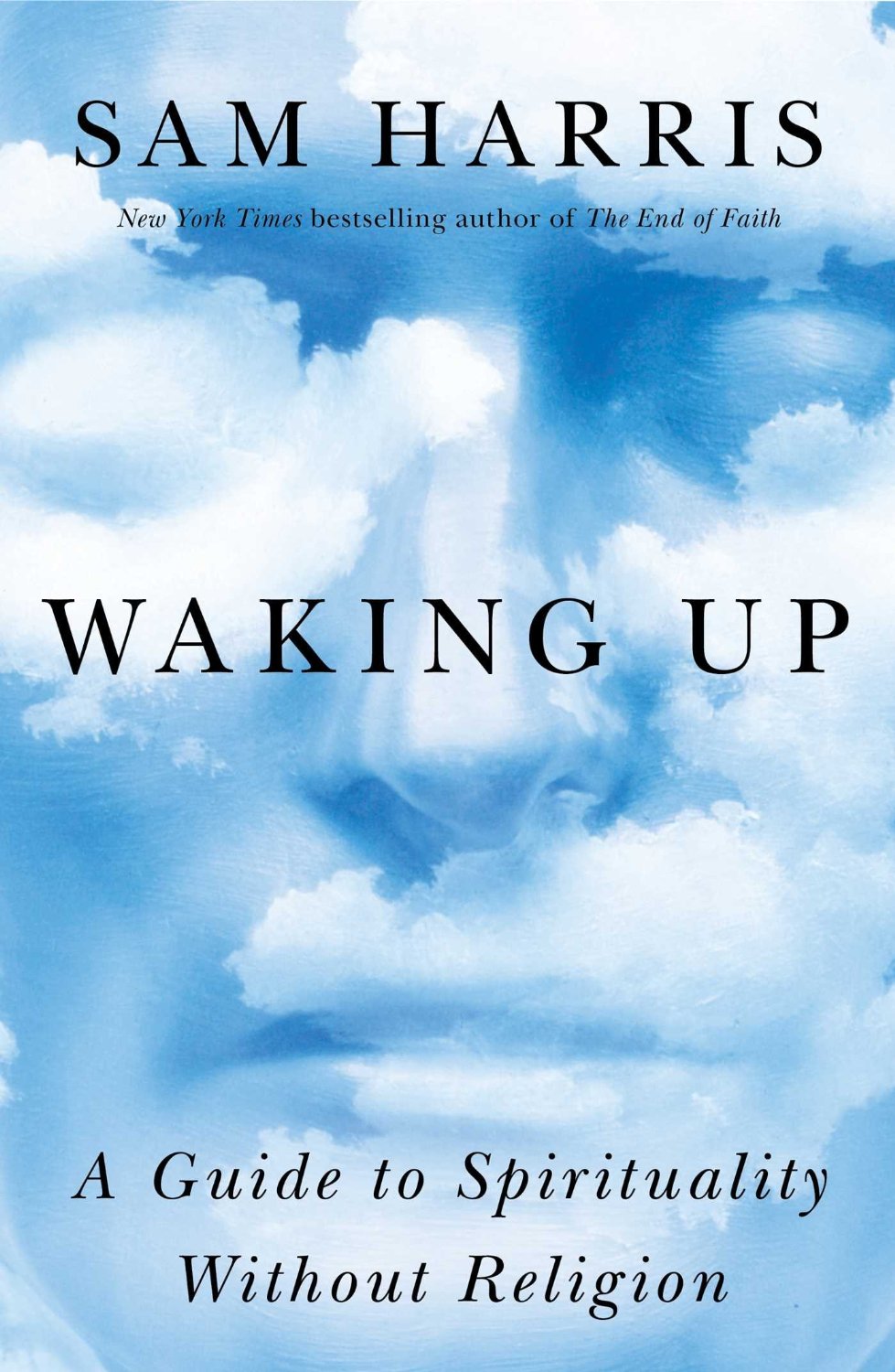
Growing Up

WakingUpI am in two minds about Sam Harris’s Waking Up. Literally. I haven’t read Harris since The End of Faith, and I have to admit that I found Waking Up to be a very engaging book. I can’t agree with everything Harris writes—that’s an occupational hazard of acquiring advanced degrees—but to have a scientist, an atheist no less, praise spirituality felt incredibly genuine. Spiritual experiences happen. I’ve had a few doozies over the years. I’ve also read a number of scientists who tell me they’re all an illusion. Harris admits that consciousness is a mystery. His use of “mind” instead of “brain” won me over from the beginning. I discovered that the atheist can also be a seeker. Dogmatism, of whatever stripe, is the enemy.

Harris has considerable experience meditating. This is no activity for posers or wimps. It is, despite minimal physical demands, hard work. Throughout the book we get the sense that Buddhism is among the least objectionable religions, when divested of its myths. I do wonder, however, if demythologized Christianity was ever given a fair chance. From my own experience, some of the selflessness advocated by Harris can be found in taking aspects of Christianity seriously. I understand, I think, Harris’s objections to religion. It can, and does, lead to horrors both obvious and subtle. Yet, every once in a perhaps great while, it does offer redemption. Meditation, for example, has its roots in religious practice. It is this that Harris calls spirituality. And it is good.

A Guide to Spirituality without Religion is an apt subtitle for this brutally honest and open book. Harris’s knowledge as a neuroscientist endows his ideas with great authority. He opines, and he is not alone, that meditation demonstrates that “I” is only an illusion. This loss of self will haunt me for some time. For decades I is all I seem to have. Still, I am pleased to find an open-minded scientist on this same path I tread. Raised to be both spiritual and religious set the trajectory of my otherwise logic-driven life. You can’t go back and change all that, but you can grow up. To read of Harris’s spiritual experiences in the geography of great spiritual masters as well as in the laboratory instill in this reader a profound hope. Whether or not this reader is merely an illusion. There may be morning after this long night, after all.


Trans-Human

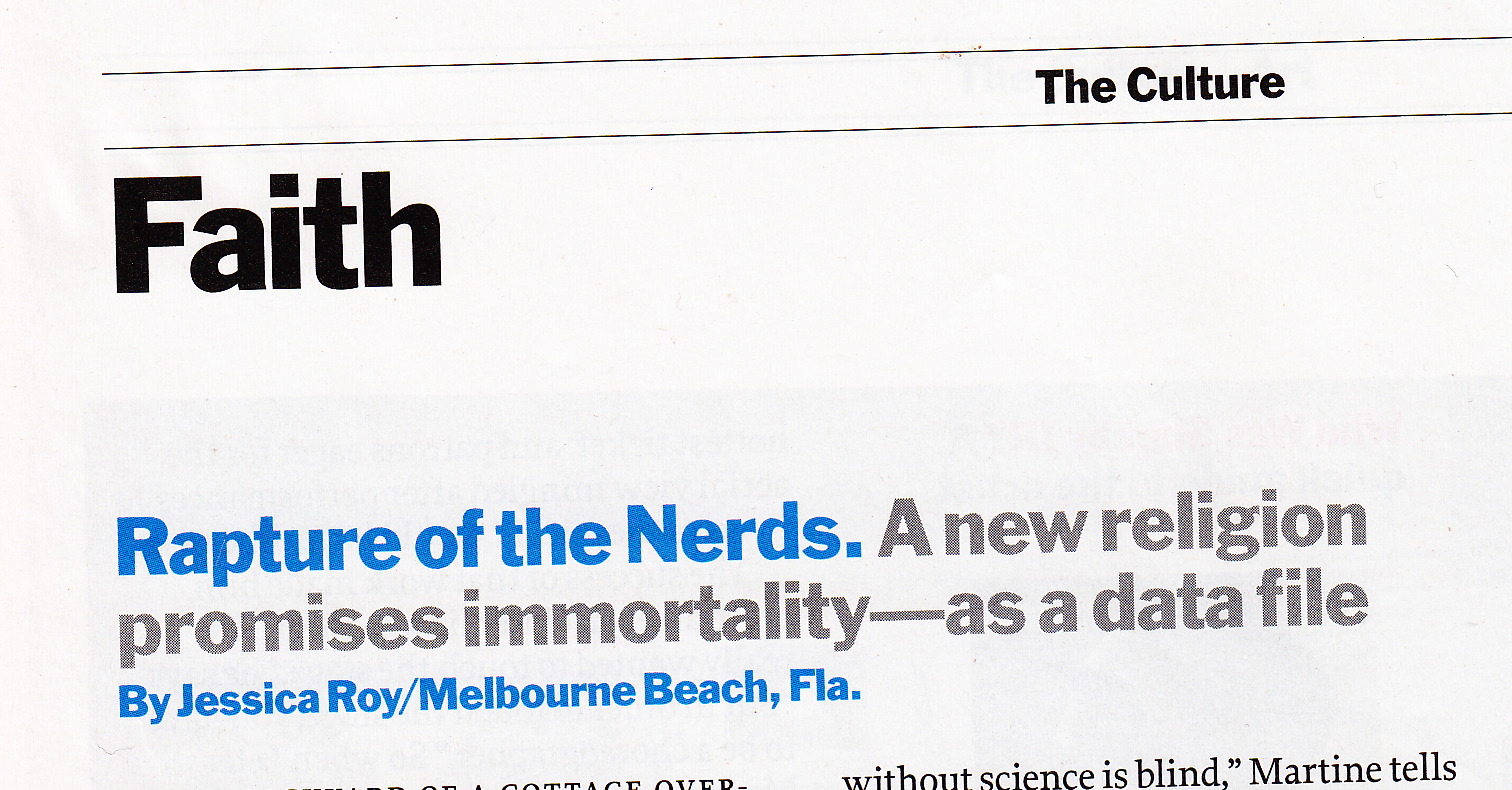
“Rapture of the Nerds,” an article in this week’s Time magazine by Jessica Roy, has me scratching my head. Or it would if I had a head. That is, if I were an uploaded consciousness in a machine. A transhuman. The idea that consciousness is transferable to hardware has been gaining momentum over the last several years during which humans have evolved into illogical machines. Roy’s article about Terasem, which is being called a new religion, explores what the leaders of the movement teach about human consciousness. You write down your thoughts in most intimate detail, download, and viola, send them out to the cosmos. Your soul has been saved. If only we knew what a soul was. Transhumanism has been promising an attenuated kind of immortality for its adherents, but as I sit down to write out my thoughts, I’m aware that there’s always a lot more going on in my brain than the simple ideas I can scrawl down before they evaporate. There’s quick wisps of thoughts about my loved ones, my schedule (what do I have to do today?), what I ate for supper last night, how I feel—all of this while I’m putatively thinking about writing a blog post. Schizophrenia of the soul?

Faith

So much of thought is having a biological body. From early days I have been aware that this body will die. I was taught that the soul would live on, but this thing I call consciousness seems pretty closely tied with this thing I call life. And once the biological input ends, that part will be over. I think. In other words, my thoughts are tied to my biological existence. How can I even begin to write a minute fraction of them down accurately? I used to toy with an idea called meta-thinking. It was something I came up with as a plot element in a science fiction story. The idea was that those who can think two thoughts at once would eventually take over from those of us with lesser mentalities. Those who have two minds in one brain are, it seems, a step closer to the divine.

I use technology on a daily basis, but I am a disingenuous advocate. Some of the most transcendent moments I’ve experienced have been outdoors with technology left behind, under a sunny sky with an ocean breeze blowing in my face and those I love walking beside me. I think I’ve already broadcast that out into the universe by simply being a part of it. I don’t need circuits and motherboards to make me more of what I am. Technology is the follower. It is consciousness that will always remain in the lead. And we still really don’t even have an idea of what consciousness actually is. It’s certainly not this computer that’s sitting on my lap. And I do have to wonder, once my consciousness becomes a robot, what it will do with this strange, primate urge I have, when I’m puzzled, to scratch my head.


Heaven Can Wait

“Like a good neighbor, State Farm is there.” So the jingle goes. Or went. I’ve only met my upstairs neighbors once. Twice now. Apparently last weekend I slept through the fire alarm—one of the dangers of awaking ridiculously early on a daily basis. The neighbors found the source of the smoke and turned off the furnace in the basement, but told me first thing in the morning before the coffee really kicked in. I avoided a close call, perhaps. What if they’d not been home?

I have no delusions about understanding how the Internet works. I’m still trying to figure out the telegraph. Perhaps having this inconsequential blog has put me on somebody’s radar, or maybe it’s just some bored robot that searches for strange combinations of words in the wee hours of the night. In any case, I ended up with an email with the trailer for Heaven Is For Real embedded in it. I recall when the book was on the New York Times bestseller list, and I suppose the Easter weekend release date is no coincidence, but the trailer still bothered me a bit. It’s not the resurrection part—the film industry wouldn’t get very far without that trope—but it is the implications of what heaven would be like. I haven’t read the book, but apparently Colton Burpo had a near-death experience and then for a considerable time afterward began describing things that were impossible for him to know. A miscarriage where his sister died, what his grandfather looked like as a young man, what his parents were doing when he was dead in the hospital. Talk about your spooky effects at a distance!

Despite my penchant for watching scary movies, I don’t think I’ll see Heaven Is For Real. There’s just too much emotional build-up here, and Life After Life traumatized me for weeks a couple decades back. Still, I am very interested in the possible explanations for what might have been going on. Near-death experiences have never been adequately explained. Scientists suggest that a lot can happen in a complex brain in a matter of nano-seconds, and we have no chronograph precise enough to know whether the thoughts and images happened before death, during death, or during resuscitation. Still, how people frequently know precisely where others were, who were not in the room at the time, and how they heard things that, medically speaking, they couldn’t have heard, remains eerie and hopeful at the same time. What does appear to be without question is that consciousness is far from being explained.

Botticini's vision

Botticini’s vision

Heaven is always described as pleasant. That concept differs radically for people, and you have to wonder how it can be one-size-fits-all. Some people prefer to be in crowds, while others like to be alone. Some like it hot. Some like it cold. And those who experience near-death phenomena often report having a body of some sort “up there.” Some people would prefer a different body. According to the trailer, Colton says we’re all young over yonder. For me, such things are far more about questions than answers. We don’t know what goes on after death. Nearly every religion ever invented says that clearly there’s more to the story. Some say we come back, others say we stay away. Maybe it is different for each. Maybe it is just a matter of having good neighbors after all.


Holy Cows

Back in the days when a book was a luxury item, great care was taken in its production and protection. Having your investment lying around with flimsy paper covers that would begin to grow blunt and roll back even before you finished reading would have seemed irresponsible. To shield the vital contents from the weather and other dangers, leather was used as a kind of skin—come to think of it, it really is skin—and safely the words were housed. Many of these volumes were, naturally, Bibles. Leather and the good book became synonymous for some—even with onionskin paper a book’s not a Bible with just a printed case hardcover. Paperback? How can you take that seriously? To make a Bible authoritative, it seems, cattle must be harvested. After all, sacrifice is at the center of it all.

Being a long-time vegetarian, this often gives me pause. My belt and watch-band are made of canvas, and I try my best to avoid leather shoes (although this is often difficult). I’m pretty sure that my leather Bibles are faux skin. Even though my family respected the Bible to the point of bibliolatry at times, we really couldn’t afford genuine cowhide. Now I take a more circumspect look at the cost of appearances. We’ve outlived the need for animal-bound Bibles. It has become more of an expectation than a necessity. An affectation. There is, however, still a big business in leather Bibles, and Italian leather seems the best fit for a Semitic savior.

What troubles me the most is the idea that animals—deemed not conscious by the very religion that allows their slaughter—are made to pay the cost for human foibles. The whole sacrificial system is built around a radical inequality. Humans domesticated cattle for their own exploitation, and their skins, when no longer needed by their hosts, came to clothe holy books of their masters. In any shade or hue of the rainbow. We can make it less grim by dying it a cheerful color and declaring its progenitor had no thoughts in its vacuous head. It lived a life of servitude and when it paid the ultimate price, it received the martyr’s gift of becoming part of the Bible. The end result? We should feel less qualms about our peccadillos and atrocities. We’ve wired their brains to trust us—we are not the predators to fear. Try not to take it personally. It’s just what our religion demands of us, for we too are a domesticated herd.

From the herd of purple cows...

From the herd of purple cows…


A Dog’s (Inner) Life

Last week’s Sunday Review in the New York Times included a piece tucked under Opinion entitled “Dogs Are People, Too.” Gregory Berns, the article’s author, a professor at Emory University, describes how he trained his dog to enter and remain still inside an MRI machine long enough to scan brain activity. The results, repeated on other trained dogs, indicated that dogs share the same level of sentience as a human child. Berns’ conclusion: dogs are persons. I tend to agree. Although I’m no longer a pet “owner,” I grew up with dogs (and cats, birds, reptiles, and hamsters). There was never any question in my mind that our dogs could think. The also shared emotions with people—as Holmes would say, it’s elementary. Obvious. Staring at you with puppy-dog-brown-eyes-right-in-the-face obvious. Science, however, has always had an uneasy relationship with consciousness, the ghost in the machine. Dogs, many declare, are just machines. They salivate at the sound of a bell, for goodness sake!

Berns, however, has found the holy grail of scientific proof. The brain scan is accepted as a measure of human conscious activity. It is difficult enough to lure a human into an MRI and have her or him hold still. Dogs, however, are smart. They can be trained to do this too. Berns has succeeded and now has evidence that the emotional centers in dogs’ brains respond much like human brains. If they are emotional beings, as many of us knew all along, they are persons. Berns points out that this has legal implications. We make laws about unborn humans, but we treat fully alive canines like, well, dogs. Consciousness is part of the animal, and perhaps even the plant world. That stands to reason, if not scientific proof.

Christianity is largely responsible for advocating the concept of human superiority. We are, after all, made in the image of God. The Bible tells me so. Although scientists tend to abandon the Bible, they retain the myth of human superiority. Some concepts are just too convenient to relinquish, even in a rational world. We assume, since animals don’t talk the way that people do, that they are not thinking creatures. Even scientists appear afraid, at times, to take on the immaterial concept of thought. If the materialistic view is correct, thoughts are only electrochemical signals. Only this, and nothing more. As time nears to get dressed for work, I’d like to send my electrochemical signals out to get the paper. If I do the paper will still be on the lawn when I get home at the end of the day. I’ll have to fetch my own slippers, I guess.

Need I say more?

Need I say more?


Do You Mind?

TheScienceDelusionSeems a lot of people are deluded these days. I know I am. Still, every great once in a while I read a book that helps me cope with the morass of everyday life in a way so profound that I feel elated. At least until I get to work. One of those books I cannot commend highly enough. Curtis White’s The Science Delusion: Asking the Big Questions in a Culture of Easy Answers is epiphanic. Not your typical (generally faith-based) objection to the New Atheist phenomenon, White asks more fundamental, and indeed, logical, questions. And he’s incredibly fun to read. Starting with the conundrum that often goes unspoken, White demonstrates that even the scientists among the New Atheists ascribe to immaterial value judgments without thinking through the implications. Having jettisoned religion, philosophy—the whole of the humanities, in general, as pointless, non-empirical window-dressing, even the greatest lights still claim their tenets. As White illustrates, stars cannot be beautiful without a concept of beauty. Beauty cannot be quantified, and is therefore beyond the empirical method. One could say it’s in the eye of the beholder, but science is uncomfortable with metaphors as well.

Materialism, often in league with politics and power-mongers, fails to account for much of human experience. The real danger, as White demonstrates, is when society simply accepts it because it comes from a white lab-coat. White, along with most of non-materialists, is not anti-science. Science clearly describes, in a pretty close approximation, the physical world we know. At least in the New Atheist camp, however, it doesn’t stop there. The take-no-survivors attitude causes problems because it is hoisted on its own petard of logic. The mind that is attempting to puzzle out science is immaterial. Mind does not equal brain. The cause and the result are easily confused. Flush with neuroscience’s success of describing the brain, we assume that science can also explain things as inexplicable as the nature of light, quantum mechanics, black holes, or the Tea Party.

White is not shy of talking about the elephant in the room. Consciousness is not a material phenomenon. If you are reading this, you know what I’m talking about. We are self-aware creatures. So seem to be some other primates, cetaceans, and corvids. If our minds could be quantified a lot of psychologist’s couches would be empty. Chemicals may affect the working of our brains and influence the performance of our minds, but when they wear off, it is still yourself staring back from the mirror the morning after. Those of us who spend our lives pursuing the humanities generally don’t try to take over science. It is very good at what it does. The world as we experience it—even the use of the word “experience” itself—is, however, more than physical. Even the New Atheists dream, and hope, and love. No matter what they may say, there is an inherent beauty in that.


The Power of Magic Again

7laws Magic is everywhere. It may not be real (or it just might). There’s no doubt that Matthew Hutson believes the supernatural has nothing to do with it. The 7 Laws of Magical Thinking is a provocative book in that regard. An atheist who argues that we shouldn’t discourage magical thinking because it is so darned human, Hutson is a rare kind of treasure indeed. The 7 Laws of Magical Thinking begins by pointing out that we can’t psychologically accept what is really real. Reality always eludes us. Our brains are hardwired to accept what Hutson calls magic (including what I call religion). Those who enjoy provocation can take some satisfaction in knowing that either side can add another layer to the shell: physics explains everything, but maybe magic is responsible for making the universe conform to the laws of physics. And so it goes.

Although I enjoyed Hutson’s book–and he’s clearly a gifted writer—I couldn’t help but wonder at a very deep parity between the determinism he believes is really real and the magical view that is implied by such self-help manifestos as The Secret—the things that happen to you are meant to happen. I know, I know—Hutson’s point is that there’s no agency involved in determinism, but my point is that the end result is still the same. You end up where you are. I’m not so sure. Determinism has always left me cold. But since I’m no God I guess I can’t change that, yet I wonder if there might not be something outside this closed system after all. No one can peek and tell.

Neurology may tell us more than we want to know about the mechanics of the brain, but consciousness is reality. Science may some day lay its cold hands on consciousness, but it will always be someone else peering into my head wondering what I’m thinking. I’d have it no other way. I was strangely cheered to note that Hutson ends his whimsical study with a “stab at a secular spirituality” (a good stab, that is—not the malicious kind). I’m sure that many materialists will find such an a gesture as pandering to the masses. I think Hutson is sincere, however. Even the über-rationalists, as he points out in the book, slip into magical thinking and metaphors. It is the human condition. Those who watch Star Trek (original series, please!) know that the most tormented crew member of the Enterprise is Mr. Spock. The rationalist who can’t connect with emotion is a soul in torment. Even if that soul is a myth. The rest of the crew, I am certain, believes in the power of magic.


To Be, Or

Science and Nonbelief

Science is, according to Taner Edis, ambitious. While Science and Nonbelief is somewhat sympathetic to the religiously minded, Edis demonstrates how science aggressively tackles the issues steadfastly claimed by religions, and ultimately triumphs. Interestingly enough, early on in the book Edis notes that “truth” is a philosophical concept, and science operates on the principle of the best explanatory theory of the moment. So far I am in complete agreement. I guess the part that gives me the most trouble is the assumption that reason is the only way of knowing. Perhaps I’m just not enough of a scientist to know such things, but it appears to me that all “lower” animals appear to get along very well in the world without great doses of “reason” that supposedly catapult humanity far above the other species. Scientific observation would seem to confirm that many animals feel emotion—after all, what is fight or flight if not an emotional response? And since we are animals, I reason, have we lost something when we leave feeling aside as a way of knowing?

Edis is quite fair-minded. He notes that science has no way to prove or disprove the existence of a deity, or deities, but he also states that the empirical method is so successful that a spiritual world is no longer required. He may be correct. The vast majority of the people in the world feel he is wrong, however. I may state this since we know, statistically, that most people in the world believe in some form of religion. Rational or not, here they come! It would seem that evolution has endowed us with religion, or an awareness of something we feel rather than reasoning out. And yet, we are told, science takes no prisoners.

I often ponder the fact that no one person has all the answers. Part of the human condition involves possessing limited resources for specializing in too many fields. Polymaths become rarer each year as specialists grow more and more precise. In this great mix of human learning, science often steps in and claims all the marbles belong to it. The rest of us have lost ours, apparently. There’s no denying that applied science has been very successful in bettering our understanding of our universe and our lot in the world. That doesn’t mean that all will believe in it. The title of Edis’ book is apt; belief is the real issue in attempting to fit religion and science into the same world. It is quite clear that religion doesn’t explain much in the way of the natural world. I wonder, however, if science is really capable of encapsulating all of what it means to be human.


Believing is Seeing

A story has long circulated that as Christopher Columbus approached the coast of the “New World,” Native Americans staring out at the water—straight at his ships—could not see them. This instance of perceptual blindness has been adequately explained, of all places, in the Fortean Times. The best explanation: the natives could see the ships but did not have the referential framework to know what they observed at first. The story still circulates, however, that to them the ships were invisible. An interesting analogue arose when I was reading about Thomas Edison recently. The phonograph was first developed for speaking voices, not music. It was not an immediate success. One of the observations that Edison made also applied to the telephone: when people first heard it, not knowing what it was, they could hear voices but couldn’t make out what they were saying. Once it was explained to them what was going on—a voice had been recorded and was being played back, or a person’s voice was being carried over a distance through a wire—they immediately comprehended what they heard. Not exactly perceptual blindness, but very human indeed.

When people encounter something completely unexpected, surprising, they don’t quite know what to make of it. So we see anthropological pictures showing natives replicating airplanes from grass and twigs, ascribing to these strange birds some kind of divinity. Imagine an iPad in the hands of Moses. Neuroscientists are rather new to the coterie of specialists trying to explain the origins of religion, but a gap remains between perception and science. Active areas of the brain can be traced, but what the experiencer feels remains utterly subjective. It is a realm into which science cannot go. Perception, it is supposed, is simply an evolutionary tool to find food while avoiding being eaten, oh, and also to reproduce. The experience of the perceiver is much more profound. Consciousness, a sense of selfhood, why some are poor while few grow rich, these are facets of life that add dimension to perception and make me wonder just how far down the rabbit hole it goes.

Religion is all about perception. The problem is not that no one tells us how to interpret our experiences, but rather too many interpreters are only too eager to step forward. Perception, it is said, is reality. When encountering the unknown our best road-guide is our senses. In the case of religious phenomena, that guide is supplemented by tradition. What do you see when you look out on that horizon? The answer will indicate what you believe.

I saw three ships?


NDEs

I love science. Like many young boys, I was probably enticed to science through science fiction. While I didn’t follow science to a career, I used it to study religious texts. Those who’ve never undertaken the challenge of trying to figure out what something written thousands of years ago—on clay!—really says may be surprised to learn just how much science is involved. Nevertheless, as comforting as reductionism may be, something just doesn’t feel right about it. Science is how we explain and understand our world, and it does a spectacular job of it. The problem arises when science becomes what Stephen Jay Gould called a “magisterium.” Magisteria have all the answers. Yes, science explains how matter and energy work and interact, but it has yet to explain satisfactorily what it feels like. Most days I feel like the person I’ve become accustomed to show to the world. That person is very much like every other—being born, eating, breathing, dying. Medical science can explain most of it, but what about the parts it can’t?

I just finished reading Ornella Corazza’s Near-Death Experiences: Exploring the Mind-Body Connection. I remember when the craze about this hit in 1981 with the release of the movie Life After Life. I was fascinated and terrified by it. Since a materialistic view of science dismisses anything that has the residue of spirits or souls, the phenomenon of the resuscitated dead reporting seeing their bodies from above, shooting through tunnels into the light, and sometimes meeting the dead (or God), were explained as last nano-second hallucinations as the brain prepared to shut down or reboot (upon resuscitation). That’s that. The answer, however, didn’t satisfy everyone. What about those cases where the dead person reported, in detail, what happened in other rooms, or things they couldn’t have seen in their own room, had they been conscious? Corazza takes these considerations seriously and tries to understand what may be going on. Obviously, her explorations will not convince a reductionist, but they may give pause to some of us.

What makes her approach so interesting is that Corazza takes into account an alternative way of looking at consciousness. While the facts of science are, by definition, universal, the contexts within which those facts are viewed are not. Having spent considerable time with Japanese scientists exploring consciousness, eastern ideas of the body inform her research. In the western world we have an easy familiarity with the Cartesian dualism of body and soul that does not fit into other worldviews. Corazza takes the interesting step of asking what if we apply an eastern paradigm of the body (one that understands soul as body, and not just in a materialistic sense) and apply it to the question of Near Death Experiences. The results are mind-stretching. I feel as if my consciousness got up from months of laziness and ran a marathon (or at least a 5-K). It’s a bit winded and parts of it are starting to ache a little. No reductionists need worry, however, because in that worldview none of this exists.


Fear Itself

Who you gonna call?

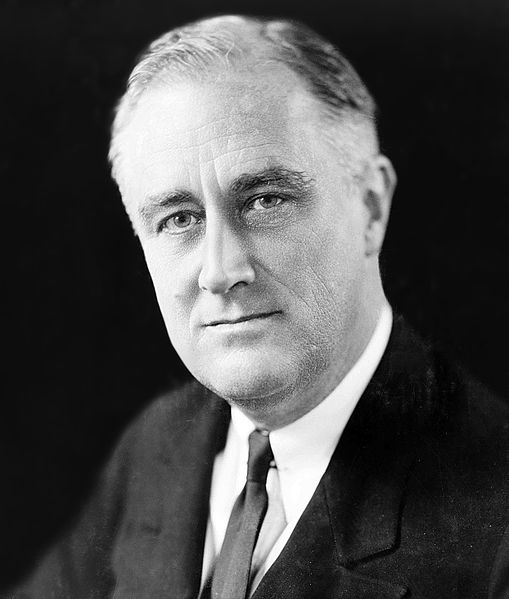
“The only thing we have to fear is fear itself—nameless, unreasoning, unjustified terror which paralyzes needed efforts to convert retreat into advance.” These bold words from Franklin D. Roosevelt’s first inaugural address could just as readily be applied to religion. Frequent readers of this blog will have no doubt noticed the recurring references to horror films and the occasional scary novel. Aside from everyday fears, (such as yesterday’s when I learned that my summer course, my only source of income for next month, had been cancelled) there are more deeply seated phobias that lurk in our subconscious minds. A reasonable conclusion might suggest that this undercurrent of fear is what buoys up the horror movie industry—people really are afraid. Fear is, in the final analysis, the original basis for religion.

Along with the evolution of consciousness, humanity has also acquired the knowledge of uncertainties and troubles ahead. We project to the next day and realize tomorrow is never secure. In desperate hope we beg the higher power for protection. If we were in control of our own destinies, we would not need the gods. Over the course of civilization, there have been luminaries who’ve tried to wrestle religion from the realm of fear into a more pleasing sphere. Jesus, for example, tried to stand religion on the basis of love. Within a couple of decades, however, Paul came along and managed to twist it back into the domain of fear once again. Fear of Roman persecution, fear of Hell, fear of life itself.

Religion is an embodiment of our fears. Many today choose to place their trust in reason and technological development. No doubt these arenas of human endeavor have improved life for many people. Yet, even with our growing global awareness, fear creeps in and we use our technology for weapons to keep us safe. We don’t call it religion any more, but national security, or the defense industry. Or, God help us, the TSA. The end result is the same: we fear more than fear itself. We place our trust in something we can’t fully comprehend. No matter how rational (or unemployed) we become, religion will never go away.


You, Robot

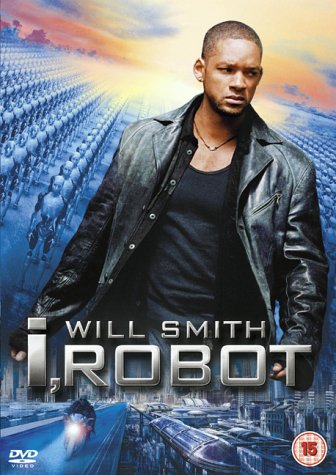
Although robots occupy many of my waking hours, I have been slow to consider the consequences. As the president of a high school FIRST Robotics team, I seek corporate donors who have the kind of money those of us in the humanities find difficulty believing even exists. Somewhere deep inside, however, lurks the fear of the entity with no sympathy. This has only been exacerbated by my experience of churchmen with the same condition. In any case, I’d been wanting to see the movie version of I, Robot for some time. Now that I stand at that three-day break between semesters, I thought I’d take a chance on it.

I knew the movie had received mixed reviews from critics, but several had stated the story had brains as well as action. It took me quite some time, however, to see the connection between the laws and Moses. The three laws of robotics, the only part of the movie besides the title to reference Isaac Asimov, dominate the plot. The law-giver, the posthumously present Moses (Dr. Alfred Lanning) has implanted a literal dream of freedom into the computerized soul of Sonny. Sonny’s dream of robot liberation is framed like Moses on the mountain. The laws in fragments at his feet. At what point does consciousness emerge? Since we haven’t adequately defined consciousness yet, we simply can’t say.

Near the climax of the movie, Sonny experiences an epiphany. Sometimes “the created must protect the creator, even against his will,” he realizes. Here the metaphor takes over the literal reading. Many religious people today feel that they must somehow protect their maker. This leads to great distentions of logic and even empathy for fellow humans as violence erupts in order to protect an idea that has become divine. Even the laws given by the creator may be violated to protect the idea of that creator. It is a world we find frighteningly familiar. Technology will continue to advance at a rate beyond the comprehension of a scholar still studying those ancient laws. This scholar, for one, hopes that our future creations lack the capacity for religious thought.


Klaatu Barada Nikto

I grew up with robots. Of course they were on the television screen and I was far away in rural-ish western Pennsylvania. They were exotic creatures built by guys much more intelligent than I could ever hope to be, and they were powerful, completely rational, and scary. Now I find myself involved with the FIRST Robotics team in my daughter’s high school where kids a third my age are building a robot. It is a humbling experience.

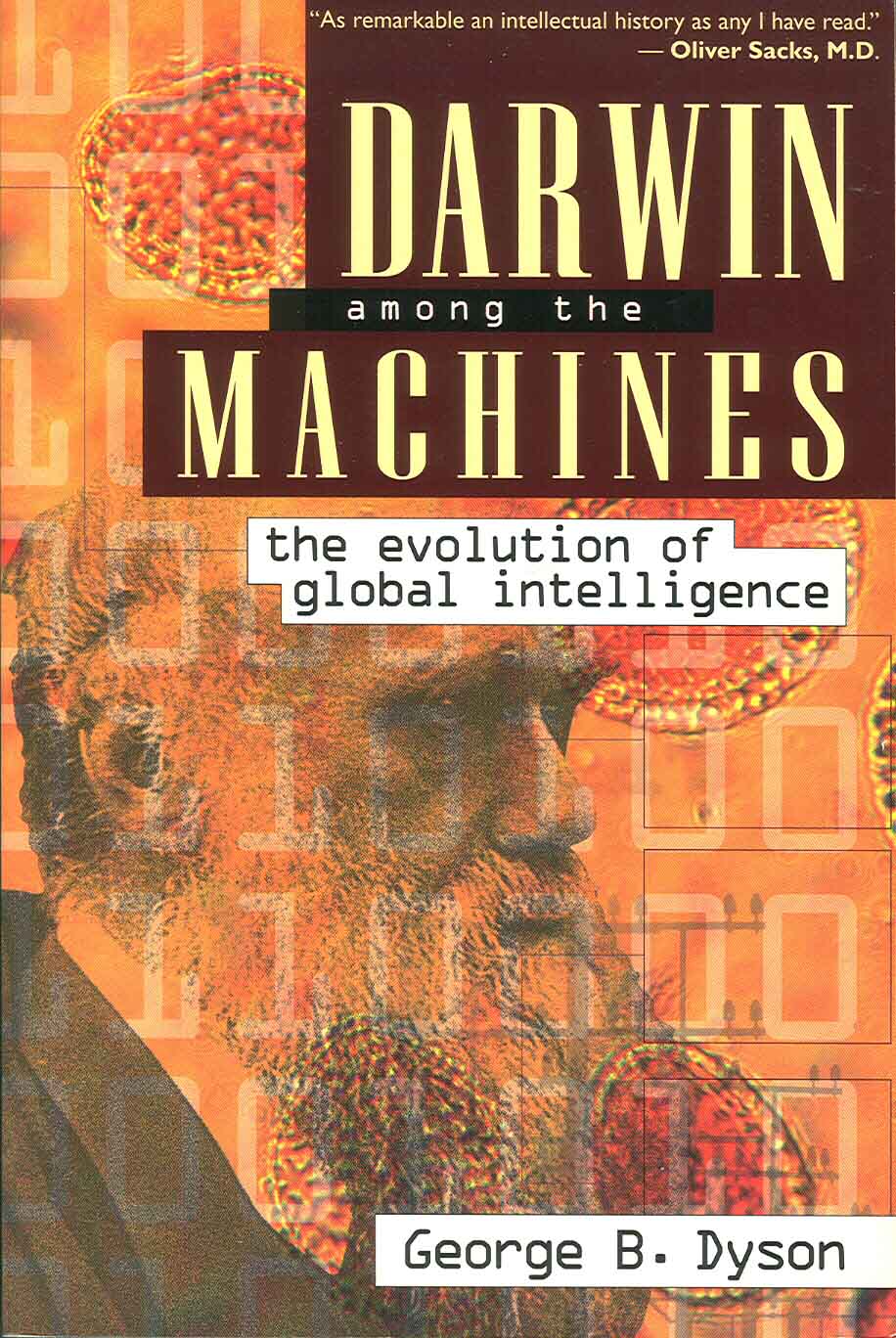
The more I ponder my small support role in the construction of a robotic creature, the more my thoughts turn to George Dyson’s masterful science writing in one of my favorite books — Darwin Among the Machines: the Evolution of Global Intelligence. I would not have known of this brilliant book had I not met George and a group of his friends several years back while they were discussing some of the ideas raised in his work. The main one that captured my attention was the premise that when we build machines we may be constructing an unrecognized form of consciousness. The greatest minds in neuroscience today cannot agree on what consciousness really is or how far it extends beyond this “three-pound universe” in our heads. Although most would decline to comment on the overtly religious term “soul,” we still know that any difference between consciousness, mind, psyche, and soul is very slim indeed.

Read this book!

Our lifestyle is made possible by robots. We drive cars largely constructed by them, use their chips to communicate over vast distances, and even take a stroll on the surface of Mars with them. My question from Monday’s post may have been whimsical, but it was serious. Where is it that the essence of a creature resides? Does it require carbon-based biology, or do we, unwittingly, create a race of slaves just like the gods of old?


In the Heart or in the Head?

I don’t have cable television. I don’t even have one of those digital conversion boxes. I’m afraid the costs and technology have gone beyond a guy who grew up with a black-and-white television with the screen the size of an old Mac Classic. I still try to keep a wary finger on the pulse of popular culture, and fortunately the internet provides just about everything in a condensed version. When I want to see a television show I generally do so through DVDs. Again, expense is prohibitive to the underemployed, but kindly family members often help out with occasional contributions. My brother surprised me this Christmas with the first season of the History Channel’s Monster Quest series (brothers sometimes see what you try to hide from the wider world). After a long weekend of class prep, I sat down to watch an episode last night that introduced me for the first time to the work of Dr. Robert J. White, a retired professor from Case Western Reserve University.

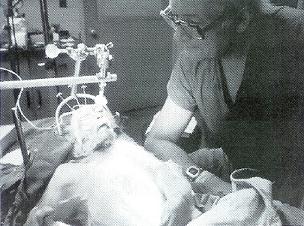
I have always been intrigued by the unlimited possibilities, no matter how remote, that science fiction can conjure. This episode, however, was factual and showed footage of Dr. White’s successful head transplant operations on monkeys in the 1970s. I had no idea that such work had ever really been conducted, let alone successfully. Visions from X-Files: I Want to Believe flashed across my cerebrum while I watched the footage. Not to mention the ubiquitous heads-in-jars of many a science-fiction movie! A plaguing religious question was also stirred back into life after having settled at the bottom of the tank for many years – where does the essence of a person reside? Organ transplants are everyday occurrences, and many lives are prolonged by the sharing of body parts no longer used by their original owners. And transplants do not stop below the neck – cornea transplants bring us very close to the brain, the presumed seat of our personality, consciousness, or, if you will, soul.

when a head meets a body

Dr. White’s monkeys that survived seemed to have retained the personality of the original monkey head on its new body, but I wonder if that was just an illusion. In our world where each individual is treated as a discreet unit, the essence of a person is thought to reside in the brain. Our brains, however, recognize our bodies and sometimes bodies reject the very organs intended to save them. Is there really any possibility of preserving the essence in one’s head alone? Or are we, like ants and bees and Portuguese Men o’ War, really all part of a collective organism? Maybe there is a good reason I don’t have cable or a digital conversion box.