Sticks and Stones

So much has been happening that I have trouble keeping up.  This past month a border skirmish erupted between the planet’s two most populous nations, China and India.  The skirmish took place in the Himalayas, around a disputed border line.  About twenty died in a scuffle that the New York Times reported as involving clubs and stones.  This image stuck with me.  As kids we used to chant “Sticks and stones may break my bones, but names will never harm me.”  Quite apart from the incorrect message in this saying, it struck me how childish border skirmishes are.  Like race, national boundaries are mere human constructs.  We’re obsessed with ownership.  Territoriality.  This land belongs to me, not you.  If you disagree we can club and stone each other to death to prove it.  

I mailed a package to someone in Canada recently.  Not only did I have to fill out a customs form, I also had to fork over quite a hefty sum, amounting to half the price of the item sent.  The reason for the high cost was that this was international mail.  Now, I can understand Canada wanting to distance itself from its southern neighbor, but why do we feel that we need to have strict borders?  We’ve been peaceful for centuries.  Being who I am, my thoughts tend toward the breaking down of religious ideals of unity.  Believe me, I know these are only ideals that we never realized in practice, but the concept haa been there from the beginning.  Religion tends to divide rather than to bring people together, no matter what the founders of various traditions taught.  Now even that is breaking down.

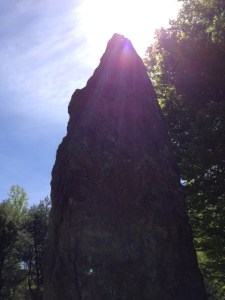
As the New York Times points out, both India and China are nuclear powers.  During this time of social distancing I had secretly hoped national aggressions might fade.  With some eight million people infected worldwide, you might think we could all work together, put down our sticks and stones, and see the human face before us.  We wear masks, I guess, for more than one reason.  The primitive nature of that skirmish bothers me.  People beating one another to death with rocks and clubs over a location difficult to reach just so both sides can lay claim to it.  In my mind’s eye I envision a gray-black monolith appearing in their midst.  A message of progress being beamed into their heads.  We’re two decades beyond that benchmark, and we still don’t get the message.
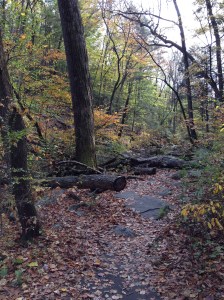
A better use for sticks and stones
Too Much Light?

The summer solstice comes whether we want it to or not.  Today is the longest day in the northern hemisphere although, as I write this the sun has not yet risen.  It was a sleepless night, making this day seem even longer than it already is.  Over on Horror Homeroom, where they understand sleepless nights, my piece on the movie Midsommar will appear.  I won’t say here what I say there, or you might not go and read it.  I will say that for a horror film Midsommar boldly sets itself in a sun-bathed atmosphere, making it all the more unsettling.  To see more you’ll need to visit the Homeroom.

There are implications for the longest day.  One of the most obvious is that from here on out days will be getting shorter.  That’s the thing about anticipation—we crave the light when it’s in such short supply in December and January.  This year of Covid, the spring blended into a long stretch of social distancing and isolation, even as the days were growing longer and the weather warmer.  It was like some spokes were missing from the wheel of the year.  Now that summer’s here many people are acting as if the need for caution is gone.  Midsommar may help with that, since it shows that the daylight sometimes shows us what we don’t really wish to see.

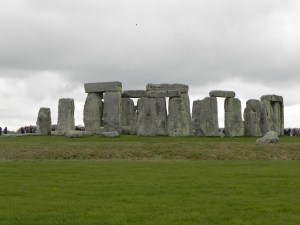
Ancient peoples kept an eye on the seasonal changes long before they learned to write.  Etched into the landscape markers like Stonehenge and Avebury and countless others were oriented toward celestial points on the solstices.  Equinoxes were also observed, as well as the half-way points between.  This altering of the earth to commemorate the progressing of the year took great effort, so we must assume it had great importance.  You don’t move boulders unless you feel strongly compelled to do so.  Such compulsion strikes us all as religious.

So it’s the longest day of the year.  What will we do with it?  When we look back at it, will we see what we wished we might have done with all that light on our side?  Will we treat it just like any other day?  The beauty of holidays (of which capitalism recognizes far too few) is that they teach us to stop and reflect for a few moments on the messages our planet sends us.  Our longest day is also a message.  What we do with that information is up to us.


Long Ranger

The summer solstice is nearly here (on which more anon).  The coronavirus outbreak reached crisis level in the United States just before the vernal equinox, so we’ve been living with this now for over a quarter of the year.  The World Health Organization has been warning that the greatest danger now is complacency.  I’ve been seeing troubling signs of it.  Many people equate the partial opening up as a license to ditch the masks and start having parties again.  I go jogging around 5 a.m. these days because, well, the solstice.  It’s light enough and I’ve already been awake a couple of hours by then.  Parks and playgrounds around here are officially closed still, but the other day just after first light I jogged by a group of guys playing basketball before sunrise.  The days are longer and it feels like nothing can harm us in summer.

Like most other people I worry about the economy.  You’d think books would be big business during a lockdown and in fact many kinds are doing quite well.  The academic kind less so.  Still, I haven’t given up my hope that the pandemic will prove transformative.  We should emerge from this better than we were going into it.  Granted, the Republican Party has put the bar really, really low, but people are, I hope, starting to realize we’re better than our government.  We know that black lives matter.  We know that science is real.  We know that people matter more than money.  Nevertheless it’s difficult to keep wearing masks when we’ve shed the winter clothes and donned short sleeves.  Disease, like Republicanism, doesn’t respect human desires.  We need to keep the masks on.

A strange kind of giddiness comes upon us during these long days.  There’s so much light!  Those who can sleep past 4 a.m. are finding the sky already glowing when they awake.  At this latitude it stays light until almost 9 p.m., or so I’m told.  Thinking back to our primal ancestors, we were only really active during daylight hours.  Sluggish and sleepy in the winter, we’re now stimulated with so many photons we don’t know what to do with them all.  I sincerely hope that Covid-19 has had enough of the human race and is ready to leave us alone.  In the light of the day, however, the evidence isn’t there to bear that out.  We can still celebrate the longest day of the year with masks on, knowing that six months from now things will be very different.


Exit, Pursued by a Bear

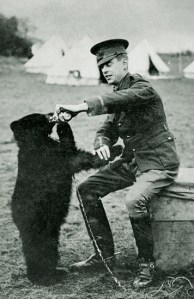
Apart from being Shakespearen click-bait, the title of this post reflects a present-day fear.  We live on the edge of rural Pennsylvania.  If you’re not familiar with the state, let me assure you, there are tons of woodlands and rural communities.  You can drive for hours in a straight line and seldom leave the forest.  When my wife sent me a warning email—I go to bed early and can’t seem to sleep late—I paid heed.  A bear has been ambling through our town.  My usual morning jog is along a trail at the edge of the woods.  Bears are crepuscular.  I watch horror movies.  Put it all together and a Shakespearean level of anxiety quickly builds.  It wouldn’t be so bad, but the photos show the bear romping through backyards and one of the reasons I jog the way I do is to avoid other people.

I see wildlife on my jogs.  I see deer frequently, along with feral cats, rabbits, and, in season, ducks.  I’ve seen raccoons, foxes, groundhogs, and even snapping turtles and salamanders.  It’s not much of a stretch to think a bear could be lurking there.  So instead I took to jogging the human streets.  The danger out here, of course, is the human-borne kind.  Covid-19 lurks, and even though I jog at 5 a.m. there are other elderly out and about.  I hear a cough and wonder whether my chances might be better with the bear.  The broken sidewalk’s a problem too.  I have tripped before in the half light, but without Superman’s knack for flying.  Or at least landing gracefully.

Thinking back, I wonder what has happened.  As I child I lived in truly rural Pennsylvania.  My brothers and I used to sleep on our open porch in the summers, even though we could occasionally hear bears going through the trashcans around the side of the house.  Our place was hard up on the woods, right at the edge of town.  I didn’t worry about the bears back then, though.  We’ve perhaps become more afraid of nature because we know we’ve not been good to it.  The episode of the X-Files we watched before bed last night had Scully saying that nature’s always out to get us.  Perhaps we’ve drawn too solid a line between ourselves and brother or sister bear.  We’re not above nature; we are nature.  But still, I’d rather not be pursued, or eaten by a bear, no matter how much I like Shakespeare.  So I’ll jog in town for awhile, taking my chances with the dangers of my own kind.

Photo credit: Manitoba Provincial Archives, via Wikimedia Commons


Rainbow of Reading

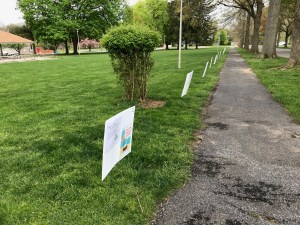
Reading in a time of plague is more than just a pastime.  It’s an opportunity to learn.  I keep fervently hoping that an occupation might be made out of reading, but those I’ve tried always have many long strings attached, most of them tied to capitalism.  Early on in the social distancing phase, a group in my town began posting children’s stories on lawn signs in the park.  Each sign stands six feet from the last one, and if you linger a few minutes you can take in a children’s book, presumably for the benefit of your child.  Such signs have cropped up in a couple of the parks here in town.  I’m pleased to see the attempts at literacy education continuing.  If anything’s going to get us out of this crisis, it’s going to be reading.

The local library, again early on, began giving away books that normally make up part of the book sale.  Libraries, which have proven their worth over and over, have been doing what they can to get people through the difficult times of loneliness, and in some cases, joblessness.  Those of us who cottoned onto reading at a young age realize just how much problem-solving you can glean from reading a novel.  Instead of encouraging writers, however, the capitalistic system makes agents and publishers interested only in those writers who are deemed to have commercial value.  All the rest, who often find a core audience after their deaths, are left to obscurity since money makes the world go round, right MC?  And yet where would we be without our formative fiction.

I’ve quite often admitted that Herman Melville’s Moby Dick is my favorite novel.  I’d always assumed that it was a success but I recently learned that it too was a flop.  At first.  There was little interest in what has become the prototypical great American novel.  Its draw is in the lessons it teaches.  A bit too long to put on signs in the park, it explores what drives some people.  Indeed, for the owners of the Pequod it is money.  But there are more important things.  As the weather has been improving, it makes me glad to see the signs of summer.  The signs posted with books.  While I have no small children to take to the park, I am made happy by the efforts of those who take the initiative to show young people the way out of any crisis.  You must read your way through.


Under the Plague

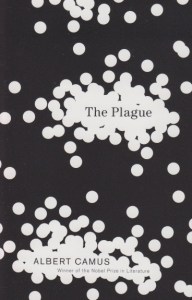
Some events transform a society.  While we keep waiting for things “to get back to normal,” many of us have already come to realize that there is no normal to which we can get back.  That’s my main impression after reading Albert Camus’ The Plague.  The story is set in 1940s Algeria where the Bubonic Plague breaks out in a single town that has to isolate itself from the rest of the world.  As the months and realizations of long duration develop, the emotions the characters go through are very much in line with what seems to be happening with Covid-19.  Indeed, that’s why the novel seems to be going through a surge of popularity right now.  I’ve always associated Camus with the great existentialist writers, but that slipped to the back of my mind while reading this poignant story.

Existentialism is all about making one’s own meaning in a meaningless universe.  This is precisely what Dr. Rieux does in Oran as his former life becomes one long ward call of service to the town.  He befriends characters who represent the best and the worst of human nature as they respond to the pressures of isolation and boredom.  Camus pointedly notes that despite the equalizing forces of death and hardship, the rich manage to make sure they have it better than the poor although they all end up in the same common grave.  There are morals to this story, and it’s clear that “leaders” in Washington have never read it.  Literature quite often teaches important lessons, but to get at them you have to read.

Rieux befriends Tarrou and it seems to me that Tarrou’s lengthy monologue on why he has volunteered to stay in Oran and help those who are suffering is the main message of the book.  Tarrou understands the lessening of suffering, the attempt to bring peace, as the main purpose of human beings.  He says at one point that it’s like becoming a saint.  Despite the ways saints are often worshipped these days, that is at the heart of their canonization.  Care for others.  Rieux points out that Tarrou doesn’t believe in God, and yet, as the story winds down it is clear that he has become a kind of savior figure.  The novel is disturbing in its simplicity and in its timeliness.  It would seem that if we’re to get anything at all out of being under the cloud of a modern plague that we need to take the view that others matter, despite what Washington says, perhaps even more than ourselves.


Under Pressure

Cars don’t get driven as much these days.  Working from home does save quite a bit on the cost of filling up a couple times a week.  Cars that sit, however, sometimes get leaky tires.  So wearing a mask like a bandit, I found myself at a local gas station air pump, dumping quarters in for three minutes of air.  As I knelt on the asphalt, I was thinking of when air used to be free.  Gas stations made enough money on fuel that it was considered a courtesy to provide a public compressor.  As gas prices grew from a quarter a gallon (that makes me sound old) to, at one point over three dollars for the same quantity, the petroleum industry became very lucrative.  And they started charging for air.

The idea is what bothers me.  Shouldn’t air be free?  I didn’t grow up a very political kid (that had to come with maturing), but I used to hear adults complaining that soon you’d have to pay for air.  They meant the kind you have to breathe, of course, but that idea stuck.  Air should be free.  All land animals have free access to it, and our biology demands it.  The only difference with this black hose I’m holding is that it has a nozzle that forces said air into a tire valve.  I remember trying to inflate a bicycle tire by trying to blow into it.  No, for that you needed a hand pump, so air wasn’t really free even then.  If there’s a way to charge for a necessity, we’ll find it.  Of course cars pollute the actual air we breathe, so we’re paying double, really.

Gas prices tumbled just as the COVID-19 pandemic began.  I’m afraid I just can’t raise any sympathy for big oil, even if we are on the cusp of the second Great Depression.  I guess I still hope for a government that has some sympathy, and not profits in mind.  Millions and millions are unemployed and all we see is mean spiritedness toward those in need.  If their tires are flat they’ll have to pay for the very air they pump.  And I’m paying four times as much to do that as a gallon of gas cost when I was a kid.  Some things, it seems to me, should just be free.  A capitalist system can’t have that, however, since money must be kept flowing.  Perhaps they should dispense it through pumps.


Teutonic Ennui

I don’t remember its title or its author.  I do recall that there was a character, or perhaps there were characters, who kept saying “etwas muss getan werden”—“something must be done.”  You see, we read quite a few existentialist short stories in German IV in high school.  There were so few of us left from the freshman intro all the way back in ninth grade that our teacher could put us right in the middle of German literature and have us read.  I wish I still had that facility now.  Although I can work my way through many languages academically (German, French, Spanish, Italian, and, of course, the dead languages of koine Greek, classical Hebrew, Ugaritic, and assorted other semitic dialects), the fluency of sitting down and just reading atrophied long ago.  Still, etwas muss getan werden.  That sense of anxiety feels like it’s permanent now.

Every now and again, when tensions are running high—this past week is an example—I find myself nervously checking online news sources frequently to see if anything dramatically good has happened.  This gets to be almost a tic.  I need to have some assurance that we’ve not become a dictatorship, or that there are those in power with enough humanity left inside them have tried to do something to make things better.  Being a nation of throw-away people is ethically wrong no matter what scale you use.  Skin color and national heritage do not lessen the worth of any human being.  We can’t even get out to protest properly because a pandemic, which is still being mishandled, rages.  The days are full of such sameness.  Etwas muss getan werden.  Please.

I wish I could remember the stories I read in high school.  Some have stayed with me through the years.  German class was my introduction to existentialism, a philosophy with which I still mostly identify.  That was the reason I would pick up books by Kafka, Camus, and Dürrenmatt when I would find them in the once plentiful used book stores.  I remember the latter’s Der Besuch der alten Dame. I recall seeing the play performed and being reminded that we are all players in a drama whose only sense comes from our assignment of the same.  Now I sit inside on sunny days.  Afraid of economic insecurity—who knows how long the jobs will hold out?—I don’t go to stores and try to order as little as possible online.  I keep waiting for something to happen.  As I learned in high school etwas muss getan werden, no matter where I read it.


Wondering about Fall

I’m not a professor, but I play one on—no, wait—wrong commercial.  I’m not a professor, but I used to be.  Now as the spring semester, which ended remotely, is winding down all over schools are asking what they should do in the autumn.  Should the fall semester—the great migratory event of the human species—be virtual or actual?  We know the coronavirus will still be lurking out there, and we know that colleges mix people from all over the world, which is one of the real essentials of education.  I try to picture myself teaching to a classroom of masked faces.  I try to envision frat parties with social distancing.  I try to imagine the dining halls where students are packed in closely together, handling knives, forks, and spoons that others have touched.  I think and shudder.

I know some younger folks.  They tend to trust certain internet personalities because they seem smart.  I’ve even occasionally asked what the qualifications of such personalities were only to receive an “I don’t know” answer.  This is among educated viewers.  Don’t get me wrong.  I don’t have my diplomas on the wall behind me.  I never even had them framed.  They’re still in the tubes.  I had to show my Ph.D. diploma to two recent employers even though I was hired by universities without ever having to unroll it.  That was back in the day when you could have face-to-face interviews.  Back when a bona fide degree from a world-class research university meant something.  Now economics are being weighed against wisdom.  It’s not a fair fight.

There’s a reason economics is called “the dismal science.”  With Malthusian overtones, we increase to the point of stressing our resources.  A disease breaks out and quickly spreads through our dense populations, but not our denser individuals.  We don’t want to be seen as uneducated, but there’s the great god Mammon to consider.  Funny thing is, back when I was still teaching schools like Rutgers had a difficult time getting tenured professors to train for online courses.  Why put yourself through the trouble when your job is already secure?  They trained adjuncts such as myself instead.  There was, to put it in economic terms, already a demand for online education.  But there are campuses to be maintained, and there’s only so much you can do at home with your own chemistry set.  And so we face the summer wondering how it will end.  It’s time for some critical thinking, but that’s above my pay scale.


Too Close?

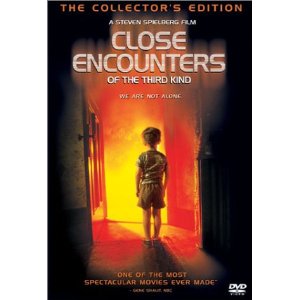
What with the US Navy admitting that UFOs are real and all, it seemed like a good idea to watch Close Encounters of the Third Kind over the holiday weekend.  Like many of my generation I saw it in a theater—itself kind of a distant memory—back in 1977.  I’m not sure why it’s been on my mind lately, but since it’s a long movie it takes a long weekend to accomodate it.  As we settled down to classic Spielberg scenes—lots of khaki and crowds and desert locations—it was a reminder of how silly we all looked in the seventies.  (What were we thinking?)  Other than that the film has aged pretty well.  The plot, although not action-packed, is probing and has several moments that seem to have inspired Poltergeist.  What made the film blog-worthy at this time, however, was the wearing of masks.

When Roy Neary and Jillian Guiler arrive at Devil’s Tower the governmental cover-up is in full play.  A nerve-gas leak—and who can check out whether such a thing really happened?—has a mask-wearing restriction in place.  I wondered where one could get a gas mask today when the crowd scenes of the pandemic won’t even leave a roll of toilet paper behind.  Checking for rubbing alcohol to make homemade hand sanitizer I found it selling for $300 per gallon on Amazon.  Where are we going to get a gas mask in circumstances such as these?  That particular scenario never really stood out to me before although I’ve seen the movie many times over the years.  Back when I was a student at Boston University the school tee-shirt worn by Barry Guiler was the interesting cultural context.

Films that survive the years take on different aspects over time.  Some suggest that a branch of the military admitting to the reality of UFOs during a pandemic was intended to underplay the event.  Others have argued that a similar release of information many months ago received similar lackluster interest.  If there are aliens out there, I have trouble imagining that they’d travel all this way for a synthesizer concert at a national monument that received a major uptick in visitors due to the movie’s release.  Maybe we love our fictional aliens more than the possibility of meeting those that seem to be vexing our navy?  The movie was the right choice for the circumstances, it seems to me.  Some things about the seventies are worth revisiting from time to time.  Strangely, in retrospect, life seemed simpler then.


Somebody Elsism

It’s 5:30 a.m. the day after Memorial Day and I’m out jogging.  I go out at this time because there’s not much likelihood of encountering many other people.  Oh, I know others are awake, but few are out on the trail at this time of morning.  I’m made a bit sad by the amount of trash I see along the path.  Yesterday turned into a pleasant afternoon and I suspect lots of people were out here then.  I even find the remains of some kind of homemade fireworks launcher, reminding me that it was supposed to be a patriotic holiday.  I’ve seen an uptick in Trump signs around here and I wonder if it has anything to do with the rampant somebody elsism that I see strewn along my jogging trail.

Somebody elsism is the attitude that I can make a mess of things and let somebody else deal with it.  (It’s my right as an American!)  Maybe you’ve seen it too.  The doggie doo-doo bags that are filled and left beside the trail for somebody else to pick up and dispose of.  It’s my right to own a dog, and although I may feel compelled to bag its leavings, somebody else will have to throw it away.  The idea’s pretty rampant.  I’ve even found such things on my front sidewalk.  I suspect this is a chapter in the myth of rugged individualism.  I have a right, but somebody else has the duty.

Life itself is like this, I guess.  We have to leave wills to help those left behind sort out the various messes we’ve made in our lifetimes.  Still, the Trump administration has all been about somebody elsism.  There is no such thing as controlled chaos.  The coronavirus should have taught us that, if we hadn’t figured it out long before.  Living together with other people requires a commitment to some basic things.  As much as I dislike yardwork, you can’t own a house and let the plants take over.  Your wild growth will seed somebody else’s weeds.  I’d rather be sitting inside reading.  It’s a holiday weekend and I have so little time to read during the week.  Won’t somebody else take care of the grass that has been loving the rain and warmer temperatures?  If only.  So I’m out jogging early, but I have to wait until it’s light.  There are so many things you can’t see before twilight kicks in, and unless somebody else picks them up I’m bound to step in them.


Remembering Cautiously

Memorial Day has a special poignancy when thousands of people are needlessly dying from a disease.  As the unofficial kick-off to summer, the holiday also marks the loosening of restrictions (most likely prematurely) and we can only wonder how many more will die when our usual carelessness resumes.  I’m not alone, I suspect, in hoping that this crisis will have brought some permanent changes, such as thinking about others.  It’s almost impossible to hope that such consciousness will rise to the level of government, of course, but if we the roots of the grass care for one another won’t that care naturally grow to a national level?  Americans have long loved the myth of rugged individualism.  There may have been a day when that was plausible, but we are now so interconnected that anyone considered successful has become so only because of considerable support of others.

This holiday is all about remembering.  Unfortunately remembering our war dead hasn’t done much to prevent wars.  If they’re not the acting out of our fears (as every belligerence since World War II seems to have been) then what are they?  Phobias of communists, terrorists, and assorted “others” lead us into mass killing, often for economic gain.  What if we were to put those vast military resources toward fighting a deadly disease?  What if we had a national will to take care of our people rather than to enrich ourselves?  Wouldn’t we be all the richer for it?  Instead we face more needless deaths, more people to remember on the next Memorial Day.  Maybe the sun will be shining then.

Those of us non-essential workers who’ve nevertheless been working remotely these past two-and-a-half months have a day off today.  Many will want to gather, but we know it’s not really a good idea.  We know the way infection works.  We have no battle plan against COVID-19.  We’re chomping at the bit for economic vitality, forgetting that those who are on the front lines are continuing to get sick.  It’s strange to have a holiday under such circumstances.  The warmer weather invites us outdoors while the plague drives us inside.  There’s a place for bravery, but when bravado masks itself with foolishness there will be a price to pay.  It’s Memorial Day and we can honor our dead by not rushing to join them with unreflective premature relaxing of safety measures.  Let’s stay safe this holiday by remembering what we’ve learned.


Ancient Technology

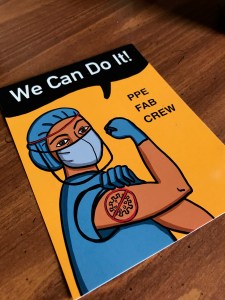
The pandemic, like any news event these days, has generated a whole new vocabulary.  I had to look up PPE on Google (Personal Protective Equipment, if you live in a cave like me).  I want to help with the effort to curb the coronavirus, but being a non-essential worker, I’m not sure what I can do.  Then my wife found an organization making PPEs.  In this case the equipment they make is face-shields.  And they were looking for, believe it or not, transparency paper.  Well, it’s really not paper, but acetate.  Although we’ve had to move several times since being pushed out of the Nashotah House nest, when I went looking for that box of transparency film that I paid for out of my own pocket in the PPPD (Pre-PowerPoint Days), I found it without too much trouble.  We still had 25 unused sheets left, and we donated them to the cause.

Nashotah House used to have one semester of required Hebrew and one semester of Greek.  Since the curriculum was highly regulated in those days, there was no opportunity for further courses in either language.  If you teach Hebrew you know that no textbook assumes just fourteen to sixteen weeks to learn it.  I quickly gave up using textbooks and had students begin translating as I walked them through it.  I had to use an overhead projector since Nashotah had no internet connection until the turn of the millennium.  It was such a small account that the cable companies didn’t want to go all the way out there to lay the physical lines then necessary for connectivity.  So I bought transparency film.  I even learned how to run it through my printer which, thankfully, wasn’t dot-matrix.

Over the years I bought quite a few boxes of the stuff.  Then the Enlightenment.  Let there be PowerPoint.  I converted all my teaching to PowerPoint slides while others made fun.  When my services were no longer required, I had to purchase a projector so that I could continue to teach on a freelance basis.  But I kept that expensive transparency film.  Now it is out there covering faces, and hopefully, unlike seminary education, saving lives.  As an erstwhile teacher of Greek and Hebrew I’ve found myself having to make some flashcards to learn the new words the crisis is giving us.  It’s a good thing, then, that when I was looking for transparency film I also found a couple packs of unopened index cards.  Sometimes antiquated pedagogy is commodious after all.


WHO Knew 2?

According to Mark Twain’s taxonomy there are lies, damned lies, and statistics.  Right now about all we have are in the last of these categories under the most statistical administration in history.  Still, if we want to get out of the house once in a while we need to look for some facts.  I keep coming back to the World Health Organization daily situation report here.  That’s because I trust WHO.  It’s an ethical, international organization not in the rear pocket of the self-proclaimed genius that puts that pocket beneath his holy posterior in the Oval Office.  In fact, just this week said genius threatened to make the United States’ contributions to WHO disappear forever unless they met his demands.  China, on the other hand, upped their contribution by a couple billion.

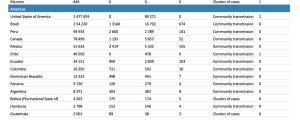
I don’t have the time, or certainly the numerical capacity, to read the entire report daily.  Nor to internalize all the vast numbers of cases and deaths worldwide.  It’s too much.  Still, I stop to check the places I know, including the one in which I happen to live.  There may be a time delay here since I check the reports early, and since the data from which I’m drawing came from yesterday, but still I have to wonder.  According to the stats provided by our grand ole US of A, there were no new COVID-19 cases on Wednesday.  We went from 1,477,459 to zero in one day.  Actually, the day before (Tuesday) we reported 31,967 cases.  Don’t believe me?  Go ahead and check; I’ll wait.

Not born yesterday (not by a long shot), I know that numbers sometimes have to be adjusted.  I receive a salary, so I know that well.  At the same time, we have a statistician-in-chief that had only days before threatened—blackmail is what we used to call it, if the other party had actually done something wrong, which doesn’t really apply—to remove all funding in saecula saeculorum.  Can I get an amen?  Many of us, perhaps even most, learned early in life that you don’t get what you want by throwing a tantrum.  Of course, most of us didn’t grow up filthy rich.  Most of us can’t afford to buy the presidency.  Heck, most of us have trouble making the rent or mortgage.  So we have this great statistical anomaly whereby one spoiled kid says if you don’t play by my ruse, I’ll take my marbles and go home.  And I’m not lying.


Qohelet’s Washcloset

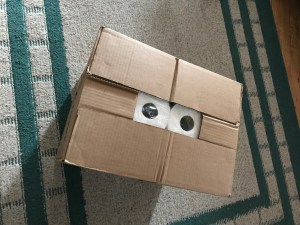
Cast your bread upon the water, as Ecclesiastes says, and it will come back to you when you need it.  Since bread is a common slang word for money, and since the toilet paper has arrived that I ordered two months ago, I see the truth in this.  Paper spent for paper to use.  While I’m pretty sure that’s not what old Qohelet exactly had in mind, it is the reality in which we live.  There are experts that tell us the toilet paper shortage isn’t due to panic buying, but over eight weeks into this crisis and the shelves in Target and grocery stores still look like Mrs. Hubbard’s cupboards.  All those people working from home must need more fibre in their diets.  Or is it less?  I can never remember.  What other than bread satisfies?  Clearly toilet paper does.  And the fact that the nearest yeast, according to Siri, is in Tennessee, clearly has nothing to do with panic buying.  Nothing at all.

People will go to any lengths to prove that we’re rational beings.  We don’t like the image of being the panicky herd beasts we are.  When I first realized the crisis was hard on us, it was March 16.  That was my first grocery store trip where beans were as rare as moral Republicans and we still can’t find pasta or flour around here, even with stores stocking daily.  The announcements on the loudspeaker beg buyers to get only what they really need, and leave some for others.  The thing about panic, though, is that it’s anything but rational.  It’s based on emotion washed in the myth of scarcity.  It also shows what an unregulated economy soon devolves into.  I’m sure many people rationalize panic buying as “just until things get back to normal.”  Vanity, vanity, says Ecclesiastes.

Instead of the myth of scarcity we should believe in the myth of normalcy.  That should’ve ended, for any reasoning being, in November of 2016.  It isn’t normal for a prosperous nation to offer up someone who clearly has no governing ability for the most powerful office in the land.  Two months into the largest crisis we’ve seen since the days of FDR and the White House response has been the null set.  Meanwhile, I ordered toilet paper from abroad on March 16.  The ship slowly made its way across the Pacific from China where, I understand, toilet paper is abundant.  I’m just glad that there’s a rational explanation for all of this.