Still Early

I’ve been thinking quite a bit about the history of horror movies of late.  Although they began being labelled “horror” in the early 1930s, the idea had been around for some time.  When I learned that the problematic director D. W. Griffith presented an early horror film based on Edgar Allan Poe in 1914, I had to see it.  Fortunately it’s easily found.  Long in the public domain, this silent film can be watched in its entirety on YouTube.  The Avenging Conscience is an adaptation of “The Tell-Tale Heart.”  The set-up is quite different, and it has a happy ending.  The characters aren’t named, apart from the sweetheart, who is called Annabel.  She’s taken from Poe’s poem “Annabel Lee,” which is also used in the film.  A young man owes his good fortune to his uncle, who raised him as an orphan.  When he falls in love with Annabel, the uncle objects.  The lad owes him loyalty.
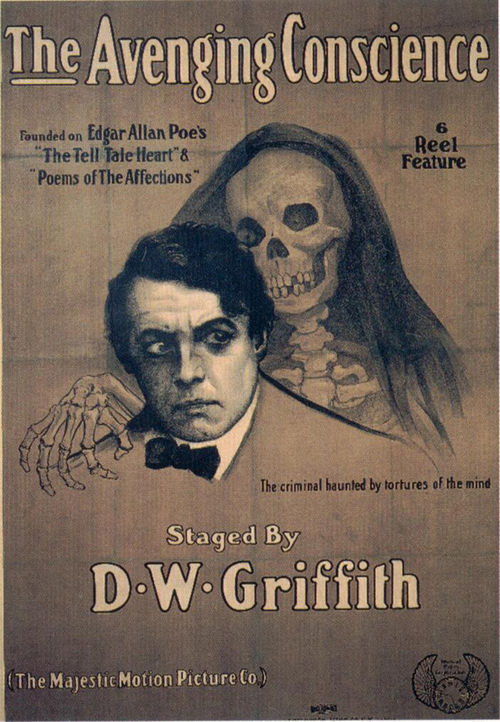
The young couple decide to break up, so as not to upset the uncle.  The young man has been reading “The Tell-Tale Heart,” and thinks about killing his uncle.  He falls asleep in a chair and when he awakes decides to do the murder.  He is witnessed, however, by a passer-by.  He has to pay him off, but he is now free to pursue his love.  He walls the body up next to the fireplace.  A detective, alerted by the uncle’s friend, interviews the young man and the tapping of his pencil reminds the nephew of a beating heart.  He begins to see the ghost of his uncle.  His guilt eventually comes out and he begins a shoot-out with the detectives.  When he can’t win, he hangs himself, which causes Annabel to leap off a cliff in despair.  Then he wakes up.  The uncle is still alive, and has had a change of heart about the young lovers.  The couple marries and a weird coda involving Pan and some strangely dressed children, apparently a book the nephew wrote, winds things up.

The ghosts, insanity, and the murder mark this as early horror.  Although the actual deaths, except the uncle’s, take place off screen, they are still horror territory.  And, of course, horror properly didn’t quite exist.  Although The Avenging Conscience can’t really take credit as the first horror film, it is certainly an early one.  And it is based on Poe.  Silent, black-and-white, and not really scary at all, this movie has a place in the history of what we now recognize as horror. Watching it is to watch a bit of history.


Poe Day

Perhaps best known for his rabidly racist The Birth of a Nation, D. W. Griffith was nevertheless influential in early filmmaking.  I’m fascinated by how literature made its way to celluloid, particularly in the early days.  It was thus that I discovered Griffith’s Edgar Allen [sic] Poe, a silent film from 1909.  A dramatized version of Poe’s writing of “The Raven,” this seven-minute movie opens with Virginia Poe—the “Lenore” of the poem—in the process of dying at the Poe’s hovel.  Not able to keep warm or to find nourishment, she languishes on a cot until Poe arrives home and covers her with his coat.  At that moment a raven appears on the bust of Pallas above the chamber door, leading Poe to write the poem in a white heat.  He knows it’s a masterpiece and leaves Virginia promising success.

In a scene only too familiar to any writer, Poe takes the poem to the publishers, three of whom simply dismiss him, the third laughing at his work.  This particular scene rings so true.  A fourth editor buys it from him on the spot.  This is, in fact, how publishing works.  I’ve had 33 short stories either published or accepted for publication.  By far the majority of them were rejected multiple times.  One of them, previously turned down by six editors, ended up winning a prize.  So it goes.  You’ll never find an editor who “gets” you every time.  Even those who like your work may eventually start sending you elsewhere.  I often wonder how many writers of what would be classics died unpublished because of some editor’s choice.  But back to Poe.

Screenshot: public domain,

Newly paid for his work, he buys food and a blanket and returns home jubilant.  Of course, it is only to find Virginia dead.  Poe’s life did have its share of intense drama.  His death remains mysterious all these years later, and Virginia’s death was a severe blow to him.  “The Raven” was published in 1845 and Virginia died two years later, with Poe himself passing yet two years beyond that.  This film, which I learned about from Jonathan Elmer’s In Poe’s Wake, was made sixty years after Poe’s death.  He’d already become an icon by then, instantly recognizable in pancake makeup.  But even now, more than a century later, publishing is still a matter of the same process.  One of my own novels has been declined over 100 times, despite having once been under contract.  I do know the feeling of being rejected by publishers, even as I participate in a ritual as old as writing for publication.  Happy birthday, Mr. Poe.