
I’ve been thinking quite a bit about the history of horror movies of late. Although they began being labelled “horror” in the early 1930s, the idea had been around for some time. When I learned that the problematic director D. W. Griffith presented an early horror film based on Edgar Allan Poe in 1914, I had to see it. Fortunately it’s easily found. Long in the public domain, this silent film can be watched in its entirety on YouTube. The Avenging Conscience is an adaptation of “The Tell-Tale Heart.” The set-up is quite different, and it has a happy ending. The characters aren’t named, apart from the sweetheart, who is called Annabel. She’s taken from Poe’s poem “Annabel Lee,” which is also used in the film. A young man owes his good fortune to his uncle, who raised him as an orphan. When he falls in love with Annabel, the uncle objects. The lad owes him loyalty.
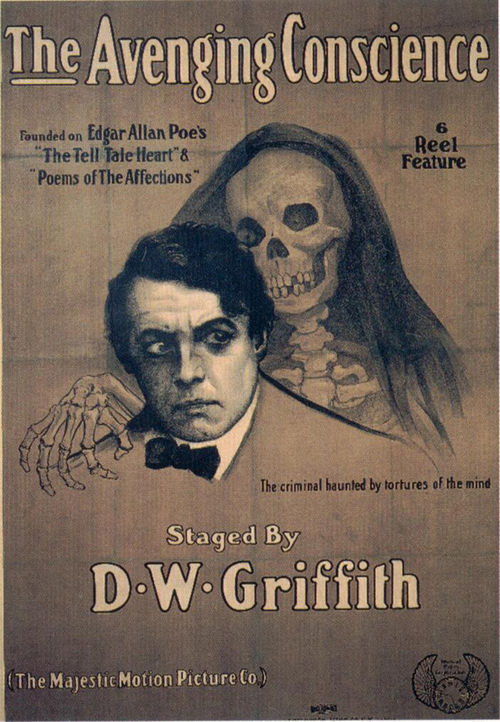
The young couple decide to break up, so as not to upset the uncle. The young man has been reading “The Tell-Tale Heart,” and thinks about killing his uncle. He falls asleep in a chair and when he awakes decides to do the murder. He is witnessed, however, by a passer-by. He has to pay him off, but he is now free to pursue his love. He walls the body up next to the fireplace. A detective, alerted by the uncle’s friend, interviews the young man and the tapping of his pencil reminds the nephew of a beating heart. He begins to see the ghost of his uncle. His guilt eventually comes out and he begins a shoot-out with the detectives. When he can’t win, he hangs himself, which causes Annabel to leap off a cliff in despair. Then he wakes up. The uncle is still alive, and has had a change of heart about the young lovers. The couple marries and a weird coda involving Pan and some strangely dressed children, apparently a book the nephew wrote, winds things up.
The ghosts, insanity, and the murder mark this as early horror. Although the actual deaths, except the uncle’s, take place off screen, they are still horror territory. And, of course, horror properly didn’t quite exist. Although The Avenging Conscience can’t really take credit as the first horror film, it is certainly an early one. And it is based on Poe. Silent, black-and-white, and not really scary at all, this movie has a place in the history of what we now recognize as horror. Watching it is to watch a bit of history.
 Steve A. Wiggins