Not a Flower

There are occasional benefits from my attempts not to learn about movies before I watch them.  I approached Bugonia unaware of what it was about, or about its twist ending.  That ending makes it a difficult film to discuss in any detail, but I’ll start with the question of how to classify it.  Different websites use different designations: horror, sci-fi, dark comedy, thriller, satire, crime, and so forth.  In some ways it’s genre-defying, like Everything, Everywhere, All at Once, Parasite, and Poor Things.  A movie that will get you thinking and one that’s exceptionally good at misdirecting you.  While not a financial success, it received critical acclaim.  It does follow a storyline, and there are hints of what’s “really” going on as the story unfolds.  Here’s the basic idea, without spoilers (I hope).
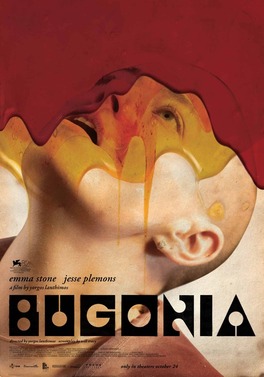
Teddy Gatz is a conspiracy theorist and mentally unbalanced.  His mother is hospitalized in a coma, having been a drug addict, and he was abused as a small boy by his babysitter.  His autistic cousin Don goes along with what he says.  Teddy is planning to kidnap an alien, the CEO of the company for which he works.  He’s convinced she (Michelle) is from Andromeda and that her mothership will be in range during the upcoming lunar eclipse.  He believes the Andromedans are killing all the bees.  He and his cousin pull off the kidnapping and imprison Michelle in their basement.  He interrogates and tortures her.  She tries to convince them that this is all a mistake, but Teddy is very certain of his convictions.  Michelle finds her way into a secret room long enough to use Teddy’s conspiracy theories against him.  He takes her back to her office so they can meet the mothership.  I’ll leave it at that.

There are definitely some funny bits to it all.  It’s also a poignant movie.  At times it felt like it was making light of mental illness, but in context it really doesn’t.  The film has a strong ecological message and a somewhat disturbing final melange of images.  Is it horror?  It definitely has some elements of the genre.  I wouldn’t say that it’s the best overall classification, though.  I’m not really sure what that might be.  The thriller elements are clearly there.  It’s the kind of story for when you’re in the mood for something disorienting and a bit threatening.  I haven’t figured out the title yet, but it is the kind of movie I’m glad to have watched.  With no warnings.

Not Poor

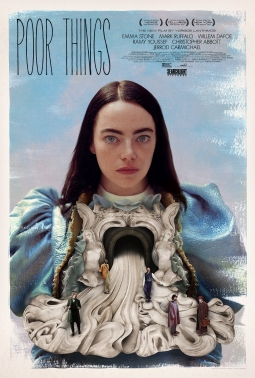
It’s an amazing era for cinema.  A number of genre-defying films have emerged and some of them are quite striking.  Some months ago I saw Everything Everywhere All at Once.  Some called it horror, but that label didn’t really stick.  It reminded me of Parasite, another movie difficult to classify.  Casting about for something we might both like, my wife and I settled on Poor Things, recommended to me by a fellow horror fan.  Other than being amazed by it, I have no idea how to classify it either.  Again, there are horror elements here but it’s certainly not a horror movie.  A comedy, yes, but a dark one.  It’s a movie that has a feminist message, but one that’s been disputed.    Perhaps a quasi-summary might help.

Bella Baxter is not what she seems.  Cared for by a Frankenstein-like doctor named Godwin, she literally has the brain of an infant in an adult body and is rapidly coming to know the world.  Rescuing her just after she died by suicide, Godwin transplanted her unborn baby’s brain into her revived body to see what would happen.  Himself experimented on mercilessly by his own father, Godwin is a rationalist, eschewing emotional entanglements.  He decides to marry Bella to one of his students but before that can happen an unscrupulous lawyer steals her away only to find he can’t control her.  After gaining experience of the world, and learning life lessons in a brothel, Bella returns home to marry her fiancé and be with Godwin as he dies.  Her cruel former husband reclaims her only to have Bella realize why she’d chosen suicide in the first place.  She returns to Godwin’s home and sets up life on her own terms.

A number of things stand out.  One is Bella’s innocence and utter lack of shame regarding her body.  Emma Stone’s acting here is incredible.  Another is the nods to steampunk sensibilities in a story set in Victorian times.  Perhaps the aspect that most caught my attention was Bella’s use of “God” as her name for Godwin, frequently calling him “my God.”  Her grammatical naivety leads to much of the comedy in the film, but this particular choice is freighted with interpretative possibilities.  Obviously, one’s parents are the models one incorporates into concepts of God.  That has been long recognized.  Another, however, is that Godwin did, in fact, create her to see what she would become.  As Godwin faces his own mortality, Bella notes “God is dying.”  What happens after this is that she becomes her own woman for the first time, not under the control of men.  I’m not sure how to classify Poor Things apart from a movie that may require another watching just to attempt a classification.