Rabbit Hole Crawl

Rabbit holes can be fun.  They can also leave you scratching your head.  David Schmoeller directed some third or fourth drawer horror films, among which is Crawlspace.  Having fallen down the Schmoeller rabbit hole, I found it streaming at the cost of frequent commercials.  Hey, that’s how I watched movies as a kid, so why not?  I was drawn to the movie by Klaus Kinski.  He is arresting on camera and directors knew it.  He was also famously difficult to work with.  Schmoeller apparently tried to get Kinski fired from Crawlspace, but without him it would’ve been a nearly complete waste of time.  That’s because Schmoeller’s story (he also wrote it) doesn’t make a ton of sense, even if it introduces some fascinating themes.  So Gunther (Kinski’s character) is a landlord.  He rents rooms in his house to young women that he murders, after spying on them through the eponymous crawl space.
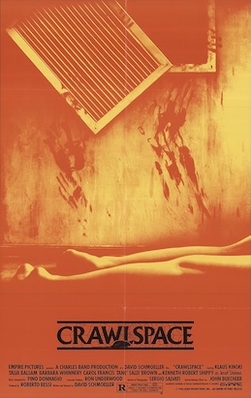
Why does he murder?  Because his father was a literal Nazi and Gunther has tendencies in that direction.  He’s conflicted, though.  A medical doctor, he saved lives.  He also killed.  Caught up with the God-like power of determining life and death, he explores it at the expense of young women.  And their erstwhile lovers.  And occasional visitors.  Kinski pulls off this double life persona, making him believable.  Even so, the story doesn’t have much other depth.  There’s a lot of crawling around HVAC vents and inventing of insidious ways of murdering and tormenting people.  When Gunther finally loses it and puts on make-up and dresses as a Nazi it’s clear that this is the endgame.  I won’t spoil the ending, but I can say there’s a bit of irony there.

I first became aware of Klaus Kinski through his mesmerizing performance in Werner Herzog’s Nosferatu the Vampyre.  His is one of the best vampire portrayals in all of cinema, in my opinion.  I wonder at the confidence of someone so difficult to work with and yet who appeared in more than 130 films.  I’ve been fired for doing a good job at least three times.  But then, I’m not a professional actor.  At least two of the directors Kinski worked with (Herzog and Schmoeller) made documentaries about how difficult he was.  There were rumors that both wanted him killed.  And yet he made a living acting.  (He was also married, and divorced, thrice.)  I’ve seen him in a handful of films and he does, in what makes it through to the final cut, command attention.  Without him Crawlspace would simply be a hole in the ground.


Zoning In

Born Jewish, and Unitarian by choice, Rod Serling believed in the inherent worth and dignity of all human beings.  Like many people, even Serling believed that season four of The Twilight Zone, which went to an hour format from the usual half, didn’t really work.  Nevertheless, the fourth episode of that season,“He’s Alive,” really should be required watching of every person in the United States.  This episode was written by Serling and it focuses on a young American fascist who’s having trouble gaining a following.  A shadowy figure then reads to him from what sounds exactly like Trump’s playbook, and soon decent people are raging along with him about foreigners and those who are different.  When the shadowy figure is finally revealed, we’re not surprised to learn it is Hitler.

The young man obeys without question, and soon it looks like he could be elected.  He has one of his best friends killed as a martyr to the cause.  He murders an old Jewish man who has cared for him since his youth.  He declares himself made of steel, with no feelings.  And when he ends up dead (everyone knows how Hitler’s career culminated), the spirit of Hitler rises from his body as Serling warns that wherever hatred exists, Hitler still lives.  Now this episode aired in 1963 but it could’ve been 2016, or 2024.  Prescient people, like Rod Serling, knew that mob thinking could be easily exploited.  Even in the first segment after the introduction the instructions are laid out.  Play on people’s fear of those who are different.  No matter how good things may be, people will be unsatisfied.  Add any power-hungry individual and you’ve got the recipe for a fascist overtaking.

The episode made me wonder if we could ever become a just society.  Ironically, that which calls itself “Christianity” these days stands in the way.  In its day, The Twilight Zone was amazingly influential.  It had a great impact on what was to follow and it’s still regularly referred to, even by those who’ve never seen an episode.  If only we’d pay attention to its message.  I’ve been making my way through the entire series, slowly, over the years.  Now and again an episode will really hit home.  I have to admit that I was physically squirming during “He’s Alive.”  It’s not that it is the greatest episode of the series, but its message is extremely timely.  The requirement for a better world is simple, but seemingly impossible to reach.  Treat others as you wish to be treated.


Eschew Stupidity

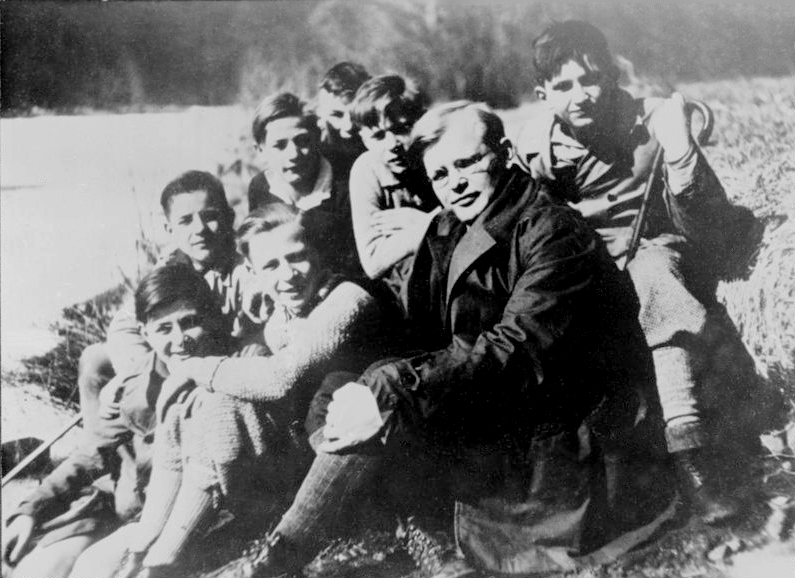
Dietrich Bonhoeffer was a certified evangelical Christian.  His theology often feels a bit pat to some of us who work in religious studies, but there’s no doubt that Bonhoeffer was a brilliant man.   Bonhoeffer believed in Jesus but resisted Hitler.  In fact, that resistance cost him his life.  My brother recently sent me a Facebook Reels video on Bonhoeffer’s observations about stupidity, which Bonhoeffer believed was far more dangerous than evil.  I shared that video in my feed on Facebook yesterday, and it is well worth listening to.  Stupidity isn’t a badge most people would wear proudly.  We all do wear it from time to time since we’re only human.  The real problem, according to Bonhoeffer, is when crowds start becoming stupid.  We’ve seen it time and again.  We’re living in such a time right now.  The antics coming out of DC right now have thinking people everywhere wondering how this is even possible.  Listen to Bonhoeffer.

Photo source: Bundesarchiv, Bild 183-R0211-316 / CC-BY-SA 3.0, Wikimedia Commons

I don’t take Bonhoeffer uncritically.  Some of us—generally without tons of friends—think critically by default.  (The women in college all broke up with me because “You’re too intense.”  I credit my wife with sticking with me, although she tells me they were right.)  Anyone can learn critical thinking.  The problem is, keeping the skill is hard work.  And the internet doesn’t help.  Whenever anyone makes a claim, personally, my default response is “How do they know?”  Yes, I do look up references.  With my particular brand of neurodivergence, I seldom trust other people to know something unless they’re experts.  (This is something the current administration is a bit shy on.)  I even question experts if their conclusions look suspect.  “Nullius in verba” is written in my academic notebooks.  Something, however, is obviously clear.  Bonhoeffer was right about stupidity.

I’m not sure what an unfluencer like myself hopes to gain by discussing this.  I do hope that folks will listen to Bonhoeffer if they have concerns about my thought process.  My deeper concern is that the church often encourages stupidity.  Unquestioning adherence to something the facts expose as untrue is often lauded.  It makes some people saints.  Churches require followers and often distrust critical thinkers.  That once cost me my job, sending my career into a tailspin.  This was well pre-Trump, but some in authority didn’t appreciate critical thinking on the part of faculty.  (Ahem, that’s what we’re paid to do).  I’m not anti-belief.  Anyone who really knows me knows that I believe very deeply in the immaterial world.  And I know that Bonhoeffer did too, right up to the gallows.


Learning Bunnies

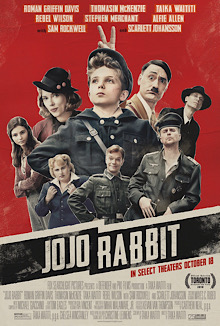
Although it was released during the first Trump administration, Jojo Rabbit was written before he was sharp bit of dust in the GOP’s eye.  Still, in the second debacle, it seemed like a good time to watch it.  Its message is appropriate for any time, but especially now.  Jojo is a ten-year-old boy who’s an enthusiastic member of the Hitler Youth.  So enthusiastic that he has Hitler as his imaginary friend.  He buys the party line without even thinking (he who has ears to hear, let him hear).  Jews are evil, according to the rhetoric.  Monsters even.  Jojo’s mother tries to help her son, missing his father, understand that love is the better way.  Then Jojo discovers something.  A girl his deceased sister’s age has been living in the walls of his sister’s room.  He quickly deduces that she is a Jew.  Were it not for her threats to implicate him and his mother, he would turn her in.

An unusual coming of age story, we see Jojo do something rare—he matures.  Getting to know Elsa he can’t reconcile what he sees with what he was taught.  She’s not evil.  She has no horns.  She’s not rich.  She fell in love with a guy and wants the same thing anyone wants.  The conflict faces Jojo every day as he decides he must learn about Jews to report this intelligence to the authorities.  The authorities, however, know Germany is losing the war.  It’s only a matter of days.  When Hitler dies by suicide, Jojo fully realizes that he has been simply following along instead of following the evidence.  His mother was hanged for not being loyal to the party and his father, he learns, was also helping the Jews.  In a moment of singular hope, Jojo grows up.

Movies can teach lessons.  Some are widely enough viewed to make a major impact on society.  Can any of us imagine a world without Darth Vader and Luke Skywalker?  In this era when sensible people seem to have forgotten that fascism is evil in its nature, films like Jojo Rabbit are important.  Thinking is not a crime.  Learning is not a crime.  Even if they’re being touted that way by the wealthy in order to protect their privilege.  We watched the movie for entertainment on a Friday night, but I received an education instead.  I wonder just when the message of love fell out of Christianity.  But then, I think it becomes clear when you think about particular movies and how we’ve come to be where we are.


Politicking

It was weird seeing my face on a 27 x 40 poster.  When I went to give my campaign speech I was wearing dress clothes that I’d bought at Goodwill.  My “campaign manager” said I did a great job, being witty and somehow confident.  I didn’t win.  Still, my stint in politics was not yet over.  The next year one of the presidential candidates asked me to be his campaign manager.  I took on the job with gusto, and, claiming no credit, I would note that he won.  So where was all of this politicking going on?  At the United Methodist Church Conference Youth Council.  I ran for council secretary one year, and lost.  I kept the poster with my face on it for a few years but the ink faded and the paper was cheap, and besides, I’ve never considered myself much to look at.

Thinking about the resources allocations (I didn’t pay for the poster—couldn’t have if I’d wanted to), I have to wonder about the priorities of the church.  Of course, it was only much later, after I’d gained significant seminary experience myself, that I realized just how political a job “ministry” is.  Yes, I had students while I taught in seminary, already strategizing on how to become bishop.  It was a political game.  Such games are no fun without power.  And money is power.  So maybe the Western Pennsylvania Conference was funding some learning experiences on the impressionable minds of the young.  It just took me a few extra years to catch on.  (Some things never change.)

I dislike politics.  Even now I wouldn’t feel compelled to do anything beyond voting my conscience were it not the clear and obvious danger that we’re in, courtesy of what used to be a conservative political party.  Any party that can’t keep a demagogue from receiving its nomination has embraced fascism and that’s a perilous road to travel as Germany and Italy discovered about a century ago.  My dislike of ecclesiastical politics certainly played a large role in my decision not to pursue ordination.  I’ve been a church insider, and what happens at board meetings?  Politics.  The person in the pew often doesn’t realize just how political religion is.  I learned Robert’s Rules of Order from church meetings.  My nomination to elected office in the organization led nowhere.  I was left wondering if there’s anywhere left that politics don’t apply.  The print on the poster faded.  The very last time I unrolled it, it was completely blank.


Night Mom

Kurt Vonnegut is one of those tragicomic writers that can leave you reeling.  Mother Night was never on my must-read list, although I’ve read about it many times.  Reading about a novel isn’t the same as reading it, of course.  I picked it up in a used bookstore earlier this year when I didn’t want to walk out empty handed.  I go into such stores with a list and try to limit myself to it.  If they have nothing on the list, I try to find an author I know.  Since I’ve read several Vonnegut novels, I have an idea of what I might find.  This one was pretty bleak, though, but then the subject suggests as much.  Those critics that say it’s funny are made of sterner stuff than yours truly, I guess.  

The story is the account of a Nazi propagandist who’s actually an American spy sending encoded messages through his radio broadcasts.  Throughout the novel he’s conflicted because he wants to be left out of the business of war, and yet he’s aware of the potential for evil on both sides.  It’s a chilling book to read in the light of Trump because American nazis feature pretty prominently in the plot.  Howard W. Campbell, Jr. is on everybody’s hit list—American Nazi haters/hunters, Russian Nazi haters/hunters, and Israeli Nazi haters/hunters, and even on his own hit list.  His role in the war made him look like a Nazi.  Vonnegut has some profound things to say, such as:  “Say what you will about the sweet miracle of unquestioning faith, I consider a capacity for it terrifying and absolutely vile.”

And this: “Where’s evil? It’s that large part of every man that wants to hate without limit, that wants to hate with God on its side.”  The book was published before I was born, and that took place about six decades ago.  The set-backs we’ve seen since then make this one of Vonnegut’s most disturbing books.  I have no doubt that he was a haunted man.  Like many who’ve been through war, he has neither luxury nor appetite for politicians and the immoral games they play to retain power.  Mother Night deals with evil and its ambiguity.  And the sad fact that as much as two people love each other and want to separate themselves from the troubles of the larger world, it’s simply not possible to do so.  The reasons for this are far too obvious but since we have difficulty seeing the obvious, novels like this are necessary.


In War’s Domain

Good for absolutely nothing, to borrow the wisdom of Edwin Starr, war has again marred Europe.  We could see it coming from afar because people keep electing autocrats and strong men always want to fight one another.  There should be international laws banning their election, but instead innocent people die because one man has to prove he’s bigger than another.  The evils of the Trump years will be with us for decades.  There’s nothing Christian about waging war.  Seems that some folks have forgotten their Sunday School.  Wasn’t the selfless, self-sacrificing carpenter from Nazareth known as the “prince of peace?”  Of course, Ukraine became Christian long before Russia did.  What deep-seated insecurity such “world leaders” have!

While not wanting to be drawn into open conflict yet again, the world has pretty much all sided with Ukraine.  It has the misfortune of being nestled next to a weary nation with a dictator who despises the west.  Who pulls down his pants and shows off his missiles when anyone starts to open their mouth.  Who isolates himself and his people in the name of self-aggrandizement.  We came close to that over here.  So close that it still makes me shiver.  We feel for the people of Ukraine.  They did nothing to provoke attack, and they probably knew other world leaders would keep their distance.  Putin, like Stalin, wants a USSR.  An empire to put the evil west in check.  Hadn’t we left that kind of thinking behind?  Hadn’t we grown up after World War Two?  Strong men learn nothing from history.  They look at it and see only a mirror reflecting only themselves.

Hitler annexed Poland.  Russia, which has more land than it knows what to do with, doesn’t need Ukraine to be part of it.  The good people of Russia are protesting, just like the women brave enough to march on Washington to protest the fascism America embraced for four years.  I’ve put off writing about this because it’s so difficult to do without dissolving into tears.  Beware of either bare-chested or chest-thumping politicians worldwide!  It’s time to end the era of the alpha male.  We need mothers to nurse us back to health.  They call it “Mother Russia” but what mother acts this way?  The women aren’t impressed, Vlad—they’re in the streets bravely protesting.  It’s International Women’s Day.  Let’s honor women. It’s time to let the women lead.  It’s time to put war behind us forever.

Photo by Jenna Norman on Unsplash

Banning Ideas

It’s been in the news lately that some communities, in keeping with the current fascist trends, are starting to ban books.  One of the plays in the Nazi book was to burn them, followed soon after by destroying the people who read them.  Ideas are, by their very nature, dangerous things.  Trying to destroy them by banning books, however, doesn’t work.  The kinds of books being banned are predictable: those that portray races as equal, those that offer understanding and acceptance of those differently gendered or oriented, and books that show the white man caught with his pants down (metaphorically, although in actual life this happens quite often literally as well).  Books premised on lies are just fine, but as soon as we get to ideas that make us think, well, we ban and burn.

Book banning is normally presented as protecting the children.  Something any attentive parent knows is that children understand a lot more than we think they do.  I suspect they realize that books are prohibited because they contain the truth.  Nobody bans a book of “harmless” fantasy—books where white men have all the answers and solve all the problems.  And when they lose their tempers they start wars, which, of course, the white guys always win.  Such stories, based as they are on basic untruths, are fantasy indeed.  Our slow move into the new millennium from the growing awareness of the sixties, has shown us the necessity of looking deeper.  Expanding beyond the stories white men tell to comfort themselves.  Those invested in this narrative are very reluctant, of course, to let it go.

The more we move into the new millennium the more determined we seem to repeat the last one.  That one had a pandemic near the beginning and wars and white men only on the front pages.  The younger generation, thankfully, by and large doesn’t share these poison biases.  They were read to as children.  Teachers and other heroes didn’t ban books, but encouraged reading them.  Local communities are making a concerted effort to break down learning and then we wonder why the United States has the highest infection rates in the world.  If only there were some way to figure out why that might be!  Reading books with uncomfortable truths might be a good start.  Ideas that can’t stand up to logical challenges may not be the best ones for building a society.   Read a book rather than banning it, and see if we all might learn something.


Last Baptist?

The Southern Baptist Convention is the largest Protestant denomination in the United States.  It’s the core of a powerful voting bloc that gave electoral (but not popular) victory to Donald Trump.  It’s also the location of an attempted takeover by a fascist faction that wants to make Christianity the most oppressive religion in the history of the world (moreso than it has already been).  This past week the Convention narrowly avoided this by electing a moderate president for the year.  The struggle was real and the consequences very deep.  The true cost of Trump’s presidency will continue to emerge for years to come.  Permission was given for extremists to be vocal and validated and bad behavior was relabeled as “Christian.”

Roger Williams’ first Baptist church (in the country)

We, as a society, have a bad habit of ignoring things we don’t believe in.  Just because many educated people have come to see the lie behind much of what “Christians” say, they assume they don’t need to pay attention to them.  Years of ignoring the insidious actions of many conservative Christian groups has led us to a political precipice where many months after the fact some people who can’t count still believe 232 is greater than 306.  While some may wonder how we’ve come to this point the answer is obvious—there are groups of “Christians,” organized and well funded, who’ve been active in politics for many decades.  The Southern Baptist Convention wanted, in some sectors, to make that official.  They wished to be Trump’s own party.  They wanted white supremacy to be the norm, women to be chattels of men, and those whose sexuality differs to be criminals.  And they nearly won.

We ignore religion at our peril.  A recent study by the British Academy has shown that in the United Kingdom the study of religion is in decline.  I know of no similar study this side of the Atlantic, but anecdotal evidence suggests the same, if not worse here.  Those who study religion from within other disciplines such as sociology, history, or psychology, don’t really address the question of what religion truly is.  People experience religion as extremely urgent.  Misguided leaders instruct them that their version of God has endorsed the very tactics the Bible itself excoriates.  When the largest Protestant denomination is nearly taken over by political extremists, we should be paying attention.  A troubling template was, despite the majority vote, forced upon us in 2016.  So much so that it feels like it was a decade ago and we suffered from it for longer than we have.  And the kettle is still boiling, only this time those dancing about it claim to be Christian.


The Heart of Memorial Day

The Memorial Day will be a somber one for the many people who’ve lost someone due to Covid-19.  Even as those who know that science can help to bring a pandemic under control have been vaccinated,  it is too late for millions who didn’t make it.  Memorial Day weekend, for many of us in northern climes, has been unseasonably cold.  Around here it’s been rainy too.  The official kick-off to summer seems to be a memorial to the long winter of 2020 and ’21.  It’s also hopeful, because things are starting to get better.  Having an organized national response helps, even as the Fascist Party is gaining strength.  “Memorial” means looking back.  Remembering the past.  I’m saddened, shocked, and distraught that one political party has refused to look at how insidious fascism is, and how it always starts under the guise of righteousness.  Remember this.

We tend to think of Memorial Day as a play day.  Indeed, the number of boats being towed as I’ve been out driving attests to the plans of many.  We’re ready for life to return to normal, but even that involves memory.  Remembering what was normal.  We have never been a fascist nation.  That’s not a memory but a sick future dream.  Those who attempt insurrection and then block any investigation into it can’t have the good of the nation at heart.  It should be a play day.  It should be frolicking in the sun.  Instead I’m wondering how we’ll ever stop this apparently inevitable evil that has taken over a country formed as a democracy.  Has it stopped raining yet?

Although I wasn’t close to him, my father was a veteran.  He fought for the cause of liberty, at least as it was understood before Trump’s America.  He was, according to his family, never the same after seeing war.  Bureaucrats, fat from the monies they pocket from special interest groups and lobbies, seem to have forgotten.  They’ve forgotten the frighteningly large national cemetery at Arlington.  They’ve forgotten that we fought to stop the very thing they are now promoting in their own country.  I’m sorry, Mr. Lincoln, these dead may have died in vain after all.  I had hopes of warm days and leisurely outdoor activities as the end of May rolled along.  Either that, or at least being able to get out and take care of all the yard work that’s been piling up over the past several weeks.  I wonder, will it stop raining today?


Just Justice

Like many people raised to believe in democracy, I’m distressed to see that the right wing, worldwide, has taken to a full-on attack against it in an effort to keep power.  In the United States Republicans that stood up against the cult of Trump (who was no architect, but a figurehead only) are now being run out of Dodge by their own party.  Meanwhile a friend in Britain sent me an article about the open and obvious corruption of Boris Johnson and how the Tories are completely overlooking it in an effort to keep “democratic authority.”  It wouldn’t be so bad if the right wing came right out and said “we want to run things, no matter what it takes,” but instead they appeal to religious ideas and try to make it seem like their side alone appeals to “justice” while doing the exact opposite.  Paging Mr. Orwell…

The best test case is Jesus.  Have you noticed how Jesus has fallen out of right-wing Christianity?  Apart from occasionally taking his name in vain, the principles they stand for generally go against the core teachings of the Gospels.  The fascism of the right wing has taken what good there was in Christianity and jettisoned the kernel to keep the shell.  It’s like a bag of pistachios where all the nuts have been discarded, leaving only the hard casings behind.  The really sad thing is that both in the US and in Britain, these power-mongers are in the minority.  They use political loop-holes to make their strong-arm tactics look like the will of the people.  Things like restricting voting access, made possible by courtroom politics.  Isn’t Justice supposed to be blindfolded?

We know for a fact that many of these same people are fully cognizant that fascism led to World War II.  They know Hitler used the same tactics to gain power.  They know that millions and millions of people died.  And now they trumpet the one thing that brought this nation together—the recognition that fascism was evil—as the way of true Christianity.  I’m sometimes asked if I believe in demons, having written a book on the subject.  Demons are, if you look closely, are considered the source of evil in the world.  Quite often stories about them have them possessing good people by pretending to be something that they’re not.  Can demons take over entire political causes?  Did we not see naked evil in the Nazi regime?  How do we not recognize it now that it has taken root in one political party that has claimed the name of “Christian” while simultaneously discarding the teachings of Christ?


V November

“Remember, remember the fifth of November,” begins the parable V for Vendetta before opening on a government not unlike our own.  Fascist, built on hatred, an angry white man speaks for the few who worship nothing but power and call it God.  Tomorrow is election day, and V can also stand for Vote.  Two years ago our nation awoke in shock.  Since that day we’ve seen hate crimes transform from illegal to commendable as Neo-Nazis are described as very fine people and those who actually do the labor for the nation have been disenfranchised so the uber-wealthy can have tax cuts.  Violence isn’t the answer, but voting can be.  As soon as the GOP sensed it might lose, it began voter suppression measures.  They have never watched V.

The hope for any democracy rests in the volition to vote.  We have to be willing to inconvenience ourselves to get to the polling station tomorrow for an outcome that will decide the fate of this nation.  We’ve had “fake news” spewn out at every fact that is distasteful.  Open, bald-faced lies backed up by sycophantic adoration of a non-charismatic hater—well, have you watched V for Vendetta?  Graphic novels, it turns out, can indeed be prophetic.  And since there are other nations out there that look to emulate the land of Amerigo Vespucci’s legacy.  We have forgotten what it was like to be a colony.  Instead we prefer following blind leaders—those who can’t understand that hateful words lead to hateful deeds.  Those who can’t understand that a terrorist can be an elected official.

I’m describing V for Vendetta, of course.  The coincidence of the Roman numeral five and the word “Vote,” however, hasn’t been lost on me.  I’ve talked to those displeased with the results of election day two years ago who hadn’t gone to vote.  What we see as V designs his intricate plan is that the will of the people still matters.  But for your will to be known, you must use your voice; you must vote.  Or be victims of our own system.  We’ve had two years to see what damage can be done—a constitution treated as a napkin and due process subverted in order to ensure ill-gotten gain.  Vivid colors have been used to stain this canvas.  We don’t often receive a chance to correct imbalances but there’s a lot at stake this time.  If you doubt me, at least watch V for Vendetta and remember that parables are, by definition, true.


Riveting

The days of angry white men backlash are hopefully numbered.  One thing this strange phenomenon of privileged males feeling under threat has brought to the surface is the long struggle of women for the basic acknowledgment of human equality.  Ironically, it took a horrible war to move the cause forward.  Rosie the Riveter became a fixture during World War Two, blazing the message that women could do the tough jobs men had always done, now that males were off trying to kill one another overseas.  These images of Rosie have found new life in the era of Trumpism that has objectified women in the crudest possible ways, because it’s, well, monkey-see monkey-do in the world of politics.  Just consider Brett Kavanaugh and try to challenge the point.

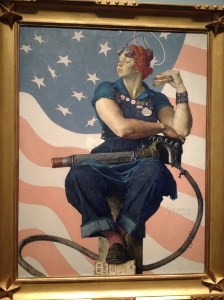
One of the more famous portraits of Rosie, back when Fascism was an evil thing, is that painted by Norman Rockwell.  A pugnacious Rosie eats her lunch with her feet on Main Kampf and her riveting gun in her lap.  (These days she would need to have her feet on an elephant rampant.)  Something about this painting always bothered me.  I could never put my finger on it.  It certainly wasn’t the confident look on Rosie’s face—she’d earned that and deserved it long before it became a reality.  Even the patriotism at that time was tasteful.  No, it was her posture.  There was something uncanny about it.  Then I learned that Rockwell had consciously copied Michelangelo’s Isaiah from the Sistine Chapel ceiling.

Isaiah, according to that famous rendition (Isaiah has never been a popular subject for paintings, for some reason), has his head turned at that peculiar angle because an angel is whispering in his ear.  Instead of a riveting gun, he’s packing a nascent Good Book, but he is receiving a direct message from on high.  I like to think it might be “The Spirit of the Lord is upon me, because he hath anointed me to preach the gospel to the poor; he hath sent me to heal the brokenhearted, to preach deliverance to the captives, and recovering of sight to the blind, to set at liberty them that are bruised, to preach the acceptable year of the Lord,” but then I’ve always been a dreamer.  Rosie, in Rockwell’s rendition, is prophetic.  She is proclaiming an equality which, inexplicably, coming up on a century later, is still unrealized.  Why?  The angry white man only recognizes God made in his own image.


Fictional Facts

“If you want truth,” Indiana Jones famously said, you need to go to philosophy class. The sad fact is most people have little practical training when it comes to such issues as discerning truth. Some time ago I read an article about how fake news travels faster and is more deeply believed than actual truth. I suspect that’s because the truth is hard. The age-old trope used to be a wizened elder sitting atop a mountain in the lotus position. A lifetime of thinking through the labyrinthian corridors of wishful belief to get to what is finally and unassailably true. Our president, with the full complicity of the Republican Party, is out to dismantle the concept of truth once and for all.

Indiana Jones was contrasting facts to truth in this scene from The Final Crusade. The idea was that facts sometimes make you question truth. In GOP University, however, facts have alternatives. He who bellows the loudest is the harbinger of truth. Never mind that still small voice that comes after the raging wind. The voice that can stop a fiery prophet in his tracks—a man who could raise the dead, for crying out loud—but even his successor called Herod a FOX. In the culture of the shrug, who really cares? Finding the truth is so much navel-gazing. There are real enemies to bomb and somebody has some money that I can take away and claim as my own. To do so we can make up facts as we go along and lies will see us through. With the Evangelical seal of approval.

Even with rumors of a fifth film swirling, I miss Indiana Jones. In his formative days fascists were the enemies, even of the Republicans. Although he was showing his age in Crystal Skull, Jones still couldn’t countenance oppressive regimes. Scientific studies show people would rather believe fake news. We’re hopelessly prone to fantasy, I guess. Even as I volunteered on the archaeological dig at Tel Dor, although I had little money a fedora was required. There was a difference, however. I knew I really wasn’t Indiana Jones. I was digging for facts so solid that they could be held in my hand. Unlike Dr. Jones’ students, I did go down the hall to Dr. Trammel’s philosophy class. Surrounded by the young Republicans of Grove City College, none of us doubted that truth was spelled with a capital T. Now Truth is apparently an artifact buried in the sand, awaiting a hapless archaeologist to bring it to light. Amid all the forgeries that non-specialists can’t tell apart.


Candles vs Demons

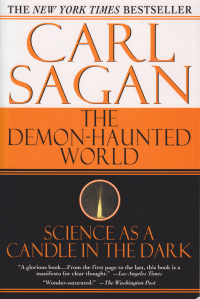
Among scientists who write Carl Sagan has always struck me as one of the more open minded. Dedicated to the scientific method, he nonetheless admits that there are some things scientists don’t know. The last time I was in Ithaca, therefore, I picked up a copy of his tour de force, The Demon-Haunted World: Science as a Candle in the Dark. I wasn’t really sure what to expect—I’ve been researching demons and I supposed they would be addressed in his book, since they feature in the title. Although that is indeed the case, the book is a collection of essays vindicating in various ways the practice and teaching of science. It is quite a scary book. It was also Sagan’s final book published in his lifetime.

Reading this just after Gabriele Amorth’s An Exorcist Explains Demons, noteworthy for its credulousness, The Demon-Haunted World was like whiplash into reality. Back into the realm of observable facts and testable hypotheses, it was indeed like a candle in the dark. Sagan admits that science can’t speak definitively on the supernatural—something that sets him apart from other science writers—but that doesn’t mean we shouldn’t apply scientific thinking anywhere it’s appropriate. And that includes the universe of politics. Published some two decades before the rise of Trump, the book is surprisingly prophetic when it points to the possibility of the rise of fascism in a nation that distrusts science. Indeed, the book shows Sagan clearly worried that an authoritarian, totalitarian government was on the rise. It’s almost preternatural in its accuracy.

The tome is large enough to dissuade a full summary within the word-limits I set for myself on these daily posts, but I can say that this book is necessary now more than ever. Sagan was a celebrity in his lifetime, a “rock star” scientist. Even so he worried about the deplorable state of science understanding among political leaders he met. For many years America has been mired in conservative causes that distrust science implicitly. Another strain that runs throughout this book is the need for education. Not only has America catered to anti-science groups, it has fallen behind much of the rest of the world in science education. Those who claim to make America great again can’t see that their very tactics have made our nation fall behind the rest of the world when it comes to education, across the board. Surely Sagan was right that a good grounding in scientific thinking is the equivalent of lighting a candle. As for the rest of the country it has been getting darker and darker, and our “leaders” have no idea even how to strike a match.