Not Frightening

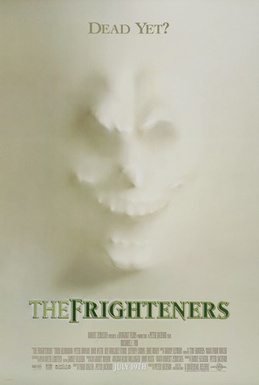
Years ago a friend, which I define as someone who wishes me no specific bodily harm, suggested I watch The Frighteners.  It finally came to a free streaming service (with commercials), so I gave it a go.  I really enjoyed parts of it, but on the whole, there was too much going on to make it an effective film.  It’s a horror comedy, and once films like that stretch beyond 90 minutes they tend to need a lot of magic juice to keep the engine running.  So, here’s the basic idea: Frank can see ghosts.  With the help of a couple of ghosts he makes a living driving spirits from peoples homes, after setting them up.  Unfortunately there’s a serial killer ghost actually killing people.  Since Frank tends to be the last one the victims see, there is some suspicion that he’s involved in their deaths.  

A young widow, Lucy, is a doctor and is trying to help a woman (Patricia) who seems to be abused by her mother.  It turns out that Patricia is associated with a serial killer from many years ago, and it’s unclear whether or not she’s innocent.  Meanwhile, a neurotic FBI agent comes to town and decides Frank is guilty and tries to kill him without due process.  Meanwhile, more and more people are dying.  It’s probably a spoiler to say that the serial killing ghost is the same as the serial killer that Patricia was in love with and she’s still helping him to get to a record number of deaths.  Frank ends up dying twice but is brought back to life at the end, after Patricia and the serial killer are taken to Hell.

The movie is stylish and a bit of fun, but if you’re watching it on a streaming service with commercials it ends up being over two hours long.  Some parts are funny, but not hilarious.  Some parts are spooky, but not really scary.  The plot is complex and takes its time unfolding.  The serial killers attempting to break a record is disturbing and not exactly in good taste.  The acting is good but the viewer’s left feeling a bit confused as to what the message is and how they ought to feel.  It’s the kind of movie that I might find myself in the mood to watch again, someways down the road, but in the short term, I’m glad to have seen it once.  I’m not sure my friend and I share taste when it comes to movies, but at least he’s not wishing me any harm.


Keeping House

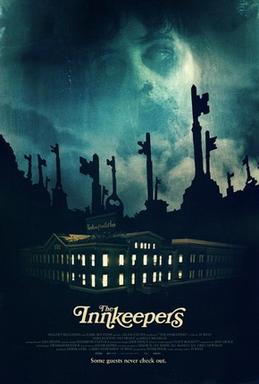
I really wanted to like The Innkeepers.  I’ve appreciated the Ti West horror that I’ve watched and Sara Paxton has a compelling screen presence.  The setting of a hotel that’s about to be shut down is a good set-up, and although the ghost story is somewhat conventional, it’s workable.  Part of the problem was clearly lighting.  Maybe I’m just too old, but when something important takes place in a scene that’s just too dark, well, it loses something.  So here’s how it goes: Claire and Luke are at the front desk for the final weekend of The Yankee Pedlar.  The guests are a woman and her young son, a psychic who used to be a television star, and an old man who wants to stay in the room where he had his honeymoon.  Claire and Luke are also ghost hunting at the hotel and a suicide-bride ghost is said to haunt the property.  When Claire finally does see the ghost, after the old man dies by suicide in the same room as the bride, Claire ends up in the basement where they get her.

The chase through the basement is dark.  I didn’t realize, until reading a summary later, that Claire, who uses an inhaler throughout the movie, died of an asthma attack.  That gives the story a nice ambiguity.  I, for one, couldn’t see that because things just weren’t lit well enough.  The final sequence, before the credits, shows the room in which the psychic was staying (she had a tendency to gaze out the window) and then the door slams on the camera.  The summary said a very light image of Claire is visible, and that she turns toward the camera before the door slams.  I watched the ending twice and couldn’t see her anywhere.  That scene was too brightly lit.  Without those two bits, the ending really doesn’t make much sense.

Movies generally involve many, many people (thus the very long credits).  Although the director is the “conductor” of the piece, sometimes I wonder about the lighting decisions, and whether this was a lighting department decision or West’s.  Whoever it was, I’m sorry to say that it made my experience of seeing the movie a confusing one.  The movie did reasonably well against budget so I suspect plenty of people saw what I could not.  I would be willing to try it again, maybe in a darker room or on a bigger screen.  A ghost story where you can actually see the ghost seems like a winning combination for an October weekend.


Dark Pliny

My current dark academia kick has me looking at the Classics again.  I taught Greek Mythology for three semesters as an adjunct at Montclair State University.  In the course of my New Testament studies I’m sure I encountered some of the classical Greco-Roman writers, but being focused on the Bible at the time, I never really followed through.  Then my doctorate got me interested in even earlier classics.  In any case, I’ve been trying to self-educate myself about Pliny the Younger.  To be honest, this is because he wrote one of the most famous Roman ghost stories.  Pliny wasn’t some guy into woo-woo subjects.  He was a magistrate and a lawyer and a noted orator.  His most famous work is the collection of his letters.  One of those letters tells his ghost stories.  Others describe Mount Vesuvius’ eruptions.  So, Pliny.

Image credit: Daderot, Angelica Kauffmann’s Pliny the Younger and his Mother at Misenum, 79 A.D. (detail), public domain via Wikimedia Commons

My fully-loaded bookshelves don’t have any Pliny.  I’m sure he’s mentioned in many of the books on these shelves, but I don’t have a copy of his letters.  I used BookFinder.com to search for used copies only to discover that the Loeb Classical Library divides his letters into three volumes, which feels like too much for casual reading.  Then I realized that most editions are edited, leaving out some of the, I suspect, less interesting missives.  Even as an editor, I don’t trust editors.  What if they left out the ghost stories because, well, serious scholars pay no attention to such things?  I discovered that Penguin Classics has an edition and from what I can tell, it seems to be complete.  I mark books that I want to remember on Amazon because they have pages even for the obscure stuff.  I try to buy the actual books from Bookshop.org.

What makes all of this noteworthy is that as I was on the Amazon page I noticed that you can “follow the author”—Pliny the Younger himself!  He must be a ghost by now.  So what the heck?  I clicked “Follow.”  I’m not in the habit of following authors on Amazon; I find my books in many different ways and most authors I know don’t like to talk about their writing, so why add another social media commitment?  I’m hoping that Pliny will be more willing to chat about writing.  He may be dead, but I’m not a prejudicial sort of individual.  I won’t hold it against him.  Who knows, maybe in addition to ghosts, I’ll learn something about Vesuvius?  And if he ghosts me, well, at least he’s a professional.


A Presence

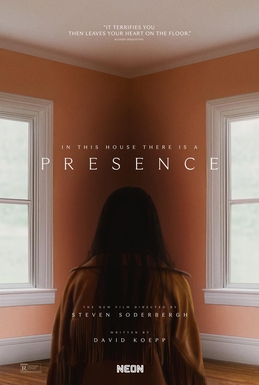
Presence is a fairly new movie, for me anyway.  I was able to stream it at the price of commercials, so I gave it a chance.  It was provocative and to discuss it I’ll probably need to reveal the ending.  For now, however, I’ll just say it’s a ghost story from the point of view of the ghost.  It reminded me of A Ghost Story, which I also saw shortly after it was released.  Both are melancholy and explore the dilemma of a ghost having to watch as time passes.  In the case of Presence, however, it is a future ghost.  As I say, more will be given away, so be advised.  The movie is about a family of four buying a very nice house in Cranford, New Jersey.  Well, it doesn’t say Cranford, but that’s where it was filmed.  The parents, who have a bit of a troubled relationship, have a teenage son and daughter.  The daughter’s close friend has recently died and they’ve moved, in part, to try to shake her out of it.

We watch from the ghost’s point of view as the realtor shows them the house, the painters get it ready, and they move in.  The daughter, Chloe, is having trouble adjusting and the presence lingers about her room.  It’s obviously concerned about her.  Chloe sometimes senses it.  When Tyler, her brother, brings a friend over the friend starts to show an interest in Chloe.  The presence tries to intervene to prevent him from taking advantage of her.  When the friend drugs her, intending to kill her (as he did her friend earlier, which, of course, she doesn’t know), the ghost rouses her brother who saves her by tackling his friend out the window, killing them both.  As the family is about to move again, the mother sees in a mirror that the presence is Tyler, their son.  He was protecting Chloe, as a future ghost.

I found it an engaging film.  Sibling rivalry—the parents play favorites with the opposite gender children—and Tyler’s often harsh dismissal of his sister’s grief, dominates their family life.  The fact that Tyler is the presence protecting his sister even when, in real time, they don’t get along, is a form of redemption.  That brief reveal at the end is what makes the movie.  Is it horror?  It has a ghost and there are moments of considerable tension.  As I’ve argued from time to time, horror isn’t a precise genre at all.  I found this listed as horror in a streaming service and although jump startles and visible monsters aren’t evident, the affective aspect is clearly there.  Yes, in my opinion, it’s horror. And it’s well done.


Out of Time

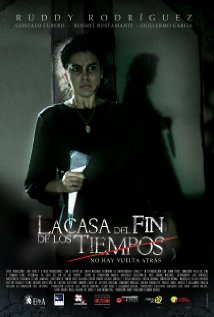
I don’t know about you, but I seldom think of Venezuelan cinema.  I feel a strange satisfaction, however, that the highest grossing movie produced in that country was a horror film.  It’s possible to find The House at the End of Time in streaming services, with subtitles.  And it’s worth doing.  It’s a movie that will stay with you.  Intricately plotted and having a lot of heart, it’s a story of loss and redemption.  After an apparent break-in at her house, Dulce is accused of killing her husband and son, and is sent to prison.  We’re shown, however, that she found her husband already dead, or nearly so, and that her son had been stolen away by a mysterious force.  After three decades, given her age, she’s released to house arrest.  A neighborhood priest becomes interested in her case, believing that she’s innocent.  It’s the house, it seems, that is haunted.  Previous families who lived there experienced similar fates.

I won’t spoil it for you, but this is a horror film with heart as well as smarts.  It also explores the life of the poor and learning to live with past mistakes.  It’s a story about a family.  Unlike many horror movies, the protagonists aren’t “all things being equal,” middle-class people.  In this regard, it reminds me of The Orphanage and The Devil’s Backbone—also both Spanish-language horror films.  And there’s a verisimilitude about the poor as the ones suffering the effects of haunting.  Now even that has become a trendy commodity.  A house haunted sometimes increases in value as ghosts become gentrified.  Obviously, ghosts can haunt anyone, but there’s almost a parable aspect to them.  Sometimes ghosts are all that the poor have.

That may be one of the reasons that The House at the End of Time is also Venezuela’s most internationally distributed movie.  And the reason that an American production company is working on a remake (presumably in English).  The ghosts here aren’t what we’ve come to expect, but religion plays a large part in the movie since the priest pays special attention to Dulce.  The reason why is eventually explained, but he is a non-judgmental cleric.  He attempts no exorcism.  Instead, he researches and seeks to find an explanation for what is happening at this most unusual house.  Catholicism is a large part of the culture in Venezuela, and I do hope that the remake doesn’t remove it.  A sympathetic cleric is often difficult to find.  And in this case, one that really pays off.


Paranormal Religion

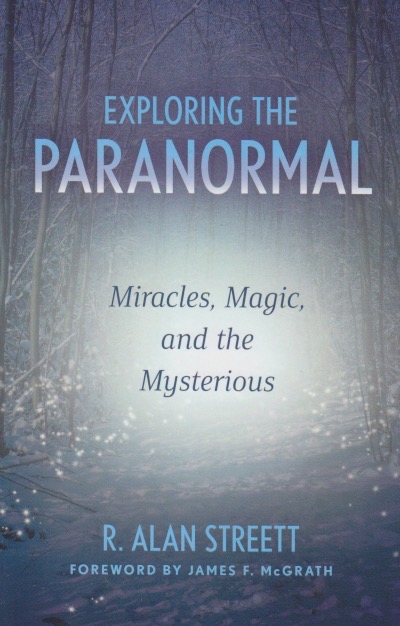
I remember well what it was like to be an evangelical.  Measuring everything by what I thought the Bible said, fearing those things that seemed to come from outside.  Being very concerned with salvation and its opposite.  At the same time, I was fascinated by the paranormal.  As I child I was teased for these interests and subsequently buried them.  Then I had a slow, protracted, and continuing waking from dogmatic slumber.  So it is natural that I would want to read R. Alan Streett’s Exploring the Paranormal: Miracles, Magic, and the Mysterious.  I didn’t know how he would approach the subject, and I didn’t know where on the evangelical spectrum he fell.  Still, I’m always interested to see how others handle what we all know—strange stuff happens and there is no real explanation for it.  Scientific method may one day be able to address some of it, but at the moment it generally falls outside the bounds.

Streett’s book is somewhat autobiographical, from his non-religious childhood, believing in parapsychology, through seminary and having an evangelical awakening, to the point that he stopped supposing such things were demonic, and on to where he stands at the moment—thinking that most such things can be explained by brain science and alternative states of consciousness.  There are a number of interesting situations and concepts described in this book; I learned quite a bit when he discussed different brain states.  I understand his theological rejection of potential realities behind the phenomena he discusses (mostly mediumship, but also reincarnation and faith healing) but don’t always agree with the conclusions.  There is much in the world that theology can’t explain.

Something that is perhaps overt between the covers, is that the paranormal is something that happens to evangelical, liberal, Muslim, Jew, Hindu, Buddhist, atheist, agnostic, and none alike.  What differs is the interpretation, based on various faith traditions and their tolerance for that which is outside.  Evangelicalism is a worldview, perhaps more so than it is a theological position.  Non-divine miracles, or whatever you want to call paranormal occurrences, don’t fit comfortably into that worldview.  Other interpreters, also raised in Christian traditions (Catholicism, for example, is quite open to mystical happenings that can fall into the paranormal category), might approach the question in a different way.  Dialogue is important, however, and trying to make sense of this world we live in, in my humble opinion, has to reach outside the reductionistic view that brains alone account for human experience.  Streett’s account offers a reasonable perspective on the issue from an evangelical outlook.


Who’s Pretty?

Movies come at you from all angles these days.  People love stories and streaming companies make enough money to create their own content.  I Am the Pretty Thing That Lives in the House is a notable effort for a Gothic film, financed by Netflix.  The pace is fairly slow and there’s little in the way of jump startles or bloodshed.  The story isn’t fully explained, but then it revolves around a horror writer, so that’s not unexpected, I suppose.  Lily is called in as a hospice nurse for Iris, although what Iris is dying from isn’t specified.  The estate manager supposes the stay won’t be long, but Lily remains in the house for eleven months, not leaving at all.  A few creepy things happen, but nothing terribly threatening.  Meanwhile, Lily, who admits to being too scared to read horror, decides to investigate Iris’ best-known book because Iris keeps calling her by the name of one of the characters (Polly).

After several months of this, Lily comes to believe that Polly was a real person and that she was murdered in the house.  Up front the movie announces itself as a ghost story and lets us know that Lily won’t survive the year.  That’s technically not a spoiler, since it says so at the very beginning.  The question becomes, what has happened to Lily?  Iris remains pretty firmly in the background, but she is the one who initiated the story.  The movie strongly implies, without outright stating it, that Polly was a real person who somehow channeled her story to Iris.  Iris, however, when she talks about Polly, seems to take the point of view of her murdering husband.  I won’t say how Lily fails to survive the year because that might actually be a spoiler.

This is one of those movies that relies on mood more than plot.  In that it manages to approach Gothic sensibilities with the very premise being, from the start, that ghosts own a house.  I live in an old house.  Apart from the previous owners, who both left alive, I have no idea who might’ve lived here since about 1890.  I haven’t seen any ghosts but I often do wonder what has happened in this place.  There are those who prefer modern houses with shiny surfaces (and generally no books),  but some of us prefer to take our chances with history.  We may never unpack that history but living among it makes us feel connected.  That’s kind of like the experience of watching I Am the Pretty Thing That Lives in the House.  Only we hope that are good guests in what may be somebody else’s dwelling.


Must Be Autumn

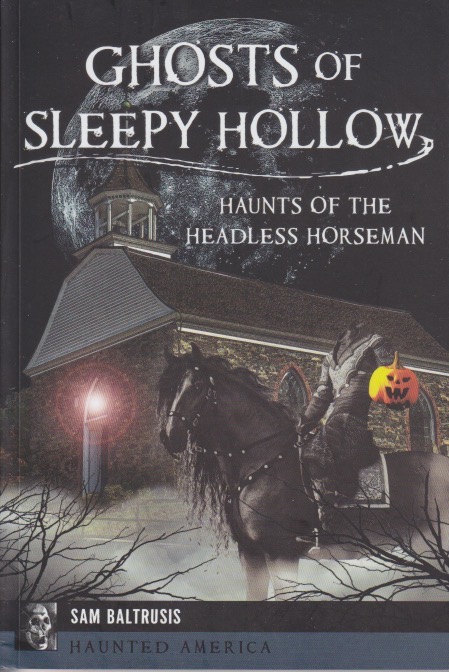
As it often goes, a friend pointed out to me a book on Sleepy Hollow that published just this week.  I preordered a copy that arrived on Tuesday and buzzed through it.  It’s what I describe to family as “one of those books”—you know, the local history, heavily illustrated quick reads from The History Press.  (I would note that I submitted what was then The Myth of Sleepy Hollow to The History Press, but they never even responded to the submission.)  In any case, Sam BaltrusisGhosts of Sleepy Hollow: Haunts of the Headless Horseman is really quite different from what I do in my forthcoming Sleepy Hollow as American Myth.  The History Press isn’t really regarded as such by historians.  I like their books nonetheless.  I was castigated by an academic journal editor early in my career for using one such book to illustrate local folklore.  (That was, by far, the snootiest rejection letter I’ve ever received.)

Aloft noses aside, there is a legitimacy in listening to what the folk say.  The tales in a book like this won’t convince skeptics, of course, but if you read them in the dark you’ll nevertheless find yourself glancing into the corner now and again, wondering if you saw something.  The book does cover the “Legend of Sleepy Hollow” and Irving’s life in a few pages—Irving was a complex man and the first truly famous American writer—before moving on to local haunts.  The thing that kept nagging at me was the easy shifting from fiction to fact.  Folklore does have a way of becoming reality (and who can definitively even say what that is?) for people.  No doubt, Sleepy Hollow has latched onto tourism in a big way.  Even more so than on my last visit there. And folklore draws on that shifting borderland between fact and fict.

One of my motivations in writing Sleepy Hollow as American Myth was that the story is largely ignored by academics and “sophisticated” readers.  It nevertheless remains important in popular culture.  Academics tend to be slow in picking up what general readers find fascinating.  I found a few academic articles on the subject, but my book was written for general readers as well.  I hesitate to say too much, otherwise, why buy it?  I have a handful of History Press (and similar) books on the region on my shelf.  I learn from them.  And I’m glad to see Sleepy Hollow getting more attention.  My only real regret about my book is that I’ll have to wait a couple of years before the price comes down.  In the meantime, those really curious about Sleepy Hollow will have this Haunted America version to read.


Lying Beneath

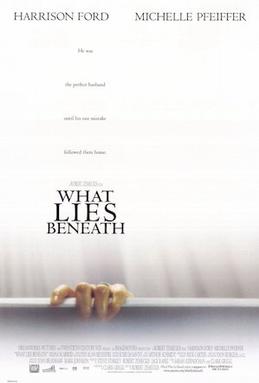
If you wait long enough you can find successful films for free on Amazon Prime.  What Lies Beneath had big-name star power and still retains a “horror” classification, although “thriller” is used about as often.  I actually enjoyed it and found some parts as scary as I am comfortable getting.  Although I guessed who the killer was well before the climax, I wasn’t sure how this would end.  This made the last fifteen minutes or so very tense.  There may be some spoilers as I ponder this a bit, so be warned.  Of course, the movie is nearly a quarter-century old, so you may already have an idea of what happens.  I’m a purveyor of older culture, it seems.

Claire Spencer, and her new husband Norman, live in an isolated spot in Vermont.  Norman is a genetic engineer and Claire used to be a musician, but the death of her first husband and adjusting to being an empty nester lead to her neglect of playing.  She starts seeing a ghost in the house Norman inherited from his father.  She comes to believe the ghost is of a missing young woman from the area, and she begins to find clues that link her husband to this unsolved case.  At first you think it’s going to be like Rear Window, but it turns into something very different.  The sense of unease is quite effective—you know something’s wrong but you’re not sure exactly what it is.

This is another of those movies where the genre feels up for grabs.  There’s an actual ghost and there are stingers.  Yet it’s directed by Robert Zemeckis, not really known as a horror director.  It’s stylish and has Michelle Pfeiffer and Harrison Ford in the leads.  It’s not really gritty at all.  There is blood and fear, though.  The more movies I watch the more I realize that genre is a tenuous thing.  Stories are forms of expression and sometimes they come in the varieties that explore some of the darker parts of life.  Norman’s tragic flaw is that he values his career above all else.  He tries hard to outshine his father’s accomplishments—he lives in his childhood home but refurbishes it.  He can’t get out from under that shadow and that drives him to extremes.  The movie received mixed reviews, but I found it gripping.  It’s well acted, as you’d expect, and hey, there’s a ghost.  It’s close enough to horror to work for me.


Mind Echoes

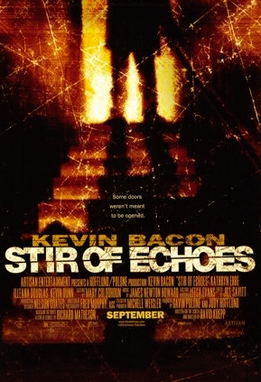
One of the things that must be frustrating about making movies is that so much competition exists.  Even when you hit on a great idea, such as using a Richard Matheson novel for a story basis, others might be producing something similar.  This isn’t unique to movies, of course.  Some of us have had the experience while writing books.  For those of us who watch movies online, rather than in theaters, the timing differential can still warp perspectives.  I’d not heard of Stir of Echoes until I stumbled onto a website that lists horror movies that have a little something extra.  While watching it I couldn’t help but think of The Sixth Sense, which I also saw at home, but quite a few years earlier than Stir of Echoes.  The acting in the latter is quite good.  The haunted kid pulls this off effectively.  And Kevin Bacon and Kathryn Erbe do a great job as parents (actor-wise).  Spoilers follow.

If you’ve intuited that the child sees dead people, you’re not far off.  It’s actually only one dead person and it’s not a Shyamalanian counsellor.  But the spooky part is his dad begins to see them too, after he’s been hypnotized by his sister-in-law, who’s an amateur.  At its heart the story follows the traditional trope of the undiscovered murder.  It does a good job of hiding the perpetrators until near the end.  The build-up is good also, with Bacon portraying Roy Neary-like obsession (interestingly, they’re in similar professions) quite well.  

The scary part, for me, was the sense that you’re not in control of your own mind.  There’s perhaps just a little too much possibility here.  We tend to think we own our minds, but what if they’re really just on loan?  I remember reading, as a high schooler, that religious people are difficult to hypnotize.  Hypnosis is still not well understood.  The larger fish in the pond is consciousness itself, which we really can’t even define.  We do know that memories are altered with time, and we can demonstrate this to ourselves by rewatching an old movie and seeing what we got wrong.  I suspect that’s why Stir of Echoes is so effective as a horror film—taking us into the realm of mind exposes us to so much that we really don’t understand.  And since ghosts seem to be pretty believable, well, the combination works.  Stir of Echoes is unsettling and a cut above much of what’s available for free streaming.  So if you’re in the mood for a ghost story, this might just fit the bill.


Early Ghosts

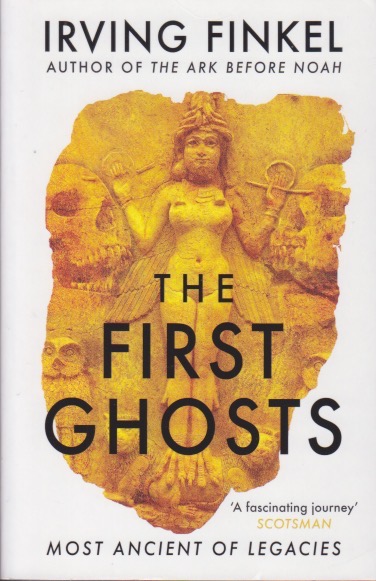
I’m not the most impulsive person in the world, but certain books I know, as soon as I see them, I will read.  Irving Finkel’s The First Ghosts was one of those books.  This wasn’t an easy book to get.  I’m guessing it was some minutiae about transAtlantic rights or some such nonsense, but it was announced a couple of years before it became available in America.  Then, of course, it had to wait its turn on my reading pile.  For those of you who don’t recognize his name, Finkel is a well-regarded Assyriologist who works at the British Museum.  Assyriology (which encompasses Babylonian and Sumerian studies as well) is, perhaps unavoidably, a highly technical field.  The languages are complex and a lot of that has to be explained before a reader can figure out what’s going on.  Some parts of this wonderful book are, unfortunately, technical.

The idea, however, is brilliant.  Ghosts have always been with us.  Finkel is well-placed to open the cuneiform world and he presents the earliest recorded ghost stories in history.  They’re not exactly modern horror, be warned.  Nevertheless, they demonstrate that from as soon as people figured out how to write, ghosts were one of their favorite topics.  Or at least, ghosts were assumed to exist and were written into many myths and legends.  Non-judgmental books like this are rare from academics; indeed, it’s difficult to imagine anyone else having written this particular book.  Even in the small world of academia not too many people read these languages and those who do are busy trying to impress tenure committees and businessmen deans.  (The reboot of Ghostbusters demonstrates this in a comical but too serious way.)

There are plenty of takeaways from this book.  A good general point in that myths do not reflect the everyday beliefs of individuals.  It’s easy to forget that.  Another striking idea occurred in his one chapter on the Bible where Finkel notes that the Good Book tends not to dwell on things considered “detestable,” such as foreign gods or demons.  That makes it an outlier concerning everyday information from antiquity.  After looking through that one window for so long, I suppose that’s why I focused by doctoral work on a “foreign” goddess.  If you can handle the technical bits and try to keep in mind multiple multi-syllabic names from forgotten languages, you’ll find a lot of really surprising and fascinating information here.  I’ve known for years that I’d be reading this book, and as autumn approached the time felt right to seek ancient ghosts.


Ghostly Book

Recently I’ve been thinking about internet searching—how some information is difficult to find.  This book provides an example.  I saw what we in the biz call a “new book announcement” (NBA for bookish sorts).  Since I’ve been reading about the Hudson Valley the subtitle of Ghosts in Residence (Stories from Haunted Hudson Valley) caught my eye.  I assumed it was a new book and eagerly awaited its release.  When it arrived I discovered that it was a “new in paperback” (NiP) edition of a book published in 1986.  This edition, published this year, didn’t update things, including author information.  Given that H. A. von Behr was born in 1902, I doubt he’s still alive, but the book simply borrows the LCCP (Library of Congress Cataloging-in-Publication) data from 1986, showing the author’s dates as 1902–  .  Perhaps unintentionally appropriate for a book about ghosts.

This is an odd book, all around.  Although published in 1986, much of it deals with even earlier times—the author’s recollections of the forties—as well as some more recent events.  Hans von Behr cuts the image of a country gentleman while his neighbors in the Valley go on fox hunts and he has what seem like daily cocktail parties on the lawn.  He dashes off an article about his favorite dog and gets a healthy check from Outdoor Life.  This is a different world.  But then there are the ghosts.  But more than that, also strange happenings.  The ghost tales are intriguing, and some of the other strange events head-scratching.  The whole has a quasi-autobiographical aspect to it, but while not revealing too much.  A couple chapters deal with hauntings in Germany.

My web searching for H. A. von Behr revealed very little.  He was a retired scientist and photographer (he had some high profile clients) and the book contains many of his photographs of the locations discussed.  This short book explains how he came to purchase a haunted farmhouse upstate for a second home (again, a different world), how he discovered it was haunted, and how many of his friends and acquaintances revealed, over time, that their houses also had ghosts.  The book is charming in its own way, and a quick read.  Still, it’s a little disorienting when you can’t find more information about someone online.  The options are to do library research (my favorite kind) but am I really that curious about this author?  I wanted to read about the ghosts, and that I did.  And many other incidental things besides.


Haunting Hudson

After Maine, the one place I’ve always wanted to live, but never had the opportunity, or could never afford, is upstate New York.  My ancestors were from the state but I just happen to’ve been born in Pennsylvania.  So it goes.  Perhaps it comes with professionally studying mythology, but one of my longterm interests is folklore.  I’m always fascinated by what people tell of their local setting.  Now when I approach books about the paranormal in a region, such as Cheri Farnsworth’s Haunted Hudson Valley, I know to take most of it with a grain of salt.  People love to tell stories and local people like to talk about where they’re from.  The Hudson Valley has had a long history of strangeness and several tales that reflect that are collected here.

I often think of ghosts.  They generally seem to prefer a single place that’s familiar.  And although you can’t take everything everyone says as gospel, there do seem to be regions beset with them.  I wonder if regions early settled by Europeans are particularly prone to haunting.  It’s difficult to imagine that, at the time with the unquestioned rectitude of church and empire, that they ever stopped to think “Hey, we’re stealing land that belongs to someone else.”  Did that idea ever come back to haunt them?  Perhaps such unspoken guilt leads to ghosts.  Or maybe simply dwelling in a place for a long time leaves plenty of opportunity for ghosts to gather.  And, of course, people do stretch the truth at times and misinterpret things otherwise explained.

No matter the reasons or rationale, these kinds of books are always a guilty pleasure read for me.  I don’t expect the get the truth, the whole truth, and nothing but the truth from them, but I enjoy them nevertheless.  Since I can’t afford to live in the Hudson Valley, the other result of such books—and one of the reasons locals appreciate them—is to make me want to travel to the region and see for myself.  For many years we lived not too far from the Hudson while in New Jersey.  Still, we didn’t make it up that way very often.  It’s a bit more of a hike now, but isn’t a hike worth making when you might see something unusual after you arrive?  My ancestors had settled north of the Hudson Valley and eventually migrated further south.  The end up in Pennsylvania, where I find myself.  But I’m still haunted by upstate New York.


Chilly Ghosts

The names of many Antarctic explorers are more familiar to me than Arctic ones, so John Franklin was a name unknown to me.  A nineteenth-century British explorer, his expedition was lost beginning in 1845 when his appropriately named ships, Erebus and Terror, became icebound.  Franklin was seeking the famed Northwest Passage and given the slow communication of the time, nobody knew for years whether he’d survived or not.  (He hadn’t.)  Shane McCorristine’s The Spectral Arctic: A History of Dreams and Ghosts in Polar Exploration is a fascinating account of the attempts to find Franklin and his ships, often with speculative means.  Franklin’s widow, Jane, was famous in Britain for her constancy and her unwillingness to give up on the search for her husband.  She also consulted clairvoyants and paid attention to noteworthy dreams.

What drew me to this account was the involvement of the supernatural.  Significant dreams and many clairvoyants—all in the Victorian Era—made suggestions and claims about Sir John’s health and survival, as well as his whereabouts.  This was, of course, in the era before anyone reflected on the rightness of the imperial ideology of exploration and exploitation.  (We seem to have a hard time shaking that even today.)  In any case, these unusual, supernatural means of gaining information were often utilized and sometimes even functioned to set the destinations for other ships sent on rescue missions.  The chapters dealing with spectral landscapes of the Arctic are riveting and hard to put down.  Arctic imagination, even for those of us who don’t care for the cold, is powerful.  And we tend to think of it in spiritual terms.  There’s something about the far north.

There are many names involved and there are some places where it’s difficult to keep track of all the characters on a casual read, but overall this study is gripping.  McCorristine, as an academic, can’t tip his hand regarding the authenticity of the phenomena he explores here, but it simply doesn’t let go.  His chapter on women in Arctic discourse is likewise engaging.  Franklin and his crew had died by 1847 but the ships weren’t “discovered” until 2014 and 2016 by Canadian expeditions.  As McCorristine points out, even such political use of resources makes statements about how indigenous people continue to be treated by nations established as colonies.  There is much to say on this point, but the book focuses instead on “polar terror and sublimity” that comes to the surface in supernatural beliefs.  Tying all of this together is an astonishing feat and the results leave much room for wonder.


Sacred Hudson

As scientific as we may wish to be, there’s no denying that there is a sense of place.  We know that some animals, at least, also feel it.  Whether theirs is a more pragmatic desire to return to where conditions were favorable to be born, or whether something deeper draws them there, we have no way of knowing.  People feel it too, this sense of place.  We know where we’re from, and if we don’t we often want to find out.  The space is somehow part of us.  There’s a compelling exploration of this in Judith Richardson’s Possessions: The History and Uses of Haunting in the Hudson Valley.  While not America’s first haunted location, the Hudson Valley was singled out for this treatment by Washington Irving.  He, however, didn’t invent it.

I’m not from the Hudson Valley.  I could never afford to live there.  That doesn’t mean the area can’t speak to me.  Richardson’s approach is academic yet readable and she considers how hauntings fill needs and how they play a role in that ever-contentious enterprise of land claims.  Ranging through literary treatments, whether the fiction of Irving or tour books of the next generation, or indeed, more recent literary efforts, Richardson deftly guides the reader through American Indian and Dutch and other inhabitants’ stories of themselves.  Race inevitably plays a part, and her tracing of the origins of some traditional tales is really remarkable.  Who owns the land?  Who truly owns anything?   

Similar treatments (I can’t help but feel somehow lesser) must exist of other haunted locations.  Richardson doesn’t engage in arguments over whether ghosts are factual since ghosts serve so many other functions.  Our lives are the stories we tell about ourselves.  Many of those tales involve the place we are or places we’ve been.  In our highly mobile society, few of us, it seems, can make a living where we’re from.  Those of us born in small towns range far and wide to find employment.  In many cases we may not want to go live where the drama of our childhoods unfolded.  Yes, there are pleasant memories there, but there are also ghosts.  Richardson explores how this plays out in one small stretch of the country.  Indeed, it’s a small stretch of New York state.  Stories of hauntings continue in that particular valley.  Uncanny, perhaps, but there are places in this world like that, and this book is a sure road post on this particular overgrown trail.