Pair of Docs

I’m not planning any trips anytime soon, but if I were I’d give Pair of Docs Travel a look. The founders of Pair of Docs are friends of mine who’ve also landed in that black hole of academia: hired, established, dismissed, forgotten. In my days at Nashotah House, eager to escape, I talked to Nelia Beth and Joel about an adjunct teaching stint at Carroll College (now Carroll University) in Waukesha, Wisconsin. They arranged for a couple of classes for me, and even wished me luck as they knew they were being forced out. Not for performance or lack of competence, but because of politics. Shortly after their moorings were thwarted, I too was cast off without an anchor. I’ve been adrift ever since. Last week, however, I had a letter from my old colleagues letting me know that they’ve gone into the travel agent business. Give them a chance—I’m sure you’ll be pleased.

An unspoken moral dimension is at work in higher education. Actually, the dimension is immoral. Those who embark on the track of higher education are culled from their teenage years by their teachers and professors. Having taught quite a long time myself, I know that a promising student stands out like a glowing rock in the sand. You know that this person is sharp enough to go far. You encourage, you advise, you try to open doors. The doctorate is awarded and before the silly academic hood touches those untried shoulders, you’ve just created another beggar to line the streets. A tin cup might be a better emblem of higher education than a diploma. At least it’s more useful.

IMG_0595

Universities keep cranking out Ph.D.s because they need the money graduate students bring to the programs. The graduate students, for the last two decades at least, have been the sacrificial victims. I have to wonder about the future of a society that takes those deemed most able by their many teachers and demoralizes them to the point of endless depression and penury. In some cultures teachers are treated like the high-achievers that they actually are. The future rests with them, not entrepreneurs. Not that you would be able to tell the difference from our sluggish economy. Seems to me that maybe we don’t have enough slaves to row this galley. And if you’re wanting to book a place on a ship or plane, maybe it would be considered a form of social justice to give Pair of Docs a try. If I could afford to travel, I know I would.

Disconnect the Dots

In the on-going loss of touch between academia and the world outside, we forever hear of the triumphal march of secularism. Academics are often loath to see the habits of the laity as being of much significance. In the book industry, however, publishers have to pay attention to what the public reads. This is one reason, I’m discovering, that some academics find it difficult to publish. Some research topics just don’t reach the wider readership’s interest. It’s an editor’s job to try to match readers with books. Among the tools we use are magazines such as Publisher’s Weekly and the Library Journal. Although it is impossible to say what people are actually reading, these periodicals trace buying and checking-out habits. And it doesn’t take a genius to see that books somehow tied to religion are frequently at the top of the list. One of the great industry trackers, Bowker, even has three distinct databases for book sales: children’s, academic, and Christian. Religion, in other words, is of tremendous interest.

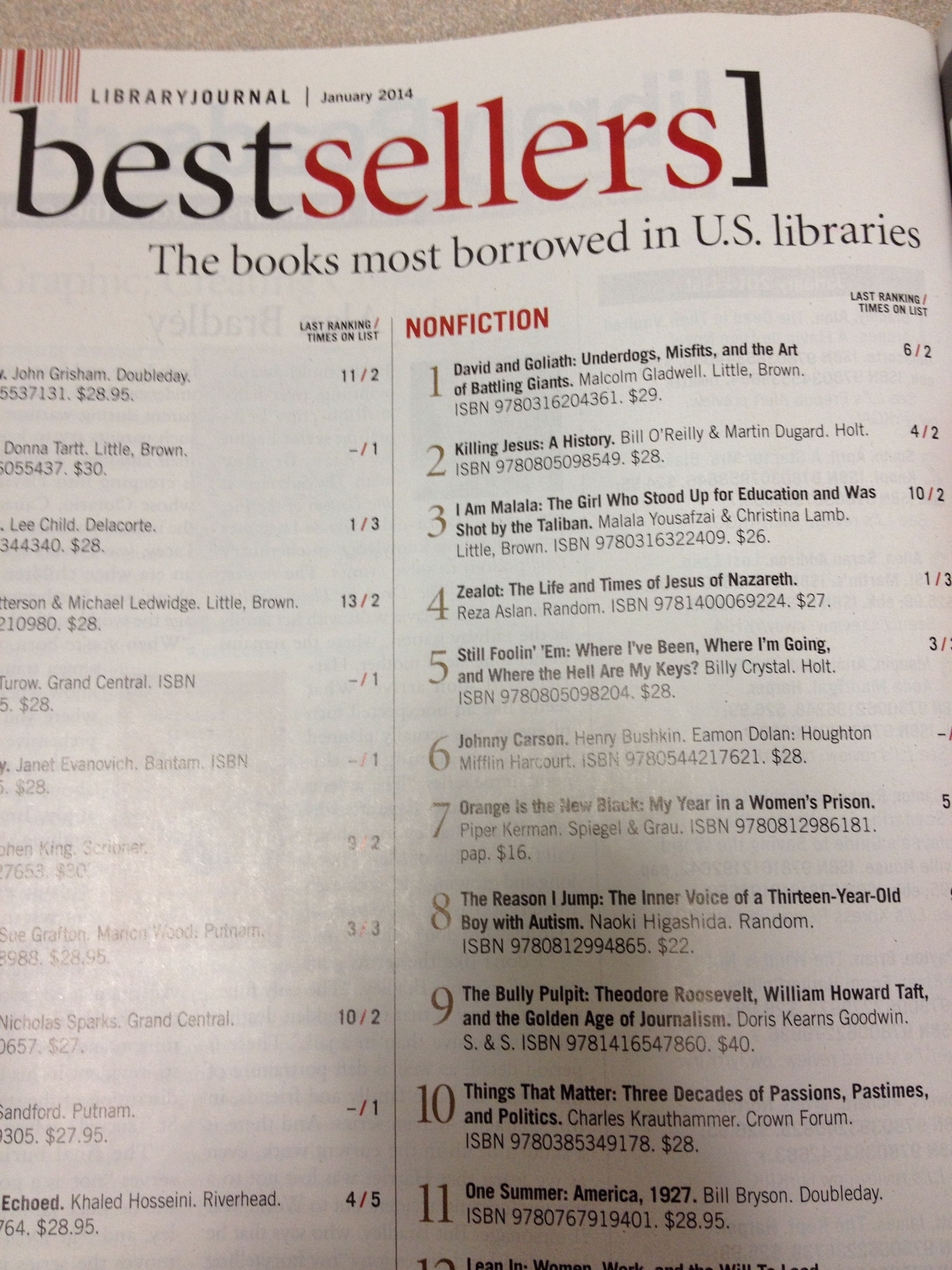
IMG_1279In the January issue of the Library Journal, for instance, there is the list of top books checked out of libraries since the last reporting period. Topping the non-fiction lists? The top four spots are occupied by books tied in some way to religion: David and Goliath, Killing Jesus, I Am Malala, and Zealot. People want to know about religion. Academics just don’t want to hear it. As a perpetual bride’s maid, metaphorically speaking, of the higher education that jilted me almost a decade ago, I hopefully watch hiring trends as the rejection letters pile up in my inbox. It is a diminishing pool. Look at the industry reporting tools: religion is irrelevant at best, puerile or worse when it comes to measuring maturity. People are dying over it, but we’d rather just not know. No wonder they call it the ivory tower—spotless as, well, a bride.

It is often a surprise to many academics how few people buy their books. As someone who had written a couple of academic tomes, I know how I daydream that my work on some obscure topic will take off and suddenly appear in the Library Journal, or Publisher’s Weekly. In actuality, the reading public will decide on the basis of what publishers make available. A writer such as myself, an independent scholar, lacks credibility and is not asked to write books. And universities aren’t hiring scholars of religion much any more. Some seminaries have even moved more toward the secular in their hiring practices, since, universities tell them, that’s the direction things are going. Those who buy books, or check them out from libraries, however, are telling a much different story. But we are much too sophisticated to look for signs among the laity. The more we progress in knowledge, the less we really know.


Today’s Truth

I spend a lot of time on Amazon. My job is one of those where it is a legitimate form of research—finding authors, seeing what’s already available on any given topic, checking prices. It’s kind of like those old, heavy tomes, Books in Print. Only lighter and faster. Of course, Amazon also lets anyone become an author. Often I’ll spy a name that I don’t recognize even after years of being in biblical studies. Many of these books are written by someone with a keyboard and an ego, but no real training. Then I came across what is surely a death-knell to civilization: books that are collected and printed articles from Wikipedia. Yes, that’s right—the source your professors told you never to cite is now available in book form. University Press (university-press.org) sounds like a reputable publisher, but as the website explains, this is a place to get Wikipedia articles on related subjects bound in book form. Author not included.

I don’t wish to single out University Press; many individuals and small-time publishers exploit the fact that just about anyone can generate enough words to constitute a “book.” Long before Johannes Gutenberg was an ink-blot in his parents’ eyes, books were hand-written. That was a form of natural selection since most of the populace was illiterate. A thousand pages written by hand are authoritative by any measure. The printing press gave rise to publishers—the gatekeepers of wisdom. The publisher decided whether ideas were worthy of print or not. Of course, I’m a bit of a hypocrite for writing such things, since most of what I’ve published has been declined a time or two before being accepted. In any case, the role of the publisher was to ensure the accuracy and orthodoxy of the book. Thus it was from Gutenberg to Wales.

Wikipedia is the first stop on many a quest for new information. With a high search engine optimization, and a built-in collective corrective, in theory Wikipedia should be mostly accurate. Depending on when you access it. A few years back I was researching a historical individual when I came across a sophomoric comment about said individual’s paternity. Since anyone can edit, I deleted the statement and read on. Still, since that time, doubts have haunted me about the combined wisdom of the human race. To hear politicians tell it, universities are merely liberal propaganda tools and the truth resides in politicians’ mouths only. I shudder at the implications. It used to be on Amazon that I knew the books had been vetted by some kind of expert reader (although they even let such as me work as an editor in the industry). Now each item has to be examined closely. For depending on the day and hour, the great wiki of truth is ever changing.

From Wikipedia, of course.

From Wikipedia, of course.


Credo Universitas

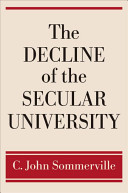
DeclineSecularUniversity“I am a Christian gentleman and I teach my course as a Christian gentleman.” The quote was made to me by a colleague at a state university, regarding a former professor of Hebrew Bible, or, in this instance, “Old Testament.” The idea rankled me a bit. You see, religion departments come under pretty constant attack for such things, since in the secular university—especially one that receives state funding—the disestablishment clause looms large. How can one simply bring one’s personal beliefs into the classroom as if normative? I suppose that’s why C. John Sommerville’s The Decline of the Secular University gave me pause. Sommerville, an emeritus professor of History at the University of Florida is no crackpot. He raises some major questions that universities, of all places, should be debating.

While Sommerville is not a scholar of religion per se, he has written about religion before, and he raises some vital questions regarding the secular enterprise. It should be no surprise that secularism can become a kind of religion, especially since the definition of “religion” is anything but fixed. We still don’t relally understand what religion is, except that every human seems to have it. Some call it rationalism or science, but it is essentially belief. None of us has direct access to reality as a Ding an sich, and we all choose to believe senses, reason, and tradition, to varying degrees. Our universities should teach us to be skeptical, but can they excise belief all together? To do so would be to reduce students (and that endangered breed, faculty) to sub-human.

What is it that makes the educated so afraid of belief? I suppose it must feel like weakness to a harsh rationality. Like the implacable Romans of celluloid fame, unmoved by human emotion. Mr. Spock in charge of the nursery. Religion is quite at home in the realm of emotion, and like it or not, humans cannot survive by reason alone. We need our feelings—survival instinct, by itself, is not always rational. As a society, however, we’ve downgraded religion to the point that universities have trouble taking it seriously. I’m sure it would open a few administrators’ eyes very wide to sit in on the religion classes I’ve taught at secular schools. Although most of the students are not majors, all, in some sense of the word, are believers. Sommerville’s book contains much that is challenging, but I think his thesis is absolutely correct: any institution that claims to be human, but removes the possibility of belief, is deluding itself and all its customers.


Retire Me This…

We’re all getting older.  My daily, grudging glimpse in the mirror reminds me that my beard wasn’t always gray, and there was a time *gasp* when no beard grew at all.  One of the realities of the brave new world we inhabit is that career stability has become a myth.  My father, in the brief time I knew him, worked as a house painter.  My stepfather worked in a sewage plant for a small town and drove a snowplow in winter to make ends meet.  These utilitarian jobs seemed never to end.  I made the mistake of going into higher education, not realizing that the risks were much higher and that I would make more money working in a sewage plant than I have ever made in my professional career, PhD in hand.  So it rankles me when I hear professors complaining about being too busy in retirement.  Retirement: what a concept.  When the guy who has custodianship of my minuscule retirement account from Nashotah House, after his gentle awaking from the defibrillator, looks at my records he always informs me, “you’re not well placed for retirement.”  Talking to my big brother we agree—our retirement plan is to die on the job.  So, when someone asks you to write another book, remember maybe it is some guy your own age who is trying not to starve.

As a society we’re aging.  Those who managed not to be fired by Fundamentalists have had a secure, tenure-ridden ride through the occupation that some of the rest of us were denied.  Busy in retirement?  Some of us will never have that privilege.  Funny thing is, it’s not funny.  I sometimes lean back in my editorial chair and realize, if this hadn’t happened to me, I would probably look at it the same way.  I would have published that second, third, and fourth book, and people would actually think my opinion mattered.  I would’ve become a resource to be tapped rather than a dancing monkey who hopes for anything shiny.  Is that another gray hair?

I don’t belittle the hard work of higher education—it’s not an easy profession. But writing books? That’s the fun part! Privilege induces blindness. How rare an opportunity it is to teach! While we as a nation devalue it, in many parts of the world those who shape future minds are revered. Yet elsewhere in the world there are those who are far worse off even than an editor—those for whom life is constant suffering and surviving another day is not reasonably assured. How easily I forget this as I neglect to balance my checkbook for fear of what I might find. We shouldn’t complain when someone asks us to give back, even in retirement. Those of us capable of writing books sometimes lack only the bona fide of a college or university position to do so. Otherwise I might hope to retire as well some day.

"Photo by Chalmers Butterfield"

“Photo by Chalmers Butterfield”


Religious Education

The elephant in the room is exposed in a New York Times op-ed piece last week. “Indoctrinating Religious Warriors,” by Charles M. Blow, puts a finger squarely on the pulse of the ailing science stance of American religious believers. Noting that the Republican party has made no secret of its attempt to capture conservative votes by touting the religious intolerance of the theological right, Blow points out that more Republicans now believe that humans were created separately from animals than accept the scientific fact of evolution. And not just human origins suffer—our future will as well. The same mentality attends denial of global warming and advocating against fair treatment of committed, loving couples (depending solely on the visible sexual equipment). It is all of a piece. Blow points out that white, evangelical Protestants make up only 18 percent of the US population, but 43 percent of the Republicans who are classified as staunchly conservative. This imbalance leads to one of the world’s wealthiest nations being sidetracked from serious global issues while we continue to debate whether the Bible in inerrant or not.

I would add a further note of concern to what Blow says: higher education refuses to take religion seriously. As a life-long sideliner who has never been permitted fully into the halls of academe, I have watched as business schools have grown from the rubble of religion departments that have at best stagnated—when they have not been actively dismantled. In the worst case scenarios, universities have closed such departments down. With the exception of evangelical institutions. Very large departments of confessionally indoctrinated religionists thrive across the country. I am not the only religion scholar to have been kicked out of the academy for an intellectually honest approach. The wider society, with eyes wide shut, has decided that religion is a passing fancy while statistics indicate the exact opposite. We as a society will continue to be manipulated by religions as long as we continue to pretend they don’t pose a real concern.

Religion serves a purpose.

Religion serves a purpose.

Nor does castigating all religion, as Richard Dawkins, Sam Harris, and the late Christopher Hitchens do/did, solve any problems. Science itself appears to indicate that religion is part of the human condition, as surely a product of evolution as our opposable thumbs. Basic psychology would dictate that such direct challenges to religion will only result in retaliation. In fact, this is something that I recall learning from kindergarten. Until our society learns to go back to school and study the four R’s—yes, religion has to be there among the basics—we will continue to suffer from those who have vested interest in using religion for their own ends while those who could educate us on the subject continue to suffer the cut jobs of those who might be part of the solution. Charles Blow wonders if he is being too cynical. I suggest that he’s not nearly cynical enough.


Piece on Earth

The New York Times recently ran a story about the academic boycott of Israel by the American Studies Association. For those unfamiliar with the ways of academics, many who teach in higher education participate in professional organizations. In my line of work it is usually either the American Academy of Religion or the Society of Biblical Literature. These organizations take on personalities of their own, often representing the character of the strongest voices within them. For example, a few years ago the American Academy of Religion decided it didn’t like the Society of Biblical Literature any more, and decided on a trial separation from their joint annual meeting. Like in most divorce cases, the children suffered. Eventually the two got back together and the study of religion could move ahead apace. The American Studies Association is an organization that has run out of patience with the Palestinian issue in Israel. The academic society is boycotting scholarship from Israel, as if professors agree with and support the policies of the government. A rare scenario indeed.

Growing up as a middle child, I often find myself in the role of peacemaker. Like AAR and SBL children, I know the lifelong insecurities caused in kids by divorce, and I know that it is important for people to talk to each other. The situation between Israel and Palestine is fraught. It is so much easier to make a decision about who is right when you don’t have as both sides populations that have been historically victimized. Like most people I have my personal opinions about who is in the wrong here, but I also realize the situation is far more complex than this small-minded biblical student’s ability to declare anything ex cathedra. It seems surprising that any academic organization would be willing to take such a stand. In most instances I’ve read of, it is politicians, not professors, who are the problem.

Of course, at the very root of the situation lies, like a snake curled, ready to strike, religion. It seems that mixed messages have been received from on high. Bethlehem, much in people’s minds this time of year, represents the issues coldly. Two groups claim the same land, broadly speaking, claimed by three major religions. Despite their common ancestry, the three major monotheistic faiths differ vastly from one another. The problem is, there is only so much habitable land. Historic ties going back hundreds, and in some cases, thousands of years, are not easily severed. Divorce hardly seems an option when both parties continue to live in the same house. Academic societies have minimal influence on public policy. They, however, can show public faces. Perhaps the best way forward does not involve silencing the voices of any who wish to speak. After all, we are told, even angels sang over the lowly town of Bethlehem in a time of deep political turmoil.

Ich habe einen Traum.

Ich habe einen Traum.


Sun Devils

Unbelievable. The unrelenting sun of Arizona is unbelievable. Even a “cloudless day” back east is only an approximation. Here it is literal. And like all things literal, it attracts the Fundamentalists. I spent the day on the campus of Arizona State University, the country’s largest university by enrollment. Outside the student union, a couple of bands were banging away in the heat, but when I passed by in mid-afternoon they’d been replaced by a street preacher. He was nattily dressed and provocative. When I first walked by he was talking about students being either “a wicked homosexual, a wicked pot-smoker, or a wicked feminist” and went on to throw in some choice words such as “Obama-loving sinner.” Nobody seemed to be paying him much mind. I went on to a couple of appointments and when I passed that way again, at least ninety minutes later, he was still at it. Now he had a small crowd. Students virtuously challenged him as he claimed that he was without sin, “yes, I am Christ-like” he said to one question, and proceeded to tell anyone that challenged him that they were not children of God and that they should run to Hell because they would enjoy it so much.

Preachit

The more I watched this charade, the more trouble I had believing that the preacher was sincere. He quoted, out of context, of course, chapter and verse. He literally thumped his Bible. His hatred for anyone who disagreed with him was plainly evident. I felt embarrassed on so many levels. This is a state university, and the man had a clear agenda of hatred and intolerance. I was here to meet the religion faculty. Everything students were being taught in their classes was being shot down by an ancient book that had relevance only by being quoted out of context. And all of this on a campus whose mascot is the Sun Devil. Devils abound on campus, but the worst, it seemed to me, preached loudest.

Somewhere along the way to enlightenment, this kind of Christianity slipped the rails to become its own self-righteous force. What right had this man to tell students they were wicked? To me they seemed hospitable, peace-loving, and kind to the stranger in their midst. The preacher, self-fascinated, claimed to be without sin. I guess that gave him the scripture-sanctioned right to cast the first stone. Good thing he wasn’t in the crowd when Jesus rescued the woman caught in adultery. When a few students pointed out his flaws in reasoning, which were many, others applauded before he flew back to his out-of-context biblical backbone. More quoting, more thumping. The sun was out in full force in Arizona, but somehow it failed to fall on one man who proclaimed himself better than all others.


More Fun than a Barrel

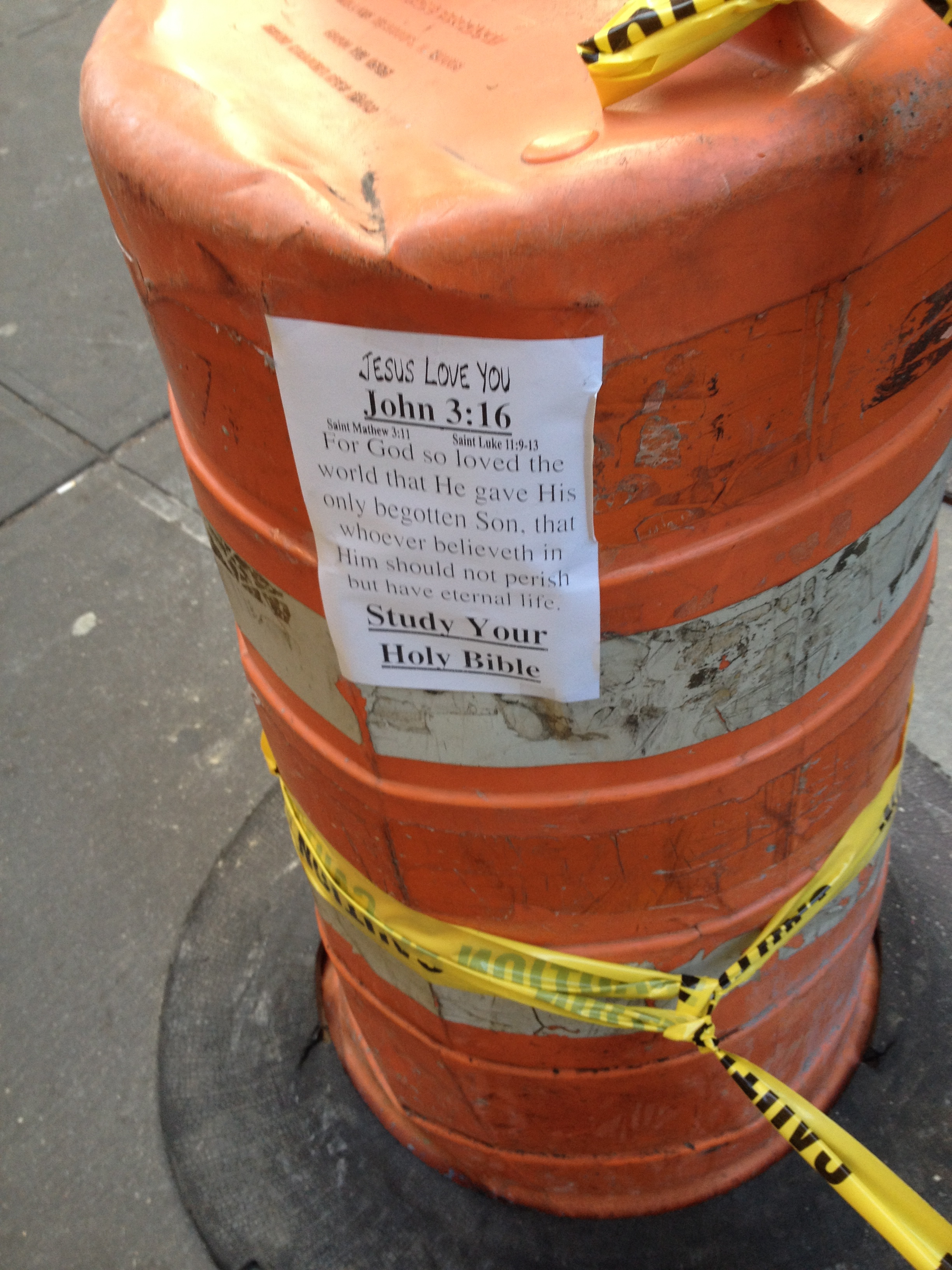
To mere mortal eyes, a traffic barrel on a Manhattan street might seem like a pretty gritty object, hardly worthy of religious veneration. Seeing leaflets advertising eternal life taped to these barrels might suggest a profound disconnect—what hath Heaven to do with traffic control?—unless one is familiar with the ardor of religious devotion. And besides, many construction sites in Midtown bear the infamous “Post No Bills” warning. When I spotted a few of these informal fliers over the past few days, however, I couldn’t help but think about religious conviction. As someone raised in an evangelical tradition, it is difficult to convey the fear in which I found myself living. Hell seemed like more of a constant threat than Heaven was ever a promise. And my young experience in a blue-collar setting had taught me that you seldom get what you hope for, no matter how hard you work for it. Somehow, no matter how good I tried to be, Hell seemed more likely than Heaven. And the Bible does suggest that if you don’t try to tell others, you’ll be held eternally responsible.

IMG_1024

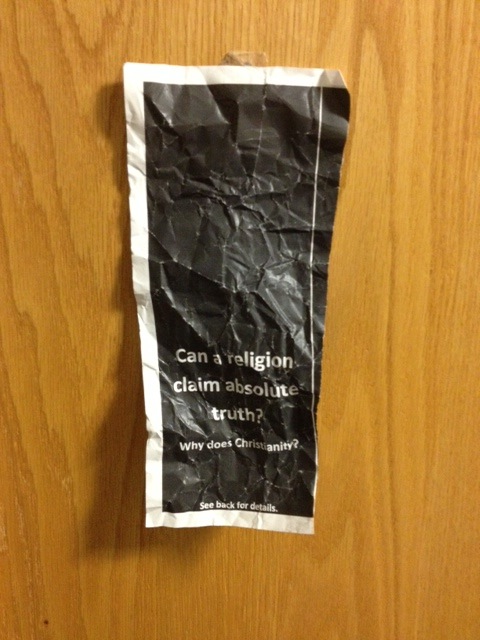
Religious conviction and fear are not far apart. I recently spoke with a Roman Catholic believer who suggested that the fear of God has been under-emphasized of late. I do suspect that it has been parodied quite a bit, but it is difficult to assess if it has truly gone underground. Perhaps among theologians it has. Like most people, I don’t read theology. For the average believer, however, fear probably plays some part in the equation that keeps her/him coming back week after week to hear the same message over and over. My daughter sent me a flier that has been appearing all over her college campus. It is a bit ambiguous, but from my own college days I recall that the young are especially vulnerable to religious coercion. Conviction is like that.

religiontruth

From my own college days I recall the earnest discussions about how far one should go to convert others. The underlying motive was always fear. Getting into Hell is so easy—we were born to it, according to some. If you just live you life as a good person, helping others and trying to improve the world, you’ll still end up there. Such is the power of eternal punishment. One of my friends, when he went to restaurants, would leave a religious tract instead of a tip for the working-class waitresses. “It’s far more valuable,” he explained, without a trace of irony. I wouldn’t be surprised to find one of those tracts taped to a dirty old traffic barrel these days. Sometimes the ardor with which we approach religion simply overlooks the more obvious implications.


Civil Lies a Ton

Often I began my classes by asking a basic question: if something pervasive, invisible, and very powerful were affecting you daily, in all aspects of your life, would you want to know about it? I don’t recall too many sleepy shoulders shrugging. We want to know what it is that is impacting us on a daily basis. Of course, I meant religion. Our secular society has a peek-a-boo affinity with religion; if we close our collective eyes, it will go away. Time and history have long put the lie to this idea—religion is a deep and pervasive force in society, and it is not about to go away. In our one-size-fits-all culture, however, we like to think that the bottom-line of greed and personal promotion will satisfy everyone. Statistics, however, seem to indicate otherwise. Not just America, but the world is a pretty religious place. I have always wondered at the strange elitism that considers itself above the influence of hoi polloi (in the literal sense). “If I’m not religious,” so the reasoning goes, “then no sensible person can be.” And we ignore religions until they explode and then go on ignoring them some more.

Although my career hasn’t turned out the way I’d hoped—I am an academic through and through—I still believe in the conviction that got me started down this rough and tangled trail. Religion is important. It is important to understand because it is very much a part of what it means to be human. Even those who are not religious have had to switch off an instinct that every child feels during a thunderstorm, and every adult feels at a time of deep, existential crisis. We may not believe, and yet we believe we believe. Religion is part of us. If we ignore it, we become strangers to ourselves.

I often look at our insipid culture. Sure, the internet provides hours of entertainment, and even some bits and pieces of knowledge. We have, however, consistently devalued those things that make us civilized. Art, music, literature, and yes, religion, all played a part in the very founding of what we consider civilized existence. Prior to that we were hunter-gatherers, roaming after the necessities of daily life. While our institutions of learning struggle to make entrepreneurs believe they still have value, we train our children to hunt and gather. It may not be food, but it is something not so different from food. Only money truly satisfies. If there were another way of being in the world, it might imply—why, it might imply that there is something more to be gained from life. And since that idea is a religious one, it is safest to ignore it and pray it will go away.

IMG_0558


Our Lady of Culture

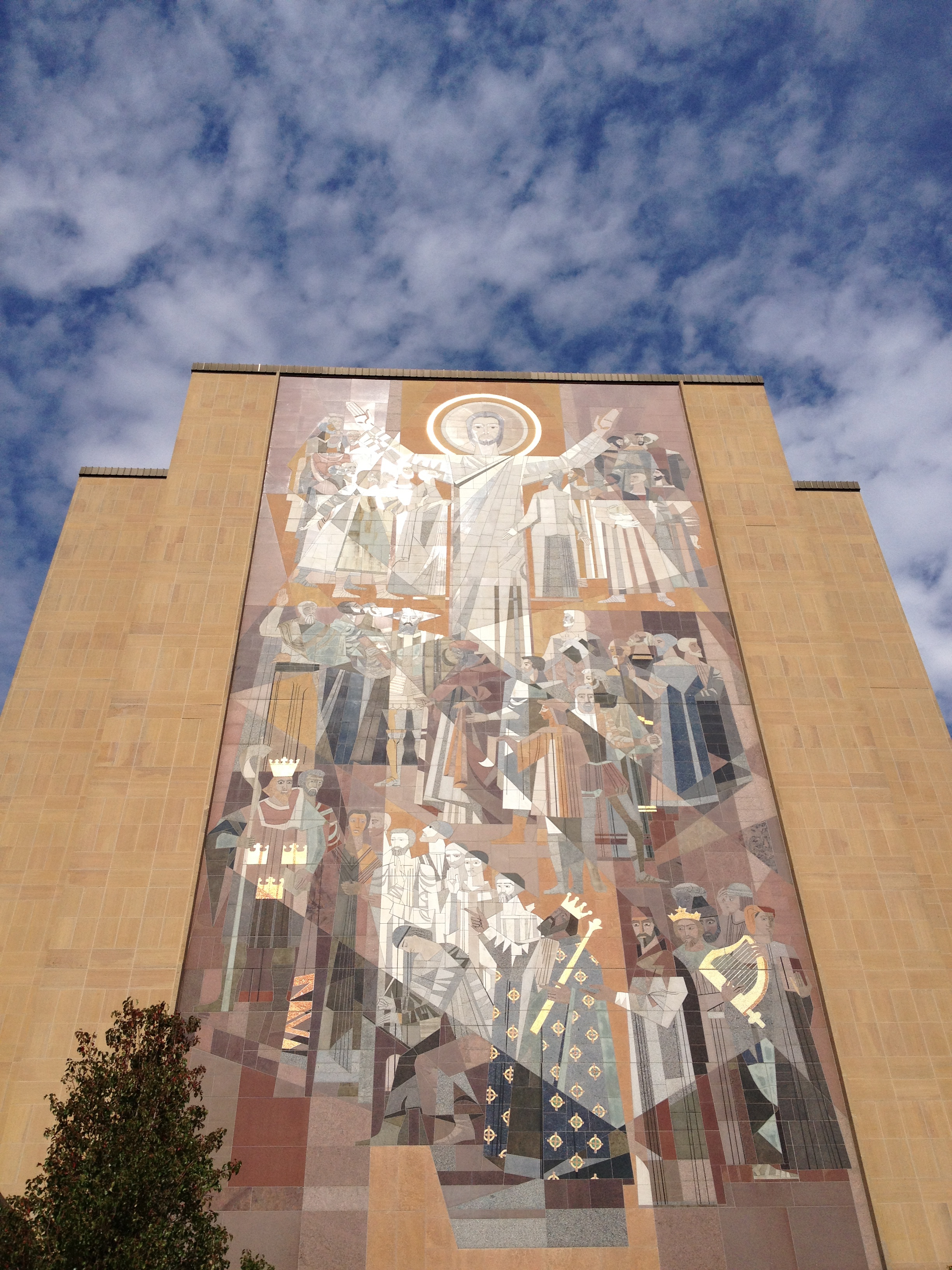
So I’m in the land where sport and religion become one.  Notre Dame is an intimidating university for a small Protestant like myself.  Like on a first date, I’m never sure what to do with my hands.  Standing below the famous “touchdown Jesus,” more properly, the “Word of Life,” I feel small indeed.  For a long while in US history, Catholicism was treated like some kind of cult.  Those of us reared Protestant were taught to fear “them” and their ritualistic ways.  I’m more afraid that someone might ask me about football stats.  Sports is a religion I’ve never studied.

IMG_0997

Culture is like a colossal Cuisinart.  Lots of stuff goes in, all of it more or less equal, and the blades begin to whirl.  Sports, religion, fast food, alcohol, a dash of education, and we’ve got an American classic.  The only time that sports come to my mind is when they start to take on the flavor of religion.  The level of the devotion of fans is the envy of many a church.  In fact, the word “fan” was borrowed from the lexicon of religious behaviors.  It is not difficult to sense the pride in football here, but then, sports are often a civilized way to assert one’s self-worth in a culture where self-worth feels under threat.  It is hard to recall a time when the Fighting Irish were not mainstream.

“High culture” has put itself on the endangered species list by becoming inaccessible in a culture that doesn’t value education (not to reflect on the academics I’ve seen at Notre Dame, which are pretty impressive).  I cringe, however, when I see polished politicians basking in their lack of introspection on issues that impact the entire human race.  They seem proud to declare themselves untainted by education.  They will support sports, however, and particularly football where violence is padded, but still encouraged.  It is culture for those who enjoy the lowest common denominator.  In the airport I noticed another “touchdown” character who, in some quarters in more recognized than the deity soaring over Notre Dame’s venerable stadium.  I was in the true presence of culture even before I boarded the plane.

IMG_0977


Arduino Anything?

Before my daughter enrolled in college I’d never heard of an Arduino. Since her high school robotics team leadership has now passed into more able hands, I figured that I’d go back to my naive days of not thinking about automated mechanical devices, devoting my gray matter to grayer matters. Still, over the past several weeks robots keep seeking me out. A spread in Delta’s in-flight magazine for July featured robots, as did an alumni magazine for August. Now the issue of Time for September has a story about robots. When my daughter sent me the Arduino video, by TED, I knew I’d better try to pay attention. Technology will change us, whether we want it to or not. It seems that from the first knapping of flint our destiny was set to manipulating our world and making it into something we create. Robots make us gods.

Arduino_Uno_-_R3

The real issue, however, in the TED video is that Arduino is open-source. Open-source means that the designs, instructions, and application of the device are voluntarily not held under copyright. Academics throughout the world are increasingly favoring open-source material—not just software and hardware, but the knowledge behind them. In my work at a for-profit (i.e. “commercial”) publisher, I know that open-source is a huge concern. It used to be that open-source, that is, free—information, was considered inferior. Like the early stages of recycled grocery bags. Arduino puts the lie to that supposition. An international team has made a device that is extremely flexible in application, and is giving it away. Many academic journals, traditional cash cows for the publishing industry, are now going open-source. Those of us who research and write don’t often do it for money—we just want our ideas shared. Commercial interests, however, are heavily vested in turning a profit from information. It is a clash of worldviews.

Never one of the great capitalists, I find open-source an intriguing concept. The problem is that those who think need to find a way to make a living in a society over-awed by spending. Universities charge tuition because professors have to be paid. Publishers charge a week’s wages for textbooks because editors have to be paid. Knowledge—the most valuable commodity people possess—fits uneasily with entrepreneurial ideals. This blog is open-source. Maybe that is why it has never garnered much attention, like a first-generation recycled paper bag. These same ideas, however, when presented in the context of university classrooms were subject to fees of thousands of dollars. Registration filled up every semester. The source is the same, a guy with a Ph.D. from a major research university making observations about how religion impacts each and every one of us, often in unexpected ways. Some things you can’t even give away. Well, if trends continue I shouldn’t be surprised if someday even this is taken over by a robot. Right, Mr. Čapek?


Proselytization and Cheese

One of the universals of many childhood lives is Kraft Macaroni and Cheese. If I were the financial sort, I would consider investing in it. As my daughter was moving into college, I noticed other worried-looking parents sitting by their unpacked cars, some with corporate-size boxes of Mac and Cheese shrink-wrapped and ready to tide a son or daughter through difficult times. It is a comfort food, a warm and welcoming friend. Some would say heavenly. Eventually, as adults, we learn to view processed foods with some introspection, moving toward the harsher, but healthier fresh varieties. Secretly, most of us would welcome the opportunity to eat like we did as kids when the consequences were unclear and the guilt was still a plucked apple away.

IMG_0960So at a college organizational fair, my daughter sent me a picture of savvy marketing. Christ the King Lutheran Church giving away boxes of childhood. When that warm, gooey, comforting sensation of childhood hits those whom society is suddenly telling they’re adults, they might have their thoughts turn to the Lutherans. Or the many other faith-based organizations eager to recruit among the young and newly independent. This, of course, is nothing new. Religions have long displayed their benefits to convince those with more earthy things on their minds. The evolution of religion is a fascinating study from the days of enforced loyalty despite belief up to the buyer’s market that religion represents today. How do you convince those who legitimately have a choice? What brand of religion is better than the others? Which is the tastiest variety?

The irony of appealing to the body to gain the commitment of the soul is one religions have had to adopt. There was a time when the way to heaven came through self-denial and spiritual discipline. Earning salvation was hard work. Now if we can get you into the pews on Sunday morning, preferably with your wallet, all is good. It is well with your soul, it is well. I feel for the modern, institutional religions. They were once a powerful force in society and by default people believed that they had a special line to God. Up to the 1950’s, even, this perception was especially strong. People learned, as people will, what they could get away with. Turns out, religion is optional. But eating is not. Not if you’re going to survive in this harsh world. And even if you don’t believe in heaven, we will always believe that in the kitchens of paradise they will be serving Kraft Macaroni and Cheese.


Disorganized Religion

In an Advice column in last week’s Chronicle of Higher Education, subtly pseudonymed Madalyn Dawkins contributed a piece entitled “Dodging the God Squad.” Dawkins, the wife of a senior college administrator, is an atheist and she shares anecdotally the woes of non-believing administrators everywhere. Even in state universities administrators must not reveal their lack of belief because powerful donors may withdraw their support or other administrators may bring them down. This leads Dawkins to posit a “God Squad” that silently polices university administrators, ensuring a kind of conventional belief structure. Of course, with any covert operation speculation must be involved. Dawkins notes that instructors may declare themselves non-believers with few consequences, but for administrators the game is much more political.

Doubtlessly covert religious groups exist; we discover them all the time. In this case, however, I wonder if Dawkins has wandered into that territory some of have written about for years but to which most academics are blind: the world is actually a very religious place. I sympathize with Dawkins. Those who are educated cannot unlearn what they’ve discovered on their academic journeys. What they often do, however, is suppose that others have kept apace. I see this all the time in the public posturing of the other Dawkins, Sir Richard, that is. Railing against belief as if it is a disease, he doesn’t seem to understand why the unwashed masses don’t get some kind of flu shot of the mind and destroy this pesky infection. What academics sometimes—often—forget is that religion serves many valuable functions in people’s lives. In a world where the privileges of an academic lifestyle are rare and becoming rarer, the disparity is only going to increase. There is no “God Squad.” There is society and there is academia.

I’ve been around the quad a time or two. I know that academic administrators often see no reason to study religion. Many of them are non-religious, as I’m sure many people know. Supposing that all others share their views, however, they cancel funds for the study of religion (one of the departments hardest hit by the “it doesn’t lead to a job squad”), as if silencing the rational voices in this discussion will make the phenomenon go away. Higher education exists for the sake of society. Those who are educated can help to educate others and slowly, slowly progress will ensue. Some of us have tried patiently to do just that over our years in the classroom. I never belittled a student’s religious belief. I did try to raise questions, and I tried to teach students to raise their own questions. My positions, however, were repeatedly cut out from under me by eager administrators. There is no God Squad. For the sake of us all, however, it would be best if administrators acted like this mythology is really true.

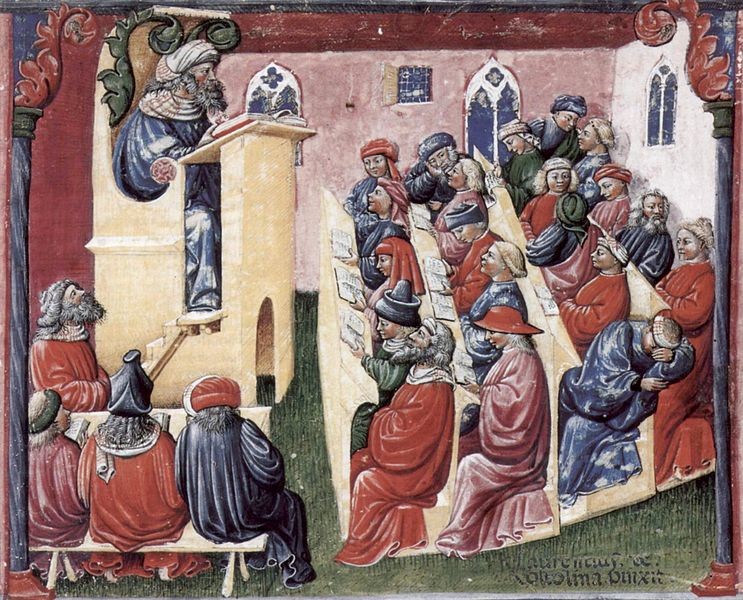
An early view of higher education.  Literally.

An early view of higher education. Literally.


Ivory Doghouse

inthebasementoftheivorytowerSome months ago I wrote a post about a book I had not yet read. In the Basement of the Ivory Tower: The Truth about College, by Professor X both entertains and informs. And depresses. Written by an anonymous adjunct English instructor, the book presents much of adjunct life in gritty realism. No one sane can possibly dispute that there are problems with higher education, however, X’s experience and mine of the same phenomenon, while eerily similar, are strikingly different. X became a Professor because of the need for extra income to help pay a mortgage. Good for him—I am glad for him. Having been an adjunct myself, however, in much more trying circumstances (fear of being turned out of a rented apartment for insolvency) makes me wonder if X delved deeply enough. X was not a Ph.D. turned away from full-time teaching after having proven himself to have “the right stuff” in the collegiate classroom. He could afford, albeit barely, house payments. He had a full-time day job.

It could be the differences in our specializations that paints the contrast so starkly. I studied religion from my undergraduate days and demonstrated competence at each step of the way. Even now colleagues encourage me that a full-time teaching job might come up. Some even lament the loss of my contribution to scholarship (not many, mind you! Far more have forgotten they ever knew me). Unlike Professor X I was fired for religiously motivated reasons. Once thrown off that lifeboat, there’s no getting back on. The religious are persnickety in that way. Being fired from a seminary is a sure sign of faulty merchandise. I spent six years, in some fashion, as an adjunct instructor with the constant specter of very real loss of everything a daily threat. Everything, of course, in my case meant mostly books. That made the threatened loss even worse.

Although my experience differed considerably, Professor X is absolutely right in his portrayal of how tenured, regular faculty often treat adjuncts dismissively. At times with disdain. As if we somehow didn’t graduate from world class universities. As if we didn’t have nearly two decades of stellar teaching evaluations. As if we’d stepped in something on the way to class. If I ran the world (and heave a sigh of relief that I never will) full-time faculty would be required to recite a prayer of thanksgiving every day that they were favored with a genuine taste of the promise that crumbles into sawdust in the mouths of the adjuncts. I was a full-time associate professor with a future. Since then I’ve become, no matter how full-time my workaday job, an adjunct with an uncertain future. And if you are lucky enough to have a full-time professorship, close your eyes, bow your head, and thank whatever it is you believe in. Ivory towers, it seems, come in many colors.