More Fun than a Barrel

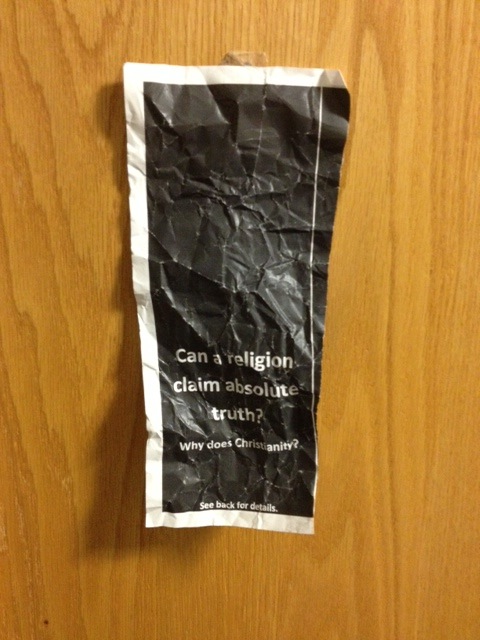
To mere mortal eyes, a traffic barrel on a Manhattan street might seem like a pretty gritty object, hardly worthy of religious veneration. Seeing leaflets advertising eternal life taped to these barrels might suggest a profound disconnect—what hath Heaven to do with traffic control?—unless one is familiar with the ardor of religious devotion. And besides, many construction sites in Midtown bear the infamous “Post No Bills” warning. When I spotted a few of these informal fliers over the past few days, however, I couldn’t help but think about religious conviction. As someone raised in an evangelical tradition, it is difficult to convey the fear in which I found myself living. Hell seemed like more of a constant threat than Heaven was ever a promise. And my young experience in a blue-collar setting had taught me that you seldom get what you hope for, no matter how hard you work for it. Somehow, no matter how good I tried to be, Hell seemed more likely than Heaven. And the Bible does suggest that if you don’t try to tell others, you’ll be held eternally responsible.

IMG_1024

Religious conviction and fear are not far apart. I recently spoke with a Roman Catholic believer who suggested that the fear of God has been under-emphasized of late. I do suspect that it has been parodied quite a bit, but it is difficult to assess if it has truly gone underground. Perhaps among theologians it has. Like most people, I don’t read theology. For the average believer, however, fear probably plays some part in the equation that keeps her/him coming back week after week to hear the same message over and over. My daughter sent me a flier that has been appearing all over her college campus. It is a bit ambiguous, but from my own college days I recall that the young are especially vulnerable to religious coercion. Conviction is like that.
religiontruth

From my own college days I recall the earnest discussions about how far one should go to convert others. The underlying motive was always fear. Getting into Hell is so easy—we were born to it, according to some. If you just live you life as a good person, helping others and trying to improve the world, you’ll still end up there. Such is the power of eternal punishment. One of my friends, when he went to restaurants, would leave a religious tract instead of a tip for the working-class waitresses. “It’s far more valuable,” he explained, without a trace of irony. I wouldn’t be surprised to find one of those tracts taped to a dirty old traffic barrel these days. Sometimes the ardor with which we approach religion simply overlooks the more obvious implications.


Civil Lies a Ton

Often I began my classes by asking a basic question: if something pervasive, invisible, and very powerful were affecting you daily, in all aspects of your life, would you want to know about it? I don’t recall too many sleepy shoulders shrugging. We want to know what it is that is impacting us on a daily basis. Of course, I meant religion. Our secular society has a peek-a-boo affinity with religion; if we close our collective eyes, it will go away. Time and history have long put the lie to this idea—religion is a deep and pervasive force in society, and it is not about to go away. In our one-size-fits-all culture, however, we like to think that the bottom-line of greed and personal promotion will satisfy everyone. Statistics, however, seem to indicate otherwise. Not just America, but the world is a pretty religious place. I have always wondered at the strange elitism that considers itself above the influence of hoi polloi (in the literal sense). “If I’m not religious,” so the reasoning goes, “then no sensible person can be.” And we ignore religions until they explode and then go on ignoring them some more.

Although my career hasn’t turned out the way I’d hoped—I am an academic through and through—I still believe in the conviction that got me started down this rough and tangled trail. Religion is important. It is important to understand because it is very much a part of what it means to be human. Even those who are not religious have had to switch off an instinct that every child feels during a thunderstorm, and every adult feels at a time of deep, existential crisis. We may not believe, and yet we believe we believe. Religion is part of us. If we ignore it, we become strangers to ourselves.

I often look at our insipid culture. Sure, the internet provides hours of entertainment, and even some bits and pieces of knowledge. We have, however, consistently devalued those things that make us civilized. Art, music, literature, and yes, religion, all played a part in the very founding of what we consider civilized existence. Prior to that we were hunter-gatherers, roaming after the necessities of daily life. While our institutions of learning struggle to make entrepreneurs believe they still have value, we train our children to hunt and gather. It may not be food, but it is something not so different from food. Only money truly satisfies. If there were another way of being in the world, it might imply—why, it might imply that there is something more to be gained from life. And since that idea is a religious one, it is safest to ignore it and pray it will go away.

IMG_0558


Our Lady of Culture

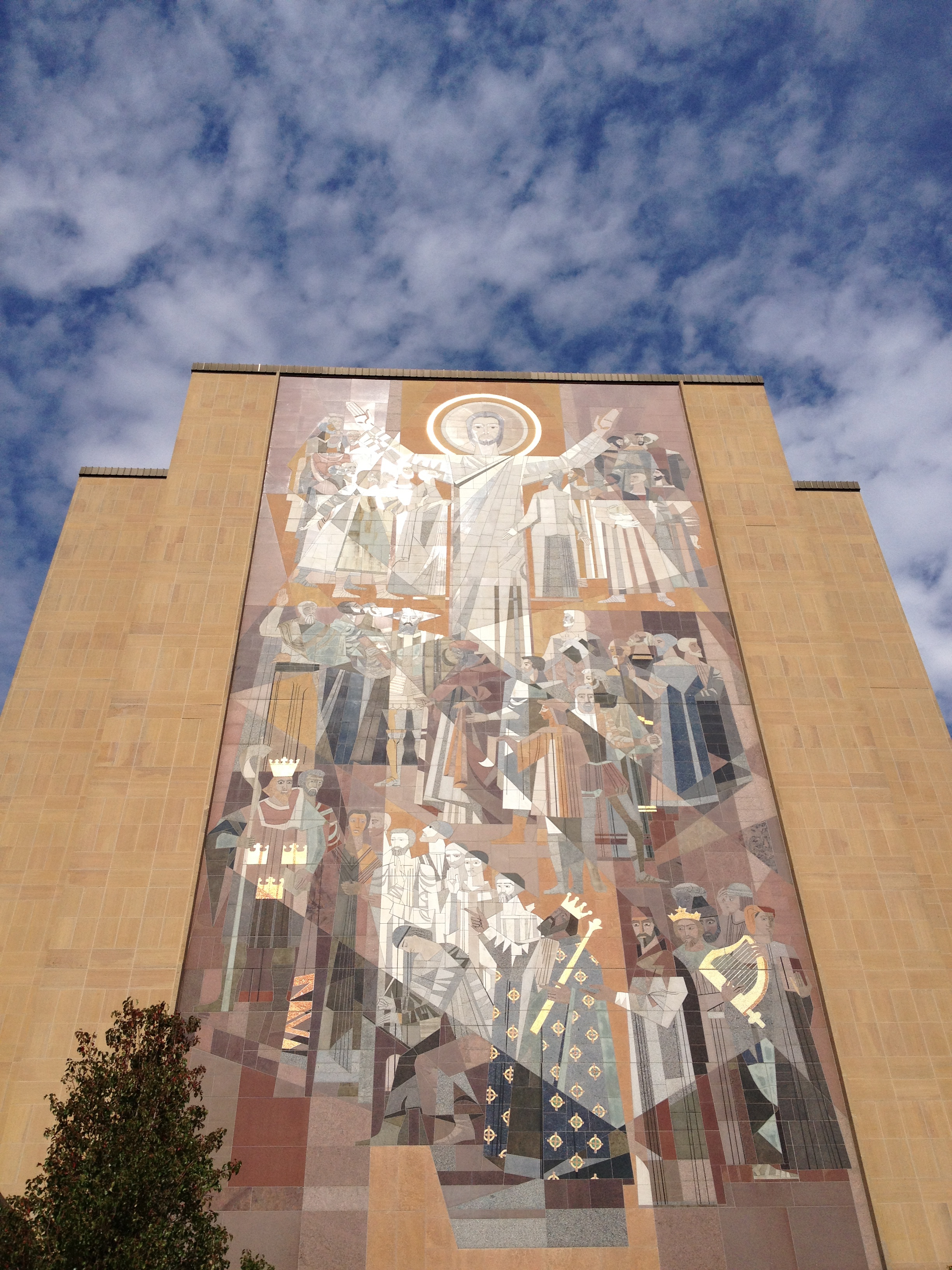
So I’m in the land where sport and religion become one.  Notre Dame is an intimidating university for a small Protestant like myself.  Like on a first date, I’m never sure what to do with my hands.  Standing below the famous “touchdown Jesus,” more properly, the “Word of Life,” I feel small indeed.  For a long while in US history, Catholicism was treated like some kind of cult.  Those of us reared Protestant were taught to fear “them” and their ritualistic ways.  I’m more afraid that someone might ask me about football stats.  Sports is a religion I’ve never studied.

IMG_0997

Culture is like a colossal Cuisinart.  Lots of stuff goes in, all of it more or less equal, and the blades begin to whirl.  Sports, religion, fast food, alcohol, a dash of education, and we’ve got an American classic.  The only time that sports come to my mind is when they start to take on the flavor of religion.  The level of the devotion of fans is the envy of many a church.  In fact, the word “fan” was borrowed from the lexicon of religious behaviors.  It is not difficult to sense the pride in football here, but then, sports are often a civilized way to assert one’s self-worth in a culture where self-worth feels under threat.  It is hard to recall a time when the Fighting Irish were not mainstream.

“High culture” has put itself on the endangered species list by becoming inaccessible in a culture that doesn’t value education (not to reflect on the academics I’ve seen at Notre Dame, which are pretty impressive).  I cringe, however, when I see polished politicians basking in their lack of introspection on issues that impact the entire human race.  They seem proud to declare themselves untainted by education.  They will support sports, however, and particularly football where violence is padded, but still encouraged.  It is culture for those who enjoy the lowest common denominator.  In the airport I noticed another “touchdown” character who, in some quarters in more recognized than the deity soaring over Notre Dame’s venerable stadium.  I was in the true presence of culture even before I boarded the plane.

IMG_0977


Arduino Anything?

Before my daughter enrolled in college I’d never heard of an Arduino. Since her high school robotics team leadership has now passed into more able hands, I figured that I’d go back to my naive days of not thinking about automated mechanical devices, devoting my gray matter to grayer matters. Still, over the past several weeks robots keep seeking me out. A spread in Delta’s in-flight magazine for July featured robots, as did an alumni magazine for August. Now the issue of Time for September has a story about robots. When my daughter sent me the Arduino video, by TED, I knew I’d better try to pay attention. Technology will change us, whether we want it to or not. It seems that from the first knapping of flint our destiny was set to manipulating our world and making it into something we create. Robots make us gods.

Arduino_Uno_-_R3

The real issue, however, in the TED video is that Arduino is open-source. Open-source means that the designs, instructions, and application of the device are voluntarily not held under copyright. Academics throughout the world are increasingly favoring open-source material—not just software and hardware, but the knowledge behind them. In my work at a for-profit (i.e. “commercial”) publisher, I know that open-source is a huge concern. It used to be that open-source, that is, free—information, was considered inferior. Like the early stages of recycled grocery bags. Arduino puts the lie to that supposition. An international team has made a device that is extremely flexible in application, and is giving it away. Many academic journals, traditional cash cows for the publishing industry, are now going open-source. Those of us who research and write don’t often do it for money—we just want our ideas shared. Commercial interests, however, are heavily vested in turning a profit from information. It is a clash of worldviews.

Never one of the great capitalists, I find open-source an intriguing concept. The problem is that those who think need to find a way to make a living in a society over-awed by spending. Universities charge tuition because professors have to be paid. Publishers charge a week’s wages for textbooks because editors have to be paid. Knowledge—the most valuable commodity people possess—fits uneasily with entrepreneurial ideals. This blog is open-source. Maybe that is why it has never garnered much attention, like a first-generation recycled paper bag. These same ideas, however, when presented in the context of university classrooms were subject to fees of thousands of dollars. Registration filled up every semester. The source is the same, a guy with a Ph.D. from a major research university making observations about how religion impacts each and every one of us, often in unexpected ways. Some things you can’t even give away. Well, if trends continue I shouldn’t be surprised if someday even this is taken over by a robot. Right, Mr. Čapek?


Proselytization and Cheese

One of the universals of many childhood lives is Kraft Macaroni and Cheese. If I were the financial sort, I would consider investing in it. As my daughter was moving into college, I noticed other worried-looking parents sitting by their unpacked cars, some with corporate-size boxes of Mac and Cheese shrink-wrapped and ready to tide a son or daughter through difficult times. It is a comfort food, a warm and welcoming friend. Some would say heavenly. Eventually, as adults, we learn to view processed foods with some introspection, moving toward the harsher, but healthier fresh varieties. Secretly, most of us would welcome the opportunity to eat like we did as kids when the consequences were unclear and the guilt was still a plucked apple away.

IMG_0960So at a college organizational fair, my daughter sent me a picture of savvy marketing. Christ the King Lutheran Church giving away boxes of childhood. When that warm, gooey, comforting sensation of childhood hits those whom society is suddenly telling they’re adults, they might have their thoughts turn to the Lutherans. Or the many other faith-based organizations eager to recruit among the young and newly independent. This, of course, is nothing new. Religions have long displayed their benefits to convince those with more earthy things on their minds. The evolution of religion is a fascinating study from the days of enforced loyalty despite belief up to the buyer’s market that religion represents today. How do you convince those who legitimately have a choice? What brand of religion is better than the others? Which is the tastiest variety?

The irony of appealing to the body to gain the commitment of the soul is one religions have had to adopt. There was a time when the way to heaven came through self-denial and spiritual discipline. Earning salvation was hard work. Now if we can get you into the pews on Sunday morning, preferably with your wallet, all is good. It is well with your soul, it is well. I feel for the modern, institutional religions. They were once a powerful force in society and by default people believed that they had a special line to God. Up to the 1950’s, even, this perception was especially strong. People learned, as people will, what they could get away with. Turns out, religion is optional. But eating is not. Not if you’re going to survive in this harsh world. And even if you don’t believe in heaven, we will always believe that in the kitchens of paradise they will be serving Kraft Macaroni and Cheese.


Disorganized Religion

In an Advice column in last week’s Chronicle of Higher Education, subtly pseudonymed Madalyn Dawkins contributed a piece entitled “Dodging the God Squad.” Dawkins, the wife of a senior college administrator, is an atheist and she shares anecdotally the woes of non-believing administrators everywhere. Even in state universities administrators must not reveal their lack of belief because powerful donors may withdraw their support or other administrators may bring them down. This leads Dawkins to posit a “God Squad” that silently polices university administrators, ensuring a kind of conventional belief structure. Of course, with any covert operation speculation must be involved. Dawkins notes that instructors may declare themselves non-believers with few consequences, but for administrators the game is much more political.

Doubtlessly covert religious groups exist; we discover them all the time. In this case, however, I wonder if Dawkins has wandered into that territory some of have written about for years but to which most academics are blind: the world is actually a very religious place. I sympathize with Dawkins. Those who are educated cannot unlearn what they’ve discovered on their academic journeys. What they often do, however, is suppose that others have kept apace. I see this all the time in the public posturing of the other Dawkins, Sir Richard, that is. Railing against belief as if it is a disease, he doesn’t seem to understand why the unwashed masses don’t get some kind of flu shot of the mind and destroy this pesky infection. What academics sometimes—often—forget is that religion serves many valuable functions in people’s lives. In a world where the privileges of an academic lifestyle are rare and becoming rarer, the disparity is only going to increase. There is no “God Squad.” There is society and there is academia.

I’ve been around the quad a time or two. I know that academic administrators often see no reason to study religion. Many of them are non-religious, as I’m sure many people know. Supposing that all others share their views, however, they cancel funds for the study of religion (one of the departments hardest hit by the “it doesn’t lead to a job squad”), as if silencing the rational voices in this discussion will make the phenomenon go away. Higher education exists for the sake of society. Those who are educated can help to educate others and slowly, slowly progress will ensue. Some of us have tried patiently to do just that over our years in the classroom. I never belittled a student’s religious belief. I did try to raise questions, and I tried to teach students to raise their own questions. My positions, however, were repeatedly cut out from under me by eager administrators. There is no God Squad. For the sake of us all, however, it would be best if administrators acted like this mythology is really true.

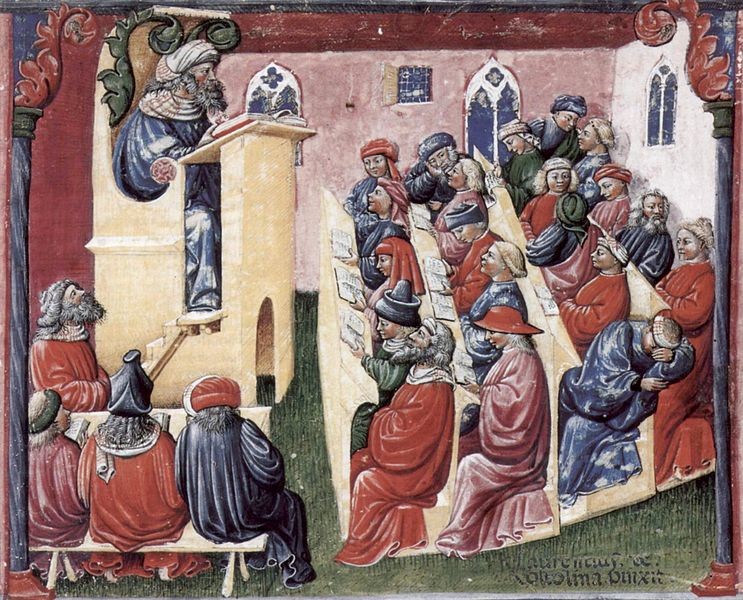
An early view of higher education.  Literally.

An early view of higher education. Literally.


Ivory Doghouse

inthebasementoftheivorytowerSome months ago I wrote a post about a book I had not yet read. In the Basement of the Ivory Tower: The Truth about College, by Professor X both entertains and informs. And depresses. Written by an anonymous adjunct English instructor, the book presents much of adjunct life in gritty realism. No one sane can possibly dispute that there are problems with higher education, however, X’s experience and mine of the same phenomenon, while eerily similar, are strikingly different. X became a Professor because of the need for extra income to help pay a mortgage. Good for him—I am glad for him. Having been an adjunct myself, however, in much more trying circumstances (fear of being turned out of a rented apartment for insolvency) makes me wonder if X delved deeply enough. X was not a Ph.D. turned away from full-time teaching after having proven himself to have “the right stuff” in the collegiate classroom. He could afford, albeit barely, house payments. He had a full-time day job.

It could be the differences in our specializations that paints the contrast so starkly. I studied religion from my undergraduate days and demonstrated competence at each step of the way. Even now colleagues encourage me that a full-time teaching job might come up. Some even lament the loss of my contribution to scholarship (not many, mind you! Far more have forgotten they ever knew me). Unlike Professor X I was fired for religiously motivated reasons. Once thrown off that lifeboat, there’s no getting back on. The religious are persnickety in that way. Being fired from a seminary is a sure sign of faulty merchandise. I spent six years, in some fashion, as an adjunct instructor with the constant specter of very real loss of everything a daily threat. Everything, of course, in my case meant mostly books. That made the threatened loss even worse.

Although my experience differed considerably, Professor X is absolutely right in his portrayal of how tenured, regular faculty often treat adjuncts dismissively. At times with disdain. As if we somehow didn’t graduate from world class universities. As if we didn’t have nearly two decades of stellar teaching evaluations. As if we’d stepped in something on the way to class. If I ran the world (and heave a sigh of relief that I never will) full-time faculty would be required to recite a prayer of thanksgiving every day that they were favored with a genuine taste of the promise that crumbles into sawdust in the mouths of the adjuncts. I was a full-time associate professor with a future. Since then I’ve become, no matter how full-time my workaday job, an adjunct with an uncertain future. And if you are lucky enough to have a full-time professorship, close your eyes, bow your head, and thank whatever it is you believe in. Ivory towers, it seems, come in many colors.


Hire Education

Physicians are trained to notice symptoms before a condition becomes fatal. That’s their job and our society pays them well for it. Who wants to die? “Where your treasure is, there will your heart be also,” a very wise person once said. If we had a physician to look over the health of the nation, I would tremble at the diagnosis. A colleague just reminded me of this by pointing out Un-Hired Ed, an infographic that reveals the chart the doctors don’t want the patient to see. My daughter is starting college. Long ago, however, we gave her that talk that parents give their kids—you know the one—the beware of the lure of higher education talk. As Un-Hired Ed points out, our society has been putting on weight: universities consume far more doctoral candidates than there will ever be jobs. I speak from first-hand experience with an earned doctorate from a world-class research university and a list of solid publications, in saying that the prognosis is distressing, likely fatal. I spent nearly a decade of my “best earning years” functionally unemployed because I was “overqualified” for job after job after job. How many people don’t even rate an interview to become a meter reader for the electric company? Well, with the unending awarding of doctorates, that, like the national cholesterol level, is sure to rise.

Universities have turned greedy eyes towards the profit margins of businesses since about the 1980s—those years of “me first” that have plunged us into an economic dark age. Salaries and privileges skyrocketed and so did college enrollments. I worked at a university that was seriously considering a “Marina Management” major. To cover all the additional courses that universities must offer to “educate” the vast numbers of students, they face a financial brick wall. College presidents expect to earn a certain (unrealistic) salary, and football coaches deserve even more. Stadiums don’t come cheap, you know! So they hire adjuncts; Ph.D.s who are functionally unemployable, and pay them less than the janitors. Woo-hoo! We’ve beat the system of fair compensation and it has only cost us the livelihood of those whose professors encouraged off to grad school because they were the best and brightest in the class!

“Like lambs led to the slaughter,” as the saying goes.

Can higher education be redeemed? I have to believe so. You see, back in the Dark Ages some of the theologically literate began to congeal into clumps of readers and writers that eventually became universities. They valued learning and passing that learning on so that, like the physician, society might heal itself. And it did. Bologna, Oxford, Paris, Cambridge, St Andrews, Edinburgh—lights began to shine in the darkness. Then business models assured our great institutions that more is better, and doctorates spread like an unstoppable disease. Society’s interests had moved on. Who needs higher education when there’s something really entertaining on YouTube? Prognosis: chronic obesity. Don’t you agree, doctor?

Un-Hired Ed: The Growing Adjunct Crisis
Source: Online-PhD-Programs.org


Thar She Blows

Any survey of “armpits of America” will laughingly include New Jersey. Having lived here for nearly seven years now, I know the apocrine insults are undeserved—I actually knew that before moving here. New Jersey has the highest per capita Ph.D. concentration in the nation. It also has the highest number of college graduates, and, for what it’s worth, the highest per capita income. These first two points come especially to the fore regarding New Jersey governor Chris Christie’s recent speech, made in Boston—a city with some small higher education affiliations itself. Propping up his creds for a presidential run, Christie said, “I think that we have some folks that believe that our job is to be college professors. Now college professors are fine, I guess. You know, college professors basically spout out ideas that nobody ever does anything about. [Rim shot!] For our ideas to matter, we have to win because, if we don’t win, we don’t govern.” (This according to the New Jersey Star-Ledger.)

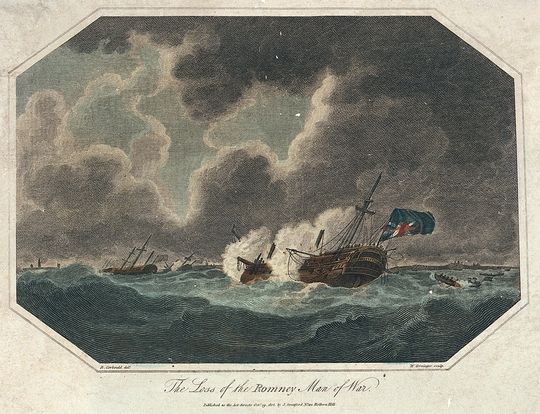
The United States, for many years now, has been falling behind in education because we won’t fund it adequately. I’m no jingoist, but I do believe that the principles upon which this country were founded were inspired. To thrive, we must be smart. Education has been the key to our improvement over the decades, and as the focus has shifted from education to capital, the hull has begun to leak. I know that I have felt it. With dismay I’ve watched as colleges and universities have hoisted the November Charlie and no vessel has come to their aid. Departments are jettisoned and we are still taking on water. And the governor of “the education state” guesses that “college professors are fine” but completely irrelevant. This man for president in 2016?

Meanwhile, yesterday, the unexpectedly happy news was announced that President Obama will be visiting my daughter’s university next week. Binghamton University is frequently overlooked by the monied special interests paid to the Harvards and Princetons of the green-lined ivies. It is, however, frequently cited as a “public ivy” for its quality education at state-school prices. Obama’s visit is for precisely that reason: good education can be affordable. Chris Christie went on to say, “For our ideas to matter we have to win because, if we don’t win, we don’t govern. And if we don’t govern, all we do is shout into the wind.” And if we don’t win we gather up our marbles and go home. Yes, I was a child once, too. And I grew up. Higher education does matter—far more than some politicians’ bluster would indicate. Do you agree, Dr. Einstein? I’m sorry, governor, I can’t hear you over the wind flapping the sails.

The_Loss_of_the_Romney_Man_of_War


Five Man Electrical Band

I grew up looking for signs. If you sincerely believe the Fundamentalist worldview, then we are all part of a great, divine dramaturgy in which we have expected roles to fulfill. The script (Holy Scripture) is a little vague on the individual details, but if you know where to look you can find signs. They may be obvious and literal or subtle and ambiguous. The faithful, however, know they must seek them out and take their chances. I grew up in a decidedly blue-collar world. In my head, though, it felt like I was meant for something more. My career ambition was to be a janitor, but my reading and the counsel I received from those who knew more than I did suggested I might have a higher calling. The concept was unfamiliar at first, but compelling. I had to be able to read the signs. I remember hearing about seminary for the first time. If I was going to be a preacher, I had to go to seminary. The summer before starting college, I sat on the dilapidated front porch of my step-father’s house and taught myself to draw the Greek alphabet. Signs were rare, but when spotted, definitive.

Seminary came to define my existence in a way that I couldn’t foresee. I started college with the idea that, all things being equal, I’d end up at seminary. Still, I was drawn to the life of a faculty member in a liberal arts setting. Eventually, I recognized it as my calling. Getting to seminary proved more difficult than I’d imagined. It wasn’t the grades—it was the expenses. I was in debt and I knew that bank barons did not forgive us ours as we forgave others theirs. In seminary, signs came to take on differing interpretations. Maybe I was correct about ministry or maybe not. Looking closely, I could see that the script had marginal notes, and that it wasn’t even the original manuscript after all. I’d learned original languages only to become more confused about the signs. When I left seminary I knew one thing for certain—I didn’t ever want to teach in one.

My first professional job, of course, was teaching in a seminary. It was not a matter of free choice as much as free economy in free-fall. In the early ’90’s recession, jobs were few and signs completely distorted. When impolitely asked to leave my seminary position after a decade and a half, I was type-cast as a bit-player. The washed-up seminary teacher. I began to see signs along the highway for seminaries trying to recruit potential clergy. This was no longer a calling, but a job option. Don’t enjoy the rat race? Why not try opting out? The pay won’t be as good, and society will come to despise the very doctrines you’ll be taught, but at least it’s a living. I still see such signs. And I’m still not sure if I’m reading correctly. And even today, I notice with appreciation when a floor is expertly stripped, cleaned, and waxed.

IMG_0723


Check Mace

In the medical sciences building of the University of St Andrews stands a glass display case cradling a mace. The mace, a symbol of smiting authority that goes all the way back to Old Kingdom pharaohs, has a long tradition in academia as well. In all the pomp and glitter of an academic processional, a dean, provost, or chancellor carries a symbolic mace, as if to keep an unruly faculty in order. (I am sure that most of them have wanted to use that mace a time or two in reality, but have been constrained by both convention and the rule of law.) Medical science is among the fields of research quickly moving away from the spiritual mumbo-jumbo of medieval superstition. We are, after all, simply soft machines, doing as nature has programmed us. What more could there be to it?

IMG_0778

Looking more closely at the mace, I see on its ornate base, a flanking ring of winged oxen. Perhaps obscure to medical students, the winged ox is the symbol of the putative Gospel writer, Luke. Each of the Gospels emphasizes different aspects of Jesus, and the symbol assigned to Luke has been the ox. If the wings didn’t give it away, the explanatory placard on the wall nearby confirms my analysis. Eyes traveling up the silver shaft, the crown of the mace houses yet another saint, this one an apostle. St Andrew (of course) tops the mace, holding his X-winged cross. Underneath is an amorphous structure for which I need to turn to the placard to have explained. The fountain of healing waters, it tells me.

IMG_0779

From tip to tale, then, the mace of medical science is inherently religious. My reading of late has been from scientists claiming that, in the words of the old commercial, “parts is parts.” There is no underlying life-force or animating principle. Life is biological robotics, so I’m told. So as I stood in St Andrews last week, considering this metallic mace, I was poised on the edge of science and symbol. There is no biological need for such symbols—indeed, the mace was originally a weapon to inflict grievous bodily harm. Now, chased with silver, intricately ornate, it begins and ends with religious implications. I can’t help wonder what the robots make of that.


Unspoken Reality

In that impressive cultural marvel known as Facebook, a few gems amid the overburden occasionally appear. The post of a friend brought to my awareness a site known as everyday feminism, where, last year a post about religious privilege appeared. The brief piece entitled “30+ Examples of Christian Privilege” highlights one of the persistently overlooked aspects of religious liberty. No matter how much the founders of the United States valued freedom of religion, the colonials were, at least on the part of the non-slave side of the equation, Christians. Whether Jamestown, Plymouth Rock, or Guanahani, those Europeans who first set foot ashore did so under the banner of one variety of Christianity or another. (Such a case might be made for Vineland as well.) Religious liberty meant fleeing the oppressive practice of state religion—always Christianity—that kept shifting according to the whims of frequently unstable monarchs. For all its wide variety, Christianity is cut from a bolt of the same cloth. At least in the lining.

The Christian Privilege cited on everyday feminism is the most insipid kind brushed with the widest strokes. Still, it does reveal just how thoroughly Christian even the secular can be. Christianity, as I often told my students, pervades our culture. We live it, breathe it, ingest it. Often subconsciously. America was and wasn’t founded as a Christian nation. Intentionally, according to the wishes of the founders, no. Unintentionally, according to the dictates of privileged classes, yes. The problem here is not Christianity—it is privilege. Depending on whence you read the words of Jesus, his message seems to have been one of a general equality, or at least fairness. Those same words, however, can be distorted to support the monolith of the privileges granted those who follow the “one true faith.” The privilege to own slaves, for example. Or to oppress others born into less fortunate circumstances.

Ironically, among academics, I’m told, there is a push to hire those who are authentically unprivileged. Although I must, by my accidental Caucasianness, maleness, and inherited Christianity, be classified as privileged oppressor, I did grow up in economic privation. So much so that my wife feared to take our infant daughter to the unsafe house in which I was reared (which was, fortunately, condemned and demolished before that became an issue). It still shows in my natural, placating obsequiousness to supervisors and bosses—I was raised knowing my place. Yes, sir. As a first generation college student, I still find myself confused by why I was rejected by a higher education into which I poured all my youthful energy. Yes, in such circumstances, it is difficult at times to see the privileges. They are there, however, as anyone willing to walk across town with their eyes open may see.

IMG_0714


Just Plain Bible

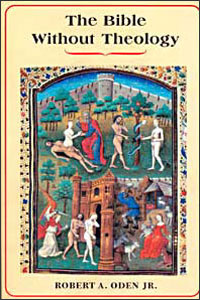
BibleWithoutTheologyBack when I was teaching Hebrew Bible in a seminary for a living, I purchased a book entitled The Bible Without Theology by Robert A. Oden Jr. I had intended to read it as a sanity break from the over-compensatory theological glosses that even the slightest reading of the Bible had in that setting. As the years passed and the book remained unread, I came to think of it as a systematic deconstructing of theological readings of the Bible, which it is not. Instead, Oden has gathered in this useful little book several essays centered on the topic of how the theological reading of the Bible has all but drowned out any other interpretations and has secured the privileged position of the Bible not only in society, but also in academia. Naturally, many people see such privilege as a witness of undisputed truth, even though how that truth is interpreted remains an open question.

Scholars, however, have the obligation not to favor their worldview over the evidence. Oden begins by discussing how history itself is perceived differently among those of various mindsets. History is an important part of the Bible’s theological reading since many Judeo-Christian interpretations revolve around a sense of historical veracity. After illustrating how history and mythology both lay claim to the text, Oden points out that even obviously mythological episodes have been blockaded by a theological reading of the scriptures. With examples from socio-anthropological studies, he demonstrates that parts of Genesis are best understood by investigating how kinship structures work, as well as how clothing serves as a status marker rather than a hidden justification for sacrifice, or chilly nights outside Eden.

Although The Bible Without Theology wasn’t exactly what I’d come to suppose it was, it remains a proper prologue to the issue. When Oden’s book appeared in the 1980s, the Religious Right was just finding its feet, fueled by a hyper-theological reading of the Bible. Since that time, the Bible has been used as theological justification to repress everyone from women to those biologically inclined toward their own gender. Bible scholars have, in general, known this is wrong. However, theologically inclined institutions won’t pay instructors for honestly engaging the text. Bible scholars are expected to throw their expertise behind the theological outlook of their institution in a way that Oden rightly points out, no other academic discipline would accept. In reaction to the biblical abuses of the Neo-Con crowd, many Americans are wondering why this one holy book is so privileged. While it may not have all the answers, Oden’s riposte will help to explain why the Bible deserves better.


Z War to End

World_War_Z_posterWorld War Z is playing in theaters and I haven’t even had time to stock up on water and canned goods. Zombies are everywhere. And we can’t say that we didn’t see them coming. As movie critic Stephen Whitty points out, there are over 900 movies featuring zombies and the vast majority of them are recent productions. Major news corporations have been analyzing this undead interest for a few years now. No doubt the zombie is a populist monster, but why does it have such a potent effect on the modern imagination? Stepping back from the screen a minute, I think perhaps an answer is very obvious.

We live in an essentially programmed society. Philosophically we believe in free will, but economically much of our lives are predetermined. Among the happiest years—speaking strictly from the point of view of what I have been required to do for work—of my life were those of adjunct teaching. I had finally broken into the realm of the major university, and I had class after class of students who wanted to learn. Many disparage undergraduates. I never did. They come to college with what they have been taught, and that teaching comes at the behest of a society that informs them college is all about money. Who needs to really learn to not split infinitives? Or reason out that even if you know that Genesis 1-3 is a myth that evolution is not about religion at all? Who needs to learn to think when your boss will not want criticism? Do what you’re told. Be a good citizen. Be a zombie.

Our children are not stupid. I had many intelligent conversations with many bright young people at our state universities. I learned from them, and I hope they learned from me. The voice of the adjunct instructor, however, is nowhere near the decibel level of higher earnings. Is not the price of being a zombie worth having an adequate home, crippling debt, and access to wifi? The zombie, after all, is the antipode to the life of the mind. Zombies are, by definition, mindless. They carry around a carcass that does only what, in the classical sense, it is told to do. And so, if I loved that bohemian life so much, why did I hypocritically leave it? I have a family that requires healthcare. I have a child to support through college. I have a retirement fund that will not support a modest lifestyle for more than a single year. Yes, I too am a zombie. World War Z is indeed already here.


Lower Education

Many people have asked me, as a former professor, why universities are so expensive. Ironically, many of these people are in flourishing businesses where the story ought to be as tired as the excuse that’s usually trotted out: faculty are paid too much, mismanagement, etc., etc. The truth is much more insidious and it begins with governments and corporate executives who can’t handle the sharp sting of criticism. I have experienced this firsthand, and unlike many academics, I have an authentic blue-collar background so that my perspective is unclouded by generations of privilege. I recently found this post on The Homeless Adjunct, and I was glad that someone is actually willing to write the truth. The high cost of higher education is because a subtle series of changes—often deliberate—that have been instituted since the 1970s to change colleges and universities into engines to power capitalistic ventures rather than to educate potential critics. Those who have a hard time accepting conspiracy theories may be disturbed by how well documented this development is.

I realize that I am a mere proverbial voice crying out in an even more proverbial wilderness. The fact is, this change in higher education, implemented since the era of protest that was the 1960s, goes on without the knowledge of by far the majority of university faculty. They still tell their promising students to continue on to graduate school, that the bottleneck that has been holding up new, or even replacement, jobs is bound to burst. Things will get better. Not. As the Homeless Adjunct points out, corporate interests now run the universities, sucking up their prestige like bloated vampires, while endorsing their own manipulative interests. How can “educated” people believe global warming is a myth? Get corporations who “oppose” global warming to fund science programs and see what happens. The truth becomes quite malleable when lucre is involved.

Even more chilling, as our brave adjunct reveals, this model has begun to filter into high school, and down to Kindergarten. The way that educational decisions are made is based only, always, and ever on the bottom line. Not for our children, but for corporations that decide what our children can, and more importantly, can’t do. Their future is being undermined.

catalog

As a former adjunct who went blindly through the system, ending up with a doctorate from a major European research institution only to fall afoul of a thickly entrepreneurial administration, the clouds were wiped clean out of my eyes. I believe in higher education. And I believe that those of us with any moral sense are obligated to take it back. We will likely be destroyed in the process, since money is the only value our society recognizes, but if we want a world where our children can thrive, education must be true education.