Suit Yourself

I guess I’m going to have to sue myself. In this litigious society I have few options left. Instead of understanding and forgiveness (some of the positive motivations that religions have encouraged) our culture is controlled by those parsing out the finest particles of the law, seeking violations, and making somebody else pay for their mistakes. Money makes everything better. It is like the new God. I have to sue someone for this coffee I spilled on myself.

You see, I’m an early riser. I’m not really a coffee addict—I have a cup first thing in the morning, something I’ve been doing since college, and that’s generally it. Still, that first jolt is helpful in the waking process. I shlep around in my Edinburgh University sweatshirt for a pajama top. I like to be reminded of my post-graduate days in Scotland, and I appreciate the irony that my PhD never got me anything but this comfy shirt. This morning, laptop humming on my, well, lap, I baubled my coffee and spilled it all down my Edinburgh sweatshirt. It seared my skin, but I couldn’t jump up because of the laptop and any sudden moves would only slosh more of the hot liquid onto my burning chest. My mind immediately went to Liebeck v. McDonald’s, where the fast food giant was sued for selling hot coffee. I don’t know about you, but I’d almost rather suffer a burn than to drink tepid coffee. But somebody has to be sued, right? The question is: whom? Mr. Coffee for making my morning cup so hot? JSW for making my Edinburgh sweatshirt so absorbent? The unnamed pottery house in England that made the mug that wobbled in my sleepy fingers? Or maybe God for making the morning so early? If there’s anyone to blame, it’s me. Oops—I’ve admitted culpability, so I’ll have to sue myself.

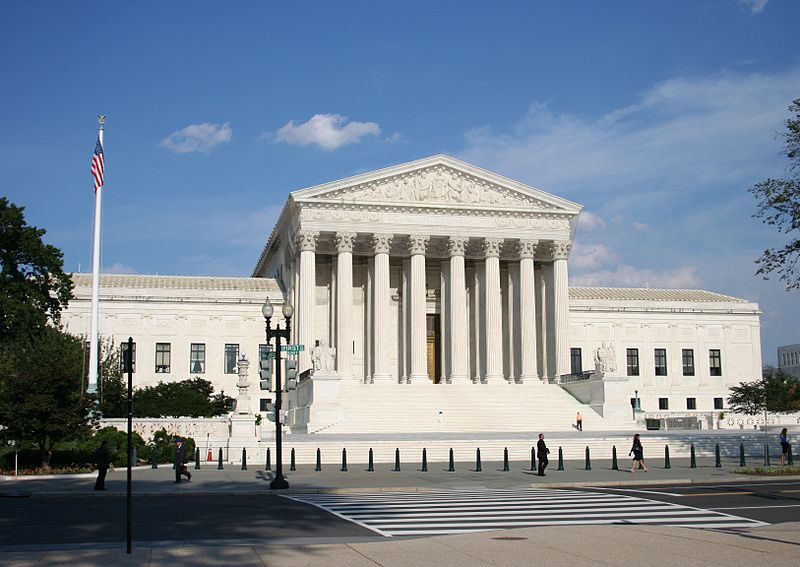
800px-SCOTUSbuilding_1st_Street_SE

For a society in love with the Bible, we’re far bigger on lawyers than forgiveness. Of course, the Bible is a pretty legalistic book. You can’t get very far in the Pentateuch without figuring that out. Only with the Bible it often isn’t a matter of suing; the stakes are considerably higher. Disrespecting parents can get you the death penalty, and mixing plant and animal fibers can get you expelled. Thumbing through my concordance I don’t see anything about coffee. I do see that I might be unclean for a day, but that’s okay because the Sabbath’s nigh. In any case, I’m too busy dreaming about what I’m going to do with all of that money.


Scholar Universe

One of the resources that editors use to find scholars of obscure fields of study is a website called Scholar Universe. Now, before you all rush to the site and crash the system, I should warn you that you’ll need to purchase an account and get a password to use it. Frankly, for our society it really isn’t worth the effort or expense for most people. The information on Scholar Universe is often outdated, and not always accurate. Once, when searching for who’s who in classical mythology, I was surprised to find my own name. I did teach classical mythology at Montclair State University for three semesters, but my longer and more complete career of teaching biblical studies was nowhere to be found. How quickly our contributions, meager though they be, disappear. In any case, when a contact breaks down, the website lists the position of a scholar as “Last Known.” More than once I’ve searched for a more updated record to find “Last Known” as a circumlocution for “deceased.” There are a few things I think I’d like to ask some dead religion professors.

I recently came across a couple of academics who had, in separate instances, been murdered. One, rather gruesomely, attacked with a hammer as he walked home from the train. We tend to think that education will somehow protect us from the vicissitudes of a world caught up in its own madness. Some of us came to this profession grasping for some sort of immortality. Higher education, while based on great ideals, is nevertheless just as susceptible to taint as any human enterprise. I have been watching as higher education has followed after the role model of business for the past few decades. There was a time when learning was thought to be worth the investment, no matter what the cost. Now a pleasant deception will do, thank you, as long as there’s cash in it.

The history of higher education has been, from the beginning, tied up with religion. The earliest universities coalesced around theological faculties, while others studied law. The two are never far apart. Even in the “New World” our early universities were formed, initially, in the service of the church. Harvard, Yale, Princeton, William and Mary, and many other colleges and universities were founded with the ideal of theological education firmly in mind. Concerns for the affairs of the world, however, inevitably came to preoccupy higher education. Secular schools have little time to study real world phenomena such as religion and spirituality. Unfortunately, those are the areas, our news sources often inform us, that would benefit the most from a bit of sensible learning. But not as long as there is money to be made elsewhere.

IMG_0684


Down Will Come Baby

Princeton Theological Seminary is a school with a history. Unofficially allied with my alma mater, Edinburgh University, PTS is one of the powerhouses for supplying educated clergy to the Presbyterian tradition. And others as well, of course. And not a few PhDs into the ranks of the perpetually unemployed. Seminaries do offer all these services. Despite failing to be considered worthy of even an interview in what I count as five separate applications to the school, I still sympathize with its need to update its technology. I suspect that is what is behind its application for a half-million-plus-dollar New Jersey Higher Education Technology Infrastructure Fund grant. Education and technology surely go together as much as old-school loyalty and fairness, do they not? A front-page story in Tuesday’s New Jersey Star-Ledger proclaims the gnat that remains in the camel juice: state funds are being requested by a fully religious organization. The application for these state pork-bellies is also shared by Beth Medrash Govoha, a male-only Jewish seminary in Lakewood. Desperate times in higher education. What would Christie do?

PTS

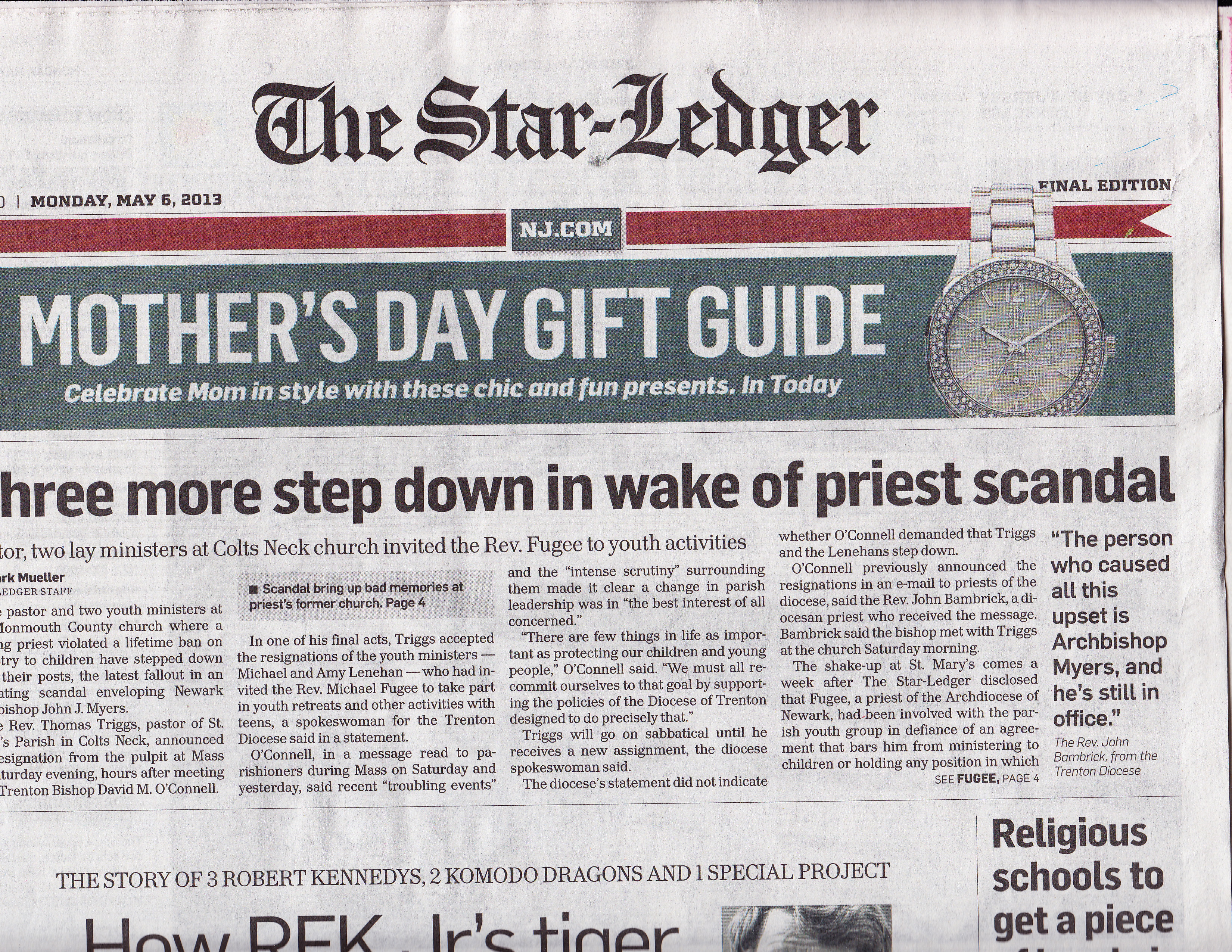
Turning the clock back twenty-four hours, another front page newspaper story places religion squarely in the public face. “Three more step down in wake of priest scandal” hit my bleary eyes on a Monday morning. This is the saga of Fr. Fugee, banned from interactions with children after a molestation case some time back. As seems to be par for this unholy course, such clergy are shifted around rather than defrocked—being seminary fodder myself I can honestly ask, what else would they do? Society has little enough use for those of us who worked our way through seminary for honest means and toward what seemed at the time noble ends. How much more so for those who mask deeply rooted neuroses under the sanctity of ordination?

Fugee_0001

Seeing religious news on the front page of the paper is nearly always cause to shudder. We will occasionally see a new Pope or maybe a genuine act of Christian (or any other religious) charity, but mostly we are served the seedy and sad and downright tawdry. Religion, although in the ascendent, is seeking hard to justify its existence. Or is it just the vaunted liberal media bias showing through? As primates we all like to watch the haughty topple. It’s even in the Bible—Isaiah got a thrill out of tall ships tipping over. Perhaps it is because religion presents itself as the unadulterated good that we like to see it stumble. I always felt a tad uncomfortable reading Goofus and Gallant while waiting for a doctor’s shot or the dentist’s chair. Yes, Goofus screwed up big time once in a while, but that confident little eagle-scout-in-waiting Gallant could do no wrong. I knew who I was supposed to emulate, but life’s just not that simple. Maybe that’s why religion makes the front page. Maybe Gallant is a myth after all.


The Four “R”s

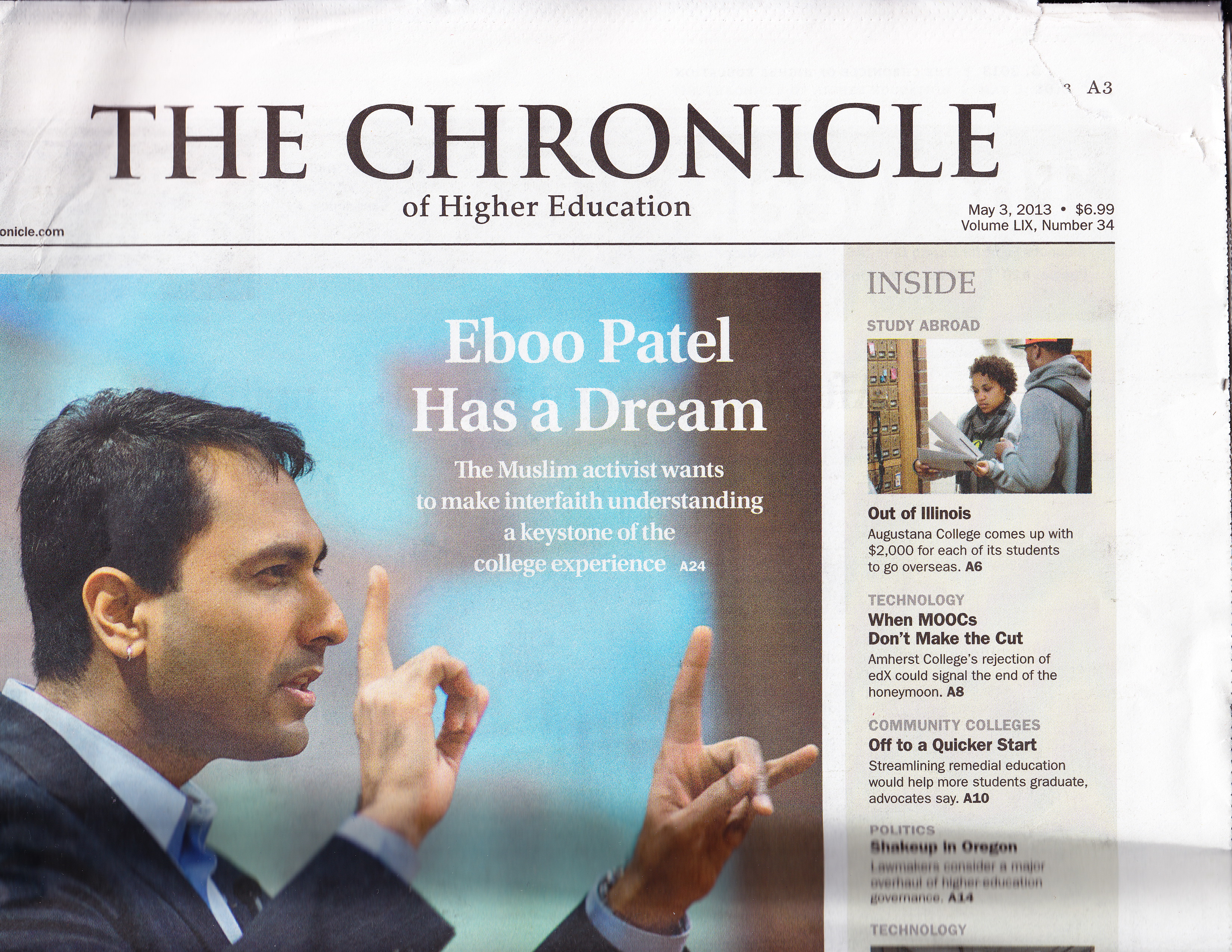
Last week the Chronicle of Higher Education feted Eboo Patel. As someone who has been on the receiving end of subtle religious violence, I appreciate what Patel is trying to do. He is a Muslim activist, the kind of which the world needs more. His last two books have been advocating for religious understanding to be considered a keystone of a college education. He’s right; religious understanding should stand right up there with the other three “r”s of education. The problem Patel faces is one I have personally faced, however; there is no money in religious studies.

Chronicle

That seems odd, even as I write it. We see lavish treasures owned by the Vatican. We see televangelists living in mansions that make Graceland seem tawdry. No huckster is more able than a skilled preacher at wheedling money out of people. Religious terrorist groups, our society conveniently ignores, are often well funded. We just don’t want to pay those professors of religion! We glory in our enlightened status and wonder why America consistently ranks among the most religious nations of the world. What department is first to receive the chop when the budget tightens? Well, it begins with an R.

What Eboo Patel is saying is what I’ve been preaching for all my adult life. We all think we know what religion is, but we actually have no idea. Universities, with rare exceptions, will do what they can to hide the study of religion like a zip on prom night. Patel is a Muslim and has good cause for wanting people to understand that his religion is not evil. He has written a couple of books advocating teaching our young about religious tolerance. It is a message America, especially, should be eager to embrace. Paradoxically, we don’t give a damn. We will cast caskets full of money into business and law departments. We will fund the research of medical and science students. Don’t ask for permission to hire a religion specialist of any description, however. Don’t you know that religion is dying out?

No doubt the electronic revolution has forever changed the way our young think about reading, writing, and yes, even arithmetic. If we had it the way our universities suggest, they would know as little as possible about the fourth, forgotten “r” that leads to much misery and meaning in our little world.


Bing Spring

Binghamton University is, like most institutions of higher education, home to many rituals. Back around a century ago, anthropologists were convinced that religions began as a set of inchoate rituals that coalesced into primitive belief systems. Although most anthropologists today see this as an overly simplistic analysis, I found a recent story on Binghamton’s website an example of a nascent religion. It has to do with placating, or perhaps defying, the weather gods.

Like most good rituals, Stepping on the Coat has a practical pedigree. According to Bing’s own archives, the ritual began the year that I was born. An undergrad that year, overwhelmed by an April snowstorm, removed his coat and stomped on it. The snow stopped. As befits a scientifically inclined institution, this was initially chalked up as coincidence, but the same result occurred again the next year. Stepping on the Coat seemed to be a cure for late season snowstorms. In this year of lazy, lingering winter, many people—some of them not even students—must be seeking a cure for unseasonable weather. Perhaps Binghamton University students a half-century ago stumbled (stamped?) upon the solution. In the whimsical tributes given on the BU magazine webpage, the sacred and the profane are never very far apart.

Binghamton in spring

Binghamton in spring

I have done considerable research on the weather and its sacral implications. Most of my research has never been published, but the overarching idea, I believe, is sound. Our human perceptions of the divine are focused on the sky. Nietzsche declared that God is dead, but that death only really occurred when we penetrated our atmosphere and landed on the moon. Even then, looking up, we saw only blackness beyond. Infinity hangs, like Damocles’ sword, above our heads. We may pollute our skies, we may shut them out with artificial walls and ceilings. We may even punch through them with rockets. But our gods are up there, somewhere. And they are the ones who dictate our weather. The human response is up to us. Do we sit inside and complain, or do we stomp the coat in defiance of an uncaring deity? Binghamton is a green university, so that even amid the burgeoning religion of coat-stepping, there is a real awareness that when the weather goes awry in this industrial era, we know where the blame truly lies. As humans, however, our religious inclinations will insist that we continue to step upon the coat and claim the whole earth as our prize.


Parochial Education

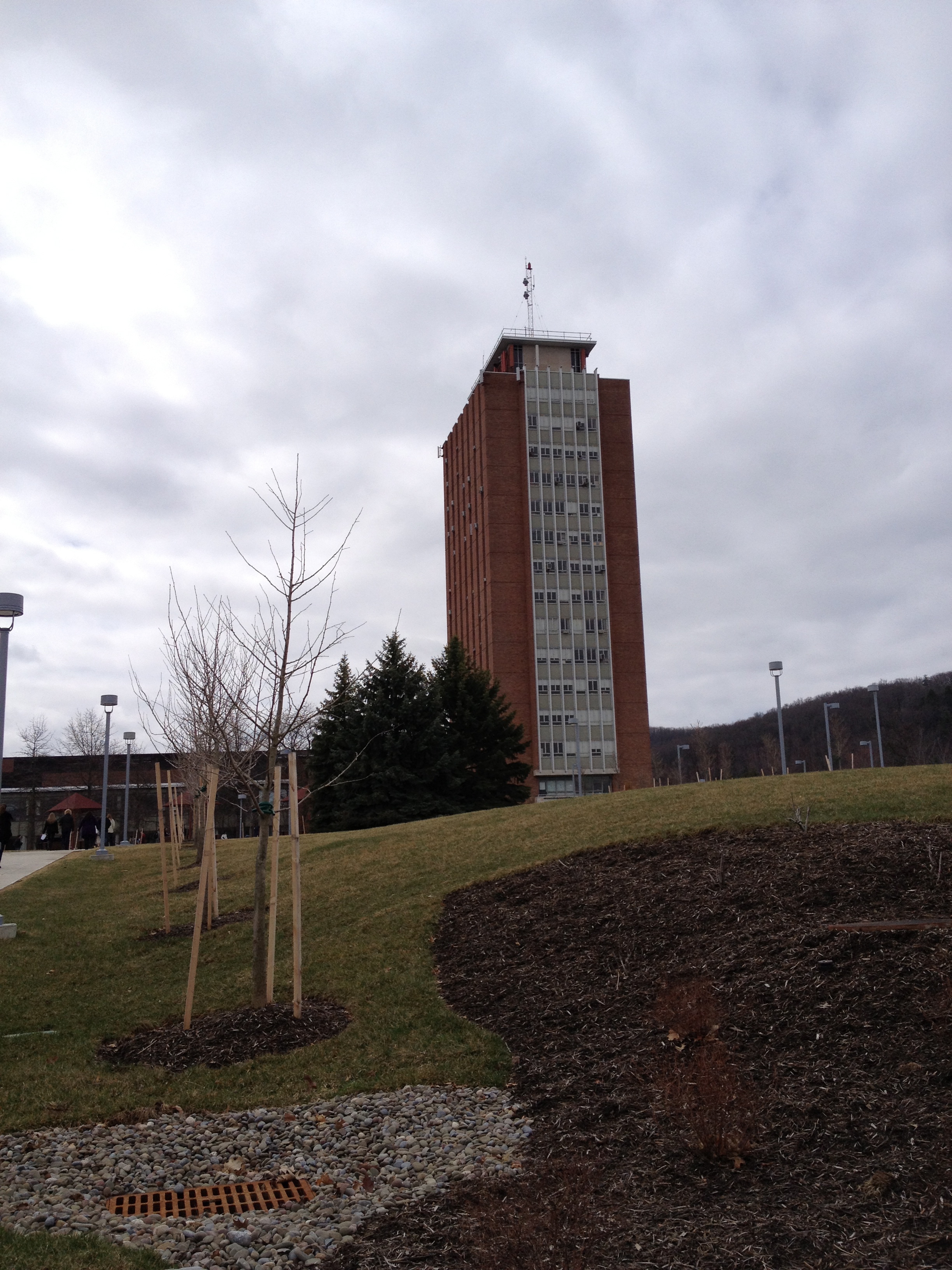
I’m sitting in King David’s Restaurant in Syracuse, New York. I’ve spent two days speaking with a wide diversity of religion scholars, and I’m realizing religion is not yet dead. A few days ago I wrote about the Burnt Over District and the Second Great Awakening. It occurs to me as I climbed the hill to the Religion Department in the rain, that I am on the trail of that Great Awakening. Syracuse University began as a Methodist school. Today, although affiliated with the United Methodist Church, it considers itself non-sectarian. Yet without those abstemious Methodists, they wouldn’t be here. The Methodists, now primarily represented by the United Methodist Church, owe their explosive growth to the Second Great Awakening. Out on the frontiers—for America was a rural nation—the revivals became showcases of the social, the supernatural, and the salacious. The Methodists and Baptists, in terms of numbers, benefited immensely.

With their enviable population base, the Methodists invested in higher education. Syracuse University, just up the hill, Adrian College, Boston, Central Methodist, Drew, Duke, Emory Universities, Florida Southern College—you could go nearly through the alphabet and not exhaust their schools—all owe their beginnings or present stature in part to those thrifty Methodists. Believers in an educated clergy, they reached out to embrace an educated laity as well. Although many of these institutions grew up and left their religion behind, the Methodists have impressed their stamp on American higher education unlike nearly any other denomination. Even when numbers in the pews decline, the Methodists will have left a legacy on the wider culture through their belief in education. About the only other Christian group invested so heavily in higher education has been the Catholic Church. Even so, the Methodist academic reputation climbs a bit higher.

I spent many happy years among the Methodists. Their way of looking at life, officially, anyway, isn’t extremist. Some aver that John Wesley was an extreme evangelist. Today he’d be snowboarding down the Alps to seek the unsaved, a Red Bull or two in his belly to stoke that restless fire. His followers, via media Methodists, eased into the mainstream—in some ways defined the mainstream. Methodism was good for a kid who needed to fit in. So as I sit in King David’s Restaurant, reflecting over my past that has landed me in this most unusual place, I am thinking about my Methodist roots. I’ve failed to impress those Methodist institutions where I was once courted for a circuit riding future. Now I watch as they educate other people’s kids. It is a safe guess that King David wouldn’t even be here if it hadn’t been for John Wesley and his personal need for assurance. If only more churches took education so seriously.

Climb that hill

Climb that hill


Adjunct Values

Well, the internet seems to have discovered adjunct Hell. Naturally, I’m too late to be part of the statistics, but I never rule that out as a future fate. This week I’ve seen several stories, some of them on major news network sites, shocked and indignant about the conditions under which adjunct instructors live. There’s quite a lot of hand-wringing and finger-pointing, but journalists and academics alike are tip-toeing around the blue whale in the room. Our society does not value education. Yes, we insist on educating children to the point of basic competency, but do we really, as a society, value that education? Ask just about any teacher. These people pour out their talent and efforts to give other people’s children the boost they need to get along in life. And many of them have to work second jobs just to make ends meet. Do we expect any less of higher education? We want it cheap and dirty with guaranteed jobs when it’s done. Universities want star faculty who publish all the time. You can’t do that when you’re busy teaching all the time. And we’ve got a glut.

The glut is PhDs. We’re cheap. More accurately, we’re broke. One of the things they don’t tell you when you apply for doctoral programs is that you are signing up to be ungainfully employed for your best earning years. Universities won’t tell you that because they need the money that graduate students bring with them, mostly in the form of student loans. News flash, America: education is not cheap! Another news flash: we are fast falling behind other cultures where teachers are respected, well paid, and even venerated. Gasp! Do such fantasy lands exist? Yes, they do.

Try a little experiment: think where you would be without your teachers. You certainly wouldn’t be reading this blog, and probably not reading at all. Your employment would likely be manual labor. Your math skills would be such that you’d be easily cheated of your wages. You would probably believe in a myth about the earth being created in six days and think that was science. When I read about the societies advancing the swiftest, America does not top the the list any more. When I learn more about those societies where the cutting edge is measured by Singapore or Beijing, I find out they highly value their teachers. They are paid well. They are respected. Here, in the US, chances are that the person teaching your kids in college makes a poverty-level salary and may be surviving by food stamps. Three quarters of our higher education teaching force consists of adjuncts. Three quarters. And these people are no slouches. They’re simply the victims of a society that doesn’t want to pay for education. Listening to administrators attempting to justify their decisions makes me squirm. How much did you say that Greg Schiano, Brady Hoke, or Bo Pelini “earn(ed)” in a year? Where your treasure is, there will your heart be also.

Any old school will do

Any old school will do


Good, Friday

Riding public transit sometimes turns into a religious experience. Various bus drivers will wish passengers a “blessed day” as they pull into the Port Authority Bus Terminal—not that I can blame them, after the traffic they face daily, for taking a spiritual breather. Lately, though, I have been wished a happy Easter by the driver. Ironically, I must note, because people of many faith traditions ride the bus. Not all are Easter riders. Just yesterday a Rastafari stood before me in line. I’m regularly joined by Hindus, Jews, and maybe even a Mormon or two (who can tell?). Holy Week in New York is a surreal experience. I chatted with some co-workers where the topic changed effortlessly from their experiences of Passover to others’ experiences of Easter. Religion is alive and well in the Big Apple, but it is mostly an afterthought to the real business of making money. That’s what we’re all here for, after all.

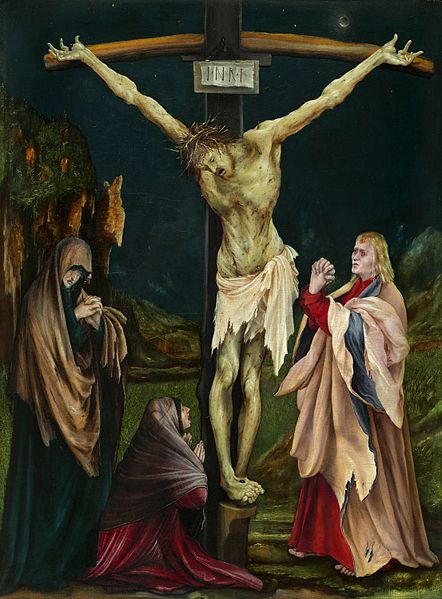
Money, according to the good book, is inimical to the lifestyle of faith. I must have a little too much faith, I guess, since I have so precious little money. Nothing throws that into such sharp relief as looming tuition bills. You see, I tried “to fight the good fight” only to learn that there’s no way to win it without playing by the entrepreneur’s rules. Filling out the FAFSA over the smoldering ruins of my “earning years” was a distinctly sobering experience. I went into higher education because I believed in it—there’s that pesky faith again. The things you believe in, however, have a way of turning on you. I suppose that’s an appropriate reflection for Good Friday.

It’s hard to be an idealist in a world where people say, “you just need someone to give you a chance,” and then turn their backs on you. So as I’m walking across town, thinking about my blessed day, I notice that we’re all in this together. Except some of us. In the idealist world, those who want it the most sometimes win it. Those who play by the rules. I had no Harvard aspirations, just a reasonable job in a little college would suit me fine. A place to think that doesn’t have wheels and aluminum sides and seat forty-nine other lost souls. But for those who have less, even the little they have will be taken from them. That’s biblical too. Higher education is one of the greatest gifts we can give our children, but it easily joins hands with Judas Iscariot. It is Good Friday, according to some. Others just call it a blessed day.

Mathis_Gothart_Grünewald_007


Free Think Ing

It is not exactly pride that I feel when I see my undergraduate college featured in a Chronicle article entitled “Group Aims to Help Conservative Parents Counter ‘PC Indoctrination’ at Colleges.” I almost feared to scroll down the page. Yes, good old Grove City College has to thrust its manly credentials into the face of reason once again. The problem is that what such conservative groups decry as “indoctrination” is, in reality, critical thinking. It took me a long time to learn this distinction. I grew up in a conservative family, but I didn’t choose Grove City because of its flaming commitment to sixteenth-century values. I chose Grove City because it was a selective, intellectually honest school close to home. Being a first generation college student, I had no family tradition on which to draw. Guidance counselors didn’t know what to do with a religious kid who seemed to have some smarts. Other colleges seemed so far away. I didn’t even know what I wanted to study. You see, being raised in humble circumstances you learn to react to the many unpleasantries that life throws at you and there really isn’t time to plan out a future. It never works out that way in any case. I felt driven, but I didn’t know where I was going. Some day I hope to find out.

In the meanwhile, Grove City College has grown even more reactionary than when I was there in the 1980s. The Chronicle article states that “Conservatives have long complained about a perceived liberal bias in higher education,” and that Jim Van Eerden, an “entrepreneur in residence,” (shudder!) at Grove City has started the ironically named “FreeThinkU” to counter the liberalities students receive in school. Talk about your mixed messages! I wonder if Van Eerden has ever considered that Free Thinking has a long association with the very progress he abhors. Free thinkers gave us the gifts of evolution, rational thought, and for a while anyway, free love. Free thought gave us Kate Chopin, J. D. Salinger, and Margaret Atwood. They literally gave us the moon and have landed our probes on Mars. Somewhere lost in space a metal plaque is spinning in infinity with a naked couple and directions to planet Earth. I think the mis-named FreeThinkU might be better rechristened as Don’tUThink.

Higher education has a long, long history with religious thinking. Early universities were often outgrowths of theological colleges. Over the centuries, as our thinking matured, the ways of the past were recognized for what they were—outdated, short-sighted, unchanging for the sake of being unchanging. The reality that meets our eyes through the lenses of logic sometimes claims beehive hairdos and horn-rimmed glasses and greased back business haircuts as its victims. The earth is warming up. We did share a common ancestor with the apes. Our universe is even larger than we ever thought. And yet “FreeThinkU” suggests that we need to set the clock back a little. Maybe just a couple of centuries, but enough to hold our kids in the twilight of misperception. Progress has to be more than raping the earth and getting rich. Free thinking has to be a willingness to use the minds we have. I wonder what the aliens will say when they land here, our Pioneer 10 plaque in hand. If they land in Grove City, I suspect, they might feel they were sold a false bill of goods.

From the alumni mag; think about it...

From the alumni mag; think about it…


Real Life Zombies

In recent months Binghamton University has been on my mind. Binghamton has a number of videos available on YouTube which I find to be entertaining and even, sometimes, very funny. I like Bing’s style. Even though I catch myself laughing once in a while, I know that Binghamton takes higher education seriously. I watched a recent, 17 minute talk on a vital topic. It is located here, and I would recommend that you watch it too. Don’t worry, I’ll wait.

Back? Okay. The situation raised here is one that makes me shudder. Few things are as debilitating and vulnerable as an uneducated populace. Both religious and political forces have made great efforts to prevent certain orthodoxies from being challenged by what they term, as an obvious swear-word, “higher education.” The fact is, folks, higher education is nothing more than an attempt to get people—often young people—to learn how to think critically. That last word is a stumbling block sometimes. Any number of people will suppose that critical thinking is the same as criticism. It isn’t. Critical thought is the ability to approach a problem—any problem—rationally. To respond with the best that our minds have taught us to do, rather than with knee-jerk reactions. Yes, emotion and jerking knees have important places in the world, but they only work well if they are accompanied by the ability to think critically.

The video makes it pretty clear that the ability to think is rapidly eroding in our culture. Perhaps not quite zombie apocalypse, but not comfortably far from it. The death of Borders was blamed on its inability to get into the electronics markets by various pundits. I disagree. Borders fell victim to a culture that has lost the joy of challenging reading. We like spoon-feeding (otherwise much of the internet is difficult to explain). In order to exercise our brains, we have to use them to read hard things. Like my high school coach used to say, if you don’t use your muscles they’ll atrophy. Looking at my mid-section, I can see that his words were true. What Coach didn’t warn us about, though, is that the same holds true for the mind. The unchallenged intellect is a dull one. This is a threat far more insidious than any Communism, or liberalism ever was. It is the dummification of America. We are a nation that loves zombies. We are also a nation in danger of becoming them as well. Fight the zombie apocalypse—read a book. And like that baseball bat you use to swing at the undead, the harder it is, the better.

They don't write them like that anymore

They don’t write them like that anymore


Persistent Idealism

Few spans of human life are so idealistic as our college years. There we meet many people from beyond our hometown, and we learn the treasures of diversity and different ways of doing things. Ideas mix and blend, and with professors who’ve learned so much telling us all the places we can go, the possibilities seem endless. I find the idealism of college kids refreshing. That’s one reason, I suppose, that I enjoyed teaching them so much. At work you’re far more often told why things won’t work and how they can’t be done. And I find myself thinking back to college and wondering when people lost their sense of vision. When did idealism die?

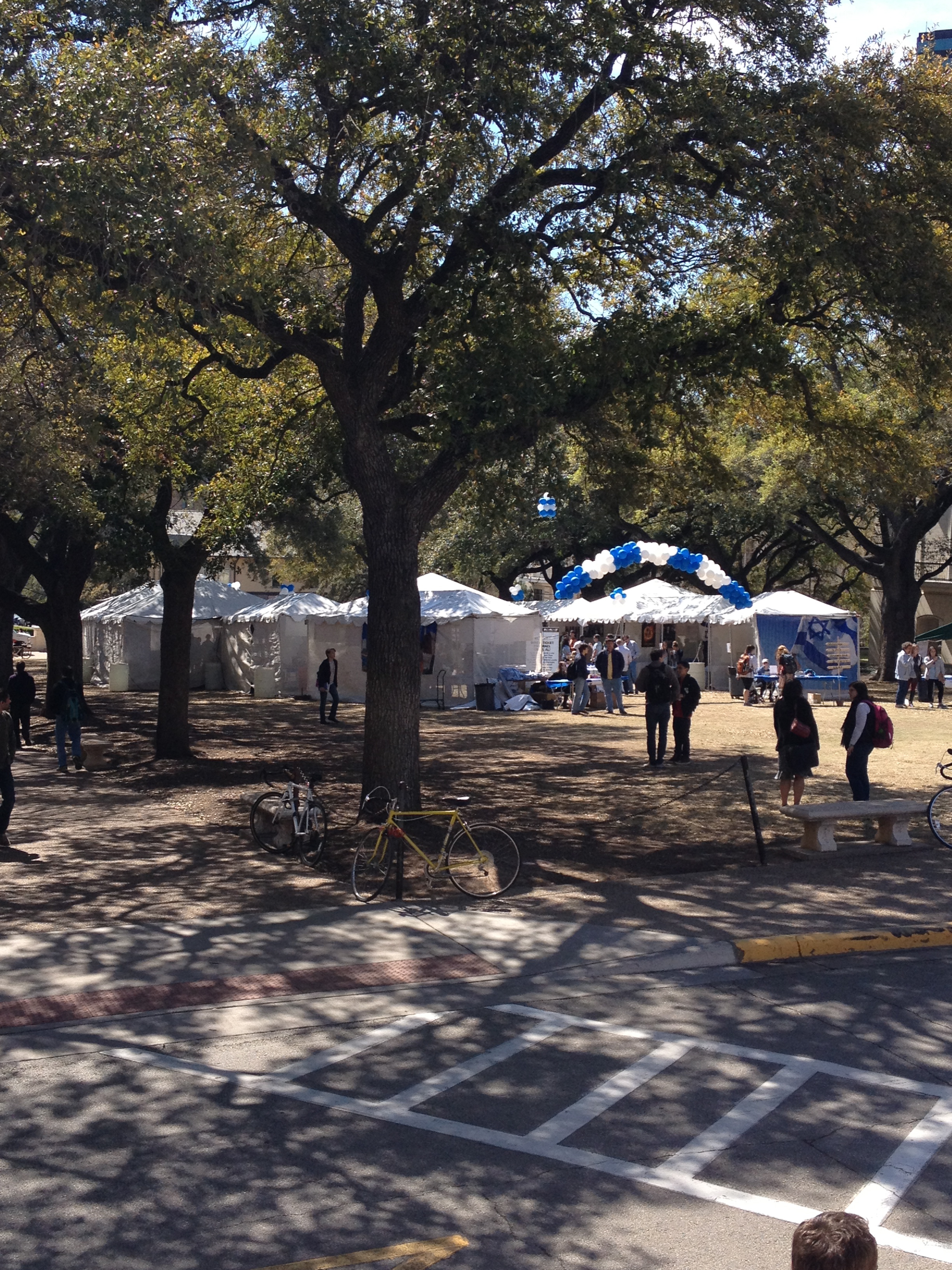
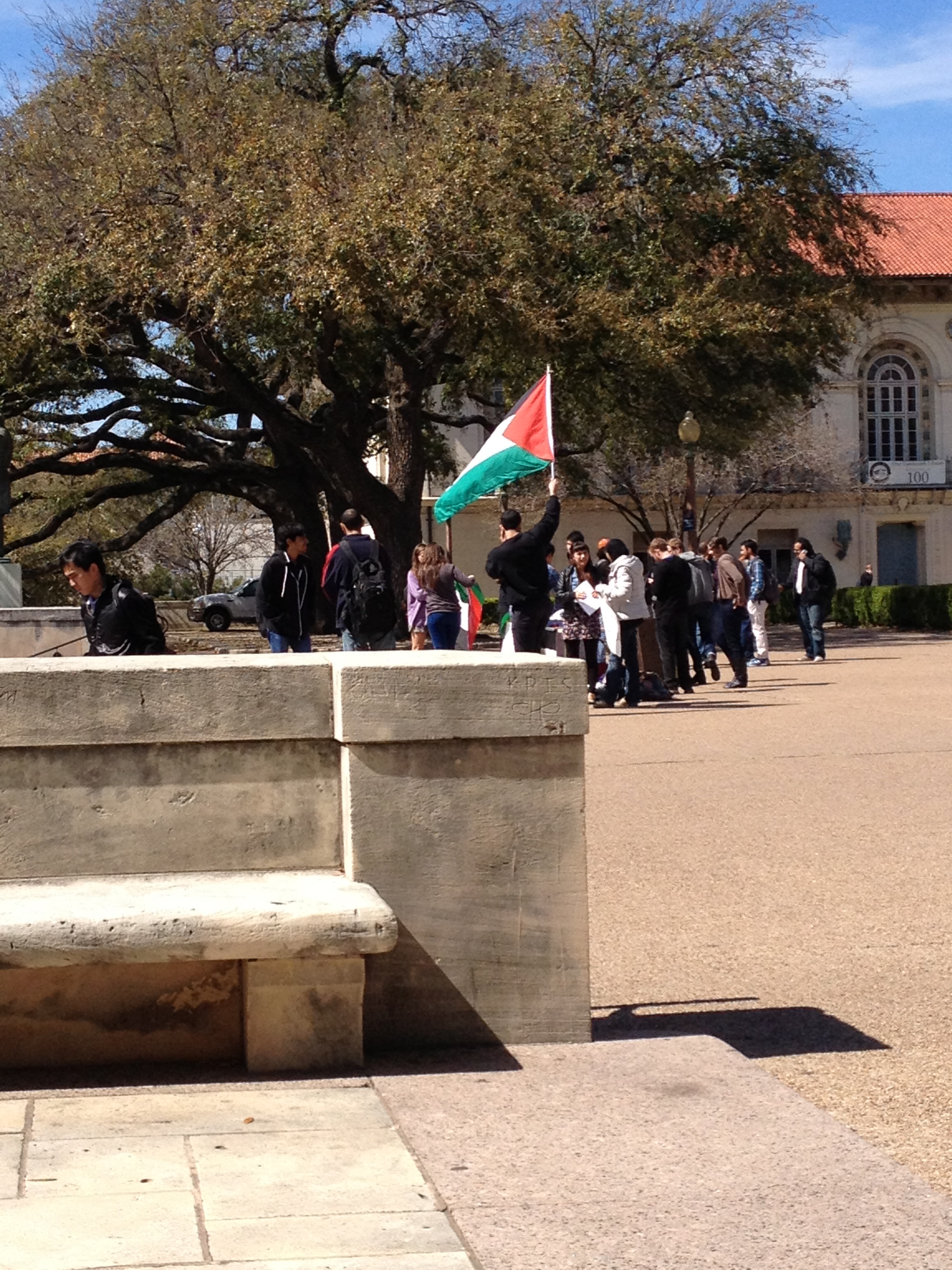
Yesterday I spent on the campus of the University of Texas at Austin. Between appointments I was crossing a quad area and noticed a bunch of blue and white balloons. We’re all still kids inside when we see balloons. I stopped to look. Then I noticed, across the street (in which sat a very obvious police car) a small group of students waving a Palestinian flag. Several police, frankly looking bored, stood between the two peaceful groups.

IMG_0581IMG_0580

Looking back to the balloons, there were a series of tents set up and a sign read “Israel Block Party.” Obviously this had been a carefully planned event, and we all know the heinous story of the constant persecution of the Jews throughout much of “civilized” history. The simple table across the street bore the sign “Free Palestine.” Less than ten students stood around, handing out literature, peaceful, yet literally flying their flag. Yes, the Palestinians have also been oppressed for much of their history. If only adults could live so peacefully as these students. My heart went out to them.

The issue of Israel and Palestine is one of the deepest scars in our collective human psyche. Indirectly, that conflict is responsible for many tragic terrorist acts, including the attacks of 9/11. And it is so frustrating because both sides (and there are actually more than two) are victims. We like our good guys in white and our bad guys in black. I’m still an idealist, after all. Yet in Israel/Palestine we have two historically oppressed groups vying for the very same land. And in the middle of this maelstrom, the Bible. The very book that can be read as an eternal promise by God that the people of Israel should own this land. By 1947, however, we’d stopped relying on God and began relying on guns. And atomic bombs. And life has never been the same since.

Images of the wall going up between Israelis and Palestinians just after the wall went down in Berlin reminded me of Bush’s proposed wall between Texas and Mexico. Here in Texas just about everyone in the lower paying jobs I’ve met is hispanic. And friendly. Grateful in a way that many of us wouldn’t emulate in such low stations. We are all people. We all experience the same feelings, needs, and desires. Why not tear down the walls and let us look at one another? Take a good, long look. And my idealistic self says, if we face another human being with love everything will be all right.


Wolves and Sheep

A state of the university address might not be a bad exercise.  If I might be so bold, as an inveterate outsider who nonetheless has tried to play by the rules, I have been cast in a supporting role—I think a few of my observations might be valid.  Some of my more pastoral colleagues try to reassure me that editors influence more people than professors, but in fact, the professors are the ones with the luxury to write books.  I get to sit on the bus and read them.  I do read many proposals before they become full-fledged books, and, interestingly, I get to discern how someone becomes an “expert.”  I worry a little about this latter point.  When it comes to religion, there are a few too many experts and dreadfully too few places for them to find gainful employment.  This is a volatile mix. I often run across religion experts who have professorships because they are of the right brand.  In a way that is almost inconceivable in any other profession, schools where religion is taught are actually allowed to discriminate.  This fact may even stretch out, in the case of some religions, to more objective fields.  Some religions teach that illness is spiritual rather than physical.  Some of them have medical schools, staffed by believers.

This comes back to the privileging of belief.  We all believe things, and most of us (if not all of us, when the lights are out) include some irrational things in that realm.  Beliefs can change, but not easily.  In the case of religions, most often we are taught our beliefs.  Sitting back and thinking about those truisms is the ultimate of academic enterprises, and yet few matters have a greater impact on society as a whole than the belief structures of people.  If you want to start a university for your brand of religion, after all, the law protects you if you keep your biases on your sleeve.  These people get to write books with the credibility that pathetic posers, like the current blogger, are doomed to lack.  You see, if someone is an expert, they have to have an institution to prove it.  That’s the way higher education works.

I read lots of stuff.  I sometimes think maybe I read a little too much because the ideas begin to affect my beliefs.  Nevertheless, it is a risk I’m willing to take.  It seems to me that if a religion is really as secure as they all pretend to be, you’d be willing to invite a few interlopers in your doors—a few wolves in wolves’ pelts.  If the sheep have to run, think of it as a chance to test their belief systems.  If the sheep overcome the wolves, then they will have earned the stars in their crowns.  Sometimes I am criticized for my liberal approach to things.  One thing my training has taught me, however, is that systems carefully reasoned through don’t shy away from challenges.  That’s a major difference on many belief-based structures.  Beliefs do not appreciate being challenged.  They want to be right.  But then, don’t we all?  It seems to me that the time for allowing prejudice against other religious views has outlived its usefulness.  If the truth is the truth, after all, it will be able to stand any fright that the wolves might bring.

Dore_ridinghood


Soul University

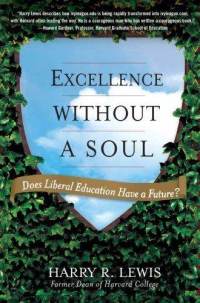
ExcellenceWithoutSoul Cambridge, Massachusetts is a likable town. As students at Boston University my friends and I would occasionally take the red line to Harvard Square and shuffle through the leaves of that venerable institution that gives the square its name. One of the treats was stopping in The Coop, the Harvard bookstore that made us all feel smart. While at Harvard last year, The Coop was part of my professional, editorial remit. I spied a book entitled Excellence Without a Soul: Does Liberal Education Have a Future?, by Harry R. Lewis. I have often thought about how higher education has slipped its moorings these past few decades, and wondered what an erstwhile Harvard dean had to say about the matter. The leaves on campus weren’t so abundant last October, but I felt that same inferiority complex that being on the Harvard campus always gives me. Of course, I had received an acceptance letter from Harvard Divinity School when I considered transferring there, but it was easier to stay at BU and complain.

Lewis’s book is a somewhat nostalgic consideration of how Harvard has evolved from a seminary to a powerhouse university—the powerhouse university—in the new world. There is no doubt that Harvard is our oldest institution of higher education, and there is no doubt that it has the money to be “the best.” But by what measure? This is one of the questions Lewis asks, repeatedly. Still, the assumption is always lurking in the background that Harvard is the best, but as Lewis notes in the book, there is no one best doctor just like there is no one best book. Harvard is good, but so are many other schools. They all suffer from the same indifference in a society that takes education for granted. The real problem is that we like simple solutions. Take a look around you—you’ll see what I mean.

It is difficult to feel sorry for Harvard. The elite of the elite, it has that time-honored patina that antique specialists love so much. What it doesn’t have it can afford to buy. There is no doubt, however, that as Harvard leans, so tilt the other universities of this country. In my professional field I’ve seldom met an unemployed Harvard Ph.D. Those of us who attended even older universities (yes, the Europeans came up with the idea first) with even more recognizable alumni—has anyone heard of Charles Darwin or David Hume? Adam Smith?—are used to being passed over for positions while Harvard writes its own checks. Elitism may be at the heart of the problem. It’s not that I wish hard times on Harvard, it’s just that I wish we’d be honest about the academic enterprise. Has higher education lost its soul? To find the answer we’re going to have to look beyond Cambridge, Massachusetts. But the leaves in autumn are certainly pretty, if not so abundant as they were before.


AAR/SBL Chicago

On just about any playground you’ll spot the kid who’s watching from the side, instead of playing with the others. That’s me. I don’t suspect that anyone starts life wanting to be left out, but some of us—attuned to the subtler messages of life—become aware that we’re not really invited or welcome. That sensation bathed me in its eldritch light once again while waiting for my flight to Chicago for the American Academy of Religion and Society of Biblical Literature annual meeting. I’ve often wondered what it must be like for those innocent aeronauts not clued in that the Friday before Black Friday (the real holiday, I’m led to believe) that flights to a specified city will be choked with crusty professors of religion. Sitting in Newark Airport and hearing the word “Ugaritic” from the seat behind me, I knew it had begun. I turned around. No flash of recognition. If was as if I hadn’t spent years learning that obscure language and publishing in the main journals. The invisible man.

The airport before the AAR/SBL annual meeting is a theological locker room where the guys gather to compare the size of their, um, theses. It’s pretty hard not to overhear, once you’re tuned in to your specialization, as colleagues lay out their publications, invited papers, international travel plans. I’ll admit to being jealous. They’re living the life for which I trained. I had taught for nearly twenty years and was never really invited to play. Now here I sit, knowing what Ugaritic is among the perplexed business travelers, but I’m not one of the big boys.

I realize that outside the rarified world of higher education Ugaritic matters even less than the homeless unfortunates shivering in the streets of Manhattan or Chicago. Back in the brief days when I tried to be a player, I remember attending an Ugaritic conference here in Illinois. Crowded into an elevator with renowned colleagues, one of them joked, “If this elevator falls, the field of Ugaritic studies may never recover.” An exaggeration, but not by much. Present company excepted. Of that august group, only one was asked to step off into the void. His exit was barely noticed. Ugaritic studies thrives. The poor beg for alms. And one kid, even though he now understands the rules of the game, still watches from outside.


Barely Departed

Back before any of us, or anyone we knew, had attended Grove City College, one tragic night a student on the basketball team crashed through the glass doors of the gym on west campus and bled to death. If you walked across that part of campus at night, it was said, you would see his ghost. Everyone knew his name was Jim, but I never saw him. Folklorist Elizabeth Tucker presents a rare treat of the anomalous and academic in her book Haunted Halls: Ghostlore of American College Campuses. Professors have traditionally shied away from the paranormal. It can be a risky way to spend your time since the supernatural has been banished from the academy for ages. That doesn’t mean that students and professors have stopped seeing ghosts, though. Tucker, like a good prof, doesn’t just tell us ghost stories and dismiss class. She tries to unpack a bit of what they might mean.

Ghost stories, even when entertaining, are able teachers. Kids going to college find themselves in liminal situations. Not really independent, not really supervised, they test the limits of what they’ve been told. Ghosts, not supposed to exist, are the ultimate rebels. They don’t even obey the laws of physics or biology. But what are ghosts if not the embodiment of the human spirit? We call them spirits, and they represent that part of us that stubbornly refuses to go gentle into that dark night.

Tucker’s book will not convince a skeptic that ghosts exist. It probably won’t cause you any sleepless nights (unless you are about to send your child off to college). Her book is more about what ghost stories say about the living, as would be expected of a folklorist. Although not a comprehensive survey, Haunted Halls may well bring back the ghostly tales of your own college years, for very few places are without their specters, especially on a rainy October night. And even though I never saw Jim as I cut across west campus in the dark, who am I to say that he’s not really there?