Parochial Education

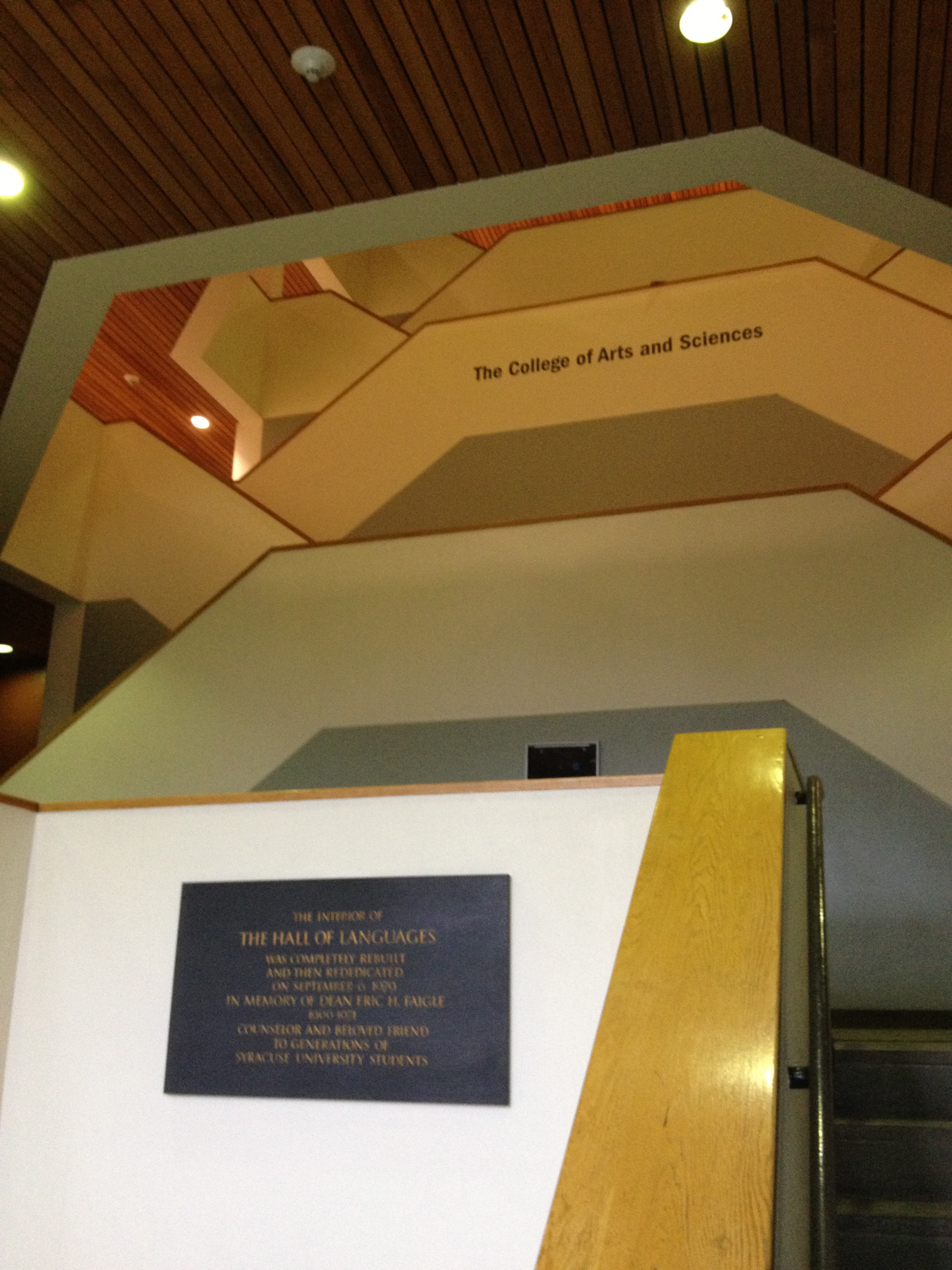
I’m sitting in King David’s Restaurant in Syracuse, New York. I’ve spent two days speaking with a wide diversity of religion scholars, and I’m realizing religion is not yet dead. A few days ago I wrote about the Burnt Over District and the Second Great Awakening. It occurs to me as I climbed the hill to the Religion Department in the rain, that I am on the trail of that Great Awakening. Syracuse University began as a Methodist school. Today, although affiliated with the United Methodist Church, it considers itself non-sectarian. Yet without those abstemious Methodists, they wouldn’t be here. The Methodists, now primarily represented by the United Methodist Church, owe their explosive growth to the Second Great Awakening. Out on the frontiers—for America was a rural nation—the revivals became showcases of the social, the supernatural, and the salacious. The Methodists and Baptists, in terms of numbers, benefited immensely.

With their enviable population base, the Methodists invested in higher education. Syracuse University, just up the hill, Adrian College, Boston, Central Methodist, Drew, Duke, Emory Universities, Florida Southern College—you could go nearly through the alphabet and not exhaust their schools—all owe their beginnings or present stature in part to those thrifty Methodists. Believers in an educated clergy, they reached out to embrace an educated laity as well. Although many of these institutions grew up and left their religion behind, the Methodists have impressed their stamp on American higher education unlike nearly any other denomination. Even when numbers in the pews decline, the Methodists will have left a legacy on the wider culture through their belief in education. About the only other Christian group invested so heavily in higher education has been the Catholic Church. Even so, the Methodist academic reputation climbs a bit higher.

I spent many happy years among the Methodists. Their way of looking at life, officially, anyway, isn’t extremist. Some aver that John Wesley was an extreme evangelist. Today he’d be snowboarding down the Alps to seek the unsaved, a Red Bull or two in his belly to stoke that restless fire. His followers, via media Methodists, eased into the mainstream—in some ways defined the mainstream. Methodism was good for a kid who needed to fit in. So as I sit in King David’s Restaurant, reflecting over my past that has landed me in this most unusual place, I am thinking about my Methodist roots. I’ve failed to impress those Methodist institutions where I was once courted for a circuit riding future. Now I watch as they educate other people’s kids. It is a safe guess that King David wouldn’t even be here if it hadn’t been for John Wesley and his personal need for assurance. If only more churches took education so seriously.
Climb that hill

Climb that hill


Adjunct Values

Well, the internet seems to have discovered adjunct Hell. Naturally, I’m too late to be part of the statistics, but I never rule that out as a future fate. This week I’ve seen several stories, some of them on major news network sites, shocked and indignant about the conditions under which adjunct instructors live. There’s quite a lot of hand-wringing and finger-pointing, but journalists and academics alike are tip-toeing around the blue whale in the room. Our society does not value education. Yes, we insist on educating children to the point of basic competency, but do we really, as a society, value that education? Ask just about any teacher. These people pour out their talent and efforts to give other people’s children the boost they need to get along in life. And many of them have to work second jobs just to make ends meet. Do we expect any less of higher education? We want it cheap and dirty with guaranteed jobs when it’s done. Universities want star faculty who publish all the time. You can’t do that when you’re busy teaching all the time. And we’ve got a glut.

The glut is PhDs. We’re cheap. More accurately, we’re broke. One of the things they don’t tell you when you apply for doctoral programs is that you are signing up to be ungainfully employed for your best earning years. Universities won’t tell you that because they need the money that graduate students bring with them, mostly in the form of student loans. News flash, America: education is not cheap! Another news flash: we are fast falling behind other cultures where teachers are respected, well paid, and even venerated. Gasp! Do such fantasy lands exist? Yes, they do.

Try a little experiment: think where you would be without your teachers. You certainly wouldn’t be reading this blog, and probably not reading at all. Your employment would likely be manual labor. Your math skills would be such that you’d be easily cheated of your wages. You would probably believe in a myth about the earth being created in six days and think that was science. When I read about the societies advancing the swiftest, America does not top the the list any more. When I learn more about those societies where the cutting edge is measured by Singapore or Beijing, I find out they highly value their teachers. They are paid well. They are respected. Here, in the US, chances are that the person teaching your kids in college makes a poverty-level salary and may be surviving by food stamps. Three quarters of our higher education teaching force consists of adjuncts. Three quarters. And these people are no slouches. They’re simply the victims of a society that doesn’t want to pay for education. Listening to administrators attempting to justify their decisions makes me squirm. How much did you say that Greg Schiano, Brady Hoke, or Bo Pelini “earn(ed)” in a year? Where your treasure is, there will your heart be also.

Any old school will do

Any old school will do


Good, Friday

Riding public transit sometimes turns into a religious experience. Various bus drivers will wish passengers a “blessed day” as they pull into the Port Authority Bus Terminal—not that I can blame them, after the traffic they face daily, for taking a spiritual breather. Lately, though, I have been wished a happy Easter by the driver. Ironically, I must note, because people of many faith traditions ride the bus. Not all are Easter riders. Just yesterday a Rastafari stood before me in line. I’m regularly joined by Hindus, Jews, and maybe even a Mormon or two (who can tell?). Holy Week in New York is a surreal experience. I chatted with some co-workers where the topic changed effortlessly from their experiences of Passover to others’ experiences of Easter. Religion is alive and well in the Big Apple, but it is mostly an afterthought to the real business of making money. That’s what we’re all here for, after all.

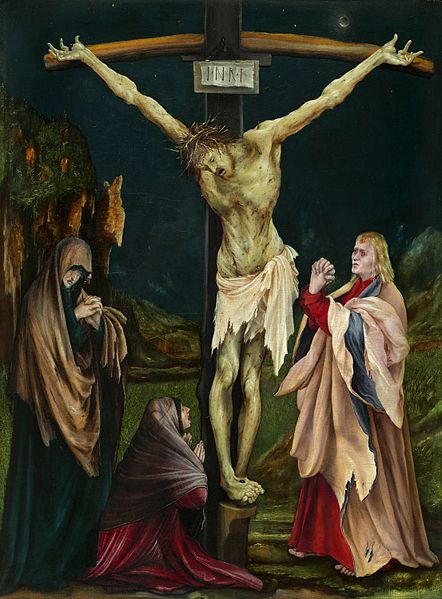
Money, according to the good book, is inimical to the lifestyle of faith. I must have a little too much faith, I guess, since I have so precious little money. Nothing throws that into such sharp relief as looming tuition bills. You see, I tried “to fight the good fight” only to learn that there’s no way to win it without playing by the entrepreneur’s rules. Filling out the FAFSA over the smoldering ruins of my “earning years” was a distinctly sobering experience. I went into higher education because I believed in it—there’s that pesky faith again. The things you believe in, however, have a way of turning on you. I suppose that’s an appropriate reflection for Good Friday.

It’s hard to be an idealist in a world where people say, “you just need someone to give you a chance,” and then turn their backs on you. So as I’m walking across town, thinking about my blessed day, I notice that we’re all in this together. Except some of us. In the idealist world, those who want it the most sometimes win it. Those who play by the rules. I had no Harvard aspirations, just a reasonable job in a little college would suit me fine. A place to think that doesn’t have wheels and aluminum sides and seat forty-nine other lost souls. But for those who have less, even the little they have will be taken from them. That’s biblical too. Higher education is one of the greatest gifts we can give our children, but it easily joins hands with Judas Iscariot. It is Good Friday, according to some. Others just call it a blessed day.

Mathis_Gothart_Grünewald_007


Free Think Ing

It is not exactly pride that I feel when I see my undergraduate college featured in a Chronicle article entitled “Group Aims to Help Conservative Parents Counter ‘PC Indoctrination’ at Colleges.” I almost feared to scroll down the page. Yes, good old Grove City College has to thrust its manly credentials into the face of reason once again. The problem is that what such conservative groups decry as “indoctrination” is, in reality, critical thinking. It took me a long time to learn this distinction. I grew up in a conservative family, but I didn’t choose Grove City because of its flaming commitment to sixteenth-century values. I chose Grove City because it was a selective, intellectually honest school close to home. Being a first generation college student, I had no family tradition on which to draw. Guidance counselors didn’t know what to do with a religious kid who seemed to have some smarts. Other colleges seemed so far away. I didn’t even know what I wanted to study. You see, being raised in humble circumstances you learn to react to the many unpleasantries that life throws at you and there really isn’t time to plan out a future. It never works out that way in any case. I felt driven, but I didn’t know where I was going. Some day I hope to find out.

In the meanwhile, Grove City College has grown even more reactionary than when I was there in the 1980s. The Chronicle article states that “Conservatives have long complained about a perceived liberal bias in higher education,” and that Jim Van Eerden, an “entrepreneur in residence,” (shudder!) at Grove City has started the ironically named “FreeThinkU” to counter the liberalities students receive in school. Talk about your mixed messages! I wonder if Van Eerden has ever considered that Free Thinking has a long association with the very progress he abhors. Free thinkers gave us the gifts of evolution, rational thought, and for a while anyway, free love. Free thought gave us Kate Chopin, J. D. Salinger, and Margaret Atwood. They literally gave us the moon and have landed our probes on Mars. Somewhere lost in space a metal plaque is spinning in infinity with a naked couple and directions to planet Earth. I think the mis-named FreeThinkU might be better rechristened as Don’tUThink.

Higher education has a long, long history with religious thinking. Early universities were often outgrowths of theological colleges. Over the centuries, as our thinking matured, the ways of the past were recognized for what they were—outdated, short-sighted, unchanging for the sake of being unchanging. The reality that meets our eyes through the lenses of logic sometimes claims beehive hairdos and horn-rimmed glasses and greased back business haircuts as its victims. The earth is warming up. We did share a common ancestor with the apes. Our universe is even larger than we ever thought. And yet “FreeThinkU” suggests that we need to set the clock back a little. Maybe just a couple of centuries, but enough to hold our kids in the twilight of misperception. Progress has to be more than raping the earth and getting rich. Free thinking has to be a willingness to use the minds we have. I wonder what the aliens will say when they land here, our Pioneer 10 plaque in hand. If they land in Grove City, I suspect, they might feel they were sold a false bill of goods.

From the alumni mag; think about it...

From the alumni mag; think about it…


Real Life Zombies

In recent months Binghamton University has been on my mind. Binghamton has a number of videos available on YouTube which I find to be entertaining and even, sometimes, very funny. I like Bing’s style. Even though I catch myself laughing once in a while, I know that Binghamton takes higher education seriously. I watched a recent, 17 minute talk on a vital topic. It is located here, and I would recommend that you watch it too. Don’t worry, I’ll wait.

Back? Okay. The situation raised here is one that makes me shudder. Few things are as debilitating and vulnerable as an uneducated populace. Both religious and political forces have made great efforts to prevent certain orthodoxies from being challenged by what they term, as an obvious swear-word, “higher education.” The fact is, folks, higher education is nothing more than an attempt to get people—often young people—to learn how to think critically. That last word is a stumbling block sometimes. Any number of people will suppose that critical thinking is the same as criticism. It isn’t. Critical thought is the ability to approach a problem—any problem—rationally. To respond with the best that our minds have taught us to do, rather than with knee-jerk reactions. Yes, emotion and jerking knees have important places in the world, but they only work well if they are accompanied by the ability to think critically.

The video makes it pretty clear that the ability to think is rapidly eroding in our culture. Perhaps not quite zombie apocalypse, but not comfortably far from it. The death of Borders was blamed on its inability to get into the electronics markets by various pundits. I disagree. Borders fell victim to a culture that has lost the joy of challenging reading. We like spoon-feeding (otherwise much of the internet is difficult to explain). In order to exercise our brains, we have to use them to read hard things. Like my high school coach used to say, if you don’t use your muscles they’ll atrophy. Looking at my mid-section, I can see that his words were true. What Coach didn’t warn us about, though, is that the same holds true for the mind. The unchallenged intellect is a dull one. This is a threat far more insidious than any Communism, or liberalism ever was. It is the dummification of America. We are a nation that loves zombies. We are also a nation in danger of becoming them as well. Fight the zombie apocalypse—read a book. And like that baseball bat you use to swing at the undead, the harder it is, the better.

They don't write them like that anymore

They don’t write them like that anymore


Persistent Idealism

Few spans of human life are so idealistic as our college years. There we meet many people from beyond our hometown, and we learn the treasures of diversity and different ways of doing things. Ideas mix and blend, and with professors who’ve learned so much telling us all the places we can go, the possibilities seem endless. I find the idealism of college kids refreshing. That’s one reason, I suppose, that I enjoyed teaching them so much. At work you’re far more often told why things won’t work and how they can’t be done. And I find myself thinking back to college and wondering when people lost their sense of vision. When did idealism die?

Yesterday I spent on the campus of the University of Texas at Austin. Between appointments I was crossing a quad area and noticed a bunch of blue and white balloons. We’re all still kids inside when we see balloons. I stopped to look. Then I noticed, across the street (in which sat a very obvious police car) a small group of students waving a Palestinian flag. Several police, frankly looking bored, stood between the two peaceful groups.

IMG_0581IMG_0580

Looking back to the balloons, there were a series of tents set up and a sign read “Israel Block Party.” Obviously this had been a carefully planned event, and we all know the heinous story of the constant persecution of the Jews throughout much of “civilized” history. The simple table across the street bore the sign “Free Palestine.” Less than ten students stood around, handing out literature, peaceful, yet literally flying their flag. Yes, the Palestinians have also been oppressed for much of their history. If only adults could live so peacefully as these students. My heart went out to them.

The issue of Israel and Palestine is one of the deepest scars in our collective human psyche. Indirectly, that conflict is responsible for many tragic terrorist acts, including the attacks of 9/11. And it is so frustrating because both sides (and there are actually more than two) are victims. We like our good guys in white and our bad guys in black. I’m still an idealist, after all. Yet in Israel/Palestine we have two historically oppressed groups vying for the very same land. And in the middle of this maelstrom, the Bible. The very book that can be read as an eternal promise by God that the people of Israel should own this land. By 1947, however, we’d stopped relying on God and began relying on guns. And atomic bombs. And life has never been the same since.

Images of the wall going up between Israelis and Palestinians just after the wall went down in Berlin reminded me of Bush’s proposed wall between Texas and Mexico. Here in Texas just about everyone in the lower paying jobs I’ve met is hispanic. And friendly. Grateful in a way that many of us wouldn’t emulate in such low stations. We are all people. We all experience the same feelings, needs, and desires. Why not tear down the walls and let us look at one another? Take a good, long look. And my idealistic self says, if we face another human being with love everything will be all right.


Wolves and Sheep

A state of the university address might not be a bad exercise.  If I might be so bold, as an inveterate outsider who nonetheless has tried to play by the rules, I have been cast in a supporting role—I think a few of my observations might be valid.  Some of my more pastoral colleagues try to reassure me that editors influence more people than professors, but in fact, the professors are the ones with the luxury to write books.  I get to sit on the bus and read them.  I do read many proposals before they become full-fledged books, and, interestingly, I get to discern how someone becomes an “expert.”  I worry a little about this latter point.  When it comes to religion, there are a few too many experts and dreadfully too few places for them to find gainful employment.  This is a volatile mix. I often run across religion experts who have professorships because they are of the right brand.  In a way that is almost inconceivable in any other profession, schools where religion is taught are actually allowed to discriminate.  This fact may even stretch out, in the case of some religions, to more objective fields.  Some religions teach that illness is spiritual rather than physical.  Some of them have medical schools, staffed by believers.

This comes back to the privileging of belief.  We all believe things, and most of us (if not all of us, when the lights are out) include some irrational things in that realm.  Beliefs can change, but not easily.  In the case of religions, most often we are taught our beliefs.  Sitting back and thinking about those truisms is the ultimate of academic enterprises, and yet few matters have a greater impact on society as a whole than the belief structures of people.  If you want to start a university for your brand of religion, after all, the law protects you if you keep your biases on your sleeve.  These people get to write books with the credibility that pathetic posers, like the current blogger, are doomed to lack.  You see, if someone is an expert, they have to have an institution to prove it.  That’s the way higher education works.

I read lots of stuff.  I sometimes think maybe I read a little too much because the ideas begin to affect my beliefs.  Nevertheless, it is a risk I’m willing to take.  It seems to me that if a religion is really as secure as they all pretend to be, you’d be willing to invite a few interlopers in your doors—a few wolves in wolves’ pelts.  If the sheep have to run, think of it as a chance to test their belief systems.  If the sheep overcome the wolves, then they will have earned the stars in their crowns.  Sometimes I am criticized for my liberal approach to things.  One thing my training has taught me, however, is that systems carefully reasoned through don’t shy away from challenges.  That’s a major difference on many belief-based structures.  Beliefs do not appreciate being challenged.  They want to be right.  But then, don’t we all?  It seems to me that the time for allowing prejudice against other religious views has outlived its usefulness.  If the truth is the truth, after all, it will be able to stand any fright that the wolves might bring.

Dore_ridinghood


Soul University

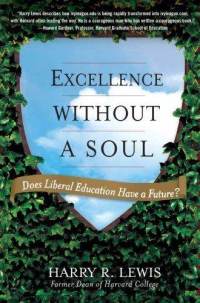
ExcellenceWithoutSoul Cambridge, Massachusetts is a likable town. As students at Boston University my friends and I would occasionally take the red line to Harvard Square and shuffle through the leaves of that venerable institution that gives the square its name. One of the treats was stopping in The Coop, the Harvard bookstore that made us all feel smart. While at Harvard last year, The Coop was part of my professional, editorial remit. I spied a book entitled Excellence Without a Soul: Does Liberal Education Have a Future?, by Harry R. Lewis. I have often thought about how higher education has slipped its moorings these past few decades, and wondered what an erstwhile Harvard dean had to say about the matter. The leaves on campus weren’t so abundant last October, but I felt that same inferiority complex that being on the Harvard campus always gives me. Of course, I had received an acceptance letter from Harvard Divinity School when I considered transferring there, but it was easier to stay at BU and complain.

Lewis’s book is a somewhat nostalgic consideration of how Harvard has evolved from a seminary to a powerhouse university—the powerhouse university—in the new world. There is no doubt that Harvard is our oldest institution of higher education, and there is no doubt that it has the money to be “the best.” But by what measure? This is one of the questions Lewis asks, repeatedly. Still, the assumption is always lurking in the background that Harvard is the best, but as Lewis notes in the book, there is no one best doctor just like there is no one best book. Harvard is good, but so are many other schools. They all suffer from the same indifference in a society that takes education for granted. The real problem is that we like simple solutions. Take a look around you—you’ll see what I mean.

It is difficult to feel sorry for Harvard. The elite of the elite, it has that time-honored patina that antique specialists love so much. What it doesn’t have it can afford to buy. There is no doubt, however, that as Harvard leans, so tilt the other universities of this country. In my professional field I’ve seldom met an unemployed Harvard Ph.D. Those of us who attended even older universities (yes, the Europeans came up with the idea first) with even more recognizable alumni—has anyone heard of Charles Darwin or David Hume? Adam Smith?—are used to being passed over for positions while Harvard writes its own checks. Elitism may be at the heart of the problem. It’s not that I wish hard times on Harvard, it’s just that I wish we’d be honest about the academic enterprise. Has higher education lost its soul? To find the answer we’re going to have to look beyond Cambridge, Massachusetts. But the leaves in autumn are certainly pretty, if not so abundant as they were before.


AAR/SBL Chicago

On just about any playground you’ll spot the kid who’s watching from the side, instead of playing with the others. That’s me. I don’t suspect that anyone starts life wanting to be left out, but some of us—attuned to the subtler messages of life—become aware that we’re not really invited or welcome. That sensation bathed me in its eldritch light once again while waiting for my flight to Chicago for the American Academy of Religion and Society of Biblical Literature annual meeting. I’ve often wondered what it must be like for those innocent aeronauts not clued in that the Friday before Black Friday (the real holiday, I’m led to believe) that flights to a specified city will be choked with crusty professors of religion. Sitting in Newark Airport and hearing the word “Ugaritic” from the seat behind me, I knew it had begun. I turned around. No flash of recognition. If was as if I hadn’t spent years learning that obscure language and publishing in the main journals. The invisible man.

The airport before the AAR/SBL annual meeting is a theological locker room where the guys gather to compare the size of their, um, theses. It’s pretty hard not to overhear, once you’re tuned in to your specialization, as colleagues lay out their publications, invited papers, international travel plans. I’ll admit to being jealous. They’re living the life for which I trained. I had taught for nearly twenty years and was never really invited to play. Now here I sit, knowing what Ugaritic is among the perplexed business travelers, but I’m not one of the big boys.

I realize that outside the rarified world of higher education Ugaritic matters even less than the homeless unfortunates shivering in the streets of Manhattan or Chicago. Back in the brief days when I tried to be a player, I remember attending an Ugaritic conference here in Illinois. Crowded into an elevator with renowned colleagues, one of them joked, “If this elevator falls, the field of Ugaritic studies may never recover.” An exaggeration, but not by much. Present company excepted. Of that august group, only one was asked to step off into the void. His exit was barely noticed. Ugaritic studies thrives. The poor beg for alms. And one kid, even though he now understands the rules of the game, still watches from outside.


Barely Departed

Back before any of us, or anyone we knew, had attended Grove City College, one tragic night a student on the basketball team crashed through the glass doors of the gym on west campus and bled to death. If you walked across that part of campus at night, it was said, you would see his ghost. Everyone knew his name was Jim, but I never saw him. Folklorist Elizabeth Tucker presents a rare treat of the anomalous and academic in her book Haunted Halls: Ghostlore of American College Campuses. Professors have traditionally shied away from the paranormal. It can be a risky way to spend your time since the supernatural has been banished from the academy for ages. That doesn’t mean that students and professors have stopped seeing ghosts, though. Tucker, like a good prof, doesn’t just tell us ghost stories and dismiss class. She tries to unpack a bit of what they might mean.

Ghost stories, even when entertaining, are able teachers. Kids going to college find themselves in liminal situations. Not really independent, not really supervised, they test the limits of what they’ve been told. Ghosts, not supposed to exist, are the ultimate rebels. They don’t even obey the laws of physics or biology. But what are ghosts if not the embodiment of the human spirit? We call them spirits, and they represent that part of us that stubbornly refuses to go gentle into that dark night.

Tucker’s book will not convince a skeptic that ghosts exist. It probably won’t cause you any sleepless nights (unless you are about to send your child off to college). Her book is more about what ghost stories say about the living, as would be expected of a folklorist. Although not a comprehensive survey, Haunted Halls may well bring back the ghostly tales of your own college years, for very few places are without their specters, especially on a rainy October night. And even though I never saw Jim as I cut across west campus in the dark, who am I to say that he’s not really there?


Queens and Playmates

Once upon a time, theology was queen. I’m no theologian, but then, I didn’t make up the phrase. A recent article in the Chronicle of Higher Education discusses how some scientists say there is no longer a need for philosophy. In passing the piece mentions that theology had, long ago, been considered the queen of the sciences. According to medieval thinkers, philosophy was her handmaid. Antiquated archaisms apart, I sometimes think back on this whole venture of education. Few today acknowledge, and most probably don’t know, that education began as a religious exercise. Writing, and reading, were overseen by the gods. Even in the modern world the earliest universities were founded to teach theology and law. Many of the ivy league schools, including Harvard, Yale, and Princeton, began as training grounds for the clergy. How quickly our forebears are forgotten.

It’s not that I think religion deserves a privileged place in the academy, but I do believe it deserves a place. Science has a long track record of spectacular successes. Not only that, but the advances in science often capture the imagination—and here we are back in the realm of the humanities, that place where feeling and possibility are unlimited. Many of those of us in religious studies—apart from creationists and their kin—gladly award science its deserved paean to successfully unpacking the intricacies of the material universe(s). As the Chronicle article demonstrates, some on the science side of the circle want to claim all the marbles and go home. Some of us want to keep the game going well after dark.

Maybe that’s a very wide metaphorical shift—from queen to playmate—it may be presumptuous. After all, what has religion, or philosophy for that matter, got to claim? What shiny Nobel Prizes to display gracefully, or great advances of which to boast? The benefits religion can claim are somewhat less tangible, but important nevertheless. While some people declare that meaning is a chimera, deep down, as a species, we know that it is important. Even more than that, the fact that you’re reading this right now owes its ultimate origin to religious thinking. Writing was the brainchild of the gods, an activity we learned in imitation of the divine. I will always find science fascinating, but I will always do so with a book held in my hands. “Now, here, you see, it takes all the running you can do, to keep in the same place,” in the words of another famous queen.


Leggo My Congo

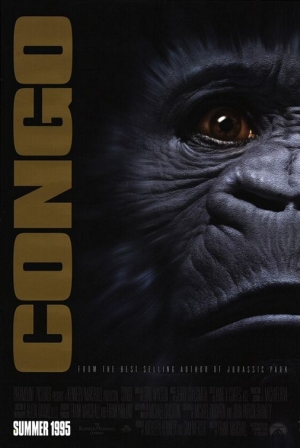
When I first saw the trailer for Congo, back in 1995, I was a new father and my interest in talking apes understandably took a back seat. While the movie sat back there like a quiet child, it was slowly forgotten. Something prompted my memory over the weekend, so I finally watched it. Now, I had plenty of time to read the negative reviews, but I have a soft spot for both talking apes and bad movies. The really fascinating aspect of Congo, however, was the fantastic liberties it takes with the ancient world, particularly the kingdom of Solomon. Solomon has been under investigation over the past few decades. Archaeologists have not found evidence of the biblical opulence concerning both his wealth and fame. It seems likely that he was an actual king, but the king of a small nation that did not have quite the pull that later tradition granted to it. Still, Solomon has become a cultural trope for great wealth and splendor, and if a movie-maker wants an easy frame of reference, well, some people will recognize old Sol. Those who do recognize Solomon probably won’t have a ready inventory of his assets to interrupt their enjoyment (that presumes a lot) of the movie.

The motive factor that brings our unlikely traveling companions together in Congo, are the fabricatedly mythical diamond mines of King Solomon, located in the Congo. A self-styled archaeologist and professional con-man from Romania assists to finance a flight to Africa to help return a homesick gorilla (Amy) who also, by the way, talks. The only realistic aspect of the heroes is that the university professors are the ones who are completely broke and have to rely on corporate funding to get their monkey off their back (well, actually she’s an ape). And then there is the huge communications giant (TraviCom) that needs the diamonds for their communications equipment. And a bunch of Africans who just want to stay alive (most don’t succeed). Solomon was never really associated with diamonds in the Bible. His wealth is described in terms of gold, silver, bronze, peacocks, and suprizingly, apes. Why and how he would have managed a mine in central Africa when even the Egyptians didn’t travel there is never explained.

Well, I shouldn’t be so hasty about the Egyptians. Our Romanian con-man is also able to translate Egyptian heiroglyphics, liberally scribbled on the walls of the fortress surrounding Solomon’s mine. These preserve the story of the “myth of the killing apes” that generated an honest-to-god guffaw from my cynical self. New mythology and corny characters aside, the movie didn’t fail to reach me. I’m always a sucker for talking apes and under-funded education, both of which represent a kind of extinction. If Solomon really had a reach all the way to the Congo, and if he extracted the huge diamonds the movie showed scattered around on the surface of the ground and if universities could actually get media attention for causes other than the shortcomings of their football programs, there could be cause for hope. In what is a bit of probably unintended social commentary, after the mine is destroyed in a volcanic eruption, only one diamond remains. And that diamond benefits neither the single surviving African nor the underfunded university professor. It becomes a weapon in the hands of a large, private corporation.


The Idea of a University

I have to admit that my sense of justice has been a bit offended by the loss of reputation of my chosen field. Seeing how universities are fast becoming job-training institutes, I fume about what once had been and no longer shall be. History is the lens through which I view the world (a subject many industrialists consider “useless,” but to their cause actually “dangerous”). Historians dispute which university was the earliest, although something similar to the idea of a university was developed in Bologna, Italy, around 1088.  The University of Paris was also very early, as were Oxford and Salerno.  While “business” as it was then known could be studied to some degree, a primary function of early universities was the training of clergy. No doubt, paranoia concerning heterodoxy and heresy helped spur on the idea that future clergy required extensive training. As universities caught on, many centers for the studying of theology (indeed, a branch of religious studies) sprang to life.  It could be argued that this was a “trade mentality,” but very quickly this became an academic point.  Who else but a theologian would every worry about how many angels could dance on the head of a pin?

Science was incorporated into theological studies from the beginning.  We all know about the antagonistic relationship between the Church and Galileo, but less often do we hear about the religious thinkers who were trying to put it all together into a workable system.  Often the university was among the few places where such abstract and critical thought could occur. Some of the great universities in the United States began as seminaries: Harvard, Yale, Boston University—they started as places to train clergy. How often do graduates of the Harvard Business School toot that particular horn? Permit me the privilege of a mournful sigh as I watch the torch pass from abstract thought to the abstract symbol of the gold standard. Money only possesses the value we assign to it.  Currency can be measured in less material avenues as well—the ability to think clearly and precisely and compassionately; these abstractions, I would lament, have inherent value.  Alas, the heart of the university has gone another direction. I have undergone the heartache of breakups before, and always one needs a little time to adjust to the loss.

The University of Virginia’s recent object lesson to higher education should perhaps serve as a warning tap on the brakes to those who would see higher education kneeling abjectly before the towering statue of commerce with its head of gold.  Maybe there is more to life than money?  Maybe education for its own sake is what sets civilization apart from life in the savage jungle.  Those who castigate our great institutions of learning seldom turn down the offer of an honorary degree.  While these academic niceties require neither coursework nor dissertation, they do offer a kind of credibility that the rich seldom find on their own.  So what is the idea of a university? Is it a place to learn a trade?  Sometimes.  The humble request those of us deemed useless make is that the university not forget its humble origins as a place of speculative thought in the service of religious thinking.  Critical thinking. Otherwise it will be more than irony that the city that gave us higher education is also the one that also gives its name to baloney.

from Wiki Commons


Lost Professors

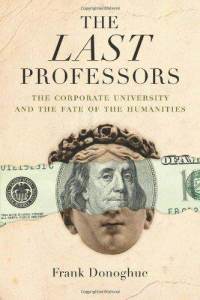
In front of my desk at home sits a chair.  That chair came to me when Gorgias Press was subleasing some of its office space and was necessarily divesting itself of unnecessary furnishings. Gorgias Press came to inherit the chair with the closing of the for-profit Katherine Gibbs School of Business, a branch of which leased half of the building.  I sit in that chair, contemplating the future of education.  I have just finished reading Frank Donoghue’s The Last Professors: The Corporate University and the Fate of the Humanities (as recommended by my friend Marvin).  Despite the fact that it is the first academic book I can recall leaving me in tears, it is a book every Ph.D. and potential Ph.D. in the Humanities should read and/or be forced to read.  Buck the trend!  Buy a book!  Donoghue is a rare individual who actually takes time to research what is going on in higher education and who has the courage to report it directly.  My regular readers will know that for nearly two decades I worked in higher education, spending every one of those years hoping that the next year things would get better.  Thank you, Dr. Donoghue, for speaking the truth.

I didn’t enter higher education as a child of privilege.  My career ambitions in high school were to be a janitor.  Encouraged along the way by well-meaning teachers and professors, I eventually found a job (lackluster as it was) in higher education.  What I didn’t realize is that the game had been rigged.  I recall being told with crystalline clarity that college and university positions were headed for a vast turn-over in the 1990s and jobs would be abundant.  Donoghue heard that story too.  His research shows that the writing had been inscribed on the wall as early as the 1970’s (before I reached high school) that this would not happen.  This is not hindsight either; studies were already indicating that higher education was going after the vaunted business model of the glitzy for-profit world.  Shiny baubles.  Worse yet, the roots of this inevitable transformation reached back to the Civil War and the nation that emerged from it—replace the dead on the battlefield with the dead in the factory.  Only only method of judging value existed: money.

The most disturbing aspect of all of this is the irreversibility of this trend: in today’s world only one value system is admitted, and it is purely material. No other way in higher education is capable of assessing worth. Rather, the alternate ways are being ruthlessly silenced by the transformation of university to corporation. That transformation was well underway long before the 1970’s, of course.  I had recognized at a young age that capitalism is a cancer that eats away the soul of people, convincing them that financial success is the only goal worth pursuing. I protested.  I spent years earning a doctorate in the Humanities to show that other values still throbbed away in the hearts of those who weren’t taken in by shiny baubles.  If you have any interest in resuscitating the human spirit, read Donoghue and weep with me.  The only consolation that I have is that I am sitting on a chair of a for-profit school that fell victim to the value system it once supported.  Capital and cannibal are too close for comfort.


Ms. Found in an Email

The other day I received a distressed message from a friend that I met in college. Marvin’s career somewhat parallels mine; he went on to get a PhD, taught for a few years in New Hampshire until the economy claimed his job, tried to make it as a fiction writer and adjunct instructor for awhile before moving to Boston to work with a publishing company. He’s never made any money for his writing, but that may be for his own good because the money that authors make goes to support the CEO of whatever corporation owns the publishing house. Still, I wish him luck. Yesterday he emailed me about a book he’s reading, The Last Professors, by Frank Donoghue. He’s convinced me that I should read it, but I thought his message would be appropriate for this blog. In Marvin’s words:

“If a more bleak preface has ever been written, I’m an illiterate ape who never reads. The writing has been on the wall for years, but those of use who are able to see it have been hopelessly myopic. In the preface he tells how industrialists since the end of the Civil War have been dead-set against liberal arts education as useless. People like the two of us who studied ‘useless’ fields, they would have as the cogs in their efficient machines, suppressing our thoughts. The only useful education they can deign to approve is one that earns them more money. There’s only one value system in the world, it seems.

“Don’t you feel like a sell-out, working in New York City, that cathedral of capitalism? Is NYU on anybody’s list of tourist stops for people down there in New York? Who goes to visit a university when there’s so much of commercial interest to see?

“And yet, corporate types are the ones who can afford tickets to shows written and put on by people educated in their ‘useless’ craft, but who are in reality their unwitting chattels. And who wants to be seen with authors and intellectuals to enhance his personal prestige, so that he will appear smart? Who are the dogs in the manger who keep everything they can’t possible use for themselves, for fear that others might enjoy it?

“We all play along with their game—we wear jeans on casual Friday and declare how good we have it. We speak their demeaning language, using humiliating phrases like ‘best practice,’ ‘core competency’ and ‘corporate values.’ In this dehumanized state we all live in cages that we’ve helped build. Corporate moguls hold their power over us because we let them. We, the workers, have the power to change it. They make the rules and we obey because we all want to be in their place.

“Education is the way out—that’s why they hate it. There’s an entire support industry built around it; those of us in the book business rely on educated readers. What happened to Borders looks prophetic to me. Time to close—I’ve just arrived at work.

“Sent from my iPhone”

Just another useless lay-about