Reading Connections

It’s flattering to have someone notice your work.  The other day I had the very first email from someone who’d read Holy Horror and wanted to discuss it.  It was from an undergraduate, no less, who was doing a report on religion and horror.  She’d read my book (and yes, it’s undergrad friendly) and wondered if I’d be willing to talk about it.  I can’t express how surprised I was (and still am).  You see, I have emailed authors after reading their books.  Many of them show no interest in carrying on a conversation with someone they’ve “met” through email.  I’ve had so many single-sentence responses with no enthusiasm whatsoever that I’ve begun to think of those employed in academia as hopelessly stuck in tunnel vision.  If you write a book you’re wanting conversation with those who read it, I should think.  At least I am.

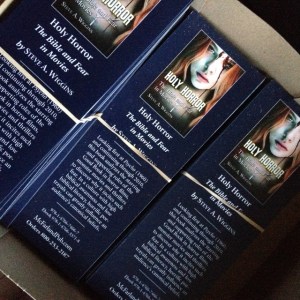
Those of us outside academe don’t have tenure committees to please or effectiveness committees to placate.  We write books to try to engage readers.  Unfortunately Holy Horror is priced for the library market.  During our phone interview, my interlocutor asked about the cover.  She said something publishers should hear: when walking around with Holy Horror her friends asked what the book was about because the cover is intriguing.  (It’s actually based on Chloë Grace Moretz from the reboot of Carrie, discussed in the book.)  In the midst of a pandemic, this first show of interest made my day, like seeing the first crocuses after a long, hard winter.  I do welcome conversation about my book.  I don’t have a classroom of students to force to buy and read it.  It’s out there for discussion.

Nightmares with the Bible is nearly finished.  Of course, publishers have hit a bit of a slow patch with many of their business partners shutting down.  Some publishers have gone into hibernation during the pandemic.  Books, though, will get us through.  A colleague of mine said the industry reports are showing that novels continue to sell while nonfiction is suffering.  Well, I’m no expert, but I do wonder if nonfiction might do better if authors would be willing to respond to this who express an interest in their work.  I know it’s a radical idea.  I also know that my books reach nowhere near what most publishers consider a viable readership.  What people are looking for during enforced isolation is a sense of connection.  Reaching out to find someone reaching back.  Books can do this, even if we never physically meet.


Distance Education

As an exile from academia, I do feel for my employed colleagues who are having to learn distance education techniques on the fly.  I do also feel compelled *ahem* to note that I was trained in online teaching long ago at Rutgers University.  The school declined to hire me then, and I’ve had no offers since.  Now it’s become fashionable for academics with virtually no online experience to look to the hills—whence is their help to come?  It’s not very often that I can claim to have been ahead of the curve.  In fact, I’m usually so far back that I don’t even know there is a curve.  Mismatches like this (someone who’s always been good at teaching, and trained to do so online, who’s been deemed exile-worthy while the unprepared now brush off their virtual bona fides) occur all the time in history.  It’s one of the things that makes it interesting.

Higher education isn’t a luxury.  I disagree with President Obama that all people should go to college, though.  Not everyone needs to.  Everyone should be able to attend, however, if they feel compelled to do so.  There are a number of myths about it that politicians of all stripes should seek to dispel.  One is that the more education you get the higher salary you’ll be able to demand.  As a Ph.D. holder I know that is decidedly not the case.  There are plenty of manual labor jobs that pay better than the options open for a humanities Ph.D. earner.  I also know that universities don’t tell new doctoral candidates this fact.  The old ways are changing.  I’ve often wondered if the collapse of civilization would be slow or rapid.  Living through it I now can see it looks slow from the inside.  Future historians will need to assess for future readers how it looks from the social distance of chronological clarity.

Historically crises have helped people pull together.  This one seems only to have divided us further.  If our government knew how, it could now model kind and considerate behavior.  It doesn’t know how.  The selfish often don’t comprehend how the wellbeing of others can affect their own.  Some companies are beginning to realize that customer loyalty after the crisis may depend on reasonable treatment at at time like this.  For others it’s more difficult than house-training a new puppy.  Nobody wants to go into exile.  When you do, however, you can’t help but notice how it changes your view of things.  Ironically I was hired away from academia the very year I had completed my training in distance education.  I can image how it might’ve been.  But then, I’m living in a land not my own.


See Index Saw

Too much of my life is taken up with indexes.  If life with technology is a teeter-totter, then my generation stands just above the fulcrum.  There are guys with whom I attended college who maintain no internet presence at all.  I’ve repeatedly searched for college buddies and come up blank.  Those in the decade following mine, if they want to work, have pretty much resigned themselves to tech.  Those in the decade before, not so much.  What does this have to do with indices?  Plenty!  You see, in academic publishing, and its consequent research, you need to look stuff up.  If you read multiple books on the same topic you’re not likely to be able to pinpoint a page number without an index.  You remember you read it here (you think) and so you stick a finger in the back and begin checking out the pages referenced until you (hopefully) find it.  That’s the old school way.

I’ve typed my fingers down to the marrow trying to explain to guys my age and older that the average academic no longer uses a print index.  Just about everything has been digitized.  Although I’m no fan of ebooks (I very seldom read them) looking things up is sure much easier with a searchable PDF.  Type in your search term and voila—an easy list of references appears that can be quickly clicked through and checked.  And yes, my colleagues, that’s what people are doing these days.  I lament the decline in print books.  When I set out to write a book I have a physical object in mind.  It has pages and a cover.  A spine.  I am writing a book, not “content” to be “exploited” in “multiple formats.”  And yet, the index is really no longer necessary.

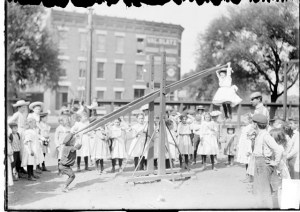
The typical academic author whose book is at the production stage fusses greatly over the index.  Calmly I explain that indexes are very rarely used.  They must have detailed indices, they insist.  The thing about teeter-totters is that they move.  I have an inner-ear problem.  As a child this prevented me from doing the usual playground things like swinging and seesawing and spinning, to different degrees.  I still can do none of those things well.  My wife and I bought a gliding rocker early in our marriage, that seats two.  We quickly learned that I couldn’t rock with her.  Indexes, you see, are on one side of that long board.  It’s the side on which the heavy weight of time rests.  So ponderous is it that the kids on the other side just can’t get it off the ground.  And I spend my days over the fulcrum trying to get the two sides to play nice together.  Without rocking the thing too much.

Photo credit: Chicago Daily News, via WikiMedia Commons


Without Peer

Peer review makes the world go round.  Well, at least the academic world.  It’s based on a simple enough premise: if your academic work is passable other scholars will be able to tell.  It’s a process fraught with peril, however.  Scholars, being human, are subject to fits of pique or of hypersensitivity, or just having gotten out of the wrong side of bed that morning.  Perfectly good projects can be shot down with a single, well-placed arrow.  Or even dart.  Problem is, there’s no better system for deciding if academic work is adequate, or even good.  There may be some objective measure out there in the universe, but if there is we don’t have access to it.  We have to rely on peer review.

During my teaching years, which numbered nearly twenty, I was never asked to peer review anything.  My first invitation came while I was working as an editor.  Of course I said “yes.”  A number of scholars, however, don’t share the basic reality that if nobody peer reviewed their work, they’d never get published.  Many scholars decline offers to review their colleagues’ work.  I even had a very senior scholar once blithely tell me that he had his own research to do, so why should he take time to review that of others.  Professional reserve prevented me from pointing out that if his colleagues felt the same way he’d be as unpublished as a fresh doctorate-holder.  Scholarship is a cooperative venture, no matter how many Lone Rangers ride the cuesta.  So why is it so difficult to find peer reviewers?

I’ll read your book if you’ll read mine!

Something I’ve noticed is that many scholars are coddled.  Constantly told that they’re brilliant and gifted, they come to believe it like miniature Trumps.  More to the point, perhaps, is the shrinking number of academic positions.  The few who hold actual jobs are bombarded with other tasks, including committee work, advisory duties, and sometimes even teaching (depending on the adjunct pool).  I know it’s tough.  Been there, done that.  Nevertheless, academia cannot survive without the basic peer reviewer.  Education is a cooperative venture.  We may imagine the academic alone in her or his study, but breakthroughs generally come through when people work together.  Of course, my job is one performed in isolation.  Increasingly, academics can be found not in their offices, but working remotely from home.  Is the sense of “peer” itself breaking down?  My own book, Nightmares with the Bible, was slowed down by peer review.  In a sense I’m glad it was.  Hi ho Silver, away!


Reading Education

Perhaps like me you’re afraid of the news.  Not because it’s fake, but because it’s real.  Then every once in a while curiosity gets the better of me and I uncover my eyes.  Sometimes you can’t help but see.  With the utter mess we’re in over here, it’s difficult to keep up with news from other countries we know.  I’ve lived in the United Kingdom and I’ve worked for British companies.  Needless to say, I wonder what’s going on over there from time to time.  Lately I’ve been getting auto-replies to my emails to British colleagues stating that they’re on strike.  I asked a friend in the UK about this.  It used to be the professorate was treated with some regard in Her Majesty’s domain.  Not being a financially minded person, I haven’t been aware of how deep or devastating our capitalism-induced recessions and depressions are.  Apparently they’ve been bad enough to derail even British higher education.

Compensation for the professorate has been eroded away.  Their pension plans have been depleted.  Knowing the problems we have over here with professors refusing to retire, I was surprised to learn the UK has the opposite problem—professors unable to afford to retire.  Now, lecturing isn’t physical labor, but class preparation (and committee work) take a considerable amount of effort.  I could see not retiring if it meant lecturing only, but with everything else required, not retiring would be, well, exhausting.  As over here the root of the problem is that higher education is the route into which many smart people are steered.  You’d think it’d be a wonderful problem to have too many highly educated people.  It’s not.  With advanced study comes advanced debt.  And limited employment prospects.

There are nations in the world where higher education is deeply valued.  Where educated people are respected.  Ironically, the nations enamored of capitalism aren’t those places.  The only learning that’s required is how to get money from someone else.  Beyond that, the rest is commentary.  British higher education has fallen on hard times since I read for my Edinburgh doctorate.  Schemes have been put in place to ensure faculty are being productive.  Yes, there are some lazy ones.  The majority, however, pull their weight and then some.  And now they’re being told they must do so until the grave.  No retired professor wants to spend her or his old age bagging groceries at Sainsbury’s.  And so they’re going on strike.  If only the world valued knowledge more than money there might be some news worth reading.


Voice of Experience

Trust your publisher.  Well, if you have one, that is.  I’m not the only erstwhile academic to have ended up in publishing, but what constantly surprises me is that academics care little about those who give voice to their ideas.  Now this blog is self-publishing.  It contains my ideas, but they are free for the taking, and here’s a bit of useful advice: trust your publisher.  These days with easy online publication and formatting that makes your posts look like a pro (not here, mind you), it’s sometimes difficult to realize that publishers actually provide more than just an imprint.  They offer services to make your book look serious, scholarly, and also to be useful to others.  Those of us who write books are often far too emotionally involved to see this.

I regularly run across academics who tell publishers how the text should look on the page.  I’m not talking about those weird and wonderful sections of ancient texts with <lacunae>… ellipses… [brackets] and whatnot.  No, there are those who want to control kerning, leading, and all sorts of things.  There are those who want practically every single word indexed, although research shows that most researchers access searchable PDFs rather than wasting their time thumbing through pages to find a reference.  And that traditional chestnut, “written for general readers.”  Publishers have access to book sales figures (at least of their own books).  There’s no need to bluff; if your book is only for scholars (does it have words like “reify” or “heuristic” in it?  Be honest now!), publishers know how to handle that.

We’re all nervous when our book gets through the acceptance process.  Peer review always breaks me into a cold sweat.  Believe me, we understand!  Take a soothing sip of tea.  Go for a walk.  Better yet, jog.  Scholars tend to be precise thinkers.  We get that.  When, however, is the last time someone used a map from a Bible for navigation?  Most of those cities don’t even exist any more!  This strange mix of online savvy and adherence to the old ways of print (which I love and of which I shall never let go) clash in ways that cause publishers great stress.  You can find a YouTube video on how to make your own book.  Those of us in the biz can tell at a glance if a book’s self-published or not.  And believe me, we’re rooting for you.  We want your book to succeed.  Why not trust those who know what they’re doing?


Amendments

Funny thing about freedom of speech.  It doesn’t really exist in a capitalist system.  Words, I suspect the powers that be know, are extremely potent.  Any system that brooks no rivals will insist on silencing dissidents.  And not just on a national scale.  Several years ago I was interviewed by a Catholic magazine for an editorial position.  I was between jobs and this looked like a good fit; in fact, the woman who arranged the interview told me that if this position didn’t work out they’d likely be able to find a different one for someone with my particular skill set.  When the power that was interviewed me, however, he noted that I had a blog.  “If we hire you, you’ll need to take it down,” he said.  It would confuse readers who might think I was speaking for the Catholic Church.  My candidacy did not proceed.

In a job I would eventually get, in academic publishing, a similar concern was expressed.  Although I hold an earned doctorate from a world-class research university, my opinions might be mistaken for those of some true authority.  Problematic.  This issue keeps coming up.  I write fiction and publish it under a pseudonym.  Sometimes I think about coming out of my literary closet, but the issues pour in hard and fast when the door’s opened.  What would those who read my nonfiction (both of them!) think?  Would I discredit myself because I have too much imagination?  What would an academic employer say?  If I ever went back on the ordination track, would a congregation of any sort understand a clergy person who thinks such things?  I get enough flak from writing about horror films.

The fact is, freedom of expression is very, very limited.  Capitalism measures all things by the bottom line and anything that might cause that trend to waver is forbidden.  Lack of team spirit.  If you want to publish, don’t work in publishing.  It’s like saying (if I might be so bold) that you shouldn’t teach if you earn a doctorate, because you might actually contribute to what we hopefully call knowledge.  This dilemma has become an entrenched part of my psyche.  I grew up innocently writing fiction.  I completed my first stories about the age of 12 or 13.  I was eventually groomed for the ministry and so the fiction had to be set aside as one of those “childish things.”  Was it?  Perhaps.  More likely though, it was simply a lesson that I would find repeated throughout my adult life.  Give lip service to freedom of speech, but don’t ever use it.


Qohelet’s Advice

Academic hypersensitivity.  I fear it’s on the rise.  I know I’ve experienced it myself—that flushing rage and disbelief that someone has written a book on the very topic on which you also published a book, and didn’t cite you.  How could they have overlooked your contribution?  I’ve seen scholars angered to the point of wanting to ruin someone’s career for not citing them.  Now academics can be a sensitive lot.  Remember, some of them specialize to a point of general social incompetence.  Anyone publishing in their specialization is like making a claim to have slept with their spouse.  This subject is theirs!  They’ve spent years reading and researching it.  How dare some new-comer not know this!

One thing many academics don’t realize is just how much material is published.  The flip side of this is just how obscure their work is.  Trade publishing and academic publishing aren’t the same thing, and the former are the books that really get noticed.  When I wrote my dissertation, back in the early 1990s, I had read everthing I possibly could on the goddess Asherah.  When I proposed the dissertation topic there had been a total of about three books written on Asherah that I knew of.  Enough to have a research base, but not enough to suggest it was a crowded field.  While I was whiling away my time in Edinburgh, another American ex-pat was writing on the same topic in Oxford.  The day of my doctoral defense, the outside examiner came in with a book just out on Asherah—in German, no less—and asked how my dissertation related to it.  Even today when I see a book on Israelite religion I flip to the back to see if my book’s listed.  Generally it’s not.  Today it’s impossible to read everything published on Asherah.

In my own case, however, I’m slowly coming to perceive the reality of the situation.  Books continue to be produced.  Articles are published at a blinding rate.  Even Google has to take a little time to find them all.  An overly inflated sense of self-importance can be a painful thing when it meets with the sharp pin of reality.  Your academic book may well go unnoticed.  Even if it’s good.  It may be priced at over a hundred dollars—I still pause and fret and kick the dirt a few times before buying any book that costs more than twenty.  Silently and slowly, I suspect, the frustration builds.  You see a book, then two, then three, that seem to be oblivious to your contribution.  A new book for review lands on your desk and Vesuvius erupts—why am I not cited?!  Has my work been forgotten?  Calm down.  Breathe deeply.  The book of that neophyte before you will also become obscure in due course.


Job’s Jobs

Many years ago, after Nashotah House decided it no longer required my unique outlook, I bought a book.  (That’s my default reaction.)  This book was on how to write killer cover letters.  I don’t remember the title or the author, but I followed the advice, well, religiously.  It got me nowhere.  Business tricks, at least historically, don’t work in academia.  Sitting at home, pondering my sins, I flipped to the chapter on advice to take if none of the rest of this was working for you.  Here’s where the human side began to show through.  Have you been eating onions or garlic before your interviews? it asked.   Do you need to lose weight?  Try dressing nicer.  It occurred to me that the business world lacks the imagination required for denying jobs.  And besides, who was getting any interviews before which I shouldn’t eat garlic?

Business advice is, in a word, shallow.  It assumes that if you’ve got the goods there’s no reason you won’t get hired.  Reality is a bit more complex than that.  I often ponder how people simply go for what they want.  They reach for the biggest piece without pondering the repercussions of their actions.  I see it in my small world of publishing all the time.  Those who are “hungry” (read “greedy”) succeed.  Those who wait behind to help others simply can’t compete.  So the cover letter book did get that part right.  Is it possible, however, to devise a society where everyone fits?  Not all are created equal, perhaps, but do we have to reward those who seem to care only for themselves?  Let them eat garlic.

The cover letter book, in the end, never really did me any good.  I found my way into publishing by being willing to aim low.  I’ve written many cover letters since leaving Nashotah House, and only two ever led to a job.  Those who work in business, what with their concerns about readers’ aromas and weights, seem never to have considered the intricacies of the intellectual job market.  What strikes me as particularly odd is that there are plenty of smart people out there, and yet they haven’t organized to offer alternatives to the greed-based structure on which our work lives are based.  They can’t, it seems, gaze beyond capitalism as a mechanism for helping individuals lead productive lives.  Business operates on the principle of replaceable parts, many of which happen to be human.  And even those who know how to write can’t hope to compete against those who prefer cogs that know to avoid onions.


Post Facto

“Yea, though I walk through the valley of the shadow of death,” Psalm 23 asserts, “I will fear no evil.”  Nor should one fear evil when flying over Death Valley, as I did coming out of San Diego, but I did.  There are perhaps not too many national monuments that can be appreciated from 30,000 feet, but the only way I’ve seen both the Grand Canyon and Death Valley is by plane.  My flight home from AAR/SBL had me sitting over a wing, so a photograph of the famed graben would simply show mostly wing and a bit of Death beyond.  This valley holds the record for the hottest ambient temperature recorded on the surface of the earth (134 degrees) and is famed as one of the filming locations for Star Wars.  Still, from the air the juxtaposition of mountains and salty, flat dearth was impressive.  I had no one with whom to share my excitement; the kid next to me was watching a movie on his phone and I had no idea who he was or if he’d be interested.

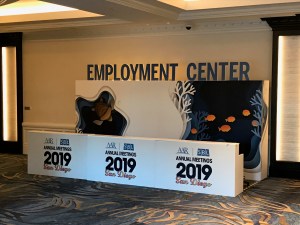
Disneyland, they say, is the “happiest place on earth.”  While I have my doubts about than endorphin-laced claim, I do know one of the opposite locales.  The hotel in which I stayed, the Grand Hyatt, San Diego, hosted the AAR/SBL Employment Center.  The hotel is not to be blamed for holding the most unhappy place on the planet, but as I looked at the booth I wondered if this was truth in advertising.  Should it not read “Unemployment Center”?  That two-letter prefix would make this at least honest, if not cheery.  I have spent some of the most miserable hours of my life in the employee hopefuls’ lounges at past conferences.  Hours and hours wasted, waiting to see if anyone, anyone at all was willing to grant you an interview.  I saw more than a few tears shed in that horrid place.  Some of them mine.

Now I’m high over Death Valley.  It feels far too sanitary to experience it in this way.  The professorate, which seeks to improve the world, is generally a powerless lot.  Signs scattered throughout the Convention Center and hotels asked such things as Does your school have over 50% contingency faculty?  And statements like Tenure track is not the norm.  The psalmist, it seems to me, got it right.  If you want to face the valley of the shadow of death and not fear, you have to walk through it.  The more people who do, the better the hope that we’ll land this plane with some kind of resolve to do be open to visions and to act upon them.


Geography Lesson

As someone who eschews easy labels, I’m always conflicted when someone asks what my doctorate is “in.”  Universities have departments, of course, and different academic fields have differing standards of what qualifies you as an expert.  My Ph.D. was mainly in the field of history of religions, but focused (all such project must be narrow) on what is best called ancient West Asian cultures.  Recently someone showed me a website with free geography quizzes on it.  (I post the link here with the caveat that this can be very addictive.)  This friend asked me how good my Asian geography was.  I knew that once I got east of Iran I was going to be in trouble.  Some countries, such as Russia, India, China, and Japan are hard to miss, but the others I was properly humbled over.

I tried the quiz again and again until I could point to any of the official Asian nations with a fair degree of accuracy.  Eurasia is a very large landmass, and when you consider that it is, apart from human-made canals, attached to Africa this is a lot of space to label.  Considering that many isolationist politicians can’t correctly find smaller countries on a map without an app, I started to realize just how lopsided the world is.  Many more people live in Asia than populate the “New World.”  They actually have more space than we do here, but much of it is too cold or too dry for comfortable living.  Still, I considered that if I’d had this quiz as a kid I might’ve known my geography much better than I do.

As I’m preparing to attend the American Academy of Religion and Society of Biblical Literature Annual Meeting in a few days, I recall priding myself at knowing all fifty states of my native country.  I’ve been to all but five of the lower 48—Alabama, Kansas, Oklahoma, New Mexico, and Nevada have eluded me (the conference never meets in them and I don’t have friends who’ll put me up for free in them).  But at least I know where I haven’t been.  

After trying my hand at Asia on the app, I attempted Africa.  Let’s just say I still have a lot left to learn.  And unlike when I was a kid, I look forward to taking quizzes.  Work interferes with web time, though, and learning modern countries isn’t the same as knowing where Hatti or Elam used to be.  Religion, after all, forms borders just as impermeable as mountains, oceans, or deserts.


Old Grains

Back when I was somebody—a professor is somebody, even if only a seminary professor—I was invited to meet with a group of Seattle writers and intellectuals.  I was in Seattle already because driving all the way out here was possible when you live in the Midwest and your summers are basically open and free.  (Professor’s privilege.)  One of the group members, the one who invited me, asked me about grain.  When the club met they ate.  With a bent toward history, one of them brought period-appropriate bread.  What kind would be fashionable for a night of ancient Near East talk?  (I was still researching and writing on Ugarit at the time, before Ugaritology passed away.)  Without stopping to think I replied “Einkorn.”  I didn’t know if einkorn was still around or not.  All I knew is that it was the earliest (at least as understood at that time) domesticated grain.  The loaf that arrived that night was a more accessible grain variety.

All of this came back to me as I stood in the local health-food store.  We don’t shop here for regular groceries—it’s expensive to eat healthily—but we’d been invited to someone’s house and said we’d bring appetizers.  The health-food store had vegan cheeses, so we needed crackers to go with.  Then I spied the word “einkorn.”  The Seattle discussion had to be well onto two decades old by now.  I was finally able to answer my question, einkorn was still alive.  The craze for ancient grains did not exist in my professorate days.  Some companies, according to occasional news stories, were trying to brew the beer of ancient Egypt or Sumer, but the health conscious hadn’t gone so far as to trying to replicate the diet of the earliest agriculturalists.

Ancient grains cost more because the yields are smaller.  Although the grain heads look disturbingly like those house centipedes that scamper in the basement when you flip on the light, they aren’t nearly the size of a current wheat head.  It stands to reason that it takes more of them to make up the same amount of flour, and appetites have grown over the millennia.  Like most vegans, I read boxes.  Another ancient grain cracker, apart from brown rice, included amaranth, flaxseed, millet, quinoa, sesame, and sorghum.  Never mixed this way in antiquity (for amaranth and quinoa were part of the “new world” and the others “old”), modern mixologists have devised new ways of using ancient grains.  Einkorn nearly went extinct with the development of wheat, rye, and barley.  But it hung on, and now, as a dozen millennia ago, it has a way of sustaining both dreams and fantasies.


Greatest Weakness

What a privilege it must be to work in a world of ideas!  (And to get paid handsomely to do so.)    My particular (and peculiar) career—if that’s what you call it—is intimately bound up with academics.  Those who know me personally treat me nicely, but the vast majority who haven’t a clue that I’m anything other than a guy who’s helping them get published sometimes forget their privilege is showing.  I’m not busting on my homies; I know what it’s like.  But I’ve noticed some interesting trends (“turns” in academese) that are fascinating from the point of view of an ordinary mortal with a mortgage and a great deal of anxiety about it.  For example, I find catch phrases time and again.  (See what I did there?)  Academic writers learn that if they buck the conventions they’ll be relegated to presses that don’t enhance your career.  All roads lead to Harvard, after all.

All of this is preamble to a curious trend that I’ve been seeing claiming that an idea’s greatest strength is also its greatest weakness.  I read this time and time again, so I began to wonder about the origin of this idea.  Now, not even Google understands “what is the origin of the phrase greatest strength is greatest weakness?” but it does bring up about a thousand-and-one websites about job interviews.  I’ve had many of these throughout this thing I’m calling a career, and just like everyone else I’ve read that when asked what your greatest weakness is reply that your greatest strength (whatever it may be) is it.  The classics such as “I’m a workaholic,” or “I just can’t stop acquiring more x” (and we all need more x), are tired cultural tropes.  How did academics pick up on this?

Does it stretch back to Achilles and his heel, or Goliath and his gigantism?  Or is it that to admit weakness is to disqualify yourself from a job?  A well-meaning friend told me I should go through this entire blog (as if anyone, including me, has time to do that) and expunge all mentions of having lost my job.  They should be replaced with insinuations that I’d chosen to leave.  “Nobody,” he implied, “likes a loser.”  Well, I guess my greatest weakness is that I’m an honest graphomaniac.  I write incessantly.  Novels and nonfiction books, short stories and essays, and even a learned article or two.  I used to be an academic you see.  And I was always honest.  It was my greatest weakness, if you see what I mean.


Time To Meet

I feel compelled to state up front that this wasn’t the mind-blowing book I was writing about in yesterday’s post.  One of the perks of working in publishing is the occasional offer of a free book.  (It’s not as generous as you might think, so when one is offered I always say “thank you.”)  The Surprising Science of Meetings, by Steven G. Regelberg, isn’t exactly “mind-blowing.”  The realization that some people make a living studying meetings was certainly, well, surprising, but the corporate world is all about returns on investments and boring stuff like that.  We all hear of companies that value innovative and exciting ideas, but most of us know the feeling of being desk drones parked behind a soulless monitor all day.  At least I’m no longer confined to a cubicle.

The academic world I once knew was the stimulating environment of learning for its own sake.  The academy has followed the business world to its own form of perdition and as Rogelberg points out, there are millions of meetings any given day.  Many of them are poorly run.  This book is for those who want meetings to flow more effectively, to better the bottom line.  Still, I found the chapter on servant leadership particularly hopeful.  I couldn’t help but wonder if Rogelberg was aware that servant leadership was something that developed in the church, out of the effort to imitate the way Jesus was said to have led his flock of disciples.  The point was not to aggrandize himself (this is a chapter 45 and his ilk should read) but to help others to be their best.  This is the kind of leadership—rare, to be sure—that the church has always, at least vocally, promoted.

It didn’t take long for ecclesiastical organizations to start running like businesses, however.  The bishop became a boss rather than someone who reluctantly had the crozier forced into his (or her) hand.  I’ve always believed you should have to take a pay cut to become a bishop.  That would immediately weed out most of the climbers.  In fact, if servant leadership is really the ideal, and the good of the company is really the goal, pay cuts should be expected as you climb the corporate ladder.  Can you imagine a business world where workers were well compensated, and those who really had vision sought promotion because their motivation wasn’t their own bottom line?  It’s an intriguing idea, to be sure.  I’d like ponder it more, but I’ve got a meeting to get to.


Pay Per View

One of the things editors can teach academics is that the latter should pay more attention.  Especially to the world of publishing.  An erstwhile academic, I learned to go about research and publication in the traditional way: come up with an idea that nobody else has noticed or thought of, and write about it.  It is “publishing for the sake of knowledge.”  (Yes, that is Gorgias Press’s slogan, and yes, it is one of my hooks—marketing, anyone?)  The idea behind this is that knowledge is worth knowing for its own sake.  Researchers of all kinds notice details of immense variety and there’s always room for more books.  Or at least there used to be.  The world of publishing on which academics rely, however, is rapidly transforming.  Money changes everything.

The world has too many problems (many of them generated by our own species) to pay too much attention to academics.  Universities, now following “business models” crank out more doctorates than there are jobs for employing said wannabe profs, and those who get jobs pay scant attention to knock-on changes in the publishing world.  Just the other day I was reading about “pay per use” schemes for academic writing that, unsurprisingly, came up with the fact that most academic books and articles lose money.  If someone has to pay to read your research, will they do it?  Especially if that research is on a topic that has no obvious connection with the mess we’re busy making of this world?  Probably not.  Publishing for the sake of knowledge is fast becoming a dusty artifact in the museum of quaint ideas.

For those still in the academic sector that means that research projects now have to be selected with an economic element in mind.  “Would anyone pay for this?” has to be one of the questions asked early on.  The question has to be answered honestly, which requires getting out from beyond the blinders of being part of the privileged class of those who are paid to think original thoughts.  Academia has followed the money.  A capitalistic system makes this inevitable.  How can you do business with an institution that doesn’t play by your accounting rules?  And academic publishers, which have difficulty turning a profit due to low sales volume, are bound to play along.  This situation will change how we seek knowledge.  More’s the pity since some of the things most interesting about the world are those that nobody would think to pay to view.