Yep, Nope

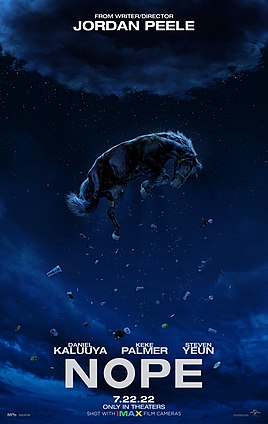
I can honestly say that I’ve never seen a movie that starts with a quote from Nahum.  I also honestly admit that Nope left me scratching my head, but very glad to have seen it.  I trust Jordan Peele implicitly as both a screenwriter and a director, and I know I need to see Nope again to make it all fit (if that’s possible).  His movies are the most Twilight Zoneish things out there, and despite Peele’s reported reason for naming the film Nope, I’m going to keep watching the skies.  It’s clear he had done his ufological homework.  Even the idea that—SPOILER ALERT—have you seen it yet?  Are you going to?  You might want to finish this later, if you haven’t—they are biological entities has been widely discussed.  

Although classified as horror, Nope has mercifully few jump startles.  In fact I noticed (there were maybe only 10 of us in the theater) that one couple had brought their kids.  I can imagine they had some interesting discussions on the car ride home.  For me, driving home alone, I felt like I’d watched Close Encounters, Twister, Signs, and Arrival simultaneously.  Peele set out to film a spectacle and he did indeed.  Horror has become more intelligent of late, and there’s so much going on here that I’ll need some time to sort it out.  The online nattering suggests the Nahum quote (“I will cast abominable filth upon you, make you vile and make you a spectacle”) reflects Peele’s thoughts on the Bible.  A more literal take might see the evacuation of waste creating a spectacle, which it does.  How to explain the angel form of the creature?

Alien horror works.  Alien sees them deep in apace, but many films, such as Fourth Kind, see them closer to home. Fourth Kind, also by an Africa American director (Olatunde Osunsanmi) never received critical acclaim, but I thought the first half was impossibly scary.  It’s natural enough to fear those we don’t understand.  Perhaps that’s one reason we tend to deny their existence.  If we deal with them in fiction we can call it horror and go home happy.  Nope asks us to consider whether our differences matter so much in the face of a non-discriminate predator that eats any human that enters its territory.  Even if they were there first.  I still have a lot of questions about the movie.  Some of them will likely never be answered.  One that will is “Do you plan on seeing it again?”  The answer is yep.


Nope, Not Yet

It’s perhaps this summer’s most hotly anticipated movie, but I’m not sure when I’ll get to see it.  Jordan Peele’s Nope opened in theaters this weekend but I’ve been busy.  For many Peele may have seemed to come out of left field with his 2017 directorial debut, Get Out (it took me a couple years to see that one), but he’d been working in films prior to that.  Then Us appeared in 2019 and instantly established him as the auteur of black horror films.  Like many in horror, Peele has a strong element of humor as well.  His films feature black actors falling into circumstances that whites have tended to claim for themselves—being the victims of monsters (often human).  I unfortunately missed Peele’s attempted reboot of The Twilight Zone in 2019-20.  Nevertheless, I know he’s a kindred spirit.

I try not to watch trailers before seeing a movie.  They give away too much.  I don’t need any enticement to see a Peele movie.  Even as I await a free weekend, I think about how horror has been a field accepting of auteurial diversity.  Women have directed horror since at least the eighties.  James Wan has been a major player in the genre since the early new millennium.  M. Night Shyamalan had his start shortly before that.  Good horror is good horror.  Often such films are quite smart as well.  Get Out drew attention for its social commentary—something for which Rod Serling was famous, and thus the naturalness of The Twilight Zone.  But when will I have time to get out and see Nope?  Perhaps I need to cash in a personal day so I can take in a matinee.

The trick will be, of course, to be on the internet without reading about it before that can happen.  Taking time off work is punished with skyscrapers of emails when you return.  But when I start having dreams about my boss coming to my messy house and helping me do necessary repairs, I think maybe I’ve been working too hard.  Movies, in such a life, seem like superfluous luxuries.  Of course, I’ve long accepted the thesis that films are our modern mythology.  They are our cultural referents, and not infrequently the source of meaning.  They explain our world.  And they require taking at least an hour-and-a-half out of the mowing, painting, hammering, and hauling that never seem to end.  Nope, I won’t have time to see the movie this weekend.  Yep, I’ll be looking forward to the first opportunity to do so.


Keeping Your Head

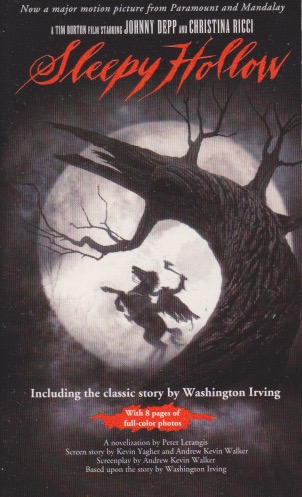
Horror is a gift that keeps on giving.  Not many horror fans are among my regular readers, but I like to keep a finger in the pie nevertheless.  Just earlier this month it was announced that Paramount has hired Lindsey Beers to direct a new big screen Sleepy Hollow.  It’s early days, of course, and the movie hasn’t been titled, let alone filmed.  Beers is just wrapping up a prequel for Pet Sematary (not yet titled) that I’ll be eager to see.  Women horror directors tend to bring refreshing angles to the genre—and why shouldn’t they?  Women writers were crucial in developing the Gothic genre that evolved into horror as we know it.  No matter what the Supreme Court says, they are just as important—probably more—than males.

I’ve been reading quite a lot about Sleepy Hollow over the past several months, which is how I came across the intelligence about this new movie.  It’s nice to know that the Hudson Valley is evergreen.  My visits there have offered brushes with the uncanny, but nothing explicit.  A weekend near the ice caves of Sam’s Point, geocaching in the woods outside Poughkeepsie, a visit to Sleepy Hollow itself to visit Irving’s grave and tip my hat to the Old Dutch Church.  With deep family roots in upstate New York, I’ve always thought it would be a great place to live.  Alas, not on an editor’s salary.  It’s been too long since I’ve given the area a visit.

John Quidor, The Headless Horseman Pursuing Ichabod Crane, via Wikimedia Commons

There have been many takes on Washington Irving’s “The Legend of Sleepy Hollow.”  Even in the silent era movies were made of it.  In retrospect, it seems odd that it took so long for Tim Burton to bring it back to the big screen.  There were some television movies, usually with plodding plots to draw the story out to commercial length.  Disney had early on devoted half a feature to it, as if the story couldn’t support its own weight.  For better or worse, that film was probably the first introduction to the tale that many people had—the story itself was written for adults.  Of course, many written kids’ versions have come out since then.  The satirical original was meant for a somewhat sophisticated readership with a sense of humor.  The story lends itself to horror treatments, however, if they’re done well.  It may have been an early viewing of the Disney tale that set me moving in this direction.  I like to think I’ve kept my head over it, however.


Free Research

I’ve lost track of how many times it’s happened, but it has been relatively few.  Someone I don’t know will approach me and ask me to post about something on my blog.  Sometimes they’ll even send me a book to highlight.  Perhaps not the most effective way to build a library, I’ll admit.  And some of the books haven’t been great.  I admire them nonetheless.  It takes great effort to write a book.  And not a small amount of faith, too.  Many books—perhaps most—never get published.  A great many are self-published.  (Those who work in publishing can be a stuck-up lot sometimes.)  Even those professionally published can use a push from time to time.  On this blog I’ve actively resisted the urge to make it about one thing.  Why?  Is life just one thing?

In a recent conversation I laid out for someone new what had been my research agenda as a young professor.  It had a direction still reflected in some of the categories you’ll find on the right column of this blog.  After writing on Asherah, I was going to give similar treatment to the other ancient goddesses attested at Ugarit.  This was perhaps ambitious for an academic waif at Nashotah House, but it was well underway.  My book on Shapshu was making good progress when the market (that dragon to every St. George) led friends to suggest turning biblical, which led to Weathering the Psalms.  A new research agenda—explore the weather terminology (the meteorotheology) of other biblical books—arose.  There were storms, after all, becalmed over lakes.  Horror entered in the jobless period and beyond.

And social justice.  I’m not a thrice-failed minister for nothing!  In fact, a recent freebie was a book on social justice.  I have a colleague as interested in monsters as me.  This particular scholar had decided to focus on the cause of the poor.  Even economists are starting to say the unequal distribution of wealth is hurting us.  While the rich fly to space on personally owned rockets, the rest of us have trouble filling up at the service station, even if we have jobs.  So it is that this blog is eclectic.  A friend told me early on that it would be more popular if I just stuck to one topic.  That’s probably true, but my mind can’t settle down like that.  And when people send me things to talk about, I’m happy to do so, if it fits somewhere in my mind.


The Network

Although it’s not NBC, the New Books Network has quite a reach with academics.  That’s why I was glad they accepted my pitch for an interview about Nightmares with the Bible.  The interview is now live and can be heard here.  The experience of getting the interview made turned into quite a saga with my pitch going back to at least November, and acceptance coming early in January.  The actual interview was over a month ago and it was posted only yesterday.  I’m not naive enough to think it will boost the sales of a hundred-dollar book, but maybe a few more people will become aware of it.  Even in academia there are too many books published for all of them to get notice proportionate to the work that goes into writing them.

Some publishers are of the opinion that editors shouldn’t try to be authors.  Obviously I disagree on that particular point.  Author-editors share the ups and downs and know what it’s like to put in the work only to have a book disappear.  I haven’t received any royalties at all for Nightmares.  I have no idea how many copies have sold.  Many writers publishing into the teeth of a pandemic fall into the same category.  While trade books—including fiction—did remarkably well during the height of Covid-19, academic books languished.  Nightmares is, of course, its own kind of hybrid.  A monster, if you will.  Written for educated laity it’s packaged and priced for the academic monograph market.  That’s why I pitched it to NBN.  I’m glad to see the recording is now available.

Nobody writes this kind of book to get rich.  I’ve had friends ask me why I bother.  Believe me, that question occurs to me too.  Some of us have something to say but the auditorium’s empty.  The Bible’s at a low point outside a specific cross-section, and that cross-section generally doesn’t pay attention to horror.  Of course, that’s another reason I do this.  Bringing opposites together offers the world, even the staid academic world, something new.  Horror is at last being taken seriously by literary and cinematography scholars.  Some biblical scholars are realizing that apart from comforting words of love, and towering demands for justice, the Bible itself contains plenty of horror.  When unlike things mix, monsters are born.  I’m grateful to the NBN for taking a chance on my book.  If you’ve got some time, and the inclination, you can listen in here.


Learning to Fly

“Be afraid.  Be very afraid.” This quote originates with David Cronenberg’s The Fly.  Of course, after watching the original, how could I not watch its successful remake?  I initially saw this one upon its 1986 release in a Boston theater.  I hadn’t seen it in some 35 years but some of the scenes were as fresh in my memory as if I’d seen it last year.  It’s safe to say that it made an impression on me.  Even usual critics of horror gave the film high marks.  Both it and its predecessor with the same title were quite successful in the financial department and became part of popular culture.  The remake ends without the philosophical statement of Vincent Price in the original, choosing despair instead.  I’ve never seen the sequel.

I picked this up as a used DVD many years ago.  Mainly I wanted to have it on hand in case the mood struck to see it again.  I did recall that, as a Cronenberg film, it was a gross-out of body horror.  So much so that it’s difficult to classify it as science fiction.  It, along with its near contemporary Alien, demonstrated that the fusion of the genres was possible.  Perhaps inevitable.  At the same time, movies, like most other media, have proliferated to the point that such standouts are rare.  Yes, there are still Academy Awards and Golden Globes, but who but a professional can see all the offerings out there?  It feels like we’ve moved beyond the time when a movie could define a generation.  But on a deeper level, that’s why The Fly is about.

We, on the far end from the white male oligarchs, are blending.  We’re no longer simply accepting what we’re told.  We’re becoming more global and more people are starting to break into the power structures.  Even if they sometimes transform if they do.  I saw a recent newspaper article about what to do with your second home, as in decorating it.  Second home?  The majority of us are having trouble up keeping our one home, and that’s if we’re even owners.  Society needs a telepod.  The end results may be messy, for sure, but we need to stop thinking in exclusive terms.  Cronenberg indicated back in the eighties that the movie was about disease and aging and letting those we love go.  That gives the film its poignancy, in a kafkaesque way.  At the same time it may be a teaching tool.  Yes, we can be afraid, very afraid, and still learn.


Whose Baby?

Some books are better known as movies.  I suspect that I, like many, saw the movie Rosemary’s Baby without ever reading the book.  It turns out that they’re very similar.  The book takes the action a few minutes beyond the end of the movie, but otherwise they’re quite close.  Reading a horror novel where you know everything that’s going to happen isn’t exactly the recipe for thrills and chills, but I’m nevertheless glad to have done it.  For a book published as long ago as it was (1967) it still isn’t easily found used.  New copies tend to be just as expensive as new books.  I just wanted to have a read to see if Roman Polanski stayed close to Ira Levin or not.

Levin had a string of successful novels, but Rosemary’s Baby is probably still his best known.  He is quoted as saying he didn’t believe in the Devil and felt guilty that his book (and movie) may have led to many people taking on that belief.  In many ways Polanski’s movie kicked off the age of modern horror, being released the same year as George Romero’s Night of the Living DeadRosemary, however, opened the door to horror with overt religious themes.  It paved the way for The Exorcist and The Omen.  The latter, written by David Seltzer, was another example of a movie based on the Devil by an author who didn’t believe in him.  Personal belief aside, that trinity of movies remade the horror scene and led to one of the strangest cooperations in cinematic history.

In the book versus movie scenario often there’s a clear winner.  On other occasions the movie is so powerfully made that it overshadows its novel.  Rosemary’s Baby, along with The Exorcist, tended to do so.  (The Omen was novelized from the screenplay by the screenwriter.)  I wonder if that might not be because religion pays right into cinematic representation.  The novels, after all, can take several days of reading on a normal workaday schedule.  The film, if well done, transports the viewer there for a couple of hours and leaves you feeling as if you’ve been through, in the case of Rosemary, a traumatic pregnancy.  It so happened that the unholy trinity of religious horror tapped into that rapt storytelling of which celluloid proves so capable a medium.  Still, reading the novel fills in many of the gaps and brings to mind the benefits of the written word.  And this is, like a birth, something to be celebrated.


Being Vigilant

While keeping to a budget, I’ve been tying to sample some new movies as therapy.  Interestingly, Hulu has had three on my long-time “to see” list, including The Vigil.  I heard about this one as soon as it came out.  Religion and horror have been a recent area of fascination, so how could I not?  A horror film partly in Yiddish is a novelty for me, and the haunting, endlessly haunting holocaust is never far from the surface.  Jacov, a young man with psychological issues caused by the death of his much younger brother, has left Orthodox Judaism.  He’s hard up for money, however, and agrees to sit as a shomer, a watcher who keeps vigil with a corpse of a person who has no family to do it, for pay.  The rabbi informs him the shomer he hired left because he was afraid, but since Jacov has done this before, he’s sure he can handle it.

Sitting in a creepy Brooklyn house with a corpse is made even more difficult by the widow’s Alzheimer’s disease and Jacov’s seeing things.  Unsettling events take place.  The problem is revealed to be a mazzik, a kind of Jewish demon.  As I explore in Nightmares with the Bible, and Holy Horror, the Jewish idea of demons took quite a different track from the Greek-inspired Christian concept.  Jesus was Jewish, but living in a Roman context.  What we in the west understand as demons is largely based on The Exorcist.  In Judaism demons weren’t the same obsession they were for Christians.  The dybbuk tends to be the soul of an evil person that can’t rest after death.  A mazzik is more a demon sent to harm, as a form of divine punishment.

The Vigil presents Jacov in that pincer of having left a religion only to find himself needing it in a time of crisis.  His Orthodox upbringing hasn’t prepared him for the world of having to interact with women, or even gentiles (as wicked as they can be).  The mazzik has haunted the man who’s just died—a holocaust survivor—and is now looking for another broken person.  Ever since the death of his brother, Jacov has been broken.  The film make effective use of several horror tropes, and is quite claustrophobic in the small house.  Even though set in New York City, isolation is the real threat.  More than that, the movie eloquently articulates how religion and horror rely on one another.  And how they might learn from each other.


Earth Haunting

I’m still not sure what I saw.  I’m not even sure how I learned about it (it was likely either Theofantastique or Horror Homeroom), but In the Earth is a very strange film.  I can’t say it’ll be on my shelf of favorites—there’s a little too much Wolf Creek here for that—but I can say it’s something I’ll be thinking about for some time.  Body horror isn’t my favorite, but I do like to remind myself periodically of the dangers of going into the woods.  Released just last year, In the Earth is a pandemic-response film that critics say is funny (I kind of missed that aspect, I’ll admit) about a scientist and a ranger who are journeying into a particularly fecund woodland outside Bristol for research.  Martin, the lead, has an ulterior motive in that the researcher already in the woods is a former girlfriend.

Martin heads out with Alma, the ranger, and they fall into a trap set by Zach, and I suppose the humor comes in Zach’s constant observations that Martin’s wounds have gotten worse and require backwoods surgery.  The couple escape Zach (who’s clearly deranged) after he drugs them and poses them in odd clothes to propitiate the spirit of the woods.  They find their way to Olivia (the researcher/former girlfriend) and her research station only to learn Zach is her ex-husband.  And here things get weirder.  To communicate with the earth, Olivia first used an old ritual book that includes the Malleus Maleficarum and additional material.  This ancient book tells how to decipher the language of the earth through the use of light and sound with the aid of a runic standing stone that’s on no map.

Religion plays a major part in the horror here.  Olivia and Zach both want to sacrifice Martin at the runic stone.  Anyone who can watch this without seeing echoes of Abraham and Isaac probably has fewer religious nightmares than I do.  Martin, they all say, is so innocent and straightforward.  Alma keeps on trying to get Martin out of the woods but either Zach or Olivia, or the forest itself via a toxic cloud of mushroom spores, prevents them.  There are so many flashing strobes and intercut images from the spores and oddly disturbing sounds to make out what really happens at the end of the film, but one thing is clear.  Zach and Olivia have taken a religious text too literally and doing so leads them to sacrifice the innocent.  Almost biblical, no?


Serious Horror

Academically, horror has historically had a difficult time.  It’s one of those genres that people have already made up their minds about (even academics), and therefore nobody talks about this Bruno.  Nevertheless it’s still there and it has a tremendous impact on our culture.  Who hasn’t at least heard about Jaws or The Exorcist?  Some of us are renegades with little to lose, and have taken to subjecting horror to academic study.  So I was delighted to find the recently launched website HorrorLex.  Check it out.  I have no idea who Lupe Lex is, but s/he has a clever website that I’ve only begun to explore.  It lists academic works on horror and is a great resource for those who wonder why professors so seldom talk about it.  They do, and here’s proof.

The website has an alphabetical index of horror movies that will take you to a remarkably full bibliography of sources on any particular film.  If you’ve got grad students working in this area this is a resource they should know about.  It’s an example of what can be done to grow knowledge without a paywall.  Publishers, who have to make money off everything, often give bibliographic aids to those who subscribe.  On HorrorLex, you can simply take a look and find a whole swarm of information.  If you’re like me, it may also be a place where you’ll start to feel a little less alone.  As an editor I’ve been open to academic books on horror and as an editor you’re always pleased to find websites where those books will be made known.

At least half of the research journey is discovering what’s already been published on a subject.  One of the things I’ve missed most about academia is access to bibliographic databases.  Trying to build a bibliography from an individual account on JSTOR and searches on Amazon is somewhat hit-or-miss.  A focused source like this is a real service, especially if it’s shared widely.  You can share this post, or you can use your own means to get the word out, but please do it, no matter how.  This is a real service that’s being offered and the website is attractive and cleverly designed.  I know that I’ve learned quite a bit from my somewhat brief (being a working stiff) visits to the site.  If you’re researching a horror film, this is a resource you shouldn’t overlook.  Go ahead, you can always trust a werewolf!


Maudren Saint

Saint Maud is one of those movies that requires some thought.  (And I’ve been giving it plenty.)   It follows a brief time in the life of Maud, a hospice nurse who becomes obsessed with saving the soul of one of her patients.  Maud has direct experiences of God, like Teresa of Ávila but the film doesn’t make it clear, until the very end, if she suffers delusions.  After the traumatic loss of a patient at the beginning of the film she becomes a devout Catholic and when she feels she isn’t succeeding in her mission she punishes herself by using medieval-level means.  She hears God talking to her and what he (yes, he’s male) demands makes the viewer wonder if she’s found the correct spiritual entity.  Moody, edgy, and theological, Saint Maud is another example of how horror and religion work together.

It’s one of those movies that, when you finish it you start looking around for someone to talk to about it.  Of course, I watched it alone, wearing headphones, so I had dialogue with my own imagination.  One of the founding principles of cinema was the realization that viewers liked to discuss what they’d just experienced.  The other horror fans I know tend to be academics far removed from here.  I don’t know any of them well enough to pick up the phone, or call up on  Zoom, and say “Hey, let’s talk about Saint Maud.”  The thing is, I understand some of the doubts and motivations of Maud.  It’s always that way when religious interactions are with an invisible, petulantly silent deity.  Kind of like watching horror movies alone.

Horror has proven to be a kind of therapy for me.  The stresses of life are many and unrelenting.  Watching someone even worse off can help, as long as it’s fiction.  The world we’ve created is a very unfair place.  Many people suffer so that a few can enjoy more than they deserve.  Their lifestyle is protected by lawmakers that they buy while others suffer.  I’d just spend a day hearing about such injustices, and then paying hefty bills, and it seemed that some weekend horror was just what the doctor ordered.  I’ll probably watch Saint Maud again once I’ve had time to recover, and to think about the implications of the story.  Horror and religion have a viable partnership.  Such films occasionally become blockbusters, but sometimes they’re smaller affairs waiting to haunt us on weekends after hearing about the sad state of the Frankenstein world we’ve all created together.


Phobia Therapy

I don’t like being scared.  That’s why I watch horror.  You see, many people deal with fear by running away from it.  Embracing artificial fears, however, prepares you for the horrors life will inevitably throw at you.  We humans have created an artificial environment for ourselves with many natural dangers removed.  For example (and there are always exceptions) we’ve been able to seal ourselves up in our homes and wear masks in public to avoid a killing virus.  For the most part we’ve destroyed our large predators.  As a society we tend to avoid the things that make us afraid which, in turn, makes us fragile when we have to face truly frightening situations.  I wouldn’t suggest becoming a fear junkie, but experiencing scary scenarios can diminish the overall  fear factor.

People often make assumptions about those of us who watch horror, even though it is the majority of Americans.  We’re seen as creepy people who lurk in dark places, unable to get along with our fellow human beings.  Perhaps it’s true, or perhaps it’s a reasonable coping technique.  I tend to think of it as a spiritual practice.  Spirituality is often about feeling, but it’s not completely divorced from rationality.  Often it has to do with that gut feeling that this is really real.  This is something that my years on this weary old globe have taught me is true.  Many times it’s this way in the face of evidence.  Others have trouble believing it, although some bearded guy alone on a mountain top says it’s true.  So life goes.

Spirituality is important.  I have many humanist friends and they are often uncomfortable thinking about spirituality.  It seems dangerous, a superstition that somehow survived enlightenment.  Enlightenment, however, is itself a spiritual idea.  There’s something inside of us that makes us who we are.  Whether it’s something physical or something else, it requires nourishing in order that we might thrive.  We expend a lot of energy arguing about the right (only right) way to do it.  The way to be a more spiritual person.  To me it seems that it’s about discovering what replenishes us.  What makes us into better people.  You find that and you feed it.  Spirituality comes in many forms and shapes.  Some of us have it fed by what others dismiss as mere horror.  There’s more to it than meets the eye, however.  I watch it to learn not to be afraid.


Day of the Lord

The kindly folks at Horror Homeroom recently asked me if I’d review the new movie, The Great and Terrible Day of the Lord.  Since I’ve been occasionally writing on religion and horror for them for a couple of years now, they knew I’d be interested.  The review just dropped and you can read it here.  Since this blog is a less formal place I’ll say a bit more about the film here, while encouraging you also to read the review.  They won’t be the same.  The movie, which is independent of any of the big studios, is hands-down the most theological horror I’ve ever seen.  That’s because it’s fully based on a religious idea.  It consists almost entirely of dialogue, so some will doubt it’s horror at all.  What is being said, however, can be quite scary.

Using only two characters, the movie would work well as a stage play.  The story revolves around a couple on a romantic weekend getaway.  Far from any other people, they’re enjoying a fancy cabin in the woods when suddenly he (Michael) reveals to Gabby (her), that he’s God.  Not all the time.  In fact, he’s come to her at this moment without Michael even knowing it because she’s going to die that weekend.  He wants to ensure she can get to Heaven.  Throughout the weekend Michael switches back and forth between being himself and being God.  Gabby fears she’s trapped with a psychopath, but as God Michael knows things about her that she’s never told him.  They discuss the problems with God’s existence and the issue of theodicy as Gabby slowly comes to accept she will die there.

My Horror Homeroom piece has spoilers, but I won’t put them here.  Horror fans might claim this isn’t horror at all.  There’s no bloodshed, very little violence, and no monsters play a role (unless you count the Devil).  Still, it is psychologically tense and it raises some scary questions.  I was raised as a Fundamentalist.  The fear implanted early that you might die not right with God has stayed with me all through my years of working in religious studies.  From my perspective this was a pretty scary film.  The script is very well written.  So much so that I wonder if Jared Jay Mason, the writer, hasn’t taken a course or two in theology.  My formal review gives quite a bit more detail, but you might want to watch the movie also.  I found it surprisingly effective.


Rats

Small town living had its benefits but one of them wasn’t seeing movies.  In the seventies, before the local mall came in, there were scattered movie theaters about.  You could sometimes see reruns on television, if you were free and awake when they were aired.  VCRs weren’t widespread and DVDs and streaming were decades away.  One horror film I very much wanted to see was Willard.  Released in 1971, it did quite well at the box office.  I was only 9 at the time so I never saw it and by the time I became aware of it theaters had long lost interest.  Kids were still talking about it years later, probably from television showings.  When my second resurgence of interest in horror came around, it was still difficult to find.  The DVD wasn’t available and it took some time for it to appear on a streaming service to which I subscribe.

I have to wonder how we got through the seventies, but I finally had a chance to stream it.  The story, since there was a new millennium remake, is probably familiar.  A young man (the eponymous Willard) who doesn’t fit in eventually befriends some rats in the run-down property of his once opulent home.  He teaches them to understand him and eventually has a virtual army of rodents.  He’s a good lad, however, and only uses the rats to redress social inequities.  His boss, a real old school bad guy, stole the steel mill from his father and is trying to drive Willard out.  You can see the boss’s fate coming from afar.  It’s not much of a horror film by present-day standards, but it does have its moments.  It would likely have more impact had I seen it fifty years ago.

The theme song from the sequel, “Ben” (also the title of the next movie), performed by Michael Jackson, rose to number 1 on the charts.  Those of us in the seventies knew it was a song about a rat.  Well, at least some of us knew.  Horror, despite its detractors, often influences mainstream culture.  Indeed, Willard seems to have had some lasting knock-on effects, including the remake just into the new millennium.  Movies from the seventies, although some are excellent, often bear the brunt of the malaise of that period.  Did we ever think big, boxy cars were attractive?  Were men really such chauvinistic pigs?  Still, the story is a good one.  I wasn’t really interested in the 2007 reboot, but having seen the original I’m now curious.  It is, at least, fairly easy to find.


Not Really Nervous

Embarrassment is a not uncommon reaction.  People who knew me as a religion professor or who now know me as a volunteer leader in my local congregation wonder why I watch and read horror.  It helps to know that you’re not alone.  Mathias Clasen is an author I’ve mentioned before.  I read his first book on horror and I was excited to see his A Very Nervous Person’s Guide to Horror Movies, recently out.  I’m not really a very nervous person in this particular regard.  As those who know me will attest, I’m nervous in many aspects of life, just not this one.  Still, after having heard the author describe what his university sponsored fear lab does I was curious how he’d approach horror for the nervous.

Clasen is an academic who clearly enjoys writing.  He’s fun to read.  He admits to being somewhat nervous around horror himself, not watching horror alone.  In fact, the book has several tips—such as not watching horror alone—on how to survive the experience for the curious but cautious.  What I inevitably take away from studies such as this is a couple of things: watching horror isn’t something only I do, and it’s actually good for you.  Studies (and here’s where Clasen is able to point to actual sources) have repeatedly demonstrated that horror has adaptive benefits.  Kids like scary stories, and there’s a reason for that.  The interest in horror generally peaks at the onset of adulthood and tends to decline from there.  Some of us, however, are perhaps arrested at that stage.  Or rediscover it.

There’s a great utility in being able to discuss horror intelligently.  Another point Clasen addresses is that horror is often intelligent but since those who don’t watch it often set the social standards it’s addressed as if it’s juvenile and unsophisticated.  Yes, there’s trash out there.  There is in every genre.  For many people, however, the popularity of slashers in the eighties forever defined horror as naughty teens getting murdered by a bloodthirsty maniac with some kind of blade.  That’s only part of the picture.  Horror has a history as old as cinema itself and the earliest exemplars were based on literature.  It has been an innovative genre from the beginning and when a particularly noteworthy horror film comes out critics and pundits are quick to relable it as a thriller or drama or anything but horror.  We need to give horror its due.  It’s always a pleasure to read a book by someone who has an appreciation of what horror has to offer, even if he’s nervous about it.