TV Zone

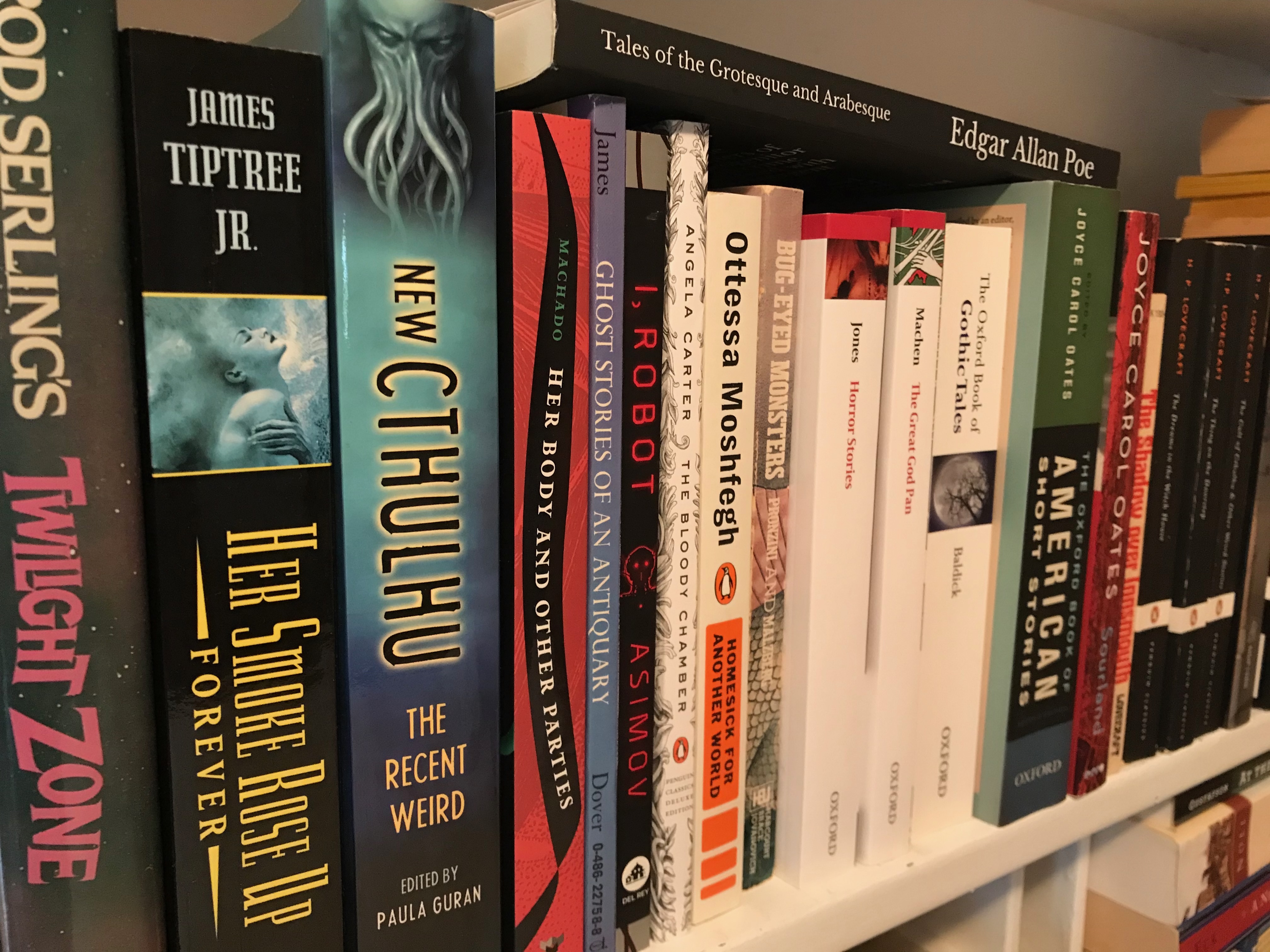
An unenviable task, it must be, to try to sum up The Twilight Zone.  Barry Keith Grant, however, has done an admirable job in this TV Milestones volume.  He addresses in a forthright way one of the questions on my mind quite a bit as of late—what are the borders of genre?  For a creative species such as our own, with imaginations that range far and high, we blend unlikely ingredients.  The Twilight Zone had finished its initial run before I ever watched television, but I was around to catch early reruns.  Their focus on the weird, the unusual, the twist ending, informed my childhood love of the strange.  They also helped shape my imagination.  This little book helps to capture some of that.

I haven’t watched every episode of the series yet.  I’ve been making my way through it slowly since I really don’t have much time for watching, and I tend to give priority to movies.  Still, The Twilight Zone was one of the most influential television programs of all time, as Grant demonstrates.  Although he tries, it may be impossible to determine just why so many people use it as a frame of reference.  Even with my penchant for analyzing, I can’t work out what it was about those disparate, discrete episodes that so captured me.  Perhaps like most influences, it was specific episodes that hit very deep.  That showed new ways of thinking about things.  That opened up worlds of possibilities.

I was exposed to Serling’s stories not only through my own reading, but also through school.  I have no hope of remembering what grade it was in, but in one of my English classes we were assigned “The Monsters Are Due on Maple Street.”  I was probably lost in the haze of puberty and adolescence at the time, but I remember well how that story made me feel.  And the teacher pointing out how people behaved when they were afraid.  Perhaps appropriately, Grant ends his book with a quote from that very episode.  Others, however, stayed with me as well.  Perhaps that’s the thing that’s so remarkable about the Zone—some episodes are not easily forgotten.  We’re accustomed to the flood of anodyne media that dowses us with entertainment of little consequence.  Some Twilight Zone episodes were that way as well.  But when we experience something significant, we tend to remember it and remember it well.  So many episodes did that kind of work on a mind too young to make lasting life decisions.  I guess I’m still waiting for Mr. Serling to step into frame and explain it.


Finding The Exorcist

This blog is the closest thing to a diary that I keep anymore.  It’s also the place where I remind myself when I read a book or saw a movie.  I started this blog (actually, my niece did, but I started putting content on) about a decade-and-a-half ago.  Most of the books I’ve read since then (but not all), have been featured here.  It didn’t start out that way with movies.  I watch a lot of films.  The other day I was wondering when I first watched The Exorcist.  I figured that it must’ve been something I’d blogged about, knowing me.  It could be that I watched it before 2009, or it could be that the search function on WordPress doesn’t allow me to find the post, if it exists.  You see, I don’t know what else to search for beyond “The Exorcist,” because I can’t recall what I might’ve written about it.  If I did.

So, in case I haven’t, I do want to say a bit more about that experience.  I was only eleven when the movie was released.  Three movies that I grew up terrified to see were Rosemary’s Baby, The Exorcist, and The Omen.  I finally saw them as an adult.  Since it was the DVD era (preceded by the VHS era, and followed by the Streaming era—all within about three decades) I bought the disc.  In all likelihood this was at FYE, which used to be a thing, just like Blockbuster before it.  Of course by the time I sat down, trembling, to watch it I’d seen many clips, stills, and parodies.  Still, I was afraid.  The movie, some thirty years old, lived up to its reputation.  I was left trembling more than when I started.

Many books have been written about The Exorcist, and although people sometimes laugh at it today, most horror fans I know still speak of it with reverence.  This movie changed horror.  It also changed demons.  Today what we believe about demons derives largely from this movie.  Its explanatory value is that it offers somewhere to turn when nothing else works.  Religion as a last resort.  And, ultimately, religion works where everything else fails.  It is possible, that somewhere in this sprawl of a blog, that I wrote first impressions of seeing it.  It would’ve been 2009, or perhaps I saw it as early as 2006.  I was struggling with my own demons then.  And, as often happens in such cases, precisely when things happened can be a little difficult to determine.


Shadow Half

Sometimes you just take a chance on a book you haven’t heard of.  You see, I keep a very active “to read” list.  The problem is that many books on it are a bit on the heavy side and it takes me a long time to get through lengthy books.  Every once in a while I go to a bookstore to browse for a book that’s short and speculative.  It seems that when I was growing up it wasn’t difficult to find fiction under 300 pages.  In any case, that’s how I found Sunny Moraine’s Your Shadow Half Remains.  It was in the “horror” section of a local bookstore.  (Even “horror” sections are now difficult to locate.)  It looked like it wouldn’t take me a month to read.  It was a good call.  It’s what I like in a scary story.

Not too gory and written with literary finesse, Your Shadow Half Remains is a pandemic story.  Well, not literally, but sort of literally.  It was published just this year and the story revolves around a pandemic in which people are infected by looking into each other’s eyes.  Nobody knows for sure how this happens, but people who are infected begin to act violently toward those around them before killing themselves.  Naturally, therefore, survivors begin to isolate themselves.  So Riley moves to a lake cabin where her grandparents got infected and died, but since there’s nobody else around the contagion can’t spread.  She lays in supplies and awaits, well, that’s just it—awaits what?  Her plan is interrupted, however, when she learns that she has a neighbor.  Maybe two.

One neighbor she starts to get to know, but they can’t look directly at one another and can’t really know each other’s motives.  Herein hangs the tale.  People are social creatures and the pandemic (in real life) caused much of its damage in the form of isolating ourselves from one another.  Other people, instead of being companions, were threats.  Especially in the early days when it wasn’t clear how the virus was spreading.  The safest thing was to stay home and avoid others.  It’s that aspect that Moraine really captures here.  A woman set to try to wait this thing out alone, but then, another person complicates things.  And how can you tell insanity from infection apart from insanity brought on by isolation?  Both seem to lead to the same results.  I took a chance on this unknown story, and it was a chance well taken.


Murphy’s Mansion

2003 was quite a year for me.  Nashotah House had experienced a fundamentalist takeover and, were I as good at reading writing on the wall as Daniel was, well, you know.  I was still working on Weathering the Psalms and teaching my classes, remaining academic dean as well.  My daughter was still pre-ten and I’d taken a very active interest in geology.  I didn’t have time for many movies.  My recent (if approaching two decades can be termed such) re-interest in horror hadn’t yet begun.  All of which is to say, I had no reason to watch The Haunted Mansion.  Oh, Disney was a big part of our lives, but I was trying hard to raise a child better adjusted than I ever was.  A haunted house movie didn’t seem like a good idea.  Especially at Nashotah.

The critics didn’t like Haunted Mansion, unlike the other Disney ride-inspired movie earlier that year, Pirates of the Caribbean.  We even missed that one in theaters, only catching up with the sequel.  In any case, Haunted Mansion, upon first viewing, isn’t as bad as I was led to expect.  The story has some depth and even seems to recycle the undead from the Black Pearl.  Disney had explored the dark side before, but this was, at the time, the closest they’d come to actual horror.  Well, comedy horror anyway.  I suspect that Eddie Murphy doesn’t tend to bring horror to mind, but he plays his part well enough.  The story is relatively compelling, although some of the elements are standard tropes.  And with Disney’s budget, it was well made.  I’d watch it again.

It seems that it falls into that twilight zone of Disney movies that have become cult classics.  We expect Disney to be either plain old classic or forgotten and locked in the vault.  Those who appreciate darker themes, however, have brought both Haunted Mansion and The Black Cauldron up to the level of having cult followings.  You tend to think well-funded studios would fail miserably when they fail and never speak of such things again.  And yet, The Haunted Mansion got a reboot last year.  Disney’s flirtation with horror speaks to the fact that kids don’t mind being a little scared.  For adults, there’s nothing terrifying here.  There is, however, a story.  A moody atmosphere—although broken up by Murphy’s renowned patter.  And plenty of ghosts and even some musing on Purgatory, Heaven, and Hell.  There’s a bit to unpack here.  So more on that the next time I watch it.  But it may take some time since I’m still catching up.


Influential Horror

Media has a tremendous effect on society.  We all know that, and every four years elections prove it time and again.  Like an infinite loop or Mobius strip.  The Brits knew this well.  During the Second World War (which we seem eager to repeat), it was against the law to produce horror films in the UK.  Such things can demoralize, don’t you know, old chap?  The first British film to claim horror’s reopening was Dead of Night, released in 1945.  Germany had surrendered in May and Dead of Night, like a breath being held, was released in September.  Although hardly scary by today’s standards, it was an enormously influential film.  It’s an anthology with a framing story that ties all the pieces together.

Walter Craig is an architect called to visit a farmhouse that requires renovation.  Upon arriving, although he’s never been before, all the people at the house are familiar to him from a recurring nightmare he has and vaguely remembers.  He feels that something bad will happen since his dream seems to be a premonition.  Meanwhile, each of the guests tell their own uncanny stories.  Since this is horror, we know that the nightmare will exact its due.  Craig ends up murdering one of the guests before waking in bed.  It was his nightmare.  He receives a call to come to a farmhouse that requires renovation.  When he arrives it reminds him that the nightmare is about to play out in real life.

The movie influenced many others.  The most famous segment—a ventriloquist that goes mad when his dummy takes over—was fuel for many haunted doll stories.  One of the tales was based on a real-life murder than had taken place in Britain in 1860.  As I learned from Wikipedia, however, the most stunning effect the movie had was on cosmology.  You may remember from science class that a debate about the origin of the universe was fought between two models: the Big Bang theory and the Steady State theory.  What they don’t teach in science class is that Fred Hoyle developed the Steady State theory based on this movie of the recurring loop of a nightmare that the dreamer is helpless to escape.  I’ve been saying for years that horror is due a lot more respect than it’s given.  These movies, as an integral part of the media, do have a very real effect on the world around them.  Dead of Night is a good example of that.  And it’s still a bloody good film, after all these years.


Facing Fear

The relationship between fathers and daughters is intangibly profound.  (I can’t speak for fathers and sons, from either side of the equation.)  That was the angle that Georges Franju took when approaching Eyes Without a Face.  I have to confess that I knew the basic idea behind this movie and it took years to build up the courage to watch it.  I’m squeamish, and the fear that the film might show too much was a very real fear.  After you watch a movie, it can’t be unseen.  Still, it is a classic of the horror genre (although that is disputed) and it gets referenced all the time.  In case you haven’t heard about it, a plastic surgeon is attempting to graft a new face onto his daughter after she’s mutilated in an automobile accident.  Things, as you might guess, don’t go as planned.

Critics didn’t care for the movie when it was first released, but, as we’ve seen from time to time, re-evaluation changes things.  It is now considered good enough to be part of the Criterion Collection and ratings on the usual websites are quite favorable.  It’s often cited for its poetic treatment of the subject, and the response of Christiane, the daughter, seems to bear that out as she moves from complicit in her father’s crimes to sympathetic to his victims.  Indeed, the surgeon himself is conflicted, but that father-daughter relationship is something he can’t ignore.  He seems compelled to help her at any cost—it’s the price of parenting, I suppose.  It’s not for the weak.  But we’re in movie-land, aren’t we?

Christiane is sympathetic to the animals her father uses for his experiments.  When she frees them, after releasing the last intended victim, she’s depicted St. Francis-like, with the doves.  Knowing her own suffering, she can’t bear to impose it on another.  Our bodies are how we present ourselves to the world.  We rely on faces to tell us much of what we need to know, even without words passing between us.  Interestingly, even when wearing her mask, Christiane’s eyes tell the viewer much of what she’s experiencing internally.  Poetic, as the critics say.  If there’s a monster here, however, he’s driven out of love in the context of an imperfect world.  Eyes Without a Face works as a horror film and the reported fainting that took place among viewers early on demonstrate that we tend to feel for others, just as Christiane comes to.  And the father?  Well, that’s the unanswered question.  He’s a victim in his own way.


Panic Inducing

Many movies appreciate in value over time.  The Devil Rides Out (also known as The Devil’s Bride) was not well received initially, but has become a highly regarded horror classic.  One of the few with a G rating, no less.  It’s also hard to see in the US, due to lack of streaming (at least where I stream) and DVDs coded to Europeans viewers.  Anyway, taken from a Dennis Wheatley novel, and screen-written by Richard Matheson, it features Christopher Lee in an heroic role during the days just before public concern about Satanism would become downright panic.  The story itself, effective if long-winded, develops among the aristocracy in England during the 1920s.  It was released, by the way, the same year as Rosemary’s Baby, which helped play into the Satanic panic.  Movies do influence the way we view “reality.”

I’ve never read any Dennis Wheatley novels, but it’s safe to say the story is pretty Manichaean in its outlook.  A coven of Satanists wants a young man and woman to complete their number but the chosen young man has a couple of older friends who quickly comprehend what is happening and attempt to put an end to it.  The Satanists, however, control real power and the movie is pretty much a tug of war between the young man’s friends and the coven.  This is done in such a way that you see very little blood, no gore, and surprisingly for the subject matter, no nudity or sex.  The Satanists here are old school—they want to worship the Devil in exchange for personal power.  It’s pretty clear that some research was done before undertaking all of this, even if the paranoia born of such things was fueled by largely imaginary scenarios. 

I’d been wanting to see this film for some time because of its clear connection between religion and horror.  There’d be no Satan, as we know him, without Christianity.  Indeed, there’s heavy Christian imagery in the film, in keeping with Wheatley’s outlook.  Crosses cause demons to disappear in an exploding puff of smoke.  Interestingly, however, there’s no crucifixes or holy water.  This is a Protestant view of the Dark Lord.  The Satanists, however, are defeated by the spirit of one of their own who refuses to allow them to sacrifice a young girl.  The ending stretches credibility a bit more than the rest of the movie, but still, overall it isn’t bad.  A Hammer production, it never had the box-office draw of its contemporary Rosemary.  Still, The Devil Rides Out was influential in its own right.  Even if finding a viewing copy requires almost selling one’s soul.


Poe’s Novel

Certain authors, some great among them, excel at short stories.  I know from personal experience that trying to publish a book of such stories is a very hard sell.  For a writer like Edgar Allan Poe, who was trying to live on his words, it often led to periods of poverty.  Thinking of him as a short-story author, I had never read his only novel, The Narrative of Arthur Gordon Pym of Nantucket.  Hailed by fellow brief-tale writer Jorge Luis Borges as Poe’s best, I figured I’d better give it a try.  I’m glad I did.  I had, however, no idea what to expect.  Those who write on Poe seldom pay it much mind.  He was famous for his poems and stories, and this gothic, sea-faring novel was, according to the introduction, suggested to him by those who felt his making a living as a writer might improve if he used long form.

Concerning the edition: the novel is in the public domain.  Penguin Classics, however, often contain nice introductions.  Indeed, the intro by Richard Kopley in this edition is excellent.  A few of his observations stood out to me—this novel was, in some measure, about Poe’s family.  Both the protagonist and the author have five-syllable names with the same cadence, ending on a three-letter surname beginning with P.  Also, as both the introduction and notes make clear, Poe was deeply steeped in the Bible.  You seldom read about Poe and religion.  Writers from America’s first generation, however, were uniquely brewed in it.  I’d never considered that about Poe before.  There are many editions of Pym available, but I recommend this one because of its introduction.

The story ends without resolution, just so you know.  Pym, talked into an adventure by a somewhat devil-may-care friend, goes out on the ocean on a boat after a night of drinking.  And herein hangs the tale.  Well, actually, the friend convinces the young man with a taste for the sea to stow away on a whaler that his father captains.  A mutiny, however, leaves Pym “buried alive” onboard.  A shipwreck leads to near starvation and a boon companion survivor.  Picked up by an explorer headed south, they discover a surprisingly temperate Antarctic circle where a native tribe turns treacherous because of their fear of the color white.  It does seem that there’s a race narrative taking place here too.  I enjoyed the story although the chapters about longitude and latitude don’t quite rise to the level of Melville’s maritime writing.  It’s a tale worth the read, however, but find one with a good introduction and it will be smoother sailing.


Wondering Wailing

You have to wonder, it seems to me, if the western, imperialistic gaze sometimes overcompensates for its past sins.  We remain reluctant to say we don’t understand something and sometimes even declare such things superior to what we produce.  That was the feeling that came over me upon reading about The Wailing.  Don’t get me wrong—I like K-horror well enough, but I’m not sure that I would say, with some critics, that it leaves American horror in the dust.  It’s good, yes, and it’s very long (two-and-a-half hours seems too long for a horror film).  The story doesn’t answer all the questions it raises and I was looking for some kind of religious message.  That’s why I watched it in the first place.  

What’s it about?  That’s hard to say.  The best that I can do is it’s about the doomed family of a Korean police officer in a small village.  As others have pointed out, this movie has ghosts, demons, zombies, exorcisms, and other horror standards.  There’s a considerable amount of Christian versus shamanism interplay.  And it seems okay, when someone else is doing it, to suggest a foreigner is the Devil.  None of this is intended to take away from the fact that the movie is effective.  I particularly found the shamanistic exorcism scene fascinating.  The thing is, you never really learn if the self-admitted Devil at the end is working with the shaman or not.  Or if the third potential villain, a woman named “No Name,” is in on it with them.  Or maybe I’m looking at this from the wrong angle.  Maybe the policeman’s family is simply doomed.  Nothing they can do changes that.

The movie suggests that such things are like fishing.  You can’t be certain who’s going to take the bait.  According to those who know, apparently a deleted scene at the end helps to clarify this a bit.  There is a lot of talk about belief, and a Christian clergyman confronting the Devil.  For me, however, I need to be able to follow a story well enough to figure out whether I’m misinterpreting or not.  The problem with a movie this long is finding the time to go back and rewatch it.  It opens with a quote from the Bible and it uses biblical tropes, such as the cock crowing three times, to make some strong points.  In fact, the opening quote from Luke 24.37-39 implies that the ghost may be God.  One thing is certain, I’ll be mulling over The Wailing for some time.  And maybe someday I’ll start to understand.  In the meanwhile, I’ll still watch and appreciate American horror, inferior though it may be.


One Host

I don’t want to seem an ungracious guest, but I don’t know if I met the right host.  I really need to start keeping track of film dates as well as titles.  I found two versions of The Host and one was free.  (This is the 2020 version.)  Despite what the critics say, I liked it.  It borrows quite a lot from Alfred Hitchcock, and, I’m told, from Hostel (which I’ve never seen).  The plot is complex and, it may be my own naiveté, but it kept me guessing.  It’s the story of how a down-on-his-luck Englishman mistakenly gets involved in a drug smuggling operation.  He travels to Amsterdam where his “hotel” claims they’ve lost the reservation but they can set him up in a stylish house with a local who has extra room.  The local turns out to be a very influential psychotic.  Herein hangs the tale.

For me, I couldn’t guess where this was going.  I thought the drug smugglers were the real scary people but then odd things start happening with the Englishman’s host.  When he doesn’t show up to work on Monday his brother goes looking for him and he too meets “the host.”  The charming murderer is generally a male role, but Vera, the host, plays it well.  It seems to me that those who criticize the movie most strongly have some viewing experiences that I lack.  This is a polished effort and it doesn’t appear to have been cheaply done.  The story has many twists and although it may imitate others, that’s how new filmmakers get started.  Most writers are willing to admit that they borrow.  Doing so with style can make a huge amount of difference.

What remains unclear to me is whether this was The Host I was supposed to watch or not.  There’s a 2013 sci-fi thriller by that title and I also found a 2006 monster film from South Korea.  With a few exceptions, movie titles tend to be short.  You can’t copyright a title.  And sometimes the most appropriate one for your work has already been taken.  Here (the 2020 version) the title maybe gives away who it is you’re intended to watch out for.  The drug dealers aren’t an idle threat, but Vera is a spider waiting in her web.  And the movie has a moral—actions have consequences.  The original apparent protagonist has little to no self control which he blames on an abusive upbringing.  There’s quite a lot of father-relationship analysis going on here as well.  If anything, The Host (2020) may be a little too ambitious, but it’s worth staying a spell.


Best King

I suspect most people have read one or two at least.  Most reading folk, that is.  I mean Stephen King novels.  He’s sure written plenty.  By my count I’ve read nine: The Shining, Carrie, ‘Salem’s Lot, Pet Sematary, It, The Stand, The Tommyknockers, Revival, and Cujo.  I probably have one or two more in me.  The dilemma is that I like King’s writing—I’m not one of those nay-sayers who call it clap-trap.  There’s real literary merit to much of it (sometimes just too much of it), and he integrates religion into horror really well.  The thing is, not all of his books are made equal.  I suspect that’s true of any writer.  I’ve consulted some lists to see which are the best and I’ve watched some movies before reading the books, but I’m starting a ranking of my own here—it will probably be revisited from time to time, as events warrant.

What’s his best?  Well, such lists are supposed to start with the worst and work their way forward.  I’ll cave to convention this time.  So, The Tommyknockers and Cujo are tied for least favorite.  Each has a reason: The Tommyknockers is too long and lacks sympathetic characters and Cujo is just too nihilistic.  The premise is good but the bleakness got to me.  The Stand comes next primarily because of the length.  I like the way that one ended up, though.  Revival, my most recent read, comes here, about in the middle.  It was enjoyable to read, even with its length.  I think King has a little trouble writing convincing kids, but the story was good.  Next I would put ‘Salem’s Lot.  Who doesn’t like a good vampire story?

Not that kind of book.

My top three are, perhaps predictably, generally among the top ranked.  My order is perhaps a bit different than most, however.  I really, really enjoyed The Shining.  The movie, I believe, is better.  That may be heresy, I know.  Carrie has all the freshness of a novelist breaking through, and it’s effective.  Better than the movie.  That leaves Pet Sematary as my current favorite.  The story there caught me up and it’s the only one of my top three that I read before seeing the movie (both of them).  The book is way, way better than the movies.  Compared with Revival, which also deals with what happens after death, Pet Sematary offers a commentary on grief that doesn’t involve everyone dying by suicide.  It’s on a much more human level.  As I read more, I’m sure I’ll form other opinions, but for the time being, these three of the King’s early novels, are, in my standing, the most deserving of the crown.


Haunted Life

It’s funny what a difference that a few years can make.  I can’t seem to recall from where I sourced my movies in the noughties.  Streaming was extremely tenuous in our Somerville apartment—the plan didn’t include the required speed for it.  Like in the old days when it took twenty minutes to upload a photograph through dial-up.  In any case, I know I’ve watched The Haunting before.  I know it was in Somerville, but having watched it again I have to wonder if my mind is playing tricks on me.  I read Shirley Jackson’s The Haunting of Hill House there, and I saw the movie.  But how?  It’s all about mind games, but the mind games are played on a woman who has an abusive family, one that damages her psychologically.  Escape is important to her, even if it is to a haunted house.

I think the last time I watched this I was looking for something that might scare me.  That phase was one of thinking not much frightened me—but this movie is scary.  Even with its “G” rating, its lack of blood and gore, and black-and-white filming.  It scares.  One thing I’ve noticed when reading about these older movies after I watch them is that many improve with time.  Shirley Jackson was known during her life but you become a classic writer only AD—after death.  The Haunting has aged well.  I suspect it has something to do with Robert Wise, the director.  What must the psychology of a man be who directed The Sound of Music, The Day the Earth Stood Still, and The Haunting?  The latter is all about psychology.

Movies that make you think are those, I believe, that may become classics.  And perhaps there’s a bit of Eleanor inside all of us.  Wanting to be noticed but eschewing publicity.  Needing someone to love us, but pushing away those who try.  Children in bad environments learn unorthodox, and often unhealthy, coping techniques.  Eleanor has difficulty accepting that John is married when she thinks she’s finally found a place that accepts her for who she is.  Even if it’s a haunted house.  Especially if it’s a haunted house.  As a child I’d no doubt have found the movie boring.  There is, however, much for adults to absorb.  And, I expect, I’ll need to go back and read the novel again.  One of the reasons for watching horror is that the viewer is seeking something.  It’s not just thrills.  I didn’t write about the movie the last time I saw it so I don’t recollect when it was.  Or even how.  My thoughts now, however, are that I should’ve paid closer attention the first time.


Colorless Sunday

Growing up, my Saturday afternoon horror movies were catch as catch can.  I never really had a plan and I’m sure that there are several films I saw that I have forgotten.  I’m sure one of them wasn’t Black Sunday.  I knew nothing of directors and their reputations then and I was unaware that Mario Bava made quite a splash with this moody movie.  I can now understand why (thanks to Amazon Prime).  This is an unusual vampire and/or witch story, and one which had quite an impact on future films, including one of my favorites, Tim Burton’s Sleepy Hollow.  Indeed, Black Sunday is about as gothic as they come.  A witch is murdered as the film opens, along with her lover.  Two centuries later a couple of doctors stop for the night in the Moldovan town where this happened.  They find the corpse of the witch and accidentally reanimate it.

The monster the witch raises (her lover, initially) attacks people like a vampire does and the victims become vampires themselves.  The best (but not only) way to kill them is by driving a sharp spike through their left eye.  This is quite violent for a 1960 film, but it certainly cemented Bava’s reputation.  In any case, the younger doctor falls in love with the local princess, but the witch has designs on her too.  The older doctor and the princess’ father both get transformed into vampires and get killed off.  By the end, only the young doctor and the princess remain, along with an Orthodox priest who helps with deciphering how to take care of occult monsters.  The plot is more complex than that, and the film is now understood as a landmark.

At the time and place where and when I went to college, courses in horror films were not on offer.  (I was rather preoccupied with religion, in any case, and might not have taken one anyway.)  By the time I was in college, however, I viewed monster movies with nostalgia, but I was trying hard to be respectable.  You always have to be proving yourself when you grew up poor.  Learning how these early horror films fit together is a form of self-education.  And it’s fun.  And horror movies offer an escape from a world where you know you’re having trouble fitting in.  Many of the movies I watch are still catch and catch can, but I think it pays to be more intentional about them.  And I’m glad I caught Black Sunday at last.


More Omens

Brushing up on my eschatology, I watched The Omen again.  The original, that is.  One of the underrated aspects of cinema is that people learn their theology from it.  Movies tend to be more memorable than sermons.  It is opined among some that The Omen is responsible for the prevalence of dispensationalism among many Americans.  I’d put a bit of a finer point on it in that The Late Great Planet Earth was being raptured off the shelves all the way through the seventies (I personally bought two copies) and it caused a feedback loop with The Omen.  Many mainstream ministers, without benefit of a Fundamentalist upbringing, were caught unawares, I expect.  Scholars of religion have noted how several aspects of the narrative—the character of “the Antichrist,” the rapture, indeed, the Apocalypse—have been read back into the Bible by credulous believers.

What I found interesting in this viewing is the debt owed to The Exorcist.  Of the two there’s no doubt as to which is the superior film.  The name Damien in The Omen, I read somewhere once upon a time, was taken from Fr. Damien Karras.  During the late seventies and early eighties, unruly boys were routinely called “Damien” by frustrated camp counselors and others.  Apart from this nod, if true, is the fact that the abruptly introduced character Karl/Carl Bugenhagen is an archaeologist exorcist.  (He’s the guy who gives Robert Thorn the knives, if you haven’t seen it for a while.)  The scene shot in Jerusalem (said to be Megiddo) underscores that Fr. Merrin is also being channeled here.  I suspect that the film was getting a bit long in the tooth and some explanatory material on Bugenhagen was left out.

It has also been suggested that the number 666 entered popular culture because of The Omen.  I would temper that a bit with the fact that a lot of people were reading Hal Lindsey’s new apocalypse as well and the two of them got the job done.  There’s no doubt that after the film the evil number took off in a direction that would’ve left John of Patmos scratching his head.  This brings me back to the point that belief is influenced—sometimes constructed—by movies.  The Omen was a huge success at the time, despite the fact that many critics (also not raised Fundie) thought the premise was silly.  Most people aren’t film critics.  The Bible can be pretty impenetrable as well.  Preachers may not be inspiring.  Movies, however, wrap it up neatly and tell you what to believe.  Perhaps it’s some kind of sign.


Lying Beneath

If you wait long enough you can find successful films for free on Amazon Prime.  What Lies Beneath had big-name star power and still retains a “horror” classification, although “thriller” is used about as often.  I actually enjoyed it and found some parts as scary as I am comfortable getting.  Although I guessed who the killer was well before the climax, I wasn’t sure how this would end.  This made the last fifteen minutes or so very tense.  There may be some spoilers as I ponder this a bit, so be warned.  Of course, the movie is nearly a quarter-century old, so you may already have an idea of what happens.  I’m a purveyor of older culture, it seems.

Claire Spencer, and her new husband Norman, live in an isolated spot in Vermont.  Norman is a genetic engineer and Claire used to be a musician, but the death of her first husband and adjusting to being an empty nester lead to her neglect of playing.  She starts seeing a ghost in the house Norman inherited from his father.  She comes to believe the ghost is of a missing young woman from the area, and she begins to find clues that link her husband to this unsolved case.  At first you think it’s going to be like Rear Window, but it turns into something very different.  The sense of unease is quite effective—you know something’s wrong but you’re not sure exactly what it is.

This is another of those movies where the genre feels up for grabs.  There’s an actual ghost and there are stingers.  Yet it’s directed by Robert Zemeckis, not really known as a horror director.  It’s stylish and has Michelle Pfeiffer and Harrison Ford in the leads.  It’s not really gritty at all.  There is blood and fear, though.  The more movies I watch the more I realize that genre is a tenuous thing.  Stories are forms of expression and sometimes they come in the varieties that explore some of the darker parts of life.  Norman’s tragic flaw is that he values his career above all else.  He tries hard to outshine his father’s accomplishments—he lives in his childhood home but refurbishes it.  He can’t get out from under that shadow and that drives him to extremes.  The movie received mixed reviews, but I found it gripping.  It’s well acted, as you’d expect, and hey, there’s a ghost.  It’s close enough to horror to work for me.