Spiraling

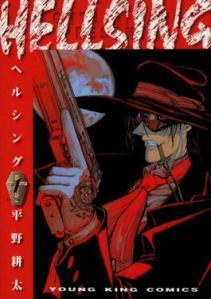
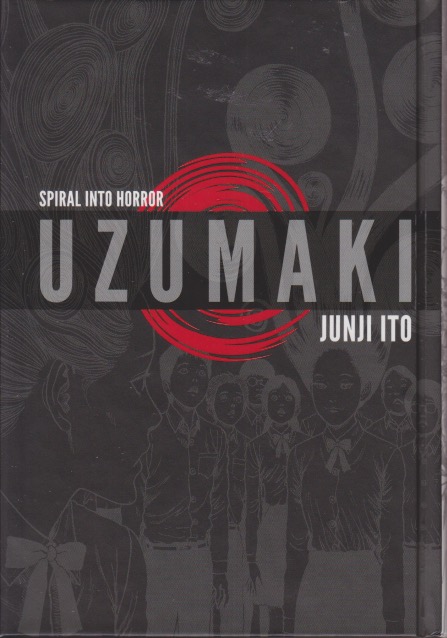
I’m not the world’s biggest manga fan, so when I post about it it’s a safe bet a friend lent me a book.  This happened a few years back with Kouta Hirano’s Hellsing series I blogged my way through.  (I don’t own the books so please don’t come knocking at my door.)  Another friend recently let me Junji Ito’s Uzumaki.  I lack the finer points of manga (or anime, for that matter) interpretation, but I see the appeal.  Both of these series are horror, and my friends know that I read and watch horror.  Uzumaki is fascinating in the sheer number of ways it involves both body horror and folk horror.  There will likely be spoilers here, so be warned.  It’s all about spirals.  At first I had difficulty seeing how they could be made scary, but there are some seriously disturbing images in this work, if you read through the entire collection.

The story follows Kirie Goshima and her boyfriend Shuichi Saito and their life in Kurouzu-Cho, a town infested with spirals.  The spirals become the vehicle of horror as some people go insane because of them, but others twist into spirals, or have spirals cut into their bodies, or become jack-in-the-boxes, or grow into snails with spirals on their backs, or turn into vampires because of umbilical cords.  The town is plagued with hurricanes and tornadoes.  The ancient lighthouse’s beam becomes an incinerating spiral.  There’s no way out of the town because all exits spiral back into it.  People who stay in the old houses in town twist into each other’s spiral bodies.  That kind of thing.  Kirie (and her family) and Shuichi try to escape but end up surviving until it becomes clear that an ancient spiral culture still has a grip on the town and it will never let go.

As a kid, much to my mother’s chagrin, I used to read American horror comics.  Some of them contained images frightening to a child.  I really wasn’t expecting that this could be replicated on an adult level, but I’m willing to admit I was wrong.  Uzumaki  is compelling as horror.  Creative and bizarre, the comic shows what can be done with a concept that is pressed for more and more ways of developing fear from something otherwise quite benign.  Junji Ito has an eye for horror and my limited exposure to manga makes me think I’d be open to borrowing more of it.  If I can fit it into my spiraling schedule.

Strange Ending

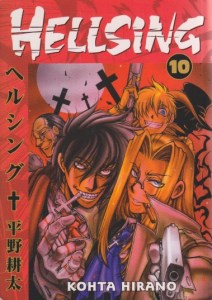
Perhaps it’s from growing up as a biblical literalist, but I’ll probably always have problems with post-modernism.  You see, when you’re taught as a kid that there is one absolute right and you already know it (it’s Genesis to Revelation, no Apocrypha, please), you kind of get the idea that things are just what they seem.  Po-mo teaches, among other things, that there’s no true objectivity—reality is subjective and there is no neutral ground upon which to stand.  I’m down with that, but the old ways of looking at things remain.  This is a long-winded way of saying I finished Kohta Hirano’s ten-volume manga, Hellsing.  Over the past year I’ve been reading for a friend of mine, but manga has never really been my thing.  I read The Watchmen as a graphic novel, but looking at pictures somehow feels like cheating.  It’s that literalist thing again.

I might be dropping some spoilers here, so if you’re even slower than me be warned.  There’s quite a bit of shape-shifting here and it’s not always easy to tell who’s who.  In a kind of homage to my childhood monsters there’s vampires, werewolves, and even a Frankenstein’s monster in the series.  All of them are engaged in a constant state of combat against which the Protestant Hellsing organization stands for a stable civilization.  The Catholics are associated with Nazis along the way.  It’s a fascinating look at how an eastern culture might view the religious wars of those in the west who all go by the name “Christian.”  I think this is the genius of the series.  The friend who lent me the volumes has no declared faith, but he finds the dynamic fascinating.  Real religious fighting has made it easy for him.

The story, however, falls clearly into the generation of those without absolutes.  For someone my age a plot clearly laid out is a thing of beauty.  In college we used to argue about how absolutes might exist.  Where did they come from, and which is the strongest?  Did God make them or does God have to conform to them?  Even without the answers, the fact that absolutes existed was assumed.  Argument-driven science tells us that a theory is never proven.  Science is the best explanation we have at the moment, based on the evidence amassed.  In its own way, it has become post-modern.  Hellsing is a kind of mind-blowing work.  It will likely be a long time before I attempt another manga series.  Although I accept the po-mo premise, I still find old-fashioned fiction my favorite.


Church Vampires

For people my age manga is a new form of reading that is easily ignored. Although I’ve read a graphic novel or two, “comic books,” no matter how adult the theme, seem juvenile. Note that word “seem.” I do know some younger folks, and one of them insisted that I read Kouta Hirano’s Hellsing. This particular friend is as interested in vampires as I am, and, knowing my history with religion, suggested this might down my alley. Dubious, I gave it a try. In this manga universe Hellsing is a Protestant organization for fighting vampires and ghouls (non-virgin vampire victims who come back as zombie-like creatures who are very hard to stop). Their activity is in England, but when they cross into Ireland they encounter a Catholic organization that kills all vampires, including the “secret weapon” of Hellsing, who is indeed a vampire.

What made reading this tale so interesting is that the reader’s sympathy is drawn to the Protestant sect. The Hellsing characters are engagingly drawn—handsome or beautiful, resilient, and naturally good fighters. The Catholic characters are ugly and maniacal. They kill all monsters, regardless of their “heart.” In this the direction from the movie Van Helsing is reversed. There Van Helsing is a hireling of the Catholic Church who won’t kill a monster unless it’s evil. The idea of the graphic novel is that religious rivalry runs deep between these two Christian organizations. Thinking about this, I wondered how Christianity might look to someone from Japan. In this context, it makes sense. Christian missionaries penetrated east Asia from both Protestant and Catholic evangelistic efforts. Although they worship the same deity, they are quite different religions. At least it must look so to anyone not raised in this strange milieu.

Colonialism, in all its forms, has forced peoples to make decisions about new religions in a somewhat violent way. Imagine someone confronting you with your way of life and warning you that you’re going to suffer never-ending torment unless you accept a faith of which you’ve likely never heard. Then you discover that there are two very different versions of that faith that mutually condemn each other. The natural result, if you acquiesce at all, would be to choose the one that either makes the most sense, or the one that got to you first. Hardly the way to gamble with eternal life. I’m not sure Hellsing is intended as commentary on the experience of the colonized. It seems reasonable to me. And if vampires are a problem, you’ll want to be sure to select the right belief system the first time around.