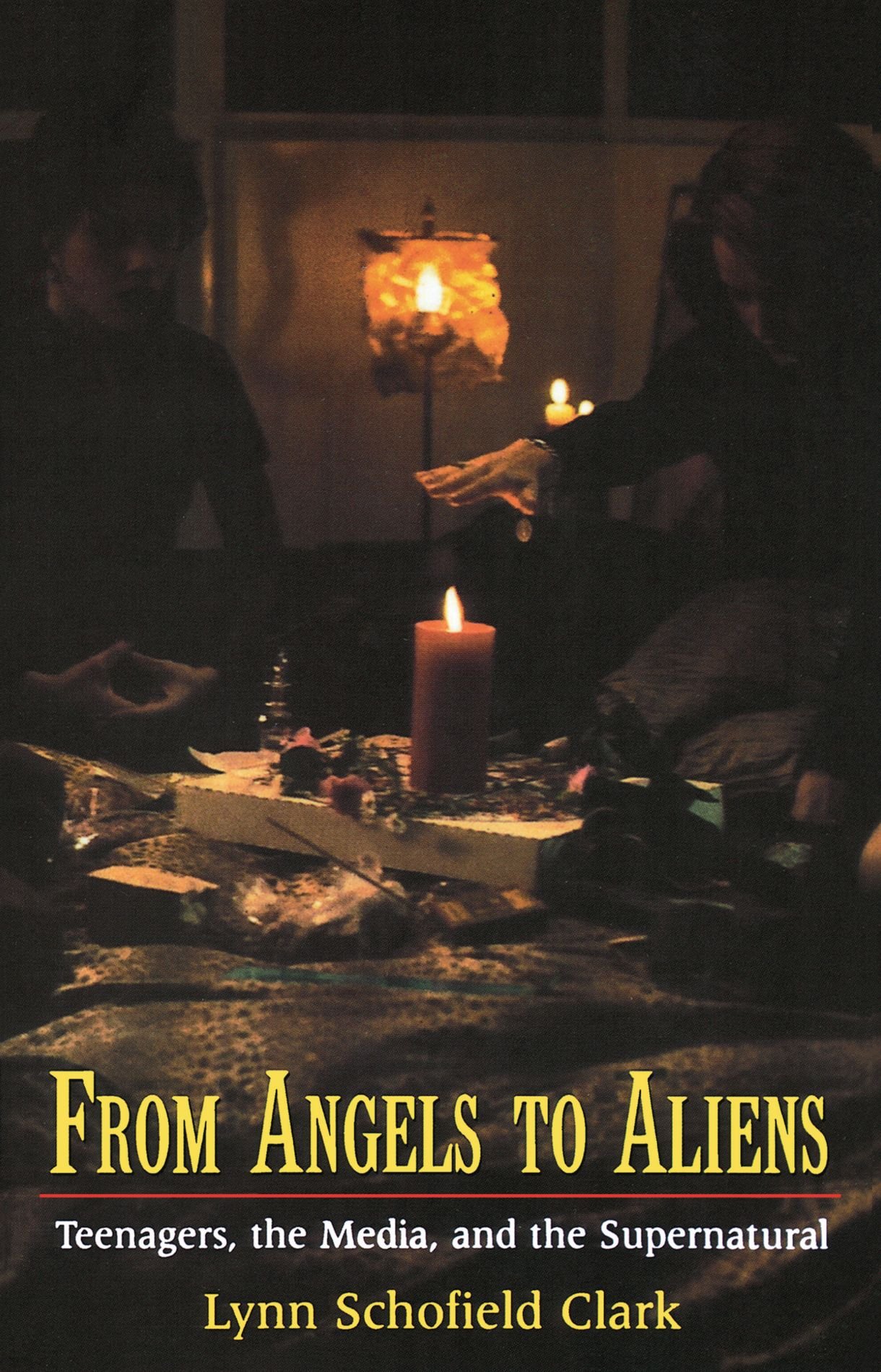
 Religious tolerance suggests that it’s less important what you believe than it is that you believe. After all, where you are born—socioeconomically as well as geographically—determines which options are open to you. And now that the world is virtually inter-connected, the media must play into the idea of what we believe as concepts mix and brew and distill. Lynn Schofield Clark’s From Angels to Aliens: Teenagers, the Media, and the Supernatural, is a study that takes all of this seriously. We know teens as the ultimate disenfranchised demographic. For those of us who were once there, no doubt concerning that status exists. But what of teens in an age where God seems to be effacing and angels and aliens invading? At least according to the media. Clark interviews several teens and their families about their belief in the supernatural, and, in keeping with what the statistics of national surveys continually show, belief in some world beyond ours is indeed deeply rooted. Many youth, however, have trouble distinguishing angels from aliens.
Not literally, of course. Rather, supernatural entities are so much a part of our media experience, and church attendance so little, that clear ideas of how these things all fit together, if they do, are lacking. Scientists are looking for life in space while denying that if it exists it ever could have intentionally travelled here. We are, after all, the most intelligent species in an infinite universe. (Did I say that belief in God was effacing?) Socially, however, angels are much more acceptable than aliens. Belief in aliens is easily equated with mental instability, while belief in angels is normal, if not a little naive. To the average person, it seems that we’re not alone. As many popular media portray, however, God remains silent and we have to wonder if there’s anyone really driving a universe with no real up or down and with an exploding singularity at its center. It’s all a little disorienting—rather like being a teenager.
Clark remains wonderfully open-minded as she asks her questions to the younger generation. I felt a bit of recognition when she mentioned her church experiences in theologically conservative western Pennsylvania, the area in which I grew up, and where neither aliens nor angels were particularly uncommon. And we were in a media black hole in those days. Stations from Pittsburgh or Erie didn’t boost their signal to reach those of us in the boondocks with much reception beyond the big three. Of course, there was nothing beyond ABC, CBS, and NBC. Well, there was PBS in the background, but this was a universe still awaiting its big bang. Angels were good, aliens were evil, and God never remained silent for very long. And nobody really cared what teenagers thought. We have evolved since then, but we still look to the sky and wonder who, if anyone, is out there.