
Podcast 19 concerns the dilemma of Moses as the bringer of Torah and how the historical record suggests Israel received the “law” from Ezra several centuries later.
Moses and the Calf
It seems that Moses just can’t get away from that calf. Last week in a manger in rural Connecticut a calf was born. The calf is brown rather than golden, but it bears a distinctly cross-shaped white marking on its forehead. The owner suspects it might be a divine message, but he’s not sure what the message is. The children of the area named the calf Moses.
Does this all fall into the category of coincidence? Or is it indeed a long-awaited sign from on high? It does fall a bit on the C.E. side of the long-expected red heifer, but it looks like it just gamboled out of a bovine White Ash Wednesday service. And it was born in December! In a manger! (Or at least the present-day equivalent of one.) He bears the name of the arch-nemesis of venerated calves — Moses, the solemn monotheist. Even the chair of the Dairy Sciences Department at the University of Wisconsin-Madison declares the Catholic birthmark to be unique.
All in all, I think the farmer got it right. If divine messages come in the form of calves, we’ve got a serious mixed-signal problem down here. The greatest crime, according the book of Kings, that the Northern Kingdom of Israel perpetrated was the erecting of a set of golden calves. And the sign we get is a denominationally confused calf? Perhaps the appropriate question at this juncture would be, “how now, brown cow?”

Photo credit: Aaron Flaum, Associated Press
Billion Dollar Babies
Yesterday I attended a holiday-themed concert. It was an unusual mix of the archaic and post-modern in that although many traditional holiday pieces were sung, the readings were from an assortment of writers, some still living. The theme, not surprisingly, was the wonder of birth. One of the readings was from D. H. Lawrence, a writer more often associated on the making of babies end of the equation. Nevertheless, as the soporific music flowed I found myself once again thinking of special babies.
The concept of a special child marked at birth has an ancient pedigree. Long before Samuel, Samson, and Moses there were ancient heroes known from their unusual births. The theme is at least as old as Sargon of Akkad, and probably even older. Those who grow to achieve great things in life must, by back-formation, have had a wonderful birth. Of course, when they were born nobody knew they were special yet, and so our mythopoeia demands we devise incredible births for them. Anyone who is a parent knows that time stops and the entire world stands in rapt silence as your own child is born. All babies are billion-dollar babies.
The subtext to all of this is that without even looking for a special child we should realize that all people have inherent value. If religions truly taught that message there would be a lot less religious violence in the world and the dreams of many more infant dreamers might be attained. Perhaps all religions should take the stories of their own origins more to heart and hear them more often than once a year.
Let Us Make Moses in Our Own Image
This week’s Time magazine contains an article entitled “How Moses Shaped America” by Bruce Feiler (actually it is an abstract from his book, America’s Prophet: Moses and the American Story). Feiler points out how Moses has been manipulated and utilized by various factions of American society from the earliest pilgrims up through President Obama’s campaign. There’s some interesting stuff here, from the proposal of the Great Seal that depicts the parting of the Red Sea to the Mosaic elements in the Statue of Liberty. No doubt about it, America loves Moses.
As intriguing as I found Feiler’s thesis, I couldn’t help but be a little bit disturbed by it. Serious biblical scholars are early taught to avoid prooftexting like a plague of frogs. Prooftexting is part of a Fundamentalist’s daily spiritual calisthenics, right after chapter-and-verse-presses. Prooftexting is pulling random Bible verses out of context to support a confessional position on any issue. You can always tell it’s coming when someone opens with “the Bible says…” Then you get a chapter-and-verse punctuation mark. What Feiler is describing in his article is just that, a use of Moses that fits the crisis of the moment. While there is nothing wrong about looking to a great leader in time of need, whether that leader be mythical or historical, I wonder how different this is than marching into battle with “Gott und Ich” inscribed on your belt-buckle.
One statement Feiler makes, however, I must take exception to: “With the rise of secularism and the declining influence of the Bible in the 20th century, Moses might have melted away as a role model.” No doubt secularism was in the ascendant during the twentieth century, but the influence of the Bible was never stronger. The twentieth century saw the Bible co-opted as part of a powerful political agenda that drove this nation to the brink of destruction. Never before had the Bible been used to deceive many thousands of untrained religious believers in the ways of war and greed and inhumanity. Bible-thumping had become more effective than rational thinking or coherent speech in the political debates we all so painfully watched. No, the Bible’s influence has not been shrinking. What is needed is a Moses to wrestle it back to its proper place. Even the Bible can be a golden calf.
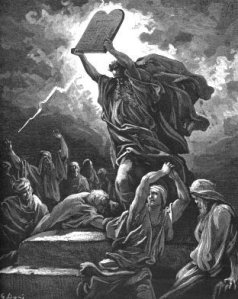
Moses gets down
Animal Alarm
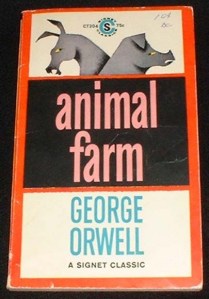
Where was Moses when the lights went out?
After undergoing a bout of oral surgery earlier this week, even before the nitrous oxide wore completely off, I pulled George Orwell’s Animal Farm off the shelf for a re-read. I hadn’t read it since at least 1984. It was even more disturbing reading it this time just off the Bush-Cheney years, and I realized that the Napoleons and Squealers are still with us. As a prophet Orwell may not have always got the dates right, but he was clever at spotting trends.
In this reading of Animal Farm a minor character leaped out at me. Among the tame, but non-domesticated animals was the raven Moses. Moses is the special favorite of farmer Jones and tells the animals of Sugarcandy Mountain vaguely up in the sky, where conformist animals go when they die. When the rebellion takes place, Moses flies off and remains absent until near the end of the story when the situation has deteriorated. Once again he is back to tell the others about Sugarcandy Mountain. The connection between Moses and Mount Sinai is transparent, although the heavenly connection is slightly misplaced.
The Hebrew Bible (certainly in the period of Moses) does not recognize what will become the Christian concept of Heaven. Like many ancient West Asians, they supposed that Yahweh lived “up there” at times (at other times he lived in the temple, or on the world at large, or atop some mountain). The “heaven” they knew of had no place for dead humans; the afterlife was a concept that developed very slowly. Moses’ motivation for the ancient Israelites, however, also resonates in Animal Farm, even as it does in the startlingly similar film Chicken Run — freedom. Freedom is the pipe-dream of many religions, but even as early as Moses those dreams run into regulations. Religions have laws long before they have heavens. Perhaps Orwell was onto something after all.
Whence Monotheism
Here are some preliminary thoughts on the origins of monotheism, recorded on a very hot and humid day!
Stay tuned for more developments, including further posts on various gods in the non-monotheistic world.
 Steve A. Wiggins