O Pomona!

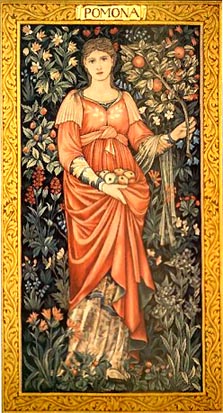
Ancient goddesses have long been a fascination with me. After writing my Edinburgh dissertation on Asherah, and taking employment at an Anglo-Catholic seminary that venerated the BVM – Blessed Virgin Mary, and not some underwear brand, as I had supposed – I realized that male-dominated religions still recognize the need for the sacred feminine. In my recent post on Halloween, I mentioned the Roman goddess Pomona. Roman religion is generally not treated with the finesse of classical Greek mythology, but it represents an important part of our western heritage. Pomona is an etiological goddess. Etiologies are stories of origins, and like other goddesses of the ancient world Pomona was used to explain the mysterious ways of nature.

The story that best describes Pomona is preserved by Ovid in his Metamorphoses. Pomona is one of the virgin goddesses, specifically the goddess of fruit. She has no known Greek antecedents. The myth involves her devoted chastity and her commitment to ripening fruit, particularly apples (and sometimes pears). Shunning all lovers, she was eventually wooed by Vertumnus, the god of changing seasons. Disguising himself as an old woman, Vertumnus visits Pomona and tells her of the wonders of love and of the attributes of Vertumnus especially. Eventually Vertumnus reveals himself, and Pomona, delighted at what she sees, loves him. Of course, apples ripen and seasons change. Winter is soon to come once the apples fall from the tree. The goddess has been subdued by masculine designs.

So it often is with goddesses. Men recognize the need for the divine feminine, but fear it and attempt to tame it. Pomona, however, survives. One of the memorable objets d’art at Nashotah House, where I sat in that chapel for over a dozen long years, was a frieze of the BVM. More technically, a Madonna and Child. The frieze hung over an altar in a side chapel behind the choir, so most people didn’t spend much time looking at it. Mary, holding Jesus, was surrounded by a frame of fruit rendered in plaster. Apples were prominent among them. There are those who suggest that apples show how Mary overcame the heinous sin of Eve. I believe, however, that the fruits surrounding the virgin demonstrate that Pomona, the virgin goddess who eventually succumbs to the advances of the male deity, still has a place in the patriarchal world of Christendom.


O Hades

Over the past week I have been grading essay exams for my mythology course. Most of my classes are large enough that assigning written work isn’t really feasible; adjuncts tend to teach many more classes than their full-time colleagues and getting grades in on time is impossible with too much paperwork. I tend to use “objective” tests, although I am aware, pedagogically, they do not reveal what a student actually knows. When I read essays, however, I am always brought to new levels of awareness. I also get the distinct feeling that I’m becoming a curmudgeon, complaining that back in my day you had to write better even to get into college. Regardless, it is a learning experience.

Last night I was reading an essay about Hades. This subject has particular interest for me since I recall attending revival services as a child where the guest evangelist shied away from using the word “Hell” in his sermons. He always called Satan’s realm “Hades,” rather like Paul, but when I studied mythology in school I learned that the places were quite different. Disney’s Hercules once again conflated the person of Hades with a Devil-like anti-god with fiery hair and the most Gothic chariot I’ve ever seen illustrated. This particular essay revealed an interesting religious training for the student; s/he wrote that unlike in Christianity, Hades was not God’s evil brother. The implication struck me – for her/his Christianity, the Devil is God’s diabolical brother. I don’t doubt for a minute that there are churches that teach such theologies, but the more I pondered the essay the more the idea expanded.

The dualism inherent in the view of God versus Satan clearly derives from Zoroastrianism. Judaism never recognized a “devil” character until meeting him in the Persian context of the Exilic and Post-exilic periods. I tarried long among the “orthodox” Episcopalians of Nashotah House where theological correctness was tantamount to being considered an actual human being. In such a school there was no time for those who thought dead Christians became angels or that you got to Heaven by being good. Yet the Devil was very real for these black-garbed acolytes of righteousness. The idea that he could be God’s brother, well, say a dozen Hail Marys and even more Our Fathers and we might let you back in the door. To me, nevertheless, it seems an almost biblical explanation for the origin of evil. Yes, Manichean in aspect, the idea does not fit nicely with a neat monotheism, but what is evil if not the antithetical DNA of God? Non-theology students have nothing to lose by expressing what they were taught in a secular mythology class, and for a brief moment in a student paper I had a glimpse of the true pluralism of Christianity.


Black Monks and Grim Reapers

Last night I assisted my daughter with a stint of volunteering at the local community “haunted house” for charity. This is one of the high points of October, so I was glad to be asked. I reprised my role that I developed for Nashotah House: in that context the character was called “the Black Monk,” based on a local ghost story. While I was on the faculty of Nashotah there were plenty of students who swore the Black Monk story was true, the actual event involved an early student who drowned while trying to walk across water (something many students think they are capable of) – this was actually during the winter, however, and Upper Nashotah Lake is not always as thickly frozen as people assume. The poor student broke through and is buried in the cemetery on campus. Halloween was a major event at that Gothic location until a new, evangelical administration came along. During a haunted hayride, the kids of the community lumbered along on a hay-wagon while costumed students jumped out to scare them. I played along in a costume my wife made where my face was invisible and the flowing black robes eerily blended into the night.

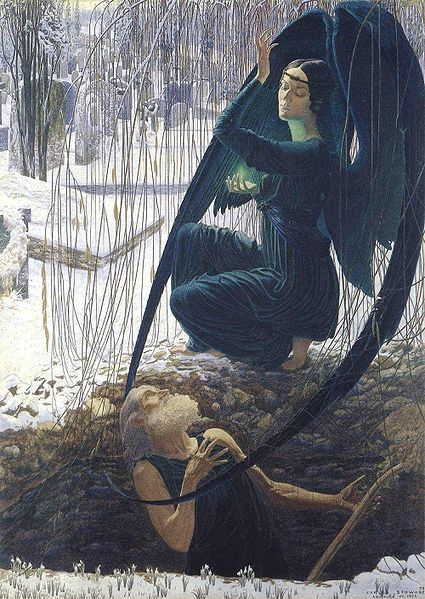
In my current secular context, of course, I was simply The Grim Reaper. This character has a very ancient pedigree. Religions from the earliest times have personified Death as a character that all people inevitably meet. The Mesopotamians had Ereshkigal, the Queen of the Underworld, the Ugaritians had Mot, the god whose name is “Death,” and the Hebrew Bible has “the Angel of Death.” We are often not given a physical description of this baleful but sometimes beneficent supernatural entity. When Revelation was finally penned, Death is one of the four horsemen, and he rides a pale horse, but we do not find many physical details. In the fifteenth century Death was pictured as a skeleton, often with a scythe. His role is that of the classical psychopomp, or guide to the next world. He is not evil, but when the doorbell rings you’d rather hope it had been Avon calling rather than the G.R.

Carlos Schwabe, Death of the Undertaker

Appealing to the fear of the unknown, I lurked last night in the shadows, face completely obscured, not speaking, stepping out to reminded holiday revelers that what is really scary is that which we can not define. When playing the silent ghoul, sudden movements are not necessary to frighten, shouts and screams are unimportant. The simple reminder of mortality and the unspoken question “is he here for me?” are sufficiently frightening on their own. Whether the Black Monk or the Grim Reaper, this character has a natural place on the chilly nights of October. And sometimes it seems there is just not enough October to keep all of us in line.


Gas Station Sukkot

One of the largest culture shocks that attended moving to New Jersey was the fact that you don’t pump your own gas here. By the time I was driving regularly, pumping your own gas was a fact of life. I’ve lived in at least half a dozen states and in all of them you pumped your own fuel. Until New Jersey. Now when I visit other states I sometimes sit dumbly waiting for the attendant to come to the window and ask what I want. You get used to being waited on.

Yesterday morning I stopped for gas – I do a lot of driving between my various classes, so this is a sleepy ritual. The attendant came and began the usual refueling when another customer stepped up to the driver’s side window. “Are you Jewish?” he asked. Actually, it is a question I am asked not infrequently. The stranger then wished me happy Sukkot, which was nice; I’ve always enjoyed the Sukkot festivities I’ve attended. He then proceeded to tell me that the country was in a mess, but as long as we held up the name of Jesus everything would be alright in the end. “We just need to hold up the name of Jesus,” he repeated.

I drove away full of gas. I wondered how we’d gotten from Sukkot to Jesus so quickly – the transition usually takes longer than that. Back at Nashotah House, a local Jewish doctor frequently invited me to bring my Hebrew Bible students to Sukkot at his house. A kind of thanksgiving celebrated outdoors, we’d sit in his stylishly decorated booth, eat snacks, and shake the luvav. By the time we returned to seminary for evening prayer, it was back to Jesus. I’ve never been proselytized at the gas pump before. I may have to rethink what the largest culture shocks have been, moving to New Jersey.


Roman Women

This week’s Life section of Time magazine features an issue that yet again raises the questions of definitions and who decides on correct religion. The feature by Tim Padgett entitled “Robes for Women” demonstrates the conflicted nature of religious authority. With the Vatican claiming women have never been priests, but historians questioning the assertion, the salient point is who has the right to decide. And what is lost, if such a change were to take place. Tradition is not threatened by change – it always stands sentinel over the past, but no religion remains unchanged for any length of time. It is not biblical authority that is lost either. Any religious body whose scriptures state, “call no man on earth your father,” yet which addresses its clergy by the title “Father” clearly possesses the casuistry to get around other biblical injunctions. What is lost is male power.

No matter how vociferous theologians may be concerning the genderlessness of God, the default male image seems deeply embedded in the human psyche. One of the most ancient and pervasive of mythological themes is the search for the father. The loving mother is the one who stays near and raises the child while the father leaves to make provision, or for reasons less wholesome. At some level we know that the deity portrayed by Scripture and tradition is male, a father who is difficult to find at times, particularly times of need. This archetypal image is not an excuse not to re-envision a genderless deity, but it underscores what generations of human experience has taught us. Referring to God as father and mother only complicates the matter by throwing into the mix all aspects of gender complications. Can humans even truly worship a god without gender?

If the Womenpriests movement succeeds, as no doubt it should, there will always remain a group who will not accept their authority. My experience at Nashotah House taught me that some prejudices are so deeply rooted that they are no longer even recognized by those who hold them. Wild examples of theological gymnastics were paraded before me as to why women should not hold priestly office. And like Nashotah House reveals, if women are finally accepted by Rome, others will split away and both sides will lay claim to the true faith. There will be no convincing either that the other is correct. The history of Christianity has taught us this sad truth. Current estimates suggest there are some 38,000 different Christian denominations. This is the common fate of all religions who claim to have exclusive access to the single, unambiguous truth.

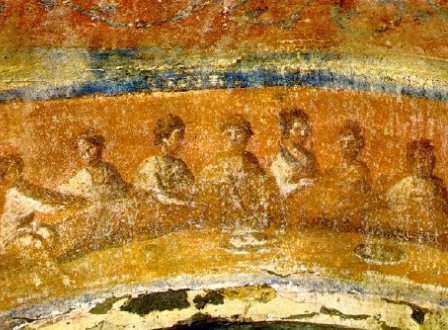
The secret of the catacombs


Delicate Matters of Faith

Friday’s New Jersey Star-Ledger ran an op-ed piece by Phyllis Zagano entitled “Teaching how, not what, to think.” The essay concerns a tale of two professors, one at the University of Illinois and one at Seton Hall. Both have come under fire for teaching on the issue of gay marriage, one from, one against, a Catholic viewpoint. Zagano’s point of view, evident from her title, is that professors should teach students how to think, but not what to think.

This is one of the most difficult aspects of teaching religious studies. I am in my eighteenth year of teaching in the field. In that time I have taught at both religious and secular schools and, in both settings, presented the material objectively. There are those in both settings who complain. Students at Nashotah House frequently wanted me to bend the Bible to fit conservative Anglo-Catholic teaching. Under immense logical pressure to accept what reason told them of the world, they wanted an authoritative book to back them up in a pre-decided outlook. A theological ace of spades to trump the uncomfortable conclusions of rationality. At the University of Wisconsin Oshkosh and at Rutgers University students frequently want to know my religious outlook so that they might know how to categorize what they are learning: is it sanctioned or is it anathematized? We need to know who you are so we can evaluate your authority in such delicate matters as faith.

I frequently ponder the issues raised by Zagano. I know of no other field of study where the stakes are so high, with the possible exception of political science. Religion is an all-encompassing phenomenon. All of life must conform to religious teaching, often with eternal consequences. It therefore makes an enormous difference what you are being taught. Like Zagano, I try to teach students to think for themselves. Both at the seminary and university I refused to reveal my personal outlook on the issues; I try to kick-start the thinking process. I have paid the price for this in the past, but it is a non-negotiable component of education. If the truth is uncomfortable, it is always possible to let someone else do the thinking for you.


Two Roads Diverged

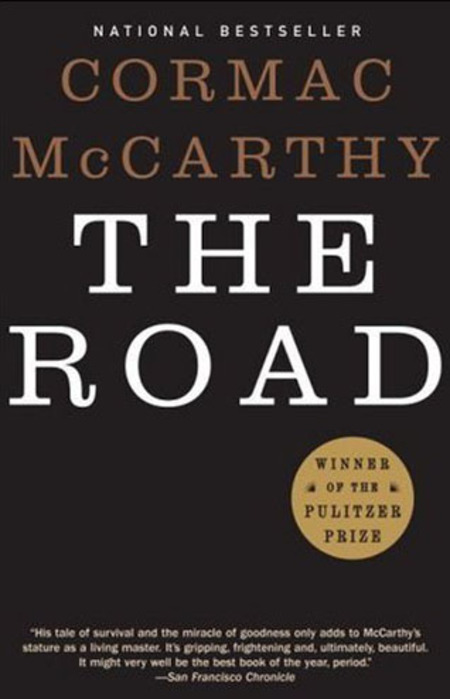
Back in my Gorgias Press days one of my co-laborers (BU) suggested that I might enjoy reading Cormac McCarthy’s The Road. Since then it has come out as a movie, and further apocalyptic events have occurred – the Deepwater Horizon disaster and the election of Chris Christie come to mind – so I finally got around to reading it. It is a harrowing book for any parent to read and I doubt I have the heart to see the movie. Already the book is spawning internet quotes and quips, but I was particularly interested in seeing how this post-apocalyptic novel handled God.

Since the Bible, via Zoroastrian influence, gave us the religious concept of the apocalypse, it is fitting to see how religion fares in its unhallowed progeny. Mostly God is absent. When the man and his son mention God, the language is spare and laced with betrayal. “There is no God and we are his prophets,” the old man declares after the man and his son leave the bunker. A few paragraphs later he states, “Where men cant live gods fare no better.” The value of the apocalyptic metaphor is that it forces us to face life as we find it: raw and uncompromising. In the fictional apocalypse it is permissible to utter aloud implications of life’s callous lessons.

My career has had its share of jagged edges. The lacerations I’ve personally received have been at the machinations of Christians eager for self-justification. Self-congratulatory individuals and collectives that suppose God has specially favored them. “There is no God and we are his prophets.” It is like reading Camus in slow motion. One of the lessons both Nashotah House and Gorgias Press taught me was that it can always get worse. Reading McCarthy’s sad yet true tale of the woe we bring upon ourselves, the lesson for those eager for the apocalypse is that they have only to open their eyes.


Weather the Psalms

Among the academic detritus cluttering my desktop is a book I wrote while employed at Nashotah House. Not being a native Midwesterner and finding myself where severe thunderstorms are a blasé fact of life for much of the year, I was captivated by and terrified of the weather. At the same time, daily recitation of the Psalms was a major part of our required, twice daily worship. With the thunder louder than I could ever imagine it outside, we’d calmly read the Psalms, at our stately pace, confident that he who rides upon the clouds could protect us, his humble servants. After many years of recitatio continua I noticed the plenitudinous mentions of the weather in the Psalms. After a painstaking five years of reading and rereading the entire Psalter, I had translated every verse with a weather reference and had written commentary on them.

Publishers showed no interest, this despite the enormous success of Sebastian Junger’s The Perfect Storm, and Erik Larson’s Isaac’s Storm (both of which I eagerly read) and the recent release of Twister. One publisher deigned to make comments as to the great problems of my thesis, so I sat down to revise this behemoth of a book. The very day I was called into the Dean’s office and fired was the last time I looked at the material. I had been revising the book that very morning. The one sad aspect of this entire episode is that every colleague to whom I mentioned the book was excited to read it when it came out. There was a real interest, but no publisher willing to take on the project, this side of vanity publishing.

Some days I think I may go back to that dead beast of a project and try to resurrect it. My academic publishing has slowed to a tortoisene pace without full-time institution support or interest (independent scholars are not worth investing in, I have learned), especially under the weight of teaching nearly a dozen classes a year. Nevertheless, the idea seems sound to me. I keep a weather-eye on the academic horizon and I have yet to spot a book like mine anywhere within the publication catalogues. Considering the importance of storm gods in the ancient world, perhaps we’ve simply moved beyond this interest, tucked away in our interior settings. Nevertheless, when a rare thunderstorm comes to New Jersey, I still remember the majesty of the weather and a forgotten book on the Psalms.

Even the NWS recognizes Noah


Mythology Gone to the Dogs

Today’s New Jersey Star-Ledger reports an inter-species religious scandal that highlights the vast difference between god and dog. Last month a Canadian Anglican priest fed a dog a communion wafer. The gesture, a spur-of-the-moment reaction to a visitor who brought his dog to church (somewhat of a rarity in itself) was likely just a reflex to seeing that inevitable lolling tongue at the communion rail. Priests see lots of lolling tongues, mostly human.

In my long years at Nashotah House, where daily communion was a requirement of all faculty and students, I’m sure I consumed several pounds of communion wafer. I also received many stern warnings that this particular food item – if communion wafers can really be considered food – was unlike any other and must be treated with the utmost sanctity. Ironically, more than once I was handed a wafer by a priest with an out-of-control head-cold who’d clearly just contaminated an entire paten full of the sacrament with an eager virus. Within a week most of the student body would be hacking up an holy phlegm, not dissuaded from sharing the common cup. Despite the obvious fact that the ritual had become a disease vector, the mythology of its sanctity lived on.

The history of Christian ritual is a specialized field with experts who know the minutiae of each subtle gesture and the history of each preposition in the Anaphora. The ritual itself has become an object of worship. For some the fate of the wafer has become the fate of the world. This is mythology in action. Nevertheless, I have often received unbelievable hostility from those crowned with righteousness. As long as the right words are pronounced in the right order with the appropriate gestures, it is perfectly acceptable to stab another human being in the back.

I grew up with dogs. With the rare exception of the occasional biter, canines have treated me very well. Some on the verge of worship. If it comes down to choices, I’ll take my chances with the dog with a lolling tongue rather than with the priest with the magical bread.

Belief in dog is not a bad thing


Faith Healing

Having dissociative reading habits sometimes leads to fortuitous coincidences. My interests have always been widely dispersed, and although I have a few perennial favorites that I keep coming back around to, reading about new interests predominates. One of my favorite reading topics is science. Apart from the requisite intro courses in college, I have unfortunately had little formal training in the sciences, so I read extensively in the field. A number of my recent reading projects, books on widely divergent areas of science, have coincidentally mentioned faith healing. Being books written by scientists, there is little by way of physical explanation except that people who believe they are improving generally do. The mechanism remains undiscovered, but the phenomenon is well documented.

Faith healing has long lain among the taboo subjects of snake handling and snake oil hawkers. Those who approach the phenomenon from a religious angle claim that it is no less than divine power that causes a person to heal. Physicians and scientists who rely on empirical evidence, however, declare that a physical cause must exist, albeit a yet undiscovered one. With no way to test results, the objective approach simply must accept that it happens, we know not why.

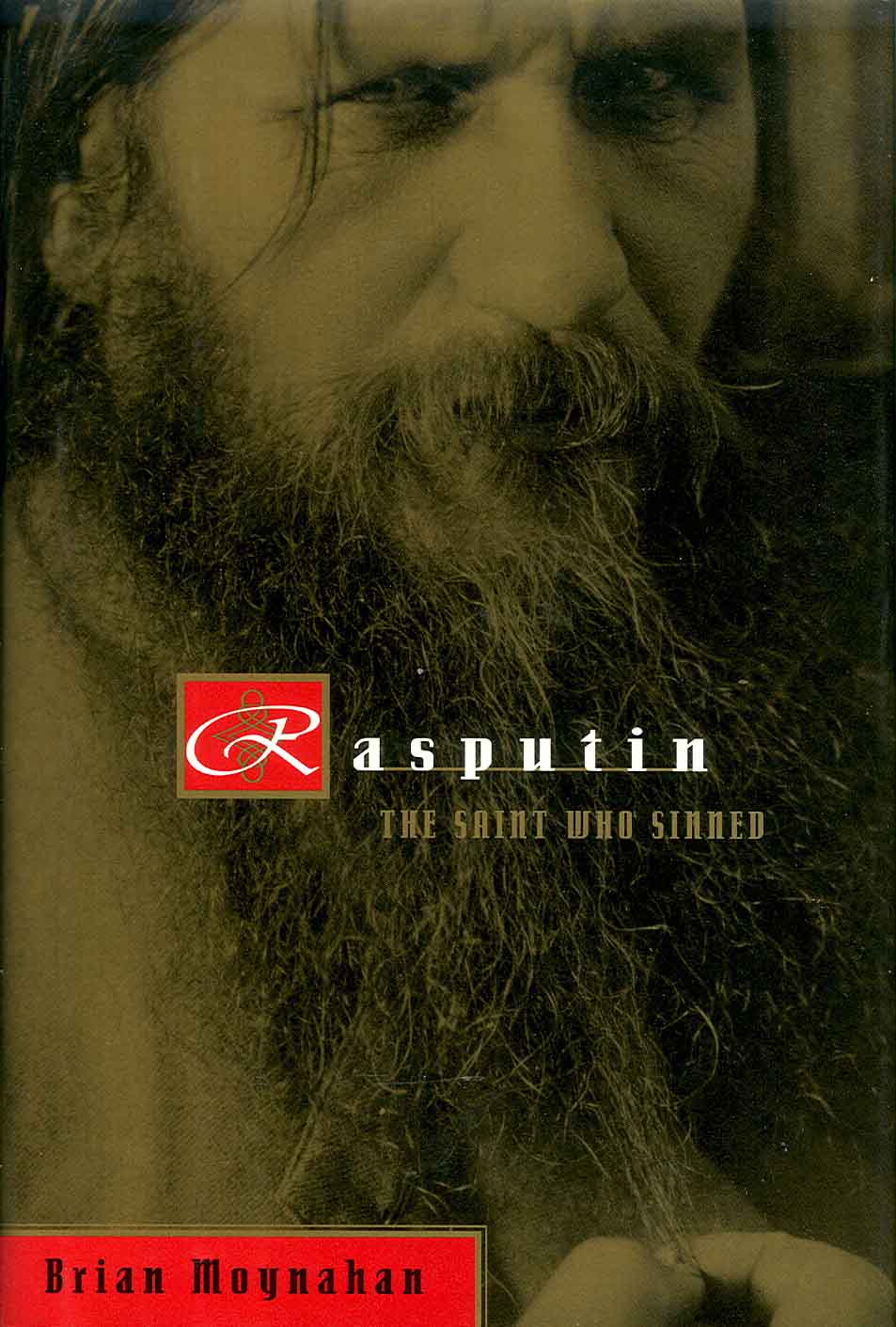
A number of years ago I read a book about Rasputin (Rasputin: The Saint Who Sinned by Brian Moynahan). At the time I was teaching at Nashotah House, a monastery-like seminary heavily influenced by Orthodox pretensions. “Rasputin” was a common slur on campus, particularly for a slovenly prelate-in-training. I had no idea who Rasputin was until I read this book. Apart from the distinctly creepy vibes his photographs give off, there are many documented cases of Rasputin’s ability as a faith healer. Few today would consider the “mad monk” as any kind of saint, but he apparently had a salubrious effect on those who believed in his power. This would shift the cause from supernatural to the suspect, unwashed hands of a notorious sinner.

Who wouldn’t want the ability to heal and make the world a place with a little less suffering? While faith healing has become a kind of holy grail for scientists, there are some not-so-holy religious folk who’ve unlocked a door that many never even suspected was there in the first place.


Great Balls of Fire

Gnu from WikiCommons

“I looked, and there came a great earthquake; the sun became black as sackcloth, the full moon became like blood, and the stars of the sky fell to the earth…” (Revelation 6.12-13a). With all the apocalyptic events of the past few days, some religious pundits are eagerly awaiting a rider on an extraterrestrial white horse with a light-saber jutting from his mouth. As the smoke from Eyjafjallajokull rises like a funeral pyre, a great green bolide streaks across Midwestern skies (landing, no doubt, near Nashotah House, among Wisconsin’s most paranormal locations), and this all follows an earthquake in China. More impressive than the snowpocalypse of this past winter, but less worrisome than the abrupt ending of the Mayan calendar.

All of this fuss reminded me of the way 1987 began. Having grown up in humble circumstances, one of my favorite pastimes was jigsaw puzzles. As my brother and I sat piecing one together on New Year’s Day while home on break, suddenly a loud boom shook our ramshackle house. Now I grew up in a small town built around a large refinery, and stories of the cataclysmic explosion that was sure to come raced through my head as my brother and I went outside to see the great pall of greasy black smoke that was certain to accompany such a disaster. We were met by clear skies and neighbors standing in a confused huddle in the streets. The news that evening reported that a fireball had been seen racing across the daytime skies of Ohio and Pennsylvania before it exploded some distance north of us. I’d just experienced my first bolide. It wasn’t the end of the world, but it was an event I’ve never forgotten.

The message I take from these many natural occurrences is that humanity is small. We imagine ourselves to be gods of our domain, controlling our environment and making it more to our liking. But we are not in control. Revelation was not predicting the end of the world, but was attempting to reassert a sense of control for people suffering from a perceived godless enemy. Today we still think of such events as a sign of God’s anger. I’m not sure what God is supposed to be angry about, unless he has happened to drop in on a Tea Party and heard how his name is being taken in vain.


True Metaphors

I have a bad habit of taking road signs metaphorically. Not that I ignore the instructions, it is just that I consider their wider implications. While I was a tormented layman at Nashotah House I was pleased to see a road sign go up along the county lane that led directly to the main campus entrance. “Detour Ahead” it read in its reflective orange glory. I knew immediately that it was a metaphor for my life.

Yesterday as I drove to New Brunswick (New Jersey) for a student’s thesis defense, a large traffic sign that allows its message to be programmed and changed easily sat beside the road. “Expect Delays” one screen read. The next tersely stated, “Church Services.” Yesterday was, naturally, Good Friday, but I couldn’t help reading a bit more into this curt nugget of truth. My mind wandered to Galileo, Bruno, and Darwin. And to thinkers who nudge conventions outside the sciences. In fact, to societal progress itself. I thought of how often human good has been blocked by the agency of religious believers. When something new and beneficial is discovered it has to go through an approval process longer than that of the FDA – by the Church. Is this new information dangerous to doctrine, to preconceived notion? Will it damage our power structure? Can it be permitted?

Back to Joseph Campbell. Raised in the context of a Christian culture, Campbell did not believe any one mythology – he believed all mythologies. He keenly felt the loss that society incurred when it forfeited its mythic heritage and jettisoned its gods. Are we better off without them or not? The answer is still unknown. Perhaps the most appropriate traffic sign of all is “New Traffic Pattern Ahead,” and the most damning is “One Way.”

The ultimate heresy


Civil Rights and Science Fiction

I remember reading L. Ron Hubbard’s science fiction before the Church of Scientology was widely known. Not surprisingly, the religious movement began in New Jersey – a state where anything seems possible (except finding a job or having a stable government). Over the weekend, however, a New Jersey Star-Ledger story noted that some former members of the Church of Scientology are trying to sue their religion for violation of labor laws and unreasonable pay. Lawyers predict such a case cannot win in court, and I personally wonder how such cases of enforced labor differ from other brands of organized religion that require that extra push from their members. Doesn’t the church reserve the right to demand, voluntarily of course, that citizens forfeit their legal rights?

When I was young and naïve (instead of being old and naïve, as I am now), I took my first teaching job at Nashotah House. I was not yet thirty. It was, of course, a conflicted situation: a bunch of men living in the Wisconsin woods trying to maintain a monastic presence nestled between the sinful cities of Madison and Milwaukee. (And a few women, always the minority of the student body collective.) One of only two non-clergy on the faculty, I was surprised when, in response to what was an unreasonable administrative demand I was told, “When you signed your contract, you gave up your civil rights!” I’m not a lawyer, but I learned an important legal lesson – never mess with the saintly sorts that make up the church administration. Religion is big business. And religious bodies can afford big lawyers.

I feel sorry for the plaintiffs in this legal dispute, but they are in a wide and vast company. Organized religions are human constructs, and human constructs will always favor climbers. Climbers who reach the top will always build fortresses to protect their personal interests. In the church they’ll call it ecclesiastical authority and trace it right back to Jesus handing Peter some metaphorical keys. No, the church is not above the felonies and misdemeanors that secular courts just can’t judge. Potential members should read the contract, including the fine print. And don’t be taken in by the bits that sound like science fiction.

Inventor of new worlds


Father Freeze

Photo credit: Dmitry Lovetsky, Associated Press

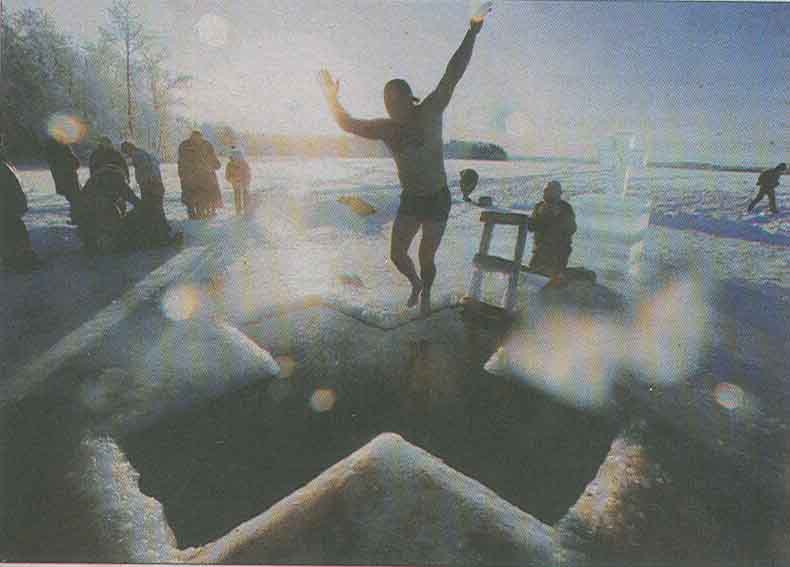
This picture appeared in the newspaper this morning. At a monastery in Valdai, some 250 miles to the northeast of Moscow, Russian Orthodox believers were celebrating Epiphany by leaping into a cross-shaped hole in the ice on a nearby lake. The temperature, as noted in the caption, was 18 degrees below zero (Fahrenheit). What the caption did not explain is that Epiphany, at least in this context, translates as Russian for “severely clenched scrotum.” Hypothermia, the Lord is frozen! Blessed is he who comes to freeze. The ice-man cometh in the name of the Lord.

Many years ago, well into the decades mark, I was talking to a friend about the liturgical churches, as opposed to the strictly Protestant ones. She had grown up staunchly Protestant and was put off by the ceremony of the sacramentally-identified churches. In our discussion she paused and mentioned a televangelist (I can’t recall which one; they all look alike after a while) who had agreed to ride down a water-slide at an amusement park, in a full three-piece suit, if his audience would raise a certain payload of cash. Although the details escape me, it seems entirely plausible ⎯ there is little a televangelist won’t do for money! Then she said, “I can’t see the Pope doing that. I guess there is some dignity to that.” I was pleased; I had made the point that some Christian groups do not need to be in the spotlight of artificial flamboyance in order to proclaim the seriousness of their message. Shortly after that I began to work at Nashotah House.

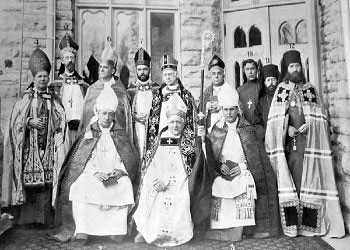
To speculate from the photo above, there was not a large gathering of the faithful on the Siberian ice. Just a few believers in an extreme masculine Christianity dressed in liturgical underwear. Nevertheless, such displays of faith have been part of religions from the very beginning. Ancient believers used to carry their statues of gods around Babylon for a day out to remind the secular that the eyes in the sky are still watching you. When a sartorially perfect prefect steps out in all his finery, what other option is there but to drop one’s hands and stare? A favored photograph at Nashotah House when I was there featured the “Fond du Lac circus,” a gathering of such high rollers in the Anglo-Catholic corner of the Episcopal Church that even a future Russian saint deigned to show up. The event was the consecration of Bishop Weller, coadjutor of the Diocese of Fond du Lac, in 1900. As I look at the Orthodox man poised over his cross-shaped hole, I wonder if my friend had it right after all. The Fond du Lac circus haunts me to this day. What is religion without the show?

The Fond du Lac Circus


Halloween All Year

Despite the obvious consanguinity with the Dawn of the Dead, I am not a mall person. Last week, however, I had a job interview and I discovered that most of my white shirts would be appropriate garb only for the undead, so my wife forced me to look around the local mall for some new apparel. As we walked down the interior boulevard crowded with people younger than us, we couldn’t help overhearing the conversation of some young women behind us. “Yeah, it’s so cool! He’s a vampire; he’s got fangs and everything!” And they weren’t discussing Edward or Lestat, but a (presumably) flesh-and-blood beau one of them knew. Yes, Halloween season is upon us again.

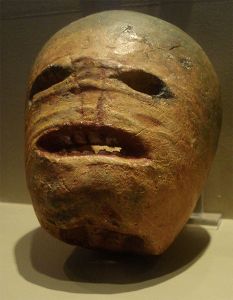
An early Celtic turnip Jack-o-lantern
(An early Celtic turnip Jack-o-lantern)

I loved Halloween when I was growing up. Despite the innate conservatism of my family, we always enjoyed dressing up, trick-or-treating, and being just a bit scared. When I reached college, however, I discovered that Halloween was perceived by many to be satanic, and I had to dig deeply into the past to argue that it came from Christian tradition and was, itself, nothing to be afraid of. Still, my friends looked at me askance. When I reached Nashotah House, a perfectly Gothic setting for the twilight of the year, I discovered that despite the theological conservatism there, Halloween was a time-honored tradition. My first year there while driving home after picking my wife up from a conference in Madison, I drove the familiar road into campus only to see a single, ghostly white face float across the road in front of us. I was so astonished I pulled the car to a stop to look back and could just make out several of the students I knew, dressed fully in black cassocks and cappa negras, only their faces showing, painted white. They stood alongside the lonely road and “floated” across it as slowly approaching cars rounded the bend. (I guess that, being potential priests, they were not too concerned with eternal consequences of metal meeting mere flesh in the dark of night.) On the campus, until the takeover by a Fundamentalist administration, All Hallows Eve was a bone fide sacral event.

The reason for Halloween’s popularity, I believe, is that deep down people really are frightened. At some level we know that we aren’t really in control of our lives and we seldom have a say about them ending. Halloween, with its dark Celtic origins, is the acknowledgment that it is acceptable to be afraid. Each year as more and more elements appear beyond our control, our pantheon of Halloween specters grows. One of our neighbors’ houses has a fake cemetery in its front yard. One of the headstones reads “The Stockmarket / 2008.” Even with the economy dipping and reeling like a drunken bat, lawns sport larger, more expensive and expansive Halloween displays. Halloween represents the pulse of fear than animates religions. We should all be afraid!