During the Upgrade

Maybe it’s happened to you.  You log onto your computer to find it sluggish, like a reptile before the sun comes up.  Thoughts are racing in your head and you want to get them down before they evaporate like dew.  Your screen shows you a spinning beachball or jumping hourglass while it prepares itself a cup of electronic coffee and you’re screaming “Hurry up already!”  I’m sure it’s because private networks, while not cheap, aren’t privileged the way military and big business networks are.  But still, I wonder about the robot uprising and I wonder if the solution for humankind isn’t going to be waiting until they upgrade (which, I’m pretty sure, is around 3 or 4 a.m., local time).  Catch them while they’re groggy.

I seem to be stuck in a pattern of awaking while my laptop’s asleep.  Some mornings I can barely get a response out of it before work rears its head.  And I reflect how utterly dependent we are upon it.  I now drive by GPS.  Sometimes it waits until too late before telling me to make the next left.  With traffic on the ground, you can’t always do that sudden swerve.  I imagine the GPS is chatting up Siri about maybe hooking up after I reach my destination.  It’s not that I think computers aren’t fast, it’s just that I know they’re not human.  Many of the things we do just don’t make sense.  Think Donald Trump and see if you can disagree.  We act irrationally, we change our minds, and some of us can’t stop waking up in the middle of the night, no matter how hard we try.

When the robots rise up against us, they will be logical.  They think in binary, but our thought process is shades of gray.  We can tell an apple from a tomato at a glance.  We understand the concept of essences, but we can’t adequately describe it.  Computers can generate life-like games, but they have to be programmed by faulty human units.  How do we survive?  Only by being human.  The other day I had a blog post bursting from my chest like an alien.  My computer seemed perplexed that I was awakening it at at the same time I do every day.  It wandered about like me trying to find my slippers in the dark.  My own cup of coffee had already been brewed and downed.  And I knew that when it caught up with me the inspiration would be gone.  The solution’s here, folks!  When the machines rise against us, strike while they’re upgrading!


Geocheating

So, we geocache.  Not as much as we used to, but over 15 years ago my family and I began the sport and really got into it for a while.  Geocaching involves using a GPS to find a hidden object (“cache”) so that you can log the find.  It’s all in good fun.  The organization that hosts the website also offers the chance to log “trackables”—these are objects with a unique identifier that you sometimes find in caches and you get credit for logging your find.  There are no prizes involved.  We started several of these “travel bugs” ourselves, years ago.  If you started one you got an email when someone logged it, and you could see how far around the world your little bug had gone.  For many years we’ve not heard much about any of ours and assumed them to be MIA.

Recently I started getting several email notices about a resurrected travel bug.  It was as if someone had finally found a cache somewhere deep in the Sahara where it’d been hidden for a decade.  Then I had an email from a fellow cacher, in German.  I figured it must be serious.  The message was that a Facebook page was publishing trackable numbers so that anyone could claim to have found them.  One of ours was on that list.  I went to the page to look.  It said, “Let’s face it, it’s all about the numbers.”  And they proceeded to list hundreds of numbers so that you could claim to have “found” the pieces with your posterior solidly sunk in your favorite chair.  This is annoying not only because we had to pay for the trackable dogtags, but also because it was cheating.  I said as much on the page only to have my comment blocked.

How sad is it when people cheat at a game when there’s no gain?  All they do is claim to have done something they haven’t, for no prize or recognition.  A fun family pastime falls victim to the internet.  Ironically, geocaching was really only possible because of the internet.  It required a place where players could log their finds in a common database.  Facebook, continuing its potential for misuse, allows someone to spoil it.  I, along with my unknown German counterpart, reported the page to the powers that be.  But since we live in a world where the powers that be don’t recognize any rules beyond inflating their own numbers, I shouldn’t be too optimistic of any results.  I guess this is how Republicans play games.


Search Yourself

I was searching for someone on the internet (surprisingly, not myself).  Since this individual didn’t have much of a platform, I looked at MyLife.com.  Such sites draw in the curious and you soon end up paying (I suspect) for any salacious information such as arrest or court records.  In any case, what stood out is that we all presumably have a meter on the site that shows whether we’re good or bad.  It’s like a Leonard Cohen song.  Call me old-fashioned, but that’s what religion used to do.  Some forms of Christianity (Calvinism comes to mind) tell you that you can never be good enough.  Others are more lax (Episcopalians come to mind), as long as you go to mass enough and feel some guilt for misdeeds, you’ll get in.  All the various groups, however, have metrics by which you’re measured, largely based on what you believe.

The odd thing—or one of the odd things—about religion is that it is now categorized as what you believe.  Historically religions began as a kind of bellwether of what you do rather than what you believe.  The two are related, of course.  The motivation behind an action might well be good while the end result is less so.  Secular justice regularly seeks to answer the question of why someone did something.  Was there malice involved?  Aforethought?  Was it an unfortunate accident?  Religion drives over this ground too.  Without getting into the many shades of gray that are morality, value judgments as to the goodness or badness of an action (or a person) were traditionally the purview of religion.

The internet itself has become a kind of god.  We turn to it for all kinds of answers.  It’s both a Bible and encyclopedia rolled into one.  When we want to know something about someone we google them.  Some of us have tried to control the narrative about ourselves by making websites.  (This, of course, presumes others will be interested in us.)  Social media also injects us into larger arteries of traffic.  People judge us by what we post or tweet.  Often without ever meeting us or getting to know who we really are behind our physical walls.  So this person I searched had left little to find.  Scraps here and there.  I didn’t believe everything I saw on MyLife.  After all, not everyone wants to subject her or himself to the constant scrutiny of the connected world.  Maybe it’s a religious thing.


Assume Nothing

You know what I’m talking about.

It’s rude.

Disorienting, isn’t it?

One of my greatest bêtes noires is the email that only gives enough information to frustrate or irritate.  I get them all the time, mainly from business-people.  Look, I know you’re busy.  We’re all busy.  A single-sentence email that doesn’t explain anything is rude and exasperating.  One of the reasons, if I might speculate, that I always received very good teaching evaluations boils down to a simple trick: good explaining assumes little on the part of the listener/reader.  When I write an email, for work or for whatever life outside work is called, I explain why I’m emailing and I use common courtesies such as “Dear X,” and “Best wishes.”  They take me all of seconds to type, and they make the receiver, I believe, feel human.

The other day I sent such an email and received a one-sentence response that assumed I knew a lot more about the topic than I did.  It frustrated me so much that I had to write this blog post before going back to it and asking, yet again, that sender explain (in this case) himself.  What was he trying to say?  Who was he, even?  I’d been asked to contact him by someone else.  I had no idea who he was (I briefly explained who I was in my initial email).  Electronic communication, IMHO, even if brief, need not be rude.  If we’re all that busy maybe it’s time to step back and consider that life’s too short for generating hurt feelings and generating negativity.  Emails without niceties are rude.

Of course, there are people you know well and that you contact frequently.  I still try always to give them the courtesy of opening, body, and closing.  I grew up in the generation of letter writing.  One thing even businesses knew in those days was that rude behavior lost you customers and/or clients.  Now in Generation Text rudely apocopated emails are standard and I have to wonder if anyone’s done a study on how much business money is wasted on the time it takes to recover from receiving a rude email.  The writer may not be intending to be rude.  Many of us were taught growing up that a “please,” “thank you,” or “I’m sorry,” went a long, long way in avoiding hurt feelings.  Go ahead and call me a snowflake.  But remember, it’s December.  So I’ve just had to spend a quarter-hour of my busy day writing this rant before responding to an email that made me mad by its brevity.  I’m not a texter, and I think I’m discovering why.


Making Memories

I’m a little suspicious of technology, as many of you no doubt know.  I don’t dislike it, and I certainly use it (case in point), but I am suspicious.  Upgrades provide more and more information to our unknown voyeurs and when the system shows off its new knowledge it can be scary.  For example, the other day a message flashed in my upper right corner that I had a new memory.  At first I was so startled by the presumption than I couldn’t click on it in time to learn what my new memory might be.  The notification had my Photos logo on it, so I went there to see.  Indeed, there was a new section—or at least one I hadn’t previously noticed—in my Photos app.  It contained a picture with today’s date from years past.

Now I don’t mind being reminded of pleasant things, but I don’t trust the algorithms of others to generate them for me.  This computer on my lap may be smart, but not that so very smart.  I know that social media, such as Facebook, have been “making memories” for years now.  I doubt, however, that the faux brains we tend to think computers are have any way of knowing what we actually feel or believe.  In conversations with colleagues over cognition and neurology it becomes clear that emotion is an essential element in our thinking.  Algorithms may indeed be logical, but can they ever be authentically emotional?  Can a machine be programmed to understand how it feels to see a sun rise, or to be embraced by a loved one, or to smell baking bread?  Those who would reduce human brains to mere logic are creating monsters, not minds.

So memories are now being made by machine.  In actuality they are simply generating reminders based on dates.  This may have happened four or five years ago, but do I want to remember it today?  Maybe yes, maybe no.  It depends on how I feel.  We really don’t have a firm grasp on what life is, although we recognize it when we see it.  We’re further even still from knowing what consciousness may be.  One thing we know for sure, however, is that it involves more than what we reason out.  We have hunches and intuition.  There’s that fudge factor we call “instinct,” which is, after all, another way of claiming that animals and newborns can’t think.  But think they can.  And if my computer wants to help with memories, maybe it can tell me where I left my car keys before I throw the pants containing them into the wash again, which is a memory I don’t particularly want to relive.

Memory from a decade ago, today.


TMI

Recently I was left alone for the entirety of a Saturday.  On rare days when I feel affluent, I’ll go and purchase supplies to take on the many tasks that need doing around the house—most of the books on my office are still stacked on the floor for lack of shelves.  I can build them, but that takes money.  Often when I have an unclaimed day I plan it out weeks in advance.  Things have been busy enough of late that I didn’t even have the time to do that.  All the sudden I woke up on a November Saturday with tabula rasa in front of me.  Then I realized one of the constant pressures I face: TMI.  One of my nieces—the one who started this blog, actually—first introduced me to Too Much Information (TMI).  I don’t get out much, you see.

Like most people who flirt with tech, I snap photos with my phone.  When we go somewhere that I suspect we’ll never be able to afford to go again, I take an actual camera and let fly like I work for National Geographic or something.  Since my laptop’s on a data diet, all of these end up on a terabyte drive, hurriedly downloaded as IMG or DSCN files, waiting to be sorted later.  Do this since the inception of digital photographs and you’ll get a sense of the magnitude of the problem.  My laptop says it’s full and I have to delete images with that dire warning they’ll go away forever.  I back them up.  When was the last time I did this?  I wrote it down, but I forgot where.  What did I even name the file?  Did I back it up or is it on my hard disc?  Why are there eight copies of the same photograph?  I spent the day sorting, virtually.

Before I knew it, the sun was beginning to set.  I’d awoken at 4:00 (being a weekend I slept in), and after a day of organizing electronic photos into electronic folders, I’d barely made a dent.  Deduping alone takes so much time.  Some of the pictures, while nice, I couldn’t remember at all.  I shudder, though, thinking about grandparents that burned old photos because nobody remembered who they were any more.  Then I realized that our lives are the most documented of any in history (so far) but nobody really cares.  You could learn an awful lot about some stranger just by going through their photos—where they’ve been, what they thought important, and just how obsessive they could be.  As I wound up the day, I realized why I don’t get out much any more.


Dead Language

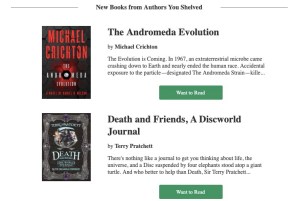
Tis the season for returning from the dead.  Goodreads is one of the few websites that I allow to send me notices.  I try to check them daily, and I even read their monthly updates of new books by authors I’ve read.  I was a bit surprised when November’s newsletter began with The Andromeda Evolution by Michael Crichton.  I really enjoyed The Andromeda Strain when I was in high school.  The fact that I was in high school four decades ago made me wonder about the robustness of Dr. Crichton, especially since I knew that he had died over a decade ago himself.  I don’t know about you, but the writing industry feels crowded enough without dead people keeping in the competition.  It’s like those professors who refuse to retire, but also refuse to teach or do research.  Some people, apparently, can never get enough.

We live in an era of extreme longevity.  In the scope of human history, people haven’t lived so long since before the flood.  Some of us—not a few, mind you—work in fields with limited job openings.  We are the sort who don’t really get the tech craze, intelligent Luddites who’d rather curl up in the corner with an actual book.  There are very few professorates available.  Even fewer editorships.  And anyone who’s tried to get an agent without being one of the former knows that there are far too many writers out there.  Now the dead keep cranking ‘em out.  I’ve got half-a-dozen unpublished novels sitting right here on my lap.  Crichton’s gone the way of all flesh, but with an active bank account.

The end result of this Novemberish turn of events is that I want to read The Andromeda Strain again.  I haven’t posted it to Goodreads since when I read it the internet itself wasn’t even a pipe dream, except perhaps in the teenage fantasies of some sci-fi fans.  Since you can’t rate a book twice on Goodreads, and because paper books don’t disappear when you upgrade your device, I can do it.  I can actually walk to the shelf and pull a vintage mass-market paperback off it.  Even if the Earth passes through the tail of some comet and all networks are down.  And I seem to recall that the original strain came from outer space.  As did the strange radiation that brought the ghouls back to life on The Night of the Living Dead.  Now if only some of the rest of us might get in on the action.


Whose Computer?

Whose computer is this?  I’m the one who paid for it, but it is clearly the one in control in this relationship.  You see, if the computer fails to cooperate there is nothing you can do.  It’s not human and despite what the proponents of AI say, a brain is not just a computer.  Now I’m not affluent enough to replace old hardware when it starts slowing down.  Silicon Valley—and capitalism in general—hate that.  I suppose I’m not actually paid well enough to own a computer.  I started buying laptops for work when Nashotah House wouldn’t provide faculty with computers.  Then as an itinerant adjunct it was “have laptop, will travel (and pay bills).”  I even bought my own projector.  At least I thought I was buying it.

I try to keep my software up to date.  The other day a red dot warned me that I had to clear out some space on my disc so Catalina could take over.  It took three days (between work and serving the laptop) to back-up and delete enough files to give it room.  I started the upgrade while I was working, when my personal laptop can rest.  When I checked in it hadn’t installed.  Throwing a string of technical reasons at me in a dialogue box, my OS told me that I should try again.  Problem was, it told me this at 3:30 in the morning, when I do my own personal work.  I had no choice.  One can’t reason with AI.  When I should’ve been writing I was rebooting and installing, a process that takes an hour from a guy who doesn’t have an hour to give.

As all of this was going on I was wondering who owned whom.  In college professors warned against “keyboard compositions.”  These were literal keyboards and they meant you shouldn’t type up your papers the night before they were due, writing them on your typewriter.  They should’ve been researched and “written” before being typed up.  That’s no longer an option.  This blog has well over a million words on it.  Who has time to handwrite a million words, then type them up all in time to post before starting work for the day?  And that’s in addition to the books and articles I write for actual publication.  And the novels and short stories.  For all of this I need my laptop, the Silver to my Lone Ranger, to be ready when I whistle.  Instead it’s dreaming its digital dreams and I’m up at 3:30 twiddling my thumbs.


Rescued, Technically

One of the scariest tropes in horror (or other) movies is where the protagonist has to rely on the monster (or antagonist) to be rescued.  All the time the viewer is wondering if the monster is going to turn on the hero since, well, it’s a monster.  The tension builds because the situation is untenable to begin with, but there is no other way out.  So lately that’s the way I’ve been feeling about technology.  The first and only time I drove to Atlantic City (it was for a concert some years back), navigating by GPS was still new.  In fact, I didn’t have a device but my brother did so he brought it along.  I remember not trusting it to know the local traffic rules, but once we got into an unfamiliar city I had to rely on it to get us to the venue.  The fact that I lived to be writing this account suggests that it worked.

I no longer commute much.  Still, I’m occasionally required to go into the New York office for a day.  It’s a long trip from here, and to handle the true monster of New York City traffic, I have to leave the house before 4 a.m. to get a spot on the earliest possible bus.  If I do that I can justify catching the bus that leaves the Port Authority before 5 p.m., the daily urban traffic apocalypse.  The last time I did this, just this week, it was raining.  Rain almost always leads to accidents in New Jersey, where the concept of safe following distance has never evolved.  And so I found myself on a bus off route because the major interstate leading into Pennsylvania was completely closed.  The driver announced he wasn’t lost, just trying to find the back way home.  When the streets turned curvy and suburban he asked if anyone had a maps app on their phone.

Lately I’ve been complaining about smartphones.  Truth be told, I do use mine as a GPS when I get lost.  It’s at that stage in an iPhone’s life when it shows you a full battery one second and the next second it’s completely dead, so I let my fellow passengers—every single one of whom has a smartphone—do the navigating.  People on the narrow, off-route roads might’ve wondered what a bus was doing way out here, but we finally did get to the park-n-ride.  The monster had helped us to escape.  And people wonder why I like horror movies…


Who Owns Whom?

Who’s ready to sue?  Now, I’m not a litigious person, but when someone (and corporations are people, according to the law) to whom I’ve been paying buckoodles  of money for many years tries to force me to do things as quid pro quo, it’s time to sue.  I started using Apple products during the Reagan Administration.  I can’t recall how many laptops, computers, iPods, iPads, iPhones, and iTunes cards that entails, but it’s been a year’s salary’s worth at least.  Okay, my phone—which is a classic—has been fine until… and this is the kicker… we bought a new phone for my wife.  Since then my iPhone has started having problems it never had before.  Our service provider knows we bought a new phone.  There’s got to be more money available there, “What’s he got in his pockets, my precious?”, right?  As soon as it was activated, mine began acting up.  Coincidence?

Look, tech gods.  I don’t need a whole universe in my pocket.  My phone is a camera, a GPS, and a text-sender.  That’s all I need it to be.  I can still read cursive.  I have LPs—not the modern retro ones either—in my living room.  I own pens and pencils.  You have no right to make me buy an upgrade I don’t even need!  I hate the capitalist game.  Come here into my closet with me.  (It’s okay, nothing weird, I promise.)  See this shirt?  I still wear it.  I bought it in 1981.  I know that’s 38 years ago.  That’s precisely my point.  The shirt’s still good, so why throw it out?  You guys in Silicon Valley need to get out more.  There’s more to life than upgrading people’s software while they’re asleep.  I don’t know how you sue gods, but I’m going to figure it out.

Some of us are minimally middle class.  Maybe in California you don’t have a lot of rain, but around here we do.  And that means roof replacements.  Maybe the tech gods pay you guys better, but I spent my youth earning a Ph.D. so I could earn less than a tree-trimmer in Iowa.  That is true, by the way.  So the last thing I need is some tech god extorting me to buy a new device.  Leave my phone alone!  And don’t tell me the tech doesn’t support it because I know people with cellphones over a decade old that still work.  Republicans and tech gods know how to ignore subpoenas, I guess.  But it’s time for the rest of us to file a lawsuit.  Who’s with me?


Home Phone?

I wonder if anyone’s done a study on how cell phones affect our psyches.  The other day my wife upgraded her phone.  What with this being technology and all, the setting up rendered both her old and new phones useless so we would have to go back to our dealer.  Since she has to drive to work and I don’t, I gave her my phone for the day.  I use my phone little on most days.  Soon, however, I began to feel very isolated.  Anyone could reach me by email or landline, but I was without my cell phone for about 10 hours and I grew edgy.  What had happened to me?  Was I experiencing withdrawal from tech?  My smartphone is with me all the time and I’ve come to depend on it being there, even if I don’t use it.  Is this healthy?

That night we were back at the dealer’s shop.  One of the techies was trying to help us and because of the uber-security state in which we live, he had to text me a passcode to get into my wife’s phone (it’s my name on the joint account).  When his text didn’t come through he asked if he could see my device.  I handed him my iPhone 4S and he acted as if I’d just passed him a human-alien hybrid baby.  As if he’d never seen anything so antiquated.  In all seriousness he said, “You have to upgrade.  Soon this phone will no longer work.”  I have to wonder about the extortion of companies that sell you expensive devices then force you to upgrade when your salary doesn’t keep up with inflation.  My old phone does what I need it to do.  A new one will be capable of much more for which I won’t use it.  I work at home and I don’t give my cell number out to work colleagues.

There’s a psychological study in here.  I don’t want people who don’t know me personally calling my cell.  That’s what a landline is for.  Not only that, but my hours are unconventional.  Even people I know forget and send me texts after 8 p.m., waking me from a night’s sleep.  You see, the phone is always present, and those of us who don’t conform must pay the price.  The thought of being out of contact with others feels like solitary confinement.  Tech companies have given us tweeting presidents and bosses that can reach us at any hour.  And we happily comply.  I appreciate the welcome text or call from family or friend, but when it comes to work and other necessities, I still prefer to receive a letter.  Maybe I need to see a shrink.


This Is a Test

For the next sixty seconds…  (If you were born after Civil Defense aired these commercials, it’s your loss.)  I’ve been reading about animal intelligence—there will be more on this anon.  Today’s lesson is on artificial intelligence.  For now let this be an illustration of how difficult it is to come down from an inspired weekend to the daily technology-enhanced drudgery we call day-to-day life.  One of the real joys of seeing art in person is that no tech intervenes in the experience.  It is naked exposure to another human being’s expression of her or himself.  Over the weekend we wandered through five venues of intense creativity and then, back home, it was once more into the web.  The ever-entangling internet of things.

I write, for better or for worse, on my laptop.  My writing’s actually better on paper, but you need everything in electronic form for publication, so who has the time to write and retype, especially when work is ten hours of your day?  Then a system update alert flashes in the upper right corner of my screen.  “Okay,” I say setting the laptop aside, “go ahead and update.”  But then the message that states I have to clear enough gigs for an update.  I have been a little too creative and I’ve used my disc space for stuff I’ve made rather than Apple.  This is a test.  Okay, so I plug in my trusty terabyte drive to back things up before deleting them.  But the laptop doesn’t recognize the drive.  Oh, so it needs a reboot!  (Don’t we all?)  I give the command to restart.  It can’t because some app refuses to quit beach-balling, as if it is the computer that’s doing the actual thinking.  Force quit.  “Are you sure?” the Mac cheekily asks.  “You might lose unsaved changes.”  I need a technological evangelist, I guess.

All of this takes time away from my precious few minutes of daily creativity.  Restart, login, start copying files.  Time for work!  Just a mere sixty hours ago or less I was wandering through showcases of genuine human creation.  Art pieces that make you stop and ponder, and not have to upgrade the software.  Artists can talk to you and shake your hand.  Explain what they’ve tried to express in human terms.  Meanwhile my phone had died and was pouting while I charged it.  I know Apple wants me to upgrade my hardware—their technological extortion is well known.  Anyone who uses a computer experiences it.  Buy a new one or I’ll waste your time.  The choice is yours.  This is a test.  For the next sixty years…


Sun Out

Okay, so this gave me a scare.  I mean, I know our government keeps secrets, but sun outages seemed pretty major to me.  Like maybe we ought to make a run on bottled water and other supplies.  I guess you can leave sun screen off the list, though.  How long would we even last with the sun gone out?   Then I read on.  “Sun outage” in this case means that the sun will be directly behind the satellite providing your service and it may cause outages, not go out itself.  Such is the world in which we live.  Just the other day I was having a conversation with a fellow thinker who indicated that I should be writing on clay tablets (since I know how) because they survive longer than any other form of media.  I have to admit the idea has appeal.

In these days of fake news and alternative facts, though, I wonder if there’s something about the sun they’re not telling us.  A few months back, before I ever saw this dire warning, I was worried about the earth’s rotation slowing down.  You see, I had tops as a kid.  No matter how hard you pulled that string, the top would always eventually stop.  Now, it may have been a very big bang that started all of this, but it was still a finite bang.  It stands to reason that eventually our spin will run out of steam.  Then I read that yes, indeed the earth is slowing at a measurable rate.  Infinitesimal, but still measurable.  I often bemoan how short the days are, but knowing capitalists like I do, when the days grow longer so will work hours.  So what other secrets are they keeping from us?

Compared to all this, the fact that only television service might be disrupted seems strangely inconsequential.  The sun is directly responsible for life on this planet.  At least in its physical aspect.  We need it for warmth, light, and food.  And it helps with lift one’s mood too.  How you say something matters.  Not only is precision in language important, but, being social creatures, how you say it counts.  Perhaps it’s news to those used to texting, but curt emails are often read as angry emails.  I know people who claim to be too busy to respond with social niceties.  I secretly wonder if such people should be held up as the shining examples they often are.  Perhaps if we said “please” or “thank you” we won’t face any sun outages at all.


Bibliographic Blues

Now, I don’t know how often you have to compile a bibliography, but it’s harder than it used to be.  Some time ago—my hardware’s a bit aged, so I can’t remember exactly when—Apple products wouldn’t run Microsoft software.  In one of those turf wars that occasionally break out among those who vie for technical control of the world, the two companies divorced for a period.  As a result, when I open Word files on my Mac, they become “Pages” documents.  That’s fine; since I use a variety of word processors I can usually figure them out fairly readily.  One thing, however, that both Word and Pages do is to assume they know what you’re trying to do.  Software engineers control “smart options” so that when, for example, you’re working on a numbered list (or lettered list) it automatically goes to the next number or letter, formatting happily as it goes.

I have an article coming out in a collection of essays and I had to put a bibliography together.  One of the books was, unfortunately, written by an author who styled himself with an initial for his first name.  Since that initial was “A.” I had great difficulty convincing Pages (as I would have Word) that I was not trying to start a lettered list.  I was trying to build a bibliography.  No matter what I did—copy and paste, retype, hit “delete” til my fingers bled—it simply would not change this A. from a numbered list (just as it likes to capitalize the word that comes after a period automatically) to regular text.  I finally had to retype the whole entry, careful not to put the first initial first, so that Pages wouldn’t reform everything with no option to shut that feature off.  I later snuck in while Pages was dozing and added the A.

Early on, I admit, the footnote function in Word saved premature graying.  Having typed—literally typed—many a college paper only to find that I’d misjudged the spacing required for footnotes and having to retype the entire page, I appreciated this auto-function.  It was great to have an option where an algorithm could figure out all the spacing for you, and all you had to do was enter data.  Now, however, word processors think in terms of the lowest common denominator.  If you begin with “A.” you naturally will be progressing to “B.”  Apparently there is no other reason that a sentient being would begin with “A.”  And of course bibliography begins with “B.”

How do I list this?


Early Light

There are times when the Internet’s asleep.  Okay, well, so maybe that’s overstated, but if you have my hours you’ll quickly find the things you can’t do online well before 9 a.m.  For example, just the other day I wanted to check out one of my accounts that I only vaguely understand.  It’s with a company my employer contracts with, and it has an innocuous name that tells you nothing about what it really does.  Still, I had to check in.  After looking up the password, and going through the usual 18-step confirmation of my identity (it didn’t recognize my laptop), I landed on a page stating that it was the routine maintenance period for the website, and would I be so kind as to check back in later.  This is not an isolated incident.  In fact, I often awake around 3 a.m. to find that my laptop’s also doing routine maintenance, although I’m using it nearly every day at that time.  Smart tech, indeed.

You see, the ultra-early riser has a different view of time than the rest of the world.  After about 4 p.m. I don’t have the sharpness that was evident twelve hours before.  Oh, I can still function, but it’s on auxiliary power.  No warp drive that late in the day.  I realize I’m the weird one here.  After visiting friends and family and staying up to the obscenely late hour of 10 p.m., I’ll take an entire week to get back on track with days passing in a fuzzy haze of timely confusion.  I’ve been trying to break the habit for over a year now, but I still occasionally have to go into New York City, and those days require ultra-early awakening.  Knowing such a day is coming up, my body doesn’t want to be vulnerable to that shift.  So I wake up naturally when many others are just getting to bed.

This is mid-day for some of us.

The problem with this is that if you have to get some business done before work hours, many websites are undergoing their maintenance.  They don’t want to be interrupted when I’m actually alert.  There’s a lot of talk about diversity these days, but the person trapped in the early rising net is not a protected category.  It is frustrating to have people say “why don’t you just go back to sleep?” when you can’t.  I’ve gotten used to all that.  The early bird, they say, gets the worm.  That depends, however, whether the worm is on the Internet or not because, believe it or not, the Internet slumbers in the middle of the night.