Zoroastrian Odyssey

Clinton's Red Mill

Clinton’s Red Mill is a popular New Jersey attraction, but numerous reports of paranormal activity have thrown an additional lifeline to the museum in the form of much-needed revenue in the form of seasonal ghost tours. Last year about this time my family and I participated in one. Touring the old grounds at night can certainly lead to spooky experiences, even for those of us who sit on the fence about ghosts. We discovered that The Atlantic Paranormal Society, the “TAPS” of Ghost Hunters fame, had investigated the Mill the previous year. We watched several episodes of the popular show, and for a lark, my wife bought me a subscription to TAPS Paramagazine for my birthday. All in good fun. I always thumb through when it arrives, but it is hard to take much of it seriously.

The last issue (volume vi, issue 2), however, contained an article about Demonology. Now, I thought I had graduated from The Exorcist and the Exorcism of Emily Rose to a healthy skepticism, but I could not resist reading this article. The first statement declares, “A demon is a fallen Angel that rebelled against God along with Satan, refusing to be humble before, and serve, God” (Adam Blai). While I never make light of things I don’t understand, I did consider the fact that the concept of demons, which derives from a Judeo-Christian mythology, presupposes a mythic war between the powers of good and evil. At the same time, I have been reading up on the Zoroastrians, one of the oldest continuously practiced religions in the world. There can be no serious doubt that the Judeo-Christian tradition borrowed the concept of the demonic from their Iranian neighbors of the ancient Persian Empire.

A Zoroastrian fravashi

The implications of the Zoroastrian connection are profound. If the ancient sage and Afghani priest Zarathustra was correct about the dualistic conflict of good and evil, was he not also right about Mithra and the Amesha Spentas as well? Zoroastrianism gave the Judeo-Christian tradition its base concept of Heaven and Hell, but the divinity of fire they did not accept. By picking and choosing what fit best into its experience, Judaism developed into a religion that allowed for Christian demons and angels and all the invisible hosts of the ethereal realms. Today many Christians accept demons as literal beings (less so jinns, although Clash of the Titans (2010) allowed for them). What does this say about the remainder of Zoroastrianism? Perhaps Ghost Hunters should begin with the Gathas and move on to the Avesta? As for me, I’ll be over here, sitting on the fence.


Holy Amos, Holy Micah, Pray for Us

The semesters when I teach the prophets invariably find me filled with a holy rage toward injustice of all stripes. Unfortunately there is plenty of cause for basic human indignation caused by greed, cupidity, and elitism. I see New Jersey, my current home, as a microcosm. In this little version of the universe, a highly diverse population with over-crowded highways and endless financial woes, I see reflected some of the great challenges facing the human race. When such a delicate balance is guided by a self-serving government the human cost will always be high.

Our current governor, Chris “Slash” Christie, has made himself a national reputation by cutting the basic services required to buoy up a state where the underprivileged seek an opportunity to get ahead. The governor’s favorite target, naturally, is public education. Public school and university funds have been chopped with a zeal to impress Vlad the Impaler (the governor’s children attend private school, thank you). The Associated Press today, however, reports that the number of the governor’s staff who “earn” more than six figures has nearly doubled since our last governor’s term ended. We the taxpayers are being asked to fork over an extra two million dollars to the state budget to support those who live in comfort while our children are being systematically targeted as luxuries the state simply can’t afford. When will people say “enough is enough”?

The Republican Party, since it has shamelessly crawled into bed with religious conservatism, has flouted the message of the Bible in the name of the Bible. Only by ignoring the biblical characters known as prophets, and one guy from Nazareth who went by the name of Joshua, is it possible to see any right in feathering the nest of public “servants” while stealing from the children of their constituencies. I am glad Amos and Micah are dead. If they were alive and in New Jersey they would be suffering torment beyond words.


The Cross in my Pocket

A local woman, whom I can only assume carries a prosperity cross, has won a 211 million dollar New Jersey lottery jackpot. As I had written some months back, when I received my prosperity cross, I tried my hand at the lottery with no rewards. Having had a dream of riches a few weeks back, I again attempted the lotto, with the added ethical motivation of assisting our state’s beleaguered educational system. Still no prosperity. It seems that the divine attention was focused a few miles north and a few days late. The happy winner has gone on record (in the New Jersey Star-Ledger) as saying, “I give God all the glory for this blessing that he has given me… He has seen and knows the highs and lows of my life, and knows the good I have done, and the good I can accomplish in his name.”

This innocent statement, no doubt whipped to a froth by prosperity gospelers, reveals all the difficulty of the weekend warrior prayers for good weather. Tweaking the world in one corner, as chaos theory demonstrates, leads to disaster in another. Not that our thankful lottery winner will unleash untold evil on the world, but it is time that people of all religions stop to consider the implications of the divine bursting in upon the mundane. In my experience, when such people are asked why God chose them and not someone else, they wax mysterious and intimate that only God knows. It is part of a great cosmic secret, only cryptically hinted at in the Holy Bible.

Call it sour grapes, or the grapes of wrath, or any other viticultural metaphor, but God does not direct the lottery. Too many truly good people suffer far too much for such easy answers. Those who promote the prosperity gospel are not among the paragons of human achievement or selfless nobility. Rather they are the idols of the self-important and acquisitive entrepreneurs. I wish our New Jersey lotto winner well – I hope she will steer clear of the prosperity gospel and actually put her money to good use.


Eternal Dampnation

Does anybody have Noah’s telephone number? New Jersey has just experienced the wettest winter on record. Since the day records began, we’ve never had this much rain. That fact came home to me yesterday while driving the fifty miles to Montclair in a tremendous downpour. I had just purchased new windshield wipers, but the cap had fallen off the driver’s side blade. Driving on a truck-infested interstate where traffic continued to fly by at above posted speed limits, I realized with horror that at each passing swipe the rubber insert that actually swipes away the moisture was creeping out of the top of the wiper fixture. There it was, just at the top of my field of view, thrashing about like a demon-possessed snake, while my field of view grew smaller and smaller. I was in lane three of an eight-lane highway and couldn’t get over to make adjustments. In a nightmare I envisioned the slippery snake making a terminal bit for freedom and flying over my head as metal scraped glass and I drove blind into whatever lay ahead.

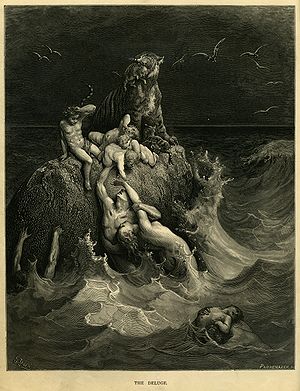
Well, the wiper stayed intact long enough to get me to the university. The rain did not abate, however. Even with battered umbrella and longsuffering raincoat, I was soaked below the knees by the time I squished into class. Unfortunately we studied the flood myth a few weeks ago. A few years back William Ryan and Walter Pitman, a couple of geologists, uncovered the fact that the Black Sea had been flooded by the Mediterranean some 7500 years ago. They posited that this sudden increase in sea-level around the Euxine Sea led to the dispersion of a world-wide flood myth. Their book became a best-seller and even Robert Ballard got in on the search for Noah’s homeland.

Hearing people talk about New Jersey’s incessant rain, I have no doubt that a major sea change was not necessary for flood stories to begin. As water levels rise, perhaps to the delight of whales and other blubber-laden beasts, the rest of us fear being perpetually covered by overwhelming waves. That is enough to start the story of a flood. Especially when your windshield wipers aren’t working on the Garden State Parkway.

Is it damnation or just New Jersey?


Civil Rights and Science Fiction

I remember reading L. Ron Hubbard’s science fiction before the Church of Scientology was widely known. Not surprisingly, the religious movement began in New Jersey – a state where anything seems possible (except finding a job or having a stable government). Over the weekend, however, a New Jersey Star-Ledger story noted that some former members of the Church of Scientology are trying to sue their religion for violation of labor laws and unreasonable pay. Lawyers predict such a case cannot win in court, and I personally wonder how such cases of enforced labor differ from other brands of organized religion that require that extra push from their members. Doesn’t the church reserve the right to demand, voluntarily of course, that citizens forfeit their legal rights?

When I was young and naïve (instead of being old and naïve, as I am now), I took my first teaching job at Nashotah House. I was not yet thirty. It was, of course, a conflicted situation: a bunch of men living in the Wisconsin woods trying to maintain a monastic presence nestled between the sinful cities of Madison and Milwaukee. (And a few women, always the minority of the student body collective.) One of only two non-clergy on the faculty, I was surprised when, in response to what was an unreasonable administrative demand I was told, “When you signed your contract, you gave up your civil rights!” I’m not a lawyer, but I learned an important legal lesson – never mess with the saintly sorts that make up the church administration. Religion is big business. And religious bodies can afford big lawyers.

I feel sorry for the plaintiffs in this legal dispute, but they are in a wide and vast company. Organized religions are human constructs, and human constructs will always favor climbers. Climbers who reach the top will always build fortresses to protect their personal interests. In the church they’ll call it ecclesiastical authority and trace it right back to Jesus handing Peter some metaphorical keys. No, the church is not above the felonies and misdemeanors that secular courts just can’t judge. Potential members should read the contract, including the fine print. And don’t be taken in by the bits that sound like science fiction.

Inventor of new worlds


Grounds for Sculpture

Few people would deny that religion and art share a common heritage. Some of the earliest human art was religiously motivated (I would contend that cave paintings and Paleolithic figurines were religious objects), and much of the contemporary art scene derives its inspiration from religious motifs and constructs. Not all art is religious, however, and not all religions are friendly toward art. Nevertheless, there is a tangible connection.

This weekend was uncharacteristically warm and sunny for a New Jersey March. This led us to take our visiting family to Grounds for Sculpture, one of New Jersey’s often overlooked treasures. Built on the remains of the old State Fair grounds in Hamilton, this park houses an impressive array of outdoor sculpture that is contemplative, innovative, puckishly funny, and even a little weird. It reflects the human experience. My family and I have been there multiple times, appreciating the sculpture from new angles, discovering new pieces, and seeing it all through the eyes of others.

Taste in art is highly personal and individualistic. Just like religious sensibilities. Both art and religion seek to make the human soul accessible to others through profound expression. Several of the sculptures in this unique garden bear biblical titles or suggestions, but they may be enjoyed as secular pieces of expression as well. Here is where art is superior to religion: it does not insist on any single way of expressing the truth. Sometimes, it seems, art may actually attain what religion only aspires toward.

Monet listens attentively to a dilettante


Politicians and Blood-Suckers

The old icons and heroes are gone. It is best just to deal with it. No one is above reproach since we are all in this human morass together. Nevertheless, I’ve always held a soft spot in my cynical heart for Abraham Lincoln. I know he wasn’t perfect, but he stood for an issue that has been a driving force for my life: fairness. Now I see that he was a vampire hunter. After having read Seth Grahame-Smith’s Pride and Prejudice and Zombies last year, I’ve decided to give a try to his Abraham Lincoln: Vampire Hunter. My fascination with monsters and religion has not been disappointed in this fanciful story.

Our quasi-fictional honest Abe begins his vampire-slaying ways when he learns that, yes, a vampire killed his mother. As a boy of only twelve, he finds the knowledge stressful to the point of burning the family Bible that he used to read to his departed mother. Why? In Abraham’s own (fictitious) words: “How could I worship a God who would permit [vampires] to exist? A God that had allowed my mother to fall prey to their evil?” I admit that I was secretly pleased to see the classic issue of theodicy being raised in a story concerned with the undead. It is the dilemma of all who want to see a good God behind all the suffering in the world. It is a dilemma that stems from the same deep wells as our inhuman monsters. We can imagine a better world, but we can’t have it.

Politicians with axes

As I see New Jersey’s governor Christie (for whom I decidedly did not vote!) slashing away again and again like Freddie Kruger at the state’s educational system, I see the twin peaks of vampirism and theodicy peering distantly over the horizon. I am deeply disturbed by the facile disregard this “visionary” Republican has for the future of his own state, for the future of our children. And I am forcefully reminded once again that vampires are symbolic of all those who prey upon the unwary. When staring into the fireplace on a cold night, I imagine myself standing beside Grahame-Smith’s fictional Abraham Lincoln, wondering what god it is that vampires worship.


Emasculating Science Education

American lags behind. Tough words to read, n’est-ce pas? America lags behind in science education. Even nations as “conservative” as Tajikistan teach evolution in their classrooms without question while the United States just can’t seem to accept the facts. The fault, with no question whatsoever, lies with a very narrow Christian interpretation of the irreconcilably contradictory creation stories that open the book of Genesis. This fact has once again come to an ugly head in New Jersey, among the bluest of states. Our, gulp, Republican governor has recently nominated Bret Schundler, a supporter of school’s rights to teach intelligent design, as state commissioner of education. I shudder.

As I teach classroom after classroom of Rutgers students, there is neither biblical nor scientific basis for Creationism. Creationism is a neo-Christian chimera forged together by political pundits who believe that if evolution is stopped in its factual tracks, America will revert automatically to the pre-hippie days of the 1950s where authoritarian dads with conservative haircuts barked out the family marching orders and saw everyone to gospel-hymn-singing churches each and every Sunday. It is a myth, they assert, that is worth believing.

The problem is that facts don’t evaporate simply because nabobs don’t like them. At the FIRST Robotics competition I attended this weekend, facts were presented. The facts are that America has fallen far behind in science education. Decades of fighting the pointless battle of Creationism at the highest political level in this country have weakened us. Those who study the Bible seriously do not question evolution. Those who study science at all cannot seriously question it. Those who do dig trenches of doubt in the minds of generations of Americans with an already inadequate understanding of science and suggest that maybe there is reason to find an atheistic plot behind evolution. There is no plot, only facts. And if New Jersey is about to join the Kansases, Arkansases, and Texases that see big cars, big oil, and big daddies as the solution to our social ills, it may be time to move to New Hampshire.


Robo-god

Yesterday I again found myself among the robots. After an early-morning school-bus ride to the New Jersey regional competition in Trenton, a mentor to a team known as the Gearheads, I felt a little out of my league. Soon, however, I fell into the spirit of the competition and watched with increasing interest as individuals highly regarded in the world of robotics lamented the lack of science education in the United States. Having just completed the nightmare of two terms with a creationist president, is it any wonder? In any case, the competition, a modified soccer match for robots – with two teams from Brazil, no less! – soon became as emotional as any sporting event. Well, for the human participants, anyway. I’m not qualified to assess robotic emotions. As the event wound down, a respected (human) member of FIRST Robotics, during a recognition ceremony, overcome with emotion, called out “God bless you!” to the adult volunteers.

Many scientists I know are personally religious people. There is no fortified gateway between scientific reasoning and the childhood teaching of religious belief. Nevertheless, an irony became apparent that has been bothering me all night long. I joined Team 102 as a mentor because of my daughter’s interest in robotics and engineering. My role is to help with editing, since I am a “humanities” type. The irony that leaves me sleepless is that Ph.D.s in the sciences are highly coveted and have an assurance for jobs. Ph.D.s in the “humanities,” however, are a sure way to block you from career success. Since I began this blog I have been officially unemployed (I pick up a course or two here and there, but no full-time offers have been presented). The people who have been most empathetic and helpful in this time of difficulty have been the robotics team. People there have tried to hook me up with people who might be able to help, but I am like an alien on the autopsy table among scientists – where do you begin? How do you help an overly qualified “humanities” ex-professor find a job? Meanwhile my co-“humanities” colleagues helplessly wring their hands and do nothing. Worse, they interview me and decide not to make a hire, based on “religious” reasons.

The past several years, as the recipient of calculated cruelty from many religious folks, stumbling along trying to find a means of reasonable support, I have come to trust the robots. The robotics team has demonstrated the most humanitarian attitude to a fellow human who has been suffering for several months. The religious tell me that God will work it out and go their righteous way. Yesterday, being blessed by a “high priest” of the robotics world, I felt that I finally found a place I belonged. Now it might be time to go back to school and find the real pulse of humanity in the sciences.

Kids building robots


Mortarboards and Greenbacks

I admit to being an idealist. I grew up far, far from academia. No one in my family had ever been to college before, but when my high school teachers described it, it sounded like a bookish place where knowledge for knowledge’s sake was valued above all more pedestrian concerns. There men and women read and studied and devoted their lives to learning. They lived in shimmering ivory towers and led the way of the future from their scholastic bunkers. And so I worked my way through college. Granted, studying religion may not have been the wisest choice for changing the future, but it seemed the right course at the time. I found a limited acceptance in academia, an idealist who just didn’t know when to give up. It was only after earning a Ph.D. that I stopped to look over the landscape with informed eyes and began to feel a deep dismay.

The best way to encapsulate that dismay became clear in a headline in the New Jersey Star-Ledger earlier this week: “More millionaires among college presidents.” It seems that the extremely rare job of college president is increasing becoming the path to riches. Now to a guy who has never found that mythical teaching position that supports a small family, this felt like a kick in the gut. More than that, it also summarized the dismal view I’d garnered of academia as a whole: it has become a money-driven enterprise.

The tawdry reasons given to justify college presidents earning six figures, some creeping toward seven, per year is that of unadulterated capitalism. Prestige, keeping up with the other corporate executives in academia, showing the strength of the school through the number of greenbacks wasted on the salary of a single individual — I simply don’t buy it. The college president worth his or her paycheck is the one who would take a pay cut for the honor of having the job. Okay, so I’m an idealist, but I believe that higher education, which began as an outgrowth of religious education in such institutions as the University of Paris, has lost its way. I know adjuncts at Rutgers who earn less than $30,000 a year (in New Jersey!) while the president’s salary tops $635,000. And don’t even get me started on the football coaches! I wonder who would win a purely intellectual contest: the University of Paris vs. the Big East Conference?

Education


God and the Boss

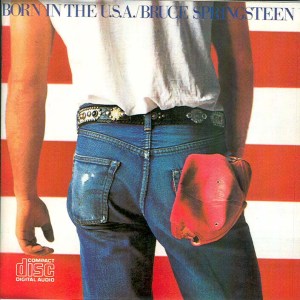
I seldom gush, nor am I given to great displays of emotion. Although I appreciate great accomplishments in others, I have never considered a living person a hero. Only Bruce Springsteen. An article in the newspaper yesterday described the first academic conference on the Boss’s music, held right where it all began — New Jersey. Unfortunately unable to attend, I relish the fact that others see in Springsteen what must be something like I see.

Last year at the Society of Biblical Literature Annual Meeting in Boston, I picked up a copy of a new book, The Gospel according to Bruce Springsteen, by Jeffrey Symynkywicz (Westminster John Knox, 2008). I am not a fan of “Gospel according to —” books, but there is a trenchant depth of struggle with religion embedded in Bruce’s songs that transfixes me almost as much as Melville’s Moby Dick. Now, this is deeply personal with me. I don’t discuss my amazement that borders on worship of Springsteen with anyone. Coming from a decidedly blue-collar background, and having wrestled against circumstance for everything I’ve earned, including my degrees, I hear resonances of empathy throbbing through what Bruce sings. He is not an icon; he is an authentic human being. And his music is a gospel.

Boss

I haven’t read Symynkywicz’s book yet. Whenever I’ve tried to read the popular bios of the Boss I soon become frustrated at how trite they all make it sound. Having survived (barely) the Reagan-Bush era with its utter lack of sympathy for the condition of most Americans, sometimes I just need to crawl into the corner alone, slip on the headphones, and listen to Nebraska over and over again.