Reflecting on Light

Now that we’re approaching the winter solstice, light is pretty much on the minds of those of us in the northern hemisphere.  Or lights.  The use of Christmas lights and Hanukkah lights may have symbolic value to the religions that promote them, but both also reflect the pagan use of sympathetic magic to bring back the light.  Human beings tend to be visually oriented, and many of us feel the increasing darkness deeply.  Days are brief enough to be awake for the entirety of daylight’s duration, and then you still have to get home after work.  After dark.  All our enlightened hours are spent for the benefit of the company.  It takes its toll.  And so we string holiday lights, bringing cheer into the preternaturally long hours starved for illumination.

Although the snow hasn’t stayed around here, I did notice an interesting reflection of light outdoors the other day.  The windows of a house were casting a light-shadow on a fence that had the look of a cross.   It took some convincing to assure me that this was pareidolia—the assigning of intentionality to random “signal.”  We see faces where they don’t really exist, and when we see crosses in this evangelical haven of America we have to assume they’re intentional.  Sometimes, however, they’re simply a trick of the light.  The sun has a low angle this time of year, and the light that is otherwise scattered back into what is wonderfully termed airglow—the natural illumination caused by sunlight as its luminosity brightens the daytime sky—is focused lower.  Light takes shape and sometimes it seems religious.

 

In New York City, where repeated patterns are pervasive, such reflections often appear on neighboring buildings as “X-Files” symbols of Xs in circles, giving the city a mysterious look.  Out here, however, they appear as crosses.  You see what you want to see.  Or, sometimes you can’t help seeing what appears utterly obvious to credulous eyes.  I’ve had people insist that crosses like this are intentional.  In reality, they’re a natural result of rectangles reflecting the morning light when the sun follows its low profile ecliptic during the waning of the year.  That doesn’t mean that it can’t be read for something else, of course,  Religion is all about interpretation.  Light forms patterns and seems strong enough to banish darkness.  And given how many hours it’s dark these days, I’m willing to take what help I can get.  The solstice will soon be here.


Christmas at the Bus Stop

I had to make one of my periodic treks into New York City this week.  Unlike most years when a warm spell comes after the onset of winter, we’ve kind of fallen straight to the heart of the season this year and those of us standing in line for the bus were experiencing it via wind chill.  The cold got some regulars to talking about Christmas.  Although I’m not the oldest one who makes this long trip, the majority of the commuters this far out have yet to attain my years.  Those chatting at the stop had kids at home that still believe in Santa Claus.  It made me recall how we trick our kids with all kinds of quasi-religious folkloric figures, but also how seriously some adults participate in the mythology as well.

Among those chatting, the leaving out of cookies and carrots was almost canonical.  The cookies are for Santa, of course, and the carrots for the reindeer.  The more I pondered this, the more it became clear that this is a form of thank offering.  The story of Bel and the Dragon, in the Apocrypha additions to Daniel, tell of how priests leave out food for an idol.  The offering is gone in the morning and the credulous worshippers assume the statue has eaten it.  Religious offerings, except those entirely burnt up, were often used to support priesthoods.  Santa has his elfly acolytes, of course, but the priesthood for his cult is that of parents eager to make Christmas a special time for their children.  Capitalism’s big pay-off.

Then one of the commuters mentioned how she had her husband leave a footprint in the fireplace ash to add verisimilitude to the ruse.  We never had a fireplace when I was growing up, and I often wondered how Santa got in when we had no chimney to come down.  In any case, my hazy morning mind thought once again of Daniel and Bel.  The way that wily Daniel exposed the fraudulent priests was by sprinkling—you guessed it—a fine layer of ash around the offering after the priests had “left” for the night.  In the morning he showed the people the footprints of the deceptive heathens to the people.  The statue hadn’t eaten the food after all!  Serious consequences followed.  Christmas, despite its commercialization, brings fond childhood memories to many of us, and we’re reluctant to let that go.  The one man in on the discussion (it wasn’t me) said that when he was growing up they had a somewhat different offering.  “My dad,” he said, “told us to leave Santa a beer and a sandwich.”  This guy’s name might’ve been Daniel.


Not so New

I remember it clearly.  The ubiquity of technology robs me of the memory of how I knew about it, but there was plenty of pre-internet buzz.  A new Bible translation was being published and people were very excited.  Including me.  By the time the New International Version (NIV) was set to appear, I had read every translation of the Good Book I knew, cover-to-cover.  Being a good evangelical, I started with the King James.  I’d read it a time or two, then moved on to the Revised Standard Version.  As you might guess, with my interests I didn’t have a lot of friends, but I do recall people complaining that it wasn’t literal enough.  I’d read the Living Bible, and the Good News Bible.  My favorite was probably the New American Standard Bible, though, because it was as close to languages I then didn’t know as I could get.

We didn’t have much money in my family, and since my summer jobs covered the cost of my school clothes, disposable income was fairly rare.  But then a miracle.  Christmas morning I opened my “big gift”—a brand new NIV.  In a way that is somehow difficult to recapture these days, I was absurdly happy getting a new Bible.  I started reading it right away.  Little did I know it would become the best-selling modern English translation of all time.  And that’s saying something—Bibles are big business.  The reason for the NIV’s appeal was that it was Evangelical-friendly.  No awkward issues like inclusive language, and, to be honest, a nicely rendered English.

Being in the Bibles business I decided to read about who was behind the NIV and found an unexpected connection with Rutgers University, where I used to teach.  The owner of the NIV translation is Biblica.  Biblica is the name of the International Bible Society, initially founded in 1809 as the New York Bible Society.  In a way that’s hard to imagine in today’s New York City, that’s where the group formed.  One of its founders?  Henry Rutgers.  Eventually the New York Bible Society became international, and like many good evangelicals, moved to Colorado Springs.  The money from continuing sales of the NIV must contribute to their somewhat posh-looking campus.  Meanwhile, Rutgers University has moved in quite a different direction.

Connections like this have always fascinated me.  Although much detritus has flowed under the bridge with all that water, I can still feel that brief, sharp release of endorphins when I pick up my well-used NIV.  I think of days of naive faith and all that has come after.  Yes, Bibles are big business, and yet somehow so very small.


Museum Monsters

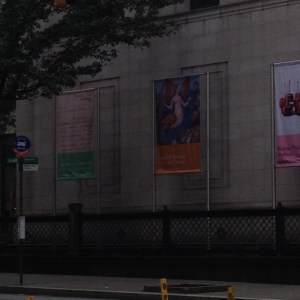
Timing has never been my strong suit.  As soon as I stopped my daily commute to New York City, the Morgan Library and Museum opened a display titled “Medieval Monsters: Terrors, Aliens, Wonders.”  To appreciate the irony of this fully, you need to realize my office was just across the street from the Morgan Library, and the daily visits would’ve provided a good opportunity for a lunch-time break with my beloved monsters.  Instead I was spending the time moving further west and unpacking.  Still, displays like this are a tacit form of validation.  Those of us who admit, as adults, that we like monsters huddle under a cloud of suspicion.  Monsters are a matter for kids—like dinosaurs and fairies—not something on which an upwardly mobile adult spends his time.  We’ll take whatever validation we can get.

Perhaps we’ve been too hasty to dismiss our monsters.  Even the Bible, after all, has them.  They help us cope in a chaotic and uncertain world.  A world of hurricanes and Trump.  A world lacking compassion and sense.  Monsters have always been symbols of the borderlands.  Creatures that cross boundaries and that shouldn’t exist but somehow do nevertheless.  Science has helped us understand our world, but in our desire to grow up enough to use Occam’s razor, we find that it shaves a little too close.  Besides, what can be more unnatural than shaving?  When we lose our ability to believe in monsters, we lose a piece of our ability to cope with an unpredictable world.  Monsters have their practical uses indeed.

If the world were more predictable, I would still be teaching instead of editing.  Or I’d still be living in an apartment rather than a house.  Moving is chaos embodied.  Like monsters, it’s best left to the young.  It’s just like this world for a monster display to open just across the street right when you’ve moved out of town.  I should expect no less in a cosmos marked by uncertainty.  Medieval Monsters isn’t the only museum display of the weird and wonderful.  Monsters have a way of showing up again once you think they’re safely gone.  Family and friends share with me their visits to other monster exhibits at other museums.  They may wonder at my fascination with them—an adult with a sober doctorate in the field of history of religions, biblical studies, ancient Near Eastern religions, whatever.  It’s kind of a monster in its own right, on display here daily.  If you happen to miss it, don’t worry.  It’ll remain lurking in its own corner of the internet.


Museum Haven

At various points of my career I’ve applied for museum curator positions.  Since those who actually land those jobs have degrees in museum studies, I’ve never gotten as far as an interview.  Still, I like to think I’d be good at it.  I spend time in museums and I’ve been told I have an okay eye for design.  And I recently read that museums are educational institutions.  That makes sense since people tend to be visual learners.  (This is something I took into account in my classes as well, illustrating lectures to make a point.  The traditional academic feels that pictures are somehow “soft” learning as opposed to the harsh realities of text and word-based instruction, but I beg to differ.)  We see things and they stick with us.

On a visit to the New York Historical Society museum I once looked at their somewhat abbreviated sculpture collection.  This isn’t the Met, after all.  One of the tricks I’ve learned about museum displays is that some curators place subtle humor in their framing of objects.  For example, my gaze was drawn to a figure of a pilgrim.  A stern-looking fellow, he’s captured in full stride, massive Bible tucked under his arm, determined frown on his face.  This is a man trying to create Heaven on earth, dour though it may be.  Taking a step back, my camera found a smile in this image.  On either side of this angry Christian were two naked women: one was apparently Artemis with her bow, the other perhaps a Muse.  The lines of the display draw attention to this juxtaposition.  There’s some humor here, intentional or not.

This also takes me back to yesterday’s post about Heaven.  Perceptions of what it is differ.  There’s a mindset like the pilgrim that sees a life of suffering being rewarded in the hereafter with endless bliss.  I do have to wonder whether too much hardship down here might not make one forget how to enjoy oneself.   It’s difficult to picture a Puritan in rapture.  It’s as if the journey—the hard road—is the real source of enjoyment here.  Each of us, I suppose, has her or his own view of Heaven.  Mine’s kind of like a library with all the time in the world without end to read.  Others, I suspect, would find paradise as a garden.  Yet others would see Heaven as a kind of museum, but it would be one where laughing out loud was okay, for the Curator definitely has a sense of humor.


Slow to Travel

A family friend recently died.  I was in New York City when I received the news, and I mused how recent a phenomenon this speed of information is.  The news wasn’t necessarily a shock—this friend had been experiencing failing health, he was a close friend of my grandfather—but for some reason Samuel F. B. Morse came to mind.  The story goes that Morse invented the telegraph because of his experience of being away from home when his wife died.  By the time he received the news and was able to get home by the conveyance of the day, she’s already been buried.  He set his inventive mind to improving the speed of communication over a distance.  In these days of receiving texts mere seconds after something momentous happens, it’s difficult to imagine that for the vast majority of human existence, personal news traveled slowly.

Feeling in a reflective mood I recalled how when I was in college I wrote letters home.  Yes, the telephone existed by then—don’t be so cynical!—but long distance bore a cost and college students find ways to save their money for girlfriends or spending a weekend in Pittsburgh.  News traveled more slowly.  Back before Morse, the swiftest option was the letter.  The death of a friend might take days or weeks to reach those close.  Distance in time, as well as space, may not have lessened the shock, but the immediacy of a text wasn’t there.  The death had occurred days or weeks ago.  There was nothing left to do but grieve and get on with life.  Like Samuel Morse—perhaps the only point of comparison between us—I was unable to get away immediately.  New York City isn’t easy to escape quickly.

We move swiftly and slowly at the same time.  I know news moments from the event, but this physical mass I inhabit is sluggish takes some time to get around.  Manhattan’s an island, and although it’s not Styx we’re crossing, the Hudson creates barriers enough.  Now my journey includes crossing the entire state of New Jersey before I can even reach home.  Were I to drive back to my original home, it would add another five hours at least in the car.  Sometimes I wonder if the immediacy of knowing is a blessing or a curse.  The shock is immediate and visceral.  But like an injection, the sharpness is quickly over and the dull ache sets in.  Our family friend had been suffering for some time.  Now he’s at peace.  I like to think he’s with my granddad, and that the two of them together won’t judge me too harshly for moving so slowly.


Stand-in Line

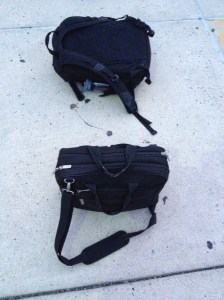
Pop culture borrows from religion without knowing it.  Or maybe it’s just that religion has become so irrelevant that people no longer care.  Whichever may be the case, those who contribute to pop culture have a rich treasury from which to take withdrawals.  This occurred to me while waiting for a bus into New York.  Many people don’t want to stand in line (who does, really?).  In the Park-n-Ride subculture, you may leave an avatar in your place.  It’s probably not called an avatar, but since there’s nobody here to ask, I’m going to use the pop culture name.  You put your bag on the pavement, marking your place and then go sit in your car.  Since I’m going to be sitting in a big car for the next two hours, I prefer to stand outside.

The idea of an avatar is mediated to most people through either computer language or the movie.  I first encountered the term in the former sense in Neal Stephenson’s Snow Crash.  I was an internet neophyte and had trouble conceiving a virtual world in those days.  Some time later came the latter.  James Cameron’s film embodied the idea—linked through software, the tired hardware of physical bodies could be given new life.  In some senses it was an even better life.  Now everyone knows what an avatar is.  Perhaps except that the idea is native to Hinduism.

Hinduism was never an organized, intentional religion such as Christianity.  It is rather a wide array of traditional beliefs that, in the light of missionary activity, had to be given a name.  There are many gods in Hinduism, and when a deity descends to earth s/he appears in a form recognizable to humans—an avatar.  Not being an Indologist, my understanding of the concept is very basic, but it’s enough to know that this religious idea found a role in pop culture first through computer representations of human beings.  We had flattered ourselves with being gods, since we had created a virtual world.  A world we couldn’t physically enter.  Avatars were, therefore, how we wanted others to experience us.  Snow Crash is peopled with all kinds of representations.  The internet today, nearly 30 years on, has many more.  After all, there are many gods.

I glance at my watch.  The bus should be here any minute now.  When it enters the lot I’ll see the deities behind these canvas and leather avatars.  They’ll be less impressive than I’ve imagined them, I’m sure.  And although we’ve created virtual reality, I still have to get on a physical bus to go to virtual work.


A Star in the East

The times they are a, well, you know—nobody wants to violate copyright.  In any case, nothing stays the same for long.  New York, for example, is a city in a constant state of transformation.  Fully grown buildings now stand where there were literally holes in the ground when I began working there.  One building near Times Square recently had a facelift that revealed the steel girders beneath.  On the I-beam were the words “Bethlehem Steel.”  And it’s not just New York.  Our cultural transformation has been taking place over the last few centuries as populations have moved to urban areas, abandoning farming to the few who remember how.  Being from western Pennsylvania, I pretty much thought the eastern part of the state was Philadelphia.  I’d heard of other urban regions, of course, such as Scranton and Allentown, but they were well outside my experience.  We didn’t get out much.

Now that I’m here in the eastern part of the state, I’m begun to explore the ever-changing micropolitan area of Allentown-Bethlehem-Easton.  The three cities blend at the edges, and this region is the third largest population zone in the state, after Philly and Pittsburgh.  It’s also the fastest growing region in the commonwealth.  I suppose we might’ve helped with that statistic.  The other day I had to run an errand in Bethlehem.  I pulled over to marvel at the hulk of what had once been Bethlehem Steel.  Now, I grew up in a town with an active steel mill, and Pittsburgh grew to fame for the same metal, but this was a behemoth of a plant.  Subdivided and open to development, it now houses a casino, in part, and an arts center.  And still there’s more space.

Bethlehem was founded on Christmas Eve by the Moravians.  Perhaps appropriate for a town trying to resurrect itself, Bethlehem calls itself the Christmas City.  Star imagery abounds, and many businesses name themselves with this Christian symbol.  The image is quite different from that of a steel city with hard-working men on the shift.  The grime and din of industry.  Bethlehem, like many places in the state, was named for its biblical forebear.  On my visit to the original Bethlehem many years ago I was, like many tourists, disappointed that it isn’t “O little town of” anymore.  There were people everywhere and it was difficult to imagine a quiet stable inside a noisy stone church thronging with the faithful.  Clearly things don’t remain unchanged for long, even in towns famous for their remoteness.  Although far from New York, they share a common heritage of people everywhere, and that heritage could bring us peace if only we would allow it.  The answer, it seems, is blowin’ in the, well, you know.


The Distortion of Absence

I’m sure it’s happened to you, too.  After some time away, you return to somewhere familiar.  For some reason this doesn’t seem to apply to places you spend only a little time—for example, the cabin where I tend to go on vacation every year.  Rather, it impacts quotidian spaces, the places you see nearly every day.  Returning after an absence, the place looks strange, as if you’d forgotten what it was really like.  A fairly common example is a college dorm room.  When you return to it after, say, the winter holiday, it looks not quite how you remembered it.  It’s a little smaller or larger than you recalled, or you didn’t remember that the floor tiles were that color.  Within a day or so the feeling disappears and you accept the “new normal.”

The strange, or unfamiliar, is the source of many monsters.  Freud famously phrased the uncanny as “unheimlich,” un-home-like.  It is close to what you expected, but not exactly.  The uncanny valley is that place where things are about right, but slightly off.  It generates a creepy feeling, as if reality is being distorted.  On a business trip to Boston a few years back I visited Boston University School of Theology, a place where I spent over two years in my twenties.  745 Commonwealth Avenue hadn’t been renovated, but I stepped inside and was stunned by how wide the hall was.  In my mind it had become far narrower.  It was downright disturbing, as if I’d walked into somebody else’s past.  It made me wonder—is any of this really real?  Or more frighteningly—is my memory that fragile?

I recently spent a day working in the New York office.  While the office itself seemed the same, the city did not.  Emerging from the Port Authority Bus Terminal I knew exactly where I was.  Or did I?  I’d walked roughly the same route daily for almost five years, and two years before that a similar track.  It was as if the bus had exited the Lincoln Tunnel into an alternate Manhattan.  Unheimlich.  I’ve returned to many places after being away for awhile and this distortion of absence always creeps me out.  Can my memory be that faulty or is all of this an illusion?  The gap between present reality and remembered reality provides crevices into which monsters crawl, waiting.  By the time I reached the block of my office the feeling had gone away.  But somehow, the monsters remained. 


Religion in the City

It’s 5 a.m., so what are all these people doing here?  On the highway.  It’s still dark and I’m on my way to the choice of public transit that will take me to New York City.  You see, telecommuting is never 100% city-free.  Somehow I’d been thinking that once we’d gotten away from New York things would be quieter.  Then I remembered that in two decades, if current trends and models continue, nearly half of the US population will live in just eight states.  New York and Pennsylvania are two of them.  Those of us who’ve moved here to get out of the rat race have made our own little mouse race, I guess.

Being in the city after an absence of almost three weeks was a shock to the system.  The first things I noticed were how loud and crowded it was.  In the summer Manhattan has, I was forcefully reminded, lots more tourists than the winter months when it feels like, as one comrade says, Leningrad.  As always when I’m in the masses on the streets, I think about how religious New York City is.  And how secular.  It is, I suspect, a cross-section of American (and international) beliefs.  People come here looking for something transcendent.  Otherwise, why leave home?  Tourism can be a sacred industry.  It brings people from different places together and, in the best of circumstances, forces them to get along with one another.

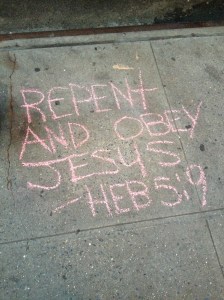
There are plenty who seek to convert those who are different.  On my way to Penn Station last night, as the light was beginning to fade in Herald Square, I woman had set up a portable mic and speakers.  She was preaching, ignored, to the evening crowds.  Among the strangers are those who believe differently.  Those who are ripe for conversion.  It’s all part of New York’s background hymn.  Then on the sidewalk I spied, scrawled in chalk, “Repent and obey Jesus — Heb 5:9;” the writing on the walk.  “And being made perfect, he became the author of eternal salvation unto all them that obey him” the selected verse reads.  We can overlook that it says nothing about repenting.  This is, after all, the melting pot where religions encounter, mingle, and blend.  Even the Fundamentalists must feel it from time to time.  The traffic home at 10:30 p.m. is quieter.  The day, I will learn, is not over yet.  Such is religion in the city.


Starting Something

Starting your own religion, I’m told, just takes patience.  You may have to die before it gets off the ground,  but if it’s a religion you’re starting you get to make the rules.  Well, until somebody else starts interpreting what you wrote.  I grew up thinking a religion had to be ancient to be real.  There’s a certain comfort in untestablity—you can’t verify the facts, so you accept them.  It took many years before it dawned on me that new religions rely on the same premises as old: someone has received the truth (at last!) and is willing to share it with the world.  Followers emerge—true believers.  And then they begin to change things.  “The founder meant this,” they argue, and really they’re starting their own sub-branch of the religion.

Not everyone is convinced by this ancient religion paradigm.  Zarathustra, for example, set out to create his own religion, according to tradition.  Jesus, it seems, was trying to reform Judaism.  The process never stops.  A couple of weeks ago in New York City I saw an adherent of a New Religious Movement.  This one had started in the 1930s.  The man appeared a little older than me, so his life may well have overlapped with that of the founder, or they might’ve missed each other by a decade or two.  Already, however, the religion had grown into its own entity, and it doesn’t seem to worry adherents that the truth was being revealed, for the first time, maybe in their lifetime.  You have to start somewhere.

So, if I were to start a new religion, what would it be?  For a variety of reasons I think I’d call it Moby.  The connection with Melville is palpable, but that wouldn’t be the reason for the name.  (Religions must have a sense of mystery, otherwise they can be analyzed until they look illogical.)  Like Unitarian Universalists, I think the religion would be more about what you value than what you believe.  Belief can be shifting sands.  New information can lead to new results—this is one of the weaknesses of religions developed when the earth was still the center of the universe.  Heaven is now outer space and Hell is earth’s iron core.  Moby would avoid such a doctrinal morass by not having doctrine.  It would need rituals and ceremonies, of course—no matter what Mr. Spock wannabes say, we need emotional engagement and ritual has the goods.  All of this requires patience, because who has the time to develop a new religion when there are only two days in a weekend?


A New Look

I beg the indulgence of my regular readers as I post a public service entry today. As I noted a few weeks back, I have filled the allotted free space on WordPress. That meant I had to move to a paid plan and what with all the extra space in here I hired a professional web-designer to help me spruce the place up a bit. This note is to let you know that within the next 24 hours the appearance of this website will change dramatically. Don’t worry, Sects and Violence in the Ancient World will still be part of it. I hope that, if you subscribe, you’ll be willing to move that subscription to the blog page because I’ll continue to use it. The new home page will allow me to attempt to bring my books to the attention of the world while continuing to do whatever it is I do on a daily basis here at the blog. Since you’ve been kind enough to read this far, I figured I could share a little of my thinking about the blog in an exercise in meta-narrative.

First of all, the title. Why do I call the blog “Sects and Violence in the Ancient World”? As much as I’d like to say it was an intentional quasi-anagram involving my initials and other key letters of my full name, that wasn’t actually it. This blog began as a summertime conversation with my extended family while on vacation. I hardly knew what a blog was then (and some would argue I clearly don’t know what one is even now!), but but brother-in-law suggested it as a place to do some podcasting. (I did, until I started working in New York City, which ate up virtually all of my free time during the week.) One of my nieces said “What would you call your blog?” Off the top of my head I said “Sects and Violence,” well, you know the rest. I originally had hopes that my career teaching ancient West Asian religions would continue some day. Indeed, I still post in that area, but my interests have shifted a bit since then. The main theme of the blog has remained religious studies, broadly conceived. I don’t limit myself to that, but I do use it as a personal pole-star.

Writing is its own reward. And besides, WordPress told me I’d run out of space. The next time you check in here, things will probably look a bit different. The blog will still be there, but there will be some other pages and features. Thanks for coming at least part way on the journey with me. And when I run out of space again, we’ll see where it goes from there.


Dreaming Reality

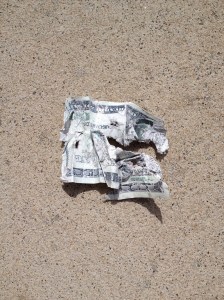
It was like that dream—you know, the one where you find a penny on the sidewalk, stoop down to pick it up, and discover that there are hundreds more of them. Maybe that’s the kind of thing those born in humble circumstances dream of, but we all recognize the draw of a windfall. People are pretty tight with their money in Manhattan, but it was early in the morning, still dark, and rainy when I saw it. A hundred dollar bill on the ground. Then I noticed more—a while bunch of them. When I reached down to pick one up, it came apart in my hand. Of course, it was a novelty replica of an actual piece of currency. When I walk through the garment district I often find great swatches of scrap cloth that have spilled out of designers’ trash bags. I’m tempted, I’ll confess, to pick them up and save them for future use. Nevertheless, this hundred dollar bill wasn’t what it appeared to be. Many things aren’t.

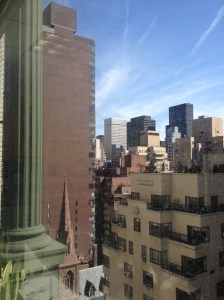
Religions around the world are predicated on the fact that what seems to be real isn’t. Even long before The Matrix came along. The idea that what occurs in our heads—or to use more conventional religious language, our hearts or souls—is truly real automatically takes us a step away from material reality. It’s not to say that this soggy, pulpy piece of paper in my hand has no existence, but it simply isn’t what it pretends to be. On mornings when the fates are all synched just so, I’ll look out the window of the bus from the helix and see Manhattan laid out in front of me like a picture postcard. “It’s not real,” I whisper to myself. Unlike the tourist in awe during a first visit to the city, I actually mean it. This concrete, glass, and steel world is not real. I’d feel a bit exposed suggesting such a thing on this blog had I not the biggest names in world religions behind me. One thing that they all seem to agree upon is that reality isn’t just what we experience in this corporeal vehicle that we currently call home.

Religion has been called the opium of the people. Marx wasn’t the first to suggest that the more needy among us were the driving force behind belief. Nevertheless, belief is present in all forms of thinking from extreme rationalism to naive acceptance of what your parents told you. The thing about religion is that it conscientiously advocates belief. It admits up front that it holds certain things to be true. One of those beliefs happens to be that things are not what they appear to be. Here in Manhattan we’re all so busy rushing around that who has the time to stop and think like that? I frequently walk past Holy Innocents church on my way to work. I may function, in this world, as an editor of biblical studies, but as I pass that edifice to a faith to which I don’t even belong, I feel the draw. Inside those doors—and I know this is true because I can sometimes hear the bells—a different reality awaits. Out here there may be hundreds of dollars scattered on the ground. When you look closer, however, you discover that they’re not what they appear to be.


Power in the Bus

“You’re not in control on a bus” my friend Marvin once wrote, in his short story “O Driver.” The commuter is the consummate captive. I don’t like to beat dead horses—we might need all the horses we can get before this is all done—but some commuters need to learn silence is golden. I take a very early bus with some hope that we might beat the inevitable traffic jams coming into New York in the morning. Every minute counts. Some people, however, feel compelled to comment when they think the bus is early. They’re already sitting on the bus, so what’s the problem? There’s another coming in 30 minutes and those of us concerned with getting in before the traffic make a point of being at the bus stop, well, early. The other day a guy got in at the stop after mine. He told the driver that the bus was running early (it actually wasn’t) but the driver obligingly sat for several minutes. The commuter’s always right, right? We got into the Port Authority late that morning. All because of one man’s mouth and his inability to keep it shut. I wonder why they even have that sign saying not to talk to the driver. That only applies when the bus is in motion. So…

The very next day the driver on the route was new. She was on time. Until. To understand this, you need to know my route is an express—it is entirely highway except for one short jog into another town about 10 miles down the road. My driver was doing great. “You missed the turn,” another passenger said. The driver apologized. A three-point-turn in a bus just isn’t possible on the highway, so she had to drive to an exit, wait for the light, and turn around. We were now speeding west, heading to New York City. The passenger, now acting as GPS, didn’t know this area very well. “Take the next exit,” she instructed. The driver dutifully did. It was a ramp with no reentry to the highway. We were touring rural New Jersey for some time before the driver found a place to make another U-turn. “Missing the turn,” the passenger now said, “That turn’s inconsequential. There’s another bus that comes just after this one.” She’s right. No less than three routes into New York follow that jog. But it was too late for us now. Finding our way to the highway, we again headed west. This time our driver took the correct exit, apologizing all the way. The next day we had a new driver.

Actions have consequences. For each and every action there’s an equal and opposite reaction. I learned the latter in physics class. The former is a life lesson that might properly be called the mother of morality. When you talk on the bus you’re taking charge of about fifty lives. It has become clear to me through my years of commuting that most people shouldn’t have that kind of power.


Urban Evolution

They say ten city blocks are a mile. They also say the internet is fast. Putting these two theorems to the text, I’ve logged several foot-miles in Manhattan to find things that aren’t there. I don’t mind the exercise, but apparently the web can’t keep up with Midtown. I’ve been working in Manhattan for going on seven years now. I very seldom leave the office during the day, eating at my desk and trying to give the man his due. Once in a great while there’s something I’m either compelled to see, or that I must find for various reasons. Almost without fail, such lunchtime expeditions lead to frustration. I recently had to visit a business that shall remain nameless (conflict of interests, you see). According to Google Maps it was a mere ten blocks—a mile—from my office. At a brisk pace I could make it there, transact my business, and return to my cube all well within an hour. As I grew close, I got that sinking feeling I recognize now as internet ghosting. Nothing remotely like my goal was at this location.

I walked in and smiled at the man at the security desk. He was even older than me. “Ah, they used to be here,” he said, “but they left a long time ago. Long time ago.” Apologizing in advance, I asked if he had any idea where they might’ve gone. “I heard they moved across from Bryant Park, on 6th Avenue. But I heard they moved from there, too. You might try it, though.” Since this was roughly in the direction of my office from where I was, I decided to swing by. When I worked for Routledge I went by here every day, and I didn’t recall ever seeing this particular business there. Their security guard was equally as friendly. “I’m afraid there’s nothing like that here.” I had to return to work. When I got back to my office and googled their store locator, the website froze. This was truly unobtainable via the internet.

Some times you’ve just got to let your feet do the walking. Things aren’t always where the internet says they will be. I’ve come to realize that New York City is constantly changing. Buildings now stand where mere holes in the ground used to be when I began working here. Commuting in daily all these years is like time-lapse photography of a plant growing. Buildings emerge behind the green plywood walls, and next thing you know what used to be a synagogue is a new retail opportunity. It may not, however, be the business you’re looking for. Before spending your lunch hour walking a mile to get there, you might try calling first.