Historic Crossing

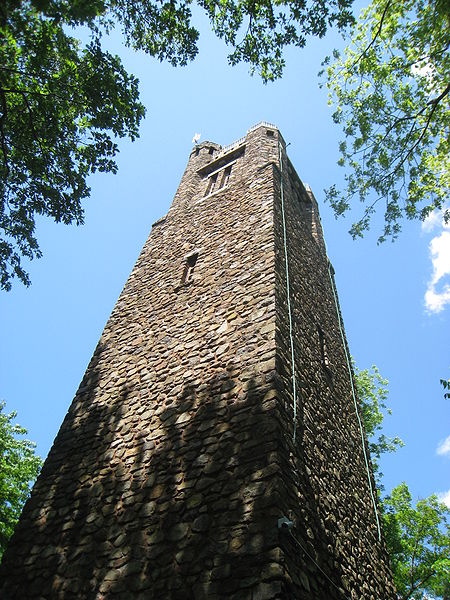
If Washington crossed the Delaware, I figured, so could I. Of course, I have a car and I was going from New Jersey to Pennsylvania, but history doesn’t always repeat itself precisely. In New Jersey, the landing side of the crossing, a modest park marks the spot, along with plenty of space for outdoor activities. Pennsylvania, meanwhile, has a tripartite park which includes sculptures, an historical village, and a tower. The tower was built from 1929 through 1931 in commemoration of the momentous crossing. My mother visited the site as a teenager, some few years after it opened. On a mission to recapture part of her childhood, I made a visit to see a bit of history, and also to experience the great views. As far as towers go, this one isn’t the tallest, but in Bucks County, it is among the highest points and you can see for many miles on a clear day. On the top of the tower I overheard a man explaining to his family that Washington built the tower in the 1700s and that it was used in the Revolutionary War. He lamented that it would be easy to be trapped on top of the tower, and urged his kids to imagine what it would have been like.

DSCN4865

My thoughts went to the Bible. We’ve come to know through archaeology and comparative sources that many of the events portrayed as history are about as accurate as having Bowman’s Tower built by a long-deceased George Washington. And yet we continue to teach children that stories for which no evidence exists are history. We don’t always have a good grasp on how to tell the difference. In the United States George Washington is nearly divine in reputation. His travels are attested on an almost omnipresent scale; even my childhood home of Franklin, a tiny burg near the Ohio border in Pennsylvania, saw visits from the general. I grew up knowing little of the history of the man who would become the first president. I did know, however, that he’d crossed the Delaware.

History is not so easy as it seems. What “actually happened” on the ground may not offer much meaning to those who seek it. Only when the events become story—sometimes sacred story—do we start to get a sense of why the Bible has such a grip on a large swath of the human race. It is story with no apology. Its historicity is far beyond recoverability: who saw the creation of the world? Even the events in the human timescale were written, for the most part, centuries after the occurrence, with all the liabilities that entails. Built by members of the Washington Crossing Park Commission, the park I’m visiting intends to demonstrate the importance of a singular event that led to the freedom of an entire nation. Indeed, the crossing of the water to free a nation has a distinctly biblical feel to it. And even if that first exodus never happened, we tell our children it did, and we have no less a figure than George Washington building a tower to prove it.


The Tower

Photo credit: Daderot, Wikimedia Commons

Photo credit: Daderot, Wikimedia Commons

I’ve never been to Bowman’s Hill Tower. In truth, I’m not even sure what its significance might be. Beyond giving a spectacular view of the Delaware River valley, it is my understanding that it is a memorial built to George Washington and his many activities in this region. It’s not even that old. I have come, however, because of a memory not my own. Many decades ago, my mother visited the tower with her parents. She has pictures but couldn’t remember the name of the tower, or even where it was. As fate and happenstance have it, I live a mere hour away and I’ve undertaken this journey to a tower I’ve never seen to bring a sacred sense of place back to life for someone else. Too bad the park is closed today. It is a sunny Saturday in July, and it seems that everyone is outside. We drove across that impossibly narrow, rickety bridge between New Jersey and Pennsylvania at Washington’s Crossing (so named on both sides in both states) to find our way to this quiet park to find a lost past. “Closed” the sign laconically says.

The urge to travel, speaking strictly for me, is the pursuit of sacred space. Over Independence Day weekend we traveled to Boston not only to see fireworks, but to revisit a site of some personal significance. In my three years in that city life took me places I never imagined I might have gone. The memories, mine this time, although hazy, still permeate the air. Boston is a sacred city. Since childhood I have had dreams of Maine. From Boston I pushed further north to the rocky coasts and gray oceans of the stormy north Atlantic. Although neither God nor angel appeared, I knew that I had once again discovered the sacredness of space. Every time I leave, I count the days until I might return.

Many locations are sacred to a person. Some of mine are in the west, and some in the east. And when I’m there I require some time alone, for the sacredness of space is a deeply personal matter. When, many years ago, I was jostled into the Church of the Holy Sepulcher amid ecclesiastical robes too numerous to identify, I knew this was a holy spot for many. The very dust of Jerusalem seems sacred with age. But what had happened to me here? Beyond the endless readings and rereadings of the biblical tales, Jerusalem was someone else’s sacred location. Aside from the dark crusaders’ crypts, there was no place to be alone. I’ve never been to Bowman’s Hill Tower. Despite driving to Pennsylvania for that sole purpose, it is a place I have yet to see. And when I finally do climb that tower, it should, I hope become clear to me whether anything of the numinous remains in this dusty corner of somebody else’s memory. Sacred space is like that, and it keeps some of us forever on the move.


Veni Creator Spiritus

Over 100 billion have been made. Not McDonald’s hamburgers, this time, but Crayola crayons. For many of us, Crayola is one of the distinct scents of childhood, and the vibrant colors Binney and Smith offered were inexpensive keys to creative expression. After a visit to the Crayola Experience in Easton, Pennsylvania over the weekend, I began to wonder how society might have changed due to the introduction of the inexpensive crayon. Reading about childhood in the Victorian era often feels like a Dickensian bleak view of want and wasting. Children learned their lessons in school, when they went to school, in black and white. The world of color was visible to them, but not ready to hand for representation. Maybe I’m under the spell of that Crayola smell again, but I wonder how giving a child a box of color changed the way the world was perceived.

DSCN4604

The Crayola Experience, like the showcase of Hershey, Pennsylvania, is not a factory tour. You’re not shown the inside of the place of business, but rather the public facing side of capitalism: the part that makes you want to buy. Even after the kids are grown. Nevertheless, the experience is one of wonder and imagination for young and old alike. Art is a deeply personal form of expression. Even as I sat at a low, brightly primary-colored table, shading away on my picture, I didn’t want anyone else to see it. This was my own self-expression. On the wall were quotes from children who were not quite so damaged as me, declaring why they decided to color the cow purple or the horse green.

DSCN4607

To participate in some of the activities you need to cash in a token; admission gives you three and more are available for purchase. The motto on the tokens is “In creativity we trust.” It is a motto that I can live with, for it seems that creativity is the realm of the divine. Otherwise, I find it difficult to fathom why a few hours amid such a juvenile pastime could be so utterly satisfying. It’s as if the rainbow, a religious symbol of my childhood, had been fractured out into countless variations and captured in wax for the expression of my soul. Breathing deeply of that paraffin recipe, I think how only the other major aroma of childhood—that of Play-Doh—can take me back to fantasies of innocent hours where the world demands nothing of you beyond being who you are. How quickly that grace period ends. And yet, for a few dollars we can go back for an hour or two, and remember what it was like to create entire worlds.


Inspired. Absolute. Final.

IMG_1394Recently I spent some time in my native Pennsylvania. Doing so sometimes makes me believe in a bizarre kind of predestination. I never had any truck with theological fore-ordainment; I’d rather just give up and get it all over with now. Nevertheless, the Bible was very present in the Pennsylvania of my youth and logic dictates that if something is, a priori, more important than everything else, only a fool wouldn’t pay attention. When we’d be driving along a country road and a prominent outcropping of rock was spray painted with “Jesus Saves,” I’d feel a quiet reassurance that my choices had been sound. I started reading the Bible as a child, toughing it through Leviticus and Chronicles, with true Protestant fervor. The Bible, I believed, could never let you down.

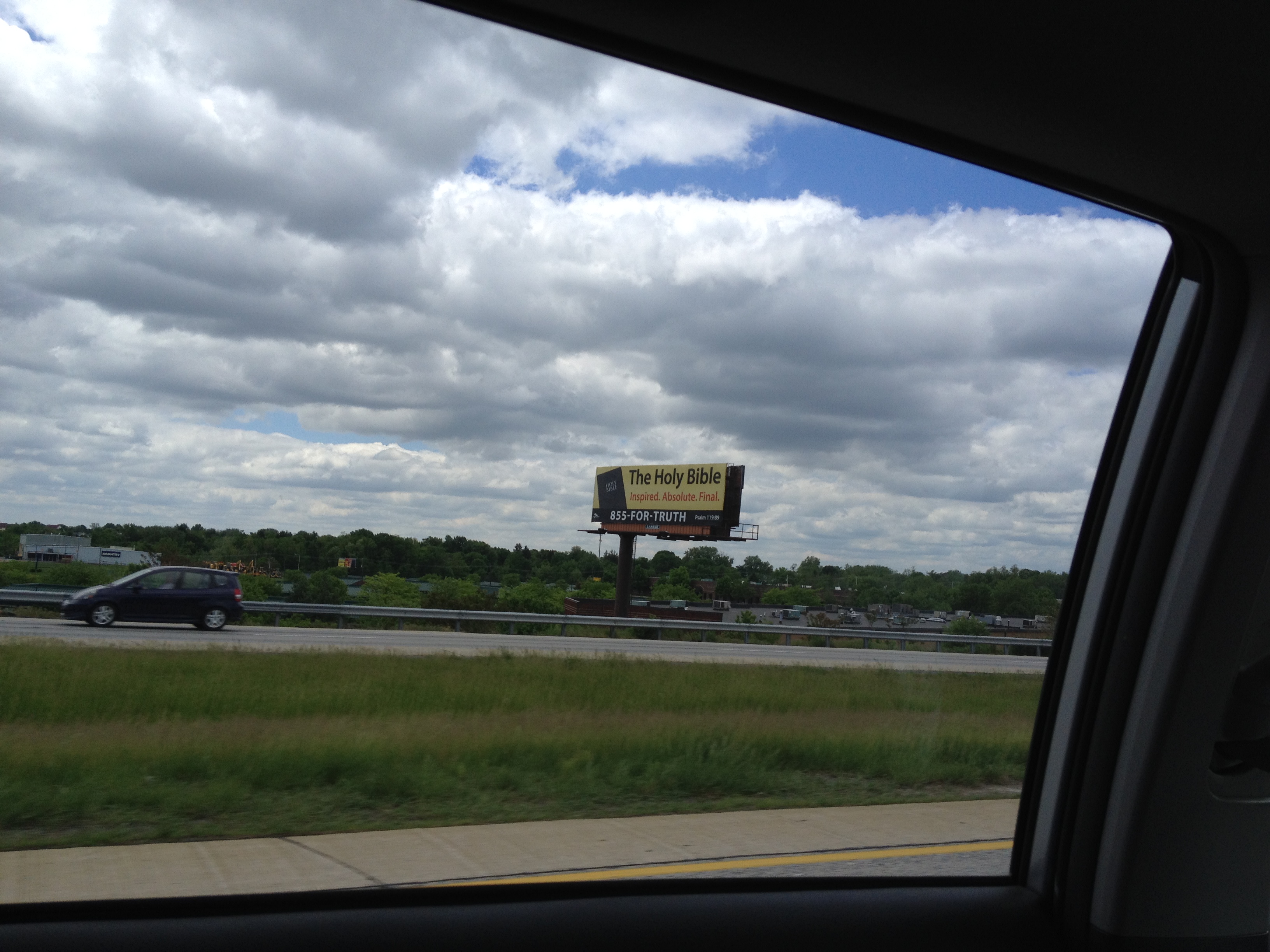
On my recent drive down memory lane, I passed a road sign advertising the sacred scriptures. It read “The Holy Bible. Inspired. Absolute. Final.” There was a number to call, ending with the words “for truth” in place of digits. Operator. Information. Get me Jesus on the line. (With apologies to Sister Wynona Carr.) The odd thing is that I always assumed this was normal. Ticking off the miles on Interstate 80, I used to see how many “Jesus Saves” graffiti I could find on overpass pylons. Even in Manhattan I still find the same phrase scrawled in the cement of a grimy sidewalk, and I always look for it when I walk that way. It was all so matter-of-fact that there seemed to be no reason to question any of it. The same held true for most of the faculty at Grove City College. No questions asked. Just read the highway signs.

Ambiguity toward the Gospel truth seemed wrongheaded and foolhardy. It is, however, difficult to take the Bible seriously without at last beginning to ask questions. Even the Bible has a backstory. Be careful how far back you turn the pages. There was a prequel to Genesis, for those who dare to look, just as their is a sequel to Revelation. Inspired—no doubt. Absolute—perhaps. Final—I doubt it. The last word comes only when all has been said and done, and given the signs I see along the road, it looks like this journey is only just getting started.


Buttons and Bows

I don’t remember what year it was, but I remember precisely where. On one of my countless trips out back—to or from school, to burn the paper garbage, pet the dog, or wander in the woods—I noticed something poking out of the dirt. The path between my step-father’s house and garage was well-traversed, and a little rise there was bald at the top, and what I saw emerging from its underground lair was round and dull. I’ve always had fantasies of buried treasure, so it is difficult to pass by anything suggesting a coin on the ground. This turned out to be a button. Not a regular, button, however. This was clearly military, and old. It was just appearing from a long rest under the ground and I didn’t know how long my step-father had lived in that house, but it had obviously been many years. There was no internet those days, but it soon became clear from my amateur researches that this was a Civil War era button. It still had a scraggly bit of dark blue thread attached. I never bothered to dig to see if the rest of the soldier was there.

Western Pennsylvania, while far from the striking Revolutionary history of the eastern part of the state, had seen its share of military transients. George Washington had established a fort in nearby Franklin, where I was born, and I was sure that more than a few Civli War soldiers had tromped through this area, although it was far from Gettysburg. I treasured that button and kept it with the very small coin collection I had amassed. It just so happened that our minister was also a coin collector. He took me to coin shows and we would sometimes exchange old pennies. One day he told me about his button collection. I mentioned my find, and he showed a great interest. In fact, he promised he’d complete my wheat-back collection from 1909 to 1958 in trade for my button. He ended up with my button, but never finished my penny series before some bishop shipped him off to another parish. History had slipped through my fingers.

Repeating patterns

Repeating patterns

Patterns are reinforced by repetition. One of the severe beauties of Manhattan is the rows and rows of identical windows. Patterns also persist in time. I stopped collecting coins ages ago, but I still squirrel away any wheat-back that lands in my pocket. Even in average condition a “wheatie” is worth double its face value. But face value is not always what it seems. Value lies in that in which we invest ourselves. I followed my mentor to seminary only to find myself traded off for many a finer specimen. Uncirculated, likely. This particular piece had been scuffed and banged against others so long that the patina warned that more might be hidden than meets the casual eye. And somewhere in rural western Pennsylvania there may be a dusty corpse just waiting to be discovered. Victims of war come are sometimes just beneath the surface.


Sowing the Wind

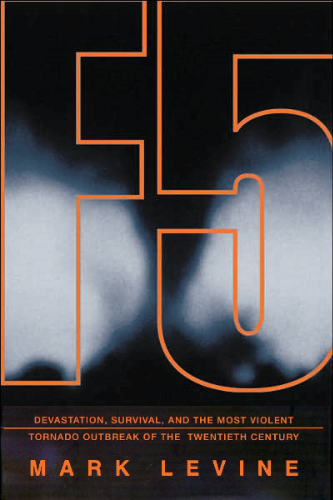
F5On May 31 in 1985, I was working at a church camp outside Uniontown, Pennsylvania when some severe storms rolled through the area. I had trouble sleeping through the thunder and lightning. I awoke the next morning to hear the news, in groggy disbelief, that tornadoes had invaded the county where my family lived. Frantic for their safety I tried to phone, but lines were down. It turned out all right—the nearest twister had been about five miles away from my home. This event was a shock because I grew up believing we never had tornadoes in Pennsylvania. I have always been terrified of them. I suppose that’s why I wrote my little book on weather in the Psalms. I just finished reading Mark Levine’s F5: Devastation, Survival, and the Most Violent Tornado Outbreak of the Twentieth Century. I’m not sure why I’m compelled to read about what scares me so much, but I suspect it’s because tornadoes have a whiff of the divine about them. Indeed, Levine’s book makes several reference to religious imagery when describing the utter destruction of Limestone, Alabama during the Super Outbreak of April 1974. It gives me little comfort that the storms that raked Ohio, Pennsylvania and Ontario eleven years later were the second deadliest outbreak following that of the book’s exploration, up to that time. There’s so much left to chance, with tornadoes.

Despite the complete lack of any intentionality behind the raw forces of nature, the phrase “finger of God” has become a fixture in the tornadic lexicon. Perhaps it is because the human perception of divine intervention has always been sporadically applied. One person’s miracle is another’s nightmare. Obeying only the complex rules of meteorology, the weather has ways of its own that even computer models cannot yet fathom. We still stand helpless in the face of the tornado. I have often thought, without a whole lot of data to back me up, that weather has played a major role in the human understanding of the divine. Quite apart from the obvious celestial orientation, the weather is easily forgotten until it turns bad, and when it does there is nothing humanly possible to do about it.

In April of 2011 a super outbreak of 358 tornadoes swept through the eastern United States and Canada, killing 348 people. In terms of damage, it was one of the costliest natural disasters in US history. And the capriciousness of the tornado stands at the center of it all. F5 is a hard book to read. The story practically turns its own pages, but the loss in human terms in the cold face of a planet that doesn’t exist for us is sobering indeed. Many religious people in the south were asking how God could allow children to be killed and hundreds of people maimed both physically and mentally for the rest of their lives. They prayed for answers that never came. And this may be the cruelest aspect of the apparently random nature of the weather. It maintains the right to kill, and prayers seem to bounce back from that brazen sky that comes just before a tornado strikes, and especially afterwards. Skies are silent. When they are not, it is time to duck and cover.


A Toy Story

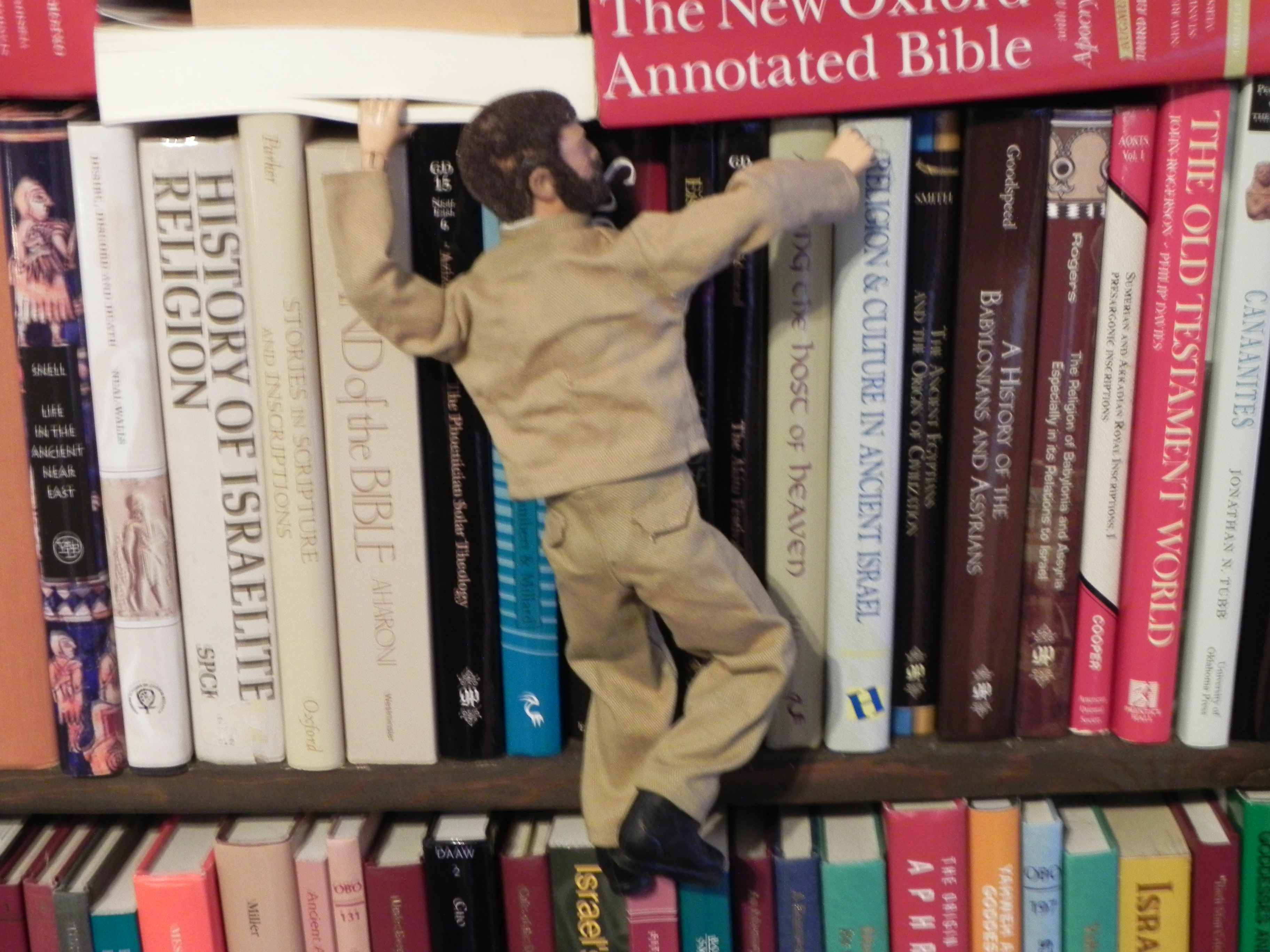
As a life-long pacifist, it might seem strange that I find myself waxing sentimental over a military-themed toy. You see, I just found out that G. I. Joe is turning fifty. For those of us who grew up in the 1960s, G. I. Joe was the acceptable “boy doll” (now, technically, “action figure”) that all the guys had. Some of us had several. We didn’t have much money, but Christmas always gave an opportunity to accessorize Joe with either the latest developments (life-like hair in a buzz cut, pull-string vocalizations, “kung-fu grip”) or the many vehicles that could be purchased separately. As the Vietnam War wore on, Joe turned his interests to science and humanitarian causes, but boys like to anthropomorphize as much as girls do, and Joe continued to get himself into many bizarre adventures. At least in our apartment he was known for fighting dinosaurs, robots, medieval knights, and even General George Custer. Joe was a fighting kind of guy. He had guns and gear and shoes that were almost impossible to remove when you wanted to change uniforms (only when Mom was out of the room). So G. I. Joe has been around for half a century now. I can’t remember childhood without him.

G. I. Joe often had near fatal encounters in our home. One of them, the talking one with life-like hair, suffered a severe war wound that left his bottom half completely dissociated from his top. I don’t think we kept the lower abdomen and legs—there was something slightly unnerving about plastic buttocks—but I did keep his top half, the talking bit. It shocked me when my Mom asked if she could take him to church. We were a “Bible believing” family since it was the days before people much talked about Fundamentalists. My mother was a Sunday School teacher. (Thus my early amazement at the magic of flannelgraphs, still primarily used for religious teaching.) We didn’t believe in evolution, and we certainly thought war was a bad thing. I did wonder, though, why Mom wanted to take a toy to church, particularly a dismembered, violent one.

Being the son of the teacher did have some perks. I knew enough to read my Bible and learn the lessons, but we were not given sneak previews for Sunday School. Seeing the trailer might make actually attending superfluous. So when Joe went to church I learned why: people are not animals. The pull-string voice box, although the sounds emerged from holes in his perforated chest, was proof. People talk, animals don’t. We didn’t evolve after all. The other kids were seemingly impressed by my evangelistic Joe. Who would’ve thought that “G. I. Joe, U.S. Army, reporting for duty” could have ever converted a lost soul? On Ebay, I see, some of these vintage talkers can fetch up to $600. Mine, I’m sure, ended up in a landfill somewhere in rural Pennsylvania where, I have no doubts, he is still preaching to the other toys about the dangers of evolution.

The ultimate adventure...

The ultimate adventure…


Porcine Prognostication

Punxsutawney Phil phled his shadow this morning, leaving many despairing another six weeks of winter, which meteorology seems to dictate anyway. I used to tell my students that Phil is a most peculiar prophet, in that he is, presumably, neither Christian nor Jew, but rather of the rodent religion (whatever that may be). People pretend the little guy has powers beyond those of the average mammal when it comes to predicting vast, chaotic systems. If a groundhog flaps his eyelids in Pennsylvania, prepare for plows and shovels and more thermal underwear. Playing into this annual phenomenon is the provocative persistence of the idea that prophecy is prediction. As much as scholars attempt to expunge the idea that foretelling wasn’t what prophets were ever really about, the populace likely wouldn’t have paid them any attention, had the possibility not presented itself that these preachers knew something the rest of people didn’t.

Prophecy is a strange phenomenon. We claim that we would like to know the future, but I’m not sure that we really would. Knowing that we’ve set ourselves on many tracks that inevitably lead to tears, do we really want to know? After taking my daughter back to college, we sat in a fast-food place to grab a bite on the way home. It had been snowing again, as it will do in the winter, and the television in the corner was blaring on about another apocalyptic band of snow. A bearded and burly Pennsylvanian at the next table turned to me, attracted, I supposed by my own facial hair, and said, “What about this global warming?” I nodded politely, not being very burly myself, but I thought of the fact that global warming does mean more severe winters in some places and warmer conditions in others. It is marked, scientists predict, by erratic weather, not a constant sauna in those regions accustomed to snow.

Although a Pennsylvanian by birth, I have noticed that my ancestral New Jersey does not receive much snow. Until this year. We’ve had the white stuff on the ground for over two weeks in a row. Yes, it snows in winter, but not usually here. I shiver and think of global warming. It is a chilling thought. Punxsutawney Phil may live far enough inland not to have to worry about learning to swim, but the same can’t be said of the inhabitants of most of the major cities of this country. We know it is coming, but we turn a blind eye. Progress in the name of unbridled big business interests brighten a future otherwise a bit more gloomy than we might prefer. Phil ducks back into his burrow and the rest of us clutch our coats a little tighter around us. Prophecy is a mixed blessing indeed. We already know the outcome before the groundhog awakes.

An agnostic groundhog ponders the inevitable (photo credit: I. EIC)

An agnostic groundhog ponders the inevitable (photo credit: I. EIC)


Sunday Best

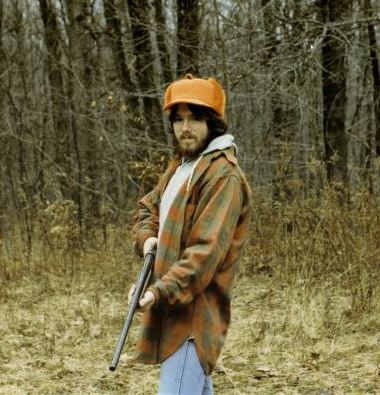
When my rural, northwestern Pennsylvania shows up in the news, I pay attention. An Associated Press story recently appeared concerning Rev. Chris Terbush of Bradford, Pennsylvania. Inspired by the success of Duck Dynasty (which seems poised to overtake even Apple as the most popular purveyor of popular culture), Rev. Terbush has encouraged his congregation to show up on Sunday mornings in camouflage, ready to go forth and claim dominion over nature once the service is over. I’ve been ambushed by enough clergy that the idea makes me a little nervous, I’ll have to admit. But then again, I know where he’s coming from. I grew up in a town that celebrated the first day of deer season as a public holiday, with schools closed and the hills alive with the sound of muskets. Not being a hunter, I just enjoyed the day off school. This upbringing, however, gave me a profound appreciation for the Jeff Daniels’ movie, Escanaba in da Moonlight. But I digress.

Religious services evolve, just like any other social phenomenon. When I was young, just as the sixties were wresting the color of life from the black-and-white fifties, going to church was a formal event that demanded your “Sunday best.” Only the worst of heathens would show up before the Almighty in anything less than a white shirt and tie, a jacket and uncomfortable shoes. You had to show the divine that you were willing to go that extra mile and implicate that you didn’t intend to have any fun when it was over because the sabbath is a solemn occasion. I remember the weird feeling of walking into church during the weekday wearing jeans for the first time. It felt as if I were dissing the rules of the club. It was an exclusive affair.

The “theology of dress” has become an area of scholarly investigation with the growth of embodiment issues. What we wear says something about our beliefs, and the fact that we wear clothes at all is sometimes even traced back to Genesis 3. The origin of “good clothes,” clearly, was a status issue. Those who could afford to keep some surplus clothes unsullied by labor wished to strut their stuff on occasion. And who better to impress than God? All of this has eroded over the years with many churches as casual as any man cave. Now you can camouflage yourself in church. There may be more going on here than meets the eye, both literally and metaphorically.

What happens in the woods stays in the woods

What happens in the woods stays in the woods


Schrödinger’s Luggage

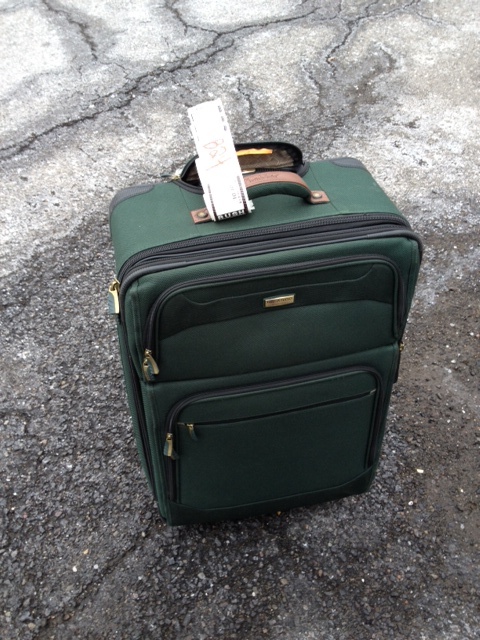
I recently had the misfortune of flying on Delta Airlines. In all honesty I suppose my antipathy to Delta began with a flight on which I was not actually a passenger. A few years ago a news story of a Delta flight navigating to the wrong city created smirks for those who can afford to fly airlines that have better track-finding skills. With all of my flying over the past years, I’ve ended up on Delta a couple of times and my sense of their muddled thinking has only been confirmed. On a recent flight before which we were informed that our boarding would be “expediated” since the captain was late landing his jet at the next gate and would be flying right back to Atlanta whence he’d just arrived, I hoped the navigation would be better than the grammar. Landing in Atlanta for a flight to the thriving metropolis of Allentown, Pennsylvania, the gate agent repeatedly told us that the flight to “Aberdeen” was about ready to board. Several customers had to call out “Allentown” a few times before the agent realized her mistake. My misgivings grew. When I landed in Allentown, my checked bag had decided to take a tour of Detroit. It was late at night and I might have been a bit brusk with the poor, graveyard-shift Delta agent, but he assured me that my bag would be in by noon the next day.

Not a particularly trusting soul any more, I called Delta baggage information the next morning after looking at their website. The website showed the bag sitting just 15 gates from my departing Atlanta flight but then taking off to Detroit. When I called the representative told me that no information was available on my baggage (the artistry of understatement!). I informed her that I had the website up and that it showed my luggage in Detroit, I wanted to know when it would be in Allentown. Her tune changed to indicate, “oh yes, it is in Detroit.” But then, she could neither confirm nor deny that it would be on its scheduled flight. I had already determined to drive back to the airport to collect it. If Delta cannot be trusted to navigate to the right location in the air, then what would be their chances be on the ground in New Jersey? As I kindly suggested to the representative that they hire employees who could read, I couldn’t help but think of Schrödinger’s cat.

Erwin Schrödinger was the physicist who came up with the thought experiment of a cat placed in a box with a deadly substance. Whether the cat is alive or dead is only a matter of speculation without looking in the box, so, in reality, the cat is both alive and dead simultaneously. I’m no physicist, but I thought of Schrödinger’s luggage being both in the cargo hold and not being in the cargo hold at the same time. This was the very mystery of the universe, courtesy of Delta’s ineptitude, being foisted upon my frantic brain. Where was my bag? It was not in my possession, and I had last entrusted it to an airline that thought the best route from the Midwest to Allentown was through Atlanta and then Detroit, but they weren’t really sure if that was the case either. There is a consolation, however. You can get a refund of your twenty-five dollar baggage misplacement fee, in the form of a voucher for your next lost luggage episode on Delta airlines. I’m about ready to crawl into that box with Schrödinger’s kitten and await my fate.

Both here and not here.

Both here and not here.


Amish Paradise

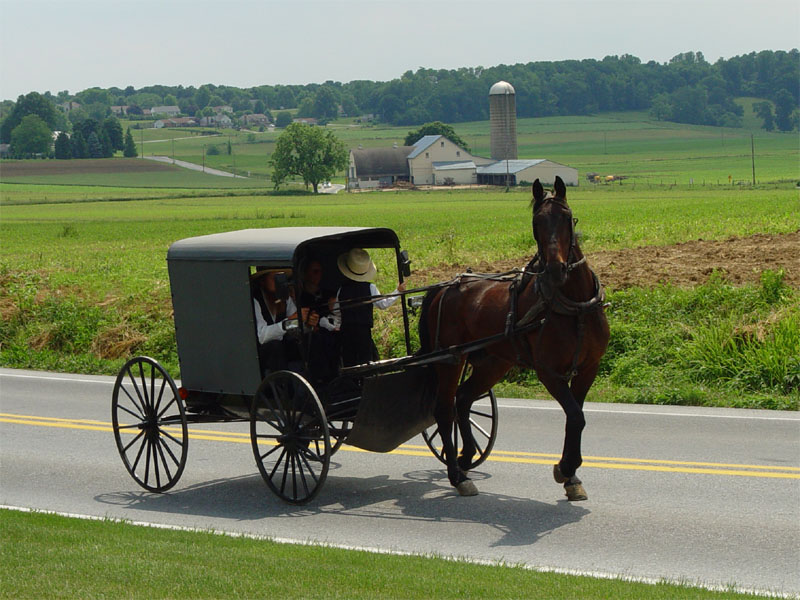
Once upon a time, intelligence could be found on cable networks such as Discovery Channel, and Animal Planet. Like higher education, however, these ventures soon learned that people do not want to be educated, but entertained. So it was that I found myself watching, with increasing bewilderment, Amish Mafia. The very discord of the title is intentional as the show “dramatizes” disagreements among the Anabaptist communities of central Pennsylvania. The result is coarse and seedy, and not a little salacious. And addictive.

Photo by it:Utente:TheCadExpert (Wikicommons)

Photo by it:Utente:TheCadExpert (Wikicommons)

I grew up not too far from several Amish communities, and I’ve visited Lancaster a time or two. Living a lifestyle that the vast majority of Americans would classify as boring, the Amish keep to themselves, constructing an existence based on strict religious principles and a rejection of modernity. Recently, however, the Amish have become a sexy topic for romances and fictional clashes between their traditional way of life and the high-tech world that surrounds them. For those of us who felt a kind of authenticity to The Witness, watching Mennonites lock and load their assault rifles to intimidate their rival construction workers, and, in the words of Weird Al Yankovic, “get[ting] medieval on your heinie,” Amish Mafia presents the viewer with a world of kidnapping, extortion, and shunning, all within one episode. Trashing-talking pietists climb into luxury cars and put drunken buggy drivers in straight-jackets where they’re hauled off to extreme Bible-reading therapy. This seemed nothing like the Amish I had learned about in classes on primitivist societies.

We like to watch the self-righteous crumble. Who doesn’t want to believe that they are about as good as their neighbor? Those of us in Pennsylvania, Ohio, Indiana, Illinois, and Iowa (from my experience) see the Amish occasionally, quietly living their lives without the amenities that define us. We resent that, yes, you can get along without cars, telephones, televisions, internet, and weapons. Who really needs well-made furniture and quilts to keep warm at night when you’ve got Ikea and a furnace like a locomotive in your basement? And they know their Bible. Goodie-two-shoes showing us something that many of us have suspected all along—authenticity comes from inside, not an electronic world we can’t touch. I don’t idealize the Amish. Their lifestyle takes discipline and a level of belief in a worldview that doesn’t match what I’ve been taught. But then, Amish Mafia also requires a gratuitous suspension of disbelief.


Without a Hitch

I’m not really afraid of dying. All those years of being taught that “to die is to gain” have obviously done their work. At the same time, it is a poignant exercise to read the posthumous memoirs of a dying man. I remember my first funeral. Although I don’t recall the name of the poor, deceased honoree, I still see the reactions of the living vividly. I was under ten at the time, and the funeral home in Franklin, Pennsylvania was in a very somber mood. The man, who had been a friend of the family, “was not a Christian.” Having been buffed and rubbed in the Fundamentalist tub from my earliest days, I didn’t realize that what was meant was actually that he hadn’t been an active member of our particular church. Nevertheless, as a child, you get deeply impressed with these kinds of things. “I’ll never go to the funeral of a non-Christian again,” I remember my mother telling a friend. “The minister couldn’t find anything comforting to say.” While funerals are sad occasions by definition, this one left a crater that is still fresh over forty years later.

MortalityChristopher Hitchens is someone I found through his book God is Not Great. I don’t have time to read magazines, and I hadn’t read any of his previous works, but he raised some extremely valid points in this diatribe. My wife recently bought me his final oeuvre, Mortality. I felt as if I were back in that funeral home. It is not that I still hold to the odd belief system of Fundamentalism—of this my regular readers will have no doubt—but it is the forlorn feeling of reading the words of someone dying who hopes for nothing. Yes, it may be Stoic, and even noble. Certainly it seems far more worthy than visions of living in opulence with lots of available virgins with whom to toy while angels strum their harps overhead, but the certitude that one’s final days will be nothing but prolonged suffering—ouch! Maybe there isn’t a heaven, and if there’s a hell there’s something morally wrong with the universe, but doesn’t some residue of a human life remain? Even if it’s just the memories, the marks that we’ve made on others’ minds, don’t we somehow survive? Dying without hope nevertheless feels like milling about in that doleful crowd of specific Christians years ago.

Hitchens does offer a chapter in his final words devoted to those Christians who responded to his cancer with an unholy Schadenfreude, trying to torture the thoughts of a dying man with the promise of an eternal hell after experiencing a temporary hell of cancer treatments. This chapter made me sick. Anyone who so completely misses the message of compassion that suffuses the Gospels can hardly claim the designation Christian, I would insist. No one, no matter what their eternal plans, has the right to try to fracture anyone’s tenuous tranquility to make their own crown shine a little brighter. Such weekend warriors likely imagine that they are defending their fragile God, but in reality they are demonstrating that some of the criticisms of Hitchens were very well placed to begin with. No religion will live up to its full potential until it succeeds in the most basic practice of all—treating all people with respect and dignity. Until then, death has the final word.


Accidental Abortion

There comes a time in life when you realize that if a small town you know makes it into the news headlines, it is likely tragic. So it was when I read this morning that a man in Mercer, Pennsylvania—just a few miles from where I grew up—shot and killed his 7 year-old son, by accident. I grew up in a part of the country that has a love affair with guns. This may have been understandable in the days when a stroll to the outhouse could mean chancing a bear or cougar encounter, but these days bear sightings are rare and cougars, well, almost unheard of. The man was trying to trade in a couple of guns at Twig’s Reloading Den. Climbing back into his truck, the handgun discharged, killing his son. This is very tragic, yet the officer making a statement said something chilling. The man thought the gun was unloaded but, “This happens all too often where people think the gun was empty.” All too often. All too often.

I grew up in western Pennsylvania, and if Facebook is anything to go by, it has become consistently more Evangelical since I left. And that is saying something. In my younger days I wore a large cross around my neck and took my fair share of ribbing for being religious. Now I see those with whom I attended school posting on all manner of conservative causes, including the contradictory anti-abortion and loosening of gun control. This is not a phenomenon restricted to western Pennsylvania. At Nashotah House it was alive and well. Several students kept guns in their dorms, protested against the violence done to the unborn, yet called killing heretics “retroactive abortion.” It was their smiles when they said such things that frightened me. Wait until they grow up to kill them.

Like any insecure person I sometimes think a gun for protection might be good. I especially think this when I’m in the grizzly bear habitat of the Pacific Northwest, miles from civilization. I picture myself shooting into the air with a rifle that out-Thors thunder itself, a mighty man. Yet the only time I actually saw a grizzly bear I immediately jumped out of the car to snap a picture or two. I dream of going back to the days before guns were invented, but this evil genie has been let out of the bottle. There’s no getting it back in. Are we vulnerable without guns to “protect” us? Yes. But my reading of the Bible my Evangelical friends so often cite insists that turning the other cheek is the way to show that you believe it. A seven-year-old is dead not far from my hometown. His father was trying to sell guns at a store that doesn’t even buy guns. The boy died in the gun store, and yet my fellow Americans feel safer knowing they’re armed. I hope your hometown stays out of the news.

Feel safer?

Feel safer?


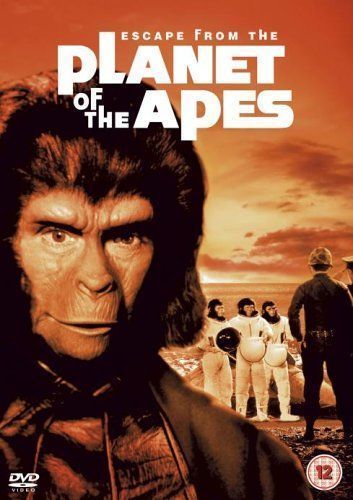
Theology of the Apes

“Alter what you believe to be the course of the future by slaughtering two innocents, or rather three now that one of them is pregnant? Herod tried that and Christ survived.”

“Sir President, Herod lacked our facilities.”

So the conversation between Dr. Otto Hasslein and the President goes in the 1971 continuation of the saga, Escape from the Planet of the Apes. Few probably pondered the weighty theological significance of this dialogue; it is not represented on IMDB’s quotes page from the movie. In fact, many critics aver that the Planet of the Apes movies devolved as they went on becoming less and less original. Nevertheless, the number of serious issues thoughtfully addressed in Escape made it one of the most well received pieces in the series. The world was a scary place in the early 1970’s, as I experienced it. It was easy to believe that we were on the brink of our own destruction—there were enough nuclear warheads to assure mutual destruction, and even a little boy in Rouseville, Pennsylvania could believe that his small town was significant enough to be a target. That message I’d heard as early as the final scene of the original movie.

The Planet of the Apes series is profoundly theological. I rewatched Escape from the Planet of the Apes recently, and was struck by just how many social issues were addressed. Consumerism, abortion, racism, espionage, the arms race, and even eugenics. In each instance the humans are inferior to the apes who had not even developed the combustion engine before learning to fly a spacecraft back through time. The conservative fear of Dr. Otto Hasslein drives the plot; he is ambivalent about the apes and what they portend. It is the destruction of his own comfortable way of life. He suggests quietly killing the apes, succeeding where Herod failed. (Think through the implications!)

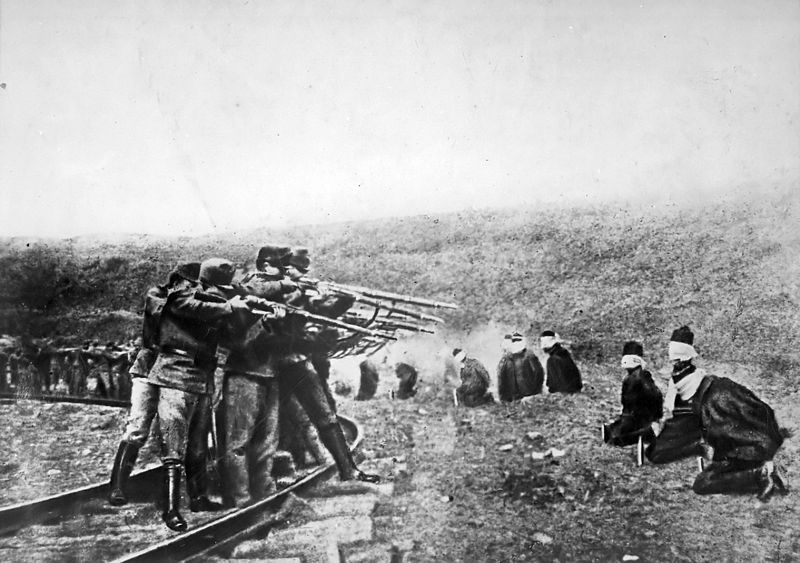
“Before I have them shot against the wall I want convincing that the writing on the wall is calculably true,” the President biblically insists.

“How many futures are there? Which future has God, if there is a god, chosen for man’s destiny? If I urge the destruction of these two apes, am I defying God’s will or obeying it? Am I his enemy or his instrument?” Otto Hasslein does not know. His science which tells him there is no God also worries him that he is the very enemy of the non-existent deity. No, the Planet of the Apes movies are not the most profound films ever to escape the camera, but there is, as in any good theology, the raising of questions. And like any theology worthy of latter-day Herods, there will always be far more questions than answers.


Night of the Johnstown Flood

Floods always have a whiff of old Noah about them. I first heard of the Johnstown flood from a minister who has had a profound impact on my life. He had been in Johnstown for the 1977 flood, and that led me to learn a little bit about America’s first great natural disaster. I decided to follow up David R. Montgomery’s flood book by David McCullough’s The Johnstown Flood. Like most stories of human tragedy, this devastating flood combined elements of human culpability with nature’s own inscrutable workings. The 1889 flood came during an unusually heavy rainstorm. Some years before, an exclusive millionaire’s club had repaired an artificial dam rebuilt for the recreation of the wealthy high above the town. Records show the repairs to have been lackluster—at one point they purchased hay to act as cheap fill. Although the members knew of the danger they did nothing to avert the deadly potential a breech in the dam would inevitably cause. When the dam burst during the storm, over 2200 people died.

Wrenching, like most natural disaster accounts are, the story of human misery raises questions of theodicy and basic humanity. Members of the club were those who ran Pittsburgh in the days before their steel mills fell silent. Apart from a few like Andrew Carnegie, who gave generously to those in dire need after the tragedy, most of club members gave nothing to the relief effort for what their negligence helped cause. They hadn’t even hired an engineer to consult about their dam project when they decided to rebuild it. Lawsuits filed failed to touch them; the suffering of thousands failed to move them. Fast forward just over a century—as the towers of the wealthy came down the working class tried to save as many as they could, some at the cost of their own lives. We all know who are regarded as the heroes.

“Was it not the likes of them [club members] that were bringing in the [foreign workers], buying legislatures, cutting wages, and getting a great deal richer than was right or good for any mortal man in a free, democratic country?” McCullough’s words, explaining the sense of those who’d lost everything to the idle dalliances of the leisured class, still ring true in the world of one percenters. Often it takes a tragedy to bring society’s inequalities into focus. As a nation we’ve gone on to have even more costly disasters since May 31, 1889, but the instability built by corporate greed has kept pace, indeed, perhaps even surpassed what it was back then. “And God saw that the wickedness of man was great in the earth, and that every imagination of the thoughts of his heart was only evil continually,” or so I have it on good authority.