
I’m guilty of a little home-state pride when I consider Philadelphia as a seedbed for diverse filmmakers. Perhaps the most famous is M. Night Shyamalan, but I recently watched Tayarisha Poe’s first feature, Selah and the Spades. Poe (and Edgar Allan also lived in Philly) is an African-American woman, and like Shyamalan, writes and directs her own movies. Selah and the Spades came out in 2019, just as we were settling into pandemic life, but it is a gentle kind of dark academia. A coming of age story set in a fictional Haldwell Boarding School, it features three African-American leads. The violence is mostly offscreen, but there is a darker story here. Selah heads the Spades, one of five factions of student-led extracurricular life on the elite campus. She’s a senior who doesn’t want to face college—she enjoys her power and doesn’t want to appoint a successor.

The factions plan communal pranks, and each has its own specialization. The Spades supply the alcohol and drugs to the student body. This involves some violence, as is to be expected. Selah has a record of ruining her protégés before they can become her successor. The movie focuses on Selah’s relationship with Paloma, a transfer to the school who seems a promising new leader. But Selah has difficulty letting go and the drama plays itself out in a student-led prom after the administration cancels the official prom due to the factions’ actions. There are lingering shots and some art house elements to the film, making it a drama rather than a thriller. Dark academia encompasses several genres and this is, as I say, a tamer one.
Philadelphia is a city with a generational history for me. My mother, who was born in New Jersey, lived in Philly for some time as a child. She found the city a scary place and unwittingly passed that fear onto me. I’ve been to Philly several times, of course. My main concern is driving there—the traffic is always intense and I don’t know my way around very well. It is a diverse city. While it’s too early to tell if Tayarisha Poe’s work will center around eastern Pennsylvania (I can’t find a summary of her second movie, The Young Wife, that states outright where it is set), it does underscore that the cinematic world is reaping some benefits from the city of sibling-like love. And such things happen best when diversity is given a place to shine.




 The specific form of penny offerings seems to go back to Benjamin Franklin’s burial, at least in America. A few years back while in Philadelphia, I saw for myself that people still leave pennies on Franklin’s grave in Christ Church Cemetery.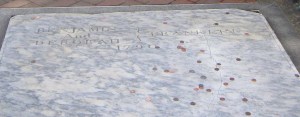
 I recalled having seen stones on tombs outside Jerusalem some years back, and I even had a student bring me a stone from Israel to keep as long as I promised to put it on her grave after she died. This practice in its recent form is associated with Judaism, but again, it has ancient roots. The building of cairns, or piles of stones, is often associated with the Celts or the pre-Celtic inhabitants of the British Isles. On our many wandering through the highlands and islands we saw several Neolithic examples in Scotland, particularly in the Orkney Islands. The practice of putting stones atop the dead also goes back to ancient times. One plausible suggestion is that it was intended to keep the dead in their graves. A more prosaic conclusion is that digging deep holes takes more work than hauling over a pile of rocks.
 Steve A. Wiggins