Planet A

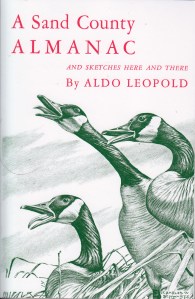
Two of the classics of ecology, A Sand County Almanac, by Aldo Leopold, and The Sea Around Us, by Rachel Carson, were published by Oxford University Press. In its present-day iteration the press has a Green Committee, on which I’ve sat from very nearly the beginning of my time there. As a committee, we’re reading these classics to see what we might learn some half-century-plus after they were published. I’d never read A Sand County Almanac before. It’s a pity, since I lived in southeast Wisconsin, from which the book takes its genesis, for about a dozen years. The writing is poetical prose, but the ideas are solid science—the land on which we’ve evolved knows how to take care of itself. When one species becomes too greedy, all suffer. Leopold ends his book by suggesting a land ethic should be put in place. Now, a human lifespan later, has it?

Hardly. Watching the Trump Administration doing everything it can to commodify any aspect of the environment that might make a buck—or at least a buck for the wealthy—is alarming in the extreme. There is no soul in the land, to this way of thinking. They believe that because they themselves lack a functional soul. A soul cannot exist without ethics. What we do to this planet is one of the largest ethical issues imaginable. No species, rational or not, destroys its own habitat. Except our own. Arrogant to the point of supposing ourselves divine, we think we can take what we want and give nothing back. And everything will be just fine. I wonder that we’ve had this inexpensive, readable guidebook this last seven decades and have continued to ignore its sage advice. Maybe we’re too busy making money to read something that sounds suspiciously like poetry.

One of the observations I had about the Almanac was how attuned to the philosophy of nature it is. Philosophy has many enemies these days, from prominent scientists to Republicans. Nobody seems to value the capacity for deep and thorough thinking through of a problem that is unbeholden to any orthodoxy. The philosopher can ask “what if?” without regret. When it comes to the environment, humans aren’t the only philosophers. We’ve convinced ourselves so completely that we’re more advanced than other species that we suppose they can’t teach us anything. One thing they do, however, without our interference, is create balance in nature. It’s an ethic to which even our species might aspire. If only we would listen to the wisdom of those who pay attention to the world that has given them life.


Occam’s Beard

Skeptics can be so much fun. We really do need them, otherwise we’d likely still be living with notions of medical science being attributed to four humors, none of which were that funny. Still, sometimes it gets tiresome to read endless references that take Occam out of context. You see, one of the foundations, if not the very keystone, of modern scientific method is that of parsimony, aka Occam’s razor. The idea is simplicity itself. If there are multiple possible explanations for a phenomenon, then the simplest is most likely correct. But only if it supports your biases. The reason I raise this question is the materialistic dismissal of “consciousness” as merely a by-product of having a brain. The reasoning goes like this—nothing exists that can’t be measured by science. Since that which isn’t material can’t be measured, the most parsimonious explanation is that it doesn’t exist. QED.

This way of looking at the world has become so common that those of us who question it are given a condescending smile and a paternalistic pat on the head. But my thinking about this goes back to Occam himself. William of Occam (or Ockham) was a late medieval churchman and thinker. As a scholar he possessed a sharp mind. As a friar he also possessed a soul. There was no disconnect in those days. His observations of the natural world led him to the reasonable conclusion that if a simpler solution sufficed, a more complicated one need not be posited. So far, so good. This is not, however, to suggest that more complex things may not be going on. Quantum physics, for example, suggests that things aren’t quite so easy to explain. And what about poor Occam’s soul? This very component that made William William has been dismissed as mere illusion. Did it therefore not exist?

Is it more parsimonious to suggest that “mind” (or soul, or consciousness, whichever you prefer) is mere illusion, electro-chemical signals flitting between highly specialized cells just happen to give off a fiction of consciousness, or would the simpler answer be, as Occam himself believed, we have souls? We have no way to measure such things, but to claim they don’t exist is to rob a great thinker of his very mind. Any of us who experience consciousness know that it’s no illusion. We feel the pains and joys of this same body day after day and, if we’re honest, we believe that we’ll continue even after this fleshy substrate wears out. There’s a profound logic here. Science doesn’t know how mind affects matter—how I can decide to type and my fingers move. The most parsimonious answer, they claim, is that it only seems to be so. A far more honest answer would be that mind is real. And I’m sure Occam himself would agree, even if he preferred to call it a soul.


The Deal

Intellectual property is a concept that only arises where thought can be monetized. Think about that. (But don’t charge me, please!) It is a strange idea, when you ponder it. In any case, one of the problems with writing book reviews is that the reviews themselves become the intellectual property of the journal in which they appear. In a mental ménage à trois, everyone gets something out of it: the publisher gives away a book for free publicity, the journal gets copyright content of value to its readers, and the reviewer gets a free book. In the best of these encounters everyone goes home happy. I began doing book reviews when teaching at Nashotah House. Academic books are expensive and although professors make more than editors do, they are still hard-pressed to pay academic press prices. After my strictly platonic affair with higher education, I stopped doing reviews for a while, but now that I have hours on a bus to read, I’ve picked up the habit again.

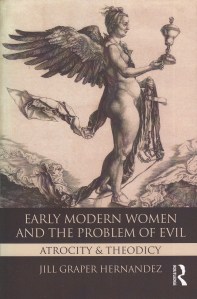
Most often I review books for the two societies of which I’m a member—the American Academy of Religion and the Society of Biblical Literature. There might, however, be a conflict of interest here. One of the main things I do on this blog is talk about books. Since I’m no longer a professor, but I still think like one, I figure it’s a compromise I can live with. The conflict arises because I post daily on my blog while publishers take weeks, or even months, to publish reviews. Despite technology, publishing is a slow business. That means that I read books I can’t really talk about until the review has appeared. That’s the case with Jill Graper Hernandez’s Early Modern Women and the Problem of Evil: Atrocity & Theodicy. I can’t say here what I say in my review since the review isn’t my intellectual property anymore. There’s another trade-off here: publishers get your name out there in return for owning your content—everything can come down to the level of business, it seems.

Still, I can use this post to reflect on theodicy—the justification of God in the face of evil. Since I don’t address this fact in my review I can say here that since Trump’s election it’s difficult to read a book about suffering without tying it to the current political situation. Many of the incumbent’s ardent supporters are coming to see that he doesn’t really care for them or their issues, and conservatives as well as liberals have four years of suffering to face. I was surprised how often in reading this philosophical treatise that our present national shame came to mind. Perhaps that’s inevitable in a book that discusses how women have been repressed in a world where they too have been relegated to the level of a commodity. Intellectual property seems less a concern when human beings are still trafficked as chattel. That’s not just bad business, it’s evil.


By Any Other Name

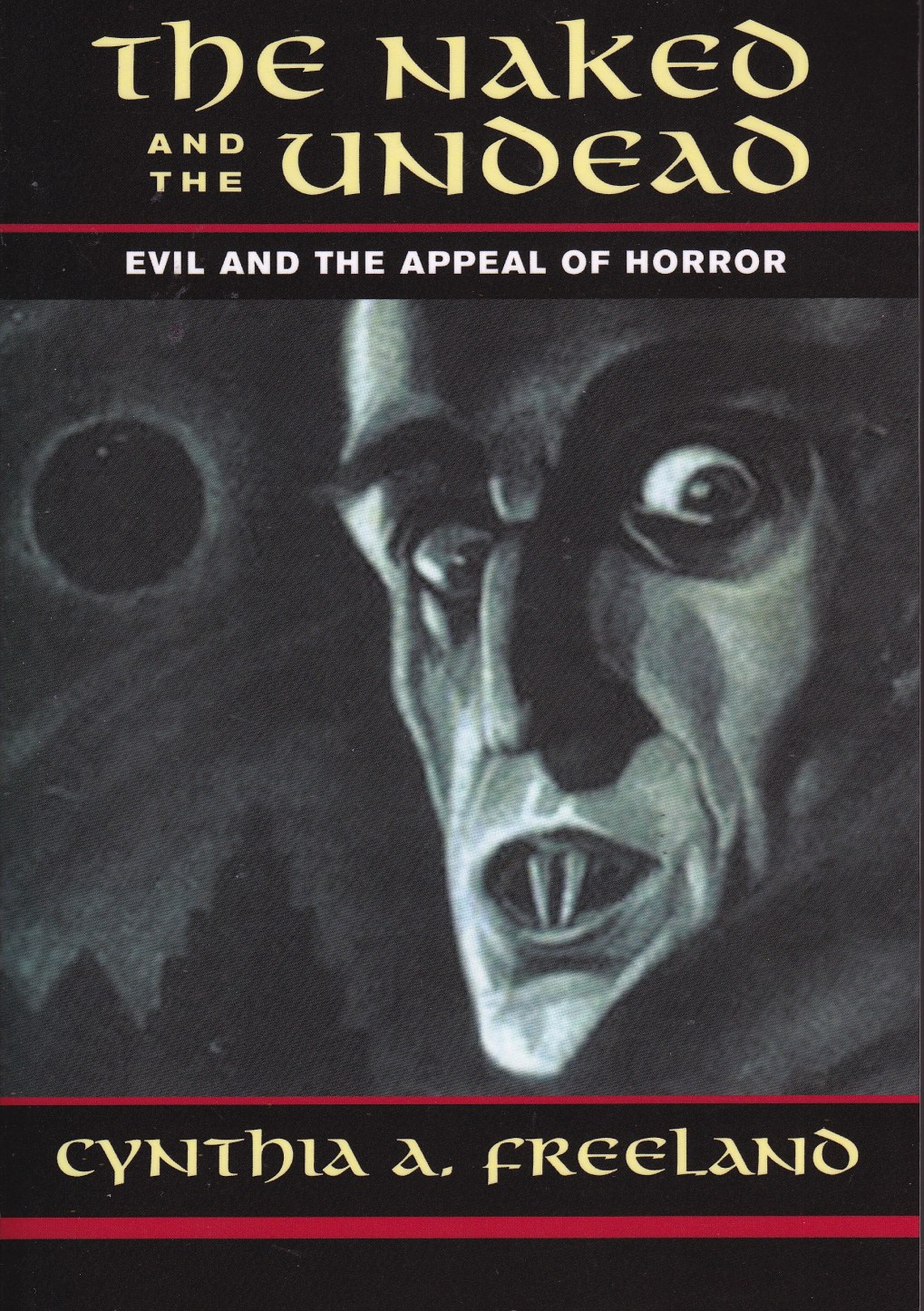
nakedundeadGood and evil. Well, mostly evil, actually. No, I’m not talking about Washington, DC, but about horror movies. Cynthia A. Freeland’s The Naked and the Undead: Evil and the Appeal of Horror is a study that brings a cognitivist approach to the dual themes of feminism and how horror presents evil. It’s not as simple as it sounds. Like many philosophers Freeland is aware that topics are seldom as straightforward as they appear. Feminists have approached horror films before, and other analysts have addressed the aspects of evil that the genre presents, but bringing them together into one place casts light on the subject from different angles. Freeland begins this process by dividing her material into three main sections: mad scientists and monstrous mothers (which allows for the Frankenstein angle), from vampires to slashers, and sublime spectacles of disaster. Already the reader can tell she’s a real fan.


One of the simplistic views of horror is that these kinds of movies—particularly slashers—are misogynistic by their very nature. Feminists, including Freeland, question that assumption. Horror is a genre with a decidedly checkered history. Some films do feature mostly female victims to male monsters. Not all do, however, and even those that do may be saying something other than the obvious. Looking for the locus of evil in these movies provides a lens that focuses the meaning somewhere other than the surface. This is one of the benefits of philosophy—probing questions may be asked and unexpected answers may result. Along the way you can have a lot of fun, too. Especially if you watch horror movies.

A large part of the criticism probably arises from the fact that film making was, for much of its earliest history, run by males. That’s not to say women couldn’t do the same thing men were doing, but the opportunities simply weren’t there. Most film makers, I expect, have trouble getting out of their heads to think about how someone of a different gender might perceive this kind of movie. Fear, we are told, is “coded” feminine. It seemed natural to such film makers to put the female in peril since both women and men would respond to it. Since then it has become clear that fear isn’t coded for gender. Indeed, one of the hallmarks of modern horror is that we all have cause to be afraid. Fear is no respecter of gender. Freeland’s analysis, now getting on in years, correctly looked ahead in many respects. Especially concerning the ongoing presence of evil.


Post Post-Truth

One of the benefits of working with words is that you get to participate in reality. George Orwell famously wrote that if people didn’t have the words to express concepts the government didn’t like, those concepts would cease to exist. At least as long as they allow us to have the internet, concepts may survive. Oxford Dictionaries’ word of the year reflects just this. The word is “post-truth.” Post-truth is a word of hard currency in the political marketplace. It essentially means that objective facts no longer outweigh emotion and personal belief in establishing reality. Think “global warming isn’t happening because it cuts into my bottom line.” Think “humans didn’t evolve from a common ancestor apes because an outdated book doesn’t say they did.” Think “Donald Trump won the election.” Truth is no longer truth without “post” in front of it. Believe what you will. No, I mean that. I choose to believe Trump was not elected. Post-truth cuts both ways.

In a world where reaction has replaced dialogue and where you win arguments by revealing your NRA card, truth is merely the first casualty. Already mainstream media, who told us the post-truth that Trump, according to the polls, couldn’t win, are now telling us it’s all politics as normal. This will be a simple transition of power. Pay no attention to the man behind the curtain. There is no wizard in Oz. Politicians lie. Only those born without a brain stem don’t realize that objective fact. We can be sure that even George Washington lied from time to time. There was no cherry tree-gate. Unless you choose to believe there was, then I guess it has to be okay. Your truth’s as good as mine.

img_3044

Over the past several years some prominent scientists have been saying philosophy is but misguided navel-gazing. It tells us nothing of reality. Truth, however, is a philosophical concept. Post is something to which you tie people before a firing squad. Truth has, until recent days, been considered that upon which all reasonable people could agree. The earth is not flat. We are flying around the sun so fast that it makes me earth-sick. We were able to put people on the moon. All of these are now post-truths. Along with the fact that every vote counts. In this slurry of fear, hatred, and distrust, who has time to worry about objective facts? Lexicographers do. And I praise them for giving us the most relevant word since Moses stumbled down the mountain with a tablet that read, “Thou shalt not bear false witness.”


The Whole Truth

In a thoughtful piece on NPR, Adam Frank discusses “Are Scientific Truths Better Than Other Truths?(.)” He describes a Ivy League conference called to discuss this point, and although I get about as much attention as adults give Barney, I’ve been blogging about this topic for years now. If only I had an institution. Or an ivy leaf. But never mind that. The topic’s the thing, and indeed it is long overdue. Science works (at least most of the time) and so we don’t require any convincing on that point. The very title of the article, however, raises the specter of the question: are scientific truths better? There’s a lot of unpacking to do and I haven’t even left home yet. First of all, “truths.” Science provides the best explanation of phenomena that we have, given the data at the moment. Since science is, by definition, falsifiable, it doesn’t provide truths. As much as scientists must begrudgingly admit it, truths are spun out by philosophers and—God help us!—theologians. The scientists who want to give us truths should probably take philosophy 101.

microgaphia_schem_1_instruments

Then there’s that surprisingly difficult adverb “better.” Good, better, best. These are value words. Science cannot assess value. Gold is “worth” more than the lint in my pockets because humans have agreed that it is. Inherently, both substances are made of the same thing: atoms. The lint in my pocket may have more exotic elements than pure gold, but nobody’s going to pay anything for it. Value, as has been endlessly demonstrated, is in the purview of religion, ethics, and philosophy. If you have to you can add the dismal science to the mix, but even that is just a social science. No physicist can tell you if this meal is better than that. It’s a matter of perspective. If I value my beans enough, not even your pâté will tempt me.

I want to stick with this latter word “better” just a little longer. Perhaps because as an underemployed thinker I’m especially sensitive to the subject. In what sense is science “better” than humanities? Show me a scientist who’s never listened to music and I’ll show you a sad individual. When we come home from the lab we still want the creature comforts that people have devised whether through science, culture, or even religion. If you value that weekend, be sure to thank a monotheist. Science tells us no day of the week is any different than any other. In my experience there’s a world of difference between Saturday and Monday. For this inveterate and unrepentant humanities student, that’s the truth.


Busyness as Usual

“Time,” Morpheus said, “is always against us.” Such is life in the Matrix. Wake before daylight. Climb on a bus. Stare at a screen for a solid eight hours. Climb on a bus. Sleep before dark. Repeat. It’s a schedule only a machine could appreciate. Since I was a seminary student, I’ve considered time an ethical issue. Take waiting in line, for example. This is difficult to convert to a good use of resources. In circumstances where the queue is anticipated, such as waiting for a bus, one might bring along a book. The unexpected line, however, is wasted time. Paying Agent Smith his due. This all comes to mind because of a recent news blurb about Søren Kierkegaard. The story in Quartz, cites the Kierkegaard quote: “Of all ridiculous things the most ridiculous seems to me to be busy—to be a man who is brisk about his food and his work… What, I wonder, do these busy folks get done?”

Kierkegaard

I’m a lapsed Kierkegaard reader. The sad fact is that philosophy takes time. You can’t sit down and whiz through it. You need to stop frequently and ponder. This was the life of the academic that I once knew. Before the Hindenburg. Before capitalism became my raison d’être. You see, you can never give too much time to work. There’s always email. The internet has wired us to that which once wired money. “We are the Borg.” There’s no time for a Danish and a concluding unscientific postscript any more. We willingly comply because the rent is due. What, o Søren am I getting done?

We rush around, it seems to me, because when labor-saving devices were invented they only led to more labor. Our European colleagues look with wonder at our febrile, frenetic pace. They wonder where it has gotten us. Has the final trump indeed sounded? Has the stock market become divine? Has money become the only Ding an sich? Kierkegaard wears a thick layer of dust on my shelf. Once I spent an entire day trying to digest a single paragraph of his writing. Now I brush him off like crumbs from my danish and I don’t have time to finish my coffee since the till is calling. I will get back to you, Søren, truly I will. It’s just that I have this never-ending task to accomplish first. After that we’ll sit down and have a leisurely talk.


Meaningful Fear

BeVeryAfraidReading about the things that wrong, like terrorist attacks, may not be the best way to occupy your time on a bus heading to New York City. Robert Wuthnow’s Be Very Afraid is appropriately titled, in any case. I had been warned. Discussing sociological reactions to nuclear war, terrorism, pandemics, and global warming, Wuthnow suggests, sensibly, that action is the best response. He also points out that, statistically, people tend not to panic. What I’d like to focus on is his repeated assertion that humans need to find meaning. Disasters only bring this into clearer view.

We live in an age when religion and philosophy have been relegated to the children’s table of academic pursuits. They are, however, the traditional intellectual ways of finding meaning . Economists may be paid much more, and scientists receive more respect, but when the bombs fall or avian flu really strikes, even they sometimes turn to their beleaguered colleagues for answers. Money is notoriously poverty-ridden when it comes to purchasing meaning. Reductionistic materialism may allow a final shrug as the curtain falls, but plenty of scientists hope for a little something more. Not everyone, of course, finds meaning in religion or deep reflection, but we are all human and we want to know what it’s all about. We need to have somewhere to look.

Even as a child I was preoccupied with meaning. I wanted to be the usual things when I grew up—scientist, firefighter, G.I. Joe—but when it came time to make actual choices I moved in the direction of careers that would allow me to find meaning. I swiftly learned they didn’t pay well. Money is not meaning, however. I was teaching in a seminary when 9/11—a major topic of Wuthnow’s study—occurred. I saw people desperately seeking meaning, but not knowing where to look. This was just my fear, growing up; what does it profit someone to gain the whole world if s/he is groping about in the dark for meaning? We’ve created a world where even greater causes of fear are likely to arise. In our emergency kits, it seems, we should leave a little room for meaning.


All for Naught

ZeroPhilosophy, it used to be said, was the handmaid to theology. According to some among the scientific establishment the whole lot should be thrown out, baby, bath water, and tub. It has always distressed me to read scientists dissing philosophy (theology I can understand). Empirical outlooks are definitively based on a philosophy, and no matter what we may think of post-modern theorists, we are indebted to philosophers far more than we probably realize. I just finished reading Robert Kaplan’s The Nothing That Is: A Natural History of Zero. I noticed the book when it was first published, but found it recently at a book sale for almost nothing. I’m glad I did.

I can’t pretend to understand all the equations in the book. There aren’t that many, thank goodness, but Kaplan uses them to make his point. He shows, through a combination of history and logic, how zero has made our modern world possible. One of the features that immediately stood out is how often religion entered the discussion. Kaplan isn’t hostile to it, he merely notes that some theologians resisted it along the way while others declared that nothingness was necessary and inevitable. Likewise philosophers. And mathematical proofs lead into some strange neighborhoods when zero’s your traveling companion. Indeed, some chapters of this little book so resembled philosophy that it was easy to forget a mathematician was our actual guide. I took some advanced math in high school that I survived only with the aid of my brother, but this book helped to make some sense of a past largely forgotten.

Science is all about numbers. Quantification. In fact, many scientific theories would simply fall apart without the math to back them up. A scientist learning math, as Kaplan demonstrates, is learning a philosophy. Even in the strange world of quantum mechanics, we’re told, the math holds up. We wouldn’t even know about some worlds if it weren’t for the equations. If math is near kin to philosophy, how can any right-minded scientist reject philosophy as nonsense? Isn’t this, logically, rejecting the basis for your own quantified discipline? And, if I may be so bold, philosophers generally acknowledge that their discipline has a, perhaps estranged, relationship to religion. If we look at it holistically instead of calling each other names, we might come to see that knowledge comes in many forms. Perhaps the most unexpected among them is that of the lowly zero.


Nothing But the Truth

Blurbs are the way of the future. It is so much easier to read something brief than to have to wade through an entire article. Is that the way the future’s going? I read the blurbs for Christian Century’s round-up page when it lands on my desk at work, and I find plenty of interesting things there. For example, a recent issue suggested that truth may be getting harder to find. It began: “George Johnson [New York Times was the source] says modern culture is reaching the point at which there are no longer any incontrovertible truths, just competing ideologies and narratives.” It goes on to describe how issues like creationism are less concerned with “truth” than with fitting the world into their view. Likewise, those who object to putting telescopes on Mauna Kea see science as cultural hegemony. In a post-modern world there is no objective truth. Even as a college student I remember learning that if I found the Truth, with a capital T, there was no way to know it was actually the truth. “All truth is God’s true” some professors used to say tritely.

That doesn’t stop those of us who’ve been motivated our entire lives by the search for the truth. But how will we know when we get there? I first learned about post-modernism in my teaching days. Some of its ideas are perfectly logical: we can’t completely share an author’s meaning; words have no meanings, only usages; when we read we bring our own meaning to the text; an author’s intention is not definitive for what a text means. These ideas are deeply disturbing when we look at them closely. Then I began to read that scientists recognize that our brains did not evolve to discern the truth. Our brains evolved to survive, and even a dim approximation of the truth will help us get to reproductive age. In fact, dim approximations of the truth might explain much of our dating behavior. So, we’re led to conclude, there’s no Truth after all. Just “competing ideologies and narratives.”

DSCN2025

I studied a fair amount of philosophy in my time, and I do believe in Truth. That’s not the same as saying I’ve found it, since no one can honestly make that claim. All that we can admit is that we believe we’ve found it. Those who object to evolution say they know the Truth and it is special creation. All the evidence points against it, but all the evidence doesn’t fit the worldview. We lose something that can’t be replaced when we jettison the truth. As soon as I learned about existentialism I realized that it had long been my philosophy—making our own meaning in a world where certainty is unknown. Even those who claim that science will give us the answers have to admit that if faced with ultimate Truth we might not like what we find. We can only believe that it will be good. And hope that we are right.


Powerful Movies

PowerOfMoviesOur friends were shocked. I don’t even remember the title of the movie, but they couldn’t believe we had gone to see it. Not because of the content of the film, but because it had been shown on a Sunday morning. Why hadn’t we been in church? This was back in Edinburgh when we had very little money—wait, we still have very little money. This was back in Edinburgh, and we had won free tickets to an early screening of a new movie. The showtime was on Sunday morning. So in our own version of weak-willed athletes from Chariots of Fire, we’d skipped church to go see the movie. I don’t remember the title and I remember very little of the film. It had something to do with Richard Wagner and a conductor. An art film. We didn’t really feel too guilty missing church to go, since at the time, it seemed like a rare opportunity and the movie was, in some sense, religious. Or at least mythological.

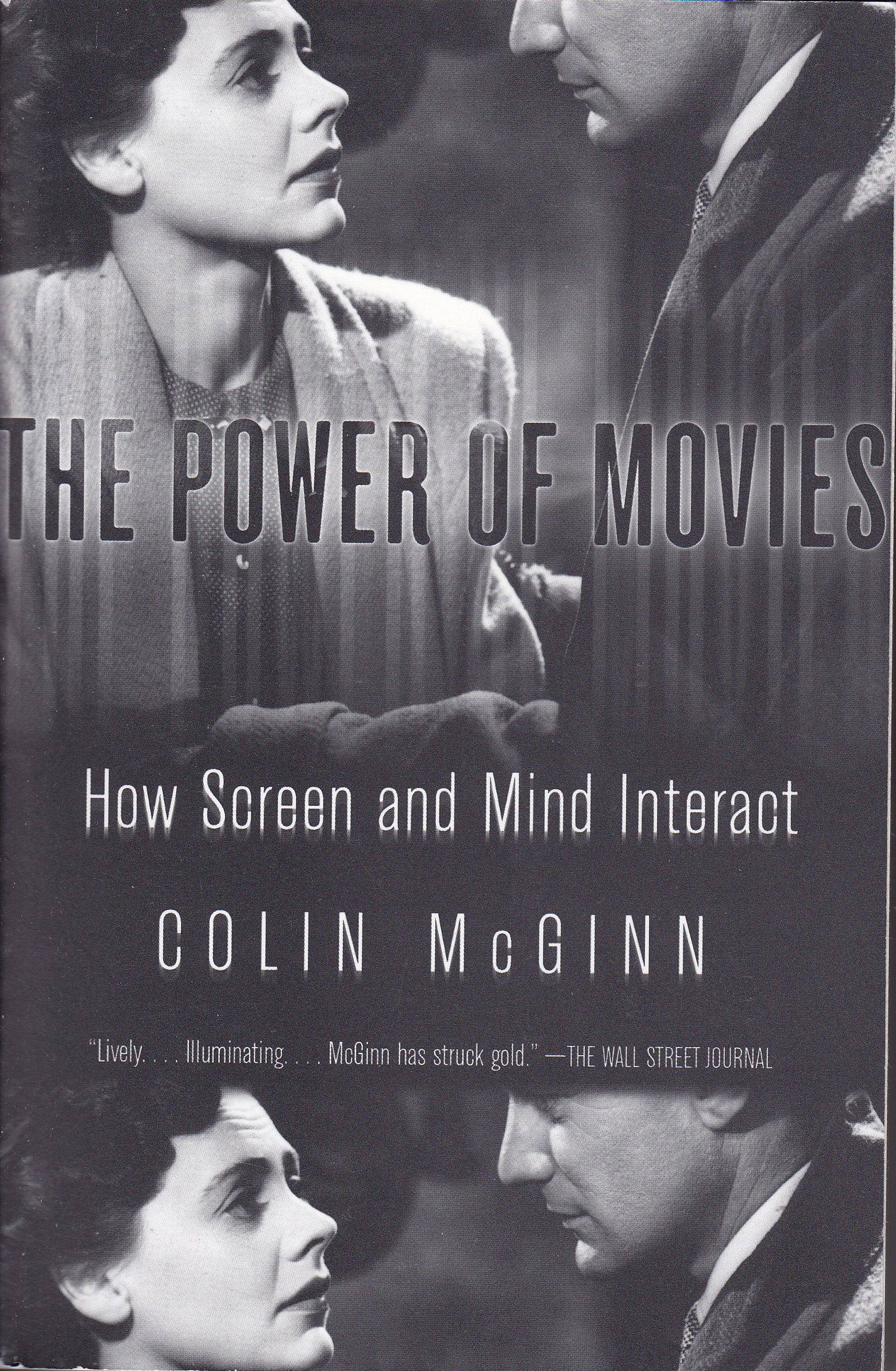
Movies have a way of really influencing people. Thus it has been since the invention of the art form. We’ve all had the experience, I suppose, of a movie hitting us with a profound impact. It never really occurred to me to ask why. That is, until I read Colin McGinn’s The Power of Movies: How Screen and Mind Interact. I’d always thought that movies were simply a successful form of entertainment, and scholars seldom take entertainment seriously. As McGinn makes clear, there’s a lot more than casual watching going on when we slip into the theater. As a philosopher, McGinn is duty-bound to look beyond the obvious. Time after time in this profound little book I found myself pausing to consider the implications of what he says. Ultimately, he suggests that movies access the same areas of the brain that dreams do, not only giving them dreamlike qualities, but also making films emotional experiences like dreams.

At one point, McGinn draws explicit connections between going to church and going to a movie. Beyond the superficial aspects of a darkened building with a performance meant to impact a person, there are clear parallels between going to the theater and going to church. Both can be transformative experiences. The Power of Movies is a powerful little book. As much as we like to think that we have custody of our minds, the realm beneath the surface—that which gives us dreams and syncs with movies—has more influence on us than we’d generally like to admit. More and more, scholars are beginning to realize that films do have a profound impact on viewers. This is not just entertainment. It may not be worship, but after reading McGinn I think it might not be too far from it. The mind able to dream, after all, is a mind that’s truly free.


Grin and Bear It

The dentist’s chair is about the last place I’d like to spend my Saturdays, but given my work schedule there are few alternatives. So there I was yesterday, yellow light glaring in my eyes, drill whirring ebulliently away, and finally gagging embarrassingly into the tiny sink at my right. Those back teeth come in handy for grinding, but they are poorly designed for brushing. I find the dentist’s office a good place for philosophical thought. In that chair where I’d rather not be, feeling sensations I’d rather not feel, I wonder in what sense my body is my own. Lately I’ve been contemplating this quite a bit. Consciousness seems attracted to a single body at a time, but the biological organism I call me doesn’t always have a say in where it is slated to go, or what it is free to do. Each job I have taken has come as an “only offer”—I’m not one of those over whom bidding wars are likely to erupt. That crown that popped off my tooth wasn’t really my doing, nor was the memorable root canal that led to it being there in the first place. Still, here I am.

Photo credit: Richard from Canton, Wikipedia Commons

Photo credit: Richard from Canton, Wikipedia Commons

Religions regularly teach that overcoming physical limitations is one of the perks of paying attention to your soul. I suspect parsing soul, consciousness, mind, and psyche is to slice this entity I call “me” a bit too thin. Whatever all or any of this is, having x-rays shot through it while the assistant hides behind the wall, it is hopefully made of sterner stuff than the teeth nature has given it. One hopes that this can’t be all to expect out of our existence. Life, if only our physical years, is too short to spend much of it in the dentist’s chair.

I’m not sure I like dentists knowing more about this body than me. Is it mine at all? I recall the exasperated call for a tongue blocker in a Wisconsin dentist office and the tooth-meister proclaimed, as if I weren’t in the room, “he has a curious tongue.” I don’t intend for my tongue to be curious, but it always seems to wonder about what finds its way into my mouth. Is it me? Is it mine? The consciousness always seems to come back to this body that does things I can’t control. These thoughts come on a sleepy Saturday morning when I should, by all rights, still be in bed. That is, if I’m indeed the one who wakes up in this body yet again today. And whichever body it may be, if it is mine, I know I brushed its teeth before going to sleep, as I have for as long as I can remember. And yet the drill whirs on.


Moral Animals

CanAnimalsBeMoralFor all of my life that I can remember, I have felt an affinity with animals. Even when I was relentlessly taught that evolution was wrong—Satanic even—I still held onto the idea that animals are more like us than they are different. I know this is partially the great sin of anthropomorphism (although I secretly doubt it is a mortal sin), but when I’ve interacted with animals, or watched them interact with each other, they’ve convinced me that they’re thinking. Since, however, we are the very top of the food-chain, we can’t allow such things. That’s why I turn to philosophy. Perhaps public transit isn’t the best place to appreciate fully a book of philosophy, but it’s the only time I have. Those who think categorically and with such rigid logic surely must have something to say on the issue of our fellow creatures. Mark Rowlands’s Can Animals Be Moral? is one of those books that might not be best read on a bus. I found myself constantly wanting to draw diagrams to visualize the course of his thought as we hit another pothole, or an angry bird killed a green pig in the next seat over.

While the animal stories that make such an engaging case are not a major part of Rowlands’s book, they nevertheless, for many of us lesser thinkers, seal the deal. When an animal acts in a way that shows its own lack of self-interest (how un-human!) we should sit up and pay attention. The question of morality, however, is thorny. Philosophers of ethics and religious analysts of the same seldom come near one another in their conclusions. We don’t know why we think morally, but it is clear we often do. It is obvious that it isn’t solely because of religion, although religion sometimes has a hand in it. It is, at the end of the day, a matter of feeling what is right. I feel that it is right to treat animals as thinking, feeling creatures. But are they moral?

Rowlands shows that some of the implications of animal morality can be serious. It was not that long ago that some animals were put on trial for the harm they’d putatively caused. Some were executed. (I wonder if they were eaten afterward?) If we attribute morality to animals, can they be blamed for their actions? Here is where the brilliance of Rowlands’s carefully argued book comes out—animals can be moral subjects without being moral agents. That is to say, they can act morally, but they can’t reason it out. I’m sure that I’m not saying this right, but the basic idea still appeals to me. Reading his final chapter on how moral Martians might view the naked apes of this planet gave me the chills. When we take ourselves off the top of the food-chain, the view becomes very sobering indeed. Would we want to be treated by Martians the way we treat animals on our own planet? Morality lies at the answer to that hypothetical question.


Truth Fully

An article on science reporting on the BBC has me thinking about truth. Again. Truth is, of course, a philosophical concept. What it means is a matter of debate, and always has been. The way that it’s used, however, is reflected in the debate-oriented situation in the story. According to IFL Science’s Lisa Winter, the BBC has been tasked with tightening up its science programs to avoid the dilemma posed by the “two sides to every story approach.” While not denying that debate is the lifeblood of science, assessing the strength of the debate is essential. For example, there is a true scientific consensus about global warming. Those who deny it are generally backed by either corporate or religious causes that motivate them to claim the truth lies elsewhere. Truth is a very slippery term. And anybody can use it and claim it. In philosophy there’s no answer key in the back of the book.

Photo credit: Marretao22, Wikimedia Commons

Photo credit: Marretao22, Wikimedia Commons

Science, which I’ve admired from my earliest years, has a really, really strong track record of describing the physical universe accurately. Truly enormous paradigm shifts are rare in science and must be accompanied by stringent evidence. Sometimes critics grow frustrated at the slowness of science to accept something that seems obvious, but scientific thinking is nothing if not careful. Enter religion. The claims of most religions lay far beyond the reach of science. And yet, religion too has a really, really good track record—not of describing the physical universe (at which it often does abysmally poorly), but of providing meaning to human lives. Scientists have actually studied this. Religion, like it or not, does help. When it makes a claim on truth, however, a religion often comes into conflict with science. And the problem is that policies based on faulty scientific outlooks can have catastrophic consequences.

So what is truth? If we define it as what really, physically describes the material universe, science is onto it. In fact, science has the best chance of giving us an intellectually honest answer. If we define truth as what a certain deity declared law about a particular aspect of human life, science can’t help. Science doesn’t concern itself with gods or their putative decrees. Religion, however, does. And a vast part of the population votes for leadership based on religious beliefs rather than on scientific principles. And most have not taken too many classes in philosophy. In a democracy we both benefit and suffer under the weight of public opinion. And right now, it seems, public opinion considers philosophy as waste of time and would prefer the truth shrink-wrapped and ready for easy consumption.


Material Goods

Few ideas are as insidious as the reductionistic materialism touted by some of the New Atheists. Atheism and materialism need not walk down the same garden path, but the idea that we are determined by the thoughtless playing out of particle physics can only be achieved by sweeping the vast majority of human experience off the table to attempt a sterile analysis that applies, it seems, only in a vacuum. I often ponder this dilemma since those who think through the implications seriously soon find themselves locked out of the room. Materialists want nothing to do with those who challenge a system that is a little too neat, while ardent believers in religion have trouble letting go of what are obviously the mythological underpinnings of belief structures. The rest of us, trying to be intellectually honest, know that strange things happen and that materialism’s strong arm is powerless to uphold a system that is simplistic.

Indeed, scientists have moved away from utility as the sole criterion for explaining the universe. Beauty, or elegance, is frequently considered to be key to a Grand Unified Theory. It may be a gut-level reaction, but it speaks to something deeply human; we need to make sense of our world. We can do that, however, only if we’re willing to be honest. I’m not sure we can be honest without acknowledging that our minds range far beyond the sum of all the electro-chemical activity within an individual brain. If they didn’t, religion, for one, just couldn’t survive. Beauty, as a qualifier, is said to be in the eye of the beholder. Philosophers, however, maintain that aesthetics, the study of beauty, constitutes a branch of philosophy that requires hard thinking and specialized training. Beauty is a driving force for many aspects of life. Otherwise we wouldn’t hire architects to design since buildings on university campuses. A pile of bricks sufficiently mortared will do.

450x230_q75

The issue is trenchant because a generation is growing up with this idea firmly in place. Scientific studies, if scientists are to be believed, demonstrate that a strict materialism erodes empathy, the sense that what others experience matters. The logical conclusion to a reductionistic world is a kind of cold solipsism where the only spark of consciousness that matters is the one that takes place inside this head. All the rest are just formulas and equations. And yet, don’t even materialists enjoy a good novel, movie, or fine meal? The world is a complex place, and we haven’t even taken the first adult steps to begin exploring the rest of the universe with the five basic senses we acknowledge. Even down here, however, there is much that reductionistic materialism can’t explain. I wouldn’t stick a god in that gap, but a dose of humble wonder, I suggest, wouldn’t hurt.