Cookie Time

All right, who wants to be the big meanie now? The fact that politics manage to besmirch just about any human enterprise, no matter how noble, is a lesson many of us learn on our slow trek to adulthood. I sadly came to realize that the church is incredibly political, and that universities could rival congress for the backstabbing and posturing that goes on. In the midst of all this politicking, one of the truly good NGOs left in the world is Girl Scouts. Sure, there will always be some councils with personality issues, and some troops will have a difficult scout or parent with which to cope, but the organization is based on the principle of giving girls the confidence and assurance they need to be successful in life. What could be wrong with that?

My wife pointed out a story on Salon.com that reveals some anti-abortion groups are now claiming that Girl Scouts supports Planned Parenthood. This is patently not true. Even if it was, it would hardly be a crime to teach girls reproductive options (after all, when is the last time a Pope or President carried a pregnancy to term?), but since people don’t think with precision, it seems best to keep girls in the dark. Some right-wing groups are boycotting Girl Scout cookies as if the devil himself were the baker. Not to be outdone in perceived self-righteousness, some Catholic Churches are kicking out Girl Scout troops for supporting abortion! All of this based on a lie. The road to the unconscionable position of the Catholic Church toward reproduction has been long and mentally torturous. Anyone who has taken the trouble to trace the church’s strange love affair with the fetus may be surprised to learn how recent the concern became an issue and how very androcentric it is. The church’s claims here rely on nothing more than good old testosterone-generating glands and the love thereof. To punish the Girl Scouts for a fictitious association with an unapproved organization shows just how mature the largest church in the world truly is.

The male bias in the majority of the world’s societies is bad enough. The United States likes to hold itself up as an icon of fairness and equality. It is the spirit upon which this nation was founded. Except when it comes to females. We don’t want our girls to have reproductive autonomy because that might make men look somehow less masculine. As for those wimpy guys who like to read, the Bible backs them up completely on this issue. God is a guy, and made guys to be in charge. No matter how much education you offer, you won’t be able to change that one-book-fits-all outlook. What will we have lost if we seriously and honestly treat both genders equally (and even those intersexed individuals)? Only the apparently fragile male sense of superiority. I say, in the spirit of America vote for equality! Buy Girl Scout cookies!

Deliver us from evil.

Political Insantorum

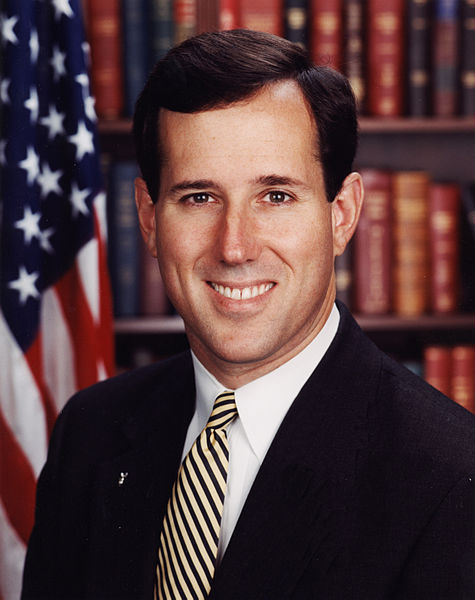
Some weeks it is Thursday before I get a look at Tuesday’s newspaper. It has been one of those weeks. On the op-ed page of the New Jersey Star-Ledger is a piece by Harvard professor Noah Feldman on the somewhat surprising rise of Rick Santorum in the melee otherwise known as the GOP nomination process. The intolerant Catholic (Santorum, not Feldman) has surprised many with his appeal to the Evangelical Protestant camp, the traditional enemies of anything popish. As Feldman points out, if you add up Santorum, Bachmann and Perry, you get the equivalent of a 2008 Iowa Huckabee with Romney staying about where he was back then. This calculus of political doublespeak points to a very basic, fundamental lie at the heart of it all: none of the candidates is a theologian, but they act one on TV. Santorum’s Catholicism is blurring with Huckabee’s Baptist sensibilities in a way that should make even the most profane Reformer shudder. Baptists supporting a Catholic? This marriage can’t end happily.

I am no politician. I’m not even a political science student. As someone who has kept a weather eye on religion for over forty years, however, it is clear that “Christianity” in America is a house built on shifting sands. For a nation founded on the notion of religious freedom, an awfully large number of citizens sure want to limit the options. Freedom of religion is the choice whether to sit on the right hand side of the aisle, or the left (with the former being strongly urged). Freedom of religion can be frightening because no one has all the answers. And politicians, who regularly distance themselves from the rest of us, send their children to private schools to underscore the fact. Is it not so, Mr. Santorum?

Those who want to take their dogma to the White House should make sure it’s at least paper-trained first. Feldman notes that Roe v Wade gave the initial push of Evangelical toward Catholic. I am reminded of the excellent book Republican Gomorrah by Max Blumenthal—those who are interested in the real roots of the overly emotional secret lives of blastoplasts should read this book. Suffice it to say that some very interested parties really didn’t care much until a particular quasi-celebrity decided to make a cause célèbre of the issue. Now the way to the seat of power is paved with unwanted pregnancies. It is high time politicians got their hands out of their pockets and off their Bibles and started using them to help the average person again. In fact, it might not hurt if they had to be an average person before running to represent them. But then, they wouldn’t be able to afford private school for their kids, would they? Mixing with hoi polloi takes more fortitude than a congress full of representatives can muster after all their pampered rearings.


Send in the Robots

The FIRST Robotics kickoff is an event that is difficult to describe for those who’ve never attended. First, it must be noted that FIRST Robotics is sometimes described as “the varsity sport for the brain.” While engineering students with a penchant for athletics are not unheard of, the majority of robotics team students are not cut from the same cloth as the athlete. The FIRST kickoff, the first Saturday in January, is the opportunity for these kids to be told it is cool to be smart and that application of brain power is not the liability that many of the electorate seem to think it is. At this event the competition for the year is unveiled, and the kids (with some adult help) have six weeks to design and build and program a robot to do some very complex tasks. It is a season of sleep deprivation, programmed Saturdays, and the celebration of learning. Before NASA shows the game animation—the competition for the year—celebrities and other people in the public eye endorse the program. It is a time for praising the benefits of science.

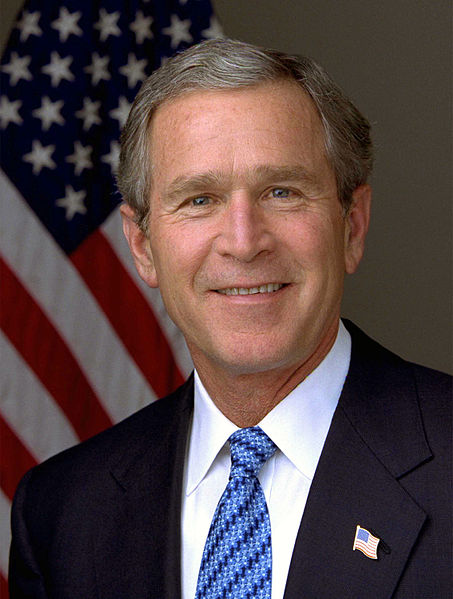
Yesterday’s kickoff, however, was marred by the appearance of one of the guest celebrities. When George W. Bush was announced as a supporter of the program, a sense of disbelief fell over the room. This man who advocated for creationism in the classroom, who fought to stop research in cutting edge disease control, who began a war as a personal vendetta, was showing his dully beneficent face on the big screen telling the kids what a great program it was. A chance, as he said, to use your “God-given talents.” He ended his brief—and obviously scripted—sound-byte with his characteristic “God bless you.” I could not stomach the hypocrisy. I’ve blogged about religion and the science of robotics before, but to have a president who did nothing to strengthen the cause of higher education and fought science with eight years at his idle hands was just too much. If I was Dean Kamen, I would have insisted that that clip be left on the cutting room floor.

The former W represented religion in its guise as the enemy of science. It should be clear to my readers that I do not believe science has all the answers, but I also believe it is wrong for religion to stand in the way of knowledge. Science is something that we shouldn’t give lip-service without backing it up with programs and funding. That one minute of disingenuous, religion-riddled speech trumped all the other endorsements, including the sensible one by Bill Clinton who emphasized the need to work together even with those who are your opponents. This was a point W obviously missed. There comes a time when some public figures, like overused cattle, should be put out to pasture. There are some cowboys that should just stay on the ranch. I understand that presidential endorsements are important to FIRST, but in this case integrity should not be compromised. Especially when most of the teenagers watching the kickoff possess far greater potential than a mere politician elected on religious sentiment and dubious counting.

Does this face inspire science?


Loaded Symbolism

Perhaps it’s all the politics in the news, or perhaps it’s the very long nights of January, but death comes to mind during the winter. One of the enduring preoccupations of religion is the issue of death. Christianities teach of wonderful rewards or horrendous punishments after the sloughing off of this mortal coil. Many eastern religions suggest the even scarier idea of reincarnation—we are doomed to repeat this sideshow over and over until we get it right. Since the universe has billions of years to go, that’s plenty of time for errors. When we finally depart, however, we leave our loved ones with the dilemma of how to handle our remains. Burial goes back to the Paleolithic Era—simple, effective, little fuss. Nature reclaims what we have borrowed for a century or less. This is the preferred Christian end, for, believing in the resurrection of the body, a body must remain. In some form. Other religions, noting the cleansing power of fire, prefer cremation. Those original Zoroastrians still prefer exposure of the dead to carnivores. It is, however, generally our religion that dictates our final disposal.

Enter the entrepreneur. The corpse becomes a commodity. You’ve got a problem and you’ll pay well for a satisfying solution. Some years back I saw ads for a company with the scientific, yet romantic concept that, as carbon, our corpses could be pressurized into diamonds. It is a costly procedure, but you could wear your beloved around your neck or on your finger as a chunk of the hardest substance on earth. A few weeks ago I found a more affordable solution on the website of Holy Smoke. Once you have made the decision to go with cremation, what do you want to do with that urn of ashes? Holy Smoke offers a solution: you can have your loved one’s remains loaded into ammunition shells. Taking care to handle the ash with profound respect, Holy Smoke will place the remains into either rifle or shotgun shells (one pound of human ash fills about 250 shotgun shells). You can then be shot toward eternity by loving relatives at their convenience. Gunpowder-propelled toward Heaven itself. Holy Smoke is located in Alabama.

Welcome to eternity

The problem of human remains is perhaps the most religious one of all. Our faiths give us the hermeneutic we need to face that great portal. As we consider the number of useless deaths brought on by Bush’s personal war in the Middle East, a kind of macabre closure can be seen through the smoke. After all, the NRA endorses the Republican Party. So does the Religious Right (unless, of course, they nominate a Mormon). Perhaps if we loaded our guns with our dead instead of live ammunition, the symbolism might finally hit its target. Holy Smoke could be offering a valuable service here to be shared between religious enemies. Instead of the kiss of peace, well, use your imagination. Perhaps it’s the very long nights of January, or perhaps it’s all the politics in the news.


The Newt Roars

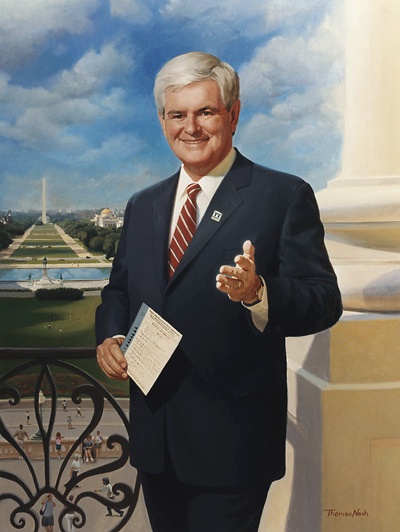
Today marks the final day of my Iowa odyssey. The state that is about as heart-of-the-nation as you can get is chaffing under the weight of political lard as the caucuses near. According to the Huffington Post, Newt Gingrich is roaring mad about the negative ads that are choking the airwaves. You’d think with a life in politics he’d be used to it by now. Religion, of course, is playing an undue role in this season’s GOP contest—everyone knows Mitt Romney is a Mormon and publishers are scrambling to get out books on that religion as fast as their authors can write. Rick Perry, to the chagrin of many, bears a Methodist affiliation and the religious sensibility of Genghis Khan. Of course, Newt appears relatively calm as a Catholic, at least for the time being. Jack Kennedy, however, he is not.

The Republican Party began a flirtation with religious conservatives as early as the Nixon years. Pundits realized that, like the Alaskan oil reserves, religious fundamentalists were an untapped resource to grease the rails to election day. Overjoyed to have a voice in high profile public office, the conservative Christian crowd began to wilt from the perceived failure of Jimmy Carter and began to glom onto the media image projected by Ronald Reagan. We all suffered through the Bush years, hearing more about God from the president than we heard about the soaring national debt or the coming crash that would implode upon the working class that elected him to office (so they say). Now, facing the choice of candidates wealthy enough to run for office, many are finding the choices on the shelves of the spiritual marketplace a little understocked.

Back in the days when America was young, the founders laid down rules declaring that no religious tests would be imposed on those running for public office. Their fears proved prescient and uncannily accurate. Today perhaps the biggest test any candidate has to pass is his or her religious affiliation. Can we imagine a Mike Huckabee, Sarah Palin, or Michele Bachmann without their Bibles tucked under arm? Religion has no corner on the market for sanity. Many, in fact, would argue that the indications sometimes point in the other direction. The corner America has painted itself into is not so much shaded with red, white, and blue, as it is with the muddy brown of religious slurry that has become the new politics. Newt, newly minted from his Southern Baptist heritage, is mad about mudslinging. I think Americans should be enraged about religion slinging instead.


Bible Review

The Christmas edition of the New York Times Book Review begins with the Bible. Appropriate enough for a book that gave us “in the beginning” and the Christmas story in the first place. Reviewed by Marilynne Robinson, the Pulitzer Prize winning novelist, the Bible is presented as the unacknowledged source of much of our literary culture. It is a message that bears repeating every now and again, since the Bible itself is often equated with those who thump it instead of trying to comprehend it. The Bible is often guilty by association. Like any book, it has parts that we wish weren’t in it, but that is only problematic for those who think of the Bible in authoritarian terms, a book that must be rebuilt into modern culture, jot and tittle. Taken alongside other ancient writings, however, the Bible is a fine example of human evolution. It represents a segment of our developing culture. And, every now and again, atheist and evangelical should acknowledge, the Bible gives us profound insights.

Robinson’s article mostly focuses on reiterations. The Bible’s influence is deep, and in the English literary world, nearly universal. What authors have written in the past—and what they are still writing today—bears the stamp of the Bible. It was the first formative book in western culture, and to dismiss it completely is to throw away a valuable part of our selves. At the same time, even so able a writer as Robinson can’t escape the subtle supersessionism that coheres to the mythic reading preferred by a large cross-section of society. The Bible is a self-referential text, but the Bible does not know that “the Bible” exists. Books that eventually made it into the collection were written without an awareness that they would become authoritarian tomes millennia down the road. Modern believers still invest the books with the mystique of divine authority, often in subtle ways.

A point made by Robinson should be read by those aspiring presidential candidates super-bussing their ways across Iowa. “Moments of the highest import pass among people who are so marginal that conventional history would not have noticed them,” she writes of the biblical narrative. The vast majority of us are marginal in this sense. Those in seats of power frequently forget that it is the unassuming compliance of those further down the food chain that lends them their power. The Bible is nearly always on the side of the oppressed. The Bible, however, can also empower those deprived by the crass world of politics. It must be rescued first. Once they are done kissing babies and shaking hands, once they settle in their opulent offices built with the money that would have otherwise gone to those babies, politicians forget the basic truths of the Bible. As long as it can be thumped once in a while, however, they will keep it in the bottom drawer until it is needed again. Only by dealing with the Bible sensibly can its abuse be stopped.

There is, I hear, balm there.


Silent Fright

Baylor University has begun to make quite a showing in the non-sectarian academic world of late. Knowing of the school’s Baptist heritage, I’d always been somewhat suspicious of any scholarship susceptible to doctrinal poisoning. I freely admit that my fear goes back to a hyper-evangelical college roommate. Even at the conservative bastion of Grove City College, John would lament the sorry religious state of the school and repeatedly thought of transferring to Baylor. (I need not fear that John will ever read this—he avoided liberal dribble like it was Planned Parenthood.) By association, Baylor became something in my mind that it apparently is not. When the administration recognized the direction the Southern Baptist Convention was going, they took steps to protect themselves from a takeover (something I’d witnessed at a much smaller school some distance north). The university press has been producing intriguing books, and the sociology department has been cranking out some fascinating studies of religion.

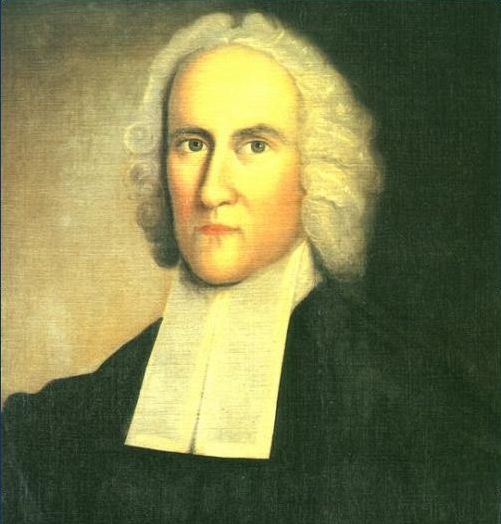
One of the more recent religion in America surveys from Baylor indicates that a correlation exists between the image of God presented by a version of Christianity and that contentedness of believers. More specifically, churches that promote a judgmental image of God (think Jonathan Edwards and his spiritual bedmates) tend to be anxiety-ridden and compulsive. Churches that teach a loving God have more balanced believers. Brimstone and hellfire, in other words, produce the expected results. What the Baylor study shows is not so much surprising as it is scientific. Well, softly scientific. As a social science, sociology relies on statistics and analysis to draw its conclusions. We now have a means of measuring religions outcomes.

Religion is, in many ways, self-fulfilling prophecy. By preparing believers for a literal Hell of a future, it cranks out automatons who’ll do anything to flee from the wrath to come. Herein lies its danger as well. Although some politicians may be naïve about the veracity of belief, many of them realize something their more liberal compatriots don’t—religion motivates. The religion of a loving God who has no Damoclesian sword hovering perilously over the heads of the faithful won’t get them to the polls. The god with believers on a skewer above the everlasting barbeque pit will. Baylor has shown us the data. If we ever hope to redress the damage constantly visited by politicians claiming God has told them to run for office, to invade Iraq, to commit war crimes in the name of the prince of peace, we must act on good information. If religion is a psychological anomaly, it pays to learn a little applied psychology. Otherwise the wrath of an angry god will consume us all.


Scared Mittless

Once again Time magazine has presented an article where the intelligent are left scratching their heads about religion. Jon Meacham’s Commentary, “An Unholy War,” details how evangelical concerns about Mitt Romney’s Mormonism has an undue weight in regard to his presidential candidacy. For many years the media industry has considered religion passé and without teeth. Sure, the street-corner preacher can still give you a good gumming, but it is rarely fatal. What those who’ve never felt the utter urgency of religion can’t appreciate is, well, its utter urgency. In a day when Buddhist monks and Catholic nuns are wired up to electrodes and told to find that spiritual sweet spot, it is easy to forget that these aren’t just laboratory fictions. For many people in the world, their religious experiences are very important and of sometimes deadly—sometimes eternal—consequence. The sophisticated, the educated, laugh it off as so much hoodoo, and try to get on with human progress. For those raised religious, however, escape is neither easy nor desirable. Those in positions of actually influencing the public need to recognize that religion is not a luxury, a trapping that might be cast off. It is a life choice cast in iron.

Just as serious as the analysis of religion is the incredible influence of religious teaching itself. Take a young child, barely old enough to understand death, and tell him or her that the worst thing they can imagine just can’t compare with the torment God has cooked up for those who step out of line. Repeat. At least once a week. When said child becomes an adult, these early ideas are deeply embedded. Since the 1980s elections in the United States have been restyled as religion popularity contests. With eternal consequences riding on the ballot, political analysts ought to be required to have had taken at least Religion 101. Probably a few upper-level courses would also help. Despite the optimism of scientists and academics, religion is not going away. The reluctance to take it seriously will not diminish its power in people’s lives.

As became very clear reading Philip Jenkins’ Mystics and Messiahs, it has only transpired that the Church of Jesus Christ of Latter-Day saints has been recognized as un-culted for less than a hundred years. As a relatively new religion, Mormonism was a “cult” until it had survived long enough to gather a band of respectable followers, such as Mitt Romney. Many Christian groups, particularly evangelical ones, have not released their perception of Mormonism as a cult. Romney, in their eyes, is effectively as pagan as Obama. Their votes, as the eight-year nightmare of the Bush administration demonstrates, can decide elections. Still, we the sophisticated laugh off the country rubes who still believe in God. And although we don’t believe in it, we already have, and may well once again, come to suffer through Hell to show just how educated we are.


Whatever Happened to Marshmallows?

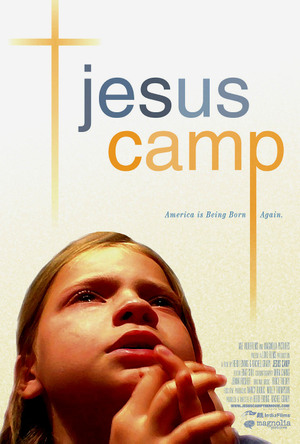
A rainy Sunday evening seemed like a good time to watch a scary movie. I had already viewed an exorcism movie or two over the last couple of days, so my wife and I decided to try something scarier: Jesus Camp. This 2006 documentary shows the workings of an evangelical, Pentecostal children’s camp run by Becky Fischer. By not skewing the evidence but by letting the organizers and children speak for themselves, a disturbing political agenda is revealed. Even more disturbing is the psychological scarring that accompanies such childhood indoctrination in a religion of fear. Fischer is obviously concerned with militant Islam, but her tactic of countering it with militant Christianity where children are soldiers (“this is war!” she shouts at one service) feels equally wrong. Part of the problem with such “Bible based” groups is that the Bible contains many contradictions and the Fundamentalists must pick and choose. For example, Rev. Fischer has chosen to disregard 1 Corinthians 14.34, stating that women should keep silent in the church. (I certainly do not advocate the literal application of that verse, nor of many others that made their way into a misogynous Bible.)

Utilizing the Bible only goes so far as a political tool. At the Kids on Fire camp the children are geared up to an emotionally intense state and lectured about the evils of abortion, evolution, belief in global warming, and Harry Potter. No mention is made that the Bible says nothing about abortion or evolution, and global warming had not yet become an issue. I can’t seem to recall Harry Potter being mentioned by name in the Bible, but other fictitious characters are from time to time. The Bible, having been written over a span of about a millennium, contains differing voices making statements for specific circumstances, and never intended to be used as political platforms. One gets the sense that “Bible believers” seldom read the Bible seriously themselves. Certain favorite passages are committed to memory and rehashed to death while others molder in dank corners of Fundamentalist basements.

What is lacking here is the long view. Once such groups win political power—they should be taken far more seriously in this arena—the religious freedom that will have launched them to that position will disappear. Like all human enterprises, however, it too will eventually crumble. Ted Haggard was spotlighted in the film, shot before his own hypocrisy came to light. At the camp George W. Bush is held up as a saint with Samuel Alito as his acolyte. The psychological manipulation and emotional abuse that the children trustingly accept is condemnation enough in itself. The camp was shut down after the film was released, but Becky Fischer, like Arnold Schwarzenegger has declared, “I’ll be back!” This is one Terminator I truly fear. Having watched a couple of exorcist movies over the weekend as well, I am left wondering which is scarier: demons that possess children or false prophets who do the same?


In Our Image

Preparing course notes on Ancient Near Eastern religions often sheds light on the religions we practice today. Religious beliefs are organic and, although many religions claim special revelation, their basic components have been around for millennia before they appeared. In the broad sweep of ancient times it becomes clear that religions evolve to fit the viewpoint of the power structures of society. The favorite god of a puissant sovereign became the chief god of a nation. When rulers change, gods sometimes change with them. Without doubting the sincerity of ancient believers, the truth is that gods serve the needs of the state as long as the state upholds the monarch. When gods become too sympathetic to the working class, well, it’s time to shuffle up the pantheon a bit. The story of Akhenaton’s advocacy of Aton worship is a case-in-point.

Somewhere along the way to modernity, symbolism became literalism. Anyone who follows the news of the various theocracies of modern history can see this pattern endlessly repeating itself. Politicians need a power-base and religious believers are often natural followers. By wedding gullibility to expediency a religious right is born. Akhenaton would have been proud. Of course, the message repeatedly doled out by our rapidly evolving, technical society is that studying history and religion (among other arcane subjects) is a waste of time. Look! New toys! We set ourselves up to fall prey to the unscrupulous.

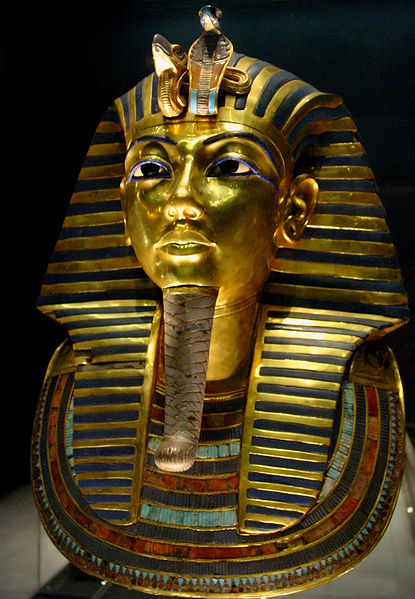
How else do we explain the revelations of hypocrisy that spring up like toadstools whenever an über-religious candidate claims public office? Thank goodness modern religions teach forgiveness! In the empires of days long gone, kings lived a life out of touch with the common worker. They enjoyed luxuries that the laborer couldn’t even conjure. When a challenge arose to that power, all you need to do is bring the gods onto your side and even the most stalwart peasant will back off. When Akhenaton’s young son Tutankhaten inherited his shaky throne, the populace demanded the old gods back. Tutankhamen acquiesced and the balance of power was restored. The gods, apparently, did not seem to notice.

The wise say nothing.


Black and What?

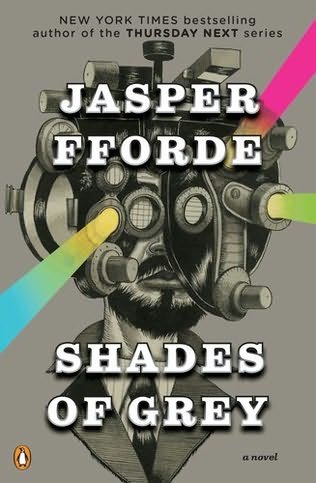
Dystopias are not all of the same stripe, or, in this case, color. Jasper Fforde’s Shades of Grey is perhaps the most colorful look at a bleak future I have ever read. The premise, funny and strangely serious, is that in the distant future color perception ability determines social rank. A cast of odd characters who see predominantly only one color vie for superiority while keeping to the rules of the founder of this society. The hilarious results often carry profound consequences. Those who live within this highly stratified culture fear those who do not, including a mysterious group known as the monochrome fundamentalists. The founder of the social order, Munsell, has achieved god-like status and his writings have the force of scripture.

This dystopia reflects, whether intentional or not, the social impact of many religions. Reading about the prefects, the political leaders of this culture, is like reading about the clergy who mistake spiritual guidance for power. The transition from pastor to politician is simple enough among social creatures like ourselves: we need those with persuasive powers to make decisions in accord with our best interests. Prefects and priests, however, are both eminently corruptible (let us say nothing of politicians) and evolution favors those who look out for themselves. The trick is to make others buy it.

Fforde’s dismal future includes Leapbacks where useful technology from the past is discarded in order to make people more compliant. In a world where color is a rare commodity, a modern usage of the rainbow seems apropos. Everything we are learning from psychology and biology—sciences still in their youth—suggests that sexual orientation is deeply ingrained, more so that just preferences or likes. The mainstream religions, however, have actively discriminated against those who are aware of their deepest needs. I know many excellent, caring individuals who’ve been kept from the ministry because of their orientation. Others who are clearly deleterious to the church climb to positions of power based on their approved sexual appetites. And society falls into lockstep with them. I don’t know Jasper Fforde’s political views, but along with him I would suggest that the ability to see shades of gray might be the best thing for any society, whether in the distant future, or especially, in the present.


Faith Value

An interesting op-ed piece by Doyle McManus of the Los Angeles Times appeared in today’s newspaper. McManus notes that twenty-eight of the forty-four Presidents of the United States have come from just four mainstream Protestant denominations. This year’s Republican front-runner list contains no mainstream Protestant denominational candidates at all. This McManus takes to reflect a growing tolerance among the American populace, but also shows how deeply rooted religion is in what has become, in a covert way, a theocratic state. Religious sentiment rules politics and savvy politicians know how to play the religion card to achieve the power they crave. As McManus’ column makes clear, when campaign season rolls around candidates begin attending church again. Of course, the average American accepts their sincere proclamations of religious faith at face value.

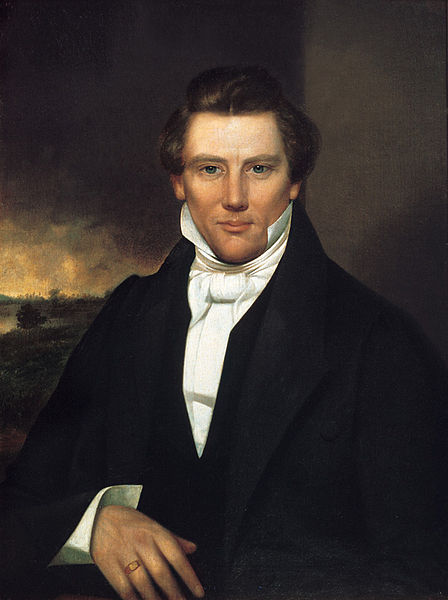
McManus also points out that the front-runner for the GOP, Mitt Romney, will face some difficulty as a member of the Church of Jesus Christ of Latter Day Saints. Most evangelical Protestants reject Mormonism from their fold, claiming that they follow a different shepherd or just see everything through rose-colored glasses. Mormonism, however, is among the fastest growing denominations in the country (the claim for fastest is staked by far too many to get an accurate count; it is a safe bet, however, that it is evangelical). Mormons tend to come down on the right side of conservative social issues, but without the seal of mainstream approval, the bid for presidency remains a difficult goal.

The other corollary that McManus points out is that mainstream denominations are losing their place of social prominence. Today it is far more likely that a person refers to a Pentecostal or non-denominational believer (or even a Catholic!) as a “Christian” than they would refer to a Methodist, Presbyterian, or a Lutheran as such. Both the political and religious rules have changed. Americans want a Christian President, but they have lost sight of what that actually means. In the mud-slinging that accompanies any campaign season, suspicions cast on a candidate’s political orthodoxy will be sure to score big points. It is an open question whether a democracy and a theocracy can truly coexist.

WWJ(S)D?


Crossing Italy

“Poor men wanna be rich, rich men wanna be king, and a king ain’t satisfied ‘til he rules everything” – sage words of a young Bruce Springsteen. Of course, “man” may well apply to institutions as well as individuals. According to a recent story in the New Jersey Star-Ledger, the European high court has ruled that it is appropriate for public schools in Italy to decorate their classrooms with crucifixes. While this may not seem unusual for the heavily Roman Catholic nation, indeed, the homeland of the church itself; nevertheless it reveals much of the nature of religion. Religions, like Springsteen’s human characters, want to take charge of everything. Partial rule just isn’t good enough in a business that deals with absolutes.

Not every citizen in Italy is Roman Catholic. Some are not even Christian. State sponsored schools bearing the insignia of the church’s glory days send a message that can be heard from the highways to the backstreets: Christianity rules! If we wheel the world around a few degrees further we will find similar rhetoric in nations like Iran, only the specific brand of religion has changed. The message is distressingly familiar: Islam rules! There was a time when the church could likely be called the only true superpower in Europe. We remember that time now as the Dark Ages.

As campaigns for next year’s elections in the United States are pumping up, we are hearing quite a bit about candidates’ religious convictions. That which used to be a private affair has become an emblem emblazoned on a flamboyant flag declaring “Gott und Ich” to the world. Worse, the religions are being used to score votes. Once in office, that religion will return to its flaccid state and politics will be business as usual. The populace, however, has trouble seeing through this. Religion is injected with such emotional freight that leaving it out of elections – or classrooms – is like abandoning a helpless infant. As they nail their crucifixes to the walls of public schools in Italy, I’ll be over here with Bruce surveying these badlands.


Dream Quest

H. P. Lovecraft was a writer who remained unappreciated during his life but who has become a very influential literary figure after his death. So it is with artists. Known mostly for his short stories, one of the novellas he wrote, “The Dream-Quest of Unknown Kadath,” carries immense religious implications. Those familiar with Lovecraft’s fictional world know of the god Cthulhu and the “Other Gods” that he places in outer space. In “Dream-Quest” Lovecraft states that these Other Gods, “are good gods to shun.” While mere fiction, the concept of divinity has become pliable in the hands of its human author. Mortals are those who describe gods, those who decide what their deities will be like. The dream of the titular quest involves the earth gods having been removed from their shining city to leave the dark and dangerous other gods in charge.

While some would dismiss Lovecraft as overly inventive, his view of the earth being clouded by the crawling chaos Nyarlathotep strangely matches what we see playing out in the headlines. Those who are supposed to protect the masses, their leaders – elected or otherwise – have shown themselves to be interested in personal gain above all sense of duty. Throughout the world, and increasingly clearly in the United States, the working poor are seen as simple commodities easily manipulated and programmed to support those who would exploit them. Crawling chaos has landed.

Lovecraft’s “Dream-Quest” has a host of unlikely heroes, among them the cats of Ulthar. These cats maintain a true divinity appropriate for the descendents of Bastet. Feline divinity represents hope to Randolph Carter, Lovecraft’s protagonist. They also represent the tendency of the earth gods only to appear when most sorely needed, otherwise simply to set their own agenda. Where are the cats of Ulthar now? The problem with gods is they don’t always show up when you need them. Many dismiss Lovecraft as just another overly imaginative writer of cheap fiction, but to those will to listen carefully he was an author that could hear a very faint pulse. Even if that pulse was coming from under the floorboards to haunt a reality where the earth gods had gone away.

A little writer shall lead them


The Ides of March

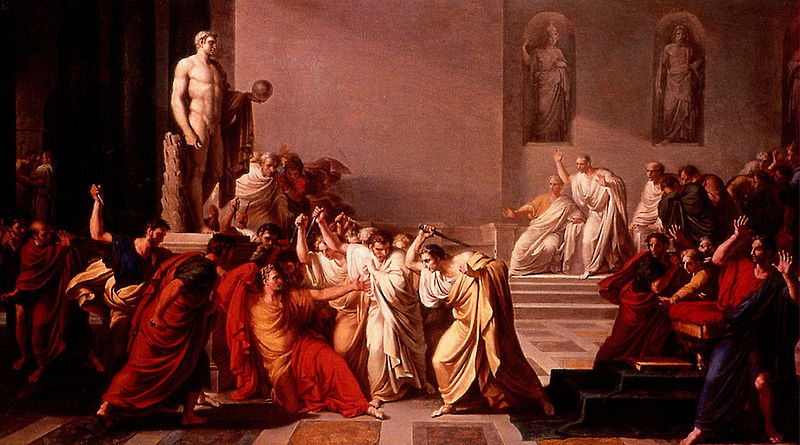
In the days of ancient Rome, politicians as well as plebeians feared the interference of the gods. Auspicious days were ignored, even by emperors, at their own peril. In my Mythology class the concept of hubris frequently emerges. Generally thought to be excessive pride, hubris can take many forms. Whenever a mere mortal strives for godhood, however innocently, it must be punished. Julius Caesar, declaring himself emperor, had to face the wrath of the gods. The ides of March kept in check the ambitions of the powerful. In a world where the political become too powerful, the very phases of the moon step in to restore balance.

The ides seem to have their origin in the date of the full moon. The month of March, named after the god Mars, featured a military parade on the ides. Then, as now, political power is simply the form of government backed by the military. The history of human unrest, especially notable since the American and French revolutions when the common people shouted, “Enough!”, is where might is shown not to equal right. Pontiffs and presidents, enamored of firepower and its blandishments, appear like Caesar before their populaces, confident in their wealth and military backing.

The concept of hubris might once again be meaningful to a culture under siege. As pundits and politicians make bids for places of abusive power, confident that there is no one above them, ethics are reformed in their own images. Have they not become their own gods? We the people bow to their vision of what should be. How many political leaders retire to uncertain futures because their own pensions have been slashed and healthcare diminished? Those who care for them in their dotage are the very children whose educational funds they’ve slashed. Hubris? It behooves all of us to beware the ides of March. Most, like Caesar, will ignore the warning and don the purple. Those who read, however, will not anger the gods.

Et tu, Brutus?