The Ides of March

In the days of ancient Rome, politicians as well as plebeians feared the interference of the gods. Auspicious days were ignored, even by emperors, at their own peril. In my Mythology class the concept of hubris frequently emerges. Generally thought to be excessive pride, hubris can take many forms. Whenever a mere mortal strives for godhood, however innocently, it must be punished. Julius Caesar, declaring himself emperor, had to face the wrath of the gods. The ides of March kept in check the ambitions of the powerful. In a world where the political become too powerful, the very phases of the moon step in to restore balance.

The ides seem to have their origin in the date of the full moon. The month of March, named after the god Mars, featured a military parade on the ides. Then, as now, political power is simply the form of government backed by the military. The history of human unrest, especially notable since the American and French revolutions when the common people shouted, “Enough!”, is where might is shown not to equal right. Pontiffs and presidents, enamored of firepower and its blandishments, appear like Caesar before their populaces, confident in their wealth and military backing.

The concept of hubris might once again be meaningful to a culture under siege. As pundits and politicians make bids for places of abusive power, confident that there is no one above them, ethics are reformed in their own images. Have they not become their own gods? We the people bow to their vision of what should be. How many political leaders retire to uncertain futures because their own pensions have been slashed and healthcare diminished? Those who care for them in their dotage are the very children whose educational funds they’ve slashed. Hubris? It behooves all of us to beware the ides of March. Most, like Caesar, will ignore the warning and don the purple. Those who read, however, will not anger the gods.
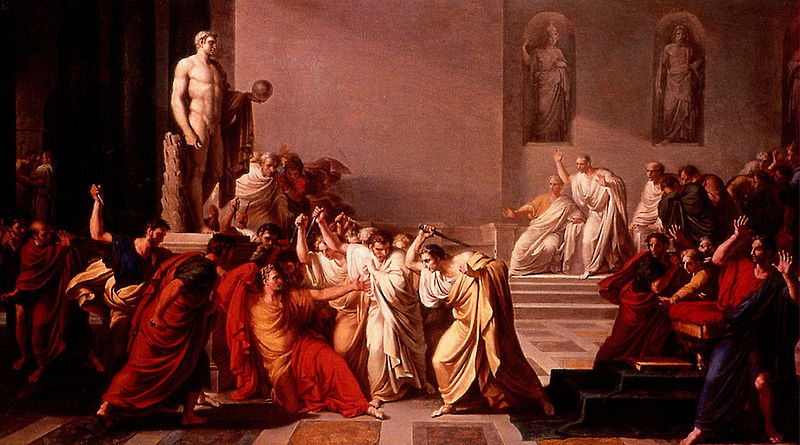
Et tu, Brutus?


Casting the First Stone

I’m not overly nostalgic for a guy interested in ancient history. I tend to look at the more recent past as a via negativa for the young who might make a difference today. Very occasionally, however, aspects of society were handled better back in the 1960s and early 70s. One of the most obvious instances of a more sane society was the segregation of politics and religion. Prior to the rise of the “Religious Right” as a political machine the religious convictions, or lack thereof, of politicians played little role in their campaigns and American culture itself was much more open. A story from today’s MCT News Service illustrates this all too well.

In an article entitled “In S.C., religion colors gubernatorial race,” Gina Smith reports on the various religious slurs that now pass for political campaigning in that state. “Raghead” (for a former Sikh), Buddhist, Catholic, and “anti-Christian Jewish Democrats” are among the aspersions freely cast by those without the sin of a non-evangelical upbringing. As if only Fundamentalists are capable of making the right political decisions. As if Fundamentalists ever make the right political decisions. Fundamentalism is a blinding force on the human psyche, and those who are misled by religious leaders who claim unique access to the truth are to be seriously pitied. Conviction that those most like you are to be trusted most may be natural, but dogged belief that pristine morals accompany any religion is glaringly naïve.

The American capacity for belief in fantasy worlds is in the ascendant. No matter how many times Fundamentalists or Evangelical politicians are arrested or forced from office for the very sins they rant against, their overly forgiving constituencies come flocking back to them. Commit the sin of being born Sikh, Hindu, Buddhist, Muslim, Jewish, or Catholic and no quarter will ever be offered. No, I have no desire to go back to the 1960s, but I sure wish politics would.


Religious Democracy

An op-ed piece in yesterday’s paper raised some important issues concerning religion and the unfortunate fall of Mark Souder. The article, by E. J. Dionne, pointed out that Souder once said, “To ask me to check my Christian beliefs at the public door is to ask me to expel the Holy Spirit from my life when I serve as a congressman, and that I will not do.” This pointed affirmation of faith is precisely the dilemma of a democratic system that allows for freedom of religion. All religions (those that are serious attempts to deal with the supernatural, in any case) are defined by the conviction that their practices, their beliefs, their ethics, are correct. When a religious individual is elected, or even converted after election, in a democratic system their religion is given power. With their faith they vote on issues that cut across religious boundaries, binding those who do not agree to their personal faith stance by law.

Europe in the Middle Ages is perhaps the most obvious example of what might happen when one religious body (in that case, the Roman Catholic Church) gains excessive political power. Problem is, these days folks don’t agree on which is the right religion. America was not founded as a Christian nation, let alone an evangelical Neo-Con one. It has become, perhaps because of this fact, one of the most actively religious nations in the developed world. As befits a consumer mentality, religions are offered in a marketplace. Within Christianity alone there are aisles and aisles of churches from which to choose. When a public servant is elected and her or his religion dictates their votes, have we not just lost freedom of religion?

Teaching for many years in a seminary is a sure way of becoming aware of the limited training that religious leaders generally receive (if any). The short time they spend being educated does not equip them to think through all the implications of their convictions. They attain the pulpit and the congressional leaders who happen to be in their congregations receive an inchoate theology confused by their three years earning a “Master of Divinity” degree. Not all are equal to the task. Those religious leaders with promise, often because of internal church politics, end up in smaller venues, their voices effectively silenced. Those with the most strident voices reach larger congregations, often without the humility of admitting that the more you learn about theology they less you know. Their congregants, armed with faulty perceptions of their own religion, burst into their congressional chambers full of conviction based on problematic conceptions. It is a very serious dilemma.

Perhaps what is needed is an oath of office for politicians rather like the Hippocratic Oath for physicians. Perhaps they should swear to put their own religious outlooks in check while considering social issues on which their constituents vary widely. Perhaps their integrity in truly representing the population they govern would lessen the impact of their inevitable personal foibles. And naturally, this oath would not be superstitiously sworn with a hand on the Bible.