Book Birds

I just read an interesting article about how social media, and the internet in general, hijacks our time.  If you’re reading this, no doubt you’ll agree.  Those of us who write books on our “free time” know that the way books are both found and sold is on the web.  Publishers  encourage authors to build a social media platform, usually involving Twitter.  Academics are often hopeless at social media—they’re lousy at following back on Twitter, as I know from experience.  There is a kind of self-importance that comes with higher education which makes many of the professorate assume the work of others is less important than their own.  It’s more blessed to be tweeted than to tweet others.  After all, such-and-such university has hired you, and that proves the value of what you have to say.

Head-banging tweeter

Book publishers, however, will be looking at how many followers you have.  Not that all of them will buy your book, but at least a number of them will know about it.  Curiosity, indeed, drives some sales.  Just like many academics, I’m jealous of my time.  I’m also conscious of that of others.  These blog posts seldom reach over 500 words.  I tweet only a couple times a day, although I understand that’s not the way to get more followers.  You need to tweet like a bird, often with images or memes, but try explaining that to your boss when each tweet is time-stamped.  The academic is uniquely privileged to be given control of their time outside of class and committee meeting.  Tweet away.  That doesn’t mean they’ll follow you back.

The reason for tweeting is, of course, self-promotion.  45 may understand little, but he understands that.  You can commit treason and people will overlook it if you tweet persistently enough.  My own Twitter activity is like the eponymous birds after which the site is named; it is active before most people are awake.  And it, like this blog, is not designed to take up your time.  Since my tweeting during the work day is limited, my tweets are seldom picked up.  I try following other academics, but often they don’t follow back.  After all, what does a mere editor have to say that could possibly be of interest to the high minded?  Alas, I fear my advanced studies of the Bible have become bird-feed.  And my forthcoming book won’t get noticed.  I only wish more colleagues would consider the adage, tweet others as you would like to be tweeted.


Editing the Week

Every great once in a while I have to pull my head from the clouds and remind myself I’m an editor.  Actually, that happens just about every Monday morning.  Surprisingly, academics who have trouble getting published don’t bother to consult editors for advice.  Having sat on both sides of that particular desk, I certainly don’t mind sharing what I’ve learned since publishing isn’t as straightforward as it seems.  It has its own mythology and authors—I speak from experience here—feel extremely protective of their books.  Nevertheless, editors are under-utilized resources when it comes to figuring out how to approach a topic.  They often possess valuable advice.

It’s easy to think publishing exists to preserve and disseminate ideas and insights, tout court.  The idea that if you get past your dissertation committee you’ve done service that requires wide readership is natural enough.  Publishers, however, have other angles to consider.  Books incur costs, and not just paper, glue, and ink.  There are many people involved in bringing a book from idea to object, and each of them has to be paid to do their part.  (Many academics in the humanities may not understand the concept of “overhead,” but it’s an everyday reality in the publishing world.)  Not only that, but even the book itself is a matter of negotiation.  My latest book (and I suspect well over 90 percent of the authors with whom I work have no idea that I write books as well) had a chapter expunged and a new one written at the behest of my McFarland editor.

One of the pervasive myths in this business is that authors write whatever book they want and then find a publisher.  Sometimes that works.  Often when it does the authors are disappointed in the results.  There are presses that specialize in cranking out such works, slapping an enormous price tag on them, selling them to libraries, and then letting them go out of print.  I’ve been there.  I know.  Academics want prestige presses to take their books to a higher profile, but without having to change things according to the advice of an editor.  There are hidden lives of editors.  I can’t share much of that here, but I can expound its corollary—taking advantage of free editorial advice makes good sense.  I wouldn’t be bothering you with such mundane thoughts on this blog, but when I rolled out of bed today I learned it was Monday morning.


Time Taking

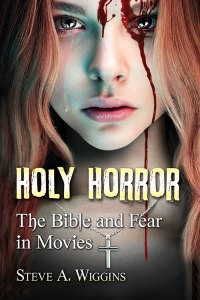
Publishing is a slow business.  In a world of instant information, such plodding may appear to be old-fashioned.  Outdated.  Each step of the process takes time and anyone can sit down and type thoughts directly into the internet, so why bother with traditional publishing?  These thoughts come to me as I read through the proofs of Holy Horror, and work on the index.  This is time-consuming, and time is hard to come by.  That, I suppose, is a major reason for doing things this way.  Ironically, people don’t have a problem seeing that handmade items—which tend to take time and be less efficient than machine-made articles—are more valuable.  They represent care and quality, things that a machine can’t assess well.  This is the world beyond math.  It is the human world.

Those of us born before computers took over sometimes have difficulty adjusting.  The world of the instant goes well with inflation—the myth that constant growth in a limited world is possible.  The fact is that value is a human judgment and we value things that take time.  It’s true that most non-fiction books are instantly dated these days.  Often it’s because information flies more quickly than pre-press operations.  It takes a couple years to write a book and a publisher takes a year or two getting it into print.  Back when the process was invented news traveled slowly and, I venture to say as a historian of sorts, didn’t often carry the dramatic shifts we witness today.  A book could take a long time to appear and still be fresh and new when it did.  For the internet generation it may be hard to see that this is an issue of quality.

Most of us are content with the satisfactory.  We’re willing to sacrifice quality for convenience.  We do it all the time.  Then, in the recording industry, vinyl starts to come back.  Corporate bigwigs—for whom fast and cheap is best—express surprise.  Why would anyone buy a record?  The question can only be answered by those who’ve listened to one.  There is a difference, a difference that we’ve mostly been willing to jettison for the convenience of the instant download.  Our lives are being cluttered with disposable-quality material.  Even now I’m writing this daily update for my blog rather than continuing the drudgery of working on an index.  We all have expectations of alacrity, I guess.  The slower world of publishing is more my speed.


Proof in the Pudding

Writers anticipate and dread proofs.  After several months of delay, I have received the proofs for Holy Horror—it should be out in the next couple of months for both of you who’ve asked about it.  Anticipation is pretty straightforward, but why the dread?  Those of us who write books have to deal with the fact that publishing is, by nature, a slow business.  What I’m proofreading now is material that I wrote a couple of years ago; the final manuscript was submitted back in January.  The internet has accelerated the pace of everything, and now that I have a daily record of my public thoughts on this blog, I can see how my own outlook has changed in that time.  Reading proofs reminds you of whence you came, not where you are.

I suspect that has something to do with the internet and instant access to information.  I also suspect that’s why many of us trust books more than the “open web.”  The oak that has taken centuries to grow is a hardy tree.  The handcrafted piece of furniture lasts longer than the mass produced.  Books, hopefully, stand the test of time.  Writing is an exercise in building eternity.  These thoughts, the author hopes, will be around for some time to come.  As long as libraries endure.   Looking at the proofs, there’s pressure to get things right.  Was I correct in what I wrote down so long ago?  Since then I’ve read dozens of books more.  I’ve even written the draft of another book myself.  I face the proofs and shudder.

Part of my angst, I suppose, is that Holy Horror will likely sell better than my previous two books.  It may actually get read.  No, it won’t be any kind of best-seller, but perhaps a few hundred people will read it.  That’s a lot of pressure for those of us who’ve primarily written for other academics.  Perhaps this fear is the reason I’ve moved to writing about horror films.  Those of us blocked from the academy have to build our own credibility, one book at a time.  Reading the proofs, although already dated, I find myself liking this book.  It was fun to write, and it has a good message, I think.  Even prestige presses know that books about horror films are of popular interest.  As I read through where my mind was in days stretching back before the nightmare of Trump, I see that I had only just started on this path.  Before me are the proofs of that.


Universal Books

I’m reading an overwritten book right now.  In fact, I just finished an overwritten book.  Such works, I suppose, are the results of being taught how to write.  It’s not that people can’t be taught to compose, but for various reasons some authors, either through the privilege of having high-powered publishers, or their own conviction that they don’t require correction, overwrite.  I suppose overwriting is, like beauty, in the eye of the beholder.  Several years back I recall a critic stating Lemony Snicket’s A Series of Unfortunate Events was overwritten.  I thought it was fun.  Yes, deliberately exaggerated, but nevertheless well-composed.  Those books were enjoyable to read because, I think, they refused to take themselves seriously.  Writers can be temperamental people.

As an editor something I need to repeat—for academics are consummate overwriters—is to keep your intended readership in mind.  No book is written for everyone.  In fact, many people can’t make it through books like the Bible because they’re hard to read.  Religious books often are.  There’s no such thing as a universal book, but some believers in some religions make the claim for their sacred texts.  Like many curious people I find it rewarding to read the scriptures of other traditions.  It’s not always easy—in fact, it seldom is.  It’s frequently disorienting and I look for an edition with an introduction.  The reason is when it comes to books, even sacred ones, it’s not one size fits all.  Many religious conflicts in the world could be resolved if we’d just realize this.

Someone who reads a lot is bound to be disappointed from time to time.  We turn to books either looking for a certain mood or specific pieces of information.  Authors often take things in their own directions.  Our minds don’t all work in the same way.  That’s why, in my opinion, reading is so important.  I prefer “long form” writing—I always have.  Sometimes an idea can be well expressed in an article, but taking the time to develop ideas requires a nuance not all publishers appreciate.  (Yes, I realize that by expressing this sentiment in a brief essay like this I leave myself open to deconstruction—one of the overwritten books I just read was written by a deconstructionist.)  Still, I have trouble abandoning books that take ideas in a way I wouldn’t go.  Usually when I start reading, I’m committed to finish.  Some would say that’s foolish.  I take it as a learning opportunity.


Masses and Markets

The other day I had to go somewhere that I knew would involve a wait.  I’ve always thought of waiting as a theological problem—time is very limited and I don’t have it to squander while dallying about for my turn.  That’s why I take a book.  The problem is that many books I read, I feel, require explanation.  That’s because many of them are the 6-by-9 format preferred by publishers these days.  The idea behind the paperback that fit into your pocket—the “mass market paperback”—was that it was essentially disposable.  Cheap, easily printed in large quantities, it was handy for taking along while on a bus, plane, or submarine.  It didn’t take up too much space.  It was easy to keep private.  I miss the mass market paperback.

The majority of my books—fiction as well as non—are larger than the mass market.  That’s the price you pay for reading books that don’t sell in those quantities.  If your interests aren’t the lowest common denominator, you have to buy a copy that won’t easily slip into a pocket.  And everybody can see what you’re reading.  I work in publishing, so I get it.  The idea is that the book cover is a form of advertisement.  The thing is, reading is generally a private activity.  I post on this blog most of the books I read (but not all!).  I want to support those who write and actually manage to find publishers to advocate their work.  But I’d really like to be able to put the book into my pocket between appointments.  

The waiting room is a kind of torture chamber of daytime television and insipid magazines.  Most of the people in here are looking at their phones anyway.  I have a book with me, and I’m vulnerable with everyone freely able to read my preferences.  I want to explain—“I’m writing a book about demons, you see.  It’s not that I believe all this stuff…” and so on.  It would be so much easier if the book were small enough to be concealed by my hands.  If others want to know what I’ve been reading, they can consult this blog.  Well, the stats show they haven’t been doing that.  They might, however, if my own books had been published in mass market format.  Available in the wire-rack at the drug store or vape-shop.  Then the readers could easily hide their interest by putting it into their pocket.  None would be the wiser.


Credulity

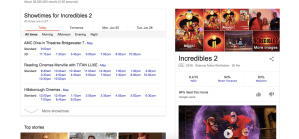
So I went to see The Incredibles 2. Like the first movie, it deals with the complexities of family life amid the feelings of inadequacy when people are kept from their full potential. The idea of humans being enslaved by their screens seemed real enough. If you’ve ever tried to walk through Manhattan in a hurry you know that one of the clearest dangers is the pedestrian staring at his or her phone. People used to come to New York to see the scenery. Now you can get the full experience all online. There’s little doubt that we do need to be saved from our screens. Meet virtual reality. After only one encounter you can drop the “virtual.” Ironically, we were all sitting in a theater looking at a great big screen.

What was even more interesting was the fact that the film began with an apology for taking so long to make a sequel. An actual apology. As if no movie ever could, or should stand on its own. It’s common knowledge that sequels seldom live up to the originals. Interestingly, the villain in the movie states that people will always choose convenience over quality. That much is certain, and in an ironic way it applies to the film in which it’s uttered. I don’t believe in the crisis for creativity. It’s still out there. Original ideas are endemic to human nature. Ideas that bring in lots of money are more rare, and so we rely on the sequel. Sure things.

Publishers play this same game. Books that are completely new ideas frequently find their way from editors’ slush piles to their rejection piles. Publishers want something similar to what they’ve done before. Even better, something similar to something that sold well last time. The odds, in a capitalistic society, are stacked against creativity. It’s money that’s important, not originality. Yes, there have been books written extolling the wonders—virtues even—of originality. Such books are more easily published if they’re written by somebody already famous. So here was the dilemma in the theater: enjoy the movie or accept the message of the movie? The rare days I’m away from the screen, I’m old enough to admit, I don’t really crave it. When I come back in the door, however, the first thing I do is login to see if I’ve missed anything. Screens can lead to a strange uniformity. As long as we’re willing to pay for it, nobody will complain.


Book Recommendations

Working in publishing has its perils. One from my personal experience is that you run into many books you just have to read. Not necessarily for work, but because you want to. This varies from publisher to publisher, of course. There weren’t too many Gorgias Press titles I felt compelled to read, although there were a few. Since then, however, my employers have transported me back to that kid in a candy store feeling time and again. Friends will sometimes send me book recommendations—I always appreciate that. Often the books are from the very publisher for whom I work. In some cases I was actually in the editorial board meeting where the book was approved. It makes me feel like my small contribution matters when someone recommends a book on which I voiced an opinion.

In these days when thoughtful approaches to life are under constant duress, it’s nice to be reminded that people pay attention to books. Relatively few buy them, of course, but books are the storehouse of our knowledge. We all turn to the internet to get information quickly. If you linger, however, you find that much of the web fall into the “opinion” column rather than that of factual reporting. Books from established publishers are vetted on at least one or two levels before a press makes a commitment to print them. Self-publishing has muddied those clear waters a bit, but the seal of approval of a reputable publisher is what makes a book. For example, if a publisher discovers a serious error in a work it will often be pulled from the market. We don’t like to spread errors.

The problem is volume. We long ago surpassed the point during which one individual could read every known book in her or his lifetime. In fact, those who were credited with doing so in the past are given a pass because many ancient texts lay undiscovered under the soil during their times. For all our foibles we are a prolific species when it comes to writing things down. For academics, publishing is often a requirement for tenure and promotion. There are a lot of books out there. This is one surplus, however, that isn’t as celebrated as it should be. I have had people suggest we have too many books in our home. Unlike too much food in the fridge, however, these pieces of intellectual nourishment don’t go bad. And if you point me to a book about which I’m already aware, I always appreciate the conversation anyway. Of some good things you can’t have too much.


Indie Bookstore Day

Although a year can seem like a long sentence, holidays are the punctuation marks that help us make sense of and organize it. Ordinary time, such as time at work, or commuting, can be endlessly tedious. Holidays, some personal, some local, others national or international, help us break up the time. Give us something to look forward to. My pity goes out to those religions that recognize no holidays and face time with a grim, Presbyterian determination to get to judgment day. The rest of us like to celebrate once in a while. So what’s today? It’s Independent Bookstore Day! Anyone who reads more than a post or two on this blog knows that I’m a lover of books. I first started taking solace in reading when things were difficult in my younger years, and reading has never let me down. In fact, I’ve often told myself that I could put up with just about any job as long as I could write.

It’s because of being in publishing that I learned about Independent Bookstore Day. Yes, it’s a promotional holiday, but it’s also a genuine celebration. As the outside world daily reminds us, those of us who read are a minority. The realistic author knows that the reading public is a small fraction of the whole. The number of people, percentage-wise, who spend their money on books is minuscule compared to those who fling their lucre elsewhere. But those of us who read appreciate the depth and reflection of each other. We may read different things, but we read. And that’s why I don’t mind going to an indie bookstore today and buying something.

One of the simple pleasures in life—call it a punctuation mark, a comma maybe—is being surrounded by unfamiliar books. Oh, I often worry what happens when we decide to move; we have lots of books at home. The last time the movers actually complained in our hearing that we had too many boxes of books. Talk about me at the bar afterwards, but don’t castigate my simple pleasures to my face, please. Books are the rare opportunity to commune with others on a deep level. How often have you put down a book and felt that you knew the author? Their soul was revealed in their writing and you had touched it. Just being in a bookstore is cause for celebration. If you have no plans for today, why not make your way to your local indie? Stand up and be counted as the literate resistance. It’s our silent Bastille Day, after all.


Academia Dot

The marketplace for ideas is just that. A place of commodity and exchange. We pay our professors good money (and our administrators even better) so that we can be given “goods.” The same is true of the publishing industry. Those of us who write books primarily (I think) think we are expressing ideas we have that we suppose are worthy of discussion. The book comes out. We await reviews. Citations. Exchange of ideas. Oh yes, and royalties. Only the naive think academic publishing will lead to much of the latter in the greater scheme of things. And so many of us turn to for-profit sites like Academia.edu to pedal our wares for free. After all, Academia is offering us a free service, isn’t it? (At least if you can ignore the constant sell-ups to find out who’s been reading your stuff.) But Academia isn’t non-profit. There’s money to be made here among gullible academics.

Oh, I have a page on Academia just like everybody else. Several of my papers, long out of the payout stage for their journals or parent books, are there for free. Academia frequently asks me if I’m sure I don’t want to upgrade—increase my visibility. Make them a bit of lucre on the side. So the other day I was flattered when I received an email about my dissertation from another vendor. I didn’t recognize the sender, but the content of the email made it clear they didn’t recognize me either. It was an offer to publish my original research done at the University of Edinburgh. Problem is, it’s already been published. Twice. Both editions beyond the purchasing power of mere mortals, but still, it’s out there. Academics, I expect, are some of the favorite targets of the entrepreneurial. We, after all, don’t speak that language. We trade in the currency of ideas. We’re easy marks.

I think Academia.edu is a great idea. Often it’s possible for those of us who are unaffiliated to find papers that journals insist on selling for fifteen bucks a pop—considering I can buy an entire book for that much, no thank you—for free. There may be hidden costs involved, but some days I do miss Robin Hood. No matter how many years I’ve been an editor, I can’t stop thinking like an academic. It comes with the territory. You can’t simply forget all that graduate school taught you. One thing most academics haven’t learned, however, is how to interpret the web. Long before our government allowed the freedom of the web to end, not all sites were free.


Title-less

I’ve been offering a few teasers about my forthcoming book. One of the reasons for not making an announcement is that the title hasn’t been settled yet. It’s pretty hard to promote a book without one. I’ve written enough about it that readers can tell it’s about horror movies. The publisher is McFarland, an independent academic publisher that specializes in pop culture and has an impressive list concerning monsters and other frightening things. Once we get a title down, I’ll say more. In the meantime, I can take the opportunity to say a bit more about the publishing industry. Not that people generally ask me about it, but I suspect many authors secretly want to know some insider tips. If not, I suspect there’s one or two other blogs to read today.

I’ll admit up front that I tried unsuccessfully to interest agents in this book. At least four wrote back to tell me it was a great idea, but a writer without a platform is like, well, an editor. I help other people get their ideas published—always a bridesmaid, as they say—physician heal thyself. When I realized I was wasting months trying to find a professional to promote my book, I decided to revert to the tried and true. When you want to know who to approach about your book, look at the spines of the books you read to write yours. Who are the publishers who produce books in this area? Sometimes the interests of a publishing house will change with the editors, so the more recent your comps, the better.

Horror sells. My project wasn’t really mercenary in that way, but rather it was the result of years of watching horror, usually by myself, and finding some commonality in the films. What exactly that commonality is will, I hope, become clear once I can freely write about my book topic. Others, you see, could swoop in and take my thesis—a perpetual fear of someone who barely has time to scribble out a blog post a day. Finding the time to write books in the off-work and off-commute hours is a real juggling act. In my case, perhaps a jugular act. Without an agent, I turned to McFarland. Many of their books helped me form the ideas for my own. Besides, they have a Scottish connection, and that means something to this old Edinburgh alum. If you want to get published, it helps to know the players. That may become even a bit easier once I’ve got a title.


Justice for All

One of the perks of working for a publisher is author talks. I’ve worked for three publishers now, and the last two have made great efforts to bring authors to their New York offices to present their work, in a kind of dry run, to those in the industry. When an author (whose book will eventually feature on this blog, so I don’t want to provide any spoilers just yet) was to speak on misogyny this week, I quickly signed up for a seat. Perhaps it’s a lack of imagination, but I could never understand how one human being could ever feel superior to another. As a child with no father around, my experience suggested that women were the strong ones. Yet when out in society I saw men always stepping in to take charge. What was wrong here?

I realize that I view life through male lenses. I’m also aware that gender isn’t nearly as definitive as we tend to think it is. Biology fits us with bits and pieces, and some of those constructed somewhat like me assume this gives them the right to dominate others. And they say we’re better than animals. Better at what, I ask? No, this isn’t about chauvinism—a man stepping in to support weaker women. This is about justice, plain and simple. We’re all born human. Humanity is nothing without those of both genders as well as those somewhere between. What should separate humankind from the vicissitudes of nature is the inherent commitment to fairness. Life is harsh and not all receive fair treatment. Do not listen to the narrative coming out of Washington, DC! The father of lies dwells there. And yes, I mean “father.”

We used to take pride in having climbed above the mere animals. We have constructed something that used to be known as democracy. Lawmakers, while fighting against women’s rights in word, nevertheless tacitly supported them at home. Now our government has declared open war on women. Men who have no idea what it is like to be viewed as and treated like an object every single day of their lives are making laws to punish those who do. I feel as though the sky is about to crack open and that blind principle we call justice is about to shout “Enough!” That’s not, however, the way that nature works. It is only when women are treated equally with men that we’ll ever be able to call ourselves civilized. Or even human. Until that day we’ll hunker down in our caves and await lawmakers who have any inkling at all of what fairness, what justice, even means.


How to Talk to an Editor

There are right ways and wrong ways to get your book published. When approaching an editor, there are a few things to keep in mind. For one thing, we’re human. Yes, I know that I have something you want. The usual career track for an academic is Brown, Harvard, dissertation published by a certain academic press with which I’m familiar. I get that. The internet, however, has made publishing into something different than what it used to be. First of all, you can self-publish. Sorting through all the self-proclaimed experts can be a full-time job when you’re trying to find the latest authoritative treatment of a subject. Also, the internet has made research into publishers much easier than it used to be. My first book, back in the day, was simply sent off to a European publisher that specialized in academic monographs in my subject area and then I moved on. Today authors see flashy first books online and want just that. You can have it all, they’re told.

My LinkedIn profile took a definite boost once I became an editor. Now I often think it would be great if someone asking to connect actually knew me. But I digress. One way not to get your book published is to state right on your LinkedIn profile—or other social media—that you have a great book and you’re letting all publishers know. You then invite them to connect on LinkedIn and your book announcement, like a peacock’s tail, is supposed to attract the hungry editor. In reality what attracts an editor is professionalism. Research publishers, find out what they actually publish. That’s pretty easy these days; there’s more than funny videos on the internet. Even browsing titles similar to your own on Amazon can help. Pay attention to the publishers of the books you’re using for your research. If a publisher has done several books in your area they are more likely to be interested in your proposal than a publisher who’s never ventured into those waters.

It may be easy to think of us editors as sitting bored in our lonely cubicles, awaiting the next great thing. The fact is we receive plenty of submissions and we have to sort through them. Treat the subject professionally. Many of us hold doctorates and are keenly aware of hyperbole when we see it. You don’t need to tell the editor your book is ground-breaking. They will make that decision based on the evidence before them. And trust your editor when it comes to things like how a book should be titled or placed or marketed. Publishers—some of which have been around for centuries—daily face the harsh realities of producing books in an era of YouTube and online television. We know it’s difficult out there. Many of us want to help. Some of us write books and have to go through the same travails as other authors in finding publishers of our own. Do your research on publishers. When an editor offers free advice, take it. A little bit of extra work by an author goes a long way in helping a book proposal succeed.


Citation Anxiety

As a recovering academic, I sometimes am compelled to look when Academia.edu sends me notices. Academia, most of my academic colleagues don’t realize, is a for-profit website that advocates open access. “Open access” (or OA in the biz) is academic trash talk for making the published results of research available for free. It’s a great idea, but it often doesn’t take into account how complex publishing really is. Peer review, printing, and distribution of articles all take money and to make all research free cuts out what those who publish the research can use to fund the venture (with a cut taken out, of course, to make the whole thing worth their while). That’s the way capitalism works. (Look it up under economics.) In any case, not realizing that Academia is also a profit-making venture, lots of us put our published papers on it, making them freely available to anybody who cares.

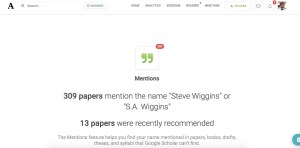
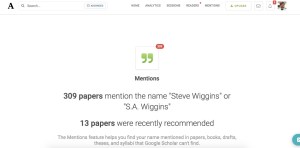
Once in a while Academia will send its users a flattering notice: “X-hundred people have cited your papers.” Be still, my throbbing heart! Desperate for any attention, most academics (let alone us exes) are thrilled that more than 100 people have read their stuff. So I clicked their link. “309 papers mention the name ‘Steve Wiggins’ or ’S.A. Wiggins’” it cheerfully reads. I know something the robot apparently doesn’t. I’m not the only Steve Wiggins on Academia. There is a slightly older agronomist whose name I share. He’s employed in academia and has more papers than me. And “S. A. Wiggins” could be anybody. My 309 paper mentions shrinks to double digits. Not high double-digits either. Names are hardly unique identifiers. With some seven-and-a-half billion people, there’s bound to be some reduplication. I always tell the few curious to search “Steve A. Wiggins”—with the quotation marks—to find the few, true references.

Taking on the internet is a fool’s errand. This blog gets a few piddly hits a day. I often consider closing it down. Readers don’t share it enough to get any attention. It takes a lot of effort on my part since I write books (both fiction and non) in my hours not at work. So when Academia shows up in my inbox my excitement spikes, just for a moment, and I go on with my other work, which never seems to get done. And then, when I’m sure nobody else is looking, I go ahead and click on the link.


Taking Time

Good writing is hard work. One of the mixed blessings of the internet is that it makes publication so easy. Get yourself a blog and nobody has to approve anything! Ideas come tripping across your fingers onto some electronic substrate and, viola! You’re an author! The problem is that being an author’s not the same as being a good author. Writing well (and I make no such claim for myself—after all this is just a blog) is hard work. A piece has to be written, and then read again and again. I’m reminded of the story of a convicted murder whose name I’m forgotten (call it a defense mechanism). This was early last century. The murderer was caught, initially after having been found wandering, disheveled, in public. As a respectable man (he was a doctor, I think) part of his defense was that he’d never have left his house without being presentable. He would have on a collar and hat. People would see him, and he had to convince them of his presentability every single time he walked out that door. (This isn’t an affliction that I share, by the way.) Writing for publication is like that—you need to take care to look respectable every single time.

I can’t speculate about how other writers do their thing, but for me the main requirement for this is time. Any piece that I want anyone else to see, has to be written. Read. Edited. Re-read. And probably edited again. All before the public sees it. This is just for the informal stuff. I’m currently writing a book (which is pretty much a constant state with me). The draft was finished months ago. I started thinking about a publisher. Then I read it again. I couldn’t believe I’d ever thought it was ready for a publisher. Several rewrites followed. I’m in the midst of another one at the moment. I think of it like my ill-used rock tumbler. You want shiny rocks, you’ve got to send them through with finer and finer grit. If you do it right, they’ll come out looking like they’re wet, and they’ll stay looking that way. Polished writing takes time.

Some things can’t be hurried. As a middle-schooler I had a summer job with the school district. One of my assigned tasks was painting bus shanties. Many of these were, as you’d expect, way out in the middle of nowhere. I’d be dropped off with a couple other teens and we’d paint the shelter inside and out. One day I got tired of the constant, boring, and repetitive task of filling a paint pan with white paint, carrying it into the shelter, using it up, and then doing it all over again several times. I decided to pour the paint directly on the plywood floor of the shelter. All I’d have to do would be to roll it out and who’d be the wiser? I only did it once. Little did I consider that the best painting, like the best writing, is a thin layer over the substrate. You need to go over it more than once, leaving time between layers. More importantly, I didn’t realize that you can’t gauge how much paint you need this quick way. The best thing is to run out and refill. Then you can pour the remainder from the pan back into the can. The floor took hours and hours to dry. Not only that, but the top surface dried first, so when I stepped in, I pulled up a thick layer of paint off on the bottom of my shoe. Tom Sawyer I was not. I had to redo it. What I learned that day, though, was a lesson about writing. Take your time. But you don’t have to take my word for it. I just write a blog.