Justice for All

One of the perks of working for a publisher is author talks. I’ve worked for three publishers now, and the last two have made great efforts to bring authors to their New York offices to present their work, in a kind of dry run, to those in the industry. When an author (whose book will eventually feature on this blog, so I don’t want to provide any spoilers just yet) was to speak on misogyny this week, I quickly signed up for a seat. Perhaps it’s a lack of imagination, but I could never understand how one human being could ever feel superior to another. As a child with no father around, my experience suggested that women were the strong ones. Yet when out in society I saw men always stepping in to take charge. What was wrong here?

I realize that I view life through male lenses. I’m also aware that gender isn’t nearly as definitive as we tend to think it is. Biology fits us with bits and pieces, and some of those constructed somewhat like me assume this gives them the right to dominate others. And they say we’re better than animals. Better at what, I ask? No, this isn’t about chauvinism—a man stepping in to support weaker women. This is about justice, plain and simple. We’re all born human. Humanity is nothing without those of both genders as well as those somewhere between. What should separate humankind from the vicissitudes of nature is the inherent commitment to fairness. Life is harsh and not all receive fair treatment. Do not listen to the narrative coming out of Washington, DC! The father of lies dwells there. And yes, I mean “father.”

We used to take pride in having climbed above the mere animals. We have constructed something that used to be known as democracy. Lawmakers, while fighting against women’s rights in word, nevertheless tacitly supported them at home. Now our government has declared open war on women. Men who have no idea what it is like to be viewed as and treated like an object every single day of their lives are making laws to punish those who do. I feel as though the sky is about to crack open and that blind principle we call justice is about to shout “Enough!” That’s not, however, the way that nature works. It is only when women are treated equally with men that we’ll ever be able to call ourselves civilized. Or even human. Until that day we’ll hunker down in our caves and await lawmakers who have any inkling at all of what fairness, what justice, even means.


How to Talk to an Editor

There are right ways and wrong ways to get your book published. When approaching an editor, there are a few things to keep in mind. For one thing, we’re human. Yes, I know that I have something you want. The usual career track for an academic is Brown, Harvard, dissertation published by a certain academic press with which I’m familiar. I get that. The internet, however, has made publishing into something different than what it used to be. First of all, you can self-publish. Sorting through all the self-proclaimed experts can be a full-time job when you’re trying to find the latest authoritative treatment of a subject. Also, the internet has made research into publishers much easier than it used to be. My first book, back in the day, was simply sent off to a European publisher that specialized in academic monographs in my subject area and then I moved on. Today authors see flashy first books online and want just that. You can have it all, they’re told.

My LinkedIn profile took a definite boost once I became an editor. Now I often think it would be great if someone asking to connect actually knew me. But I digress. One way not to get your book published is to state right on your LinkedIn profile—or other social media—that you have a great book and you’re letting all publishers know. You then invite them to connect on LinkedIn and your book announcement, like a peacock’s tail, is supposed to attract the hungry editor. In reality what attracts an editor is professionalism. Research publishers, find out what they actually publish. That’s pretty easy these days; there’s more than funny videos on the internet. Even browsing titles similar to your own on Amazon can help. Pay attention to the publishers of the books you’re using for your research. If a publisher has done several books in your area they are more likely to be interested in your proposal than a publisher who’s never ventured into those waters.

It may be easy to think of us editors as sitting bored in our lonely cubicles, awaiting the next great thing. The fact is we receive plenty of submissions and we have to sort through them. Treat the subject professionally. Many of us hold doctorates and are keenly aware of hyperbole when we see it. You don’t need to tell the editor your book is ground-breaking. They will make that decision based on the evidence before them. And trust your editor when it comes to things like how a book should be titled or placed or marketed. Publishers—some of which have been around for centuries—daily face the harsh realities of producing books in an era of YouTube and online television. We know it’s difficult out there. Many of us want to help. Some of us write books and have to go through the same travails as other authors in finding publishers of our own. Do your research on publishers. When an editor offers free advice, take it. A little bit of extra work by an author goes a long way in helping a book proposal succeed.


Citation Anxiety

As a recovering academic, I sometimes am compelled to look when Academia.edu sends me notices. Academia, most of my academic colleagues don’t realize, is a for-profit website that advocates open access. “Open access” (or OA in the biz) is academic trash talk for making the published results of research available for free. It’s a great idea, but it often doesn’t take into account how complex publishing really is. Peer review, printing, and distribution of articles all take money and to make all research free cuts out what those who publish the research can use to fund the venture (with a cut taken out, of course, to make the whole thing worth their while). That’s the way capitalism works. (Look it up under economics.) In any case, not realizing that Academia is also a profit-making venture, lots of us put our published papers on it, making them freely available to anybody who cares.

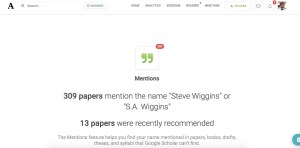
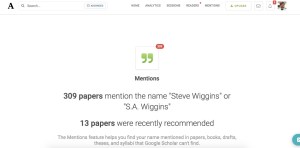
Once in a while Academia will send its users a flattering notice: “X-hundred people have cited your papers.” Be still, my throbbing heart! Desperate for any attention, most academics (let alone us exes) are thrilled that more than 100 people have read their stuff. So I clicked their link. “309 papers mention the name ‘Steve Wiggins’ or ’S.A. Wiggins’” it cheerfully reads. I know something the robot apparently doesn’t. I’m not the only Steve Wiggins on Academia. There is a slightly older agronomist whose name I share. He’s employed in academia and has more papers than me. And “S. A. Wiggins” could be anybody. My 309 paper mentions shrinks to double digits. Not high double-digits either. Names are hardly unique identifiers. With some seven-and-a-half billion people, there’s bound to be some reduplication. I always tell the few curious to search “Steve A. Wiggins”—with the quotation marks—to find the few, true references.

Taking on the internet is a fool’s errand. This blog gets a few piddly hits a day. I often consider closing it down. Readers don’t share it enough to get any attention. It takes a lot of effort on my part since I write books (both fiction and non) in my hours not at work. So when Academia shows up in my inbox my excitement spikes, just for a moment, and I go on with my other work, which never seems to get done. And then, when I’m sure nobody else is looking, I go ahead and click on the link.


Taking Time

Good writing is hard work. One of the mixed blessings of the internet is that it makes publication so easy. Get yourself a blog and nobody has to approve anything! Ideas come tripping across your fingers onto some electronic substrate and, viola! You’re an author! The problem is that being an author’s not the same as being a good author. Writing well (and I make no such claim for myself—after all this is just a blog) is hard work. A piece has to be written, and then read again and again. I’m reminded of the story of a convicted murder whose name I’m forgotten (call it a defense mechanism). This was early last century. The murderer was caught, initially after having been found wandering, disheveled, in public. As a respectable man (he was a doctor, I think) part of his defense was that he’d never have left his house without being presentable. He would have on a collar and hat. People would see him, and he had to convince them of his presentability every single time he walked out that door. (This isn’t an affliction that I share, by the way.) Writing for publication is like that—you need to take care to look respectable every single time.

I can’t speculate about how other writers do their thing, but for me the main requirement for this is time. Any piece that I want anyone else to see, has to be written. Read. Edited. Re-read. And probably edited again. All before the public sees it. This is just for the informal stuff. I’m currently writing a book (which is pretty much a constant state with me). The draft was finished months ago. I started thinking about a publisher. Then I read it again. I couldn’t believe I’d ever thought it was ready for a publisher. Several rewrites followed. I’m in the midst of another one at the moment. I think of it like my ill-used rock tumbler. You want shiny rocks, you’ve got to send them through with finer and finer grit. If you do it right, they’ll come out looking like they’re wet, and they’ll stay looking that way. Polished writing takes time.

Some things can’t be hurried. As a middle-schooler I had a summer job with the school district. One of my assigned tasks was painting bus shanties. Many of these were, as you’d expect, way out in the middle of nowhere. I’d be dropped off with a couple other teens and we’d paint the shelter inside and out. One day I got tired of the constant, boring, and repetitive task of filling a paint pan with white paint, carrying it into the shelter, using it up, and then doing it all over again several times. I decided to pour the paint directly on the plywood floor of the shelter. All I’d have to do would be to roll it out and who’d be the wiser? I only did it once. Little did I consider that the best painting, like the best writing, is a thin layer over the substrate. You need to go over it more than once, leaving time between layers. More importantly, I didn’t realize that you can’t gauge how much paint you need this quick way. The best thing is to run out and refill. Then you can pour the remainder from the pan back into the can. The floor took hours and hours to dry. Not only that, but the top surface dried first, so when I stepped in, I pulled up a thick layer of paint off on the bottom of my shoe. Tom Sawyer I was not. I had to redo it. What I learned that day, though, was a lesson about writing. Take your time. But you don’t have to take my word for it. I just write a blog.


Weather Vain

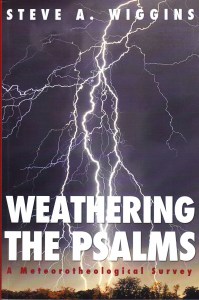
The other day I was awakened by a severe thunderstorm. It’s been quite a while since that’s happened. Unlike when we lived in the Midwest, thunderstorms in New Jersey tend to be widely scattered and somewhat uncommon. (It’s all a matter of perspective, I know.) My basis of comparison is how often I notice such storms. I’ve never been able to sleep through one. Thankfully this one came at around 4:30 a.m., past when I’m usually awake on a weekend. I’d forgotten the raw power of just how loud and bright such a storm can be. Danger seems all around. The feeling is primal and urgent. As I got out of bed and walked into the dark kitchen, windows filled with electric blue followed by and tremendous blast, I thought once again of Weathering the Psalms and the story behind it.

By the way, when I speak to young scholars about publishing I tell them this isn’t the way to go about finding a topic. That having been said, my book was born in the Midwest. Life at Nashotah House revolves around required chapel twice daily. Weather does not stop it. In fact, holding the daily office by candlelight because a storm had knocked out the power was not uncommon. Morning and evening prayer—indeed, all of the canonical offices—are built around the recitation of the Psalms. Reading the Psalter in slow, stately tones while thunder raged outside, rattling the ill-fitting stained-glass windows, left an indelible impression. It was only natural in such circumstances to notice how often the Psalms mention the weather. Thus a book was born.

I’m currently at work on a new book. I can’t say the topic just yet because someone might be able to beat me to it. (Knowing the way I come up with book ideas, however, I doubt it.) Sitting in my darkened living room, in my writing chair with the fury just outside, I was strangely inspired by the storm. Then it was over. Silence followed by birds singing, just like in Beethoven’s sixth symphony. The thunderstorm is one of nature’s psalms. As at Nashotah House, in the Midwest we had perhaps too many of that particular kind of psalm. Nevertheless, in the silence that followed I was left strongly in touch with my muse. These are the states that lead to poetry and song. Every great once in a while they might even lead to a book idea. As I tell students, just don’t expect that anyone else will get it.


Independent Bookstore Day

Many modern mini-holidays are centered around things you might buy. I don’t mind that so much in the case of Independent Bookstore Day—of which I wish you a happy one. Quite by accident I found myself in an independent bookstore just last night, not aware I was prematurely celebrating. If anything might save us from the muddle we’re in, it’s books. We live in a society with plentiful distractions, many of them shallow. Books take some effort. They demand your time. They make you take some quiet space to think. Books came along with, and perhaps were the source of, civilization. Today we’re harried and hurried and frantic with an electric source of information and entertainment that never turns off. And we’re seeing the results of that playing out on an international scale. How different it would be if we’d grab a book instead!

The strange thing is that those inclined to action often suppose reading to be an utterly passive activity. The basis for human progress, however, has often been what someone has read. Surprisingly, books can be the source of progress. When we see reactionary elections taking place around the world, leaders who don’t read emerge as the hailed champions of regress. We’re living through that right now. Books can be dangerous. Think about it—you’re being given access, however briefly, to someone else’s mind. The combined power of minds is an impressive thing. If what I’m reading is anything to go by, the hive mind is a source of incredible strength. You want action? Put multiple minds together. There’s a reason that civilization has gone hand-in-hand with literacy.

In the wake of Borders going under, independent bookstores have started to make a comeback. Those of us who work in the publishing industry have to keep an eye on those numbers. A visit to a bookstore is all about discovery. Quite often I’ve walked in with a list in hand. When I exit my list has grown rather than shrunk, and the purchase I’ve made was likely not on the list to begin with. Independent Bookstore Day gives us a chance to think about how very much we do not know. Unlike those who claim power and brag that they don’t read, admitting that we have more to learn is the way toward progress. I may not be the most active man in the world, but I do recommend action in the form of getting to a bookstore. If we each do our part, we can’t help but to make the world a better place.


Publish or Perish

Working in publishing, I’m well aware of the stresses of the information industry. Jobs frequently evaporate as new, less formal ways of spreading ideas develop. To the typical academic what a university press offers is the secret knowledge of where to send their monograph to get it printed and bound. As if a printer and spiral binder weren’t available at the local Kinko’s. Oh, wait. Kinko’s doesn’t exist any more. You can do most of this at your own university anyway. With 3-D printers you might even be able to print a reader. No, what academic presses have to offer is credibility. If we’re honest we’ll admit that some presses are known for publishing just about anything sent to them while others are selective. The selective presses are often considered the more reliable since they set up the highest hurdles and accept only materials that come as close to being true facts as information can. Self publishing, as might be expected, has muddied the waters.

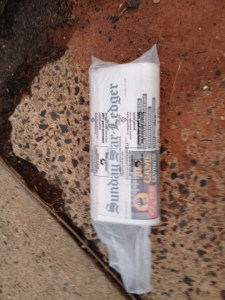
The same is true in book publishing’s cousin, the newspaper industry. As analysts point out, you can get whatever “news” you want from social media. With varying levels of truth. Stop and think about the people you knew in high school. Those who tend to friend you on Facebook. Would you trust them for accurate news? This has become all the more important because our government is now in the business of fabricating facts. Fact checking is too much work and besides, who has time? It’s easier just to believe lies than it is to buy a copy of the New York Times. Newspapers, you see, used to offer the same thing as the academic press—credibility. The New York Times and the National Enquirer are two different things—you could tell at a glance. Now it’s hard to tell where the news originates.

img_3186-copy

This point was made by Deborah Lev in a recent editorial in the New Jersey Star-Ledger. The real problem is our nation’s founders presumed that democracy would work for informed voters. Yes, there were difficulties with the way the system was set up. It was based on privilege and convention. We’ve finally, in theory, gotten to the point that any citizen of a certain age can vote, but we have no requirements for ability to discern the issues. That would be elitist. And we have eroded the traditional sources of attaining quality information—publishers of all sorts are struggling. For some topics self-published books outstrip traditionally published tomes by a fair margin. You can’t believe everything you read. Don’t take my word for it. I’m open to fact-checking. Just be careful where you reap your facts, because not all facts are created equal.


Colorful Leaves

Weekends, it seems, are incomplete without being among books. You might think that someone who works in publishing might want to get away from books in the off hours, but quite the contrary. I love a good walk in the woods in autumn. Especially if it’s followed by a trip to the local independent bookstore. It just feels right being among books. I realize that I’m in the minority by expressing such an opinion, and that the book buying (and book publishing industry) is (are) small compared to other forms of passing one’s time, but they are significant beyond their size. My wife and I have scoped out the various indie book sellers all around. When we have to take the car in for service, we drop it off, have lunch at a diner, and stroll down to the bookshop. It’s a pleasant way to spend an afternoon.

img_2984

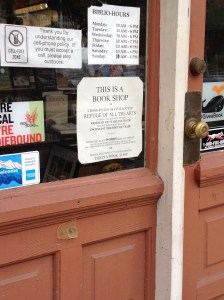
Here’s the sign on our Clinton indie. In case you can’t make it out, the legend says “This is a book shop. Cross-roads of civilization. Refuge of all the arts. Against the ravages of time. Armoury of fearless truth. Against whispering rumour. Incessant trumpet of trade. From this place words may fly abroad not to perish as digital waves but fixed in time. Not corrupted by the hurrying hand but verified in truth. Friend, you stand on sacred ground. This is a book shop.” I especially appreciate the sentiment of sacred ground. Indeed, sanctuaries of all sorts often house books. As libraries experience funding difficulties, civilizations are in the throes of collapse. Just to have books around me makes me feel secure.

Some months ago we had to have a refrigerator replaced. Our apartment has a strange, offset back door that makes getting anything of size in or out difficult. The front door is a fairly straight shot, but just beyond the entryway I had set up a bookshelf after we moved in. The appliance guys came in, jaws literally dropping. “I’ve never seen so many books in one place,” one of them said. They then complained and told me they couldn’t get the old fridge out as the landlord had said they’d be able too. “Your books are in the way,” they complained with accusatory tones. I had to unload the books from two shelves and move them while they watched. I, the lover of books, was duly chastened. I’m afraid my love affair with reading has only become more passionate since that day. The books are back on their shelves and they’ve been joined by more friends. What is a weekend without books but a wasted opportunity?


Nobody’s Business

Working in academic publishing some insights are available that academics typically miss. For example, it isn’t unusual for a professor to ask why royalties aren’t higher on ebooks because “they don’t cost the press anything.” Ah, my poor, simple academics! If only life were so kind. Ebooks don’t require any ink, paper, or binding. They require a whole lot more than that. Ebooks require publishers to hire entire new divisions to oversee the complicated, technical, and swiftly-changing business of having ebooks in the format that they can be accessed by various reader platforms. Think of it this way: instead of buying materials, publishers have to enter an entirely new business area to sell what they always sold without it before. Now let’s twist the letter-opener just a bit more. Ebooks have exploded exponentially. Anyone with an Amazon account can be an author. Who buys academic books? University libraries. How to libraries decide what to buy? Well, let’s just say “it’s complicated.”

Now let’s go a bit deeper. Have you noticed that instead of fewer presses there are more and more of them? Stop and think about this. Universities have been churning out more and more doctorates for a system that has had a shrinking number of positions for at least the last three decades. Yes, someone’s entire academic career could have been spent in a vanishing profession and they never noticed. There are no jobs out there, my dear professors. Why do you continue to churn out graduate students? The student knows that s/he will be expected to publish. A lot. Librarians, whose jobs have gotten a whole lot more complicated, face budgets that have been simplified. That is to say, administrators say “Ebooks cost less, so libraries need less money. Besides, there’s Wikipedia.” A doctoral dissertation on a single word in a single verse on a single book in the Bible is not likely to get noticed in such a situation.

The fact is society is hungry for new knowledge. It just doesn’t want to pay for it. That’s the illusion cast by the internet: knowledge should be free. Tenured professors, however, don’t come cheap. Just ask the professional adjunct living out of his car and eating Ramen noodles heated up with the cigarette lighter. We don’t think about her, however, because she’s not writing books. Society wants an alternative to consumer capitalism. It just doesn’t want to pay for it. Presses start up because there is plenty of content out there—all those dissertations you direct—and anybody can make an ebook cheaply. Print-on-demand alone can keep a press in business. The knowledge pours out the facet, goes over the hands and down the drain. Professors, comfortable in their paneled offices, will never complain. You’ve beat the system—congratulations! But I just can’t help you with those ebook royalties. If you’ll excuse me, my noodles are getting cold.

img_2401


Rumors of Books

An off-the-cuff remark by Sandeep Mathrani, some CEO of something or other, had the publishing world buzzing a couple weeks back. The rumor began that Amazon.com was about to open hundreds of brick-and-mortar bookstores. After the opening of a store in Seattle, the idea—neither confirmed nor denied by Amazon—has made the book industry reassess its future yet again. Stock in Barnes and Noble immediately fell, but soon recovered. As someone whose entire life has revolved around books, I was glad to read the story. I have no idea of the business implications—I just don’t think that way—but the fact that book news was deemed newsworthy at all was heartening. Of course, it would be even better news if this signaled a growing interest in books.

DSCN5025

The book industry has been a steady one, despite worries and shifts of format, but it has never been as robust in America as it has been even in the small nation of Iceland. There are too many distractions for people to dedicate the quiet hours required to open a book and learn from it. When I sit on the bus and the driver has forgotten to turn on the overhead reading lights, almost nobody complains. Although I see some Kindles in the dark, it is often social media or movies that the person next to me is viewing. A longish bus ride, it seems to me, is the place for a book. Portable knowledge. Do we ever stop to consider the wonder of this anymore? All it takes is a rumor and the industry quivers.

Books, like monsters, are one of those topics that has an inherent connection to religion. No matter how secular a writing may be today, books have close ties to religion, and they always have. The great secrets of religious explorers and inventors are kept between the covers for any awaiting enlightenment. We have become a more secular people, but the religion of secularism is intellectual. The basis for such thinking comes in book form. For me, there’s always a sense of accomplishment with finishing a book. A gold star on the sticker chart. And I worry about books following the thylacine into extinction. And if the thylacine is something you don’t recognize, I have a book that I could recommend.


Revisionist History

I recently came across a website with academic papers available on it.  Although the internet has yet to achieve its promise as a locus of solid academic material, such sites are becoming more common.  I’ve been uploading my own papers onto Academia.edu since they seem to be old enough not to impact anyone’s sales aspirations.  In any case, this particular website I found noted that a paper had been updated at such-and-such a time, and that anyone who had downloaded the previous version should delete it and use the new one instead.  This is a dilemma.  I know of publishers who make corrections without issuing new editions.  When I buy a book, what it actually says will depend on the printing rather than on the edition.  I wonder if such retractions are really fair.  How does one know when she’s reading something outdated?
 
Picture this: a young kid, perhaps an unknowing fundamentalist, reading his Bible.  Then he gets a newer copy of the same translation.  But soon he notices that there are differences.  Although the example may sound overly Talmudic, it is factual.  Bibles, being printed in large quantities, are especially susceptible to error.  When did the printed word become something that’s negotiable?  I’ve been pondering clay tablets and their apparent immutability.  Contrary to popular belief, most clay tablets weren’t fired—it was a lot of effort for something that had limited value.  Some tablets show signs of erasure or additional words being added.  In the case of clay, this is often very clear.  Besides, the readers were few and specialists.  They knew what they had.  But for a modern person staking the salvation of her soul on a document, is it not problematic to change a jot or tittle (of which not the least shall pass away)?  Has technology made us immune to fixed texts?
 
Back to the website I found.  What if I downloaded the faulty paper and wrote my own paper based on it?  How would I know to go back and check to see if a new version had been uploaded?  Am I to spend all my time revisiting web pages to see what has changed?  Knowledge itself seems now to have become whimsical.  What is true depends on the date and time you accessed it.  Perhaps I’m just a dreamer, but there was a time, it seems to me, before post-modernism, when you might purchase a book and be fairly certain of what you had.  Errata sheets (or the more fancy addenda et corrigenda) didn’t intrude into the typeset page.  You could still read correctly, assured that someone had spotted and acknowledged the mistake.  We have, I fear, outlived the need for sic.  And it is only a small step from siclessness to truth that changes second by second. Is this the siclessness unto death?

IMG_1363


What I Meant to Say

XML. CSS.  Abstracting.  Separating content and meaning.  Sounds kind of scary to me.  As a would-be writer, plodding my way through what used to be the humanities, I’m sometimes frightened when I hear techies talk about where publishing “has to go” to remain “competitive.”  Since technology drives industry these days, we all need to bow before the image with a head of gold.  What you write on the page has to be edited to make it say what you meant it to say.  Then the meaning has to be excised and converted into XML, because that’s the way ebooks like it.  Page numbers are an artifact, and if your device can’t find the phrase you half remember, don’t go looking for an index.  You see, XML files don’t have pages—they’re just an illusion caused by the limited size of paper.  The meaning lies in the stripped, naked, and shivering content.  Or meaning.  Or something.
 
So goes the brave new world of publishing.  We live in the days of inferred information and bowdlerization in inscrutable acrostics.  I’ve actually heard techies say, “we need to teach authors to produce what we need.”  Have you ever seen a dog wag so fast?  Or a tale hold so perfectly still?  What do I mean?  Ask an expert.
 
IMG_2359

The blank page of actual paper used to terrorize many a student.  There are few things so transcendent to me as a new, unused Moleskine.  The very blankness of the pages is like unto the whiteness of Heaven.  This is a place where thoughts can roam free, and I can feel the thoughts coursing from my brain to my fingers as the pen traces paths never before seen.  As this blog attests, my writing does not draw the countless masses.  The vast majority of it written on paper will never be seen by another human being.  Thoughts are captured there, mid-flight.  They’ve never been tamed or tagged or abstracted from their meaning.  In the mind of some, I must suppose, that means they really mean nothing.  When I hold them, however, which I can never do with an XML file, I know that some things are simply too important to convert to what someone else declares they must be.


Fresh Thinking

Lateral Thinking_0001Creativity receives an immense amount of lip service. Too bad that doesn’t correlate to actual appreciation. I’ve been working since I was 14. In all the jobs I’ve had, the first was the one that used my creativity most fully. I was a teenage assistant-janitor, doing manual labor. Laborers have great incentive to be creative since it can reduce the amount of work you have to do. Of course, at other times it can create more work. While I was teaching (the second-most creative job I’ve held), I picked up Edward de Bono’s classic, Lateral Thinking: Creativity Step by Step. Shortly after purchasing it I lost my teaching job with a change of administration and I’ve been involved in the least creative phase of my career ever since—publishing. I hope that I’m still a lateral thinker, and I read de Bono wishing to verify that I might be.

Lateral thinking, simply put, is the ability to see things differently. Logical thinking, with which we’re all familiar, is linear, or what de Bono calls “vertical.” Each step is based on the previous step and each step has to be right all the time. My mind, however, finds avenues out to wander among the daisies during the whole process. My interior dialogue is often a long stream of “what ifs” and questioning why things are done the way they are. I guess it’s no wonder that the church was leery of me. Lateral thinking, de Bono notes, does not sit well with dogmatism, nor with the arrogance of presuming you’re already right. If you’ve already got the answers, you need not ask any more questions. You go to seminary to learn to shore up the party line. Individual thinking is unwanted, and what’s more, it’s even dangerous.

So I have moved into the realm of business which, it would seem, stands to gain the most from creativity. Instead, standard business practices hamper, if not actively discourage, creativity. Having people sit in cubicles and maintaining rigid, often long, hours, and performing tasks that a lemur could be trained to handle. This is hardly the breeding ground of new ideas. I’ve attended “brainstorming” sessions in the industry where the leader shoots down immediately any idea that doesn’t lock-step with where s/he believes the company should be going. That’s not brainstorming, it’s brainwashing. Creativity may indeed lead to a temporary loss of profits. The truly creative business mogul will know, however, that it will lead to great leaps ahead further down the road. If you want to find the truly creative among the company, I suggest one place to go. Ask the janitors. Their ideas are likely the most creative of all.


Public Knowledge

Sometimes the media gets it wrong. If one were to believe in the tales of industry prognosticators, our libraries would be closing, we’d all own Kindles, MOOCs would have replaced expensive college courses, and New York City should still be shoveling out from the worst blizzard since the Ice Age. We thrive on extremism. Although I don’t regularly read the newspaper (who has time?), the internet makes news memes available just as they happen and I feel somehow cheated if I have to wait more than an hour for trenchant analysis of an event I’ve just witnessed. Still, the publishers haven’t all shut their doors yet, colleges are managing to stay afloat, and libraries can be happening places. This became clear to me when I recently attended an event in the quaintly named Old Bridge Public Library. It was a Saturday, the time of the week when the gripping fingers of employers feel their weakest. Although I saw no evidence of an old bridge anywhere, I made my way through the traffic to the library where I met with a surprise—the place was crowded!

IMG_1901

For those of you not fortunate enough to live in New Jersey, Old Bridge is probably best considered a satellite of New Brunswick, home of Rutger’s University stadium. (I think there may be a university associated with it too.) That is to say, it is an urban area, and any antique structures to convey one across the water have long devolved to only nomenclature. Like anything in north-central New Jersey, it’s not far from New York City. When I arrived for my event, the parking lot was already full. It was not because of the event, either. Less than 20 showed up for that. When I went inside I found the library a veritable hive of activity. And it wasn’t just lonely, homeless people trying to get out of the cold. Families with kids, people with their grandparents, even other middle-aged adults like myself, all found their way to this island in the sea of a municipal complex not walkable from anywhere. I left encouraged.

Yes, the world of books and education is changing. Publishers feel stress, but that stress mostly has to do with predicting the best form to provide for content. Self-publishing has become a phenomenon, but many know that the self-published book has a difficult life in front of it. Libraries, however, are not the graveyards we’ve been told that they are. We need repositories of information that isn’t on the internet. And more importantly, we need places where, although the librarian shushing us may be iconic, we can get together with like-minded individuals and truly educate ourselves. I do sometimes tremble when I think of the future. The values I acquired as a young person seem, at times, on the verge of extinction. I learned that when this seems to weigh too heavily on my mind, I need to head to the nearest public library and support the old bridge to knowledge.


White Carrots

Acronyms are useful in a complex world, although they are frequently opaque to outsiders. Taking a new job you’re found constantly swimming in an alphabet soup of abbreviations that can drown you as easily as ABC. Each the church has them. As an undergrad religion major at a Presbyterian school I had to memorize TULIP (Total Depravity, Unconditional Election, Limited Atonement, Irresistible Grace, and Perseverance of the Saints), all of which but the last I had to reject on the grounds of sanity. As aids to memory they can serve as mnemonic devices, or they may simply be frustrating caricatures of reason. In any case, we all know them. In universities departments or divisions are known by acronyms, local businesses and landmarks may be as well. The internet has only speeded the process up, with countless abbreviations, some of which are definitely NSFW.

IMG_1889So it was that I learned an acronym that is current in the publishing industry. I always thought of the parsnip as a rather curious root vegetable, somewhat like a white carrot. As a child I severely disliked them, but I’ve come to appreciate them, roasted and glazed, as an adult. The word itself is somewhat fun to say: PARSNIP. It is also an acronym of things publishers, particularly those who publish textbooks in English as a second language, have to avoid. PARSNIP stands for, according to the popular explanation, Politics, Alcohol, Religion, Sex, Narcotics, Isms, and Pork. Interestingly to me, at least four of these things have their traditional taboo status because of religions. Clearly Religion is one of those, but restrictions on Alcohol, Sex, and Pork are also based on religious rules. One could argue that Narcotics also fits into that category as well. As I’ve mentioned many times on this blog, religion, substances, and sex are all deeply intertwined.

One of the curious things about this is that our post-Christian society has declared that religion is not worth discussing, or even learning about. We slash religion departments from universities and then wonder why we can’t discuss things like sex and alcohol, without which our society would apparently collapse, freely in other cultures. When I was a child, reading MAD magazine, I quickly learned two things that adults didn’t discuss were religion and politics. The list has grown since that time, but apart from the fact I have no idea which Isms are to be avoided, I see PARSNIP as the white carrot of religious taboos. And politics. In this secular world, we’ve become very politically correct, although we really shouldn’t mention politics in that phrase. Now I’m wondering if maybe I should reevaluate TULIP after all. At least the first part.