B’s and Q’s

A friend who read my review of The Stuff recommended Q: The Winged Serpent.  The former was the first Larry Cohen movie I’d seen, one that I stumbled upon while looking for something free to watch.  I was favorably impressed—it was a comedy horror that worked.  Q was earlier and was more of a low-budget horror, but with elements of satire in it.  As well as social commentary.  If you can handle stop-motion animation, and you want to see the inside of the Chrysler Building dome, you might enjoy this monster flick.  And there was a good deal of theology in it.  It’s certainly worth talking about in the context of horror and religion.  One warning in advance: if you’re like me, all the camera motion—many aerial shots of Midtown Manhattan, it might make you a little woozy.  It did me.
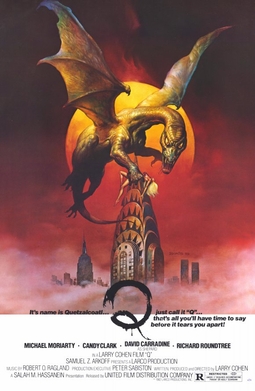
The movie follows a petty criminal who discovers the lair of Quetzalcoatl inside the Chrysler Building.  Meanwhile, a priest of Quetzalcoatl is sacrificing willing victims in Manhattan to bring the deity back.  A cop who’s willing to believe (Detective Shepard) researches beliefs in the Aztec god and tries to connect the sacrificial murders with people who are disappearing—often from Manhattan rooftops.  The question arises: is this a god or just a monster?  That’s a freighted question these days.  This idea is that if it can be killed it’s just a monster.  If not…

The story has its shortcomings and the direction isn’t great, but overall it’s not bad.  A creature-feature with some thought.  As Shepard chases down experts he starts to understand that even if this is just a monster, there are devotees of Quetzalcoatl in Manhattan killing (willing) victims.  At one point Shepard says, upon seeing a victim with his heart cut out, “All we have to do is eat the bread and drink the wine,” or something similar.  This is fairly sophisticated coming from a B movie.  Religion is also behind some of the humor as well.  When the Aztec priest comes after the petty criminal he can’t kill his victim unless he says a prayer.  The criminal refuses, and in doing so saves his life.  Interesting thought.

While having the trappings and feel of a B movie, Q gives the viewer of religion and horror movies something to think about.  The movie doesn’t reference the Bible or quote it, so it can’t make Holy Sequel, but it’s worth a lazy weekend afternoon to give you something to think about.

More Water Monsters

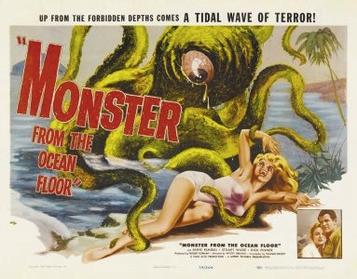
Monster from the Ocean Floor, one gets the sense, wouldn’t have merited a Wikipedia article were it not for the fact that it was the first film Roger Corman produced.  Despite its B-movie quality, there’s quite a lot to like about it.  First of all it has a strong female lead.  Julie Blair is the only gringo in Mexico to believe the locals that there’s a monster just off shore.  Steve Dunning, the scientist, is an avowed skeptic.  The plot is cheesy—the monster is an overgrown amoeba irradiated by the Bikini Island underwater nuclear tests, and it’s killed by getting a submarine in the eye—but there are some very effective cinematographic moments.  When the young boy talking to Julie in the opening turns to stare at the ocean where his father disappeared, the framing and emotion are perfect.

The theme music for the approach of the shark, and then the amoeba, anticipate Jaws by a couple of decades, and I have to wonder if John Williams hadn’t watched Monster from the Ocean Floor.  (I’m sure even cultured people watch the occasional B-movie.)  There’s also an unexpected religion angle.  A series of episodes in the film have a couple of locals trying to kill Julie as a sacrifice to the monster.  Despite the holes in the plot, it’s remarkable that in 1954 there could be dialogue suggesting that the Christian God (“the other god” according to a local woman) isn’t the God that Quetzalcoatl is.  All the same, the sacrifice is based on the folklore that the sacrifice of the “fairest” (Julie is, naturally, blonde) will appease the monster.  Maybe not the most solid theological basis, but still, not bad for a bad movie.

I’ve recently published a piece on Horror Homeroom about women and water monsters.  Having a strong woman in a 1954 film is especially remarkable.  Julie, despite the skepticism of the scientists, takes the initiative to dive right down and see the monster for herself.  It’s only when she comes up with physical proof that the men consider that she may be right (and in danger).  Of course, the men do have to rescue her—you can’t have it all.  Yes, it’s a cheaply made movie with a paper-thin plot but it was beginning to show that a woman could take the reins and with good motives (if nobody else will do something about the monster, she will).  Although she’s the love object of the movie, she’s so much more.  And a submarine in the eye—that’s gotta smart.