Them Apples

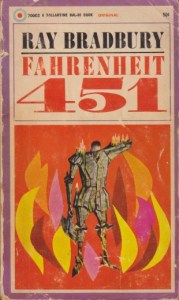
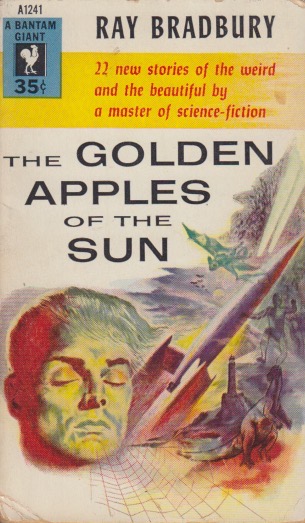
Although I’ve had this book as long as I can remember, I’d never read it.  Not the whole way through, until now.  As I kid I read Ray Bradbury when I could.  I’m sure I read a story or two in Golden Apples of the Sun, but I didn’t approach the entire collection.  I was drawn in at this late age by “The Fog Horn.”  This is the story that lay behind The Beast from 20,000 Fathoms, that classic of Harryhausen, the other Ray.  It’s been years since I’ve seen the movie, but the story was on my mind and I kept going.  Some of Bradbury ages well, while other stories, not so much.  The designation of his tales also changes over time.  As Stephen King says in Danse Macabre, Bradbury didn’t so much write science fiction (as the cover of this edition declares), even if the people occasionally get into rockets.

I realized as I read just how much my early writing style was influenced by Bradbury.  My stories were vignettes like these, not as accomplished, of course, but without lots of violence.  And with horror elements.  But it kept coming back to me how Bradbury’s characters, even the time-traveling ones, are stuck in the button-down forties and fifties.  I naturally overlooked this as a child but all these decades later and the strict binaries of, for example, men’s and women’s worlds, comes through on every page.  When women are the main characters, they’re usually not very flatteringly drawn.  The same goes for caricatures of races, although Bradbury is sympathetic he also uses stereotypes.  And many of the stories in this collection are just about everyday events, not a speculative element in sight.  Maybe I did try to read it through as a kid, but lost interest.

Writers struggle against irrelevance.  Those who look to the future sometimes get it right but often don’t.  And some reflect a present that we’d rather not acknowledge.  Of course, when I’m writing fiction I tend not to think in these terms.  The story simply takes you over and you can’t help being a refugee from the year in which you were born.  This is especially evident when Bradbury casts a rosy lens back toward childhood years.  As a child myself I had no idea that Bradbury was a time traveler from the twenties and thirties.  His childhood was nearly over by the time my mother was born.  It was a different world.  Some of his stories managed to transcend time and its for those that I keep reading him.

Something Wicked

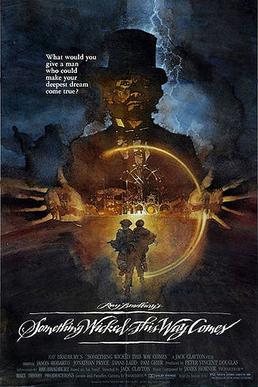
There comes a morning each year, pre-dawn, that it happens.  I crawl out of bed and things feel slightly chilly.  The furnace hasn’t been turned on yet, and ever sensitive to cold, I put on long sleeves and slippers to do my morning writing before the sun.  I start getting a powerful hankering to watch my autumn movies.  This year when that happened, in September, I finally watched Something Wicked this Way Comes.  Now, Disney isn’t a studio known for its horror films.  Over the years, however, they’ve produced some family-friendly efforts toward the scary end of the spectrum.  I tried to make the case in Holy Horror (and a list on IMDb agrees with me) that Pirates of the Caribbean falls into that gentle horror category.  I’ve read established writers on horror claim that The Watcher in the Woods was the movie that frightened them most.  I don’t think Something Wicked falls into that category, but I can say I liked it better than the novel.

And that’s saying something, because it was written by Ray Bradbury.  Bradbury’s stories were an integral part of my childhood.  In fact, much of my fiction writing is modeled on his work.  I didn’t really care for the novel Something Wicked this Way Comes, which I read last year.  The film is an improvement.  And it had a tortured way to the silver screen.  It began as a short story.  Bradbury himself adapted it into a screenplay anticipating a role for Gene Kelley.  This was in 1958.  When that didn’t pan out, he wrote it as a novel.  Filmmakers began to show an interest in the early seventies, but the movie didn’t come out until 1983, after Disney bought the rights and took over production.  The screenplay is mostly Bradbury and the soundtrack rips off Star Wars more than once.

Bradbury could get a little too nostalgic about boyhood.  His yesteryears seem far too innocent to me.  Although, having a few scenes where Jim shows curiosity about sex was a bit racy for Disney, I should think.  Jonathan Pryce does a fine job as Dark, and the mood isn’t bad for family-friendly fare.  I was never much of one for carnivals.  I can’t do rides and it’s easy to see through the games you can’t win and even if you do your prize is cheap.  Other entertainments always appealed to me more.  Still, the film sets a mood, and that’s generally what I’m after when the mornings begin to feel chilly and I’m looking off into another winter.


This Way

The more I get to know myself—pleased to meet you, sir—the more I realize that my childhood was cobbled together from small but repeated exposures to my favorite things.  I knew Dark Shadows from watching a limited number of episodes and reading a limited number of cheap novels.  I knew Alice Cooper from just two of his albums.  And I knew Ray Bradbury from a couple collections of his short stories.  No doubt this is in part because we weren’t exactly affluent and I found my books, by chance, at Goodwill.  I had no way of collecting Bradbury’s oeuvre, and besides, I was trying to get to know Edgar Allan Poe as well.  I knew Bradbury as a short story writer, and that’s still how I primarily think of him.

I felt compelled to read Something Wicked This Way Comes recently.  Since I’m used to Bradbury the short story author, it felt overdrawn to me.  I know this is heresy.  Great horror writers point to this novel as highly influential and inspirational.  Maybe if it were read closer to when I was born, when it was published.  Too many long paragraphs, especially early on, contain almost abstract descriptions without clear actions, leaving me confused.  Once the story got underway it was quite good.  As someone who writes, I know the dilemma of trying to freeze poetry into prose, and to make a coherent story from thousands of separate impulses.  Believe me, I know.  These days such things are edited out and stories become as thin as Bradbury’s Skeleton Man.  I guess I’m just out of practice.

The plot is great, but it feels so 1950s.  So boy/male oriented.  So American.  I suppose I attended my fair share of carnivals as a kid.  We didn’t go often, and I never knew one to settle on the edge of our small town.  And although we were free to ride our bikes or run as far as we cared to, home was never that far away and, I knew, there were scary things in the ubiquitous woods.  Ray Bradbury’s short stories were likely the main source behind my own early attempts at fiction.  Even today I’ll be scribbling along and think, “this is kind of like Bradbury.”  But I always have his short work in mind.  There are some great parts in Something Wicked, and it does build the tension toward the end.  Still, when it’s said and done I’ll be thinking of Bradbury’s short stories and how they formed my own nostalgia, even if only in little fragments.


In the Dark

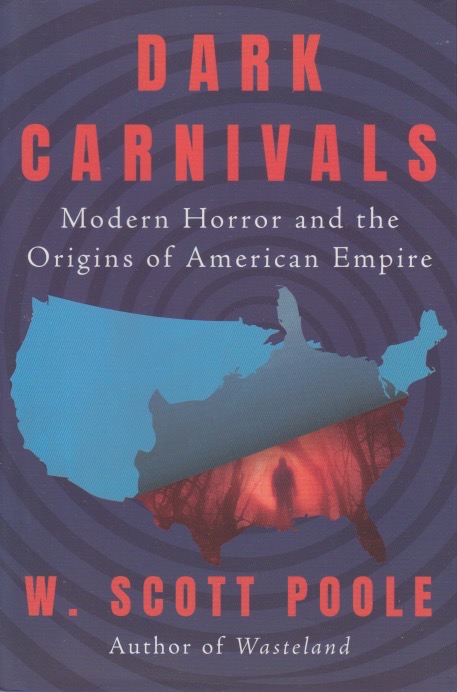
I’ve read several of W. Scott Poole’s books, and each time I read one I want to read another.  Dark Carnivals: Modern Horror and the Origins of American Empire is my most recent.  At first I was a bit reluctant to pick this one up because I misunderstood the “carnivals” of the title.  I don’t find clowns scary and I’m not really a fan of carnivals.  I didn’t make the connection with Ray Bradbury’s early story collection Dark Carnival.  Bradbury?  Well, why didn’t you say so?  But there is serious darkness here.  Poole traces the history of the American empire alongside the truths that horror films reveal.  This isn’t an easy book to read despite Poole’s fluid style and literary gifts.  Historians are uniquely placed to find truths that our country has so carefully hidden in our efforts to make ourselves the international “good guys.”  In unflinching terms, Poole traces the darkness of our acts, domestic and abroad, that have created so many dark carnivals.

The first couple of chapters are nearly impossibly good.  The entire book is insightful, but as is often the case with pop culture I find my experience limited to movies and novels of the horror genre.  There is absolutely fascinating stuff here.  It really begins with Harry Truman, but Poole traces how Ronald Reagan’s presidency was in many ways guided by science fiction authors who projected proudly the idea of America dominating the world.  Even to the point of becoming fascists.  Often confusing movies for reality, Reagan prided himself on being an empire builder who was a boon companion to the rich while keeping the poor exploited and un-empowered.  And it hasn’t just been Republican presidents who’ve done this (although they are clearly the most egregious offenders).  There are many moments of pause and reflection in this book and much of the horror comes from history rather than horror films.

Poole has made a name for himself as an analyst of politics and horror.  Very few “innocent” stories are as guileless as they appear to be.  Empires demand loyalty and must be constantly fed.  And they are extremely hierarchical and oppressive of those beneath the level of influence in their considerable power structures.  Dark Carnivals is a brilliant and disturbing book.  It did, however, take me down an avenue that Poole himself doesn’t explore.  Ray Bradbury was pretty much a Democrat until Reagan.  He wholeheartedly bought into Reagan’s false narrative and became friends with Republican presidents.  The disconnect from the man who wrote such masterpieces critiquing this kind of thinking caused a bit of personal whiplash for me.  His own dark carnival had drawn him onto that insidious merry-go-round.  Even the insightful can be lured by the tempting power of empire.


Mother of Life

Homeostasis is, if I recall correctly, the state of equilibrium that entities and systems seek.  When we’re too warm we seek someplace cooler and when we’re hungry we look for something to eat.  It’s a great process of evening things out because we live in a world of extremes.  Well, relative extremes for a planet that suited to life.  Autumn came in with a chill this year, at least around here.  We had a couple of nights with frost before apple-picking season even began.  Over in Denver they went from a heat wave to inches of snow overnight.  I often wonder, if our species manages to survive long enough, what life will be like once everything evens out.  Until then, because of human climate degradation, we’ll be facing more extremes.  That’s the way the GOP likes it.

Meanwhile, there may be evidence that life exists on Venus.  Or at least in the atmosphere of the hottest planet in the solar system.  Up through my college years I toyed with the idea of being an astronomer.  I’d learned in high school (for we were a Sputnik-era school in rural Pennsylvania that had a working planetarium) that it was mostly about math.  I’m afraid I have no head for such things.  Still, I remain fascinated by other planets and their potential.  I’m in the market, you might say.  Venus had captured my young imagination not only because Ray Bradbury and C. S. Lewis wrote stories about living there, but because of the images from the Russian Venera (blush, giggle) probe program.  I knew in high school (planetarium, remember?) that Russia had landed probes on the rocky surface of Venus that had only functioned for a couple of hours at most before breaking down in the extreme conditions.  Extremes, again.

Venus could, it was thought, never have supported life.  The new evidence, however, stands to show us just how little we understand life.  It exists in the most inhospitable environments on our planet.  When life was found near black smokers on the ocean floor it was considered a fluke.  Maybe life is the norm instead of the rarity our exaggerated sense of self-importance suggests.  Venus, after the sun and moon, is the brightest natural object regularly visible in our skies.  Both the morning and evening star, it beckons to us.  Although not definitive, we’ve found evidence of life on both Venus and Mars.  And yet many of us prefer science deniers to lead our nation.  So I think of homeostasis as I look at Venus out my early morning window.


For Illustration Purposes

With the non-essential stores closed, my daughter asked me the other day “does that mean bookstores?”  Sadly, yes.  More weekends than not I spend some time in a bookstore.  Fortunately we are well stocked for an apocalypse, book wise.  Lately I’ve been on a kick of reading short stories.  I’ve certainly written enough of them to fill a book or two, and it’s nice to start something you can finish in one sitting.  I just finished reading, or perhaps re-reading Ray Bradbury’s The Illustrated Man.  I say “perhaps re-reading” because I know I read many of the stories in the edition of the book I bought as a tween.  Some of the tales I didn’t recall at all, making me think I was reading selectively in those days.  That’s the nice thing about story collections: you don’t have to worry about continuity.

That having been said, the conceit of the illustrated man himself is that of a framing device.  His tattooed body is the canvas on which all of these tales are painted.  A surprising number of them are religious in theme.  Many of them take place on Mars.  Rockets are ubiquitous.  As a child I hadn’t realized that many of Bradbury’s stories were published in the late forties and in the fifties.  They still felt futuristic to me, having grown up in a small town with very little exposure to technological developments.  Reading many of the tales as an adult, I was surprised at how much they influenced my own fiction writing style.  I must’ve read a lot more of them when I was younger than I recall.

My tweenage years were long enough ago now that memories slip into one another.  I can’t remember when this or that happened, especially as regards reading.  When did I first read about the incessant rain on Venus?  Or about the writers living on Mars dying out as their books are destroyed?  Looking back over my own fictional work I see Bradbury’s fingerprints everywhere.  Bradbury couldn’t afford to attend college, so he did what he knew—he wrote.  Of course, back in those days publishers and agents weren’t dealing with the volume they face these days.  The internet has made writers of us all.  And I have to admit that some of the stories in The Illustrated Man disappointed me.  They didn’t reach the level of either depth or insight that I had recalled.  Overall, however, the impression was good, if nostalgic.  As the days become a long series of interconnected hours of sitting in the house, it’s a real gift to have short stories to punctuate the days.


The Tube

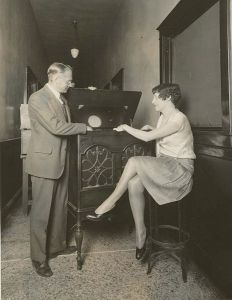
I’m sitting in a medical facility waiting room.  I’m not afraid of dying, but medical stuff terrifies me.  To calm me down, inane daytime television is on.  I may be one of the very few who brings a book to such places, but I can’t read with the insipid chatter going on.  This time, since I’m waiting for someone else, I brought my laptop.  Nevertheless, I can’t help but think of Ray Bradbury at times like this.  Many people think Fahrenheit 451 is about burning books.  Bradbury did write about burning books in his short stories, and it does happen in Fahrenheit 451, but that’s not what the book is about.  In interviews he said that he intended, as is pretty obvious from a straightforward reading of the text, to warn about the invasive nature of television.  It was, metaphorically, burning books.

Waiting rooms always bring that to mind.  Not only that, but it’s Valentine’s Day and all the talk shows are going on about how it’s “the day of love” (every day should be).  It’s not a day off work; I had to cash in a sick day to be here.  The word “holiday” keeps cropping up on the television, to which I have my back. Ever since leaving Nashotah House I haven’t watched television.  On our recent move to Pennsylvania our cable company didn’t offer a non-television option.  It was unthinkable.  We pay for something we don’t use.  Burning books.  I don’t have time for television.  I see shows that have proven their worth via DVD well after they’re off the air.  And that only when I can read or write no more in a day.  I guess I’m a Bradbury disciple.

Like any disciple, I have changed certain teachings of my leader.  Bradburyism is a religion objecting to ubiquitous television.  At the same time, I grew up watching the tube, and to this day I’ll stop just about anything to watch DVDs of The Twilight Zone.  Rod Serling, however, selected stories and teleplays that were well written.  This was a literate show.  Besides, my daily life often feels like the Twilight Zone.  Like Valentine’s Day in a waiting room.  The book beside me remains unopened.  It’s the same when I take the car to the garage, or go in for an oil change.  You can’t escape it, even though everyone else is paying attention to their phones.  How long until we learn to switch off?  Of course, medical waiting rooms are the places where I may need brainless distraction the most.

Photo credit: Smithsonian Institution


VFD

It’s been a few years since I read Fahrenheit 451, the classic novel by Ray Bradbury.  Like so many dystopias, it’s seen a resurgence of interest since 45 was elected.  (I can’t help but notice the shared digits.)  Bradbury was a writer of his time.  So much, I suppose, could be said of all of us who write—how can we be anything else?  Still, it’s difficult not to see that his fear was of television decimating reading.  And intelligence.  We’ve got the internet now, so the effect has been magnified a bit.  The tale, despited being dated, is poignant.  The more electronic we become the more of what used to be termed “real life” we miss.  At this reading it was clear that The Book of Eli was largely based on the last pages.

When Montag confesses to his wife that he’s been secreting books away, and she finds him insane for doing so, he takes the book in his hand to a former acquaintance, Faber.  It turns out that the book is the Bible, perhaps the last in existence (see what I mean?).  On the subway ride he tries to memorize the Good Book.  Now, I’ve been on the New York City subway, and I know the delays can be long, but there’s an error of scale here.  The Bible’s a big book.  Still, he gets pieces of it down.  Now, in the 1950s, when Fahrenheit 451 was published, the Bible was known for its liberating qualities rather than its darker side.  Also the atomic end of World War II was clearly still a painful living memory.  The two may not be unrelated.

Given the age of the story, I won’t worry about spoilers.  In case, however, it’s on your list proceed with caution.  The war that’s been building the entire story takes place the night of Montag’s escape.  Along with the intellectuals forced out of the cities, he becomes part of a human library.  Each person is, through a memory recovery technique, capable of recalling the books they’ve read.  Montag becomes, appropriately enough, Ecclesiastes.  Perhaps the least evangelical book in the Bible, along with Job (with which most evangelicals find themselves cheering on Job’s friends), Qohelet has long been one of my favorites.  It’s an honest book.  The same can be said for Bradbury’s novel.  Primarily a short story writer, Bradbury didn’t sustain the narrative to novel length very often.  But when he did he fashioned a book that, particularly now, needs to be read.


Religion, He Wrote

A friend recently sent me the New York Times obituary for Carol Serling, the wife of one of my heroes, Rod Serling.  Perhaps it’s a personal weakness, but I often wonder about the religion of my favorite writers.  More often than not I discover that they’re affiliated with tolerant faiths, sometimes unattached to any specific tradition.  Rod Serling grew up Jewish but became a Unitarian-Universalist by marriage, and—it doesn’t stretch the imagination—remained one by conviction.  I’ve read a bit about the UU tradition, and it is based primarily on values rather than beliefs.  In fact, the idea that religion is a matter of what you believe is only one way of defining it.  Historically one’s religion was a matter of what one did, not necessarily what she or he believed.

Authors that I read often deal with religious issues.  It’s important to confess that I don’t select fiction based on its having religious themes.  Anyone who’s read more than one or two of my posts will know my reading is eclectic and many of the books represented here have shown up because of wildly different circumstances.  Reading challenges, friends’ recommendations, and preparations for educational presentations are often driving forces.  In the fictional realm I’m drawn to the speculative, but also often to the catch-all category called “literary.”  Stories that feel authentic in either category have an element of religion in them.  Life portrayed without it doesn’t seem believable.  I’ve been re-reading some Ray Bradbury.  There’s often suggestive material there.

Raised a Baptist, Bradbury is often also claimed as a Unitarian-Universalist.  Apparently he didn’t like the label, but his behavior was more a selection of tenets that he found compelling from various religions.  All of this may sound strange in a context where “religion” is increasingly a dirty word.  (To be honest, it has been doing much to earn such a reputation.)  Still, it is a very deep part of being human.  Rod Serling’s stories advocated fair treatment of all people and often his sense of justice landed him in trouble with advertisers for The Twilight Zone.  Religions comfortable with maintaining prejudice, or turning a blind eye to lawbreaking in the name of false virtue would certainly not understand refusing to take money from questionable sources.  I suppose there’s a reason I enjoy the stories from the days when America still had a conscience.  The legacies of such writers, it is to be hoped, will outlast what passes for religion these days. 

Any other gods before me…


Sci-Fi Culture

I’ve recently taken up rereading Ray Bradbury stories from my childhood.  Bradbury’s difficult to classify, but he’s often genrefied as science fiction, but many of his stories are horror and fantasy related, or just plain stories.  One aspect upon which future readers, I believe, may pick up—and this isn’t just a Bradbury thing—is how people were projected into the future with the culture of the past remaining intact.  Things like characters smoking in the most unlikely of places.  I picked up on that the first time I watched Alien.  In space, where no-one can hear you scream, air has got to be a precious commodity.  And yet there they are, smoking in space.  Same thing with Bradbury.  The culture of the 1940s and ‘50s when he was writing such stories simply couldn’t see beyond the time when culture was what everyone did.  It seems weird in 2019.  How much weirder it will look in 2050 (presuming we make it that far).

There’s almost a “gee-whiz” quality to such stories of the past.  People in the future, and in space, drink coffee and wear blue jeans.  They may have more technological homes, but their home lives reflect the forties and fifties as well.  The women are housewives and the husbands go to the office, or outer space, to work.  I suppose cultural verisimilitude was a different thing back then.  Did nobody really consider that patriarchy might be a problem?  Did everyone think clothing would never really change?  And not a hint that vegetarianism might catch on.  What makes the future the future in these stories is tech.

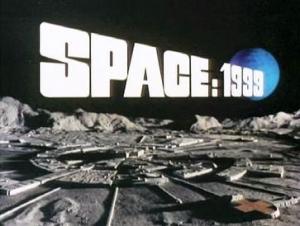
These days we’re loaded with tech.  In some ways we have more of it on our person at any given moment than all of Bradbury’s space-workers ever had.  In one of his stories a character was born in the impossibly far year of 1993.  I used to watch a show called Space 1999.  We haven’t colonized the moon yet (we may be working on it, but considering how long things like an obvious impeachment take, I wouldn’t hold my breath).  Speaking of holding breath, I’m pretty sure some of the characters were smoking on Moonbase Alpha.  Or my memory is cloudy.  (The earlier, and more lasting series Star Trek pretty much avoided several earth-bound habits, although Captain Kirk was pretty fearless when it came to the possibilities of space-spread STDs.)  I read Bradbury as a throwback to my childhood.  His stories have both an prescience and naivity that make them compelling period pieces.  From our current standpoint, one wonders if there will be any culture left at all in the future.  Perhaps we should enjoy what we have, while we still can.


Dayglow

Yellow and orange leaves on a damp pavement.  A sky claustrophobically occluded with gray clouds.  A decided chill in the air.  All you have to do is add a few pumpkins and the feeling of October is complete.  I don’t know why this particular image of the change of seasons grips me the way it does.  As a homeowner I don’t want to turn the heat on too soon because the gas bills will jet up and will stay that way for seven or eight months.  I get depressed when skys are cloudy for days at a time.  Around here the leaves have only just begun to change.  In other words, there’s a decided difference between the way I imagine October and the way that it feels on the ground.  In my imagination there are Ray Bradbury titles, The October Country, The Autumn People, but here in the physical world I shiver and add another layer.

Over the past several weeks I’ve been struggling to figure out why horror appeals to me.  It seems to be the Poe-esque mood rather than any startles or gore.  The sense of mystery that hangs in the air when you simply don’t know what to expect.  Will it be a warm, summer-like day or will it be rainy and raw, a day when you wouldn’t venture outside without the necessity to do so?  October is like that.  It is changeable.  Beginning in late September it is dark longer than it is light and for much of the rest of the year I will go to bed when it’s dark outside.  It’s always still dark when I awake.  Is it any wonder that October has its hooks in me?

Short stories, of which I’ve had about twenty published, seem to be the best way to capture this mood.  You see, it isn’t a sustained feeling.  It’s piecemeal like that extra quilt you throw on your bed at night.  The urge to hibernate creeps in, but capitalism doesn’t allow for that.  October is an artist, and I’m just the guy wandering the galley, pausing before each painting.  This feeling only comes after summer, and it is fleeting.  In November the leaves will be down and the cold will settle in quite earnestly.  The candles we lit for Halloween will be our guide-lights to those we hold out to Christmas when the dayglow will begin to return at an hour that reminds us change is the only thing that’s permanent.  And in this there’s a profound hope.


Significant Places

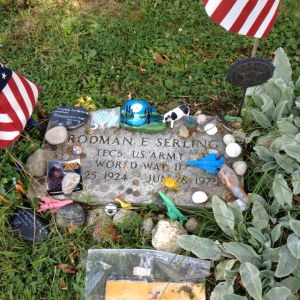
Upstate New York may not get the attention that the state’s largest city does, but it is a place of wonder.  One of those sources of significance is the unique blend of individuals who’ve impacted both American culture, and, in turn, my life, that called this region home.  It’s difficult to describe what I’m feeling as I’m standing next to Rod Serling’s grave.  This is a man who held a profound influence over my outlook by letting his imagination go where it would.  It’s more than the Twilight Zone—although its theme is one of the ringtones on my phone—it’s the sense that I somehow knew this man I never met.  It’s also the sense that his gravesite is so humble, in a rural area outside a small town, the kind that often featured in the stories he wrote and presented.  It’s the sense of connection.

As I young person I practiced writing short stories based on the mood set by the Twilight Zone, with a dash of Ray Bradbury thrown in.  From a small town myself, imagination was my means of enlarging my world.  We didn’t have the money to go many places but the magic box in our living room could take me to weird places alive with transcendence.  The results were beyond price and there was something deep and liberating here, even for a kid whose religion said it was all nonsense.  Even religion requires escaping sometimes.  I know the publishing world has moved beyond what was fashionable in the sixties and seventies, but that can’t dislodge the shard in my chest right now.  If there are spirits in cemeteries, they are here.

Some time ago I began, as I had time, uploading my photos of famous writers’ graves (along with those of other recognized names) on Pinterest.  On the way to Interlaken, I wondered aloud why nobody seemed to show an interest.  I find cemeteries peaceful places, and sacred spaces are those where people significant to us have been, in some form, at some time.  I know Rod Serling loved upstate New York.  It was his escape from the busy life of a writer whose cachet was marketable back in the days when anything seemed possible.  Retreats are those places we go to restore ourselves when work simply won’t allow creative people to have unstructured time.  I wasn’t expecting a huge mausoleum or towering monument here.  Others have found their way to this place nevertheless.  I am in a sacred place and the quiet here is kind of a prayer.


The Zone

My youth—who am I kidding?—my life has been a search for father figures.  Since I grew up with television, many of them came from the tube.  The professor from Gilligan’s Island, Mr. Rogers, Barnabas Collins, and Rod Serling.  Serling was like the father I couldn’t remember in that he was always smoking.  But unlike my father, Serling had an imagination in sync with mine.  The Twilight Zone was in reruns by the time I caught up, but it gave me an odd kind of happiness.  The sort that you had as a kid after the bath was over and you were wrapped up snuggly and warm in a bathrobe, and you got to watch one of your favorite shows before going to bed.  I discovered Serling as a writer when I was in Junior High School.  He was right up there next to Ray Bradbury, in my book.

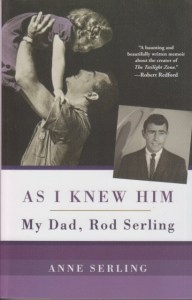
I have to admit to feeling anxious as I read Anne Serling’s As I Knew Him: My Dad, Rod Serling.  You see, she actually was his child and I’m afraid of learning too much about those I put on my personal pedestals.  Her book, however, didn’t disappoint.  Serling lived a writer’s life, something I’ve coveted since I was a kid.  If I couldn’t have a father, at least I could write about life as I saw it.  I still write fiction inspired by, among others, Rod Serling.  Spending much of my time in Binghamton and Ithaca for my own family reasons, I was only obliquely aware of how much I was traversing the region Serling considered home.  As I read his daughter’s autobiography—or is it a biography?  Who can tell the difference?—I was inexorably drawn in.  Fathers and daughters can be the best of friends.

Sometimes I wonder if those who know writers the best are their true fans.  I don’t mean groupies or the like, but rather those whose lives have been transformed by their words.  I’m reminded of Evermore, written by a relative of Edgar Allan Poe.  Family, it is true, see a side of a person that the reader does not.  But who are we, really?  Those of us who write may be saying more in our fiction than we care to admit even to those who know us well.  Rod Serling recognized dimensions well, I suspect.  A writer’s life requires sacrifice and keeping things hidden.  Anne Serling’s book is a gift to those who write, even if it is about someone else’s father.


Bradbury’s Dream

There’s a Ray Bradbury story—I can’t recall the title, but with the Internet that’s just a lame excuse—where explorers on Venus are being driven insane by the constant tapping of rain on their helmets.  They try to concentrate on discovery, but the distraction becomes too much for them.  Living in Pennsylvania has been a bit like that.  I grew up in the state and I knew it rained a lot.  Here in the eastern end we’ve hardly since the sun since March.  And when you’ve got a leak in your roof that only compounds the problem.  If I were weathering the Psalms, mine would be a lament, I’m afraid.  You see, the ground’s squishy around here.  Mud all over the place.  Rivers have been running so high that they’re thinking about changing their courses.  And still it rains.

There’s a lesson to be taken away from all this.  The fact that we use water for our own ends sometimes masks the fact that it’s extremely powerful.  Not tame.  The persistence of water to reach the lowest point contributes to erosion of mountains and valleys.  Its ease of transport which defines fluidity means that slowly, over time, all obstacles can be erased.  It’s a lesson in which we could stand to be schooled from time to time.  Rain is an artist, even if it’s making its way through the poorly done roofing job previous occupants put into place.  Would we want to live in a world without valleys and pleasant streams?  And even raging rivers?

There’s no denying that some of us are impacted by too much cloudiness.  When denied the sun it becomes easy to understand why so many ancient people worshipped it.  Around here the temperatures have plummeted with this current nor-easter and the heat kicked back on.  Still, it’s good to be reminded that mother nature’s in control.  Our high officials have decided global warming’s just alright with them, and we’re warned that things will grow much more erratic than this.  As I hear the rain tapping on my roof all day long, for days at a time, I think of Bradbury’s Venus.  Okay, so the story’s appropriately called “The Long Rain” (I looked it up).  Meanwhile tectonic forces beneath our feet are creating new mountains to add to the scene.  Nature is indeed an artist, whether or not our species is here to appreciate it.  If it is, it might help to bring an umbrella this time around.


The Persistence of Unity

I came across some Ray Bradbury books while unpacking.  I recently learned that Ray Bradbury was a Unitarian.  Now, the religion of a writer is only ever an ancillary bit of information, yet for someone of my combination of interests, it’s compelling intelligence.  Having grown up reading Bradbury, my own fiction often comes out seeming like an imitation of his.  I discovered him the way I found most of my early, influential writers—through Goodwill.  Living in a town with no bookstores, Goodwill was a great venue for walking out with a good handful of books for under a buck.  Since Mom was there looking for “practical” stuff, I hovered over the book tables and discovered a new world.  Then I grew up.

Embarrassed by my childish interests, I gave away or sold most of my Bradbury books after college.  I was more sophisticated than that now.  I read Greek and was soon to learn Hebrew.  Books were meant to have footnotes, and lots of them.  Who wants to be seen with Bradbury on their shelves?  But the indiscretion of youth does come back to haunt one.  About two decades later I began to yearn for something missing from my life.  Perhaps like a good Unitarian I wasn’t exactly sure what it was, but I knew it was lacking.  Then my daughter was assigned Fahrenheit 451 for school reading.  I tried to read whatever she was assigned, and once I did memories of Bradbury flooded back.  I no longer had his books, but that could be remedied.

Occasionally I’m criticized for having too much in the way of books.  I’m sometimes asked if I will ever read some of them again.  The answer is how should I know?  I jettisoned Ray Bradbury with Episcopal pretention, only to find that behind the ceremonial there was a more unified version of things waiting.  A continuity with my younger self.  A lust for imagination.  A desire to remember what it was like to walk on Venus.  Or to see a man presciently covered with tattoos.  Or simply to thrill at the idea of October.  I began to acquire the old books again.  The newer editions lacked the visual resonance of the old, but the essence was still there.  Orthodoxy, I discovered, often isn’t true to life.  What’s true is what we discover early on.  Sophistication isn’t all it’s cracked up to be.  And yes, I may well just read that again after all.