Zoning In

Born Jewish, and Unitarian by choice, Rod Serling believed in the inherent worth and dignity of all human beings.  Like many people, even Serling believed that season four of The Twilight Zone, which went to an hour format from the usual half, didn’t really work.  Nevertheless, the fourth episode of that season,“He’s Alive,” really should be required watching of every person in the United States.  This episode was written by Serling and it focuses on a young American fascist who’s having trouble gaining a following.  A shadowy figure then reads to him from what sounds exactly like Trump’s playbook, and soon decent people are raging along with him about foreigners and those who are different.  When the shadowy figure is finally revealed, we’re not surprised to learn it is Hitler.
The young man obeys without question, and soon it looks like he could be elected.  He has one of his best friends killed as a martyr to the cause.  He murders an old Jewish man who has cared for him since his youth.  He declares himself made of steel, with no feelings.  And when he ends up dead (everyone knows how Hitler’s career culminated), the spirit of Hitler rises from his body as Serling warns that wherever hatred exists, Hitler still lives.  Now this episode aired in 1963 but it could’ve been 2016, or 2024.  Prescient people, like Rod Serling, knew that mob thinking could be easily exploited.  Even in the first segment after the introduction the instructions are laid out.  Play on people’s fear of those who are different.  No matter how good things may be, people will be unsatisfied.  Add any power-hungry individual and you’ve got the recipe for a fascist overtaking.

The episode made me wonder if we could ever become a just society.  Ironically, that which calls itself “Christianity” these days stands in the way.  In its day, The Twilight Zone was amazingly influential.  It had a great impact on what was to follow and it’s still regularly referred to, even by those who’ve never seen an episode.  If only we’d pay attention to its message.  I’ve been making my way through the entire series, slowly, over the years.  Now and again an episode will really hit home.  I have to admit that I was physically squirming during “He’s Alive.”  It’s not that it is the greatest episode of the series, but its message is extremely timely.  The requirement for a better world is simple, but seemingly impossible to reach.  Treat others as you wish to be treated.

Another Level

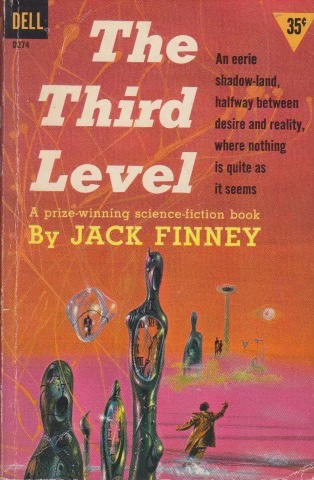
Jack Finney is probably best remembered as the person who came up with the idea for The Invasion of the Body Snatchers.  His book, The Body Snatchers, was the inspiration behind the two movies based on it, as well as various knockoffs.  The Third Level is a collection of short stories he wrote.  I’ve been trying to introduce more short stories into my literary diet, and this one was recommended by Stephen King in Danse Macabre.  Specifically, he mentioned it as being more like what The Twilight Zone should’ve been than much of what Rod Serling wrote.  Now, I’m an unapologetic Rod Serling fan.  This is based on memories from childhood when I watched the show and, let’s be honest here, wished he could be my father.  I already had a taste for the unusual and sometimes macabre, and so I was curious what King thought might do Serling better.

The Third Level was labeled as science fiction, but sci-fi and horror share more than a boundary or two and at least four of the stories have nothing sciency about them.  As a collection it’s good in the same sense as a mature reading of Ray Bradbury is good.  I would’ve liked this—probably loved it—as a kid.  I was reading, however, for The Twilight Zone.  There are some good twist endings here, but not all the stories have them.  A couple of them are pretty straightforward whimsical romances.  Many of them feel very much like they were written in the forties and fifties.  A couple of the stories, late in the collection, I really liked.  They were a bit more Zonish than some of the others.

One of the problems in writing a brief post on a collection—and no collection is uniformly great—is that it’s difficult to give a sense of the whole.  So instead I’ll just focus for a minute on the last story, “Contents of the Dead Man’s Pockets.”  This one shows the power of Finney’s descriptive writing and it caused physical reactions I seldom get when reading.  It involves a man climbing out on an eleventh-story ledge to reclaim an important bit of paper that blew out the window.  More than once I almost had to put the book down.  Fear of falling is deeply embedded in the human psyche and Finney is able to probe it for more pages than I was comfortable reading.  Well done, sir.  Overall, the collection is good to have read.  It won’t change my mind about the Zone, however.  It reached me a little too late to do that.


TV Zone

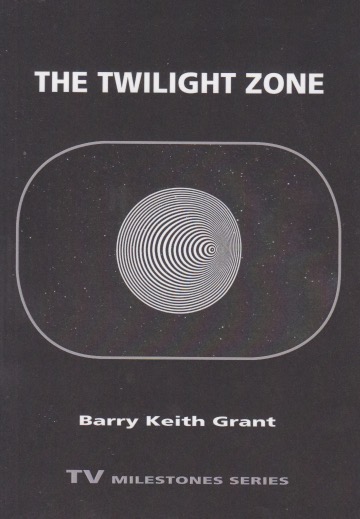
An unenviable task, it must be, to try to sum up The Twilight Zone.  Barry Keith Grant, however, has done an admirable job in this TV Milestones volume.  He addresses in a forthright way one of the questions on my mind quite a bit as of late—what are the borders of genre?  For a creative species such as our own, with imaginations that range far and high, we blend unlikely ingredients.  The Twilight Zone had finished its initial run before I ever watched television, but I was around to catch early reruns.  Their focus on the weird, the unusual, the twist ending, informed my childhood love of the strange.  They also helped shape my imagination.  This little book helps to capture some of that.

I haven’t watched every episode of the series yet.  I’ve been making my way through it slowly since I really don’t have much time for watching, and I tend to give priority to movies.  Still, The Twilight Zone was one of the most influential television programs of all time, as Grant demonstrates.  Although he tries, it may be impossible to determine just why so many people use it as a frame of reference.  Even with my penchant for analyzing, I can’t work out what it was about those disparate, discrete episodes that so captured me.  Perhaps like most influences, it was specific episodes that hit very deep.  That showed new ways of thinking about things.  That opened up worlds of possibilities.

I was exposed to Serling’s stories not only through my own reading, but also through school.  I have no hope of remembering what grade it was in, but in one of my English classes we were assigned “The Monsters Are Due on Maple Street.”  I was probably lost in the haze of puberty and adolescence at the time, but I remember well how that story made me feel.  And the teacher pointing out how people behaved when they were afraid.  Perhaps appropriately, Grant ends his book with a quote from that very episode.  Others, however, stayed with me as well.  Perhaps that’s the thing that’s so remarkable about the Zone—some episodes are not easily forgotten.  We’re accustomed to the flood of anodyne media that dowses us with entertainment of little consequence.  Some Twilight Zone episodes were that way as well.  But when we experience something significant, we tend to remember it and remember it well.  So many episodes did that kind of work on a mind too young to make lasting life decisions.  I guess I’m still waiting for Mr. Serling to step into frame and explain it.


Revisiting the Zone

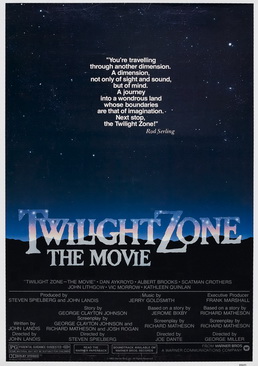
Like many people in the early eighties, I heard about the terrifying accident that killed Vic Morrow, Myca Dinh Le, and Renee Shin-Yi Chen during the filming of Twilight Zone: The Movie.  Because of that I steered away from ever seeing it.  I grew up loving The Twilight Zone, and I was probably enough of a self-assured critic at twenty to suppose the movie would never have been as good as the original series had been.  Still, it didn’t leave my consciousness.  Not entirely.  There have been a couple of television reboots of the series—most recently by Jordan Peele—and it seems that those of the present day still see the cultural value in the original.  Peele’s relaunch, although short-lived, brought the movie back to mind and I finally decided to watch it when I learned that one of the segments was based on “Nightmare at 20,000 Feet,” given my recent gremlin kick.

I knew the film was an anthology and those are always dicey.  I also knew I’d be watching an actor in his final role—the scene in which he and the children actually died was not used in the movie, of course.  I didn’t realize how many stars were in the cast, and I didn’t even know what the other three episodes were.  Critics (paid and un) have opined that the episodes increase in appeal as the movie progresses, and the opening segment has been hailed as one of the scariest introductions among films.  So some forty years after it released I watched it.  I actually found it to be largely in the spirit of Rod Serling.  I don’t know what he would’ve thought of the movie, but it seems to have continued his message.  The first segment, the one in which Morrow starred, wasn’t based on a single original Twilight Zone episode as the other three were.  A few “Easter eggs” exist for fans, such as Burgess Meredith narrating and Helen Foley saying she’s headed to Willoughby on the remake of “It’s a Good Life.”  No doubt, “It’s a Good Life” and “Nightmare at 20,000 Feet” are among the most famous of the episodes in the series.

Part of me is surprised that the film was released at all.  Deaths have occurred, of course, in the making of other movies.  Some in which millions of dollars had already been invested.  Still, watching a final performance like this has a haunted quality to it.  At times it seems that acting can be a dangerous profession.  And certain movies may always be difficult to watch because of it. But should we expect anything different from this Twilight Zone in which we live?


End the Stigma

I’ve been a lifelong fan of Edgar Allan Poe.  I bought books about him (and by him) from a young age, fascinated by a person who expressed himself so beautifully in the face of trauma.  Of  a different era, and mindset, was Rod Serling, creator of The Twilight Zone.  Another childhood hero of whom I made the assumption of some trauma.  One thing interesting about both of these influential writers is that relatives have written about them claiming that they weren’t as haunted as they seemed.  I wonder, however, if they write such things because we still, we are still stigmatizing trauma.  We’re great victim-blamers.  Perhaps it’s because we want to distance ourselves from the scary forces at play.  We fear that unhappy master, whom, in Poe’s words, “Unmerciful disaster followed fast and followed faster.”  We don’t want to attract such things to ourselves.

Reflecting on my father recently—I didn’t know him well at all—I was thinking about his experience in the Korean War.  I don’t know what happened to him there and I never had the opportunity to ask him about it.  But I do believe that, like Rod Serling, he may have been traumatized by combat.  War leaves trauma in its wake.  Few, I suspect, come out of such situations without deep scars that haunt them the remainder of their lives.  And still we fight.  I knew, already at a young age, that I could never be a soldier.  This despite growing up with G. I. Joe.  Some of us spend our lives trying not to harm others.  Trauma follows on from that since the world has its share of unmerciful disasters.

There are those who claim Poe wasn’t the experiencer of doom and gloom about which he wrote so eloquently.  He lost those close to him to disease.  Even now there are many stigmatized diseases.  That’s one of the reasons employers are insistent that conditions suffered by employees not be revealed.  Our whole medical privacy mindset plays into the stigmatizing those who face illness.  Tuberculosis was only one of many widespread diseases during Poe’s life, and it’s still widespread in parts of the world because companies like Johnson & Johnson and Danaher price gouge the well-understood cures to maximize profits.  And we blame the victims.  I return to Poe at intervals in my life.  I also watch episodes of The Twilight Zone.  And I think of my father.  There is trauma in the world, and some of it, at least, is preventable.  We must stop blaming the victims.


The Goodreads Zone

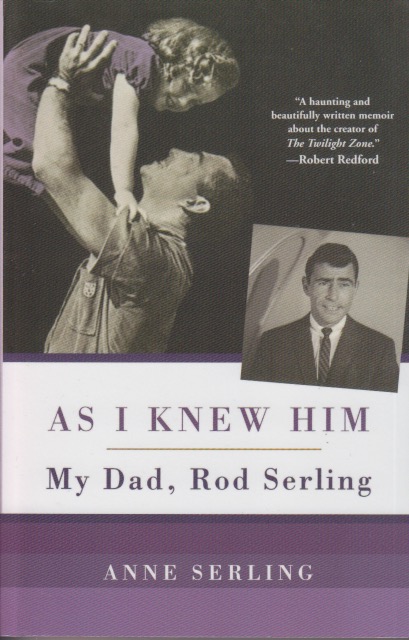
It happened on Goodreads.  I suspect she had no idea how much that simple “like” meant to me.  Social media is too big to be everywhere, so I primarily engage with those who reach out to me (without trolling), on Twitter, Facebook, YouTube, and Goodreads.  Even with my activity on these venues, comments are rare.  Likes a bit more common, and always appreciated.  Several months after I posted a review of her book, As I Knew Him: My Dad, Rod Serling on Goodreads, Anne Serling liked it.  That may not seem like much, but this was the actual daughter of Rod Serling himself, liking something I wrote.  If you feel the way I do about The Twilight Zone this will be a personal brush with greatness.  Almost as if Serling himself approved.

I’ve met a few famous people in my time.  Mostly they are ordinary people and act like ordinary people.  Only those of us around someone famous know that millions of people have heard of one of us.  Heard of and admire.  The rest of us manage to get along, but we do so without notice.  Unless someone “likes” what we do.  It’s kind of like having someone famous blurb your book.  In any case, my childhood consisted of many snippets of things that made me who I am.  One of those snippets was The Twilight Zone.  I watched a lot of television growing up.  We were not a reading family (neither parent finished high school), so the television was the item of choice after work/school.  Much of what I watched washed off.  Not The Twilight Zone.

Like reading through the Dark Shadows novels, I’ve been slowly watching my way through The Twilight Zone alone.  Nobody else in my family cares for it and since I don’t have much free time I only get to it on rare occasions.  Now that mowing time is here, those occasions are even fewer.  I guess I feel that I have to justify why I’ve come around to writing about horror as an adult.  You don’t get to be an adult without having some kind of childhood first, and mine involved The Twilight Zone.  Anne Serling’s involved being raised by the creator of The Twilight Zone.  To me, that’s a validating kind of fame.  To be seen by someone who could, if she wanted, have an instant and ready-made audience.  A reverie, started by something that happened on Goodreads.


Twilight on Christmas

We have too many ornaments for the single Christmas tree we can afford.  There are few reasons for this.  One is that I married into a family with Christmas ornaments.  While on my own I never set up a tree and I owned very little beyond books and some LPs.  Besides, I went home for Christmas.  Another reason is that although I seldom think of Christmas before December, we tend to buy ornaments as souvenirs.  Not for everywhere we go, but we did start a ship sub-collection when visiting coastal locations.  We also have a moose sub-collection.  I spent quite a bit of my early adulthood out in the woods looking for moose, generally in Maine.  Then there’s the “other sub-collection.”  The one that’s be relegated to it’s own mini-tree.

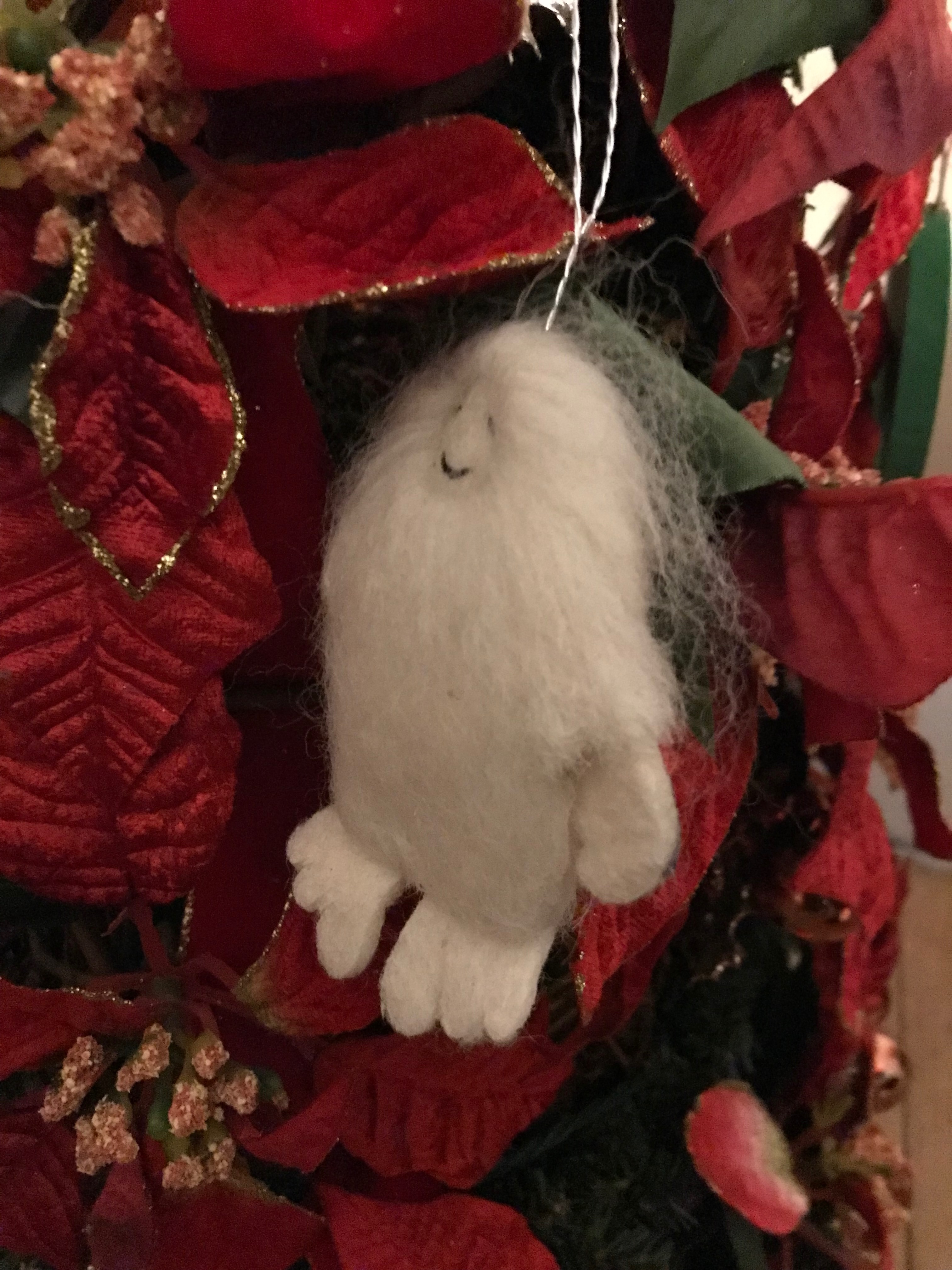
To understand this, let me begin by noting that Christmas is the birthday of Rod Serling (shoutout to my friend John Morehead for pointing this out).  Rod Serling is one of the reasons—he can’t take all the blame, of course—that I’m interested in strange things.  The Twilight Zone affected me profoundly as a child, and probably had more impact on my life trajectory than I might’ve realized.  The “other sub-collection” consists of the weird ornaments.  It began with a Cthulhu ornament I found online a few years back.  Then, at a fair trade shop in Ithaca, I found a yeti ornament.  How could I not support fair trade?  This year at Christkindlmarkt I found an alien head made from a recycled Christmas tree trunk round.  It seems my strange Christmas ideas aren’t unique.

Bethlehem styles itself “Christmas City.”  The celebration in the Lehigh Valley is palpable.  My family generally spends a December Saturday strolling up and down Main Street, visiting the quaint shops.  Last year one of them had ornaments of sasquatch skiing.  I didn’t buy it, thinking someone might pick up on my pointing it out.  This year I went back to the store but they didn’t have it any longer.  A quick online search, however, revealed many options for a cryptid Christmas.  What can I say?  These things make me happy!  This year I’ve been thinking quite a bit about ghosts and the holidays.  It’s an ancient connection that has been lost to the commercialization of Yule and Saturnalia and other December celebrations.  So, Rod Serling was actually born on Christmas day.  I hope that however you celebrate this day it will bring you joy, no matter how weird.


Visualizing Twilight

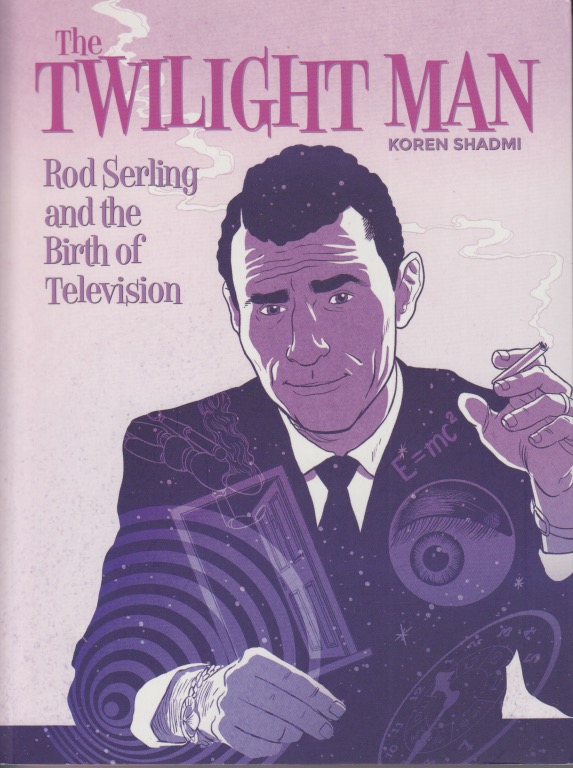
Graphic novels still feel like cheating.  That childhood message that comic books “aren’t really reading” has proven difficult to dislodge.  That, and the fear that we are entering a post-literary world, keep me from reading many of them.  Koren Shadmi’s The Twilight Man: Rod Serling and the Birth of Television, however, caught my attention right away.  Like many other people my age, my thinking was heavily influenced by The Twilight Zone.  As a kid, television had a kind of authority to it.  This is what adults were feeding us.  Although I was hardly intellectual then, I thought deeply about things and one of those things was The Twilight Zone.  The episodes were profound.  The twist endings certainly were among the best on the tube.  Shadmi’s graphic novel of Rod Serling’s life is a tribute to the influence the man had.

For a graphic treatment, The Twilight Man is strangely affective (yes, that’s spelled correctly).  I tend to shy away from hagiographies, and Shadmi’s treatment isn’t one.  It does illustrate, however, how Serling fought against a commercialism that would eventually win out.  Those who control the money control what we see.  Granted, the democratizing influence of the internet has let competition arise from unseen quarters—there are young people who watch YouTube to the exclusion of television altogether—but few shows manage the impact that The Twilight Zone had when there were only essentially three large networks.  Now we have so many choices that cultural reference points are rare.  Those who’ve never seen it, at least for the time being, know what The Twilight Zone is.

This book is biographical, based on published biographies.  There’s something about knowing, however, that the episodes actually happened.  Being in combat (as Serling was) puts some people into their own kind of limbo.  At least one person in my own family was irrevocably changed by fighting in a war.  The remarkable thing is that Serling came out of it wanting justice for all people. The book even points out that he became a Unitarian, although it doesn’t dwell on that point.  Some things, such as spiritual insights, are difficult to illustrate I suppose.  I can  see why Shadmi’s tribute receives good press.  Graphic novels are a means of telling a story that moves people.  I re-learn this each time I read one, which is something I rarely do.  Now that I’m starting to explore this genre I’m perhaps learning to address my own prejudices.  As long as there are still words to read.


2020 in Books

As has become traditional on this blog, I like to revisit my reading for the year before the next one begins.  No matter what else goes wrong, we have books.  As I noted yesterday, I’ll be devising my own reading challenge for the coming year and if nothing else, it’ll be diverse.  For 2020, according to Goodreads, I finished 78 books.  Since I was in the final stages of getting Nightmares with the Bible to the publisher, several books early on were about demons, and many of them were quite good.  The nonfiction that really stick out in my mind, however, includes D. W. Pasulka’s American Cosmic, Richard King’s Ahab’s Rolling Sea, Gary D. Rhodes’ The Birth of the American Horror Film, Jeffrey J. Kripal’s Secret Body, Barbara Ehrenreich’s Living with a Wild God, and Ernestine Hayes’ The Tao of Raven.  If anything ties these books together it is likely their honesty when it comes to the spiritual quest.  It can legitimately take many directions.

Fiction has, at least for much of the year, been driven by a few factors: books I have on hand during a pandemic, The Modern Mrs. Darcy’s reading challenge, and books on my reading wishlist.  That list is constantly growing and the books that stand out particularly are again diverse.  Especially memorable were Ralph Ellison’s Invisible Man, Hank Green’s An Absolutely Remarkable Thing, Han Kang’s The Vegetarian, Scott Shibuya Brown’s The Traders, Andrew Michael Hurley’s The Loney, and Silvia Moreno-Garcia’s Mexican Gothic.  Apart from their diversity these books have little in common.  I suppose that’s a testament to the importance of reading widely.  On that list there are only two “white” men but a lot of great books.

Another couple of categories might apply: big books and short story collections.  Big books intimidate me, but I read five of over 500 pages: Ellison’s Invisible Man again, Herman Melville’s Moby-Dick, Mark Twain’s The Innocents Abroad, George Eliot’s Middlemarch (my longest book for the year), and Ann Radcliffe’s The Mysteries of Udolpho.  These books are all in the “classics” category, I see.  Short story collections are more edible, and I read nine of them, including four “by” Rod Serling.  The first was an edited collection of his works, and the other three were his own Twilight Zone adaptations.  I read a few plague books because of the pandemic, but they weren’t really among my favorites.  Perhaps they were a little too close to reality.  Nevertheless 2020 was a good year of reading, overall.  I’m looking ahead to what gems 2021 might hold.


New Twilight

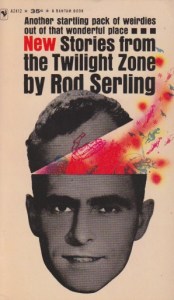
The strange thing about The Twilight Zone is its ability to endure in the minds of those exposed to it at an early age.  Often it’s more the image of it, that feeling of awe and wonder, that remains with me.  Rod Serling cut a sophisticated figure with what, for the time, was an unbounded imagination.  New Stories from the Twilight Zone was the last of the three standard collections of his tales.  Another book of stories published the same year, From the Twilight Zone, is a little difficult to pin down from online descriptions.  It’ll probably be the subject of a future nostalgia-laden post.  Reading the current collection is like déjà vu; some of the stories I remember from seeing on television, and others I’d probably read before.

In some ways these stories are time machines.  A slice of the early sixties.  The cover of my edition emphasizes that dramatically with Serling’s head hinged open and colorful ideas (“weirdies” in the copy) flying out.  Over half a century later the Zone continues to fascinate, despite the obvious context in which Serling originally wrote.  The enduring nature of his contribution somehow validates me, and probably many other kids of the sixties too.  The stories all suggest that the world isn’t quite what it seems.  It relates to what I posted on a couple days back, the weird, the eerie.  In other words, these are good stories.  Timeless in their own way.  Reaching back toward childhood, they help with the aging process.  

Weird tales have become a popular genre, and I suspect the popularity is due largely to the internet.  Those of us who liked stories such as these were an earlier generation of nerds (of the non-technical variety), those who didn’t find sports or girls or controlled substances—the more mainstream forms of diversion—to our liking.  We were perhaps misfits, but we knew we could well find a place in The Twilight Zone.  This may have been its great, subliminal draw; anyone could find her or himself in the Zone.  Some of the narratives were scary, some were funny.  Others were just odd (“weirdies”).  But they could sell books and Serling was able to make himself a household name through his imagination.  The internet has, in turn, made it more difficult to get noticed in its democracy of expression.  Indeed, it has become a twilight zone of its own.  At least it’s one where it’s a simple matter to still find the books that made us who we are.


Back in the Zone

In general I’m a fan of reading the book before seeing the movie.  In some cases, however, the written version comes later.  A few months back I started to have a hankering for stories written by Rod Serling.  I’m aware that he mainly wrote scripts, but I also know he had a rare talent for doing so and most of the books I’d collected as a child were collections connected to Serling but not written by him.  He had, during his lifetime, “novelized” three volumes of Twilight Zone scripts into books of short stories.  The second of those books, More Stories from the Twilight Zone, is one I’d not read before.  I remembered some of tales from episodes I’d watched while others were new to me.  All that they have in common is that something isn’t as it “should be.”

This “oughtness” is an illusion, as we’ve learned over the past four years.  Each day has an incredible sameness even as everything changes radically, almost daily.  To me that’s one of the comforting aspects of the Twilight Zone in these days.  Not only does it take me back to my childhood, but it also prepares me for the unexpected.  Rod Serling was a great metaphorical writer.  Quite often on this blog I try my hand at it, writing posts that are apparently about one thing but that are really about something else.  I think most of us tend to be literalists when we read (thus the crisis literalism has wrought when it comes to the Good Book).  Unless we know to shift our focus we take things at face value.  These stories try to teach us otherwise.

Some of these stories anticipate Stephen King.  Others reflect Ray Bradbury.  They are eclectic but unified by a voice that was able to see that the world could actually stand some improvement.  People could treat each other better.  Without being preachy, they are often like morality plays.  Of course that is my experience of reading them.  Readers differ in their responses.  The Twilight Zone was an influential series in a world open to new experiences.  If the twentieth century has taught us nothing else it has shown us that we can take nothing for granted.  To go deeper than the surface, that’s as it should be.  What are the stories really about?  A large part of it will depend upon what the reader takes away from them.  All of this is very helpful, at least to this reader, in times like these.


In the Zone

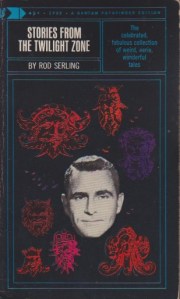
Since it lies somewhere between waking and sleeping, between youth and old age, the Twilight Zone is often where I find myself.  I’m hard pressed to say why the show made such an impression on a young and otherwise religious mind.  Maybe it was because religion itself deals with the Twilight Zone of human experience.  In any case, reading Rod Serling’s Stories from the Twilight Zone, as I continue to make my way through the books of my childhood, was a trip down memory lane.  While living in coronapocalypse, these short stories, novelized from Serling’s teleplays, take you back to a different time.  The late fifties and early sixties seem so very different from where we are now.  And reading about them, I’m not sure why some people want to go back there.

At the same time, reading the physical book takes me back.  My edition was printed in 1964.  It smells like an old book.  It has that unmistakable feel of pulp fiction.  Reading a book is so much more than scanning the words with your eyes.  It’s the lying on your back on a lumpy couch on a hot, humid summer day after being at work for endless hours.  It’s the foxing of the pages and the almost laughable cover design.  But more than that, it’s a signpost back to childhood.  This is a book I first held before leaving home.  It was a refuge from a tense life never knowing what might happen in a day.  Believing that escape was possible could save a soul from a ton of grief.  At the same time, those characters who do escape often learn why that isn’t the best option after all.

Some of these stories I remembered from the shows I watched, while others seemed unfamiliar.  There really are no surprises here.  You see, the Twilight Zone was long ago and the stories have entered our national consciousness.  Some have been borrowed, adapted, and parodied by others.  Others, such as “The Monsters Are Due on Maple Street,” were even part of anthologies we read and discussed in school.  Why are human beings so distrustful of others?  I remember us talking about that in class.  Serling’s version has a more grim ending, it seems, that the one I recollect as a youth.  Sitting here in coronapocalypse, however, I see it playing out around me every day.  We don’t know who might be infected.  And suddenly reading about the Twilight Zone seems like a most sensible thing to do in the circumstances.


Layers of Brick

If, like me, you can’t see a neighbor’s brickwork without thinking of “A Cask of Amontillado,” then I need not explain why I watch horror films.  I know that as of late some literary scholars have challenged the idea that Edgar Allan Poe wrote horror.  There is now, and always has been, a bias against the genre.  In fact, many would point out that Rod Serling’s Twilight Zone wasn’t really horror, no matter how creepy some of the episodes were.  Some would cast Ray Bradbury into that lot as well, and others would not.  I spend a lot of time pondering this because those of us who enjoy some of what’s called horror are often cast as misfits.  And misfits have a lot in common with monsters.

The connection with religion is a palpable, yet intangible one.  It does seem that religion has its origins in fear and as it branched out it came to have different emphases.  Jesus, for example, apparently stressed love, at least according to the gospel of John.  That religion of love came, eventually, back around to fear.  Calvinism, especially, is suffused with it.  There’s a reason that it is the religion expressed in particularly effective horror.  Apparently they meet similar needs, but psychology is not an exact science, and our tastes in it differ.  Even our interpretations do so.  As the bricklayer puts down row after row of masonry, the thoughts get walled up in days where work prevents serious consideration of the deeper questions.

It’s been years since I’ve read “A Cask of Amontillado.”  The story has stayed with me, however, whether it’s horror or not.  Stories about imprisonment are like that.  The other day a police car stopped outside our house.  We live in a working-class, but descent neighborhood.  From the bits and pieces glimpses out the window revealed, there was a problem with a car that had been parked on the street for quite a while, and that didn’t belong to any of the local residents.  The natural response to seeing that car just outside was fear.  We fear criminals and we fear the police.  We fear what Covid-19 is doing to us, even to those of us who’ve managed not to contract it.  Traditional religion would tell us punishment comes from the Almighty.  These things are all related.  And across the way the bricklayer keeps up his work, row after row.


WWW

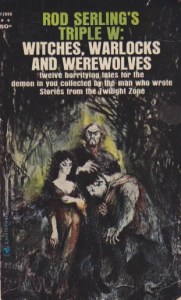
With a few exceptions I think we’ve lived beyond the time when a single name could spawn an industry.  I used to watch re-runs (itself an arcane concept) of The Twilight Zone when I was a kid.  These weird stories drew me in, and, it seems clear, not only me.  Rod Serling’s brainchild led to an industry and “twilight zone” became a household concept.  Lots of little books were written bearing Serling’s name in some way.  One of those paperbacks was Rod Serling’s Triple W: Witches, Warlocks and Werewolves.  I can’t remember where I picked it up, but it was a used book and it had Rod Serling’s name right there on the cover.  Going over my books to find unread gems, I picked up Triple W and sat down to find out what it was like.

None of the stories are by Serling himself.  He’s listed as the editor and he wrote a very nice little introduction.  The tales here reflect, as the subtitle indicates, witches, warlocks, and werewolves.  Some are old stories and some are fairly recent for a book published early in the 1960s.  Descriptive writing does tend to evoke a scene, but I’m often amazed at just how dated it can make a story seem.  What struck writers from the 1940s and ’50s as huge sums of money are likely less than we pay for our monthly internet bill.  Men all try to act tough and the ladies prepare dinner.  Stereotypes.  That’s somehow appropriate for this collection since most of the stories have to do with witches.  Serling was well aware of the tragedies of history, and these tales are told mostly for fun.  The scariest characters are the witch hunters (generally men).

Serling’s famed conscience shows in the choice of the final piece.  Not a story, not even fiction, Charles Mackay’s “Witch Trials and the Law” is an essay about the horrors of witch hunting.  It’s a rather sober piece with which to end a book of speculative fiction, but then Serling was always known for his impatience with injustice.  Also included is Nathaniel Hawthorne’s “Young Goodman Brown,” which I’ve been wanting to read for some time.  Given his shame at the Salem trials and his own ancestor’s part in them, it was mildly surprising that Hawthorne’s story seems to presuppose the reality of witches.  Of course, it condemns the respectable folk who, in reality, all participate in the ills of the society in which they find themselves.  In all, this collection made me think.  Not bad for an impulse purchase on what was probably a rainy afternoon. 


Not Sterling

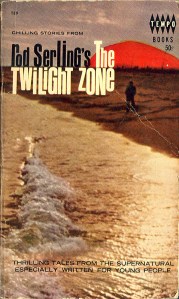
Only indirectly has the coronavirus pandemic influenced my decision to read books of short stories.  Indirectly because bookstores are closed and I have several such volumes gathered here at home.  This particular collection includes a book “especially written for young people” called Chilling Stories from Rod Serling’s The Twilight Zone.  This is a book I had as a young person, discarded, and then regretted discarding.  I have to say that most books I discard I eventually regret.  When you’re young and moving from apartment to apartment, though, you can’t keep all your books.  Anyway, I re-acquired it several years back.  The book doesn’t list an author.  Instead, the title page says “Adapted by Walter B. Gibson.”  Gibson was best known for writing The Shadow series.  The end result is that I don’t know who wrote the stories in this book.  They have the ideas of Rod Serling, but the writing isn’t in his style.

When I buy a book (I got this one used on the internet, back when it was young) I like to know the author.  WorldCat lists Serling as the author, but the book was published pre-ISBN days, back when publishers could be a bit less than transparent about such things.  Other websites put Gibson first under authors, followed by Serling.  The publisher, Tempo Books, was an imprint of Grosset & Dunlap, which eventually came under the Random House/Penguin umbrella.  Originally publishing primarily children’s books, Tempo lists this book for young readers, although as an adult reader I wonder if it could appeal to young people today.  There’s no sex and any violence is really implied rather than explicit, but there’s some adult-level subtlety going on.  Books for young readers are much different these days.

Just recently my daughter introduced me to the increasing sophistication of levels of book genres.  Like most readers and writers I’m encouraged at how young adult books have taken off.  A future generation of readers is cause for hope.  There are now “new adult books.”  These are targeted at those college aged or just over.  Unlike young adult titles they’ll have sex and adult language.  My Twilight Zone book lacks these, and it also lacks the sparkle of Serling’s teleplays.  Serling was a playwright and screenwriter.  These stories clearly contain his ideas but not his ability.  I didn’t know that as a child.  I do know that I never finished the book before now.  One of the reasons, I expect, is that it didn’t really seem like I was reading Serling, even to my young self.  Still, ghost stories during a pandemic have their own appropriate place, and who doesn’t want to be young at heart?